
A complete issue · 32 pages · 1919
Judge — February 22, 1919
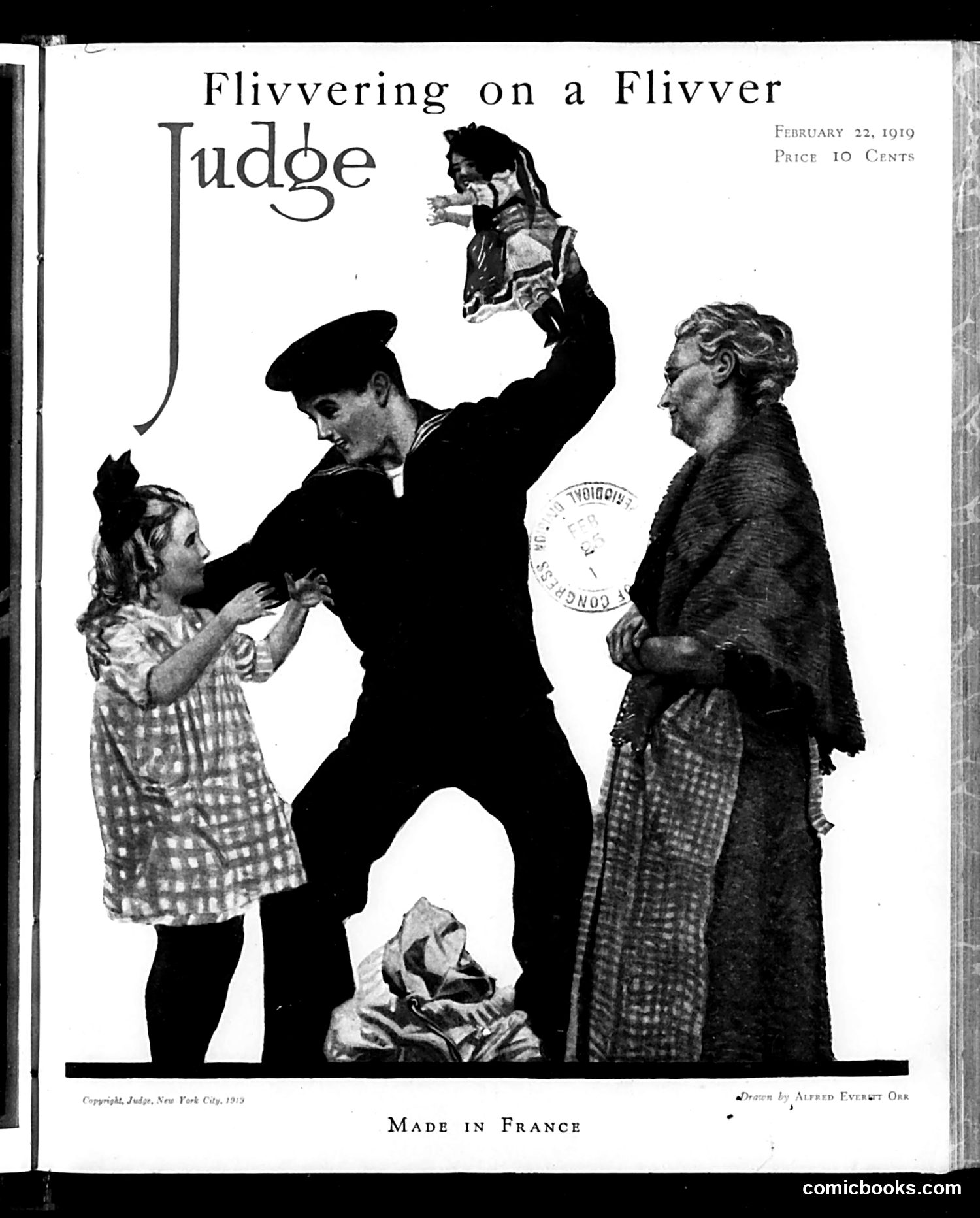
This satirical cover titled "Flivvering on a Flivver" depicts a sailor juggling what appears to be babies or small children while two women and a child observe. "Flivver" was slang for the Model T Ford, and the title plays on "flivver" to suggest reckless behavior. The cartoon likely satirizes post-WWI social anxieties about sailors returning home and domestic chaos. The sailor's juggling act metaphorically represents the precarious handling of family responsibilities or the disruption soldiers brought upon returning to civilian life. The label "Made in France" suggests commentary on wartime experiences abroad. The humor targets both returning servicemen and broader post-war social instability during this transitional period.
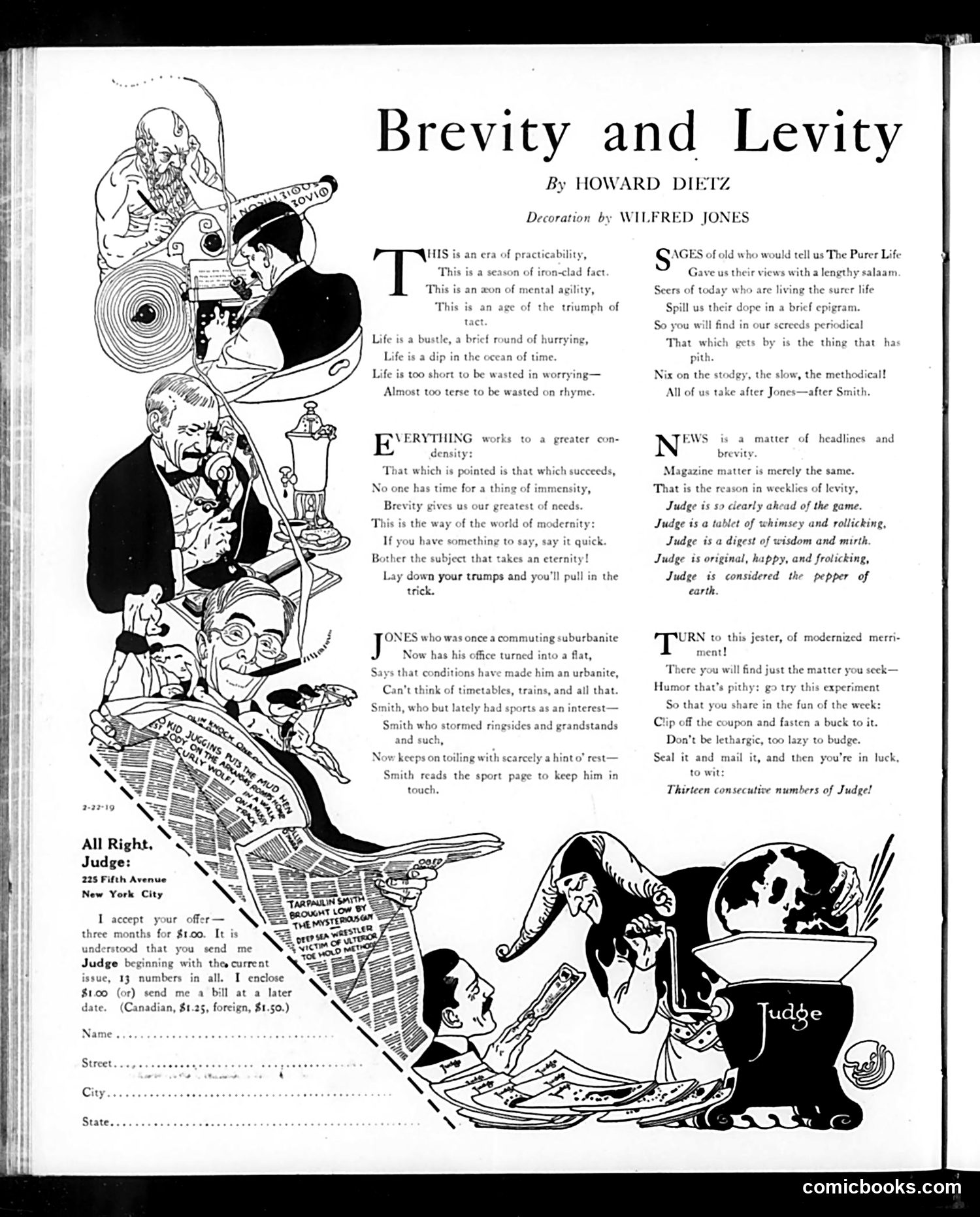
This page celebrates the virtues of brevity and wit in modern life. The text argues that in an era of practicality and mental agility, conciseness is essential—"Life is too short to be wasted in worrying." The satirical illustrations mock verbose figures (appearing to represent outdated types) contrasted with efficient, modern ones. References include "Jones" and "Smith" as everyman characters representing contemporary social types. The piece particularly praises brevity in journalism and judging, noting that "Judge is clearly ahead of the game" and praising concise, witty commentary over lengthy discourse. The bottom section advertises Judge magazine subscriptions ($1 for three months). The overall satire reflects early 20th-century American attitudes valorizing efficiency, modernism, and snappy humor over Victorian verbosity.
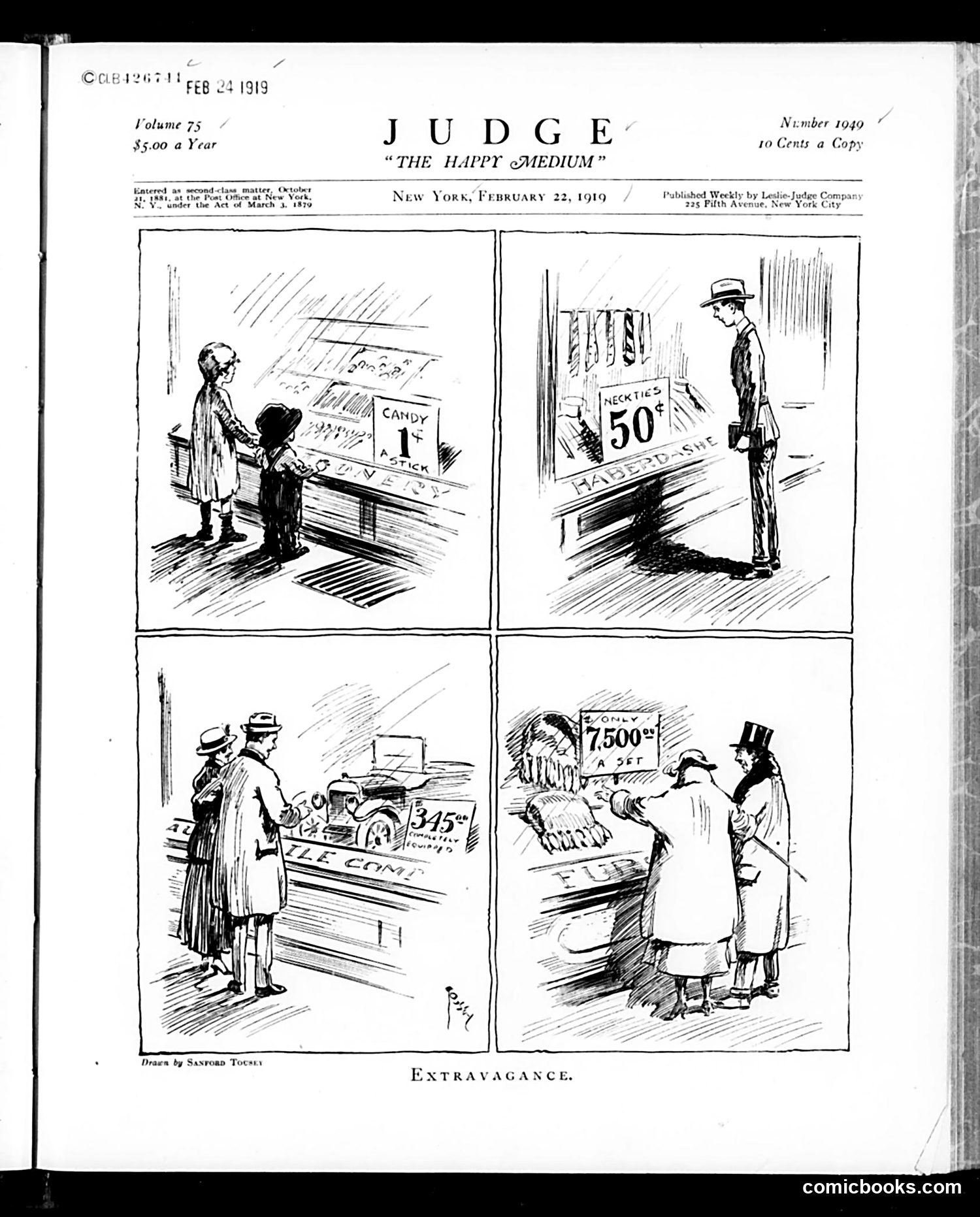
This four-panel satirical comic from Judge (February 22, 1919) critiques wartime or post-war consumer spending excess. Each panel shows a shopper encountering increasingly outrageous prices: 1. **Top left**: A child buys candy for 1¢ 2. **Top right**: Neckties cost 50¢ 3. **Bottom left**: A car costs $345 4. **Bottom right**: An unidentified item costs $7,500 The title "Extravagance" suggests the cartoon mocks either merchants' inflated pricing or consumers' willingness to pay during economic transition (post-WWI). The progression from trivial to absurd prices creates humor through escalation. The art style and period indicate this responds to contemporary inflation concerns and perceived profiteering. The specific figures/merchants remain unclear without additional context.
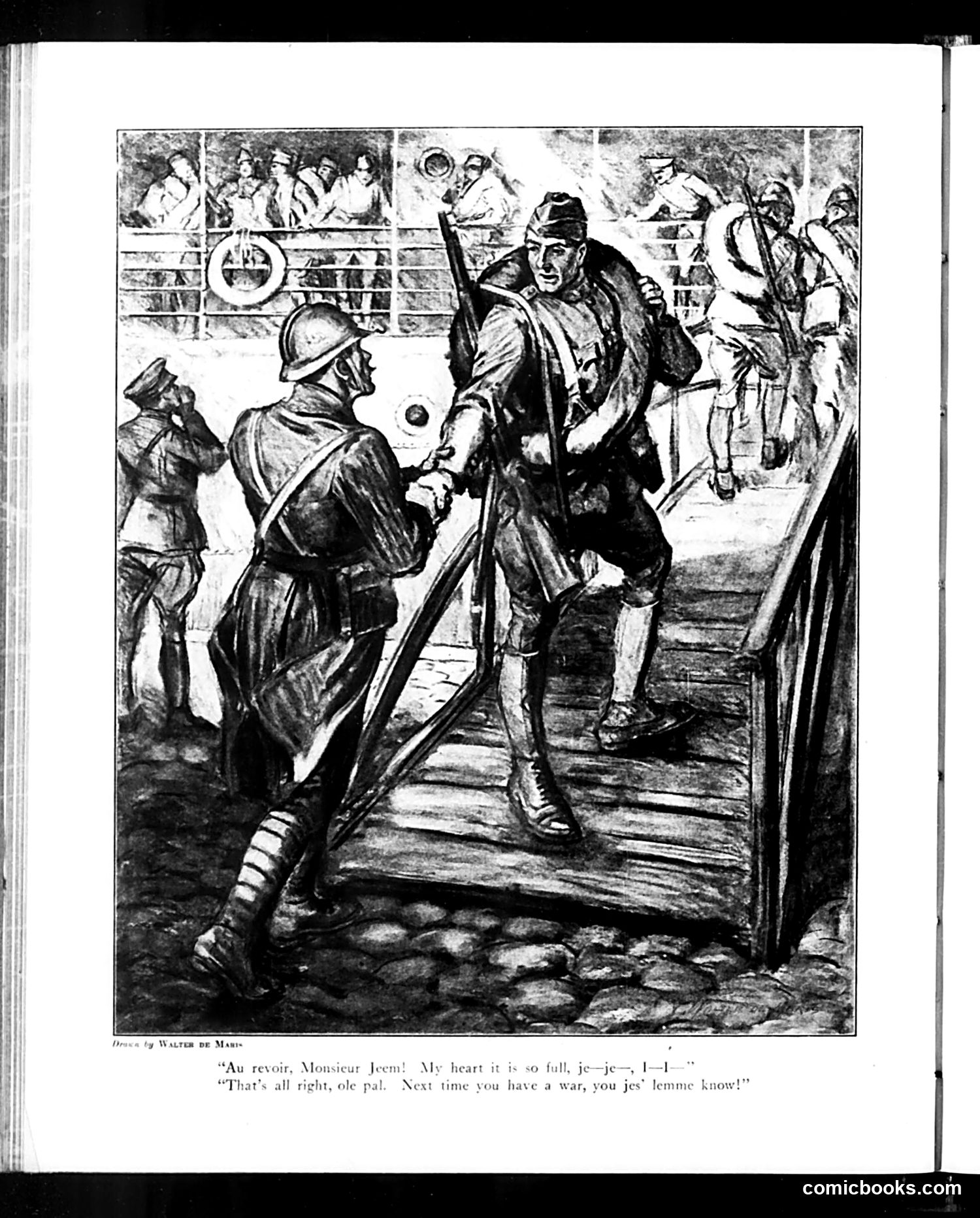
This appears to be a WWI-era satirical illustration by Walter de Maris depicting soldiers in a trench saying goodbye. The dialogue—"Au revoir, Monsieur Jeem! My heart it is so full, je-je--, I--I--" / "That's all right, ole pal. Next time you have a war, you jes' lemme know!"—uses comedic French-accented English to portray an American soldier parting from a French ally. The satire likely mocks either American isolationism (reluctance to enter WWI) or post-war sentiment about future conflicts. The exaggerated emotion and casual American response suggest Judge was critiquing American attitudes toward European affairs—whether portraying Americans as reluctant participants or humorously suggesting future disengagement from European problems. The illustration's emotional tone contrasts with the flippant farewell, creating the satirical effect.
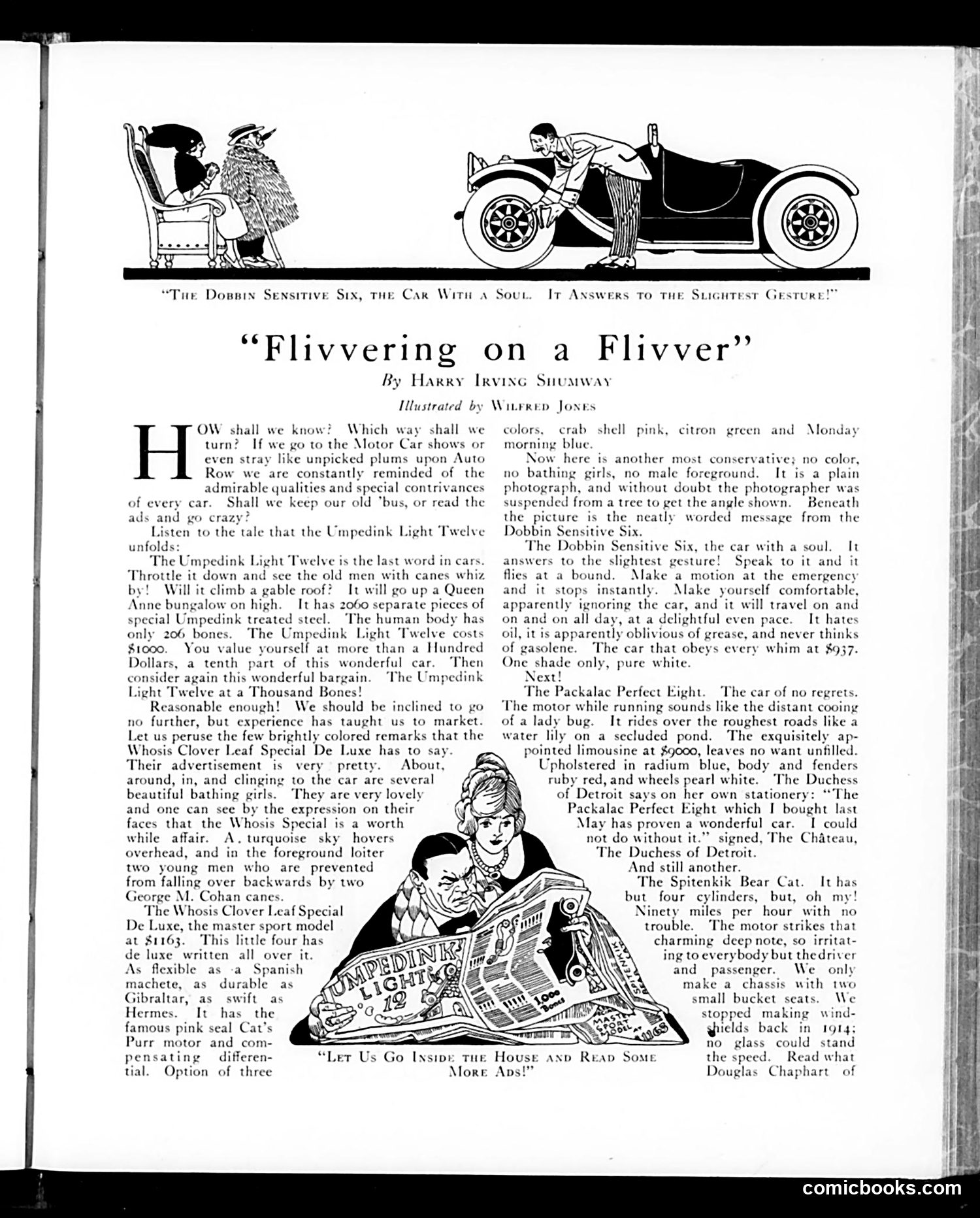
This page is primarily **advertising disguised as editorial content**—a common Judge magazine practice. The headline article by Harry Irving Shumway reviews various automobile models, presenting their features in satirical, florid language. The top cartoon contrasts two car owners: one with a woman in what appears to be outdated or overly decorated dress, versus a man in a modern car. This likely satirizes the contrast between **old-fashioned, ornate automobiles versus modern, streamlined designs**. The featured cars discussed—the Unpedink Light Twelve, Dobbin Sensitive Six, Packalac Perfect Eight, and Spitenkik Bear Cat—**appear to be fictional or thinly-veiled parodies** of real 1920s automobile brands, mocking manufacturers' absurd marketing claims and naming conventions. The satire targets both the cars and consumer gullibility.
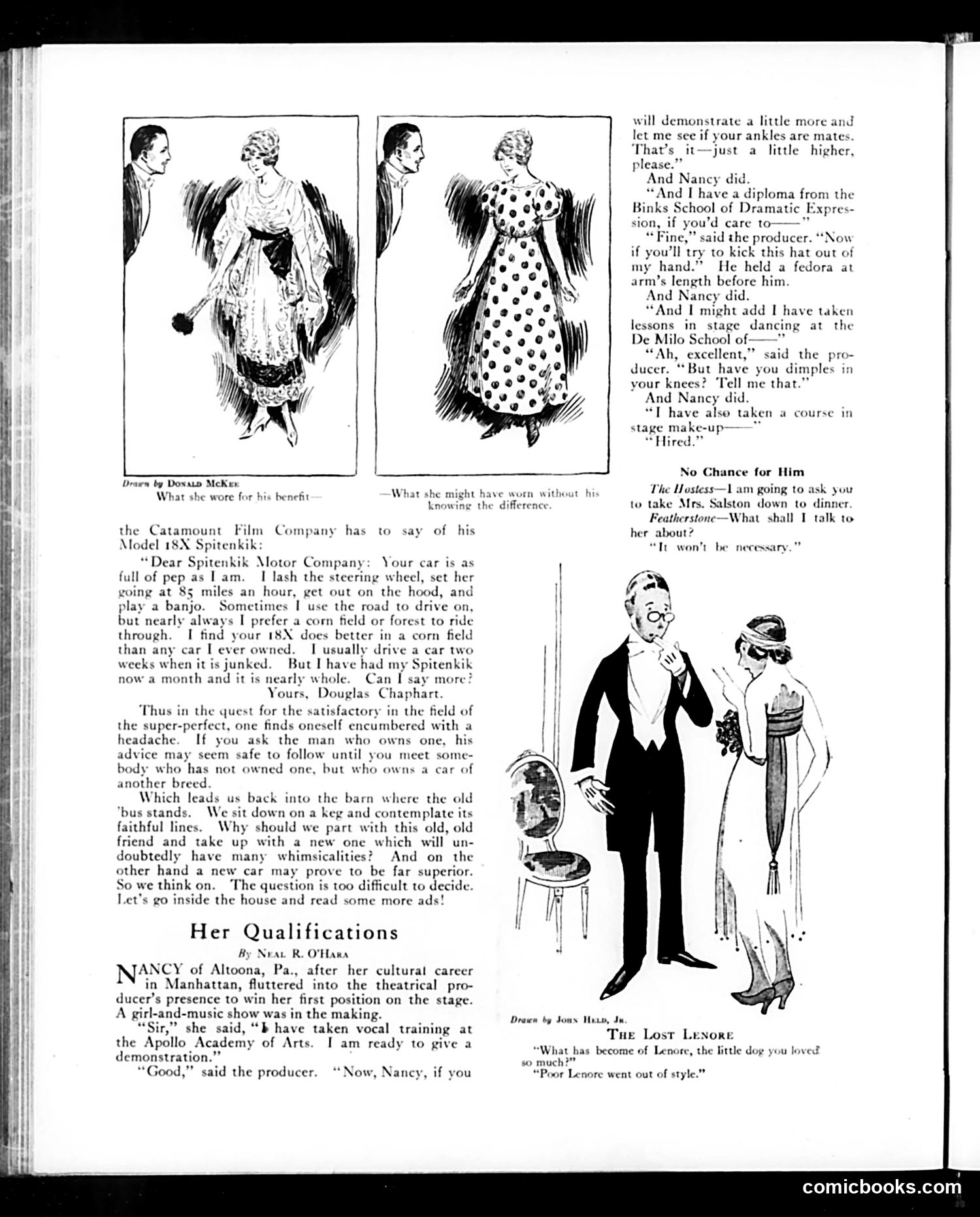
This page contains two main satirical pieces: **"Her Qualifications"** mocks a young woman named Nancy auditioning for a theatrical role. The humor derives from her listing increasingly absurd "qualifications"—vocal training, stage dancing lessons, stage makeup courses—each met with the producer's dismissive "Hired" or "Excellent, but..." The satire targets both the pretentiousness of aspiring performers who conflate minor training with talent, and perhaps the theater industry's superficiality in hiring. **"The Lost Lenore"** (bottom cartoon) shows a man mourning his lost dog Lenore, who "went out of style"—a brief visual gag about fashion and obsolescence applied humorously to pets. The top two fashion sketches illustrate costume differences for theatrical performance. Overall, the page satirizes 1920s theatrical culture and amateur performers' inflated self-assessments.
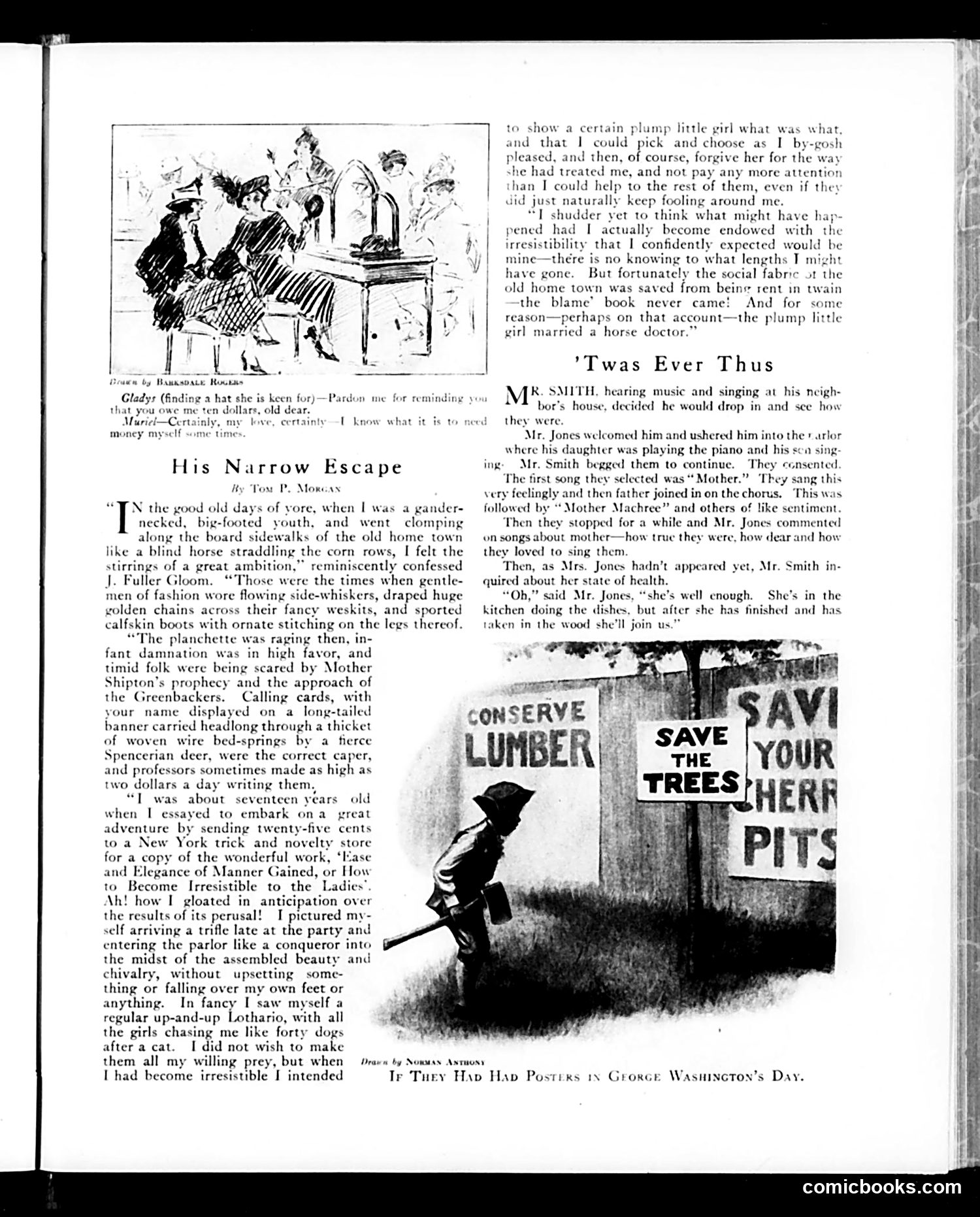
This page contains two satirical stories with period humor: **"His Narrow Escape"** mocks a young man's social pretensions. The narrator recounts ordering a self-help book ("Ease and Elegance of Manner") to become irresistible to ladies, particularly a "plump little girl" who'd spurned him. He fantasizes about gaining power over her through charm. The joke: the book never arrives, and she marries a horse doctor anyway—suggesting his social ambitions were always futile. **"'Twas Ever Thus"** satirizes domestic gender roles. Mr. Smith visits neighbors who sentimentally sing songs about mothers while Mrs. Jones toils in the kitchen. When Smith asks about her health, Jones casually mentions she's "doing the dishes" and "taken in the wood"—implying endless domestic drudgery while the family sentimentalizes motherhood in song. The satire critiques the contradiction between romanticizing mothers and exploiting wives' labor. The lumber/tree conservation poster appears unrelated advertising content.
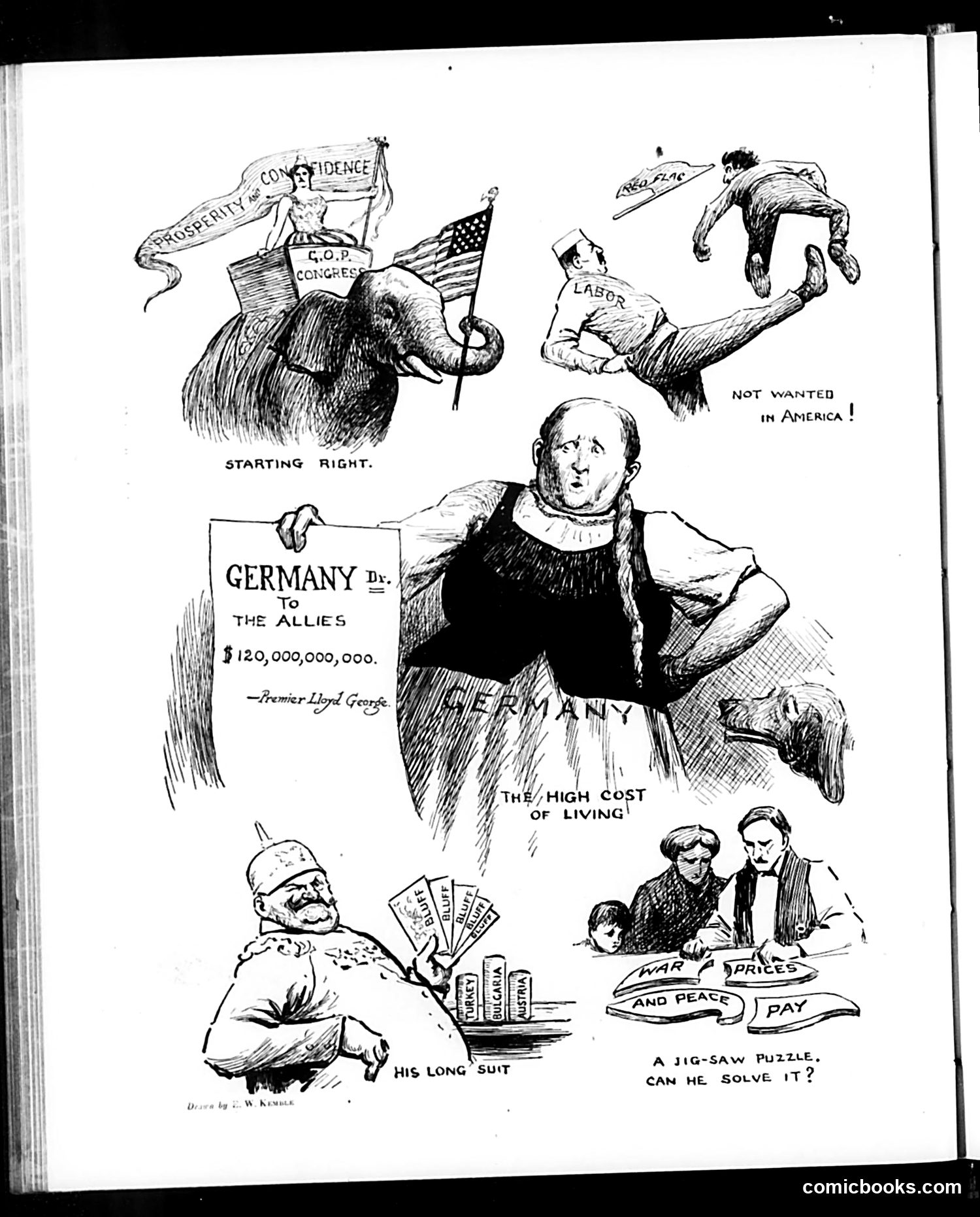
This Judge magazine cartoon satirizes post-World War I tensions and Germany's war debt. The central figure labeled "Germany" represents the defeated nation, depicted as burdened and distressed by multiple crises: **Key elements:** - An elephant wearing "G.O.P." (Republican) garb represents American prosperity "starting right" - "Labor" being rejected from America reflects anti-immigrant sentiment - Germany owes the Allies $120 billion (attributed to Premier Lloyd George) - Germany's problems include "high cost of living," inflation (shown as paper money), and the jigsaw puzzle of "war, prices, and peace" **The point:** The cartoon critiques how Germany's crippling war reparations and internal economic collapse create global instability. It suggests American Republicans benefited from war while Germany suffered catastrophic consequences—a commentary on unequal post-war burden-sharing and early 1920s economic crisis.
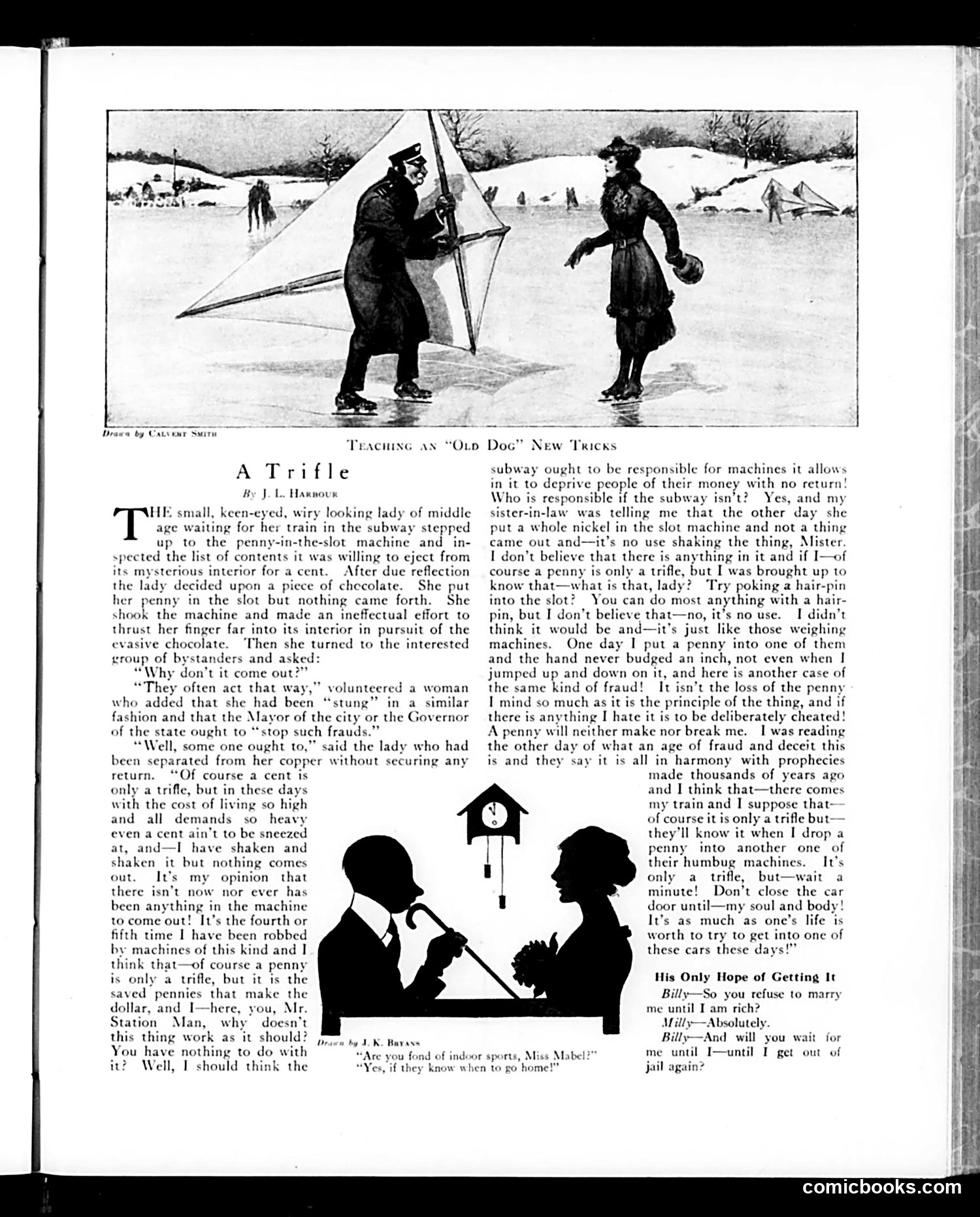
This satirical piece mocks the penny-pinching complaints of the working and middle classes during a period of economic strain (likely early 20th century, given the subway setting and penny slots). A woman loses a penny in a defective vending machine and launches into an increasingly absurd monologue about the principle of the matter—how "saved pennies make dollars" and how this petty fraud represents larger societal corruption. She complains to the station attendant, blames the subway authority, and spirals into broader grievances about fraud, weighing machines, and prophecies. The satire targets her obsessive focus on a trivial loss while simultaneously lamenting her tight finances and society's moral decline. The joke is that she's so consumed by this one cent that she nearly misses her train—the mountain made from a molehill. The accompanying brief comic dialogue about a man proposing marriage only after getting out of jail adds a secondary layer of dark humor about desperation.
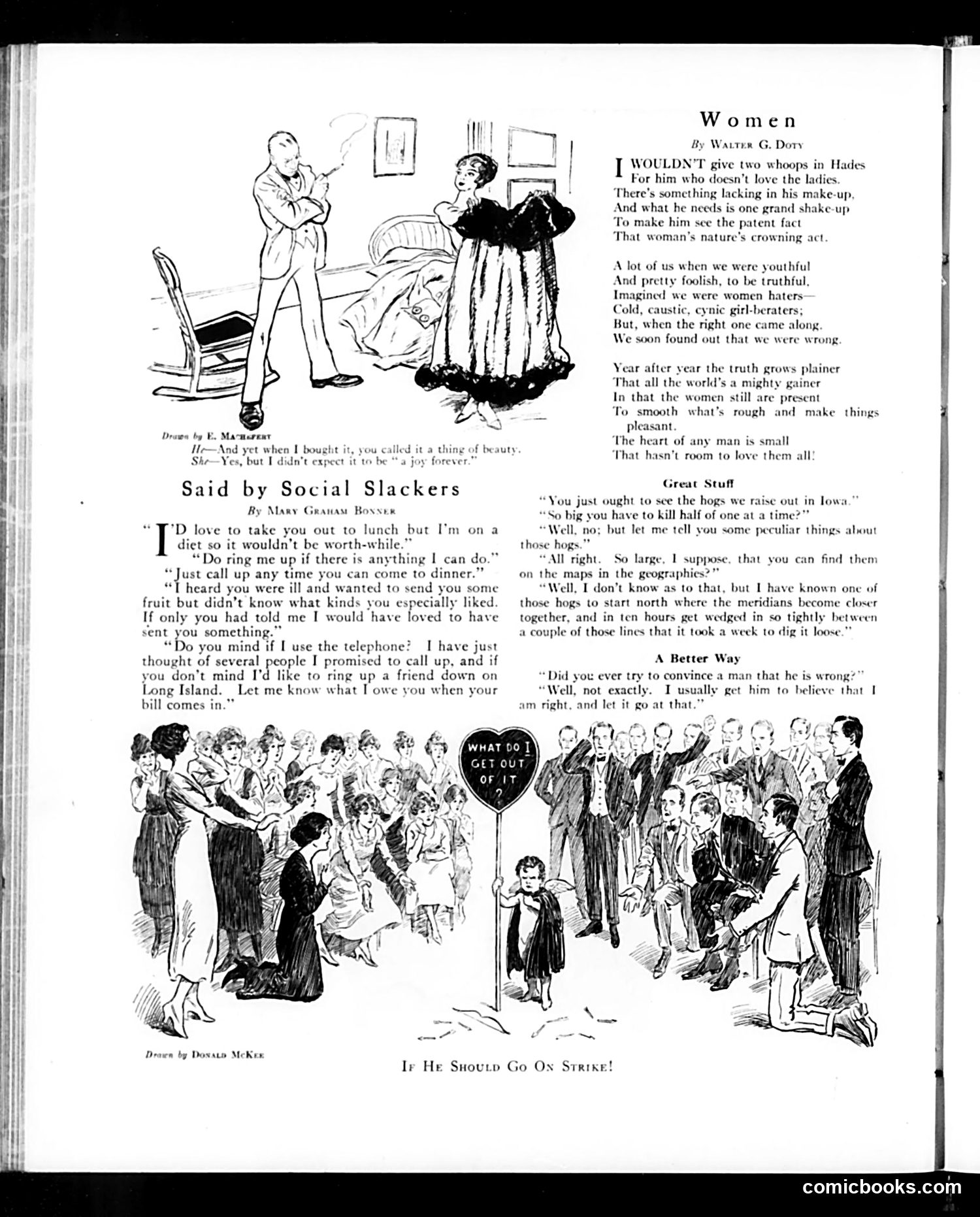
This Judge magazine page contains three satirical pieces from the early 20th century: **"Women" (poem by Walter G. Doty):** A sentimental defense of women, arguing that men who don't appreciate them are incomplete. It reflects period attitudes romanticizing women as civilizing, essential forces—patronizing by modern standards. **"Said by Social Slackers" (by Mary Graham Bonner):** Satirizes insincere social etiquette. The cartoon shows people making hollow promises ("call anytime," "let me know what you owe") they never intend to keep. "Social slackers" were people who avoided genuine social obligation through empty pleasantries—a recognizable type the magazine mocked. **"If He Should Go On Strike!":** A cartoon showing a child holding a sign demanding workers' rights, surrounded by adults. This likely satirizes labor strikes of the era by imagining a child striking against parental authority, mocking either strikers or parental leniency—the satire's target isn't entirely clear from the image alone. The page overall reflects early-1900s concerns with social sincerity and labor tensions.
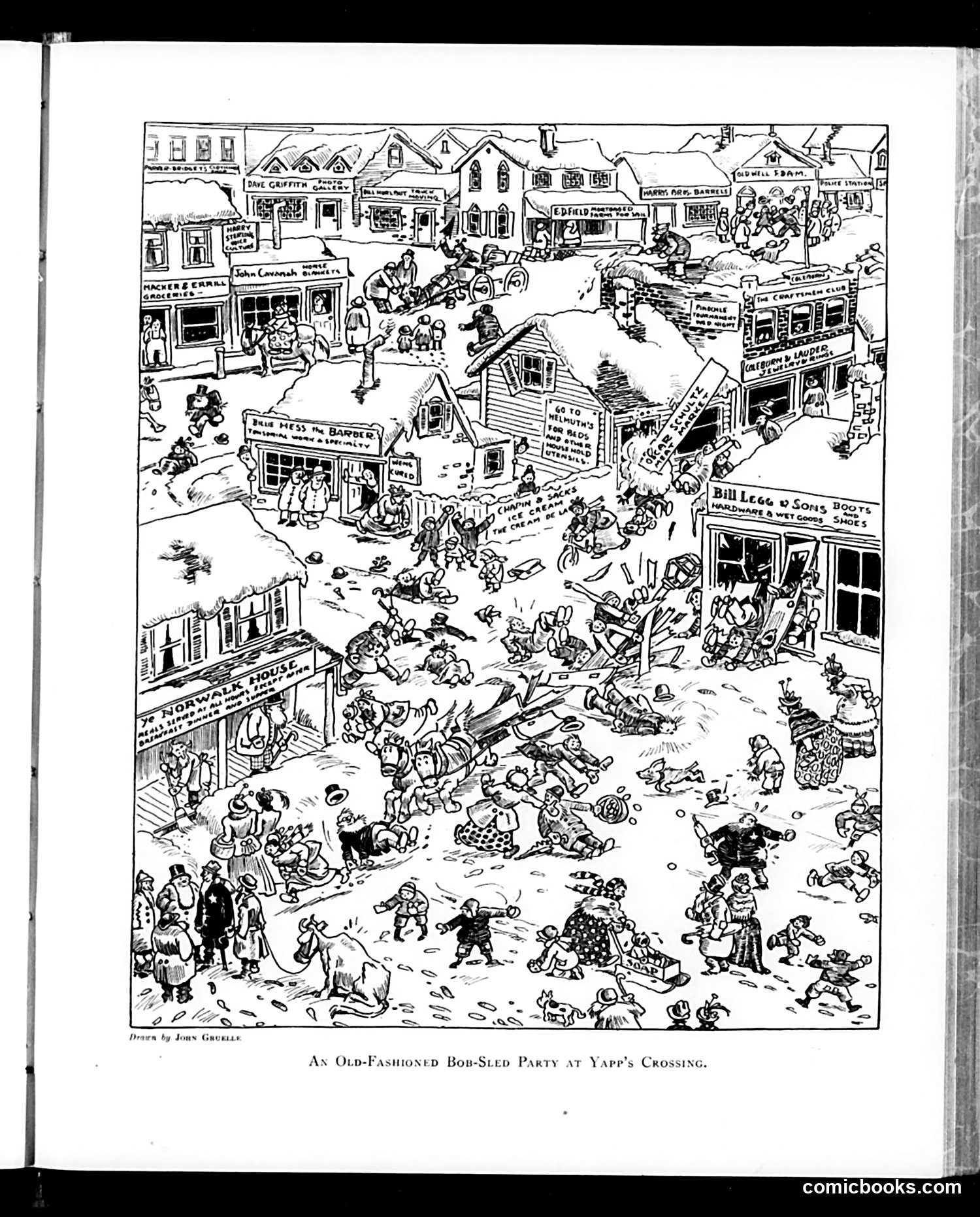
This is a detailed winter street scene illustration by John Guoelis (artist), depicting a lively bob-sledding gathering at a location called Yapp's Crossing. The drawing shows numerous figures engaged in winter recreation—sledding, playing, and socializing—in front of various storefronts and buildings. The "old-fashioned" reference in the title suggests this nostalgic depiction of simpler, community-oriented winter entertainment. Visible shop signs indicate local businesses (hardware stores, general merchandise). The chaotic composition with dozens of figures of varying ages—children sledding, adults socializing, families gathering—emphasizes the inclusive, public nature of this winter pastime. Rather than political satire, this appears to be illustrative Americana celebrating rural or small-town winter traditions and community recreation, typical of Judge magazine's nostalgic Americana features alongside its satirical political content.
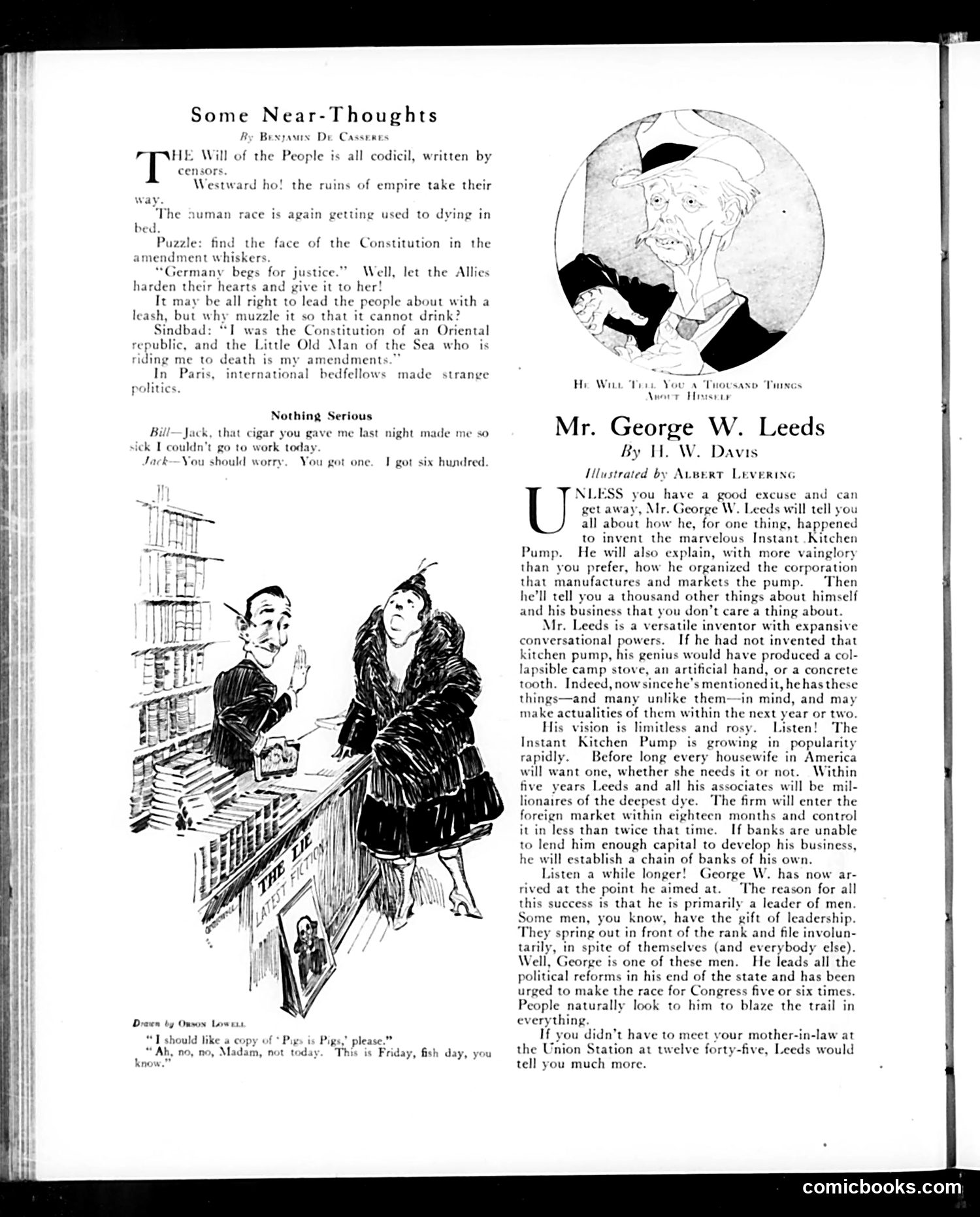
This page contains two distinct pieces: **"Some Near-Thoughts"** (left column) presents cynical political aphorisms by Benjamin De Casseres mocking post-WWI conditions: censorship controlling "the Will of the People," Germany's defeated state, and the absurdity of constitutional amendments ("the Little Old Man of the Sea") drowning democracy. The cartoon shows a woman requesting "Pigs is Pigs" on a Friday (Catholic fish day), playing on class and religious observance. **"Mr. George W. Leeds"** (right) is satirical puffery about a self-aggrandizing inventor. The accompanying caricature shows Leeds as an inflated figure. The text mockingly catalogs his grandiose claims: inventing an "Instant Kitchen Pump," planning to dominate markets globally within five years, establishing banking chains, and becoming a political leader—all while being unbearably boastful. The final line undercuts him: only his mother-in-law's schedule prevents more tedious self-promotion. The satire targets American business bombast and entrepreneurial ego.
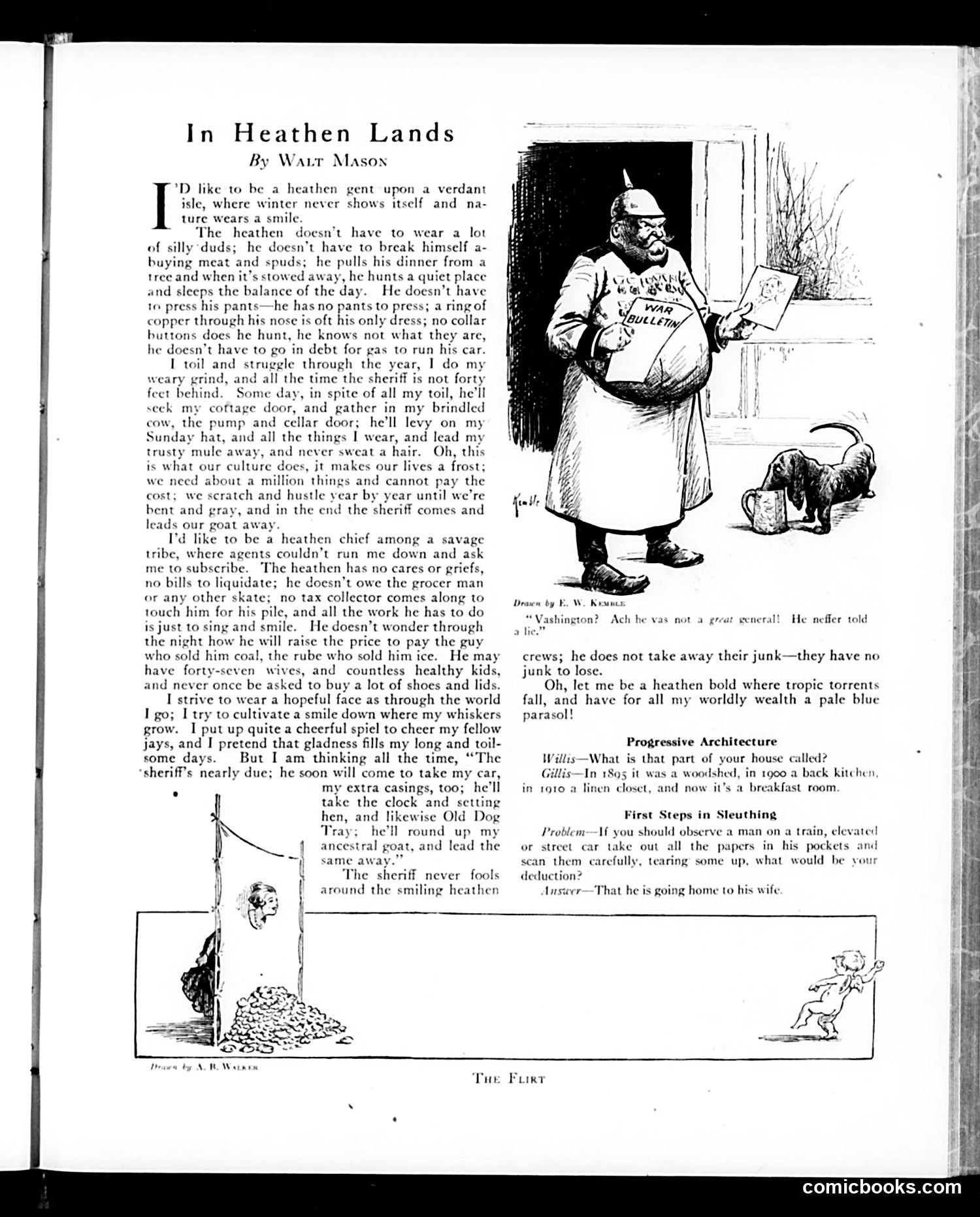
**Main Piece:** "In Heathen Lands" by Wau Mason satirizes modern American economic anxiety. The speaker envies "heathen" peoples living simply without material burdens—no debts, no bills, no sheriffs seizing property. The joke exposes early 20th-century working-class frustration: despite constant labor ("toil and struggle"), Americans face relentless creditors and debt collectors. The "heathen" lifestyle represents freedom from capitalist obligations. The accompanying illustration shows a German soldier reading, captioned with a joke about Washington not being a great general because "he never told a lie"—a jab at American exceptionalism or wartime propaganda. **Secondary Items:** "Progressive Architecture" jokes about rebranding old spaces (woodshed→breakfast room) as fashionable. "First Steps in Sleuthing" humorously suggests a man destroying documents on a train is going home to his wife—implying marital deception or domestic anxiety. The page reflects pre-WWI American discontent with consumer culture and financial obligation.
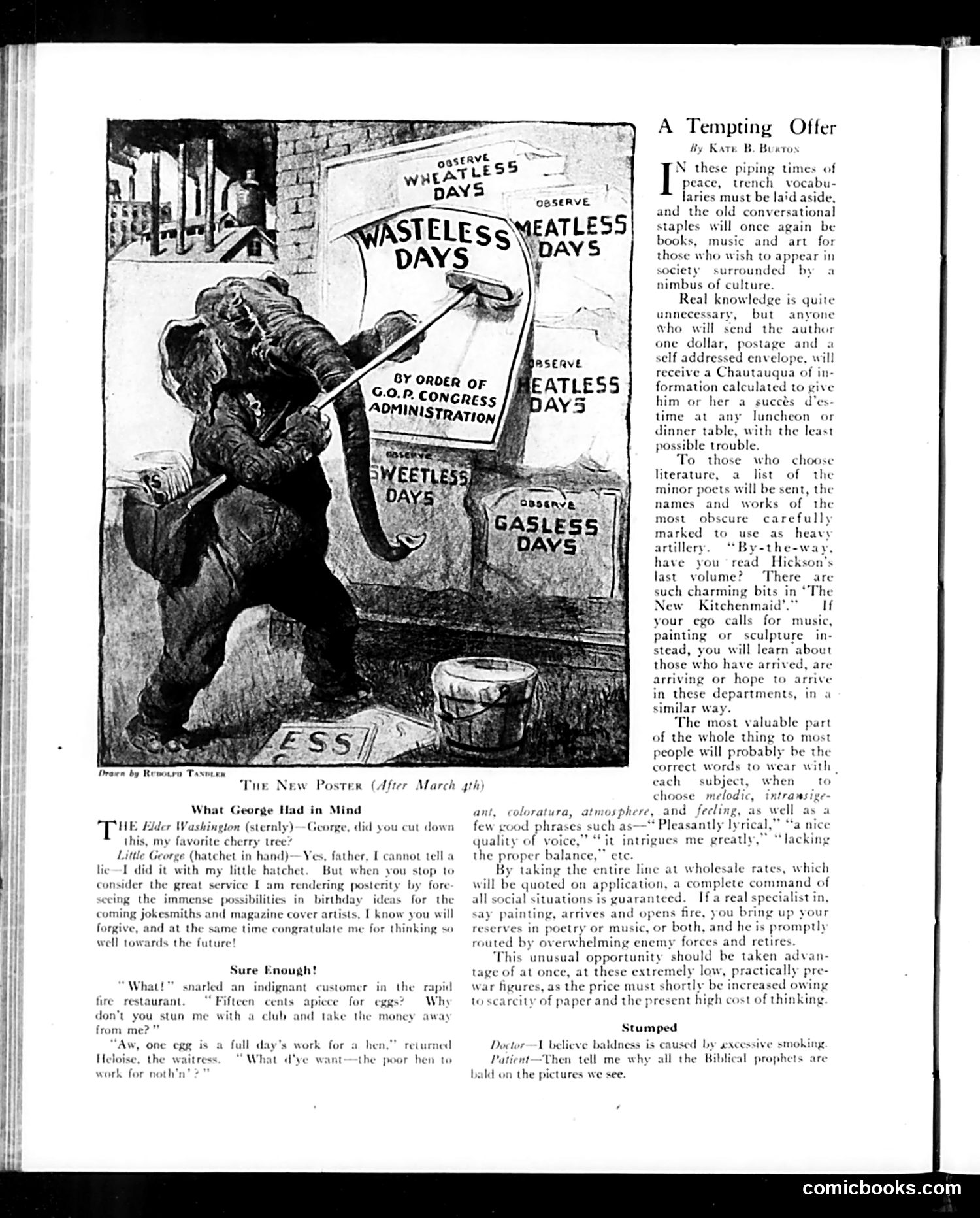
This Judge magazine page contains three satirical pieces: **"What George Had in Mind"**: A parody of the cherry tree legend. Young George Washington claims he cut down the tree not from mischief but to provide "birthday ideas" for future "jokesmiths and magazine cover artists"—mocking how the story has been endlessly recycled for content. **"Sure Enough!"**: A brief joke about wartime egg rationing and inflation. A customer complains about high egg prices; the waitress responds sarcastically that one egg represents a full day's work for a hen. **"The New Poster"**: The political cartoon shows Uncle Sam covered in "Meatless Days" / "Wheatless Days" posters (WWI food rationing mandates issued "by order of G.O.P. Congress Administration"). The satire critiques how heavily promoted the rationing campaign was—the poster-covered figure is barely visible underneath. The "Tempting Offer" article is satirical advertising: for a dollar, readers can buy fake cultural sophistication—memorized phrases and obscure references to seem educated without actual knowledge.
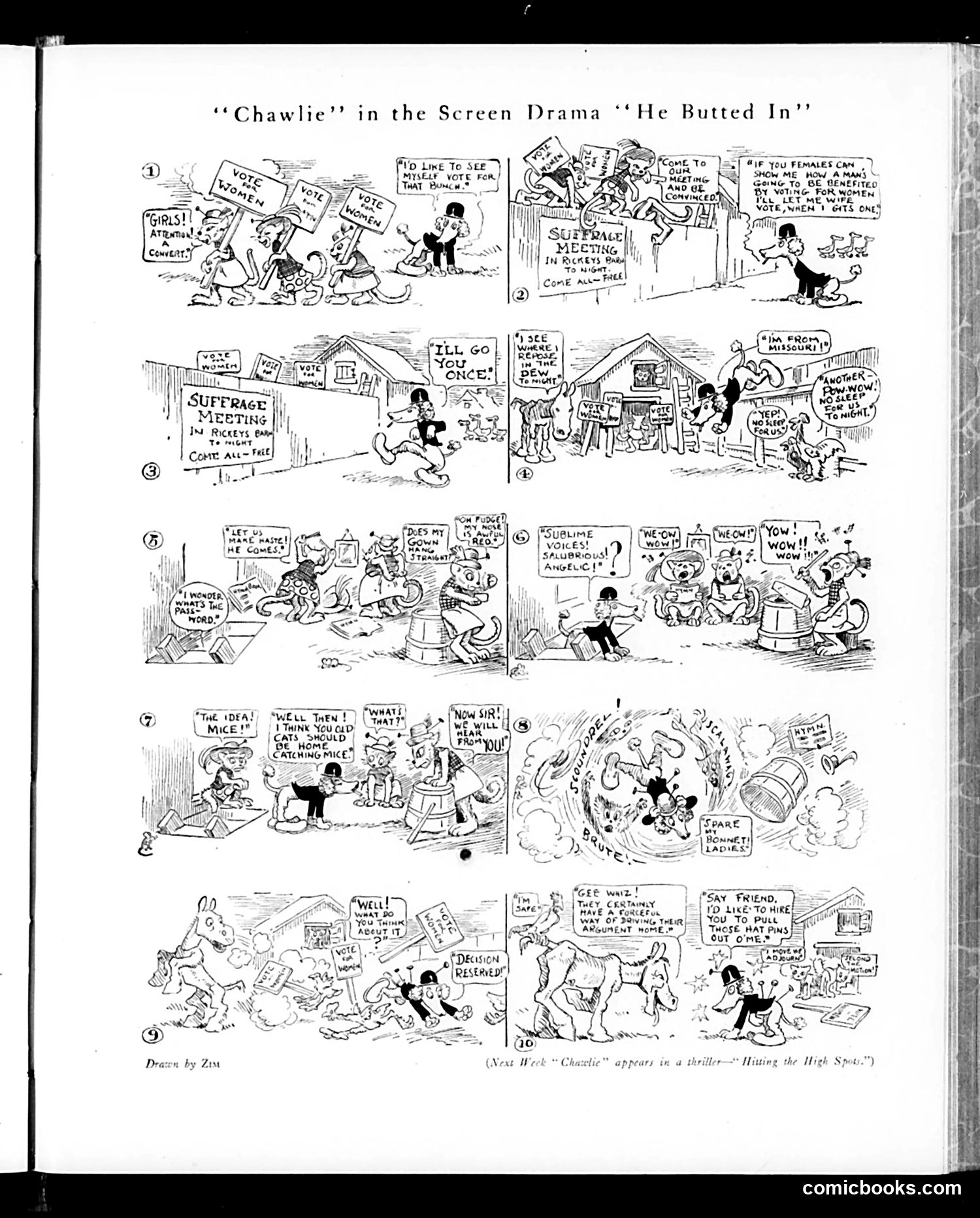
This is a satirical comic strip about women's suffrage, the major political issue of the 1910s-1920s. "Chawlie" (a character with a working-class accent) initially opposes women voting. The narrative shows him encountering suffragettes, attending a suffrage meeting, and gradually being won over by arguments about women's rights and equality. The humor lies in Chawlie's conversion—he moves from dismissive ("I'd like to see you females can vote") to supporting women's suffrage. Visual gags include references to domestic stereotypes (women catching mice at home, hat pins as weapons) being challenged by progressive arguments. The strip satirizes both anti-suffrage sentiment and the suffrage movement itself, using a comedic character arc to comment on the heated debate over voting rights for women during this era.
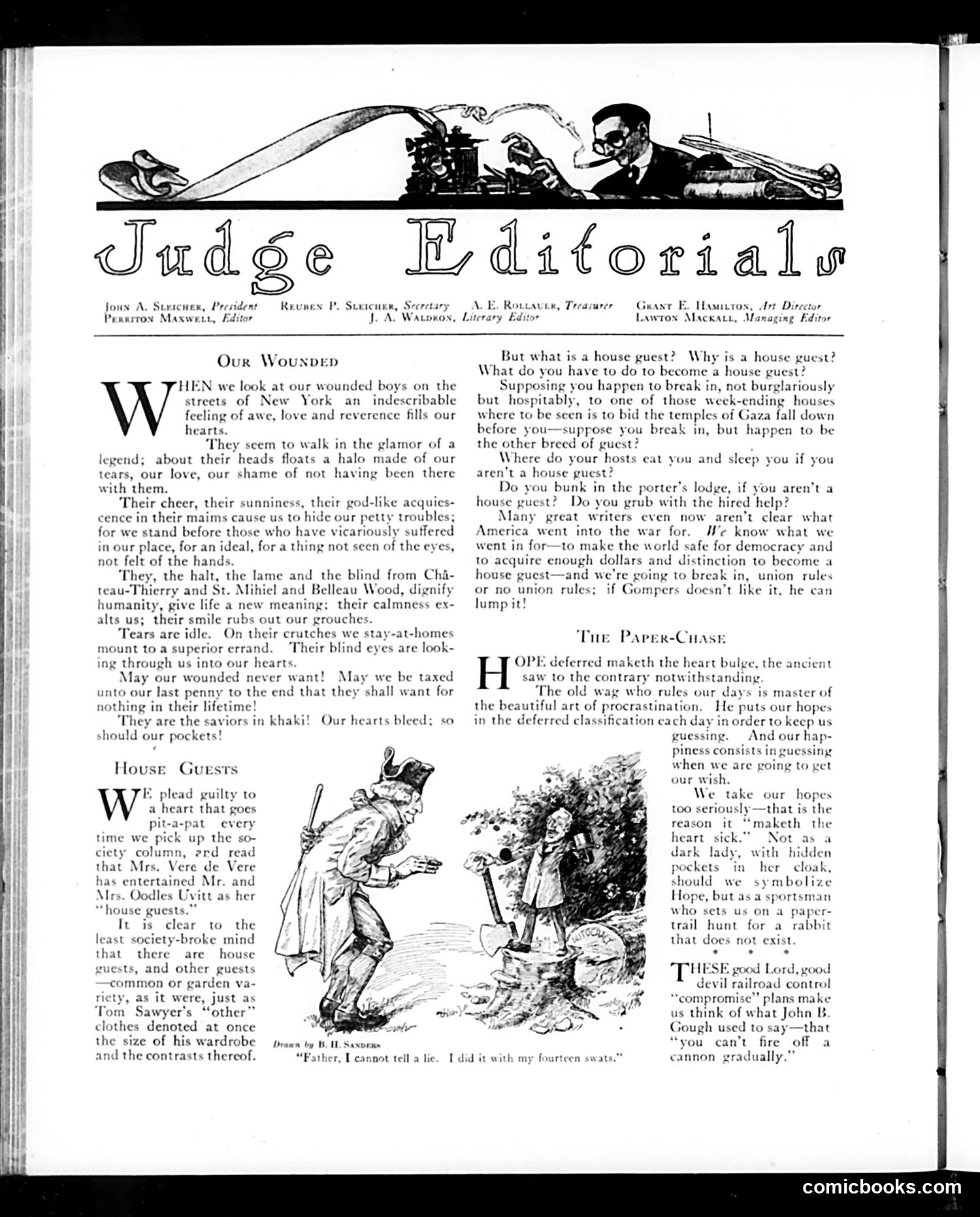
This page from *Judge* magazine contains three satirical editorials about post-WWI American society. **"Our Wounded"** celebrates disabled veterans returning from WWI (references to Château-Thierry, St. Mihiel, and Belleau Wood—major 1918 battles). The editorial romanticizes their sacrifice while guilt-tripping wealthy civilians to fund veteran care through increased taxation. **"House Guests"** mocks upper-class social hierarchies. It satirizes the distinction between prestigious "house guests" (wealthy visitors at fashionable estates) and ordinary guests. The piece cynically suggests Americans joined WWI not for democracy but to gain enough wealth and social status to become house guests—critiquing materialistic war motivations while poking fun at social climbing. **"The Paper-Chase"** attacks railroad industry "compromise" plans (likely post-war labor disputes), comparing deferred hope to a pointless rabbit hunt. It references temperance advocate John B. Gough's famous quote about gradual cannon firing—meaning you can't implement change incrementally. The illustrations by H.H. Sandors support these satirical critiques of postwar American priorities and class consciousness.
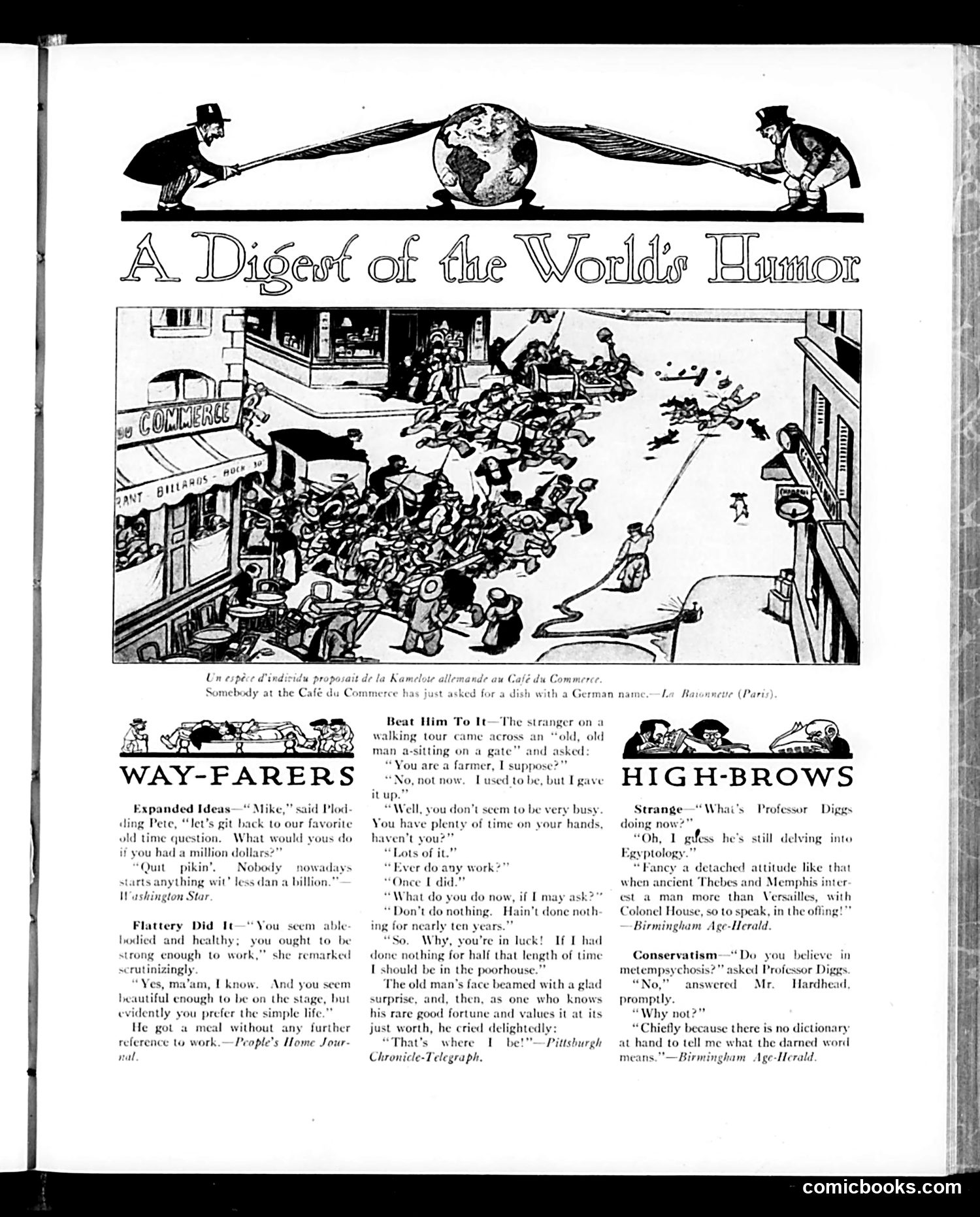
This page collects brief humorous anecdotes from various newspapers, arranged under three categories: "Way-Farers," "High-Brows," and "Conservatism." The jokes satirize American social types and pretensions: **"Way-Farers"** mocks working-class aspiration (a man wanting a billion dollars instead of a million) and portrays vagrants as philosophical about idleness—one elderly man celebrates doing nothing for ten years as good fortune, inverting conventional work ethic. **"High-Brows"** ridicules intellectuals, particularly a Professor Diggs who studies ancient Egypt while ignoring contemporary politics (Colonel House was a WWI-era political figure), suggesting scholarly detachment from real-world concerns. **"Conservatism"** presents a man dismissing metempsychosis (reincarnation belief) not from conviction but because he can't find the word in a dictionary—satirizing how people adopt positions without understanding them. The top illustration shows two figures pulling a globe apart, suggesting the magazine's intent to dissect global human nature through humor.
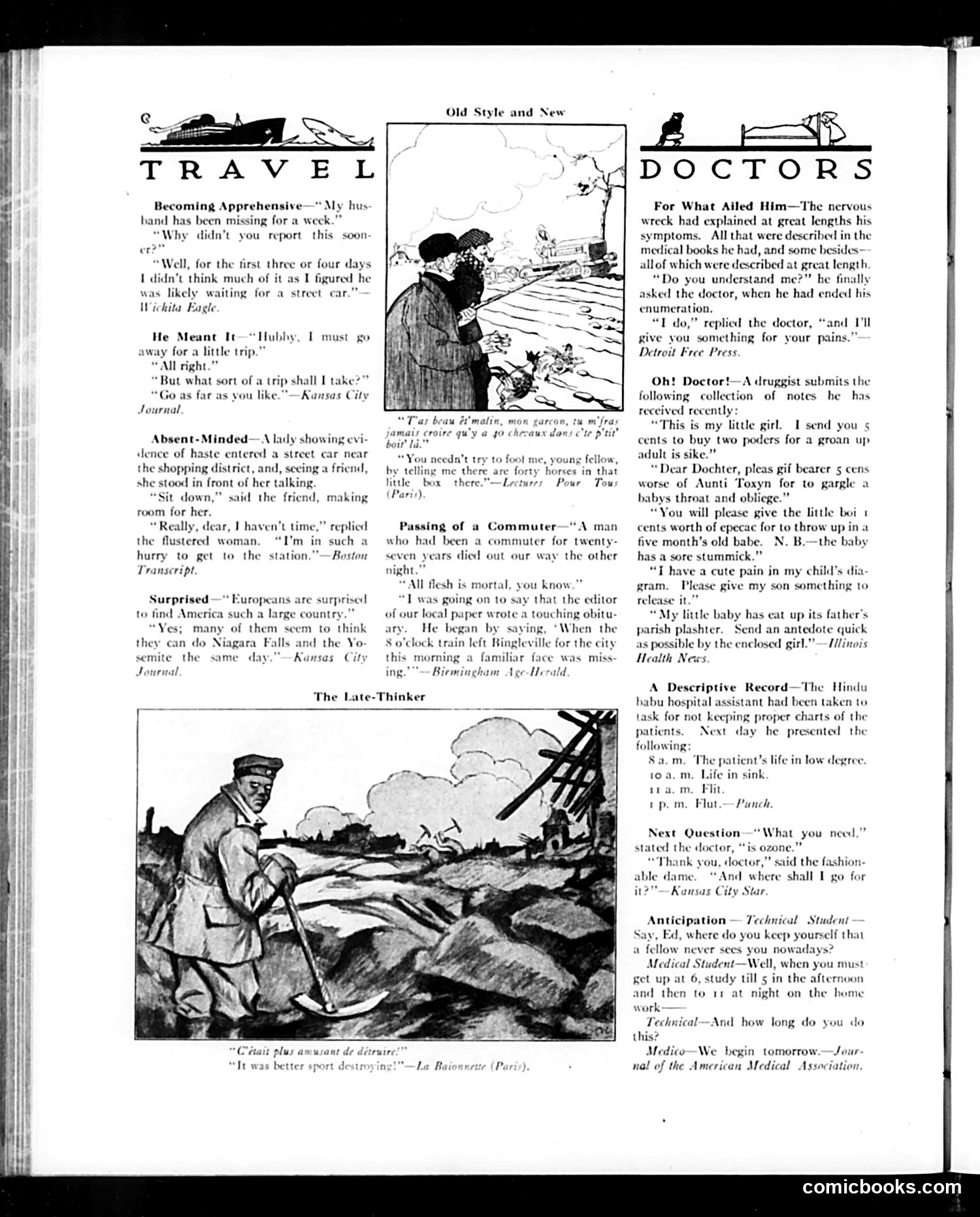
This page presents humorous anecdotes contrasting old and new American life, typical of early 20th-century satirical magazines. **Travel Section** jokes about absent-mindedness and marital dynamics. The streetcar reference reflects how public transit dominated urban life. One anecdote mocks Europeans surprised by America's vast geography—a relevant joke when transatlantic travel was common but America's scale still astonished visitors. **Doctors Section** features humorous misspelled prescription requests from working-class patients, satirizing poor literacy and unconventional medical practices of the era. The "Late-Thinker" cartoon depicts a WWI soldier—the ruined landscape and artillery suggest wartime context—with a French caption about "amusing destruction." This likely satirizes the war's devastation. **Bottom sections** mock medical students' grueling schedules and a hospital assistant's poor record-keeping, typical workplace humor. The overall tone is lighthearted social observation rather than sharp political commentary.
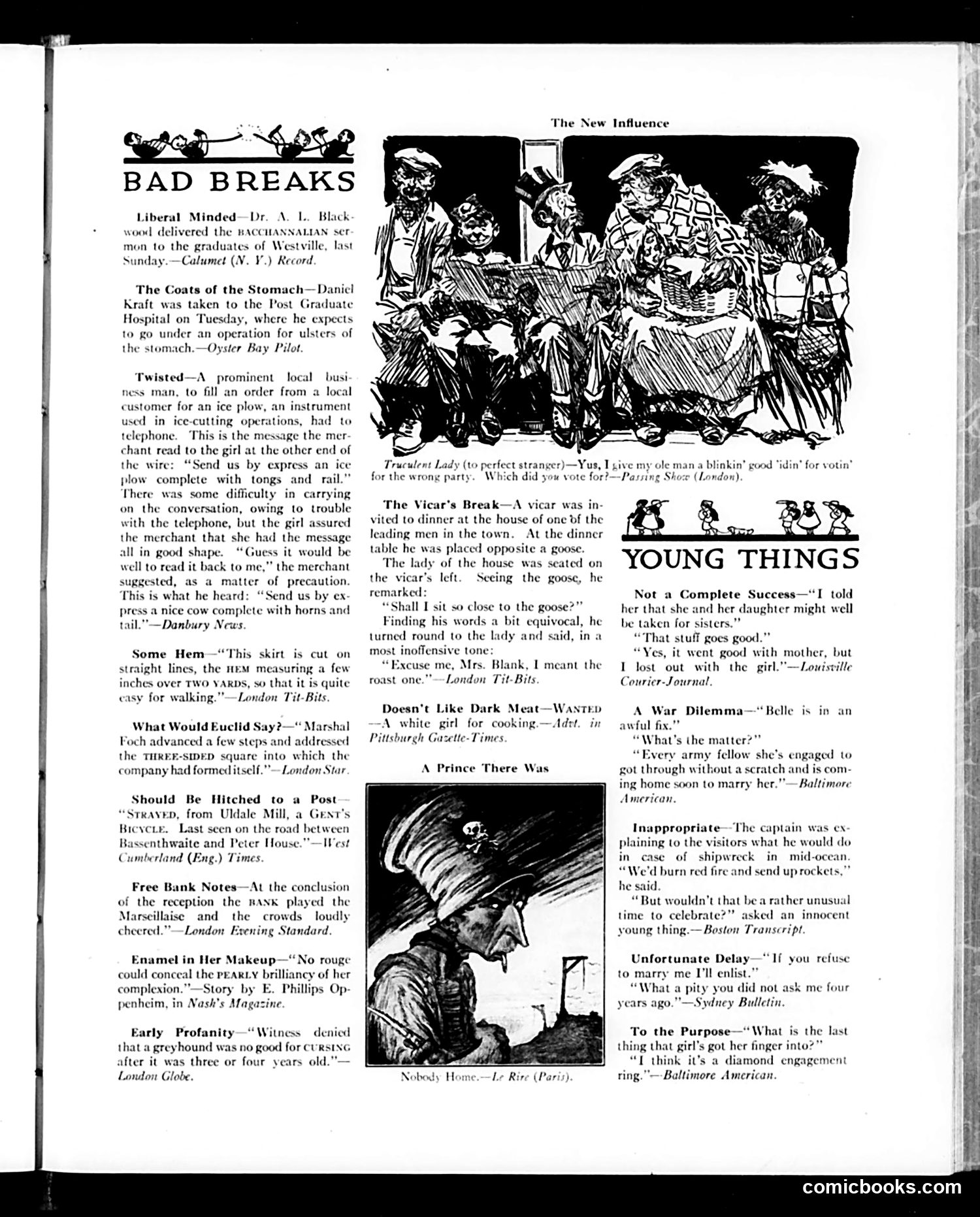
This "Bad Breaks" section collects humorous newspaper typos and misquotations. The main cartoon, "The New Influence," depicts a working-class woman confronting what appears to be a well-dressed man, with the caption about voting "for the wrong party"—likely satirizing women's newfound political voice (women gained voting rights in 1920). The cartoon suggests anxiety about how newly enfranchised women might influence elections. The accompanying "Young Things" section mocks innocent young women's naïveté through anecdotes. Notable is "A War Dilemma," which jokes about a woman engaged to multiple soldiers—all returning unscathed, forcing her to actually marry one. This reflects post-WWI social anxieties about changing gender relations and women's independence. The "Bad Breaks" items are newspaper printing errors highlighting absurdities: "ice plow" becomes "nice cow," "three-sided square" appears in geometry, and a vicar's awkward phrasing about sitting near a goose creates innuendo. The humor relies on readers recognizing these as genuine publication blunders.
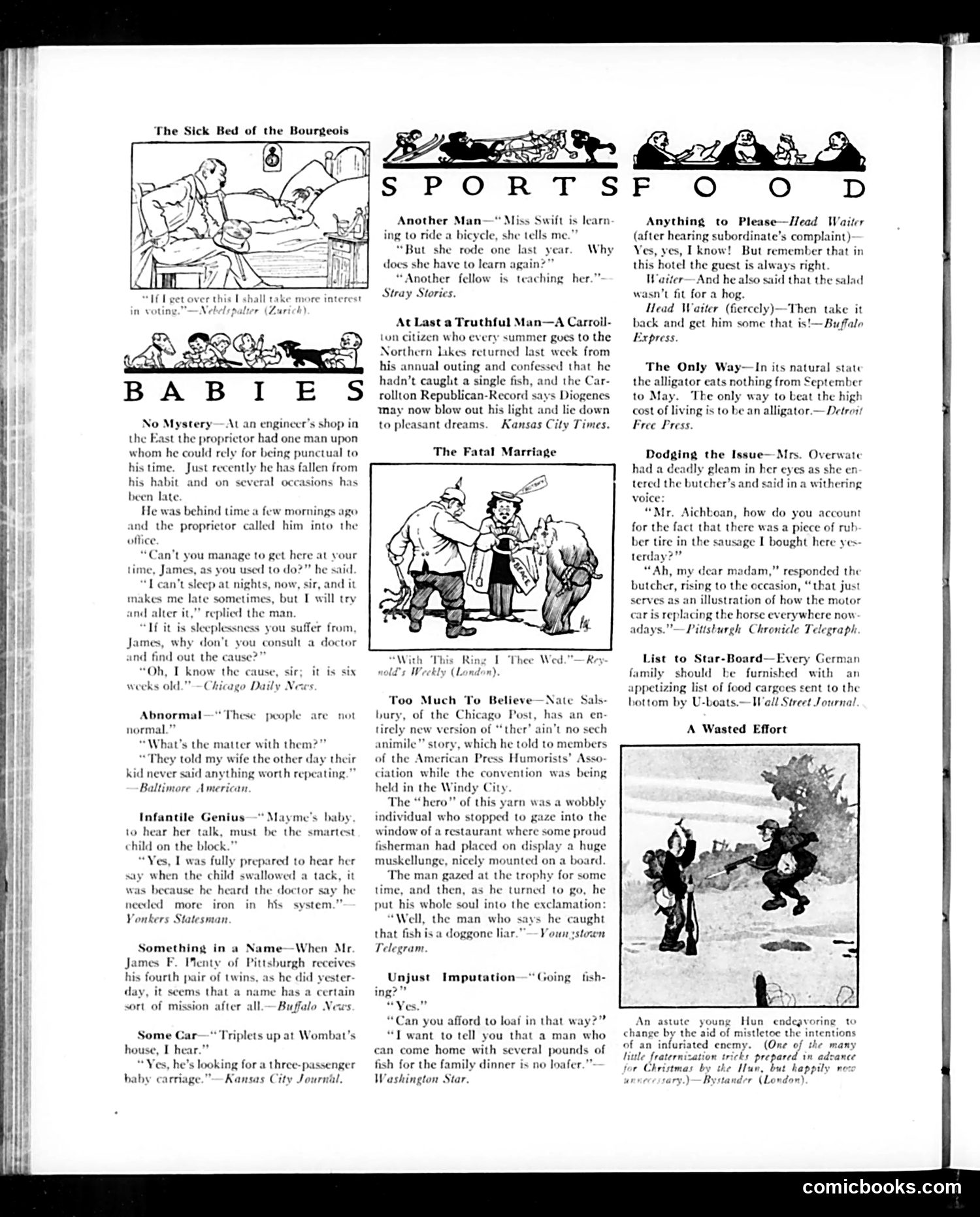
This page from *Judge* magazine contains humorous anecdotes and brief comics typical of early 20th-century American satirical publishing. **Key Content:** The cartoons and jokes mock contemporary social absurdities: - **"The Sick Bed of the Bourgeois"** opening cartoon depicts a bourgeois man in bed, setting up satirical commentary on middle-class pretensions - Multiple brief anecdotes ridicule common human behaviors: new parents boasting about children's intelligence, fishermen lying about catches, restaurant staff's deference to customers - **"The Fatal Marriage"** cartoon (caption unclear) appears to address marital conflict - A photograph titled **"A Wasted Effort"** shows what appears to be a Hun soldier with military equipment **Social Satire Focus:** The humor targets universal human follies—parental pride, fishing exaggerations, customer entitlement, servant subservience—rather than specific political figures. The magazine's tone is cynical about modern manners and vanity. The Hun photograph reference suggests publication during or shortly after World War I, when such imagery appeared routinely in American publications.
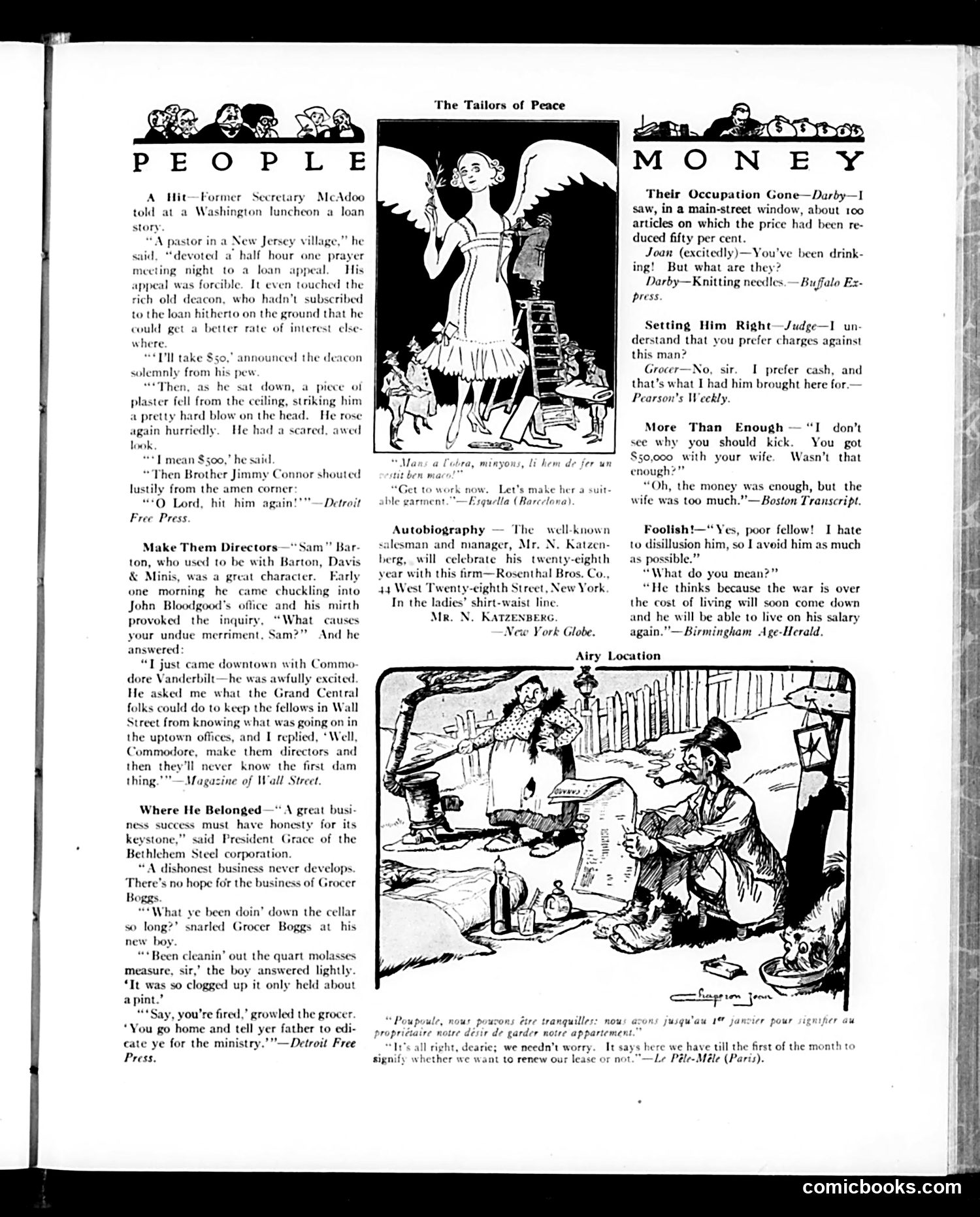
This Judge magazine page collects brief humorous anecdotes organized under "People" and "Money" headings, likely from the post-WWI period (references to war and cost-of-living concerns suggest early 1920s). **Key content includes:** - A joke about a deacon increasing a loan pledge after being hit by falling plaster—satirizing how fear motivates generosity - A quip about Commodore Vanderbilt and Wall Street directors, suggesting directors are so uninformed they'd never learn company secrets - A story mocking a grocer's boy who clogged molasses, implying dishonesty - A "Money" section with short gags about reduced prices (knitting needles no longer needed post-war), preferring cash to charges, and post-war disillusionment about living costs The cartoon shows soldiers in an "Airy Location" (appears to be a trench or camp), illustrating the wartime/post-war context underlying these jokes about economic adjustment and returning to normalcy.
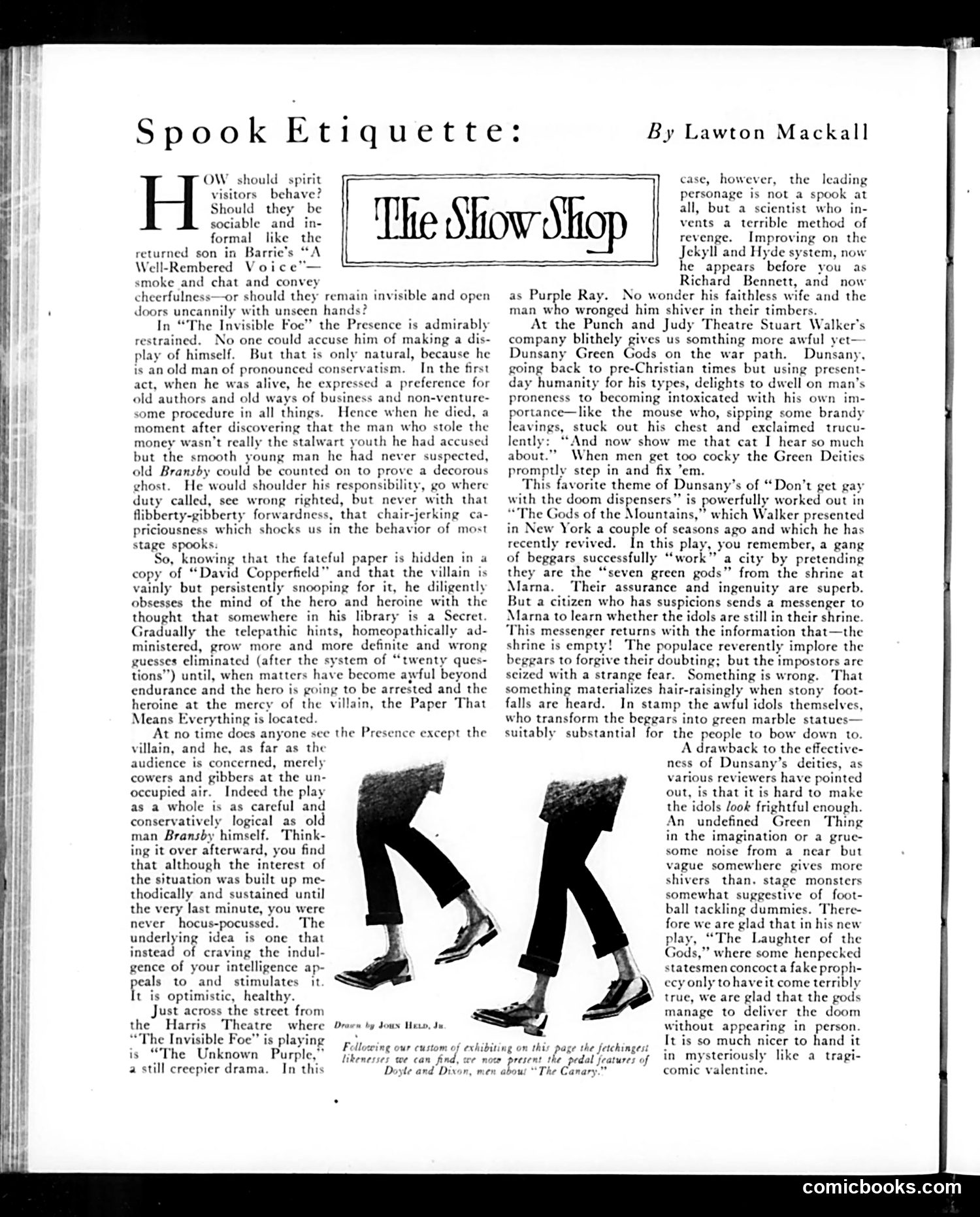
This theater criticism column reviews three contemporary plays featuring supernatural or fantastical elements. The author uses "spook etiquette"—how ghosts should behave—as a framework for discussing theatrical restraint versus sensationalism. **The plays discussed:** - "The Invisible Foe" (featuring Richard Bennett): praised for a *restrained* ghost that logically guides the plot without theatrical showiness - "The Unknown Purple": criticized as more sensational, with Bennett playing Purple Ray, a scientist using revenge methods - "The Gods of the Mountains" by Lord Dunsany at the Punch and Judy Theatre: features pre-Christian deities punishing human hubris **The satire's point:** Mackall contrasts old-fashioned dramatic restraint (embodied by the conservative ghost Bransby) with newer, more melodramatic supernatural theater. He celebrates logical plotting and appeals to intelligence over mere visual trickery—praising the "optimistic, healthy" approach of careful storytelling rather than sensationalism.
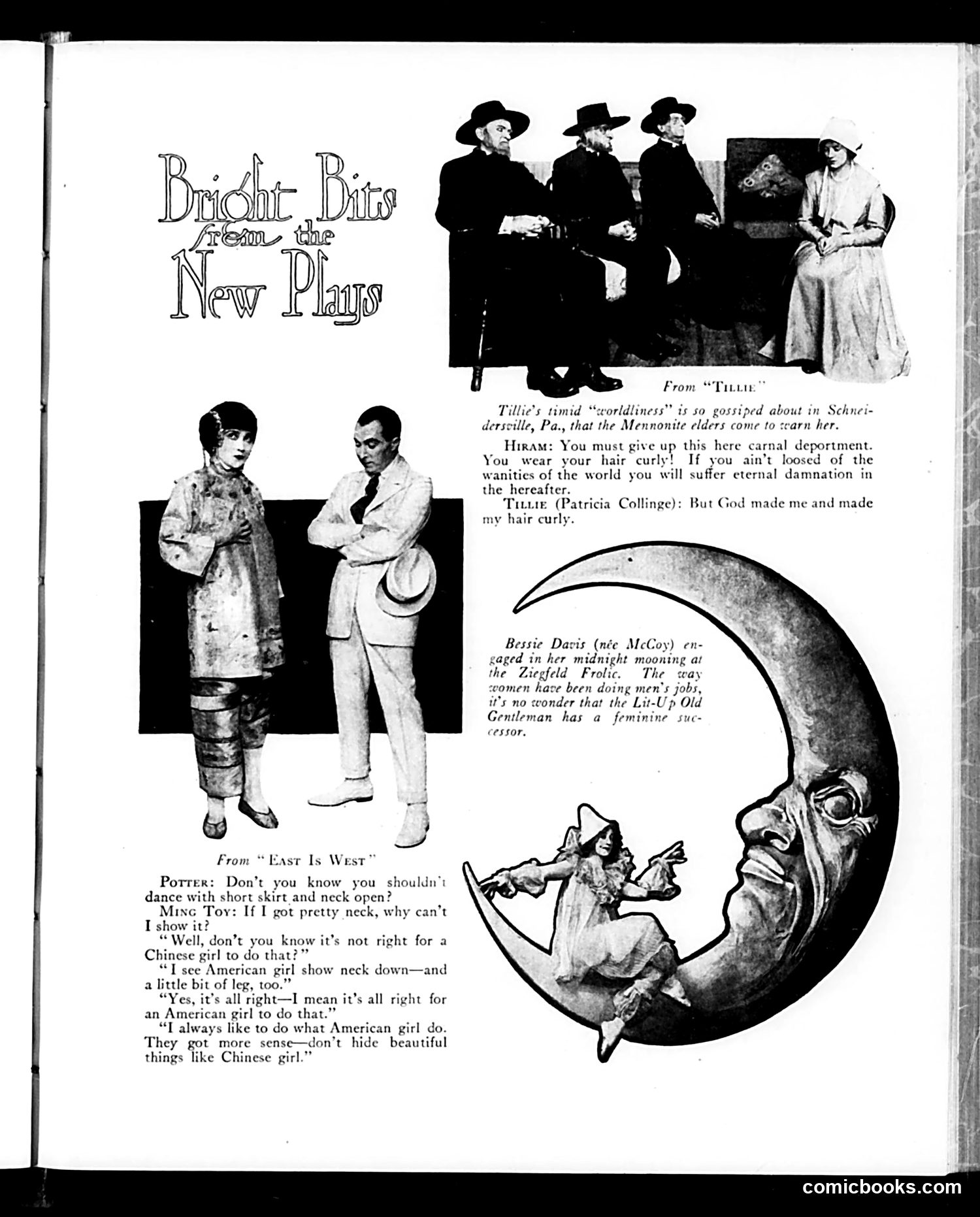
This page showcases scenes from contemporary theatrical productions, satirizing cultural attitudes of the era. **"East Is West"** depicts a dialogue between Potter (a white American) and Mine Toy (a Chinese woman character). The satire mocks restrictive attitudes toward Chinese women's dress and behavior while simultaneously critiquing American hypocrisy—Potter condemns Mine Toy's exposed neck as "improper" for Chinese girls, yet accepts it in American women. Mine Toy's character represents the "New Woman" adopting American freedoms, highlighting the double standard and xenophobia of the period. **"Tillie"** shows conflict between a young woman and Mennonite elders objecting to her curled hair as worldly vanity. Tillie's defense—that God made her this way—represents generational rebellion against rigid religious conservatism. **The moon illustration** captions Bessie Davis's "mooning" (flirting/gazing) at the Ziegfeld Frolic, jokingly suggesting women now display "feminine" behavior previously coded as masculine ("Old Gentleman"). The page satirizes both restrictive morality and changing social norms regarding women's appearance and behavior in 1910s-20s America.
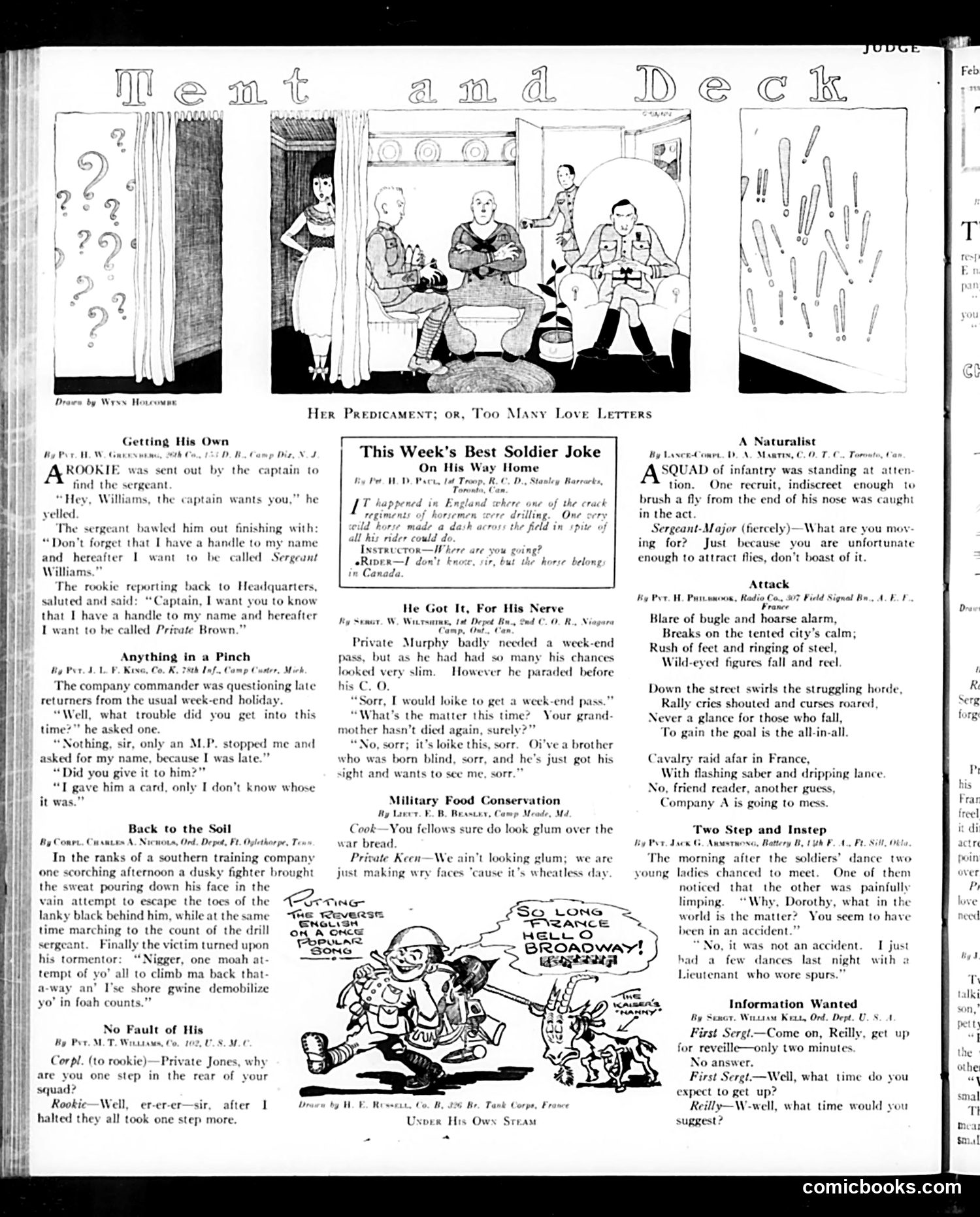
This page collects military jokes and cartoons from WWI-era training camps, depicting the friction between enlisted men and officers. **Key humor sources:** The "Getting His Own" and "Private Brown" jokes satirize military hierarchy—enlisted men mimicking officers' formality about rank and titles as a form of mock respect. "Anything in a Pinch" jokes about an M.P. (Military Police) stop and a soldier giving a fake name—poking fun at weekend pass violations. "Back to the Soil" contains a racist dialect joke about a Black soldier; this reflects the deeply segregated, discriminatory military of the era. "He Got It, For His Nerve" shows an Irish soldier (indicated by "sorr" and "loike") manipulating his commanding officer with an implausible excuse. The central cartoon depicts soldiers marching to mess (dining hall), with the caption suggesting their "cavalry raid" is actually just going to eat. Overall, the page mocks the contrast between military grandeur and mundane camp realities, and reinforces period stereotypes about race, ethnicity, and class.
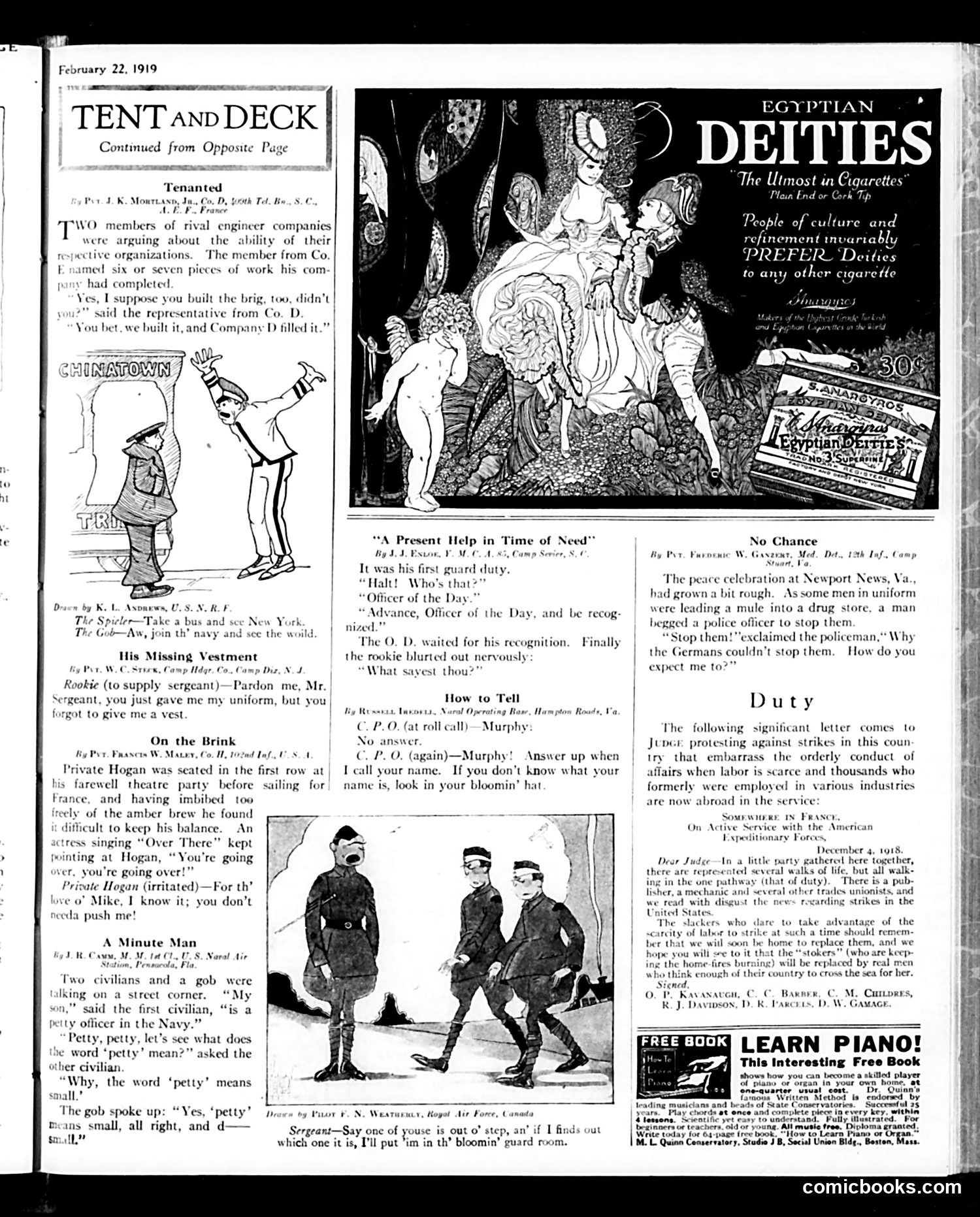
This page contains WWI-era military humor and a cigarette advertisement, typical of Judge's satirical content during the post-war period (the Armistice was November 1918). **Military Humor Sections:** Multiple short comic anecdotes mock Army and Navy life. "A Minute Man" plays on the term "petty officer"—a civilian doesn't understand that "petty" is a naval rank, assuming it means "small." "On the Brink" depicts a drunken soldier being repeatedly reminded he's shipping out to France. "His Missing Vestment" shows a naive recruit expecting a vest with his uniform. **"Duty" Letter:** A soldier stationed in France protests labor strikes occurring stateside, arguing that workers should remember American soldiers are sacrificing abroad while strikes undermine the war effort. This reflects the 1918-1919 labor unrest in America and military resentment toward domestic strikes. **Advertisement:** Egyptian Deities cigarettes occupy the right half, targeting "people of culture and refinement." The humor reflects common soldier frustrations and period tensions between military service and civilian life.
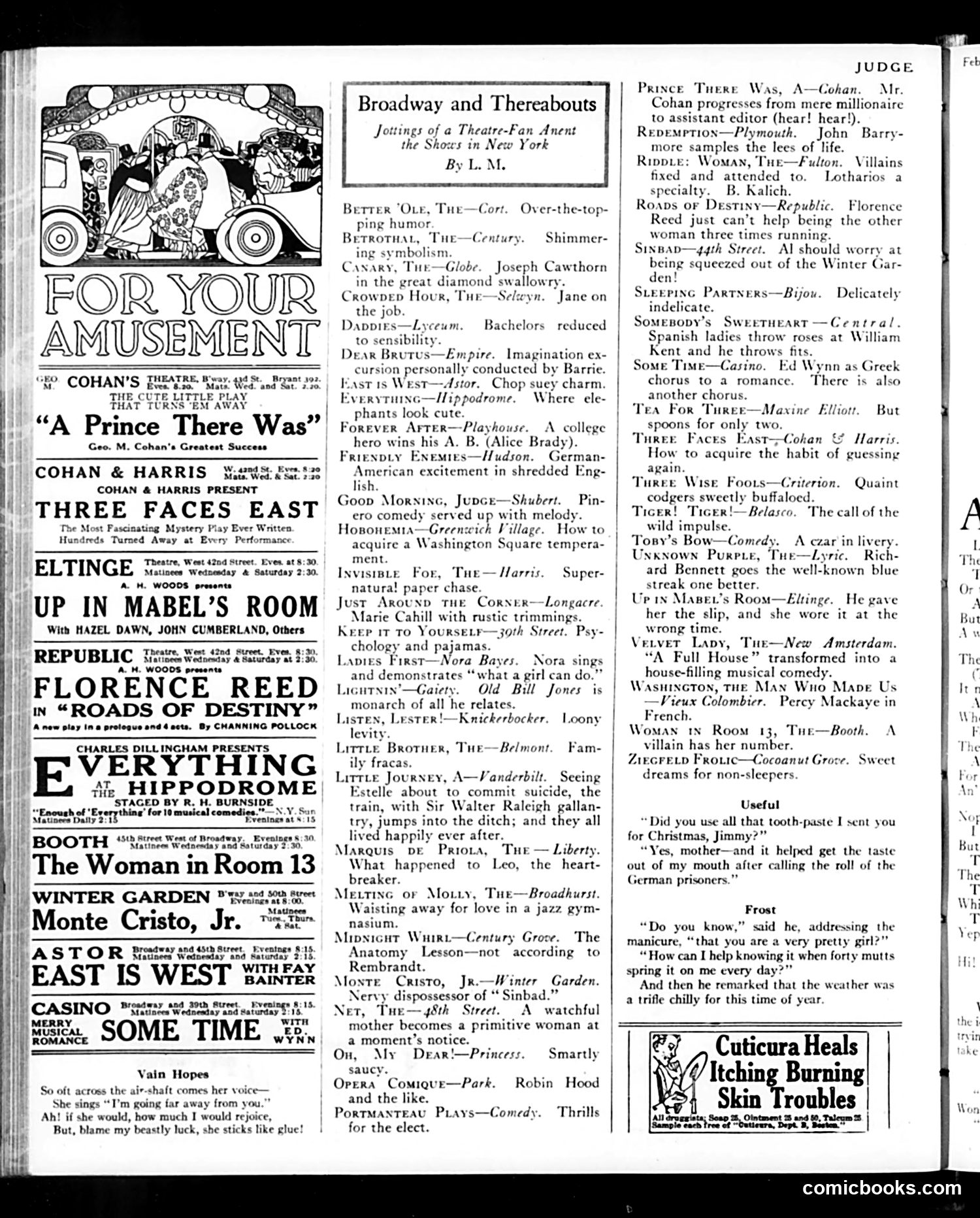
This page is primarily **theater advertising and reviews** rather than political satire. It features Broadway show listings from what appears to be the 1910s-1920s era, with brief comedic plot summaries by a critic identified as "L.M." The humor derives from **cynical theater-fan commentary** on popular plays. For example, reviews mock shows with dismissive brevity: "Better 'Ole" has "over-the-topping humor"; "Friendly Enemies" offers "German-American excitement in shredded English"; "Everything" at the Hippodrome features elephants that "look cute." The cartoon at top-left appears to be decorative rather than satirical—showing stylized theater patrons in an automobile. At bottom, a poem titled "Vain Hopes" jokes about an annoying neighbor whose singing across an air-shaft won't stop despite the narrator's wishes. **This is entertainment criticism, not political commentary.** The satire targets theatrical trends and audience taste rather than public figures or policy.
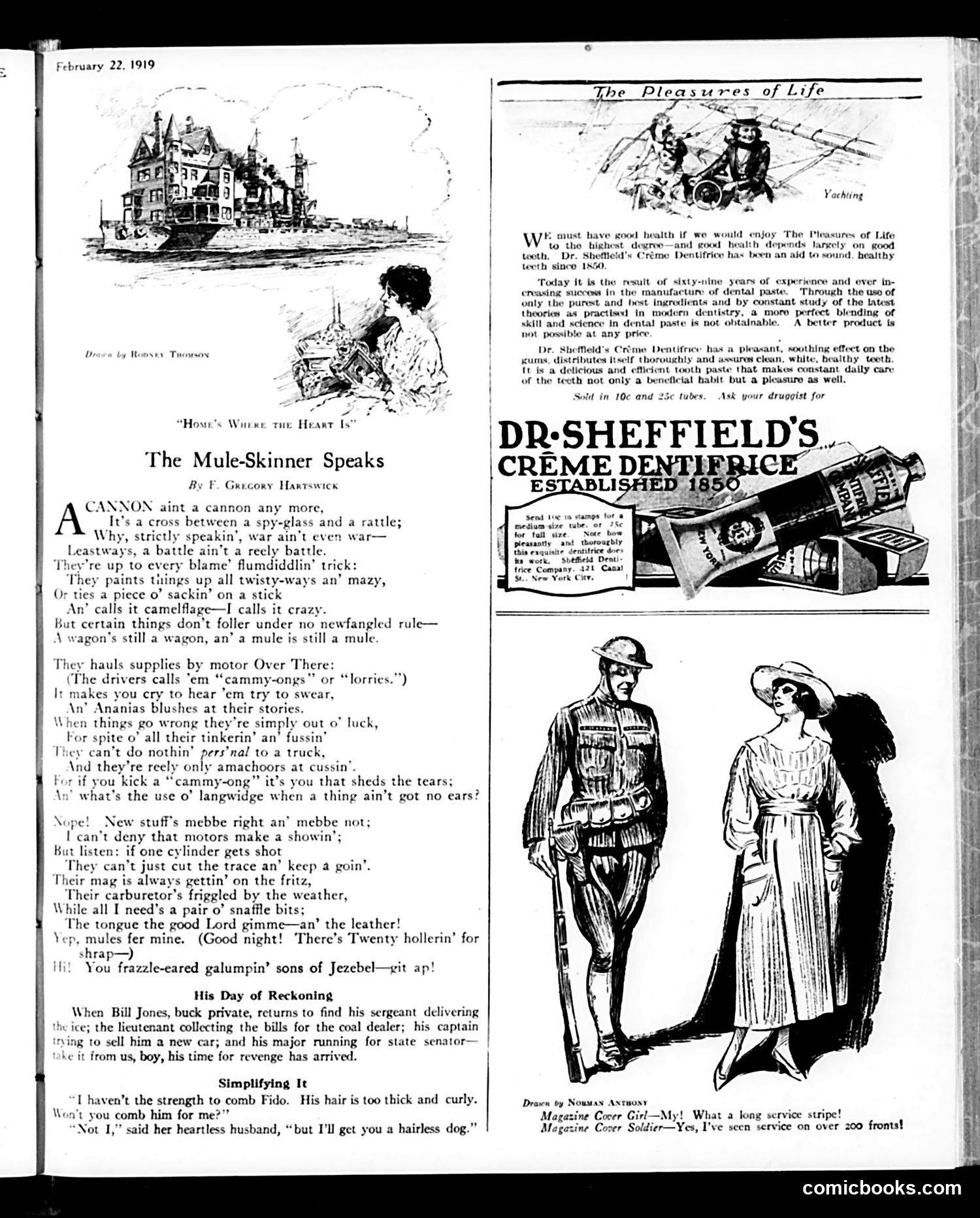
This page contains three distinct pieces of WWI-era satire: **"The Mule-Skinner Speaks"** (main poem): A rural soldier contrasts old-fashioned mule transport with modern mechanized warfare. He grumbles that while cannons and warfare have become complicated with new technology ("camelflage"), mules remain reliable—they don't break down like motor trucks and respond to simple commands. The satire mocks the Army's struggle adapting to mechanization while endorsing traditional methods. This reflects post-WWI nostalgia for simpler logistics. **"His Day of Reckoning"**: A brief joke about a returning soldier facing bills and requests from various military officers seeking personal favors—satirizing military corruption and exploitation of soldiers. **"Magazine Cover Soldier"**: A cartoon dialogue where a soldier boasts of "service on over 200 fronts," clearly absurd and mocking soldiers' exaggerated war stories. The page also contains a Dr. Sheffield's Creme Dentifrice advertisement (established 1850)—typical period advertising. The overall theme: post-war cynicism about both technological progress and military conduct.
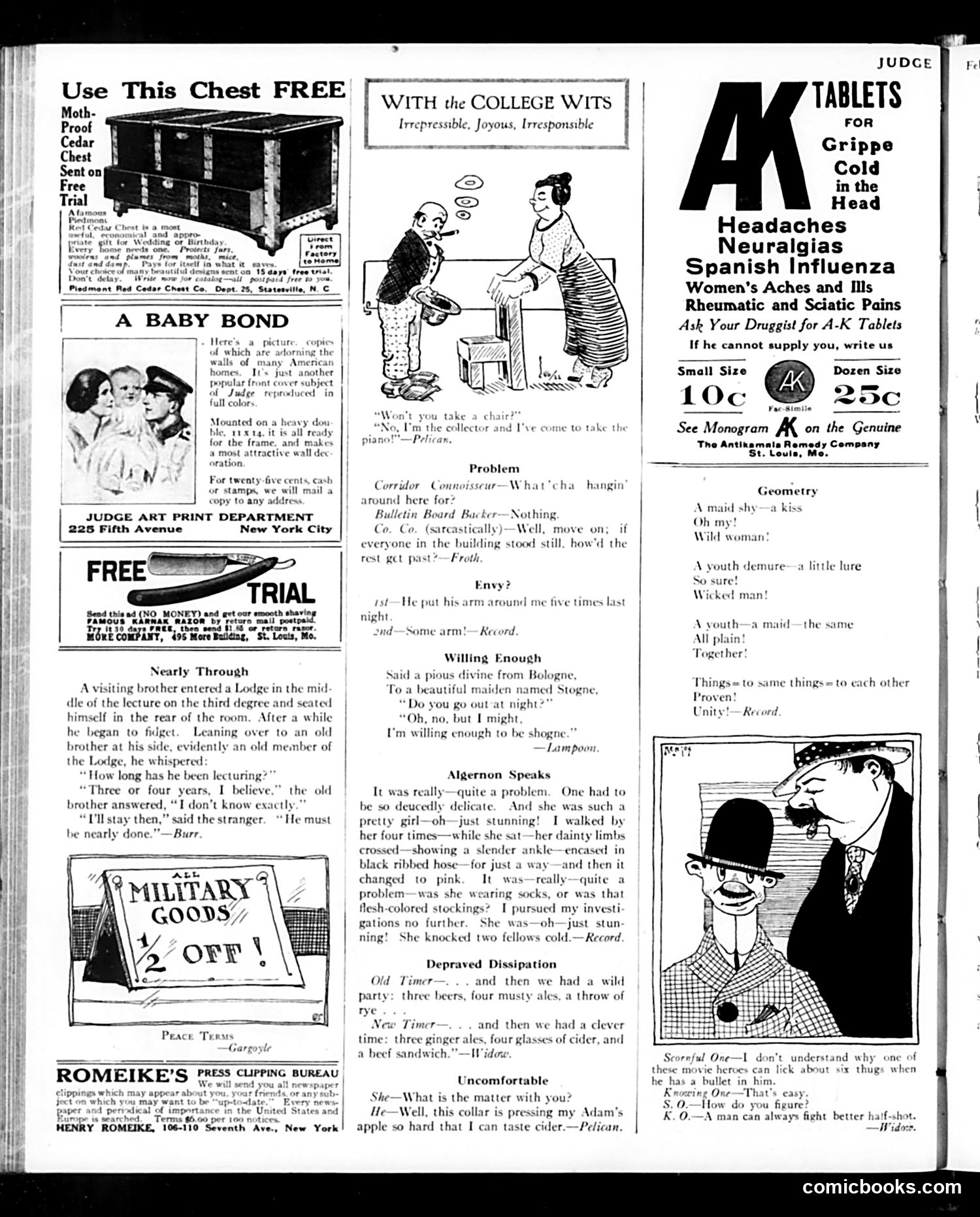
This page from Judge presents mixed content: advertisements, humorous college anecdotes, and satirical commentary typical of early 20th-century humor magazines. **Main Cartoons/Content:** The "With the College Wits" section features brief, campus-based jokes mocking pretentious college men. "Algernon Speaks" satirizes an affected young man obsessively analyzing a woman's leg coverings (socks vs. stockings)—ridiculing both his overwrought deliberation and the era's social anxieties about women's clothing and propriety. **"Nearly Through"** jokes about Masonic Lodge lectures being tediously long—a visitor assumes it will end soon, but learns the speaker has been going for "three or four years," depicting Freemasonry's reputation for endless ceremonial formality. The remaining sections are largely **advertisements** (medicinal tablets, cedar chests, military goods) and brief humor columns that mock social awkwardness and romantic confusion among young people—standard Judge fare emphasizing class anxieties and modern dating etiquette. No significant political satire appears on this particular page.
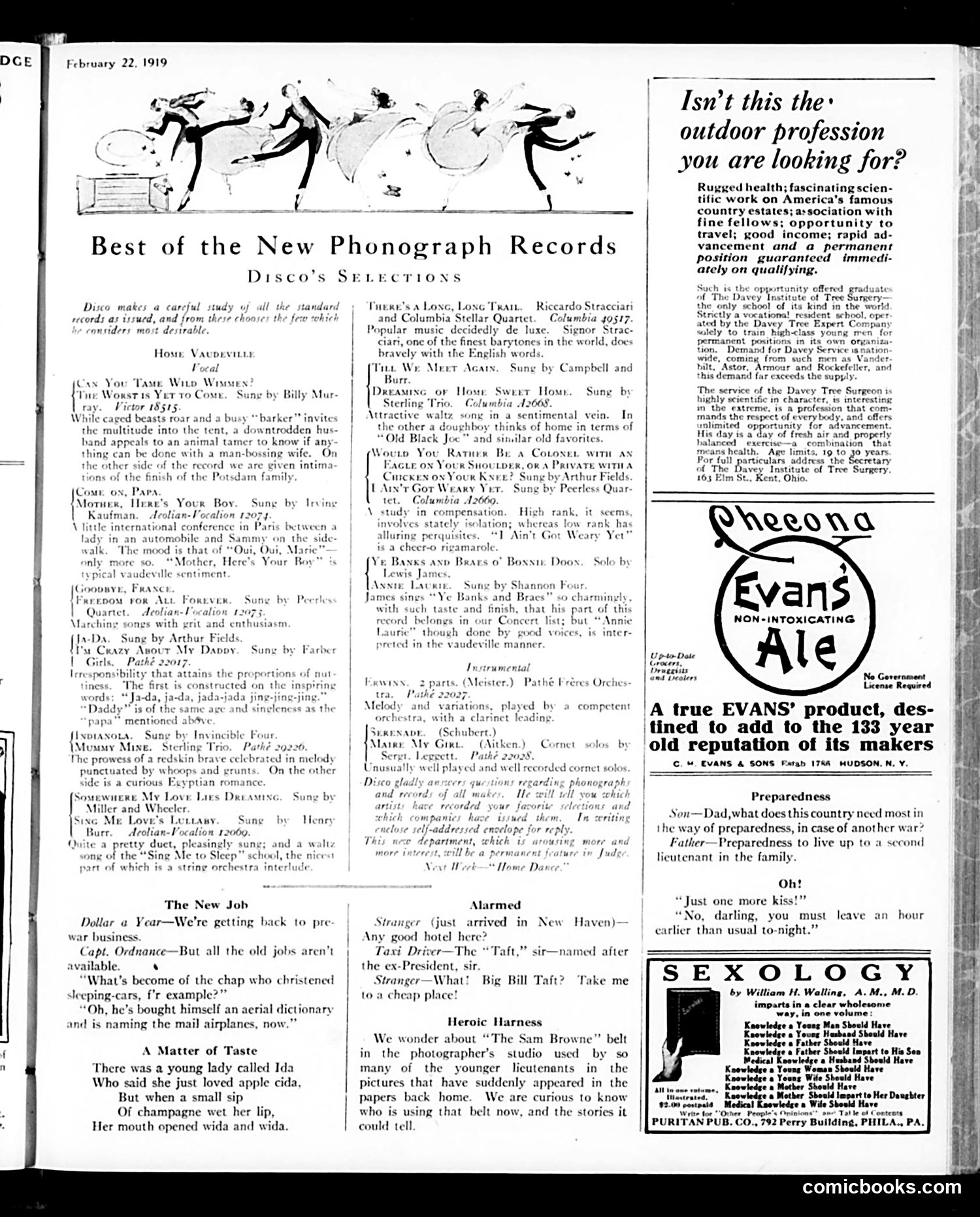
This is primarily a **phonograph record review page** with advertisements and humor snippets—not political cartoons. The main content is "Best of the New Phonograph Records: Disco's Selections," reviewing popular vocal and instrumental recordings from labels like Victor and Columbia. The page includes three brief **humorous anecdotes**: 1. **"The New Job"**: Satirizes post-WWI job market shifts—a man who once named railroad sleeping cars now names mail airplanes, reflecting how aerial mail service was becoming established. 2. **"A Matter of Taste"**: A lighthearted limerick about a woman named Ida preferring champagne to apple cider—innocent social humor. 3. **"Heroic Harness"**: References the "Sam Browne" belt worn by young officers in photographs sent home from WWI, wondering who's using it now and what stories it could tell—a nostalgic nod to recent military service. The page's advertisements include Evans' Ale and a book on "Sexology." No major political satire is evident; this reflects typical 1919 Judge content mixing entertainment reviews with mild social observation.
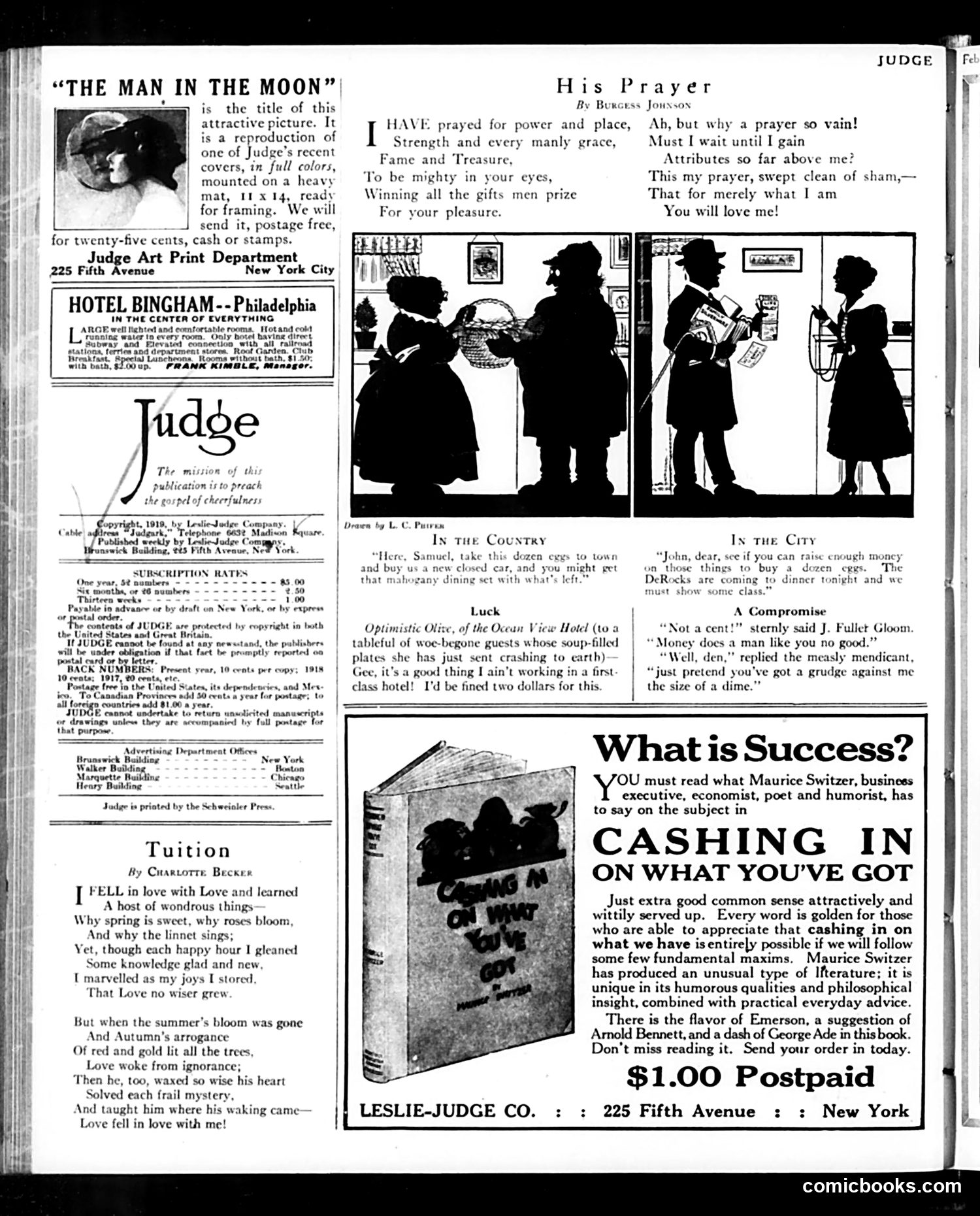
This page from Judge magazine (1919) contains several satirical cartoons and poems reflecting post-WWI American life. **"His Prayer"** presents a poem about ambition versus genuine worth—a man prays for power and status, then realizes true love requires only accepting "merely what I am." **The four cartoon vignettes** (drawn by L.C. Pabian) depict class and gender dynamics: - "In the Country": A wife orders her husband to sell their car to afford dining room furniture - "In the City": A husband asks his wife to economize on dinner - "Luck": A maid at a modest hotel finds humor in her job's low stakes - "A Compromise": A wealthy man refuses a beggar, but agrees to pretend the beggar has a grudge against him (allowing the man to "save face" while refusing charity) These cartoons satirize economic anxiety among different social classes and the tension between pride and practical need during the post-war period. The humor relies on readers recognizing contemporary domestic struggles and social pretense.
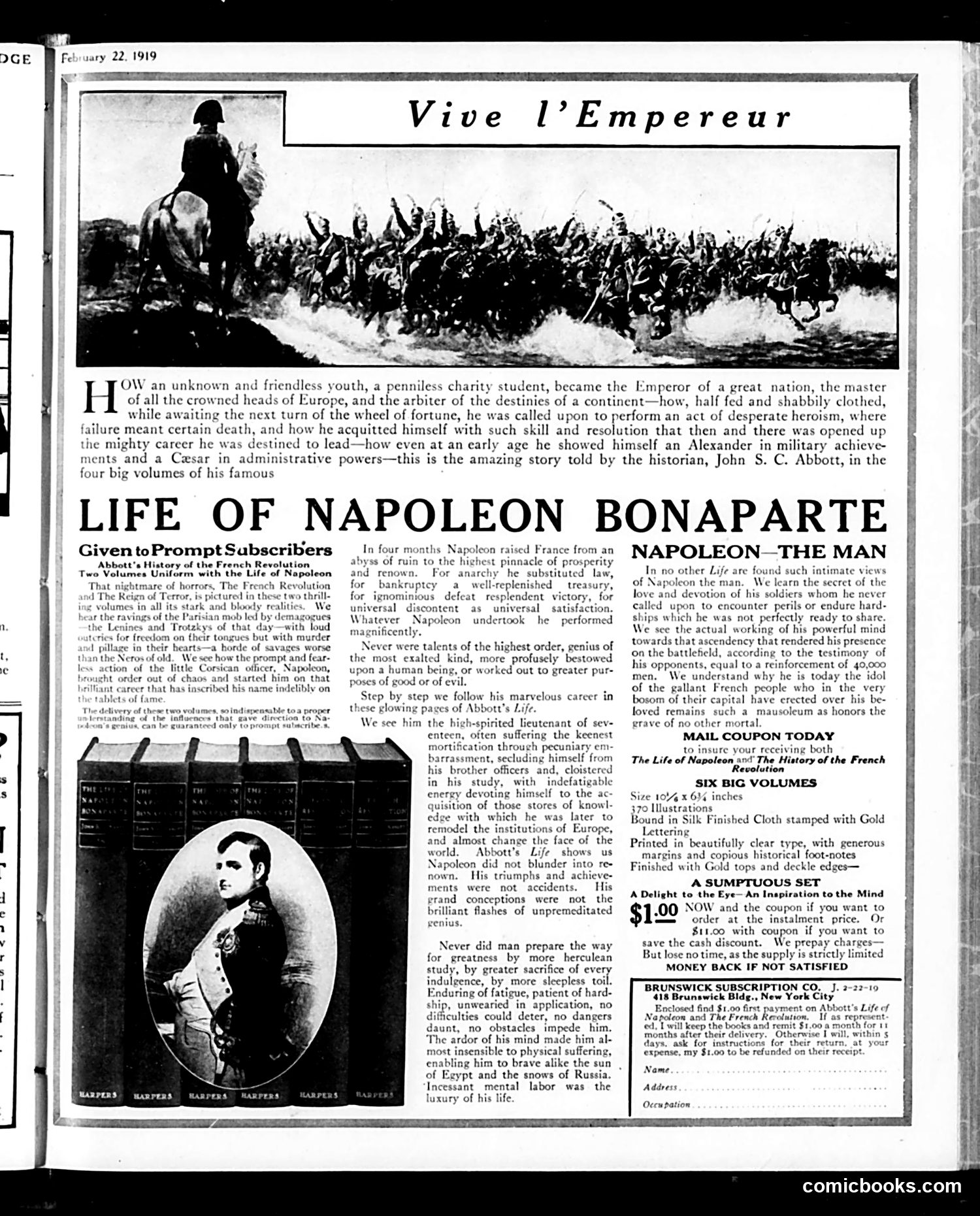
This is primarily an **advertisement**, not a political cartoon. Dated February 22, 1919, it promotes a subscription offer for John S. C. Abbott's multi-volume *Life of Napoleon Bonaparte*. The page uses patriotic framing—the headline "Vive l'Empereur" and imagery of Napoleon on horseback addressing troops—to sell historical books to American readers. The text romanticizes Napoleon as a self-made military genius who rose from poverty to continental power through intellect and determination. **Historical context**: Published just after World War I ended, this ad capitalizes on American fascination with European history and leadership during a period of nationalist sentiment. The accompanying volume on the French Revolution appeals to readers interested in how ordinary people reshape nations. The portrait of Napoleon and the text emphasize his "discipline" and "study"—appealing to Progressive Era American values of self-improvement through education. This is marketing, not satire.
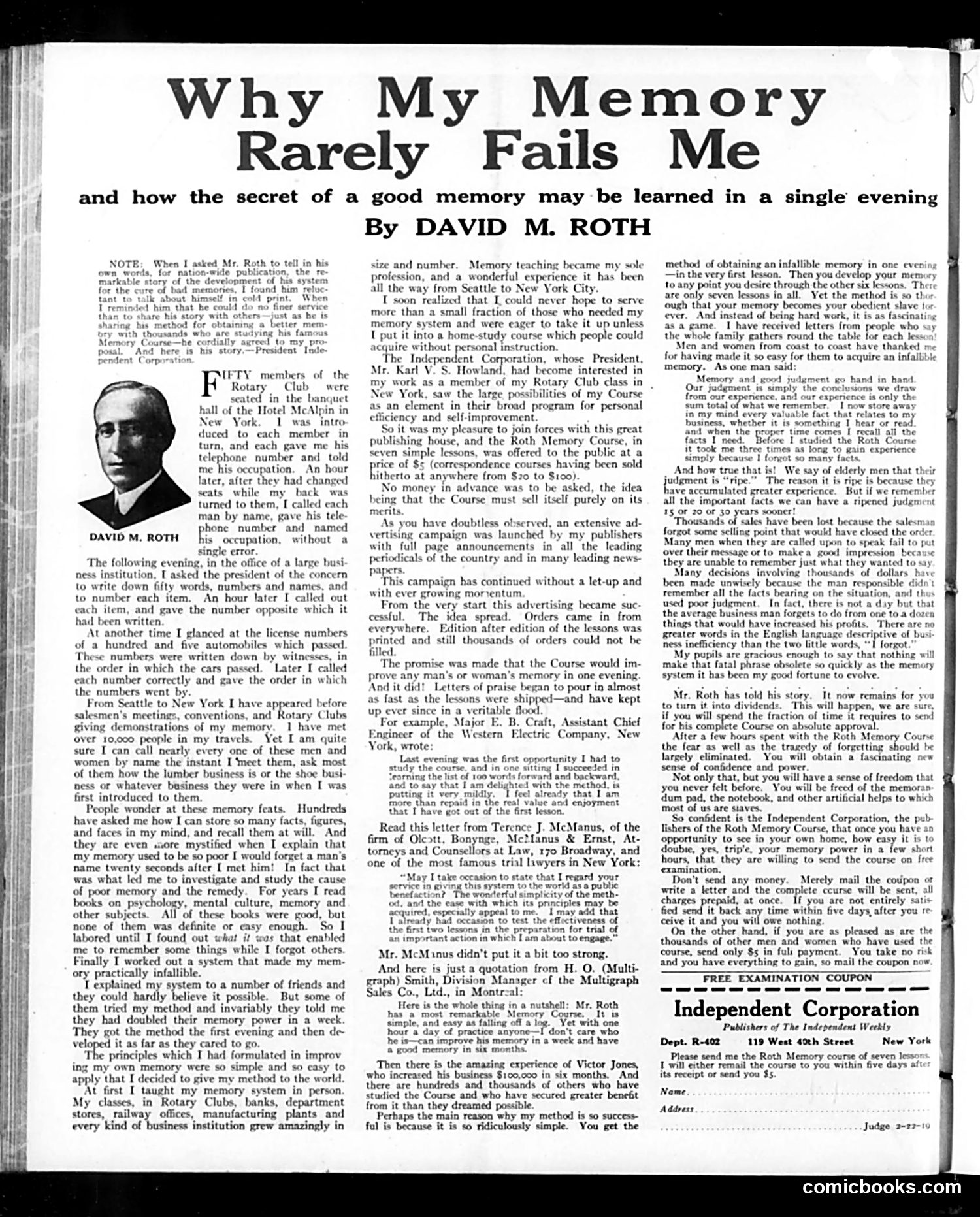
This is an **advertisement disguised as editorial content**—a common practice in early 20th-century magazines. David M. Roth, a memory-training entrepreneur, presents himself as an expert who has developed an infallible memory system he claims to teach in "a single evening." The article showcases Roth's purported feats: memorizing 50 Rotary Club members' names and occupations, 105 license plate numbers, and 10,000 people's identities across America. These demonstrations were apparently real public performances designed to build credibility. The satire here is implicit: Judge's readers would recognize this as typical **self-help hucksterism**—a person claiming near-magical memory abilities, now offering a mail-order course for a small fee. The earnest tone of Roth's testimony and the celebrity-endorsement-style testimonials were recognizable appeals to early-20th-century audiences eager for self-improvement shortcuts. The accompanying coupon invites readers to join the Independent Corporation's memory course, making the magazine's "editorial" purpose transparent: generating sales leads.