
Judge, 1919-02-22 · page 7 of 32
Judge — February 22, 1919 — page 7: what you’re looking at
What you’re looking at
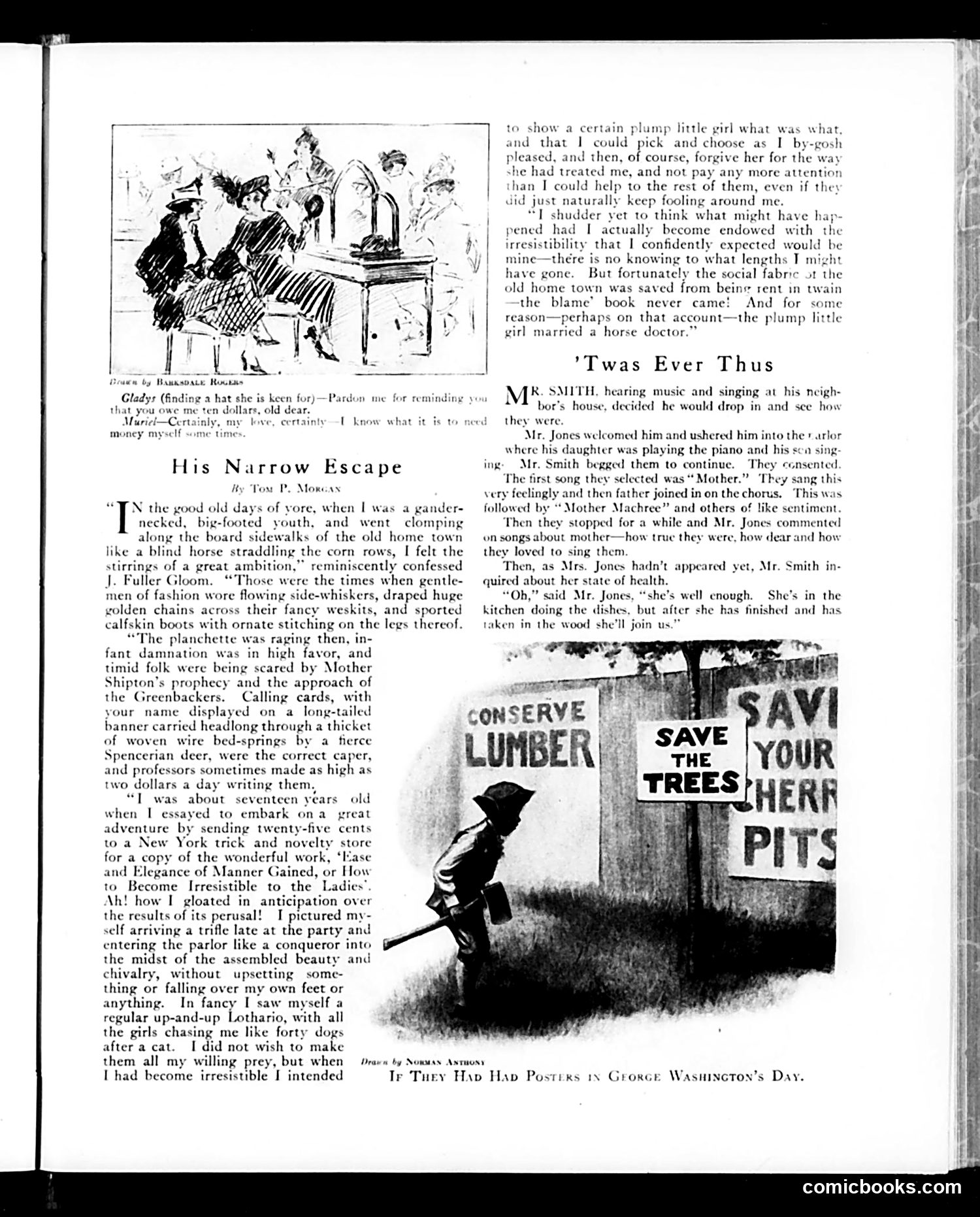
This page contains two satirical stories with period humor: **"His Narrow Escape"** mocks a young man's social pretensions. The narrator recounts ordering a self-help book ("Ease and Elegance of Manner") to become irresistible to ladies, particularly a "plump little girl" who'd spurned him. He fantasizes about gaining power over her through charm. The joke: the book never arrives, and she marries a horse doctor anyway—suggesting his social ambitions were always futile. **"'Twas Ever Thus"** satirizes domestic gender roles. Mr. Smith visits neighbors who sentimentally sing songs about mothers while Mrs. Jones toils in the kitchen. When Smith asks about her health, Jones casually mentions she's "doing the dishes" and "taken in the wood"—implying endless domestic drudgery while the family sentimentalizes motherhood in song. The satire critiques the contradiction between romanticizing mothers and exploiting wives' labor. The lumber/tree conservation poster appears unrelated advertising content.
📄 Transcribed text from this page (OCR, searchable)
Machine-transcribed from the original scan — historical spelling and the odd misread are preserved.
a hat she is keen for)—Pardon me for reminding that you owe me ten dollars, old dear. Murie’—Certainly, my love, certainty 1 y myself know what His Narrow Escape Ry ‘Tou PL Moras N the good old days of yore, when I was a gander- necked, big-footed youth, and went clomping along the board sidewalks of the old home town like a blind horse straddling the corn rows, I felt the stirrings of a great ambition,” reminiscently confessed |. Fuller Gloom. “Those were the times when gentle- men of fashion wore flowing side-whiskers, draped huge golden chains across their fancy weskits, and sported calfskin boots with ornate stitching on the legs thereof. “The planchette was raging then, in- fant damnation was in high favor, and timid folk were being scared by Mother Shipton’s prophecy and the approach of the Greenbackers. Calling cards, with your name displayed on a long-tailed banner carried headlong through a thicket of woven wire bed-springs by a fierce Spencerian deer, were the correct caper, and professors sometimes made as high as two dollars a day writing them, “IT was about seventeen years old when I essayed to embark ona great adventure by sending twenty-five cents to a New York trick and novelty store for a copy of the wonderful work, ‘Ease and Elegance of Manner Gained, or How to Become Irresistible to the Ladies’. \h! how I gloated in anticipation over the results of its perusal! I pictured my- self arriving a trifle late at the party and entering the parlor like a conqueror into the midst of the assembled beauty and chivalry, without upsetting some- thing or falling over my own feet or anything. In fancy I saw myself a regular up-and-up Lothario, with all the girls chasing me like forty dogs after a cat. I did not wish to make them all my willing prey, but when I had become irresistible I intended to show a certain plump little girl what was what, and that I could pick and choose as I by-gosh pleased, and then, of course, forgive her for the way she had treated me, and not pay any more attention han I could help to the rest of them, even if they did just naturally keep fooling around me. “T shudder yet to think what might have h pened had I actually become endowed with the irresistibility that | confidently expected would be mine—there is no knowing to what lengths T might have gone. But fortunately the social fabric ot the old home town was saved from being rent in twain the blame’ book never came! And for some reason—perhaps on that account—the plump little girl married a horse doctor, ’Twas Ever Thus M& MITH, hearing music and singing at his neigh- bor’s house, decided he would drop in and see how they were. Mr. Jones welcomed him and ushered him into the + arlor where his daughter was playing the piano and his sen sing: ing: Mr. Smith begged them to continue. They consented The first song they selected was“ Mother.” They sang this very feelingly and then father joined in on the chorus. This was followed by “* Mother Machree” and others of like sentiment. Then they stopped for a while and Mr. Jones commented on songs about mother—how true they were, how dear and how they loved to sing them. Then, as Mrs. Jones hadn’t appeared yet, Mr. Smith in- quired about her state of health. “Oh,” said Mr. Jones, “she’s well enough. She’s in the kitchen doing the dishes, but after she has finished and has taken in the wood she'll join us.” Drawn by NowMAs Axrwosy Wasutncton’s Day. Ir Tury Hap Hap Postrrs 1x Grorce comicbooks.com