
Judge, 1919-02-22 · page 16 of 32
Judge — February 22, 1919 — page 16: what you’re looking at
What you’re looking at
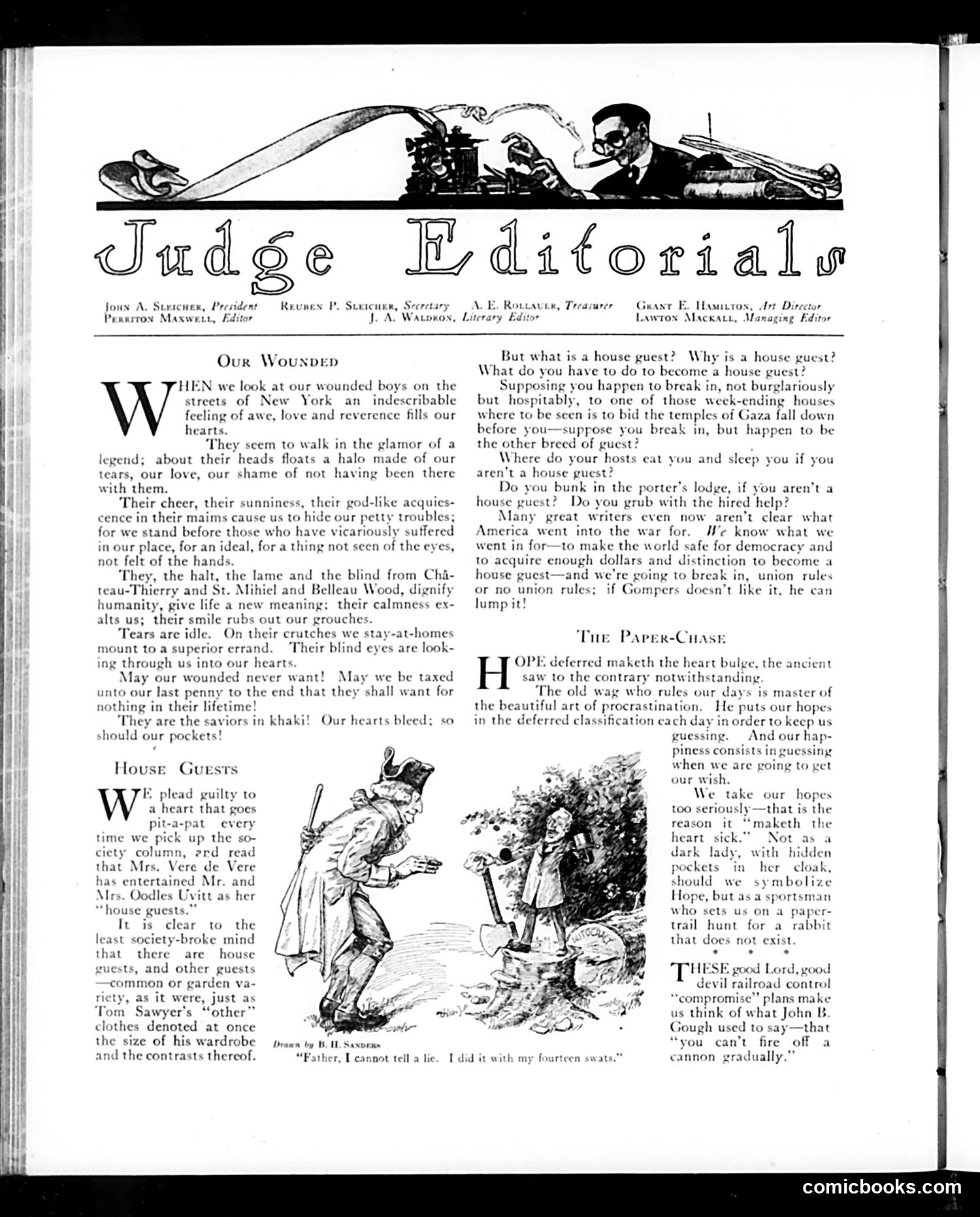
This page from *Judge* magazine contains three satirical editorials about post-WWI American society. **"Our Wounded"** celebrates disabled veterans returning from WWI (references to Château-Thierry, St. Mihiel, and Belleau Wood—major 1918 battles). The editorial romanticizes their sacrifice while guilt-tripping wealthy civilians to fund veteran care through increased taxation. **"House Guests"** mocks upper-class social hierarchies. It satirizes the distinction between prestigious "house guests" (wealthy visitors at fashionable estates) and ordinary guests. The piece cynically suggests Americans joined WWI not for democracy but to gain enough wealth and social status to become house guests—critiquing materialistic war motivations while poking fun at social climbing. **"The Paper-Chase"** attacks railroad industry "compromise" plans (likely post-war labor disputes), comparing deferred hope to a pointless rabbit hunt. It references temperance advocate John B. Gough's famous quote about gradual cannon firing—meaning you can't implement change incrementally. The illustrations by H.H. Sandors support these satirical critiques of postwar American priorities and class consciousness.
📄 Transcribed text from this page (OCR, searchable)
Machine-transcribed from the original scan — historical spelling and the odd misread are preserved.
Revusen P. ” J foun A, Strrcner, Preside’ Pexerron Maxweut, £& A. Watpnon, A. E.R Literary Edi AviK, Treasurer Geant Hasuntox, drt Director ” Lawron Mackatt, Managing Editor Our Wounvep HEN we look at our wounded boys on the streets of New York an_ indescribable feeling of awe, love and reverence fills our hearts. They seem to walk in the glamor of a legend; about their heads floats a halo made of our tears, our love, our shame of not having been there with them. Their cheer, their sunniness, their god-like acquies- cence in their maims cause us to hide our petty troubles; for we stand before those who have vicariously suffered in our place, for an ideal, for a thing not seen of the eyes, not felt of the hands. They, the halt, the lame and the blind from Ch teau-Thierry and St. Mihiel and Belleau Wood, dignify humanity, give life a new meaning: their calmness ex- alts us; their smile rubs out our grouches. Tears are idle. On their crutches we stay-at-homes mount toa superior errand. Their blind eyes are look- ing through us into our hearts. May our wounded never want! May we be taxed unto our last penny to the end that they shall want for nothing in their lifetime! They are the saviors in khaki! Our hearts bleed; so should our pockets! e Guests Hou » plead guilty to a heart that goes pit-a-pat every time we pick up the so- ciety column, ard read that Mrs. Vere de Vere has entertained Mr. and Mrs. Oodles Uvitt as her “house guests.” It is clear to the least society-broke mind at there are house guests, and other guests common or garden va- riety, as it were, just as Tom Sawyer’s “other” clothes denoted at once the size of his wardrobe and the contrasts thereof. Drawn by BAL Saxpens her, I cannot tell a lie I did it with my But what is a house guest?) Why is a house guest? What do you have to do to become a house guest? Supposing you happen to break in, not burglariously but hospitably, to one of those week-ending houses where to be seen is to bid the temples of Gaza fall down before you—suppose you break in, but happen to be the other breed of guest? Where do your hosts cat you and sleep you if you aren't a house guest? Do you bunk in the porter’s lodge, if you aren’t a house guest? Do you grub with the hired help? Many great writers even now aren’t clear what America went into the war for. MWe know what we went in for—to make the world safe for democracy and to acquire enough dollars and distinction to become a house guest—and we're going to break in, union rules or no union rules; if Gompers doesn’t like it, he can lump it! The Parer-Cuase OPE deferred maketh the heart bulge, the ancient H saw to the contrary notwithstanding The old wag who rules our days is master of the beautiful art of procrastination. He puts our hopes in the deferred classifica n cach day in order to keep us guessing. And our hap- Piness consists in guessing when we are going to get our wish. We take our hopes too seriously—that is the reason it “maketh th heart. sick.” ot “a dark lady, with hidden pockets in her cloak, should we symbolize Hope, but as a sportsman who sets us on a paper- trail hunt for a rabbit that does not exist. HESE good Lord, good devil railroad control “compromise” plans make us think of what John B Gough used to say—that “you can’t fire off a cannon gradually. fourteen swats. comicbooks.com