
Judge, 1919-02-22 · page 22 of 32
Judge — February 22, 1919 — page 22: what you’re looking at
What you’re looking at
This theater criticism column reviews three contemporary plays featuring supernatural or fantastical elements. The author uses "spook etiquette"—how ghosts should behave—as a framework for discussing theatrical restraint versus sensationalism. **The plays discussed:** - "The Invisible Foe" (featuring Richard Bennett): praised for a *restrained* ghost that logically guides the plot without theatrical showiness - "The Unknown Purple": criticized as more sensational, with Bennett playing Purple Ray, a scientist using revenge methods - "The Gods of the Mountains" by Lord Dunsany at the Punch and Judy Theatre: features pre-Christian deities punishing human hubris **The satire's point:** Mackall contrasts old-fashioned dramatic restraint (embodied by the conservative ghost Bransby) with newer, more melodramatic supernatural theater. He celebrates logical plotting and appeals to intelligence over mere visual trickery—praising the "optimistic, healthy" approach of careful storytelling rather than sensationalism.
📄 Transcribed text from this page (OCR, searchable)
Machine-transcribed from the original scan — historical spelling and the odd misread are preserved.
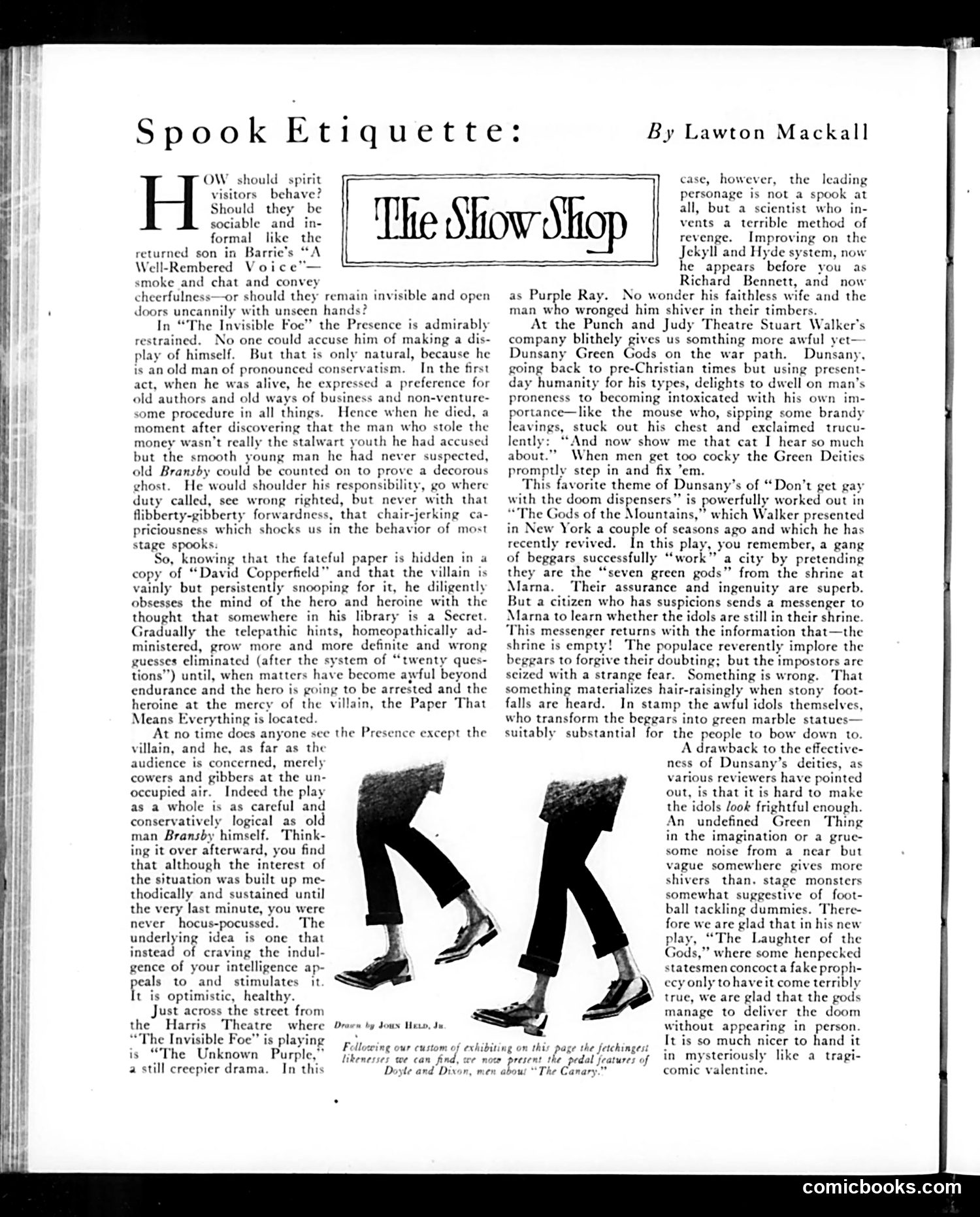
Spook Etiquette: By Lawton Mackall case, however, the leading OW should spirit visitors behav Should they be sociable and in- formal like the returned son in Barrie’s “A “The SHiow Stop | personage is not a spook at all, but a scientist who in- vents a terrible method of revenge. Improving on the Jekyll and Hyde system, now Well-Rembered Voice™ smoke and chat and convey cheerfulness—or should they remain invisible and open doors uncannily with unseen hands? In “The Invisible Foe” the Presence is admirably restrained. No one could accuse him of making a dis- play of himself. But that is only natural, because he is an old man of pronounced conservatism. In the first act, when he was alive, he expressed a preference for old authors and old ways of business and non-venture- some procedure in all things. Hence when he died, a moment after discovering that the man who stole the money wasn’t really the stalwart youth he had accused but the smooth young man he had never suspected, old Bransby could be counted on to prove a decorous ghost. He would shoulder his responsibility, go where duty called, see wrong righted, but never with that flibberty-gibberty forwardness, that chair-jerking ca priciousness which shocks us in the behavior of most stage spooks: So, knowing that the fateful paper is hidden in a copy of “David Copperfield” and that the villain is vainly but persistently snooping for it, he diligently obsesses the mind of the hero and heroine with the thought that somewhere in his library is a Secret Gradually the telepathic hints, homeopathically ad- ministered, grow more and more definite and wrong guesses eliminated (after the system of “twenty ques- tions”) until, when matters have become ayvful beyond endurance and the hero is going to be arrested and the heroine at the mercy of the villain, the Paper That Means Everything is located. At no time docs anyone see the Presence except the villain, and he, as far as the audience is concerned, merely cowers and gibbers at the un- occupied air. Indeed the play as a whole is as careful and conservatively logical as old man Bransby himself. Think- ing it over afterward, you find that although the interest of the situation was built up me- thodically and sustained until the very last minute, you were never hocus-pocussed. The underlying idea is one that instead of craving the indul- gence of your intelligence ap- peals to and stimulates it It is optimistic, healthy. Just across the street from the Harris Theatre where “The Invisible Foe” is playing tusiow of exiil is “The Unknown Purple,” dbase a still creepier drama. In this ste and, Drawn by Joux Herp, Ju he appears before you as Richard Bennett, and now as Purple Ray. No wonder his faithless wife and the man who wronged him shiver in their timbers. At the Punch and Judy Theatre Stuart Walker's company blithely gives us somthing more awful yet- Dunsany Green Gods on the war path. Dunsany, going back to pre-Christian times but using present- day humanity for his types, delights to dwell on man’s proneness to becoming intoxicated with his own im- portance—like the mouse who, sipping some brandy leavin; stuck out his chest and exclaimed trucu- lently And now show me that cat I hear so much about.” When men get too cocky the Green Deities promptly step in and fix ’em. This favorite theme of Dunsany’s of “Don’t get gay with the doom dispensers” is powerfully worked out in “The Gods of the Mountains,” which Walker presented in New York a couple of seasons ago and which he has recently revived. In this play, you remember, a gang of beggars successfully ‘“w a city by pretending they are the “seven green gods” from the shrine at Marna. Their assurance and ingenuity are superb. But a citizen who has suspicions sends a messenger to Marna to learn whether the idols are still in their shrine. ‘This messenger returns with the information that—the shrine is empty! The populace reverently implore the beggars to forgive their doubting; but the impostors are seized with a strange fear. Something is wrong. That something materializes hair-raisingly when stony foot- falls are heard. In stamp the awful idols themselves, who transform the beggars into green marble statues— suitably substantial for the people to bow down to. A drawback to the effecti ness of Dunsany’s deities, as various reviewers have pointed out, is that it is hard to make the idols /ook frightful enough. n undefined Green Thing in the imagination or a grue- some noise from a near but vague somewhere gives more shivers than. stage monsters somewhat suggestive of foot- ball tackling dummies. There- fore we are glad that in his new play, “The Laughter of the Gods,” where some henpecked statesmen concocta fake proph- ecy only tohave it come terribly true, we are glad that the gods manage to deliver the doom without appearing in person. It is so much nicer to hand it in mysteriously like a tragi- comic valentine. comicbooks.com