
A complete issue · 32 pages · 1919
Judge — February 15, 1919
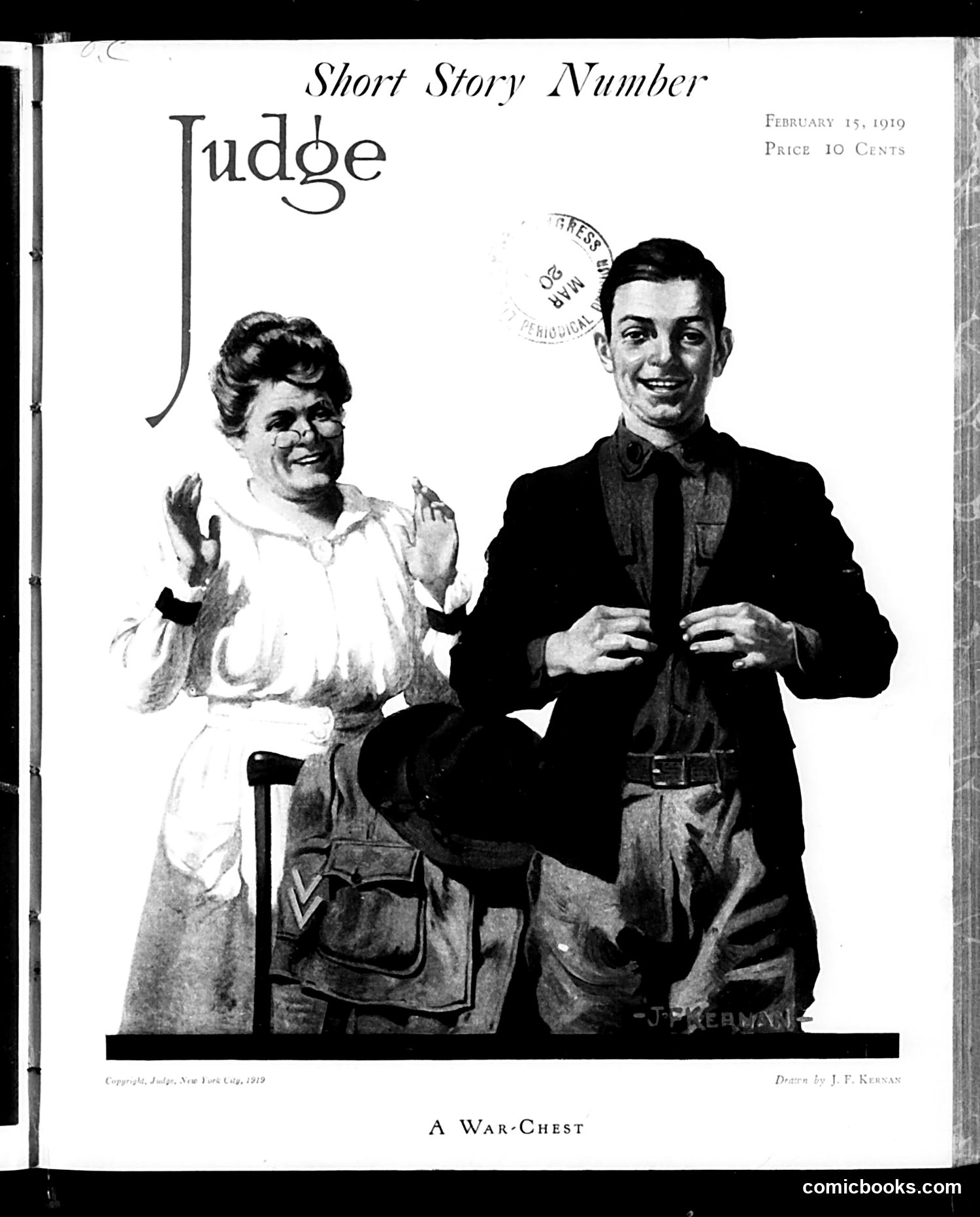
This illustration depicts a woman and man, both smiling broadly. The caption "A War Chest" is a visual pun: the man appears to be displaying his actual chest/torso (he's unbuttoning his jacket), while the woman gestures approvingly beside him. Published just after World War I ended (November 1918), this likely satirizes American war bonds and fundraising efforts. The "war chest" was a literal term for military funds. The joke appears to be about physical fitness or masculine vigor as a form of national wealth or strength—a humorous take on patriotic appeals to American vigor during the postwar period. The artist is credited as J.F. Kernan.
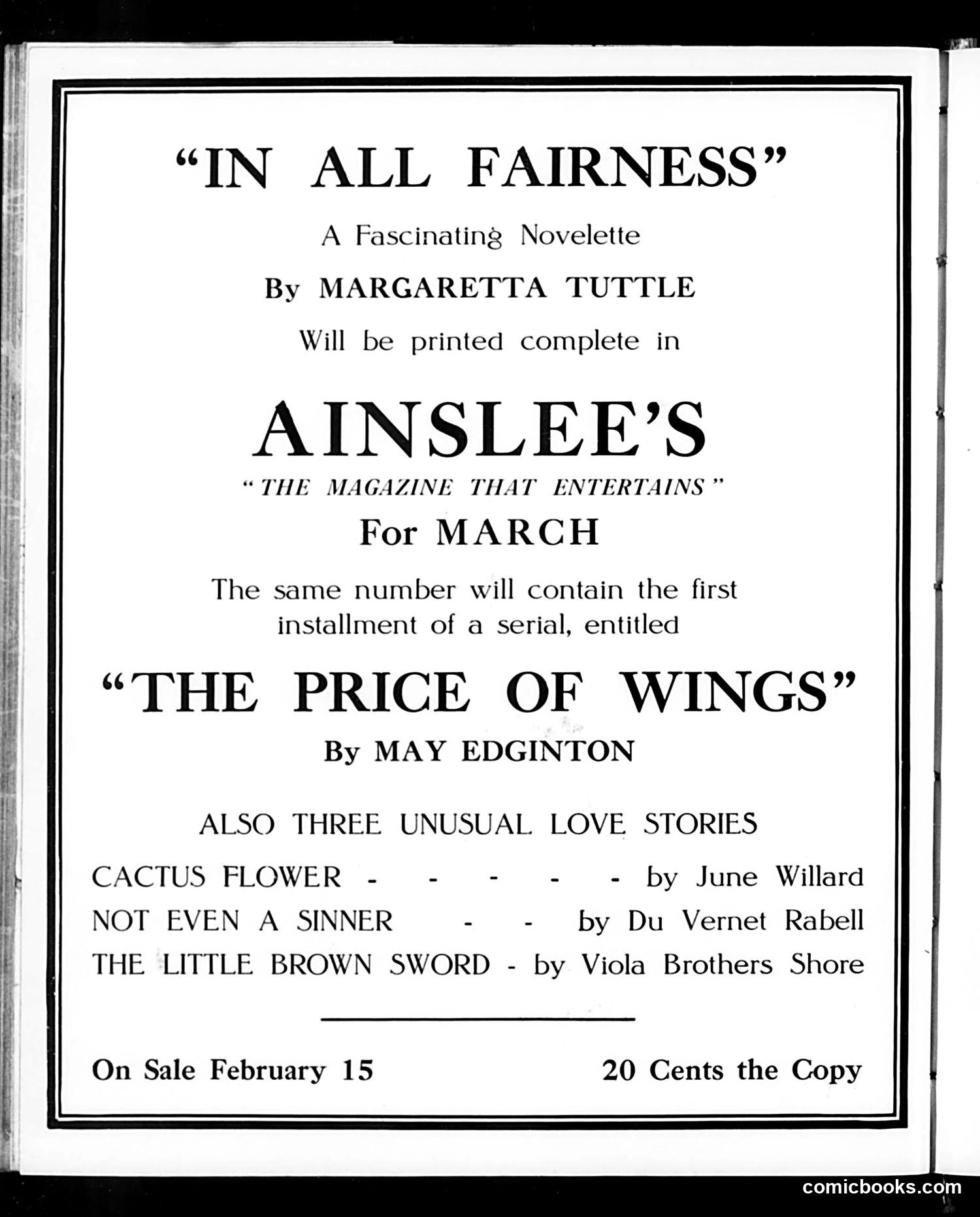
This is primarily a **magazine advertisement** rather than editorial cartoon content. It promotes upcoming fiction in *Ainslee's* magazine for March, including: - A novelette titled "In All Fairness" by Margaretta Tuttle - A serial's first installment: "The Price of Wings" by May Edginton - Three short love stories by various authors The page advertises leisure reading material aimed at early 20th-century magazine subscribers. The 20-cent price and February 15 sale date suggest this is from that era. There is no political satire, caricature, or social commentary—it's straightforward publishing industry promotion for romantic and dramatic fiction popular with that period's general readership.
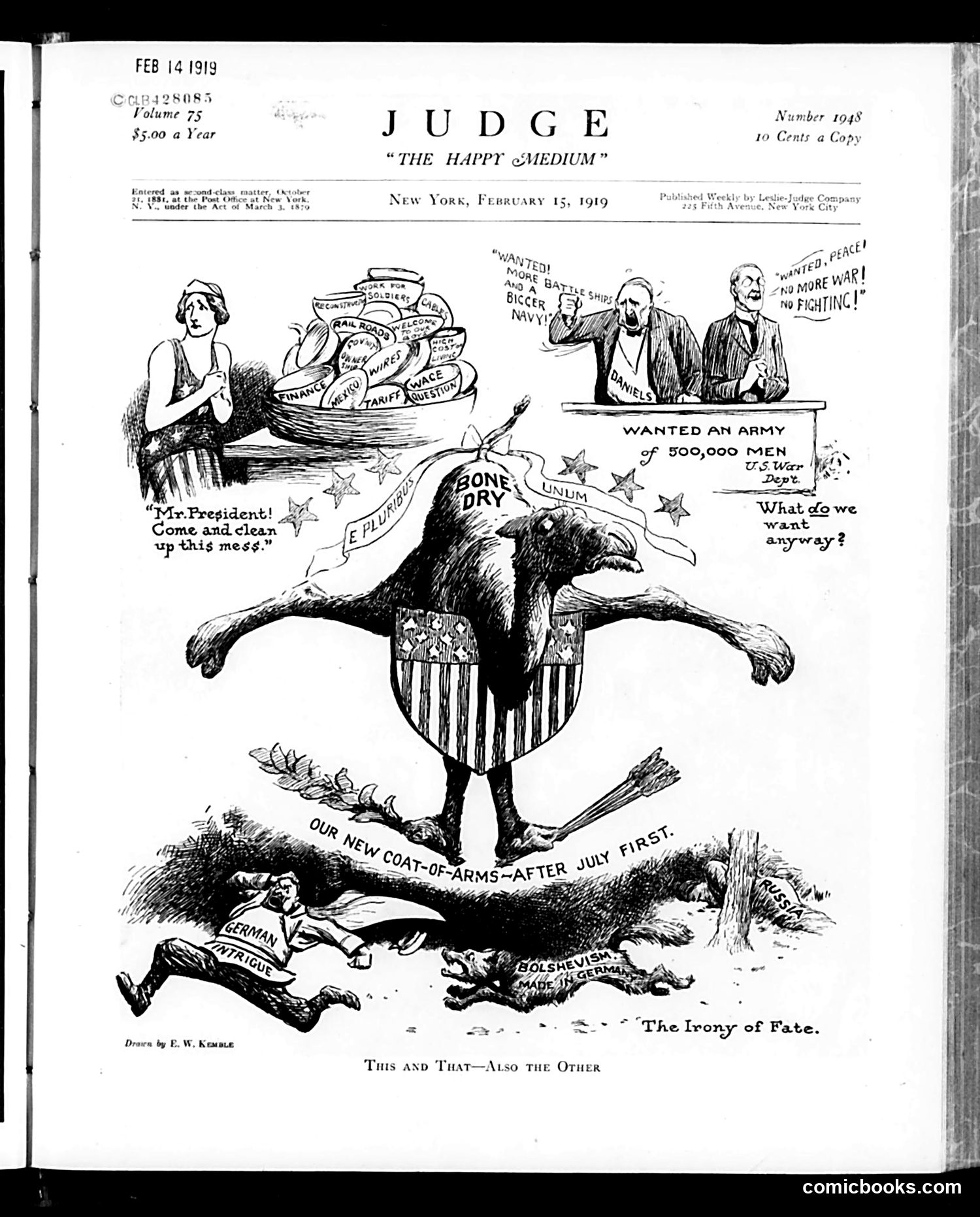
This cartoon satirizes American contradictions following World War I. The central figure is Uncle Sam (the eagle-shield on his chest), struggling to balance competing demands: the left panel shows a woman saying "Mr. President! Come and clean up this mess" (likely referencing domestic concerns); the right shows officials demanding "Peace" while the War Department wanted 500,000 troops. Below, defeated German and Bolshevik figures lie dead, labeled "Our new coat-of-arms—after July first." The satire's point: despite victory, America faces internal chaos—domestic unrest, conflicting war/peace goals, and political gridlock. The "irony of fate" is that winning the war hasn't solved America's problems; it's created new ones.
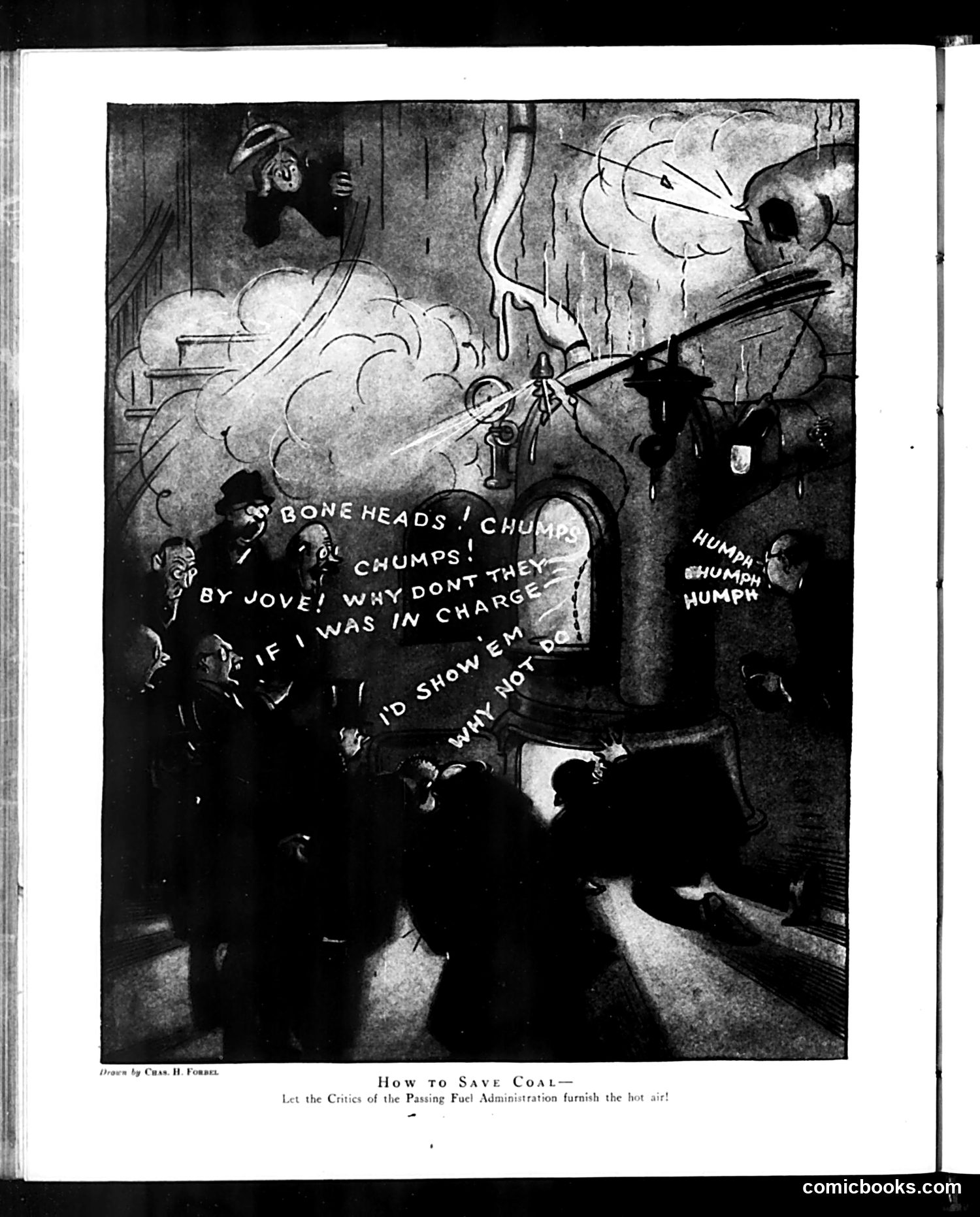
This political cartoon by Cass H. Forbes satirizes coal conservation efforts during what appears to be World War I rationing. The central figure represents a bureaucrat or government official ("Passing Fuel Administration") literally surrounded by hot air and bombast—depicted as inflated clouds of smoke. The lower figures (appearing to be critics or fuel inspectors) sarcastically suggest the bureaucrats should "show 'em" their efficiency through action rather than empty rhetoric. The joke critiques government fuel administrators as hypocrites: they demand coal-saving from citizens while producing nothing but "hot air"—wasteful talk and ineffective policies. The title's irony suggests the real way to save coal is to eliminate the verbose, unproductive bureaucracy itself.
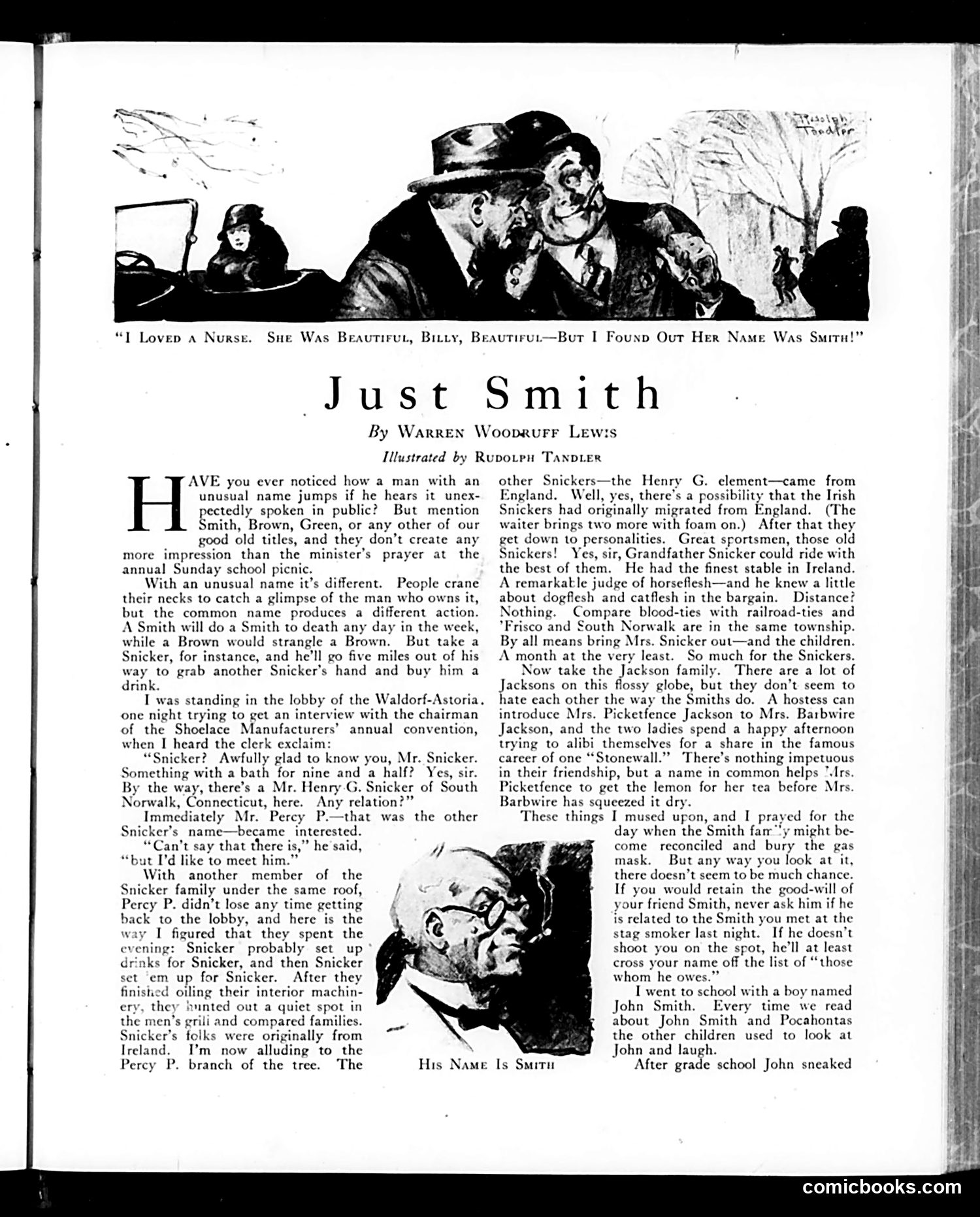
This page satirizes the commonness of the surname "Smith" through a humorous short story. The top cartoon illustrates the narrator's romantic disappointment: he loved a beautiful nurse, only to discover her unremarkable last name was Smith. The story explores how "Smith" appears everywhere in American society—multiple Snickers families with Smith connections, Jackson families feuding with Smiths, schoolboys named John Smith mocked by classmates. The central illustration ("His Name Is Smith") emphasizes this ordinariness. The satire mocks how such an ordinary name lacks distinction or memorability in public life. Unlike unusual surnames that create impressions, Smith produces indifference—making it simultaneously both common and forgettable in social contexts. It's gentle social humor about American naming conventions.
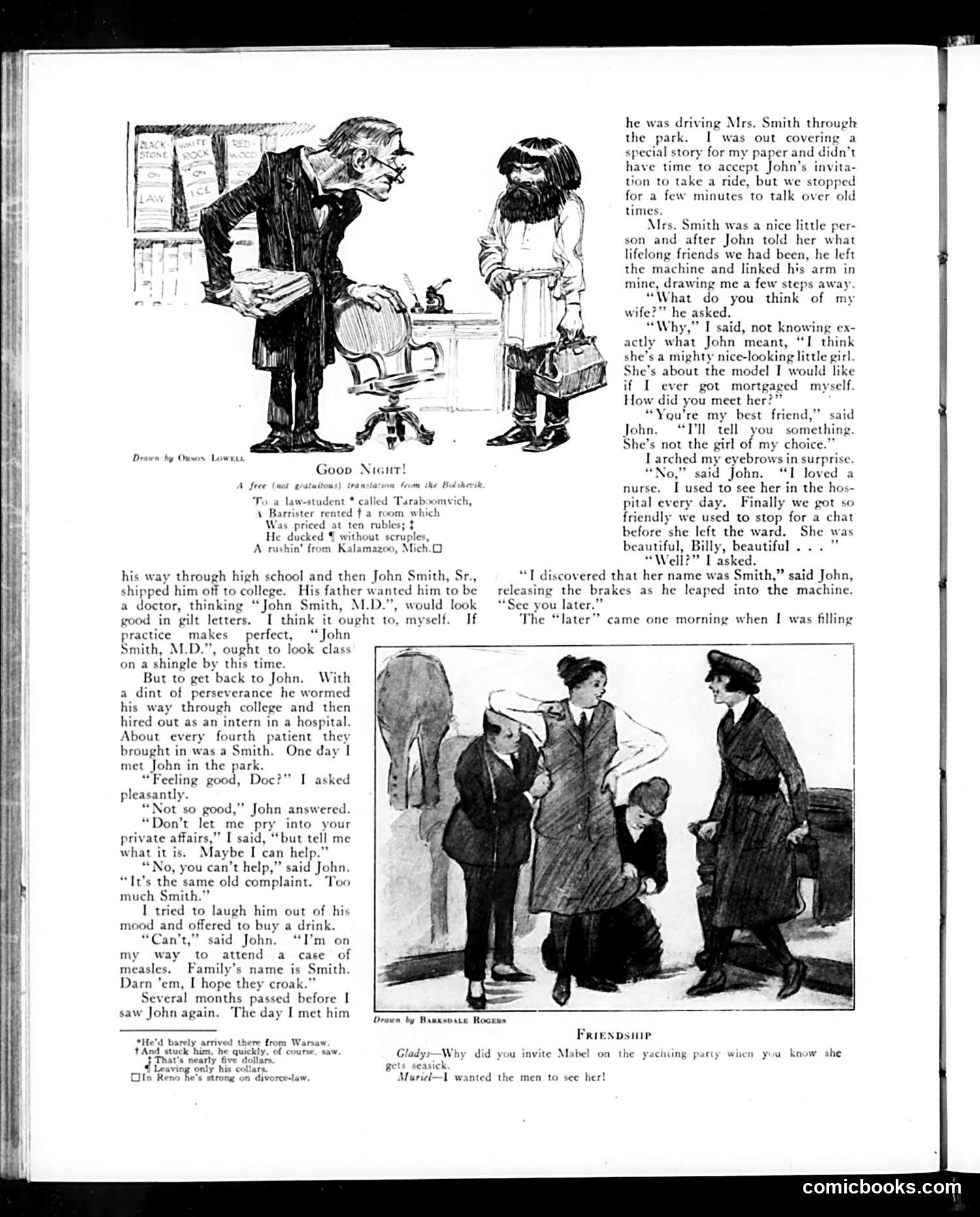
This page contains a serialized story titled "Good Night!" with illustrations by Orson Lowell, rather than political satire. The narrative follows the narrator's friendship with John Smith, a medical doctor, and describes John's romantic interest in a woman he met at a hospital. The top cartoon shows a man in professional attire speaking with a young woman, illustrating their initial meeting. The lower illustration by Barksdale Rogers, titled "Friendship," depicts a social scene at what appears to be a yacht party, showing the narrator introducing his friend Mabel to John, though she becomes seasick. This is primarily **light domestic fiction and humor** rather than political commentary—typical of Judge's miscellaneous content beyond its political cartoons.
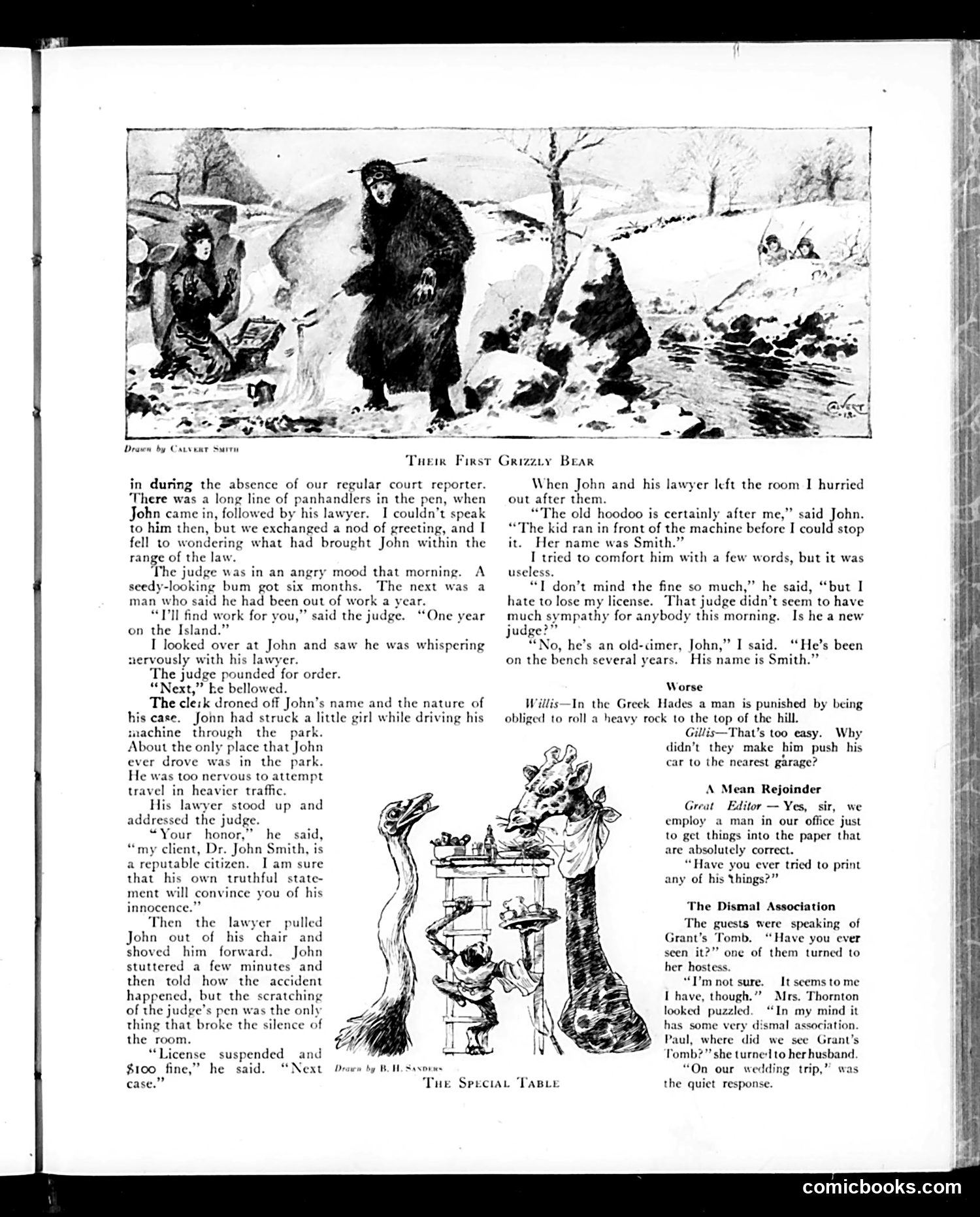
This page satirizes judicial inconsistency and bias. The main cartoon depicts a judge harshly sentencing poor defendants—a vagrant gets six months, an unemployed man gets a year—but then leniently punishes "Dr. John Smith," a wealthy driver who struck a child, with only a suspended license and $100 fine. The irony is reinforced by the ending: the judge's name is also Smith, suggesting possible favoritism or that the judge simply has more sympathy for the respectable classes. The title "Their First Grizzly Bear" (drawn by Cesare Sart) likely refers to the menacing judge as an unpredictable threat to the powerless. The page also includes humorous shorts mocking modern inconveniences (pushing cars to garages as punishment worse than Sisyphus's boulder) and social pretense, typical of Judge's satirical style criticizing inequality and hypocrisy in early 20th-century America.
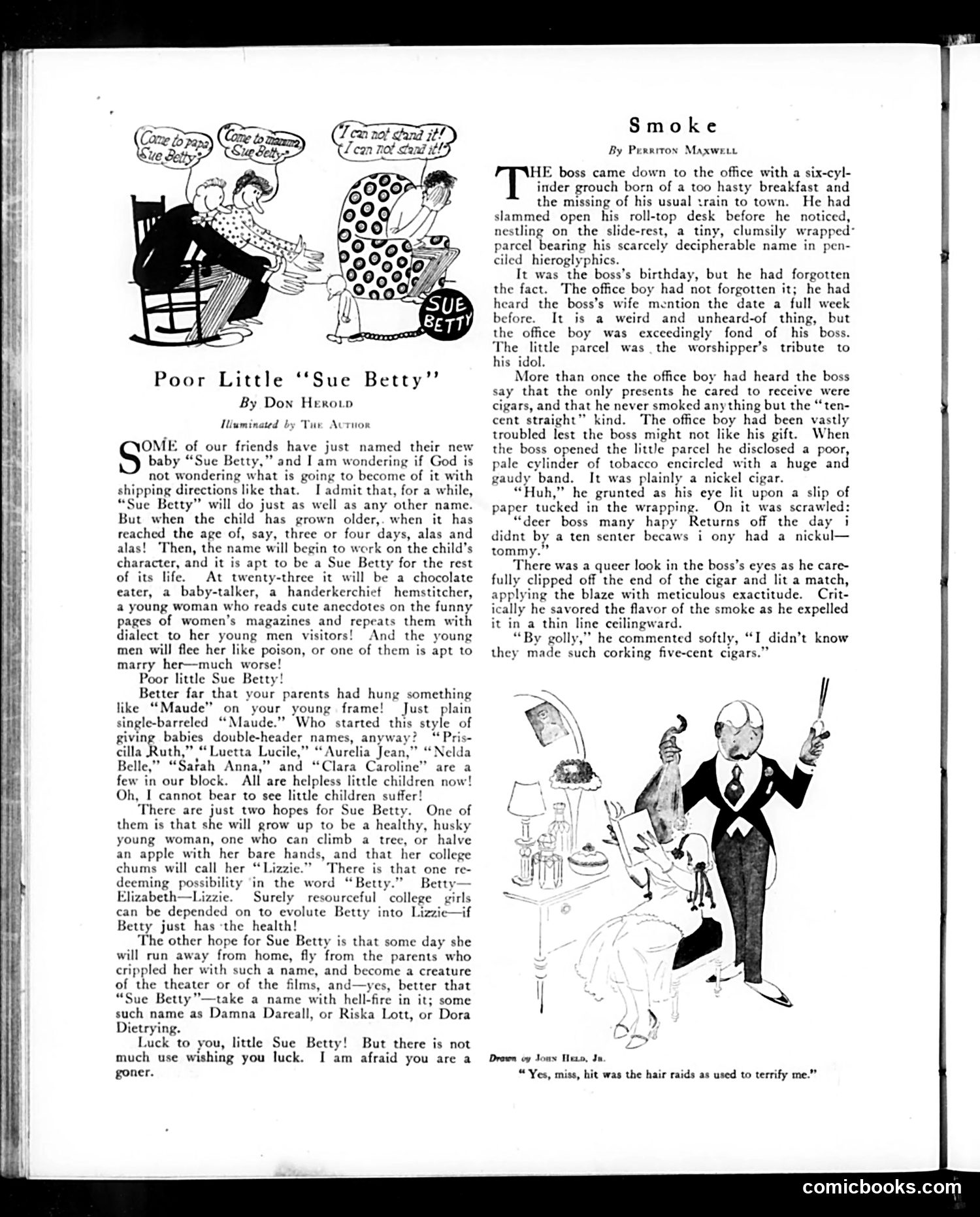
This page contains two satirical pieces from Judge magazine: **"Smoke"** (right): A sentimental story mocking workplace sentimentality. An office boy gives his beloved boss—a grouch who only appreciates cheap cigars—an even cheaper nickel cigar for his birthday, with a misspelled note explaining his financial limitations. The joke targets both the boy's naive devotion and the boss's likely emotional vulnerability to such humble gestures, subverting his tough persona. **"Poor Little Sue Betty"** (left): A humor piece lamenting the trend of hyphenated baby names ("Sue Betty," "Sarah Anna," etc.). The author sarcastically predicts the double-barreled name will make the girl into a vapid woman who reads women's magazines and repeats anecdotes. His "hopes" for her—either becoming a tomboy nicknamed "Lizzie" or running away to become a theatrical performer with a scandal-ready stage name—mock both conformist domesticity and theatrical aspiration. Both pieces are gentle social satire targeting early-20th-century American manners and naming conventions.
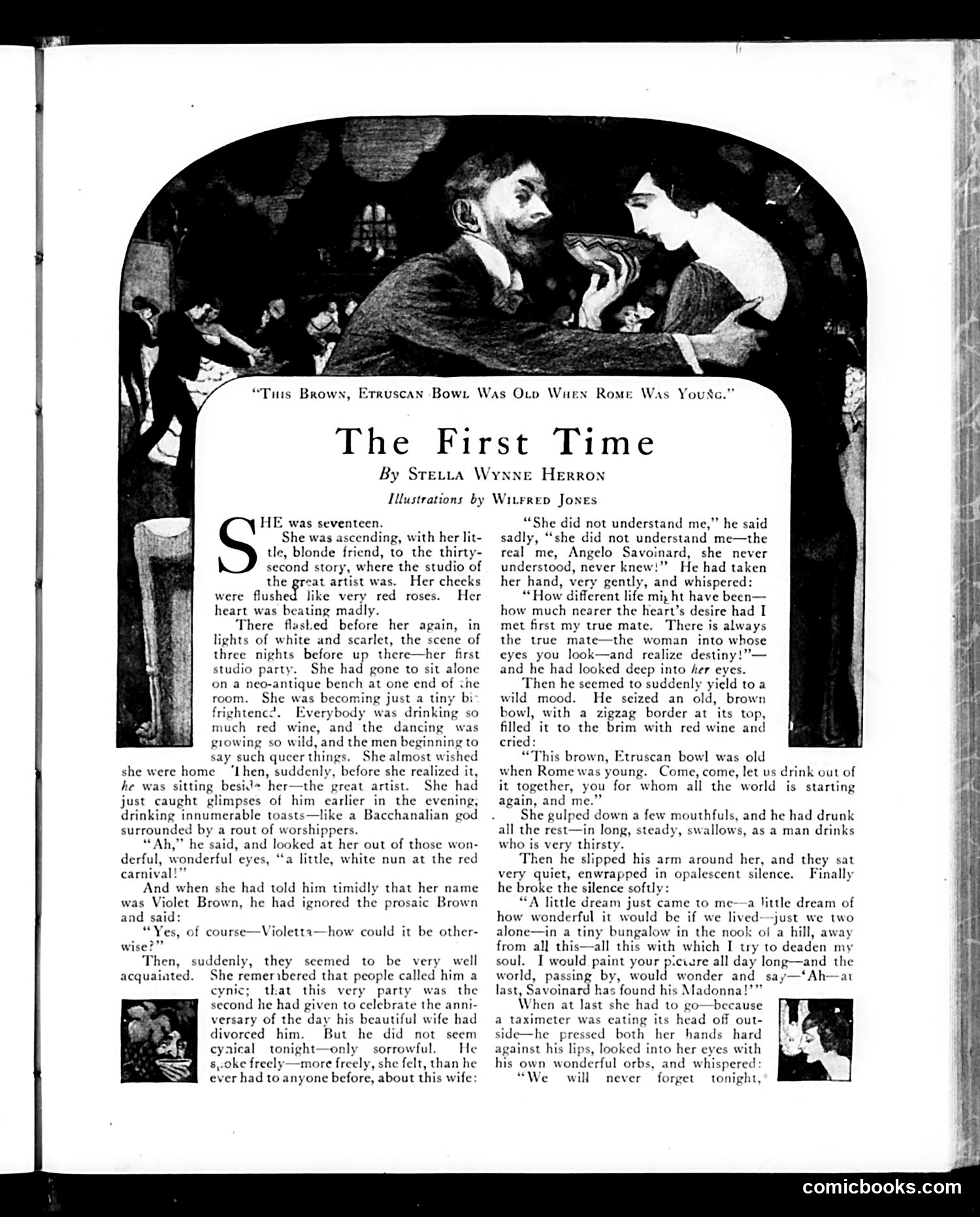
This is a romantic short story, not political satire. It depicts a seventeen-year-old woman named Violet Brown meeting a famous artist, Angelo Savoinard, at a studio party. The narrative portrays a seduction: the artist, recently divorced, targets the naive girl with flattery and romantic declarations, sharing an antique Etruscan bowl of wine and speaking of a dream life together. The illustration shows the two figures in intimate conversation. The story appears to romanticize what would now be recognized as predatory behavior—an older established artist leveraging his status and emotional manipulation on a young, innocent woman. The "Etruscan bowl" serves as a literary device symbolizing artistic sophistication meant to impress her. This reflects early-20th-century attitudes toward age-gap relationships and artistic bohemian culture, presented here as romantic rather than exploitative.
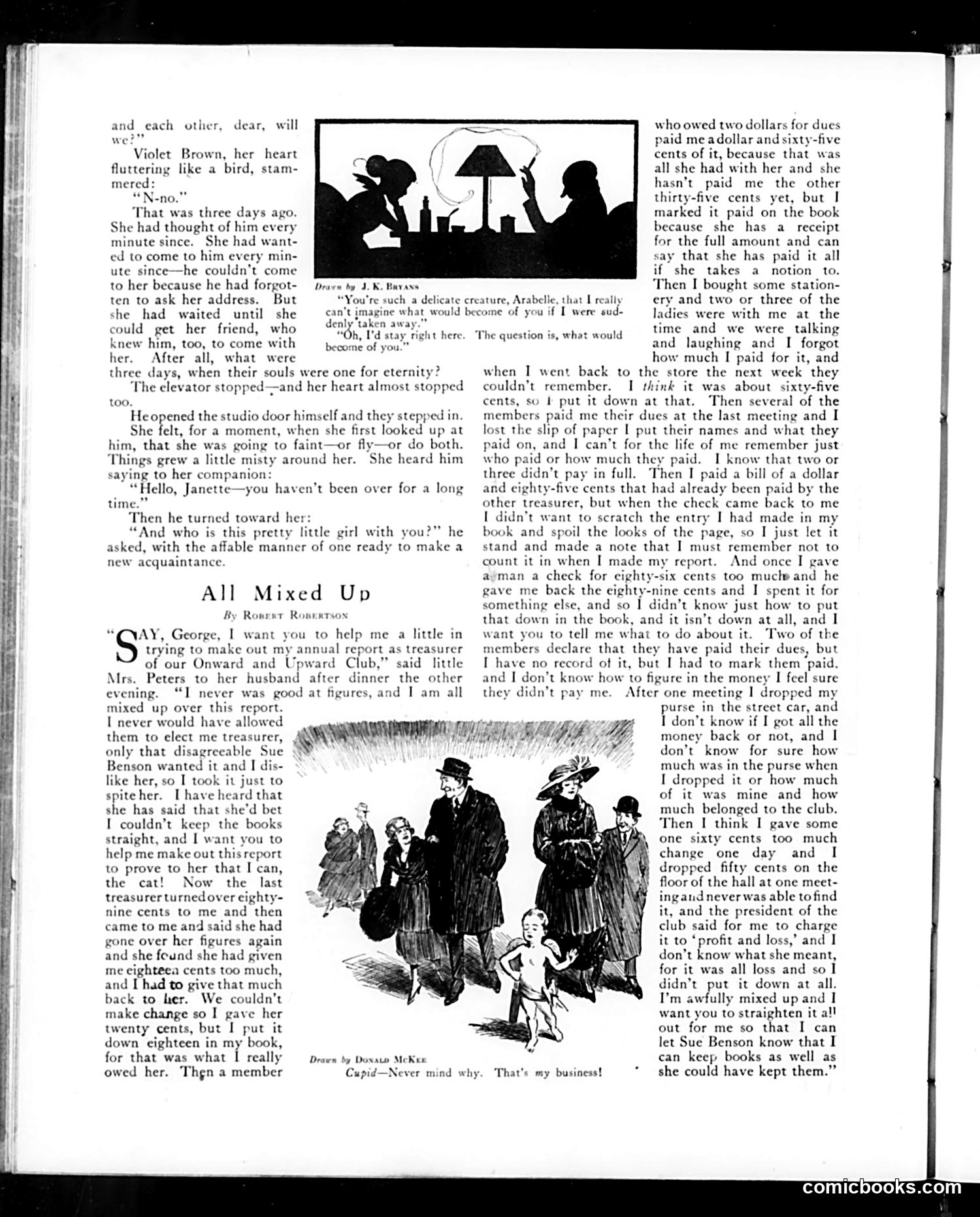
This satirical story mocks the incompetence and casual dishonesty of women serving as club treasurers in the early 20th century. Mrs. Peters, treasurer of the "Onward and Upward Club," confesses to her husband a series of accounting disasters: she's recorded wrong amounts, lost receipts, double-paid bills, and generally fabricated her books rather than admit errors or recalculate figures. The satire targets two things: first, the assumption that women lacked mathematical ability and business acumen; second, the petty vanity that motivated her acceptance of the treasurer role—she took the job primarily to spite a rival (Sue Benson) rather than serve the organization. The cartoon illustrations (by Donald McKee and J.K. Barrows) show domestic scenes. The piece is fundamentally about how social clubs operated among middle-class women and the casual attitudes toward financial responsibility that sometimes prevailed.
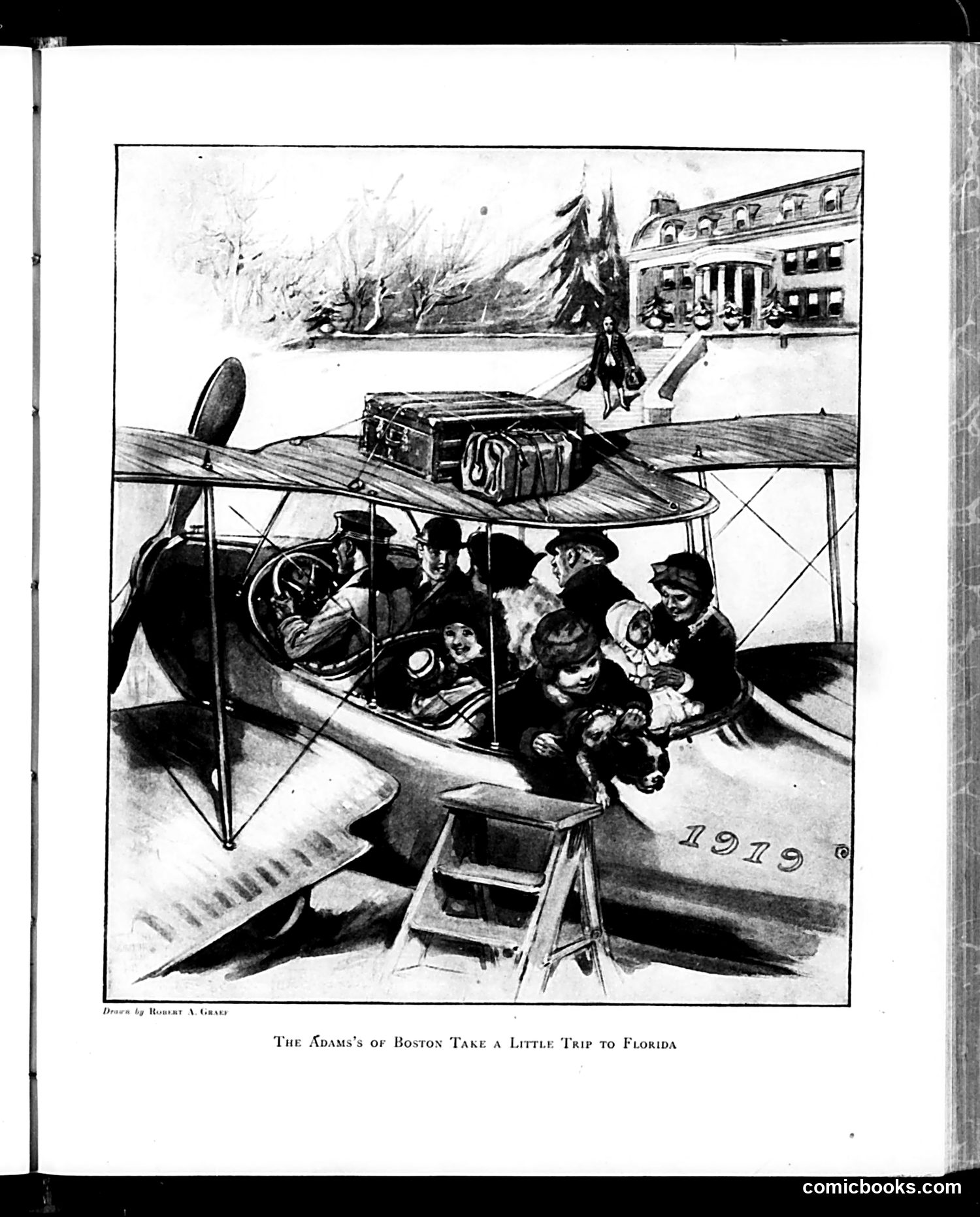
This illustration by Robert A. Graef depicts a wealthy Boston family boarding a seaplane for a vacation to Florida. The cartoon satirizes the leisure activities of the upper class during the 1920s (indicated by the "1929" marking). The scene contrasts the family's formal attire and luggage with the aircraft's modest accommodations, humorously capturing how even the wealthy must squeeze into cramped early aviation travel. The grand resort building visible in the background establishes the destination's luxury appeal. The satire likely mocks either the pretensions of Boston's elite, the discomforts of early commercial aviation, or both—highlighting the gap between wealthy expectations and travel realities during the aviation age's infancy.
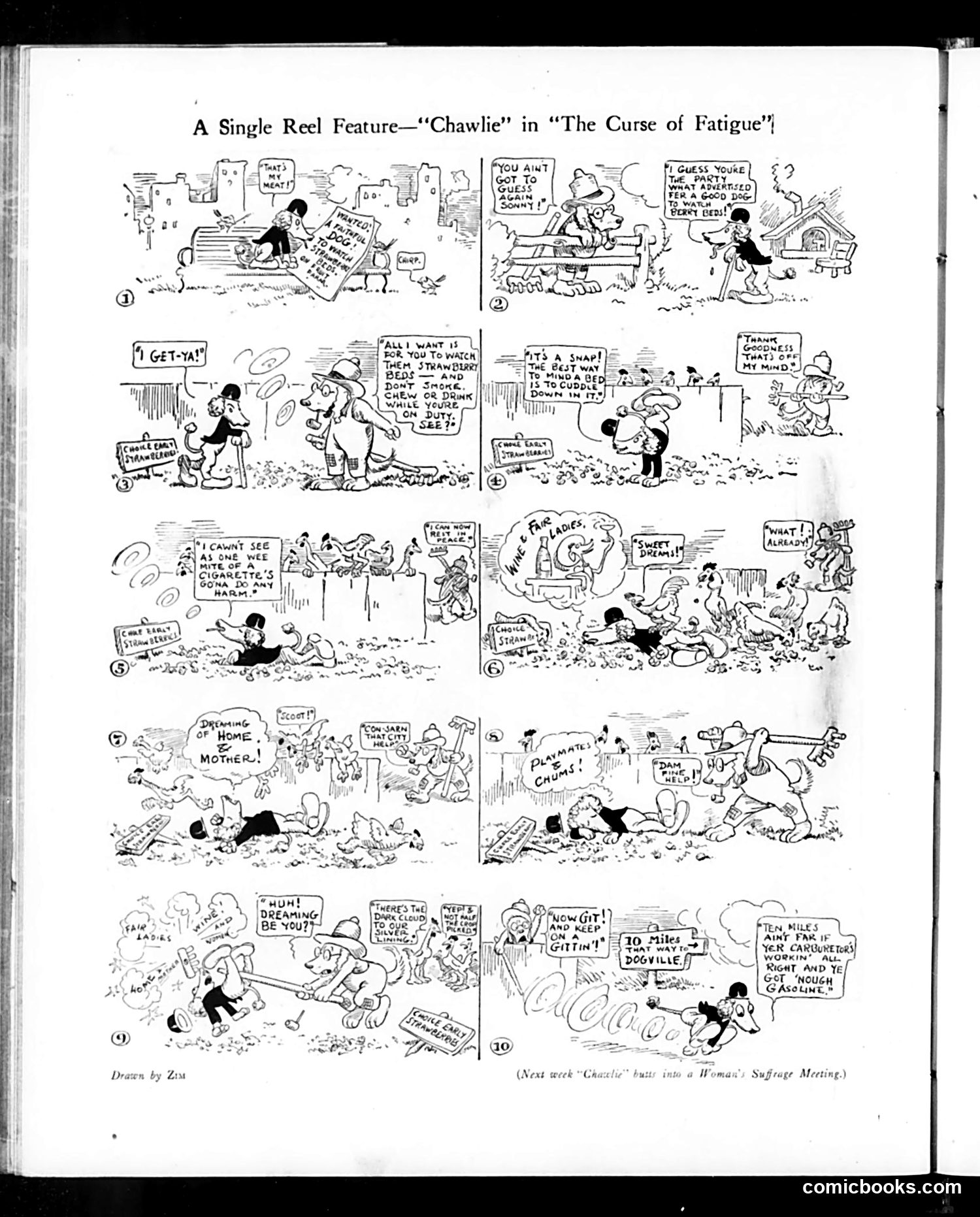
This is a 10-panel slapstick comic strip drawn by Zim featuring a character named "Chawlie" (likely depicted with an exaggerated accent or ethnic dialect based on the spelling). The narrative follows Chawlie's exhausting day: he's hired as a watchdog but criticized for poor performance, attempts various schemes to stay awake (strawberry beds, smoking, cuddling), grows increasingly fatigued, and eventually passes out while being chased or confronted by his employer. The "joke" relies on physical comedy—the progressive deterioration of an incompetent worker facing fatigue—typical of early 20th-century Judge magazine humor. The final caption promises next week's installment involves Chawlie disrupting a women's suffrage meeting, suggesting the strip uses the character for broader social satire. The humor is crude by modern standards, relying on slapstick and the character's apparent incompetence rather than wit.
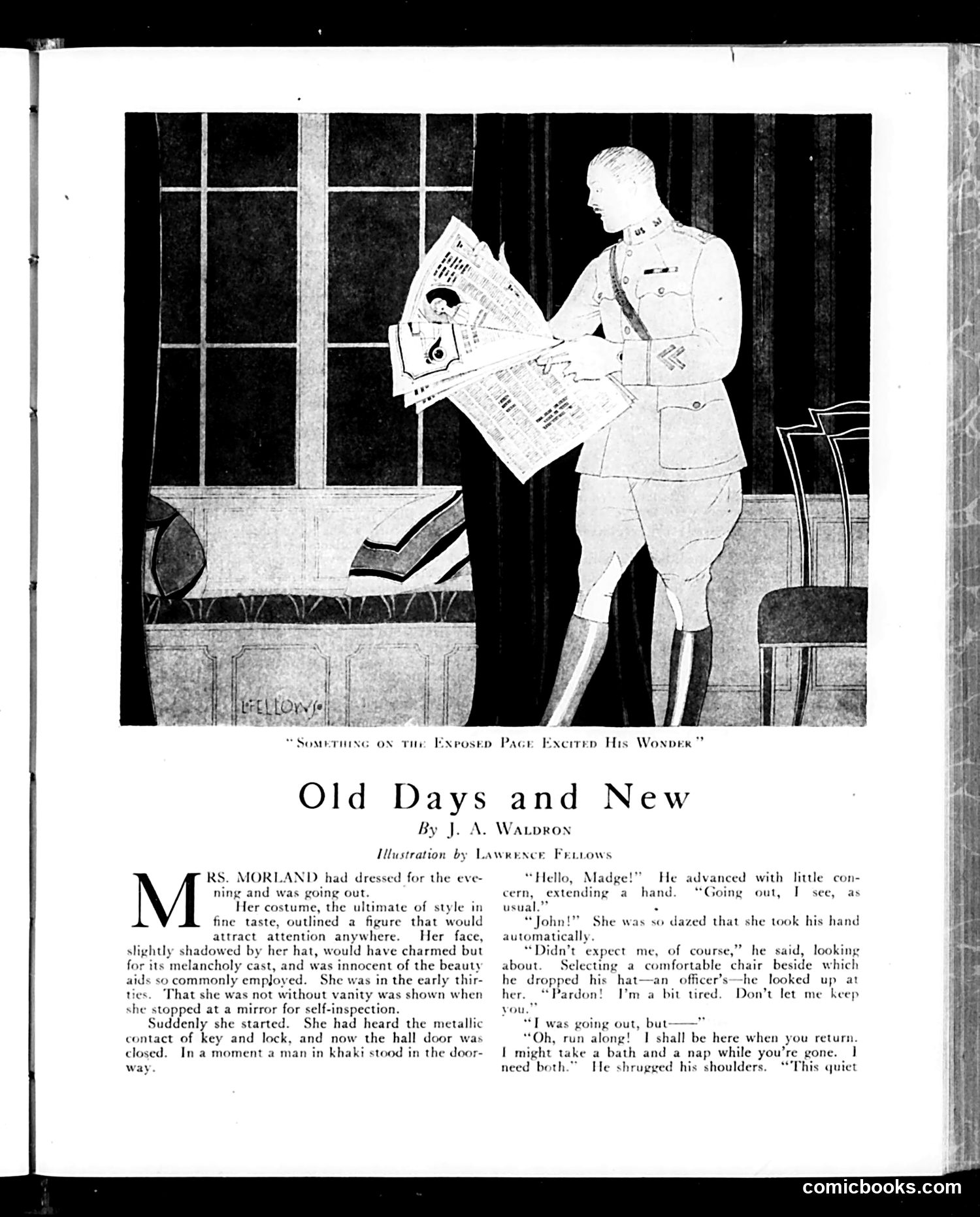
This story illustration depicts a soldier in khaki uniform (identified as "John") unexpectedly returning home to his wife, Mrs. Morland. The satire's title contrasts "old days" (pre-war domesticity) with "new" (wartime disruption). The joke hinges on gender role reversal and social expectations: Mrs. Morland has dressed elegantly for an evening out—suggesting independence and modern female autonomy. John's casual, exhausted arrival interrupts her plans. His indifference ("run along") and self-focused needs (bath, nap) subvert the traditional expectation that wives exist to serve returning soldiers. The cartoon likely satirizes post-WWI social tension: soldiers returning to find women who'd gained independence during wartime. The "exposed face" caption suggests surprise at who women had become in men's absence—more autonomous, less decorative.
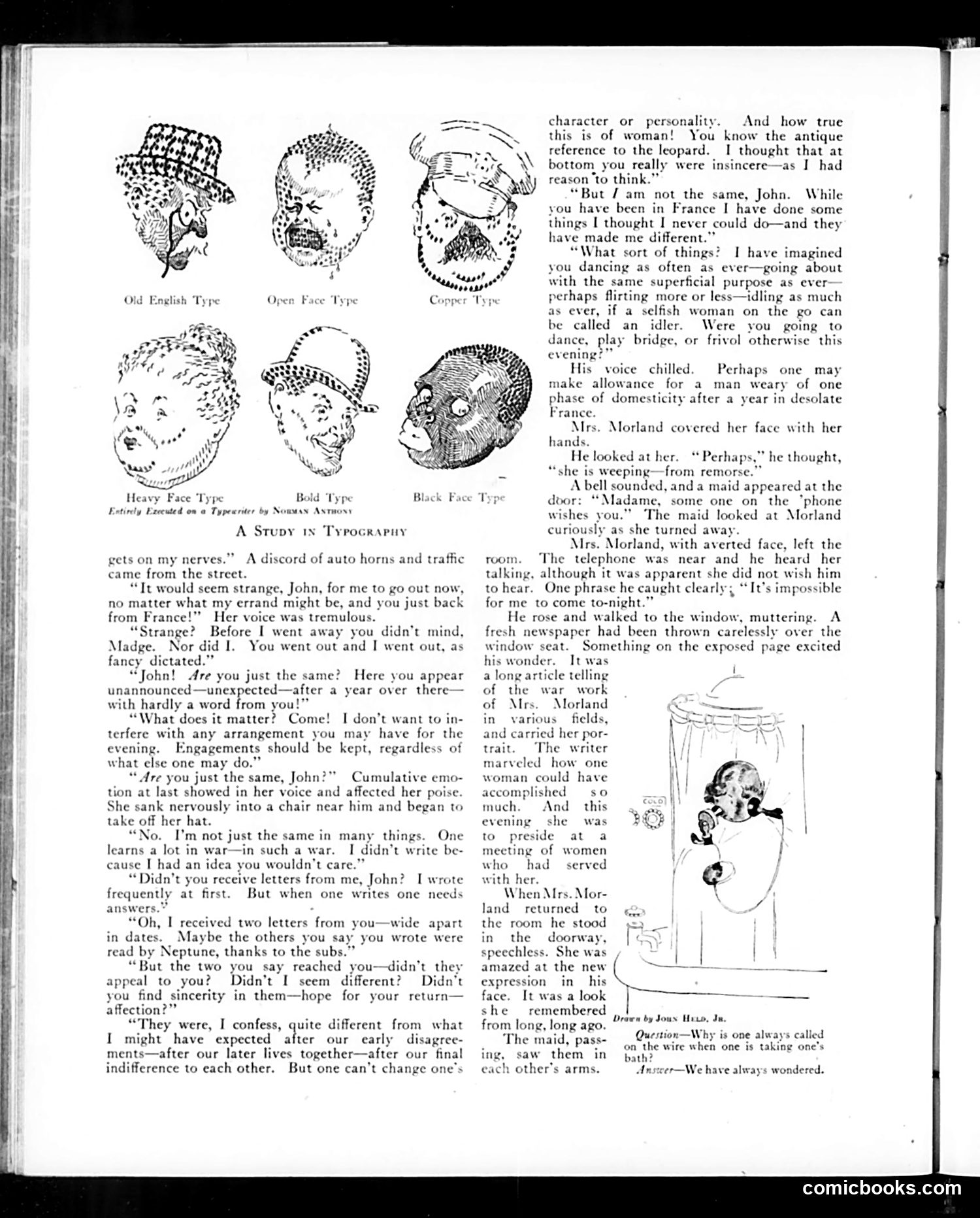
This page presents a domestic drama exploring how World War I changed both soldiers and the home front. John has just returned from France expecting his wife Madge to be unchanged—still superficial and idle. He's bitter about her wartime letters and dismissive of her claims to have "done things I never could do." The twist: John discovers a newspaper article praising Mrs. Morland's extensive war work in various fields. His harsh judgment—that she remained a frivolous socialite dancing and flirting—was entirely wrong. The article reveals she accomplished substantial wartime service. His final expression shows recognition and contrition. The satire critiques male assumptions about women's capabilities and their invisibility during wartime contributions. The title refers to the decorative face-type illustrations at top, which frame this meditation on how people's "true character" may be unknowable or misconceived.
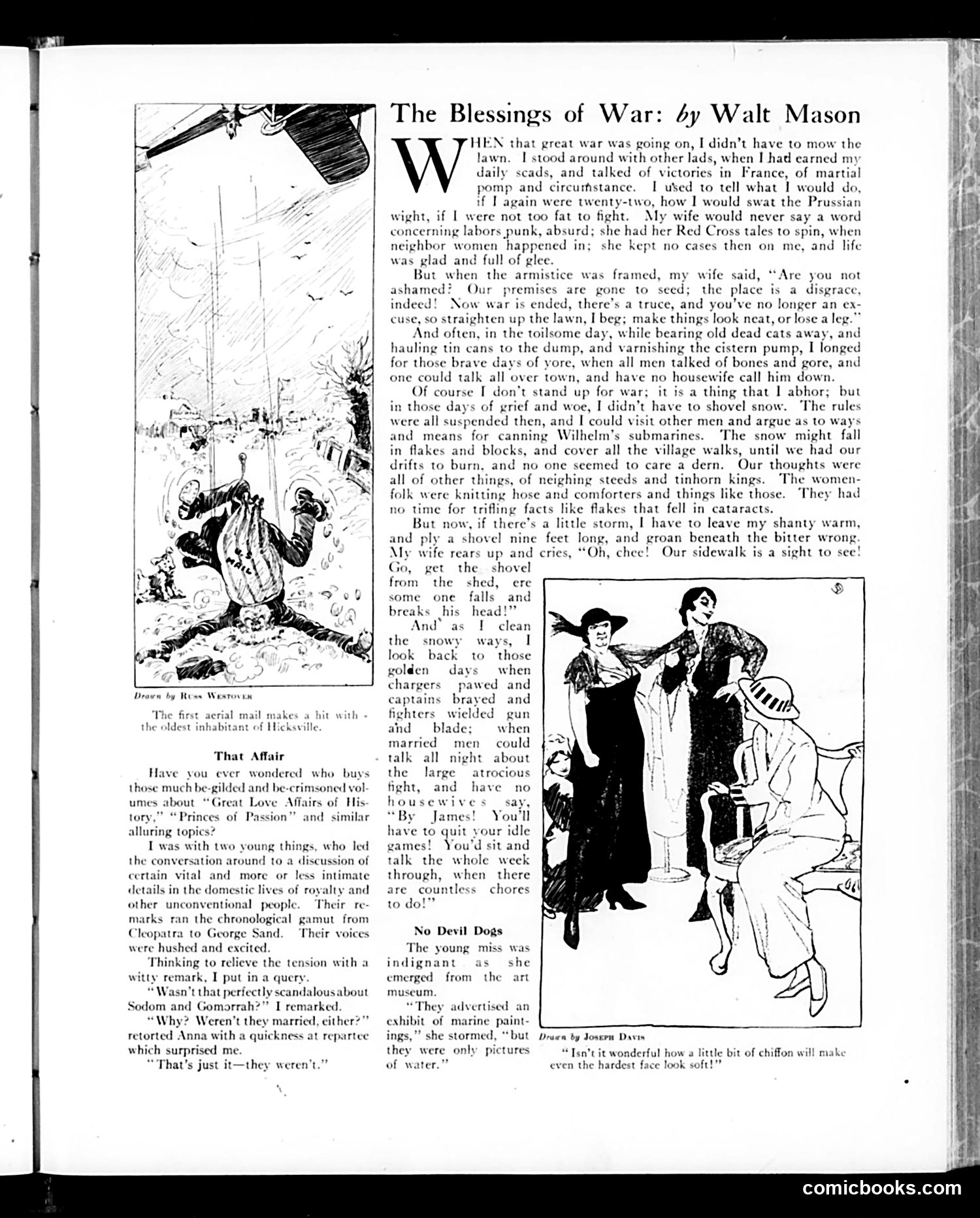
This satirical poem uses post-WWI domestic life to critique wartime nostalgia. The speaker, a married man, confesses he *misses* World War I—not for patriotic reasons, but because wartime suspended ordinary household duties. While the war raged, he could idle with other men discussing military affairs; his wife was occupied with Red Cross work and didn't nag him about lawn care or chores. Now that peace has returned, his wife demands he maintain their neglected property—shovel snow, haul garbage, varnish the cistern. The satire targets men who romanticize war's "glory" while actually just wanting escape from domestic responsibilities and nagging spouses. Mason uses gentle humor to expose how some men weaponized patriotic sentiment to avoid housework—a reversal of typical war glorification. The cartoon above (unrelated) depicts WWI's first aerial mail delivery.
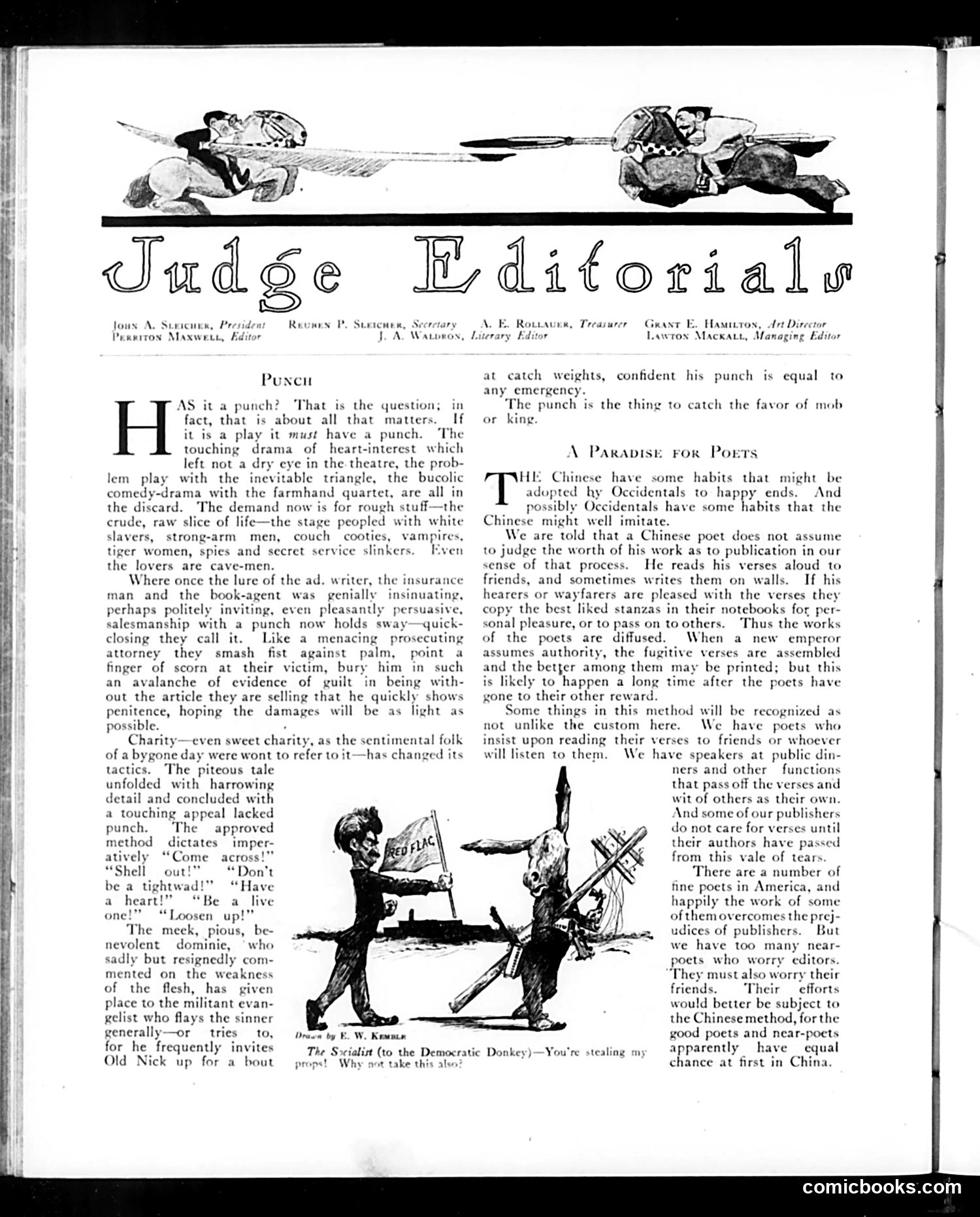
This page contains two distinct editorials with accompanying cartoons: **"Punch"** discusses modern theatrical and sales trends. The editorial laments that contemporary audiences demand aggressive, sensational entertainment—"rough stuff" featuring crime, violence, and seduction—over sentimental drama. It extends this observation to advertising and fundraising, where aggressive "hard sell" tactics ("Come across!" "Shell out!") have replaced gentle persuasion. The shift reflects early 20th-century American culture's embrace of bluntness and force. **"A Paradise for Poets"** compares Chinese poetry traditions favorably to American practices. Chinese poets don't seek publication but read verses aloud; listeners copy favorites and spread them organically. The editorial critiques American publishers for rejecting poetry until authors achieve fame or die, and mocks "near-poets" who inflict their work on captive audiences at dinners. The cartoon (by E.W. Kemble) shows a Socialist confronting a Democratic donkey, referencing contemporary political tensions, though the specific reference is unclear without additional context.
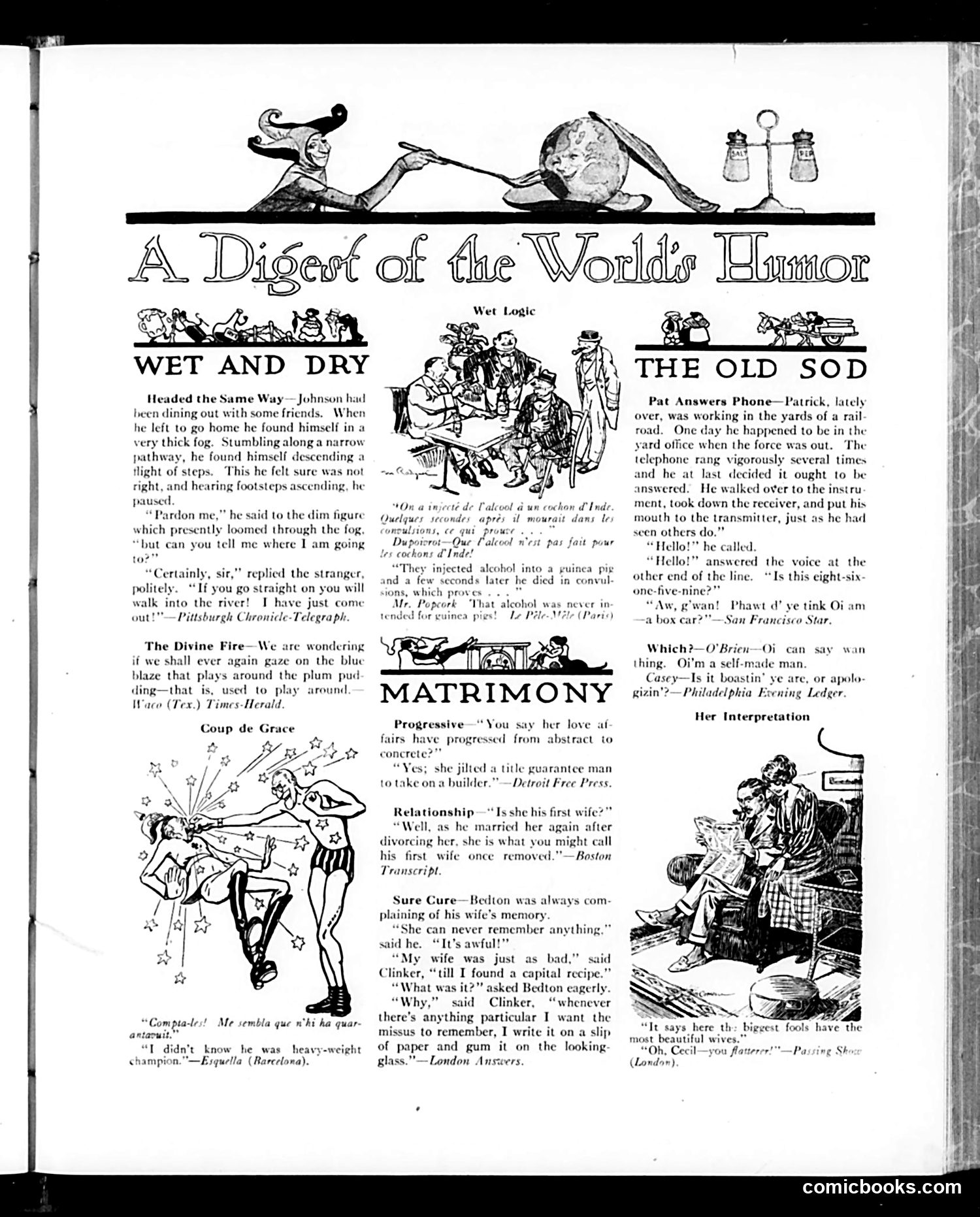
This is a humor compilation page featuring short jokes organized by theme. Key sections include: **"Wet and Dry"**: A fog-based pun where a drunk man asks directions and is warned he'll walk into a river if he continues straight—the joke being he came FROM the river, so he's "headed the same way" regardless. **"Matrimony" section**: Multiple quips about marriage and wives, including jokes about women's infidelity ("progressed from abstract to concrete"), remarriage logistics, and wives' forgetfulness. These reflect early 20th-century stereotypes about women's memory and marital discord. **"The Old Sod"**: An Irish immigrant joke where Patrick, unfamiliar with telephones, doesn't understand how to use one properly—playing on period stereotypes about Irish workers' unfamiliarity with modern technology. The cartoons are small, illustrative vignettes accompanying the jokes. The overall tone is light satirical humor typical of Judge magazine, aimed at middle-class readers. References to alcohol ("wet logic," guineas pigs injected with alcohol) and marriage troubles were standard Judge fare of this era.
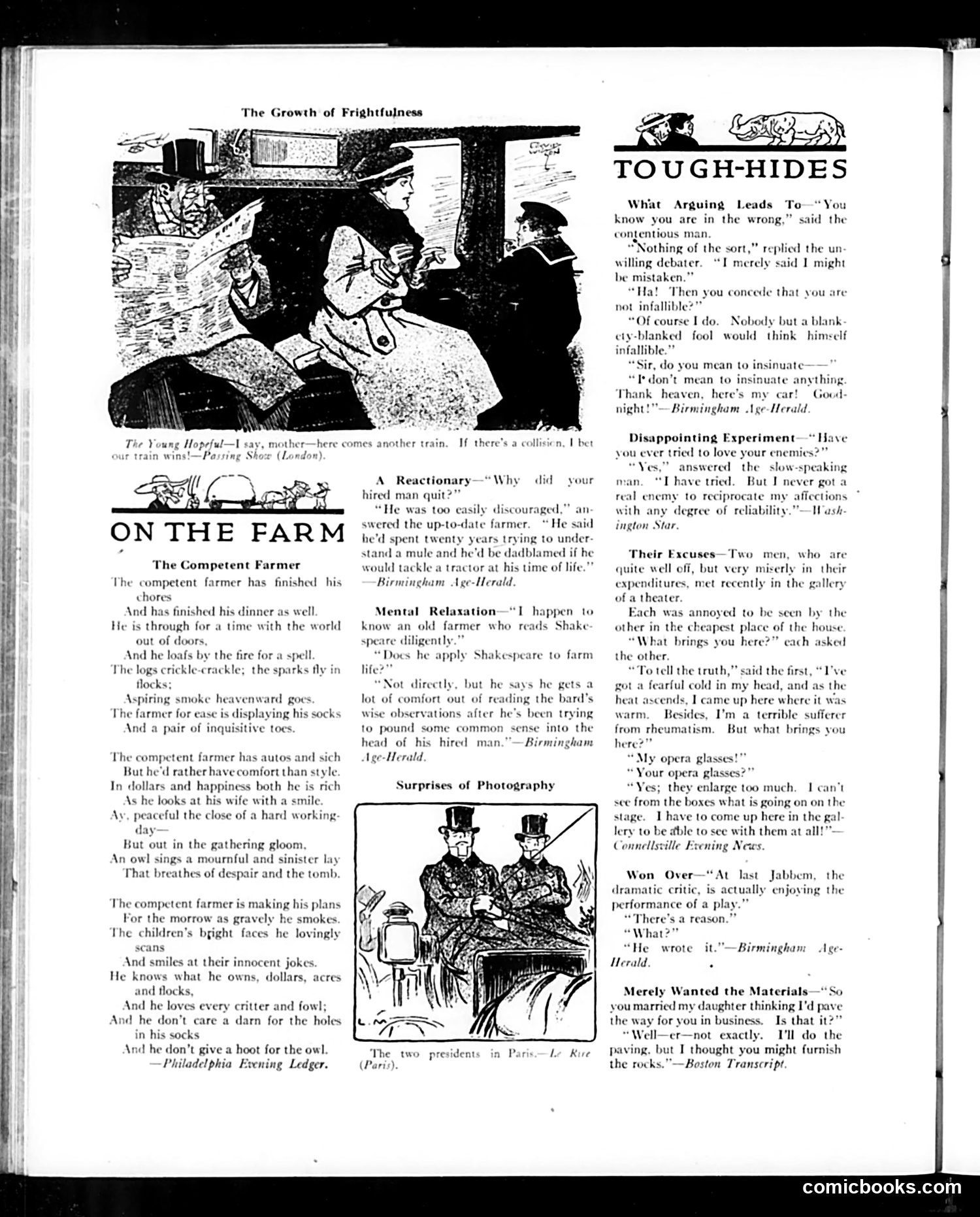
This page from *Judge* magazine contains humorous anecdotes and one cartoon rather than political satire. The content reflects early-20th-century American attitudes: **"The Competent Farmer"** is a sentimental poem celebrating rural contentment—a farmer relaxing by the fire, content with his modest life and family, contrasting with an ominous owl's cry foreshadowing loss. This romanticizes farming life. **The short jokes** ("A Reactionary," "Mental Relaxation," etc.) are genteel humor: a farmer resistant to tractors; a farmer finding solace in Shakespeare; two wealthy men making excuses for sitting in cheap theater seats; a theater critic finally enjoying a play because the author wrote it. **"Surprises of Photography"** shows two men with cameras, likely playing on confusion between photography and something else (unclear from the image alone). The recurring theme is *contradiction between appearance and reality*—people's excuses masking true motivations. The humor is mild, class-conscious (poking at pretension), and assumes a educated readership familiar with classical literature and social conventions. There's no overtly political content visible on this page.
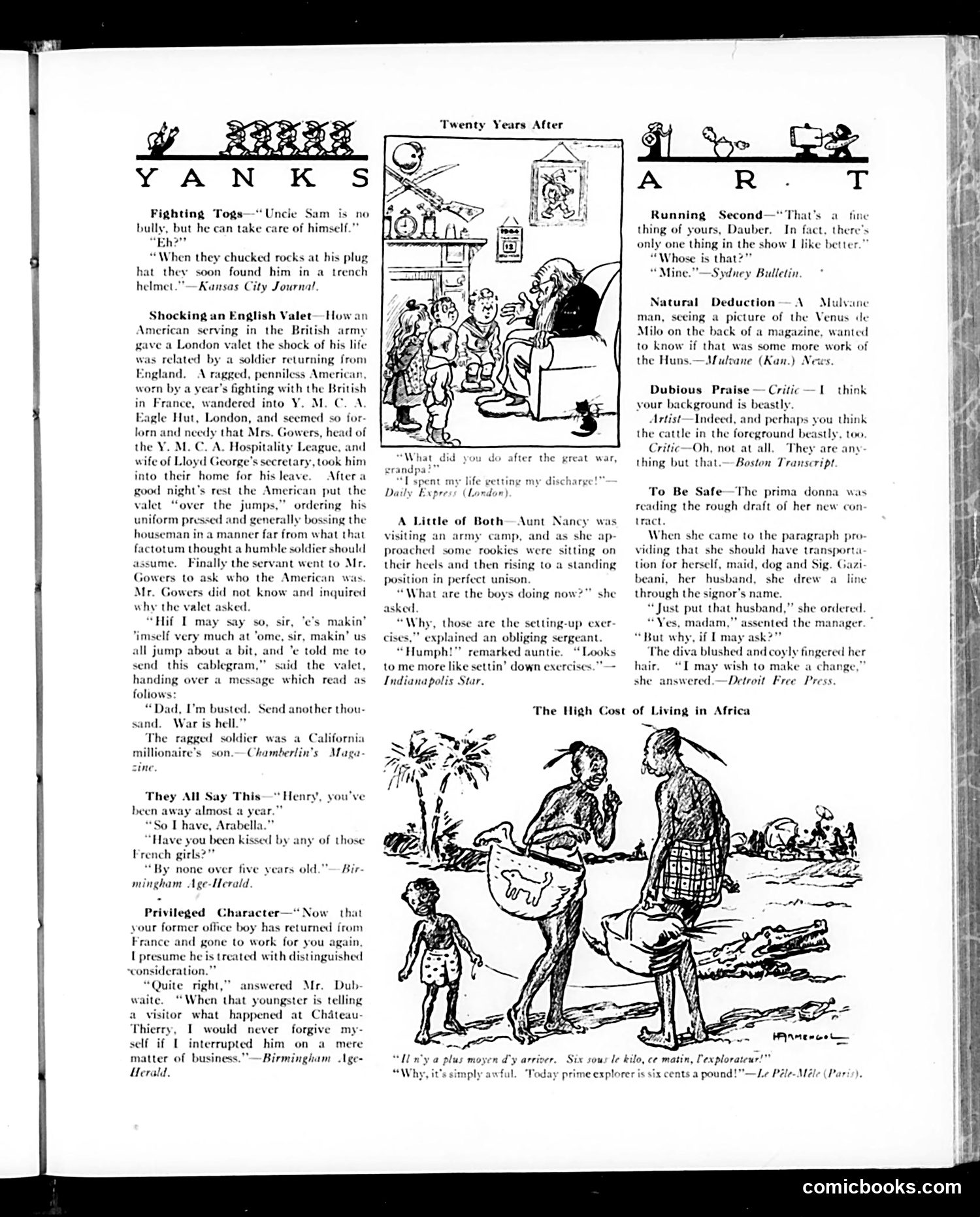
This page from *Judge* (a WWI-era American satirical magazine) contains several brief humorous anecdotes about American soldiers and post-war life: **"Fighting Togs"** mocks American soldiers' resourcefulness under fire—when rocks are thrown, they quickly construct trenches. **"Shocking an English Valet"** satirizes class differences: a wealthy American millionaire's son, serving as a ragged soldier in France, bosses around a British household servant and cables his father for money, embodying American informality that shocks rigid English class hierarchy. **"Privileged Character"** jokes that returning soldiers deserve special deference—an employer won't interrupt his former office boy's war stories, treating combat service as conferring social status. **Other brief items** humorously address: French women, Venus de Milo damage (blaming the "Huns"), and a prima donna's contract negotiations about her husband's travel allowance. **"The High Cost of Living in Africa"** (bottom cartoon) depicts colonial Africans negotiating meat prices, using French text. The humor reflects American attitudes toward the war's end and soldier reintegration.
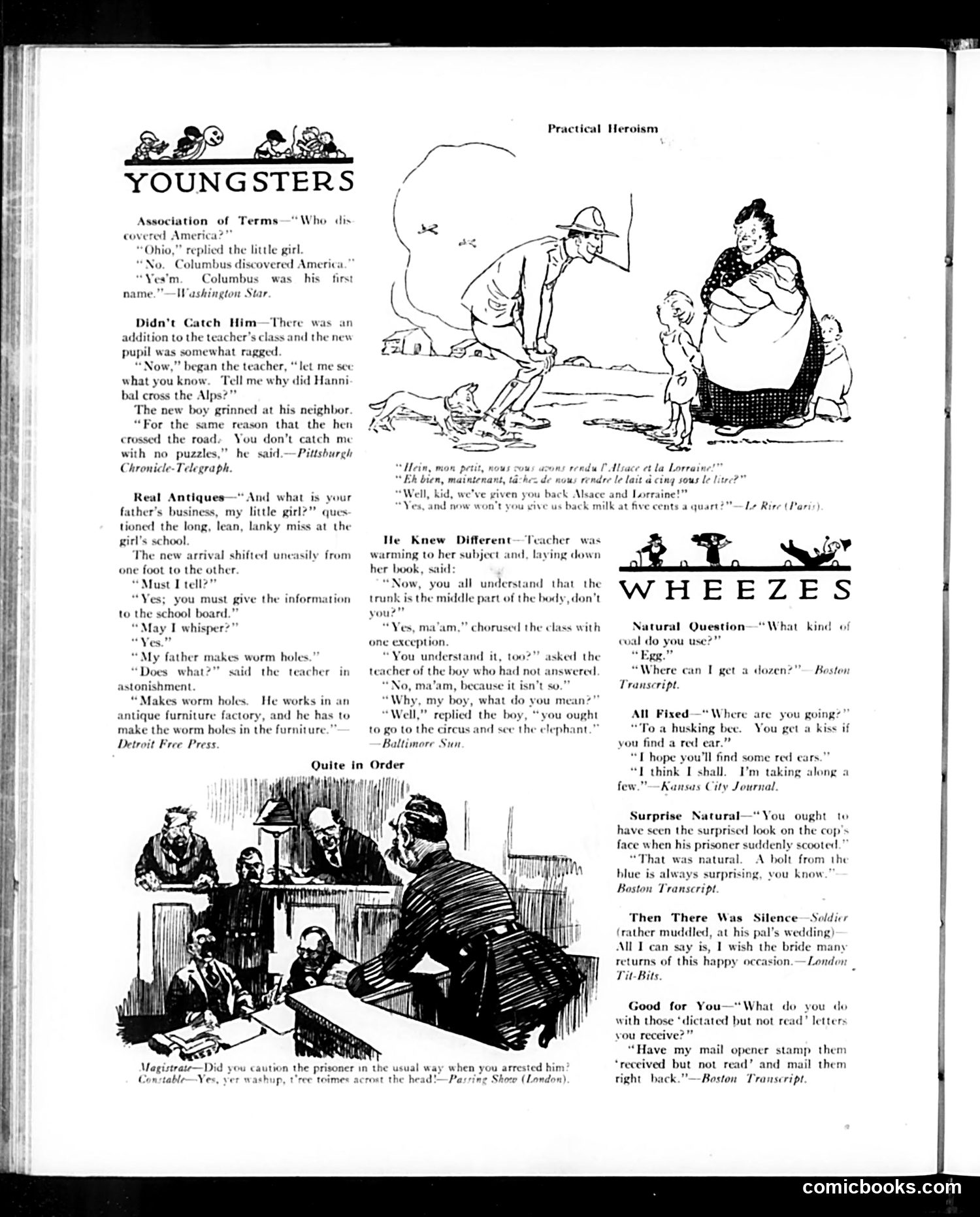
This page collects brief humorous anecdotes targeting children's logic and schoolroom scenarios—typical of early 20th-century humor magazines. The jokes mock childish misunderstandings: a girl claiming "Ohio" discovered America (confusing Columbus's first name), a ragged boy outwitting a teacher's riddle, and a girl whose father makes "worm holes" in antique furniture (genuinely, not metaphorically). "Practical Heroism" appears to reference the Alsace-Lorraine region (Franco-German border disputes), though the cartoon's exact meaning is unclear from the visible image. Other brief "Wheezes" include wordplay about coal, husking bees, and mail handling—gentle domestic humor. The "Quite in Order" cartoon depicts a magistrate's courtroom scene but lacks sufficient context to determine its specific satirical target. Overall, this represents Judge's lighter, family-friendly content rather than sharp political satire—humor based on innocent misunderstandings rather than current events.
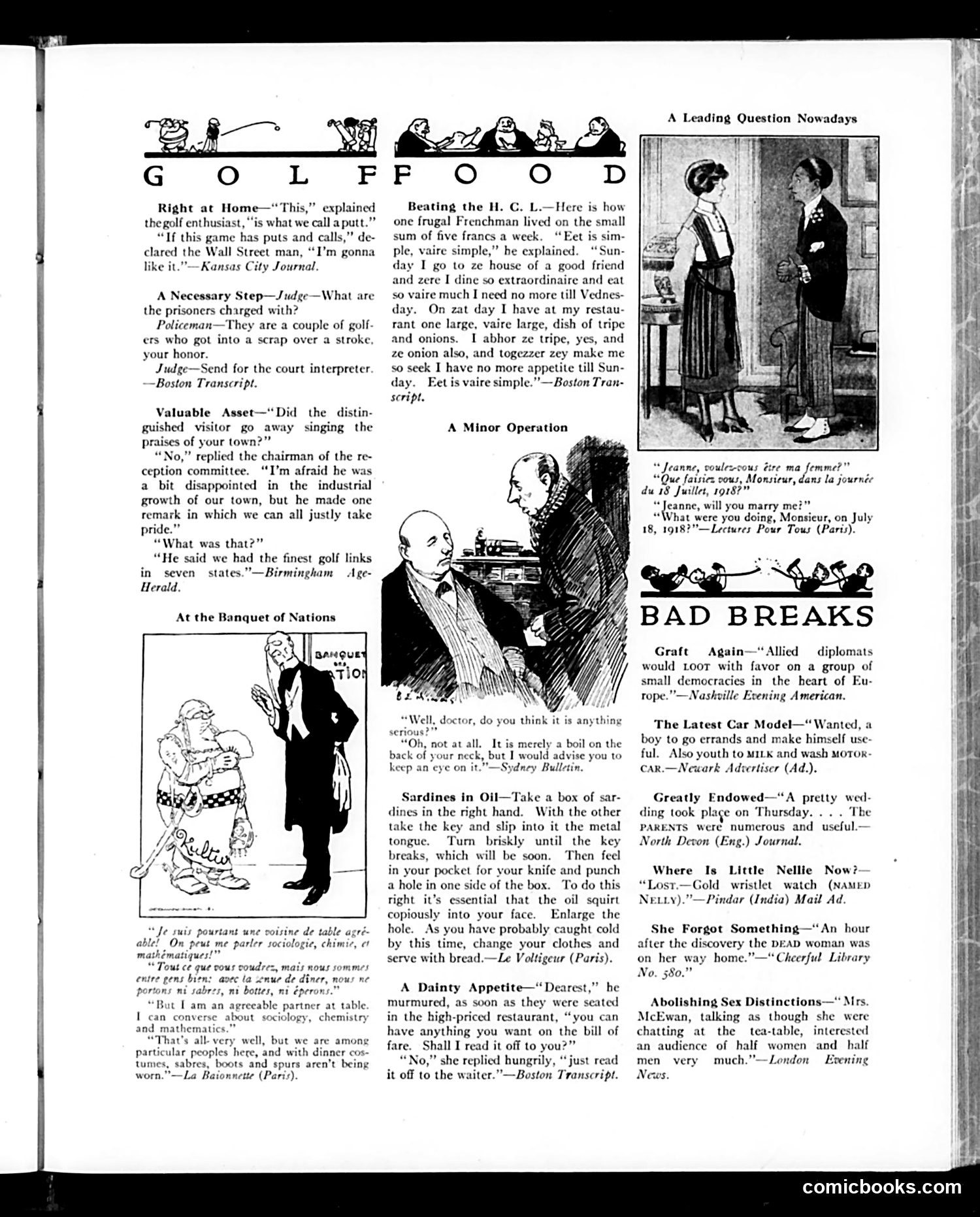
This page collects brief humorous anecdotes and satirical observations from 1918, centered on three themes: **Golf jokes**: Multiple items mock golf's popularity among American businessmen and the intense disputes it generates. The Wall Street banker confusing golf terminology ("puts and calls") with stock market language satirizes how golf has permeated elite culture. **Post-WWI European commentary**: References to French life (sardines, frugal living, diplomatic dinners) reflect American fascination with Allied Europe. "A Leading Question Nowadays" jokes darkly that French women now interrogate suitors about their whereabouts during the July 18, 1918 German offensive—suggesting war has fundamentally altered courtship. **Social observations**: Items mock consumerism ("Dainty Appetite"), wartime inflation ("Beating the H.C.L."—the High Cost of Living), and class pretensions (the Banquet of Nations dialogue in French). The "Bad Breaks" section presents newspaper typos and classified ad mishaps for absurdist humor—a common Judge feature mocking media carelessness.
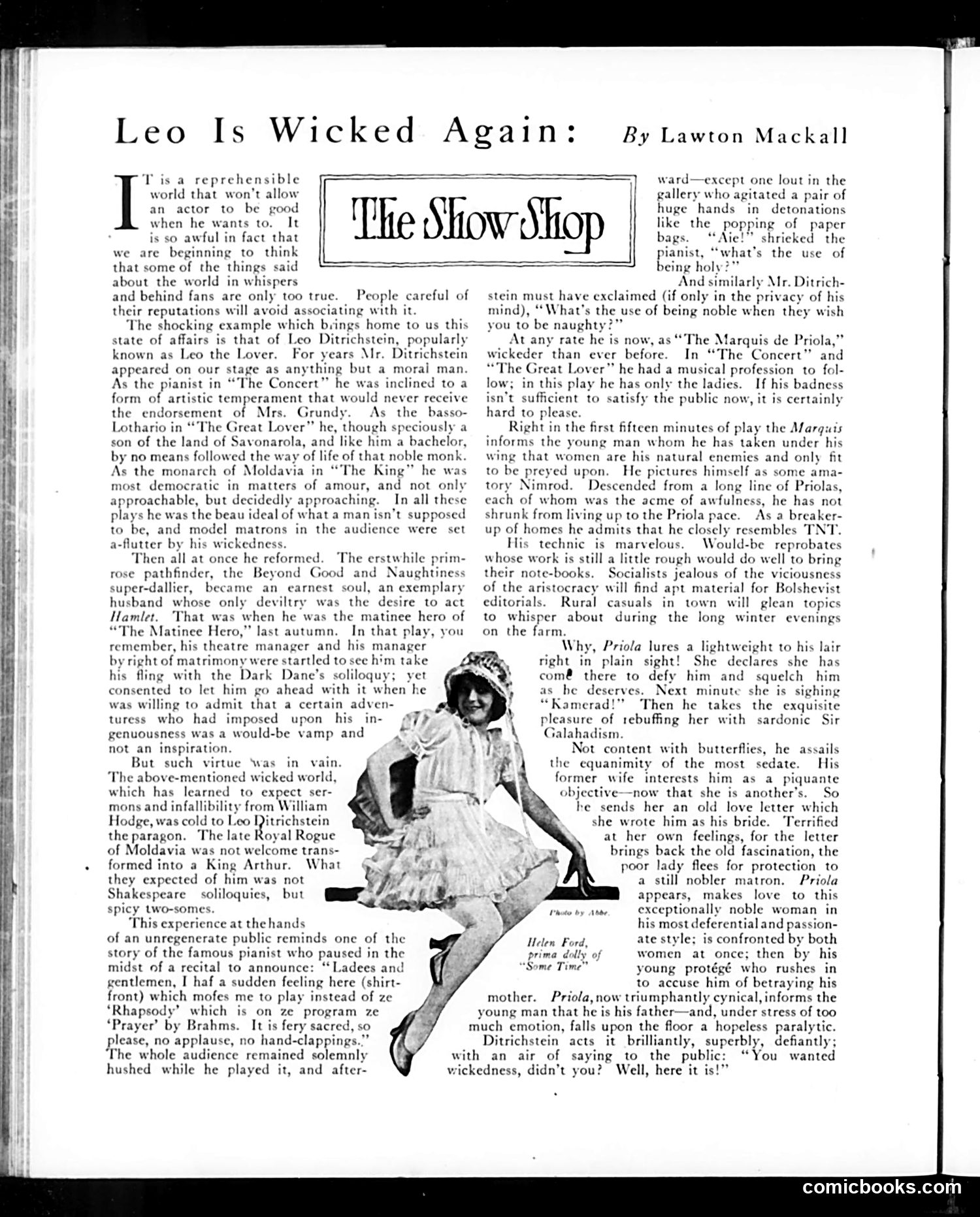
This article by Lawton Mackall satirizes actor **Leo Ditrichstein** (popularized as "Leo the Lover"), who built his reputation playing morally corrupt characters—a seductive pianist, a rake nobleman—that audiences loved. When Ditrichstein attempted reform by playing virtuous roles like Hamlet, the public rejected him. The satire highlights society's hypocrisy: audiences *demanded* he remain "wicked" for entertainment despite claiming to value morality. The accompanying photograph shows an actress (likely **Helen Ford**, captioned as "prima doll of 'Some Time'") in period costume, presumably from one of the theatrical productions discussed. **The joke**: Ditrichstein learned audiences don't actually want moral actors—they want entertaining villains. His return to playing the dissolute "Marquis de Priola" satisfies public appetite for scandal more than genuine virtue ever could.
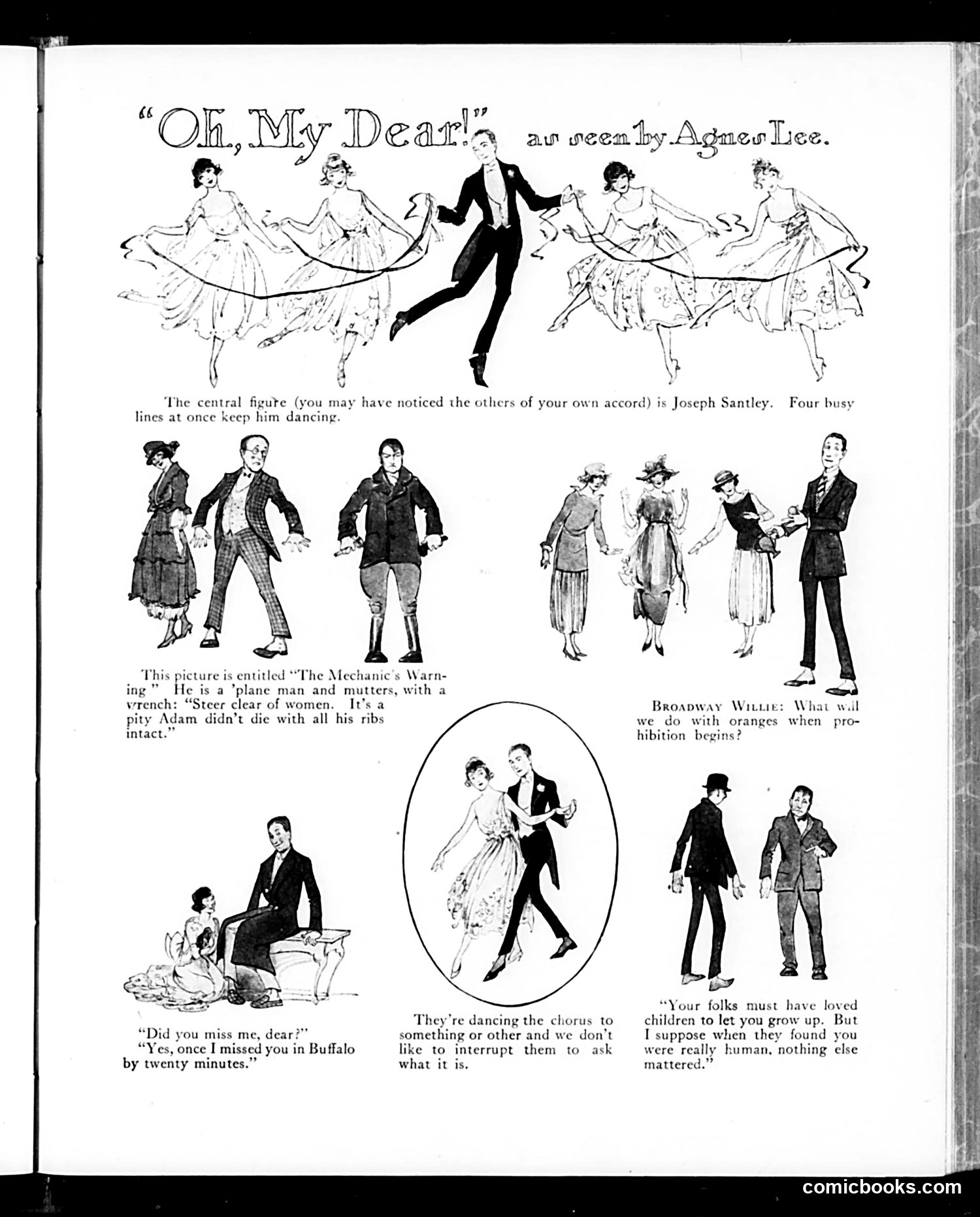
This page satirizes Broadway theater life, centered on performer Joseph Santley dancing with four women. The humor relies on theatrical in-jokes and social commentary typical of Judge's era: **The satire targets:** - **Gender dynamics**: "The Mechanic's Warning" mocks misogyny through exaggeration—a man warns against women while invoking Adam's rib, suggesting women are inherently troublesome. - **Vaudeville excess**: Multiple romantic entanglements and the famous line "Yes, once I missed you in Buffalo by twenty minutes" mock theatrical performers' casual, serial relationships. - **Prohibition-era concerns**: "Broadway Willie" jokes about what to do with oranges when alcohol prohibition begins—oranges were famously used to make illegal alcohol. The scattered dialogue creates a chaotic Broadway scene reflecting the moral anxieties of 1920s America: women's increasing social visibility, theatrical culture's perceived immorality, and Prohibition's impending impact. Judge presents these as absurd through exaggerated drawings and deadpan captions.
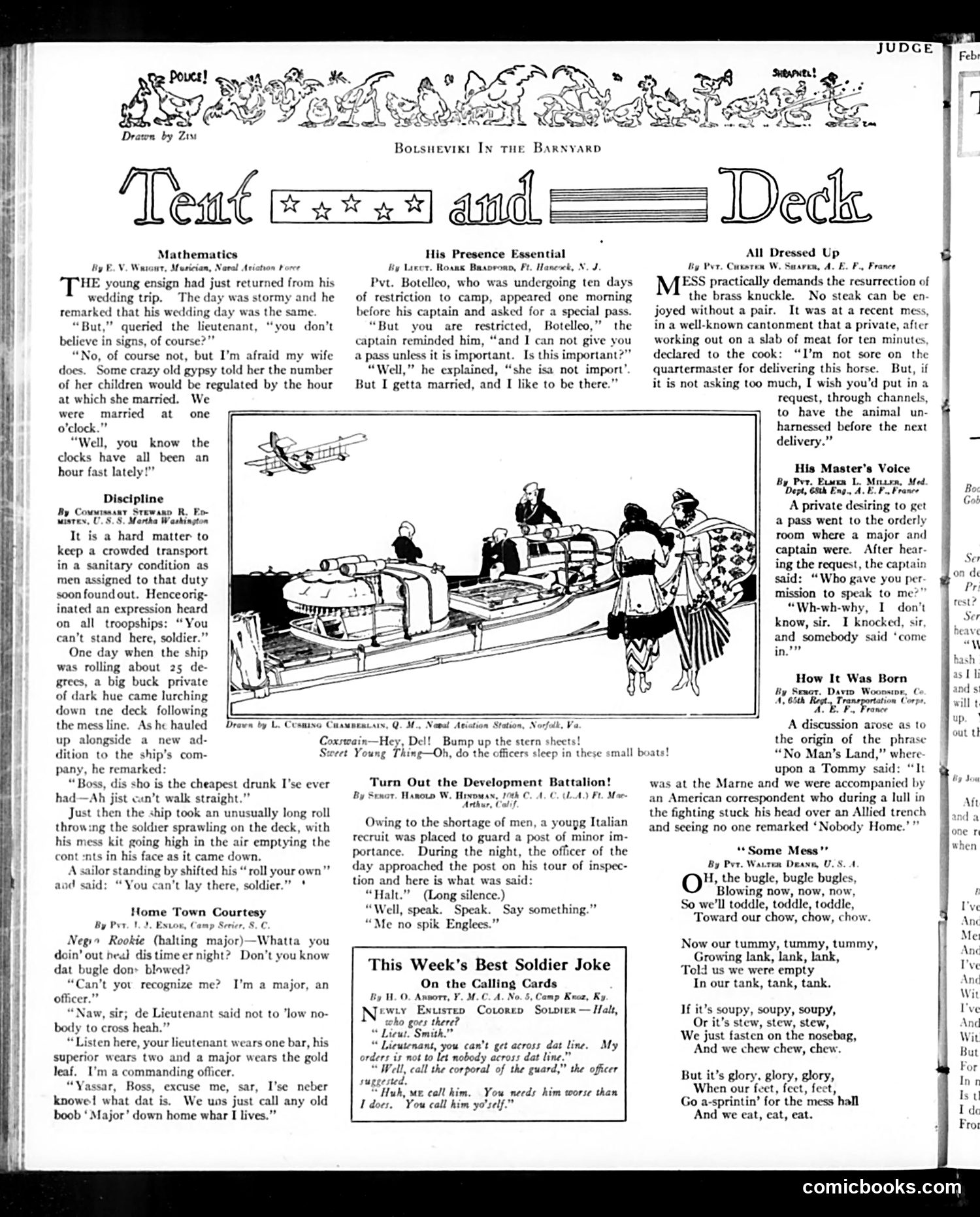
This Judge magazine page contains several military-themed humorous stories from World War I era, told through illustrated anecdotes about soldiers and naval personnel. The main cartoons mock military life and discipline. One depicts a Private Botelleo requesting leave—not for urgent military matters, but to get married, claiming his fiancée is "not important" but he wants to be there. Another shows a soldier covered in mess food after a ship's roll, with a sailor's deadpan response about not standing on deck. A recurring theme is racial stereotyping: a "Negro Rookie" guard speaks in exaggerated dialect, unable to distinguish ranks, while an earlier anecdote features a Black sailor using dialect humor. These reflect period attitudes and would be considered offensive today. The jokes target military bureaucracy, poor food quality, and hierarchy confusion. The satire assumes readers familiar with wartime naval operations and army camp life would find these situations relatable and absurd.
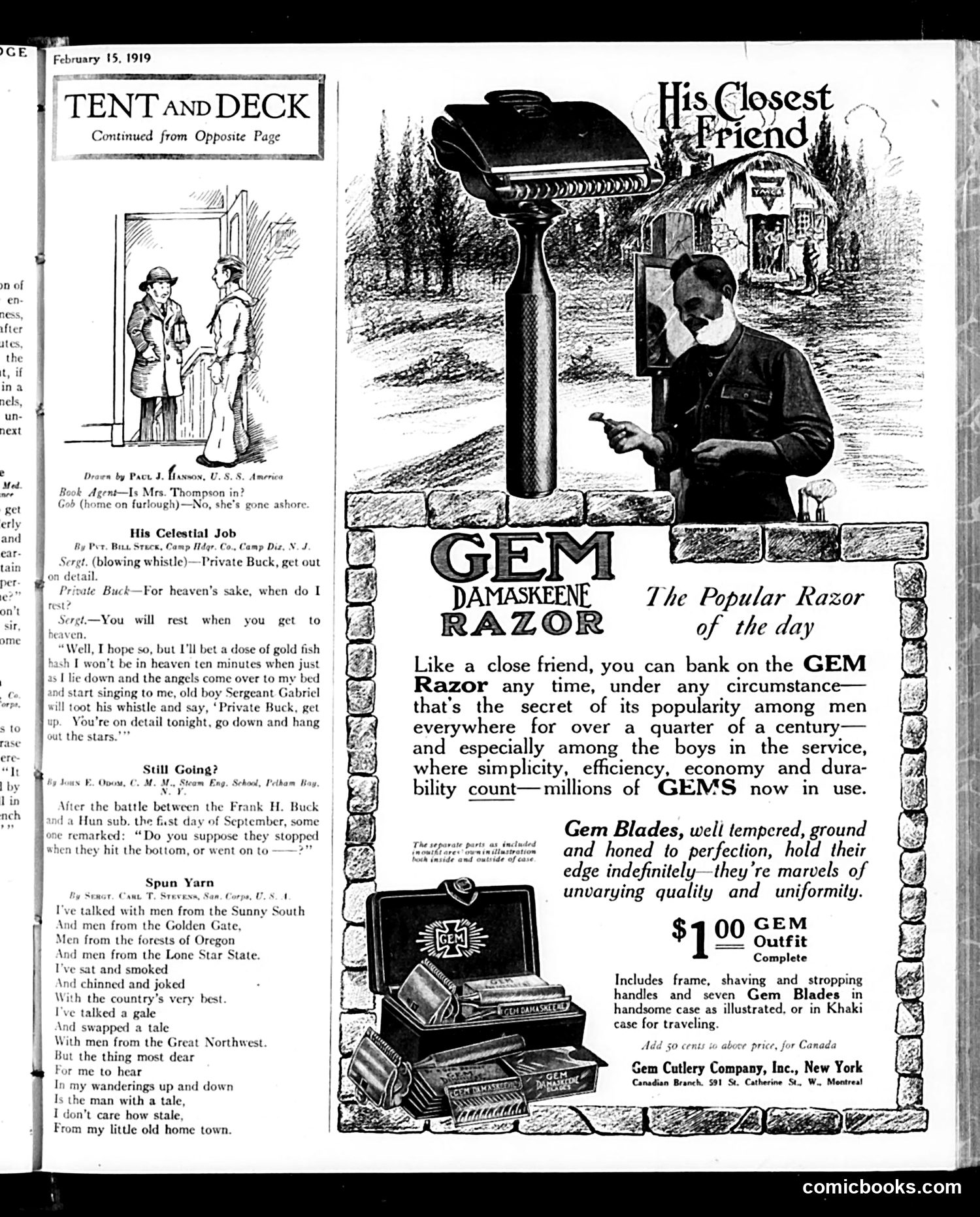
This page contains WWI-era military humor and a razor advertisement. The cartoons mock army life through exchanges between sergeants and privates—depicting the tedium and harsh discipline of camp routine. One joke plays on a soldier's exhaustion; another references a soldier on shore leave whose wife is absent. The "Spun Yarn" poem celebrates American regionalism and homesickness, a common theme in 1919 when soldiers were being demobilized after the war's November 1918 armistice. The prominent **Gem Damascene Razor advertisement** explicitly targets servicemen, emphasizing the razor's reliability "especially among the boys in the service." The image shows a man shaving outdoors—likely depicting the practical appeal to soldiers. At $1.00 complete, it's positioned as an affordable, essential item for military life. This reflects how WWI accelerated commercial marketing directly to soldiers as a distinct consumer demographic.
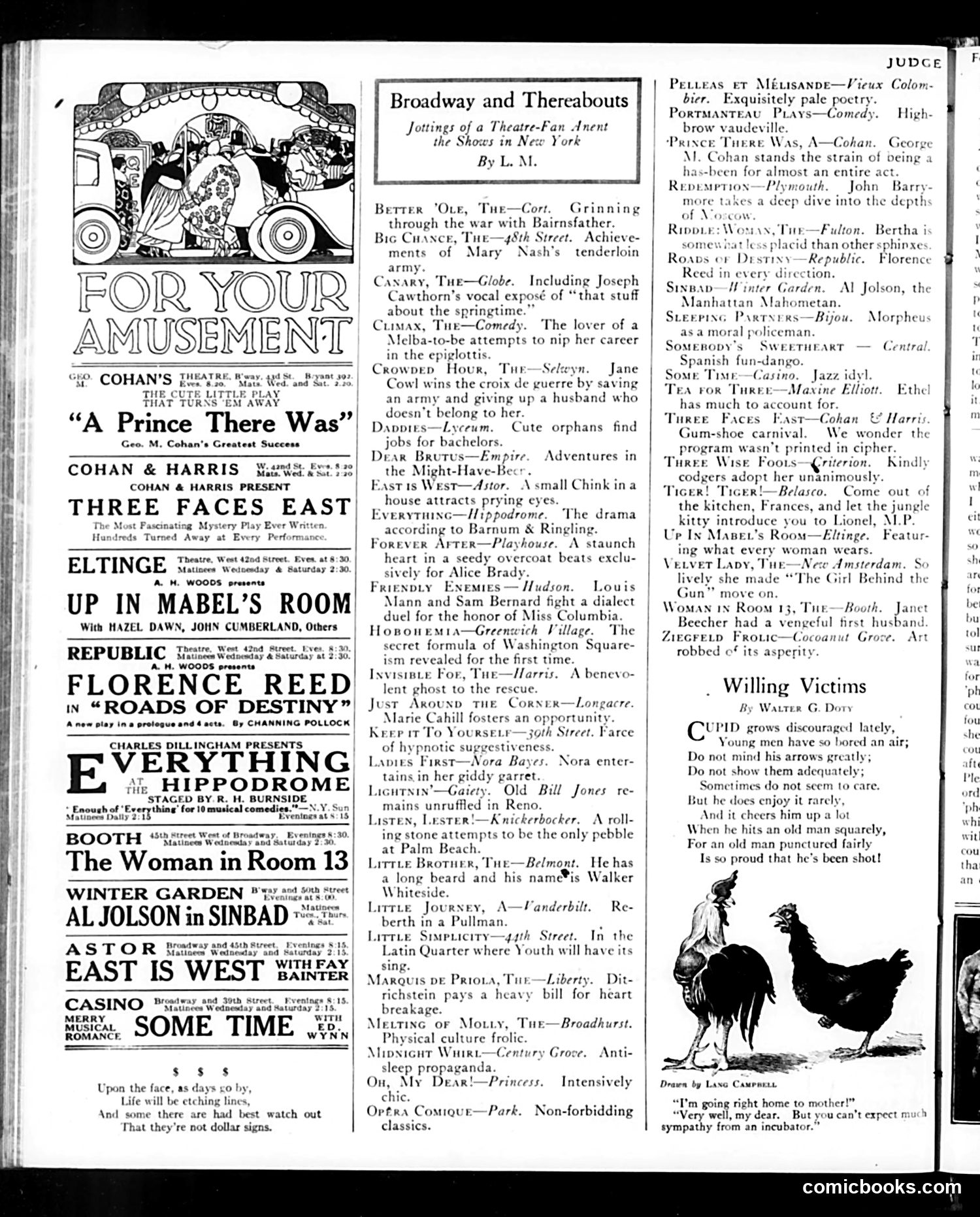
This is primarily a **theater advertising and review page** from Judge magazine, listing Broadway shows circa 1918-1920. The main visual content is a single cartoon by Linn Campbell (bottom right) showing a person riding an ostrich, captioned: "I'm going right home to mother!" / "Very well, my dear. But you can't expect much sympathy from an incubator." The joke relies on the absurdity of treating an ostrich egg-laying capacity as a domestic problem—the "incubator" reference puns on both the bird's reproductive biology and the speaker's cold indifference. It's a mild marital/domestic humor gag typical of the era. The accompanying poem "Willing Victims" (left column) cynically comments on aging and vanity, warning that facial wrinkles might become "dollar signs"—suggesting people desperately pursue cosmetic remedies. The bulk of the page consists of theater listings with brief, sardonic plot summaries by "L.M." The tone is gossipy and dismissive of contemporary Broadway productions.
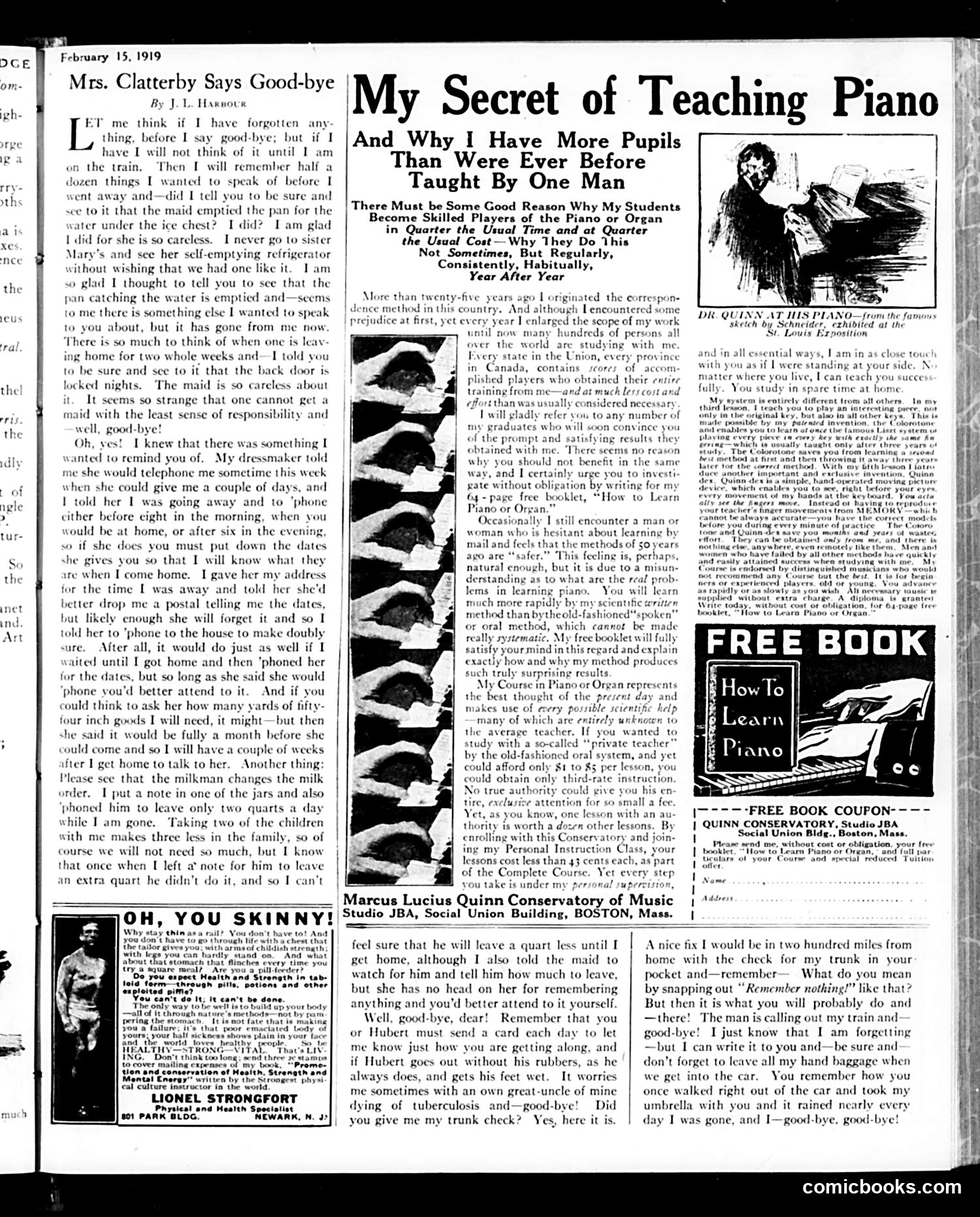
This page contains two distinct elements: **Main Content:** "Mrs. Clatterby Says Good-bye" is a humorous domestic sketch satirizing neurotic, fussy housewives of the era. Mrs. Clatterby obsessively recites instructions to her husband before leaving home—emptying refrigerator pans, locking doors, managing the milkman's delivery, coordinating with her dressmaker. The satire targets her compulsive worrying, her assumption that her husband is incompetent, and her inability to stop talking despite repeatedly saying "good-bye." It reflects period anxieties about domestic management and gender roles, mocking women who treat their households (and husbands) with excessive scrutiny and control. **Advertisements:** The page includes ads for piano instruction and physical fitness (Lionel Strongfort), targeting readers interested in self-improvement through mail-order courses—a common 1919 advertising appeal. The humor derives from recognizable domestic comedy types familiar to Judge's readers—the scatter-brained, worry-prone matron, the hapless husband, household staff incompetence.
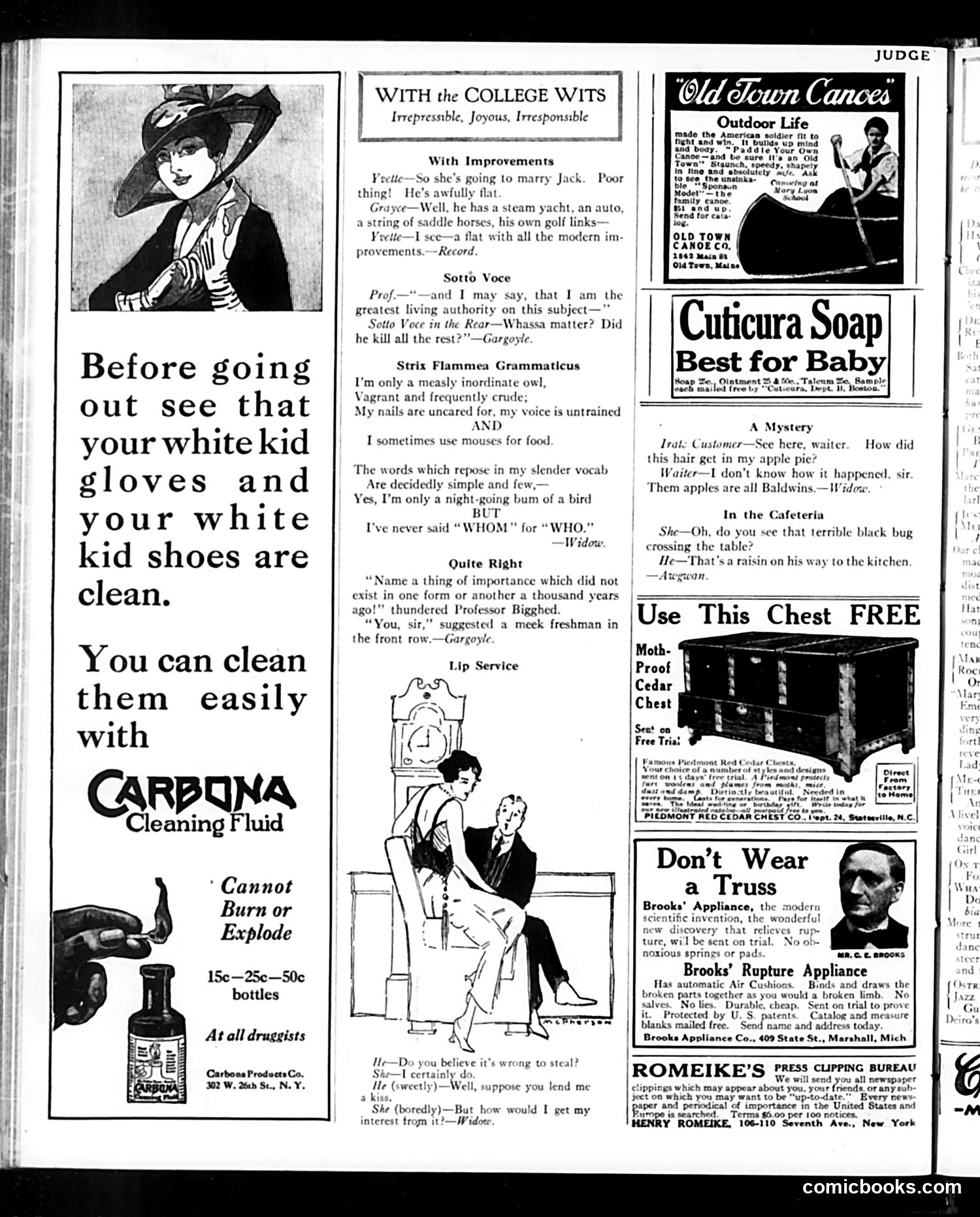
This page from *Judge* (a satirical weekly) contains humorous college-themed jokes and period advertisements, likely from the 1910s-1920s based on styling. **The "College Wits" Section** presents brief comedic exchanges mocking various social types: - **"With Improvements"**: Satire on materialism—a woman considers marrying a poor man because he owns luxury items (yacht, auto, golf links), reducing him to "a flat with modern improvements." - **"Sotto Voce"**: Professors' pretension—a professor claims authority on a subject; a student sarcastically questions if he killed all competitors for the title. - **"Strix Flammea Grammaticus"**: An owl boasts of correct grammar ("never said WHOM for WHO") despite being crude and eating mice—mocking pedantic grammar-snobs. - **"Quite Right"**: A freshman's comeback to a professor's rhetorical question about ancient importance. The remaining jokes target flirtation, theft morality, and cafeteria humor. The advertisements are period-typical (cleaning fluid, baby soap, medical devices), with one notably promoting a "rupture appliance."
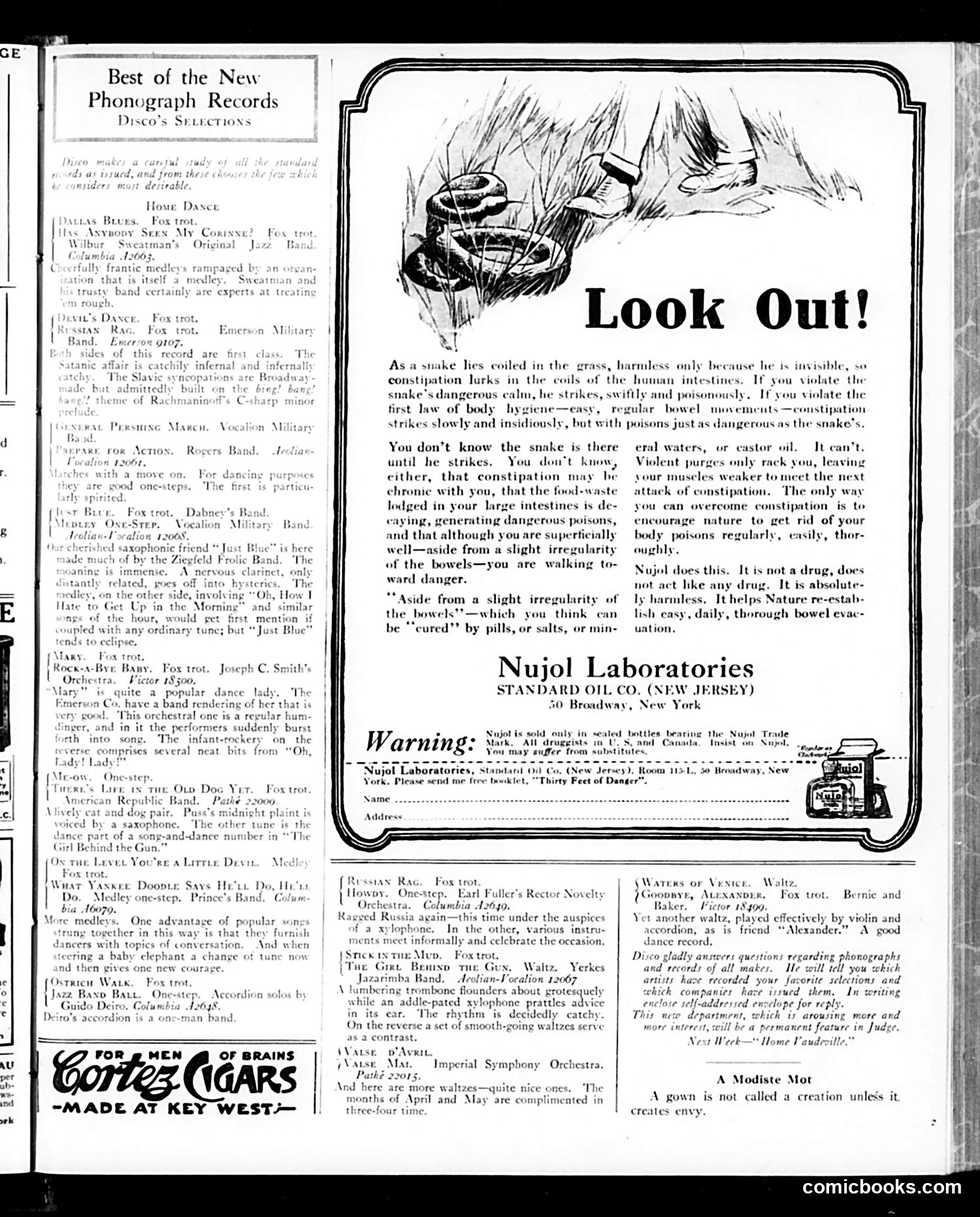
This page contains **no political cartoon or satire**—it's primarily a record review section ("Best of the New Phonograph Records") mixed with advertisements. The dominant content is a **Nujol Laboratories advertisement** featuring a large illustration of a snake and dramatic text warning about constipation as a hidden danger ("like a snake...invisible"). The ad promotes Nujol, a mineral oil laxative made by Standard Oil, claiming it's not a drug but a natural remedy for bowel regularity. The advertisement uses fear-based marketing typical of early 20th-century patent medicine advertising, comparing constipation to an invisible predator. This was common before modern FDA regulations. The surrounding text discusses dance records, jazz, and waltzes from various orchestras and bands—standard entertainment coverage for Judge magazine's era. There is minimal satire here; this is **straightforward editorial and advertising content** rather than political or social commentary.
This is primarily a **promotional/advertising page** for The Evening Mail newspaper rather than a satirical cartoon page. The left column advertises the newspaper's entertainment features and columnists (Burns Mantle, Mabel Herbert Urner, etc.), promoting it as New York's premier source for drama, society, and lifestyle content. The right side contains three separate short humorous pieces: 1. **"The Book-Seeking Youth to His Love"** by George S. Kaufman—a poem satirizing the Valentine's Day book-gifting trend. A young man comically despairs that no volume adequately expresses his passionate feelings; he needs a book "hot enough / To light a cigarette with." 2. **"Good Reasoning"** is a brief joke about a judge imposing a $5.10 fine (including a ten-cent "war tax") on a prisoner for beating his brother-in-law, reasoning the man got $5 of pleasure from it. 3. **"Painting the Lily"** is a short theatrical anecdote about achieving realistic storm effects through hard work. These are light, topical humor pieces typical of Judge's satirical style, touching on wartime taxes, romance, and theater.
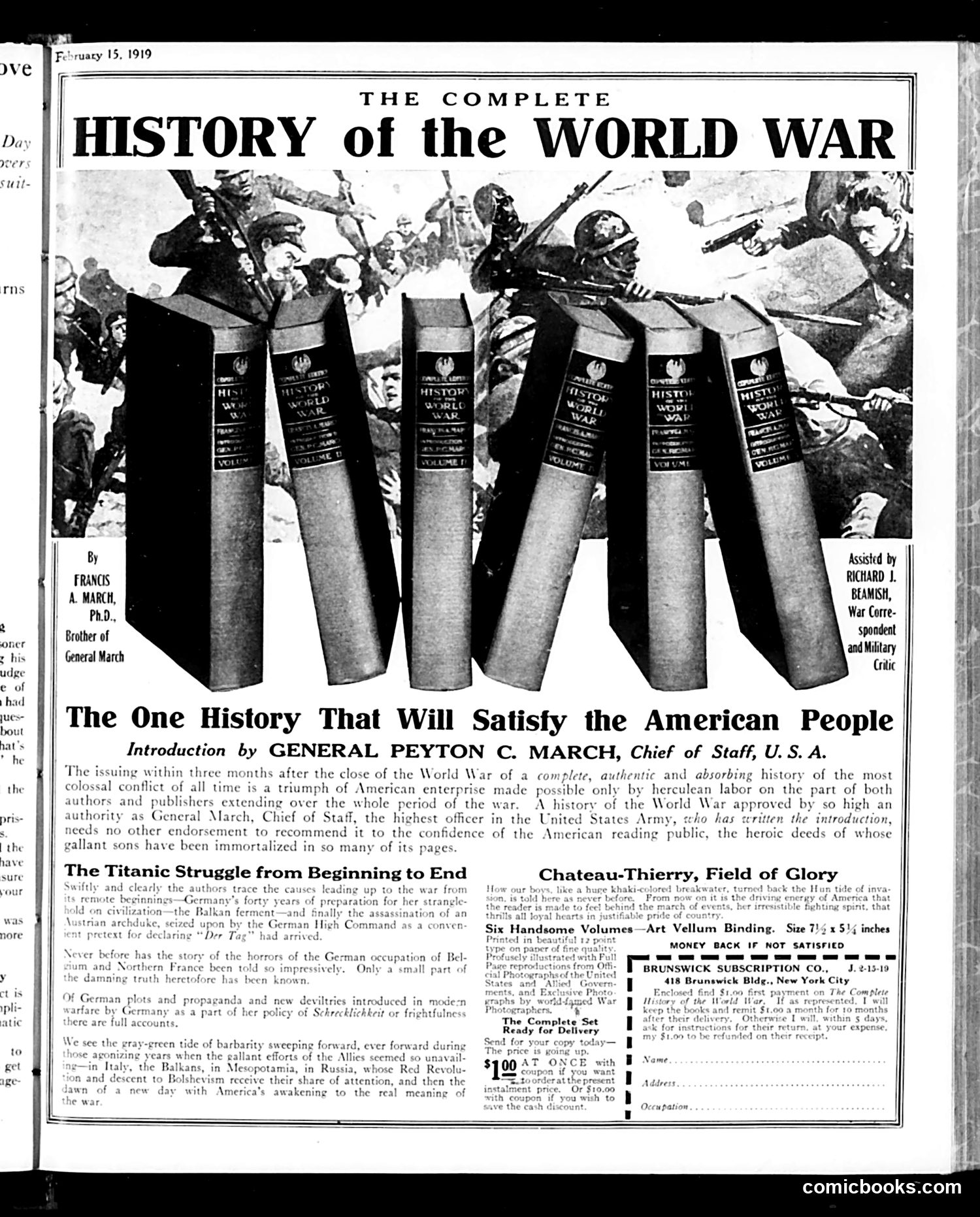
This is primarily **advertising copy**, not satire or political cartoon. The page promotes "The Complete History of the World War"—a six-volume book set published by Brunswick Subscription Co., appearing in Judge magazine on February 15, 1919 (just weeks after WWI's November 1918 armistice). **Key elements:** - **The books themselves** are displayed as the visual centerpiece, arranged with decorative military imagery in the background - **General Peyton C. March**, Chief of Staff of the U.S. Army, provides the introduction—lending military authority to the product - **The pitch** emphasizes this is "the one history that will satisfy the American people," published within three months of war's end - **The appeal** is to readers eager for a complete, authoritative account of "the most colossal conflict of all time" This reflects post-WWI American appetite for comprehensive war documentation. There is **no discernible satire or joke**—it's a straightforward subscription advertisement capitalizing on immediate public interest in understanding the war they'd just finished fighting.
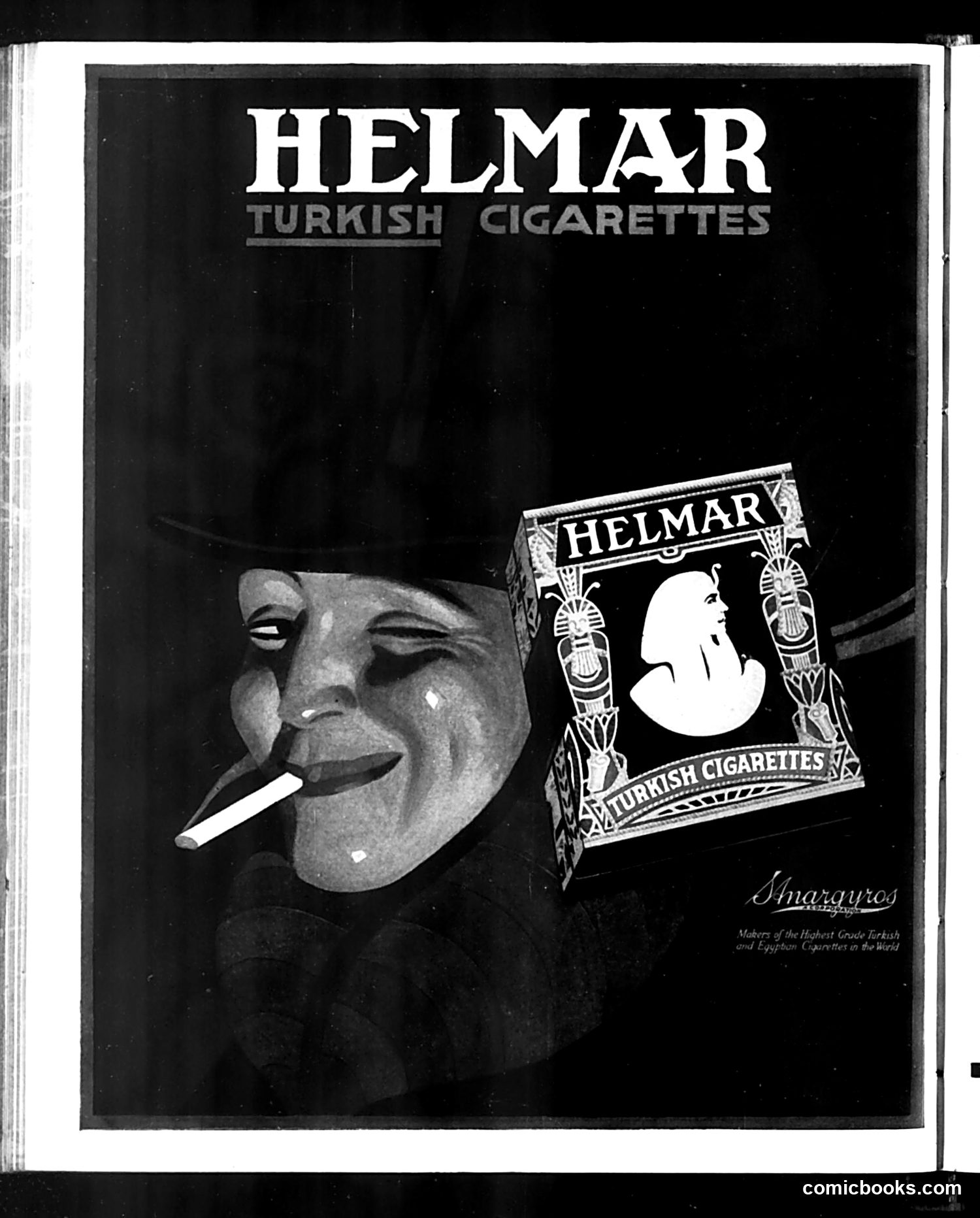
This is a vintage cigarette advertisement for Helmar Turkish Cigarettes. The page features an exaggerated caricature of a face in profile smoking a cigarette, paired with the product's packaging showing a classical female profile silhouette. The ad's appeal likely relied on early 20th-century marketing that associated Turkish cigarettes with exoticism and sophistication. The grotesque caricature style was common in period advertising, though by modern standards such depictions appear crude and potentially offensive. The text indicates Helmar marketed itself as "Makers of the Highest Grade Turkish and Egyptian Cigarettes in the World." This represents straightforward product advertising rather than political satire—a typical *Judge* magazine advertisement rather than editorial content.