
Judge, 1919-02-15 · page 14 of 32
Judge — February 15, 1919 — page 14: what you’re looking at
What you’re looking at
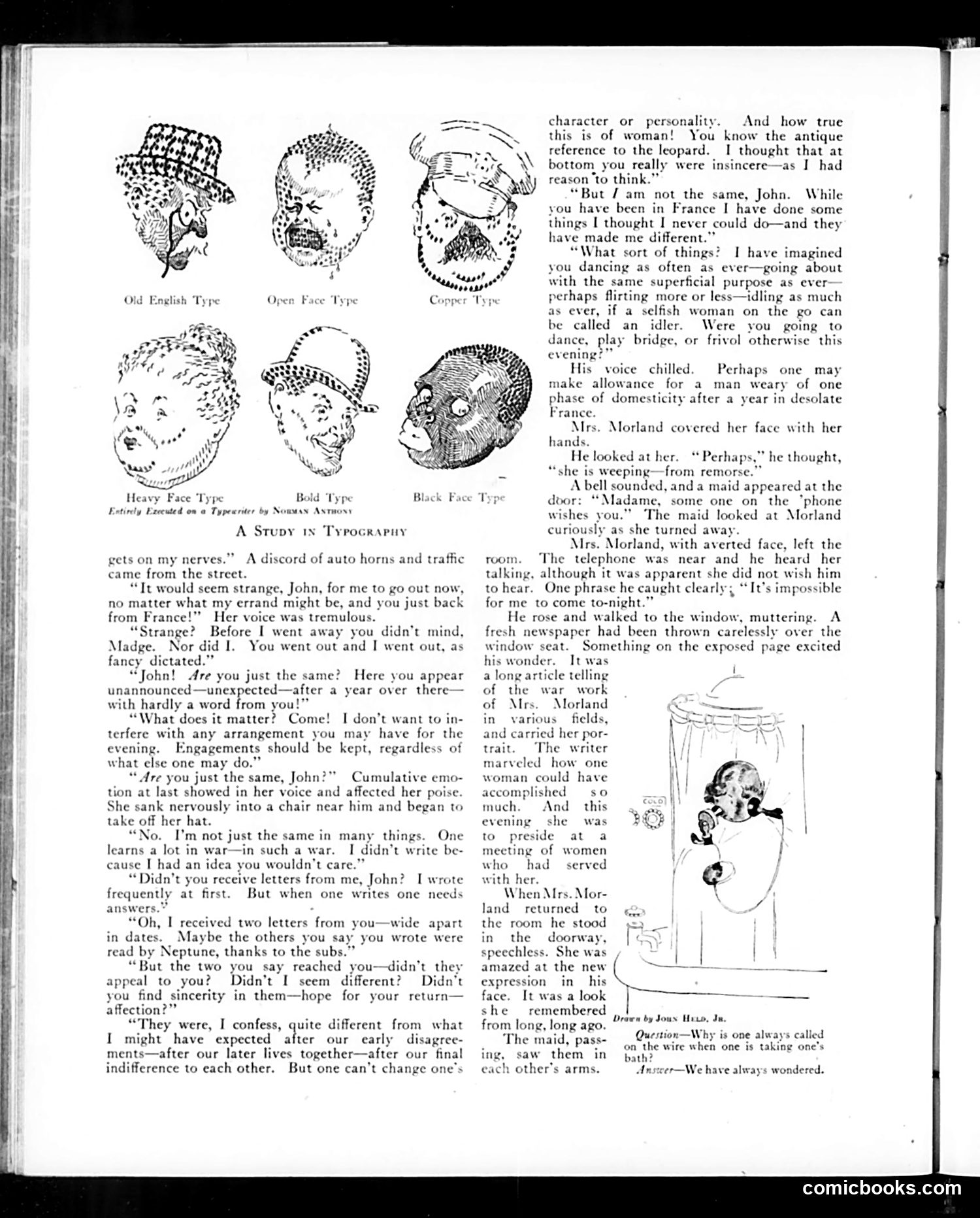
This page presents a domestic drama exploring how World War I changed both soldiers and the home front. John has just returned from France expecting his wife Madge to be unchanged—still superficial and idle. He's bitter about her wartime letters and dismissive of her claims to have "done things I never could do." The twist: John discovers a newspaper article praising Mrs. Morland's extensive war work in various fields. His harsh judgment—that she remained a frivolous socialite dancing and flirting—was entirely wrong. The article reveals she accomplished substantial wartime service. His final expression shows recognition and contrition. The satire critiques male assumptions about women's capabilities and their invisibility during wartime contributions. The title refers to the decorative face-type illustrations at top, which frame this meditation on how people's "true character" may be unknowable or misconceived.
📄 Transcribed text from this page (OCR, searchable)
Machine-transcribed from the original scan — historical spelling and the odd misread are preserved.
y Face ‘Type Entirely Executed on a Typeariter by Nowaan Axtnosy A Stupy is Typocrapuy gets on my nerves.”’ A discord of auto horns and traffic came from the street. “Tt would seem strange, John, for me to go out now, no matter what my errand might be, and you just back from France!" Her voice was tremulous. “Strange? Before [ went away you didn’t mind, Madge. Nor did I. You went out and I went out, a fancy dictated.” “John! Are you just the same? Here you appear unannounced—unexpected—after a year over there— with hardly a word from you!” “What does it matter? Come! I don’t want to in- terfere with any arrangement you may have for the evening. Ei ngagements should be kept, regardless of what else one may do.” * Are you just the same, John?" Cumulative emo- tion at last showed in her voice and affected her poise. She sank nervously into a chair near him and began to take off her hat. “No. I’m not just the same in many things. One learns a lot in war—in such a war. I didn’t write be- cause I had an idea you wouldn't care.” “Didn't you receive letters from me, John? I wrote frequently at first. But when one writes one needs answers “Oh, I received two letters “from in dates. Maybe the others you say read by Neptune, thanks to the subs. “But the two you say reached you—didn’t they appeal to you? Didn't I scem different? Didn‘t you find sincerity in them—hope for your return— affection?” “They were, I confess, quite different from what I might have expected after our early disagree- ments—after our later lives together—after our final indifference to each other. But one can’t change one’s you—wide apart you wrote were character or personality. And how true this is of woman! You know the antique reference to the leopard. I thought that at bottom you really were insincere—as I had reason ‘to thin “But J am not the same, John. While you have been in France I have done some things I thought I never could do—and they have made me different.” “What sort of things? I have imagined you dancing as often as ever—going about with the same superficial purpose as ever perhaps flirting more or less—idling as much as ever, if a selfish woman on the go can be called an idler. Were you going to dance, play bridge, or frivol otherwise this evening His voice chilled. Perhaps one may make allowance for a man weary of one phase of domesticity after a year in desolate France. Mrs. hands. He looked at her.“ Perhaps,” “she is weeping—from remorse. A bell sounded, and a maid appeared at the door: “Madame, some one on the ‘phone wishes you.” The maid looked at Morland curiously as she turned away. Mrs. Morland, with averted face, left the room. The telephone was near and he heard her talking, although it was apparent she did not wish him tohear. One phrase he caught clearly; “It’s impossible for me to come to-night.” He rose and walked to the window, muttering. A fresh newspaper had been thrown carelessly over the window seat. Something on the exposed page excited his wonder. It was a long article telling of the war work of Mrs. Morland in various fields, and carried her por- trait. The writer marveled how one woman could have accomplished — so much. And _ this evening she was to preside at a meeting of women who had served with her, When Mrs. Mor- land returned to the room he stood in the doorway, speechless. She was amazed at the new expression in his face. It was a look she remembered from long, long ago. Morland covered her face with her he thought, Drawn by Joux Hiro, Jn. The maid, pass. __ Qu¢stion—Why is one always called z + PaSS- on ‘the wire when one is taking one’s ing, saw them in path? each other's arms. Answer—We have always wondered. comicbooks.com