
Judge, 1919-02-15 · page 22 of 32
Judge — February 15, 1919 — page 22: what you’re looking at
What you’re looking at
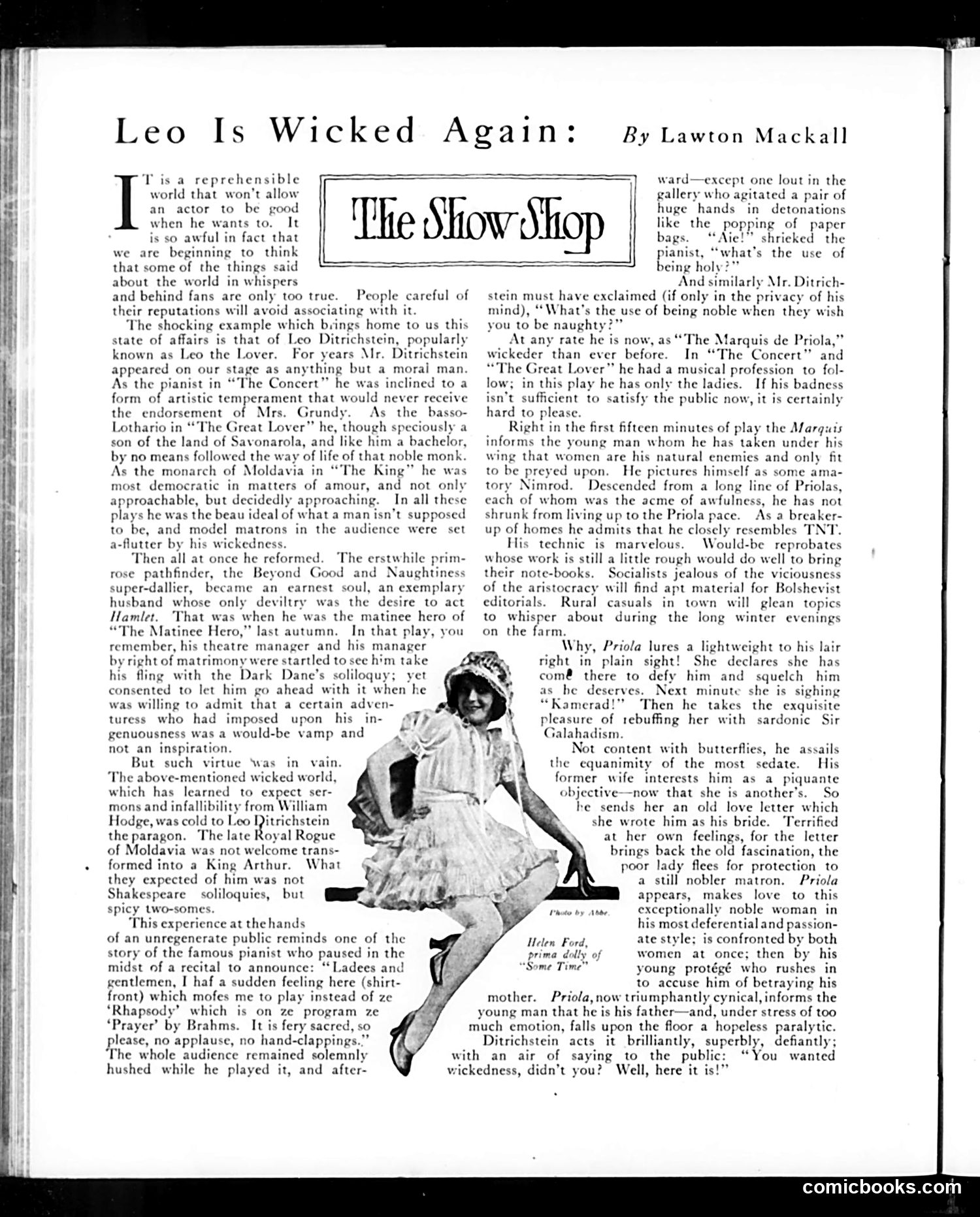
This article by Lawton Mackall satirizes actor **Leo Ditrichstein** (popularized as "Leo the Lover"), who built his reputation playing morally corrupt characters—a seductive pianist, a rake nobleman—that audiences loved. When Ditrichstein attempted reform by playing virtuous roles like Hamlet, the public rejected him. The satire highlights society's hypocrisy: audiences *demanded* he remain "wicked" for entertainment despite claiming to value morality. The accompanying photograph shows an actress (likely **Helen Ford**, captioned as "prima doll of 'Some Time'") in period costume, presumably from one of the theatrical productions discussed. **The joke**: Ditrichstein learned audiences don't actually want moral actors—they want entertaining villains. His return to playing the dissolute "Marquis de Priola" satisfies public appetite for scandal more than genuine virtue ever could.
📄 Transcribed text from this page (OCR, searchable)
Machine-transcribed from the original scan — historical spelling and the odd misread are preserved.
Leo Is Wicked Again: By Lawton Mackall T is a reprehensible world that won't allow an actor to be good when he wants to. It is so awful in fact that we are beginning to think | The Stow Sho i] ward—except one lout in the gallery who agitated a pair of huge hands in detonations like the popping of paper “Aie!” shrieked the “what's the use of bags. pianist, that some of the things said about the world in whispers and behind fans are only too true. People careful of their reputations will avoid associating with it. The shocking example which brings home to us this state of affairs is that of Leo Ditrichstein, popularly known as Leo the Lover. For years Mr. Ditrichstein appeared on our stage as anything but a moral man. As the pianist in “The Concert” he was inclined to a form of artistic temperament that would never receive the endorsement of Mrs. Grundy. As the basso- Lothario in “The Great Lover” he, though speciously a son of the land of Savonarola, and like him a bachelor, by no means followed the way of life of that noble monk. As the monarch of Moldavia in “The King” he was most democratic in matters of amour, and not only approachable, but decidedly approaching. In all these plays he was the beau ideal of what a man isn’t supposed to be, and model matrons in the audience were set a-flutter by his wickedness. Then all at once he reformed. The erstwhile prim- rose pathfinder, the Beyond xd and Naughtiness super-dallier, became an earnest soul, an exemplary husband whose only deviltry was the desire to act Hamlet. That was when he was the matinee hero of “The Matinee Hero,” last autumn. In that play, you remember, his theatre manager and his manager by right of matrimony were startled to see him take his g with the Dark Dane’s soliloquy; yet consented to let him go ahead with it when he was willing to admit that a certain adven- turess who had imposed upon his in- 7? genuousness was a would-be vamp and not an inspiration. But such virtue Was in What ¢f + formed into a King Arthur. they expected of him was not Shakespeare soliloquies, but spicy two-somes. This experience at the hands of an unregenerate public reminds one of the story of the famous pianist who paused in the midst of a recital to announce: “Ladees and gentlemen, I haf a sudden feeling here (shirt- front) which mofes me to play instead of ze ‘Rhapsody’ which is on ze program ze ‘Prayer’ by Brahms. It is fery sacred, so please, no applause, no hand-clappings..” ‘The whole audience remained solemnly hushed while he played it, and after- vain. f t The above-mentioned wicked world, f which has learned to expect ser- a mons and infallibility from William Hodge, was cold to Leo Ditrichstein . the paragon. The late Royal Rogue Jah ¥h of Moldavia was not welcome trans- > hilt ag with an air of saying to the public: wickedness, didn’t you? being holy And similarly Mr. Ditrich- stein must have exclaimed (if only in the privacy of his mind), “What's the use of being noble when they wish you to be naughty?” At any rate he is now, as “The Marquis de Priola,” wickeder than ever before. In “The Concert” and “The Great Lover” he had a musical profession to fol- low; in this play he has only the ladies. If his badness isn’t sufficient to satisfy the public now, it is certainly hard to please. Right in the first fifteen minutes of play the Marquis informs the young man whom he has taken under his wing that women are his natural enemies and only fit to be preyed upon. He pictures himself as some ama- tory Nimrod. Descended from a long line of Priolas, each of whom was the acme of awfulness, he has not shrunk from living up to the Priola pace. As a breaker- up of homes he admits that he closely resembles TNT. His technic is marvelous. Would-be reprobates whose work is still a little rough would do well to bring their note-books. Socialists jealous of the viciousness of the aristocracy will find apt material for Bolshevist editorials. Rural casuals in town will glean topics to whisper about during the long winter evenings on the farm. Why, Priola lures a lightweight to his lair right in plain sight! She declares she has comé@ there to defy him and squelch him as he deserves. Next minute she is sighing ;, Kamerad!”) Then he takes the exquisi ? pleasure of rebuffing her with sardonic §$ \ Galahadism. , Not content with butterflies, he assails the equanimity of the most sedate. His former wife interests him as a piquante objective—now that she is another's. So he sends her an old love letter which she wrote him as his bride. Terrified at her own feelings, for the letter brings back the old fascination, the poor lady flees for protection to a still nobler matron. Priola appears, makes love to this exceptionally noble woman in his most deferential and passion- ate styl confronted by both women at once; then by his young protégé who rushes in to accuse him of betraying his Priola,now triumphantly cynical, informs the Photo by Abbe Helen Ford, prima dolly of “Some Ti mother. young man that he is his father—and, under stress of too much emotion, falls upo: $ n the floor a hopeless paralytic. Ditrichstein acts it brilliantly, superbly, defiantly; “You wanted Well, here it is!” comicbooks.com