
Judge, 1919-02-15 · page 8 of 32
Judge — February 15, 1919 — page 8: what you’re looking at
What you’re looking at
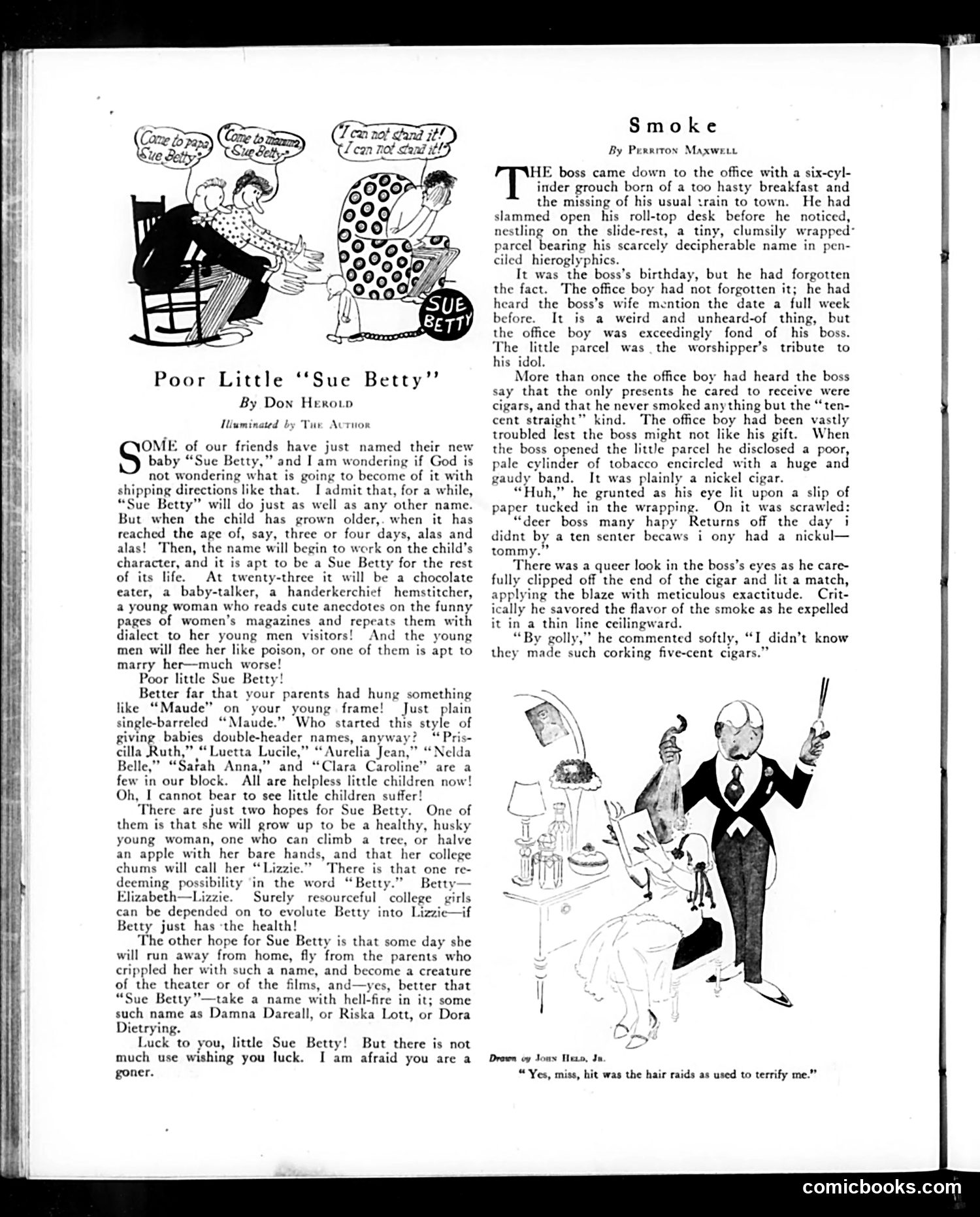
This page contains two satirical pieces from Judge magazine: **"Smoke"** (right): A sentimental story mocking workplace sentimentality. An office boy gives his beloved boss—a grouch who only appreciates cheap cigars—an even cheaper nickel cigar for his birthday, with a misspelled note explaining his financial limitations. The joke targets both the boy's naive devotion and the boss's likely emotional vulnerability to such humble gestures, subverting his tough persona. **"Poor Little Sue Betty"** (left): A humor piece lamenting the trend of hyphenated baby names ("Sue Betty," "Sarah Anna," etc.). The author sarcastically predicts the double-barreled name will make the girl into a vapid woman who reads women's magazines and repeats anecdotes. His "hopes" for her—either becoming a tomboy nicknamed "Lizzie" or running away to become a theatrical performer with a scandal-ready stage name—mock both conformist domesticity and theatrical aspiration. Both pieces are gentle social satire targeting early-20th-century American manners and naming conventions.
📄 Transcribed text from this page (OCR, searchable)
Machine-transcribed from the original scan — historical spelling and the odd misread are preserved.
Lexi not hand itf can not stand itt Poor Little ‘‘Sue Betty” By Don Heroin Mliuminated by Turn At THOR OME of our friends have just named their new baby “Sue Betty,” and I am wondering if God is not wondering what is going to become of it with shipping directions like that. I admit that, for a while, “Sue Betty” will do just as well as any other name. But when the child has grown older,. when it has reached the age of, say, three or four days, alas and alas! Then, the name will begin to werk on the child’s character, and it is apt to be a Sue Betty for the rest of its life. At twenty-three it will be a chocolate eater, a baby-talker, a handerkerchiet hemstitcher, a young woman who reads cute anecdotes on the funny pages of women’s magazines and repeats them with dialect to her young men visitors! And the young men will flee her like poison, or one of them is apt to marry her—much worse! Poor little Sue Betty! Better far that your parents had hung something like “Maude” on your young frame! Just plain single-barreled “Maude.” Who started this style of giving babies double-header names, anywa “ Pris- cilla Rut Luetta Lucile,” “Aurelia Jean, velda Belle,” “Sarah Anna,” and “Clara Caroline” are a few in our block. All are helpless little children now! Oh, I cannot bear to see little children suffer! There are just two hopes for Sue Betty. One of them is that she will grow up to be a healthy, husky young woman, one who can climb a tree, or halve an apple with her bare hands, and that her college chums will call her “Lizzi There is that one re- deeming possibility ‘in the word “Betty.” Betty— Elizabeth—L Surely resourceful college girls can be depended on to evolute Betty into Lizzie—if Betty just has ‘the health! The other hope for Sue Betty is that some day she will run away from home, fly from the parents who crippled her with such a name, and become a creature of the theater or of the films, and—yes, better that “Sue Betty”—take a name with hell-fire in it; some such name as Damna Dareall, or Riska Lott, or Dora Dietrying. Luck to you, little Sue Betty! But there is not much use wishing you luck. I am afraid you are a goner. Smoke By Pererton Maxweut E boss came down to the office with a six-cyl- inder grouch born of a too hasty breakfast and the missing of his usual train to town. He had slammed open his roll-top desk before he noticed, nestling on the slide-rest, a tiny, clumsily wrapped* parcel bearing his scarcely decipherable name in pen- ciled_hieroglyphics. It was the boss’s birthday, but he had forgotten the fact. The office boy had not forgotten it; he had heard the boss’s wife mention the date a full week before. It is a weird and unheard-of thing, but the office boy was exceedingly fond of his boss. The little parcel was the worshipper’s tribute to his idol. More than once the office boy had heard the boss say that the only presents he cared to receive were cigars, and that he never smoked anything but the “ten- cent straight” kind. The office boy had been vastly troubled lest the boss might not like his gift. When the boss opened the little parcel he disclosed a poor, pale cylinder of tobacco encircled with a huge and gaudy band. It was plainly a nickel cigar. “Huh,” he grunted as his eye lit upon a slip of paper tucked in the wrapping. On it was scrawled: “deer boss many hapy Returns off the day i didnt by a ten senter becaws i ony had a nickul— tommy.” ‘There was a queer look in the boss’s eyes as he care fully clipped off the end of the cigar and lit a match, applying the blaze with meticulous exactitude. Crit- ically he savored the flavor of the smoke as he expelled it in a thin line ceilingward. “By golly,” he commented softly, “I didn’t know they made such corking five-cent cigars.” Drown oy Joux Mero, Jn “Yes, miss, hit was the hair raids as used to terrify me.” comicbooks.com