
Judge, 1919-02-15 · page 5 of 32
Judge — February 15, 1919 — page 5: what you’re looking at
What you’re looking at
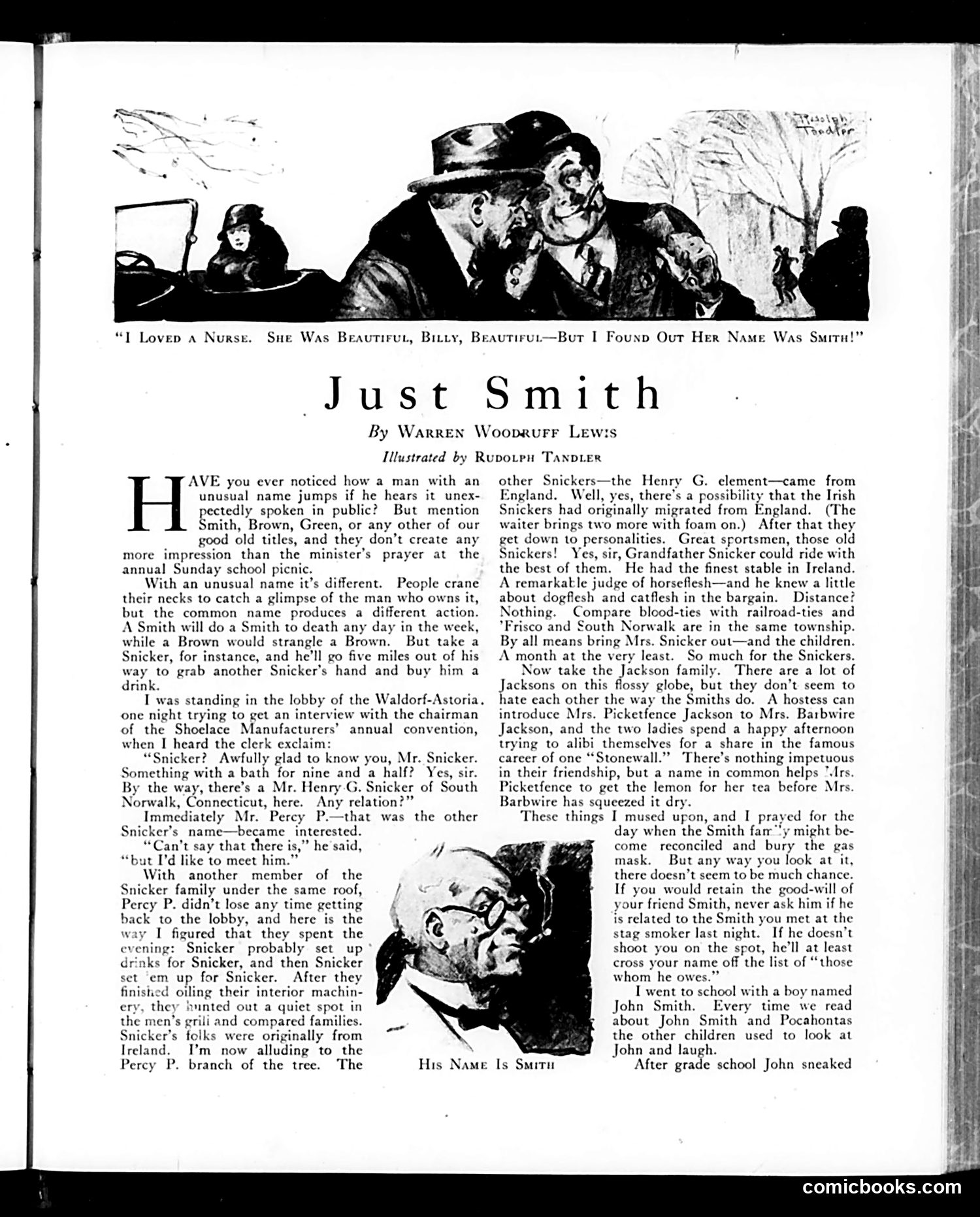
This page satirizes the commonness of the surname "Smith" through a humorous short story. The top cartoon illustrates the narrator's romantic disappointment: he loved a beautiful nurse, only to discover her unremarkable last name was Smith. The story explores how "Smith" appears everywhere in American society—multiple Snickers families with Smith connections, Jackson families feuding with Smiths, schoolboys named John Smith mocked by classmates. The central illustration ("His Name Is Smith") emphasizes this ordinariness. The satire mocks how such an ordinary name lacks distinction or memorability in public life. Unlike unusual surnames that create impressions, Smith produces indifference—making it simultaneously both common and forgettable in social contexts. It's gentle social humor about American naming conventions.
📄 Transcribed text from this page (OCR, searchable)
Machine-transcribed from the original scan — historical spelling and the odd misread are preserved.
“T Lovep a Nurse. Sue Was Beautirut, Bitty, Beautirut—But | Founp Out Her Name Was Smiru!” Just Smith By Warren Woopaurr Lewis Illustrated by Ruvoteu Tanpier AVE you ever noticed how a man with an unusual name jumps if he hears it unex- pectedly, spoken in public? But mention Smith, Brown, Green, or any other of our good old titles, and they don’t create any more impression than the minister’s prayer at the annual Sunday school picnic. With an unusual name it’s different. People crane their necks to catch a glimpse of the man who owns it, but the common name produces a different action. A Smith will do a Smith to death any day in the week, while a Brown would strangle a Brown. But take a Snicker, for instance, and he'll go five miles out of his way to grab another Snicker’s hand and buy him a drink. I was standing in the lobby of the Waldorf-Astoria. one night trying to get an interview with the chairman of the Shoelace Manufacturers’ annual convention, when I heard the clerk exclaim: “Snicker? Awfully glad to know you, Mr. Snicker. Something with a bath for nine and a half? Yes, sir. By the way, there’s a Mr. Henry G. Snicker of South Norwalk, Connecticut, here. Any relation?” Immediately Mr. Percy P.—that was the other Snicker’s name—became interested. “Can't say that there he said, “but I'd like to meet him.” With another member of the Snicker family under the same roof, Percy P. didn’t lose any time getting back to the lobby, and here is the way I figured that they spent the evening: Snicker probably set up drinks for Snicker, and then Snicker set ‘em up for Snicker. After they finished oiling their interior machin- ery, they hunted out a quiet spot in the men’s grili and compared families. Snicker’s folks were originally from Ireland. I’m now alluding to the Percy P. branch of the tree. The His Name Is Samiti other Snickers—the Henry G. element—came from England. Well, yes, there’s a possibility that the Irish Snickers had originally migrated from England. (The waiter brings two more with foam on.) After that they get down to personalities. Great sportsmen, those old Snickers! Yes, sir, Grandfather Snicker could ride with the best of them. He had the finest stable in Ireland. A remarkakle judge of horseflesh—and he knew a little about dogflesh and catflesh in the bargain. Distance? Nothing. Compare blood-ties with railroad-ties and sco and South Norwalk are in the same township. By all means bring Mrs. Snicker out—and the children. A month at the very least. So much for the Snickers. Now take the Jackson family. There are a lot of Jacksons on this flossy globe, but they don’t seem to hate each other the way the Smiths do. A hostess can introduce Mrs. Picketfence Jackson to Mrs. Barbwire Jackson, and the two ladies spend a happy afternoon trying to alibi themselves for a share in the famous career of one “Stonewall.” There’s nothing impetuous in their friendship, but a name in common helps ‘sIrs. Picketfence to get the lemon for her tea before Mrs. Barbwire has squeezed it dry. These things I mused upon, and I prayed for the day when the Smith fam"'y might be- come reconciled and bury the gas mask. But any way you look at it, there doesn’t seem to be much chance. If you would retain the good-will of your friend Smith, never ask him if he is related to the Smith you met at the stag smoker last night. If he doesn’t shoot you on the spot, he'll at least cross your name off the list of “those whom he owes.” I went to school with a boy named John Smith. Every time we read about John Smith and Pocahontas the other children used to look at John and laugh. After grade school John sneaked comicbooks.com