
Judge, 1919-02-15 · page 9 of 32
Judge — February 15, 1919 — page 9: what you’re looking at
What you’re looking at
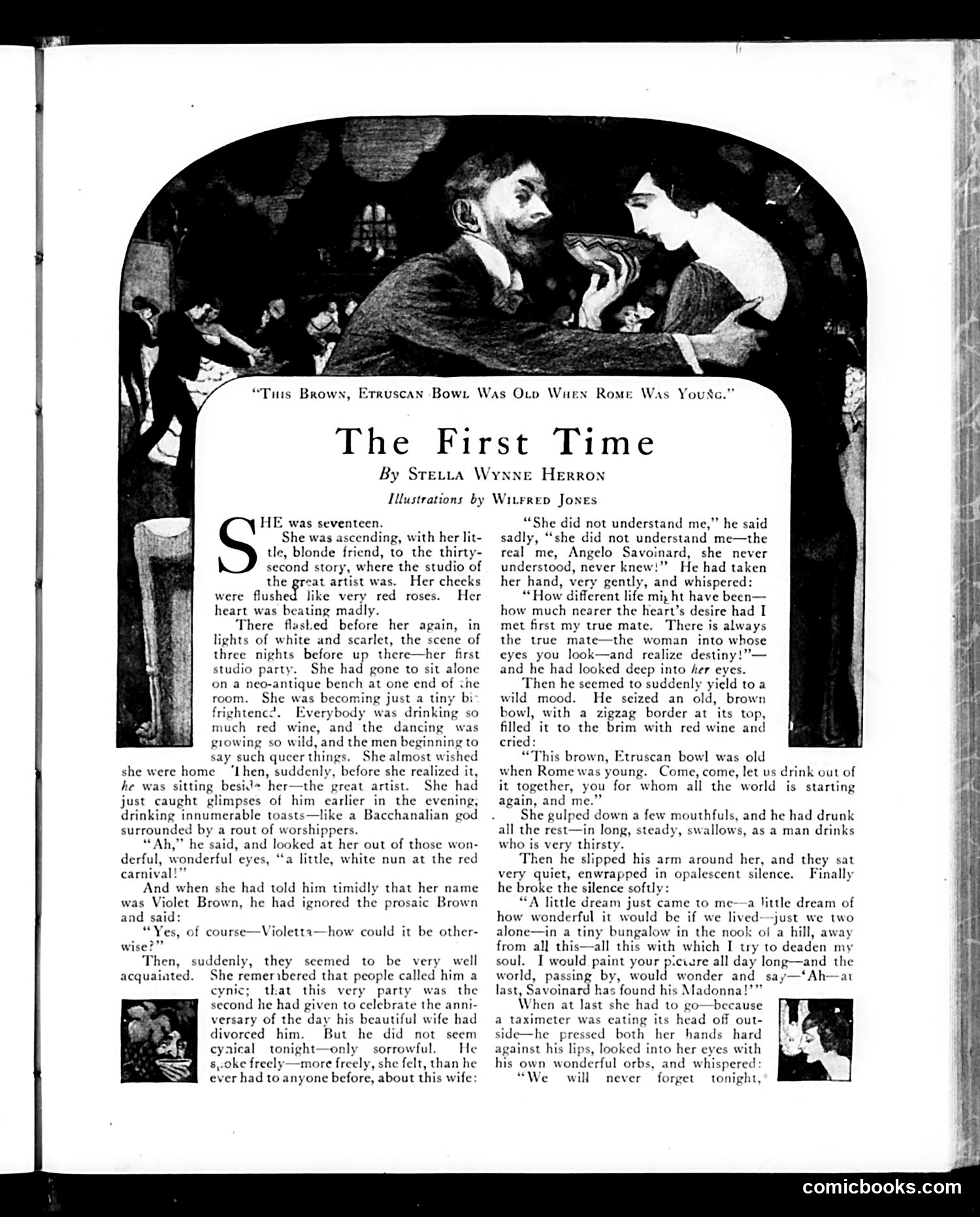
This is a romantic short story, not political satire. It depicts a seventeen-year-old woman named Violet Brown meeting a famous artist, Angelo Savoinard, at a studio party. The narrative portrays a seduction: the artist, recently divorced, targets the naive girl with flattery and romantic declarations, sharing an antique Etruscan bowl of wine and speaking of a dream life together. The illustration shows the two figures in intimate conversation. The story appears to romanticize what would now be recognized as predatory behavior—an older established artist leveraging his status and emotional manipulation on a young, innocent woman. The "Etruscan bowl" serves as a literary device symbolizing artistic sophistication meant to impress her. This reflects early-20th-century attitudes toward age-gap relationships and artistic bohemian culture, presented here as romantic rather than exploitative.
📄 Transcribed text from this page (OCR, searchable)
Machine-transcribed from the original scan — historical spelling and the odd misread are preserved.
n, Etruscan Bowt Was Otp Wuen Rome The First Time By Stetta Wy HE was seventeen. She was ascending, with her lit- tle, blonde friend, to the thirty- second story, where the studio of the great artist was. Her cheeks were flushed like very red roses. Her heart was beating madly. There flasted before her again, in lights of white and scarlet, the scene of three nights before up there—her first studio party. She had gone to sit alone on a neo-antique bench at one end of che room. She was becoming just a tiny bi frightenc? erybody was drinking so much red wine, and the dancing was growing so wild, and the men beginning to say such queer things. She almost wished she were home ‘Lhen, suddenly, before she realized it, he was sitting beside her—the great artist. She had just caught glimpses of him earlier in the evening, drinking innumerable toasts—like a Bacchanalian god surrounded by a rout of worshippers. “Ah,” he said, and looked at her out of those won- derful, wonderful eyes, “a little, white nun at the red carnival!” And when she had told him timidly that her name was Violet Brown, he had ignored the prosaic Brown and said: “Yes, of course—Violetta—how could it be other- wise?” Then, suddenly, they scemed to be very well acquaiated. She remeribered that people called him a cynic; that this very party was the second he had given to celebrate the anni- versary of the day his beautiful wife had divorced him. But he did not seem cynical tonight—only sorrowful. He 8,oke freely—more freely, she felt, than he ever had to anyone before, about this wife: Illustrations by Witrrep Jones Was Yousc.” Herron “She did not understand me,” he said sadly, “she did not understand me—the real me, Angelo Savoinard, she never understood, never knew!” He had taken her hand, very gently, and whispered: “How different life mi, ht have been— how much nearer the heart’s desire had I met first my true mate. There is always the true mate—the woman into whose eyes you look—and realize destiny!”— and he had looked deep into her eyes. ‘Then he seemed to suddenly yield to a wild mood. He seized an old, brown bowl, with a zigzag border at its top, filled it to the brim with red wine and cried: “This brown, Etruscan bowl was old when Rome was young. Come, come, let us drink out of it together, you for whom all the world is starting again, and me She gulped down a few mouthfuls, and he had drunk all the rest—in long, steady, swallows, as a man drinks who is very thirsty. Then he slipped his arm around her, and they sat very quiet, enwrapped in opalescent silence. Finally he broke the silence softly: “A little dream just came to me—a little dream of how wonderful it would be if we lived—just we two alone—in a tiny bungalow in the nook of a hill, away from all this—all this with which I try to deaden my soul. I would paint your piciare all day long—and the world, passing by, would wonder and (say—*Ah—at last, Savoinard has found his Madonna!?” When at last she had to go—because a taximeter was eating its head off out- side—he pressed both her hands hard against his lips, looked into her eyes with his own wonderful orbs, and whispered: “We will never forget tonight, comicbooks.com