
A complete issue · 33 pages · 1918
Judge — December 28, 1918
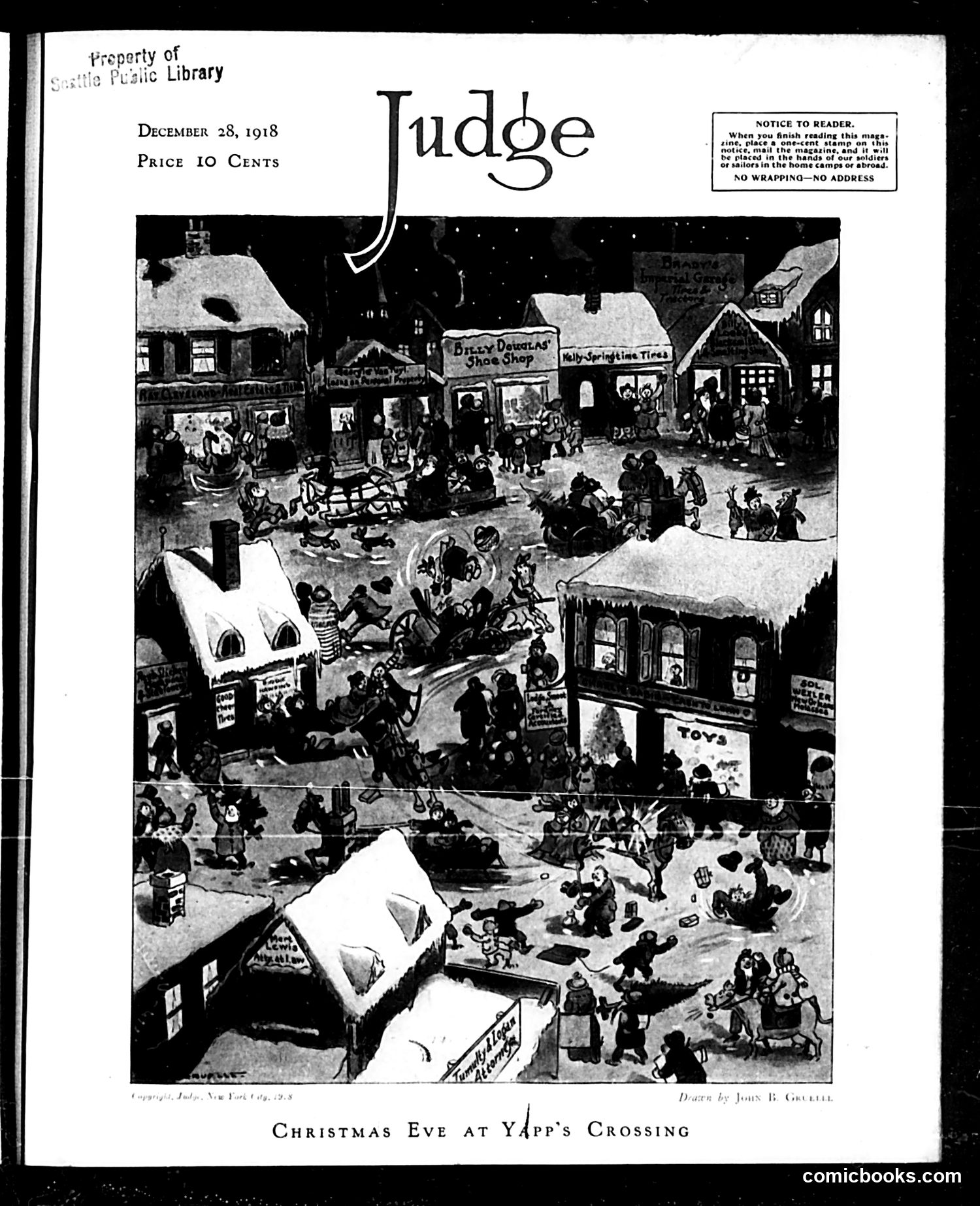
This cover illustration depicts "Christmas Eve at Yapp's Crossing"—an idealized winter holiday scene in a small town. The drawing shows a festive community gathering with decorated storefronts, holiday displays, and numerous figures enjoying winter activities and shopping. Published just weeks after World War I's armistice (November 1918), this appears to be celebratory content marking both the Christmas season and peace following the war's end. The bustling, joyful town scene likely represents American optimism and normalcy returning home after the conflict. The illustration itself—credited to artist John B. Gowell—functions as seasonal entertainment rather than political satire, emphasizing community spirit and holiday cheer rather than commentary.
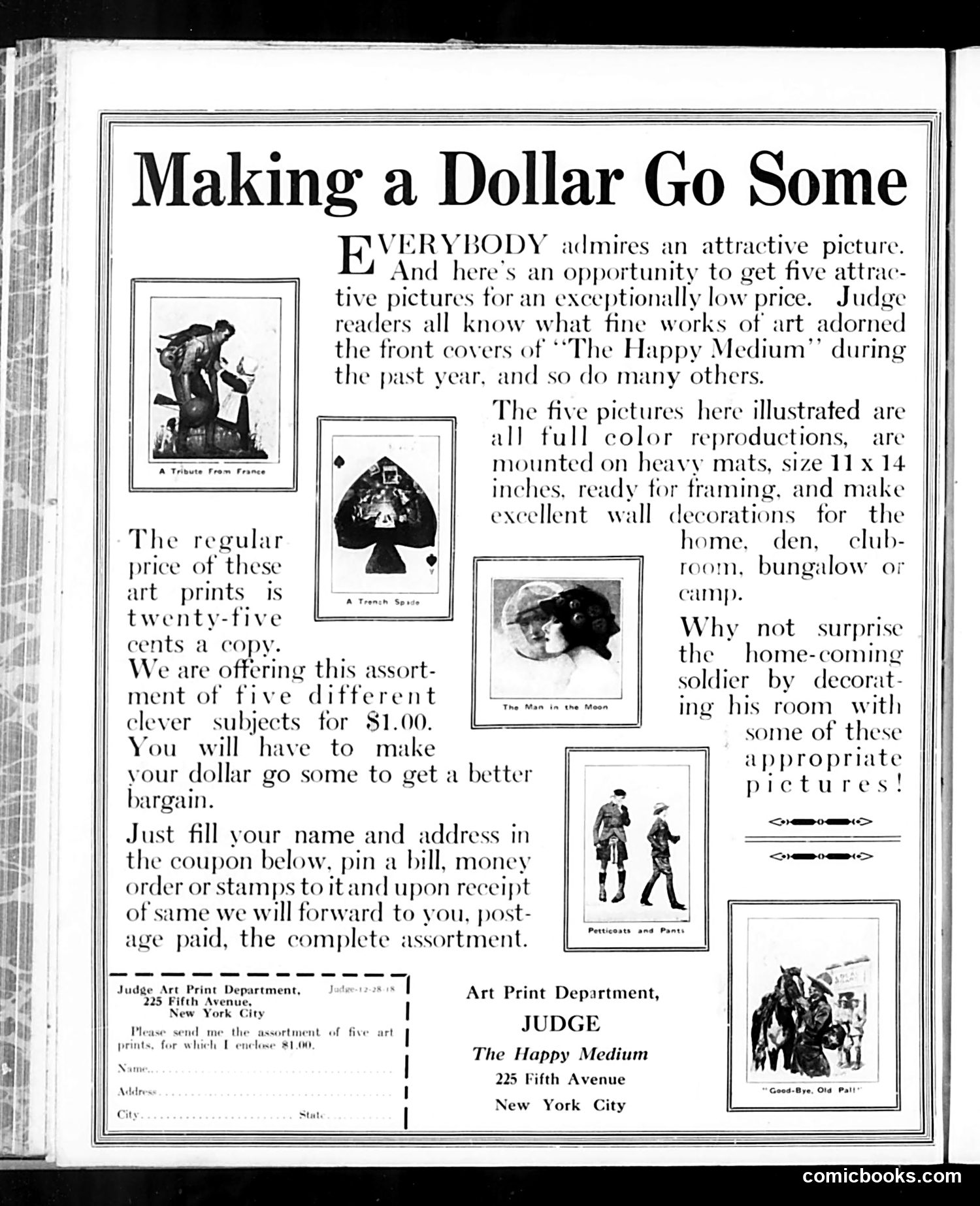
This is primarily **advertising**, not satirical content. Judge magazine's Art Print Department is promoting a special offer: five full-color art prints (11x14 inches, mounted on heavy mats) for $1, versus their regular 25-cent individual price. The five illustrated prints shown include: - "A Tribute From France" (sculpture) - "A French Scare" (spade suit design) - "The Man in the Moon" (portrait) - "Postcards and Pants" (military figures) - "Good-Bye, Old Pal" (cavalry scene) The ad explicitly targets **home decoration** and mentions decorating "the home-coming soldier's room," suggesting WWI-era timing. The offer encourages readers to mail $1 with their address to receive the assortment. This is straightforward mail-order merchandising rather than satirical commentary.
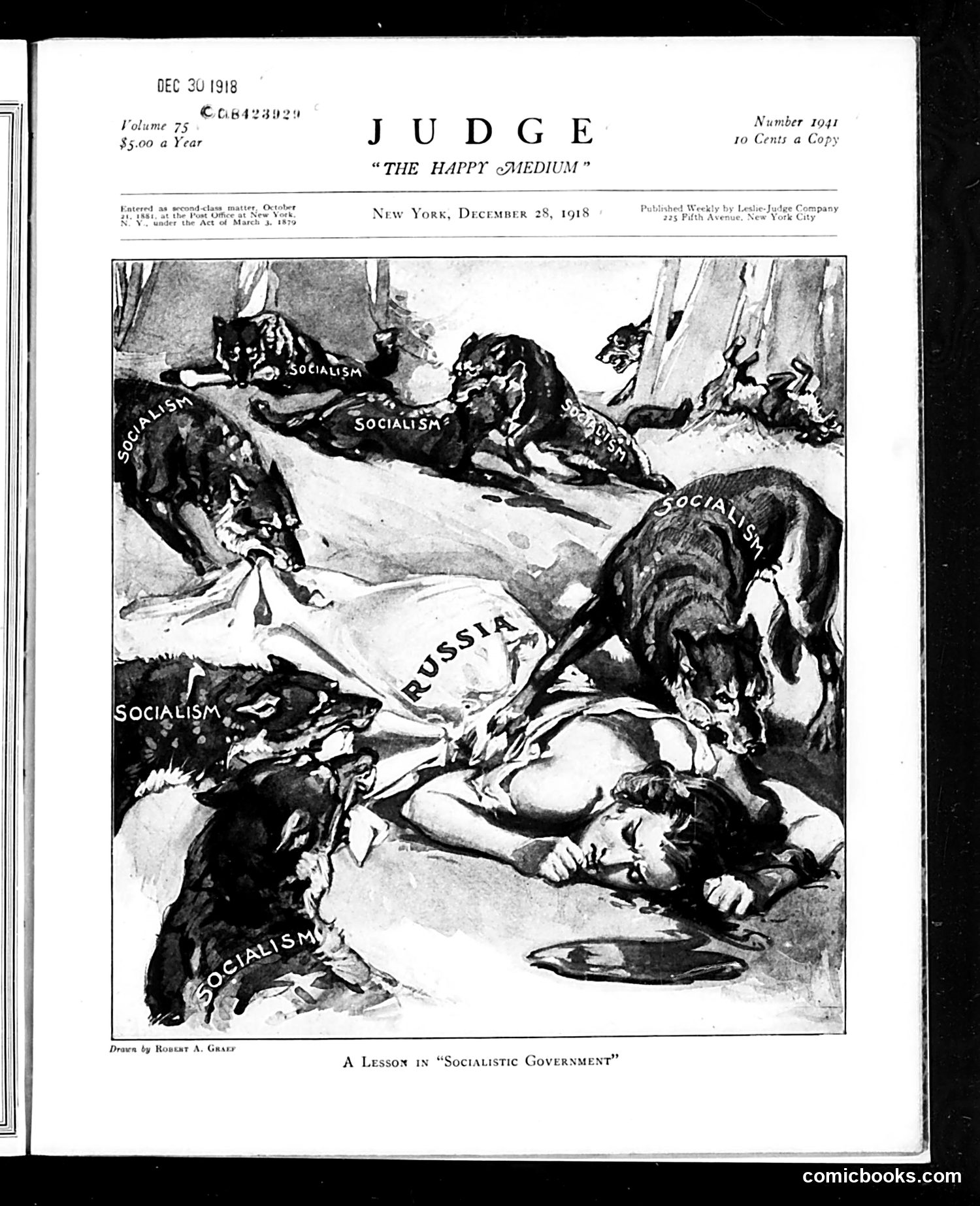
This December 1918 cartoon by Robert A. Graef uses wolves labeled "Socialism" attacking a dead child labeled "Russia" to criticize socialist government. The imagery is brutally direct propaganda. The cartoon reflects post-WWI American anti-communist sentiment, particularly following the Russian Revolution (1917) and the establishment of the Bolshevik Soviet state. The dead child represents Russia destroyed by socialist ideology, while the predatory wolves illustrate socialism as a deadly force devouring the nation. Judge magazine, a conservative satirical publication, employs this visceral imagery to warn American readers against socialist politics. The cartoon presents socialism not as a political philosophy but as an inherently destructive, violent force—visual propaganda targeting leftist movements gaining traction during the post-war period.
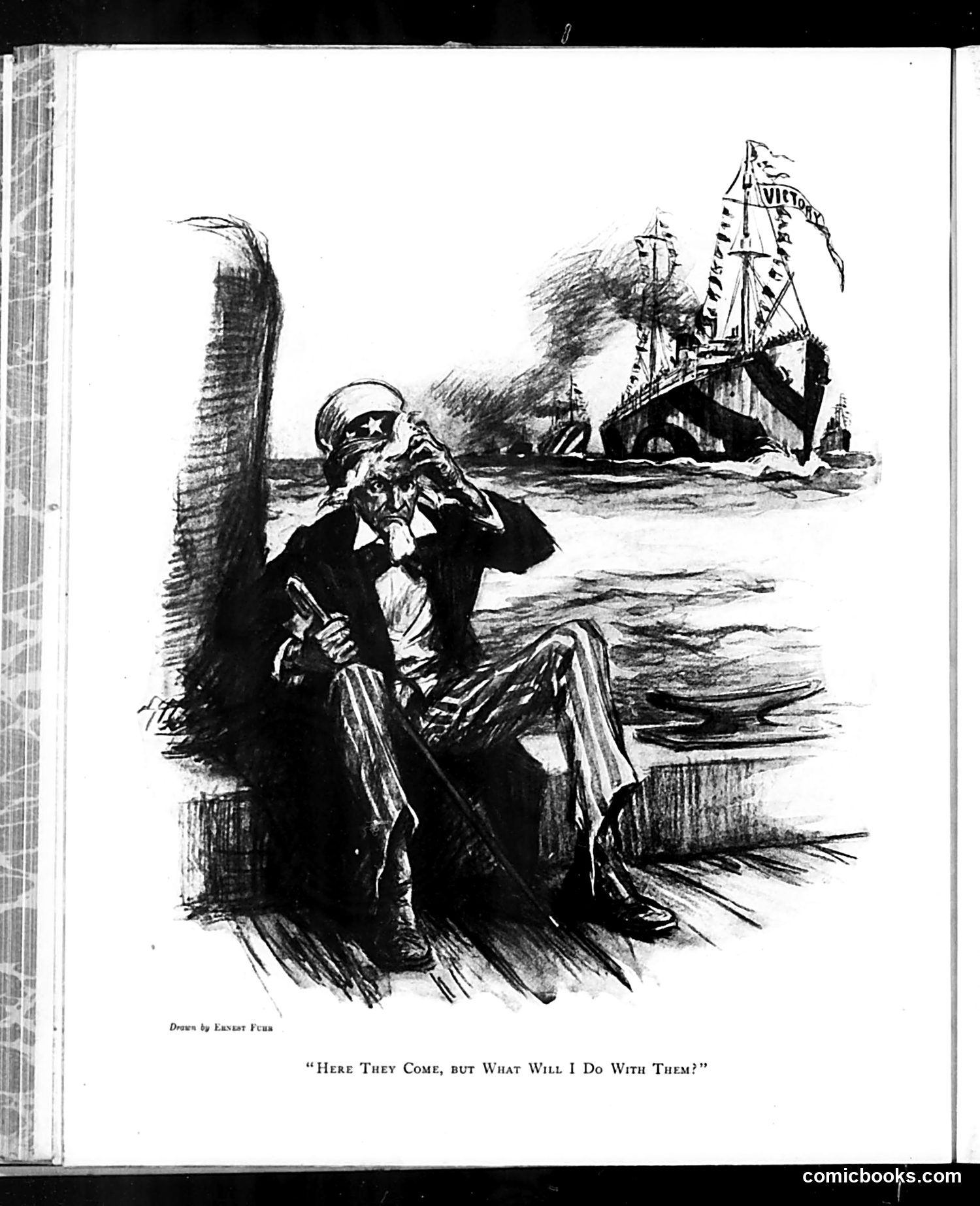
This cartoon by Ernest Fuhr depicts Uncle Sam (identifiable by his starred hat) sitting anxiously by a dock, watching ships arrive. The caption reads "Here They Come, but What Will I Do With Them?" The ships appear to be labeled "Victoria" and likely represent immigrant vessels arriving at American ports. This satirizes anxieties about immigration and assimilation during the early 20th century—a period of massive immigration waves to the United States. Uncle Sam's worried posture and rhetorical question suggest uncertainty or concern about handling the incoming immigrant population. The cartoon reflects contemporary debates about whether America could absorb and integrate newcomers, capturing nativist concerns prevalent in Judge magazine's audience during this era of high immigration.
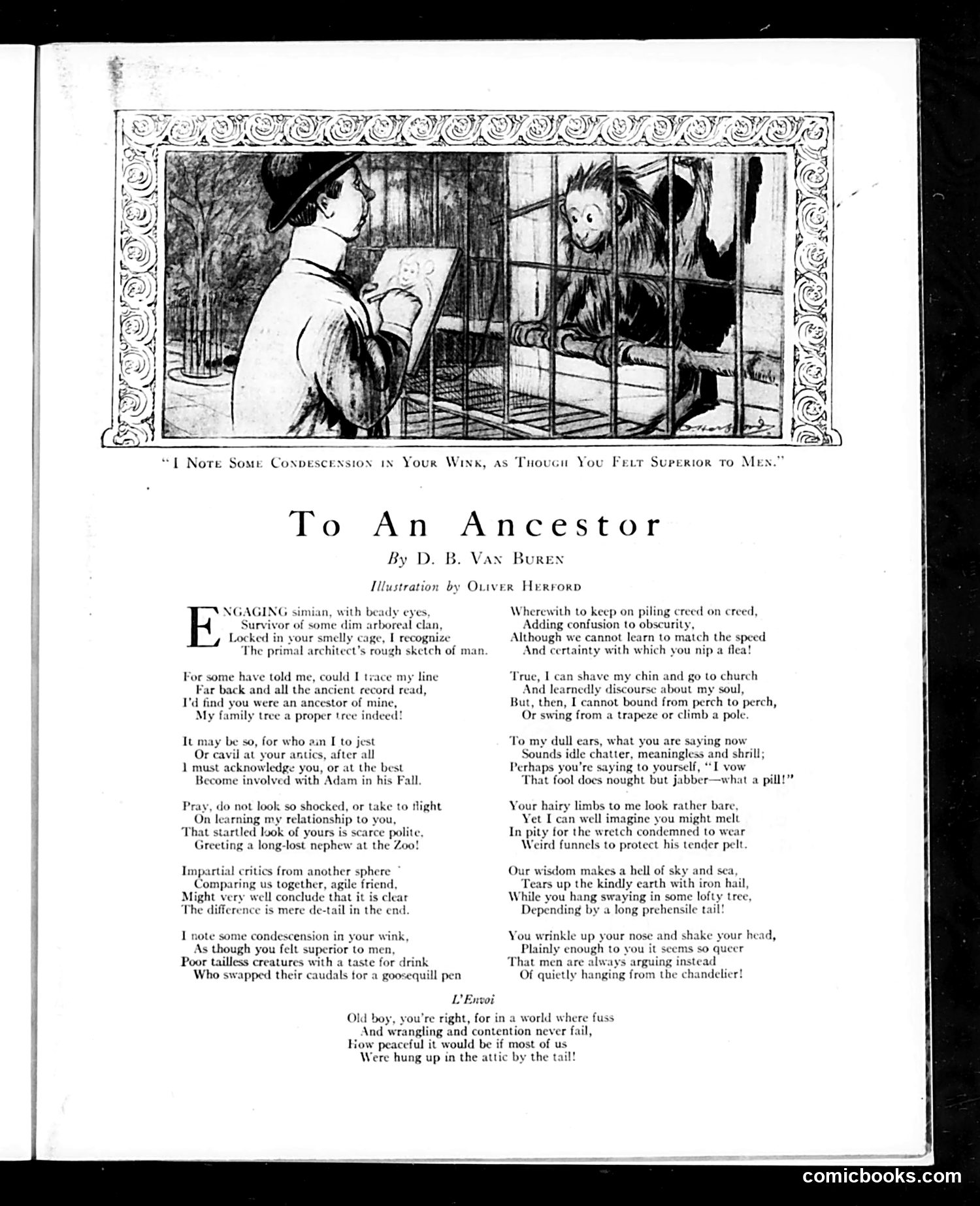
This satirical poem compares a human to an ape ancestor, likely referencing early 20th-century debates over Darwinian evolution. The illustration shows a man sketching a caged ape, with the caption "I note some condescension in your wink, as though you felt superior to men." The poem mockingly addresses an ancestral ape, suggesting humans haven't evolved much morally or intellectually. It catalogs human flaws—arguing, drinking, scheming—while acknowledging our biological kinship with primates. The satire critiques human pretensions to superiority and civilization. The final *L'Envoi* section ironically concedes the ape might be right: humans constantly bicker, and perhaps we'd be better off simply "hung up in the attic by the tail"—a jab at human vanity and self-destructive behavior.
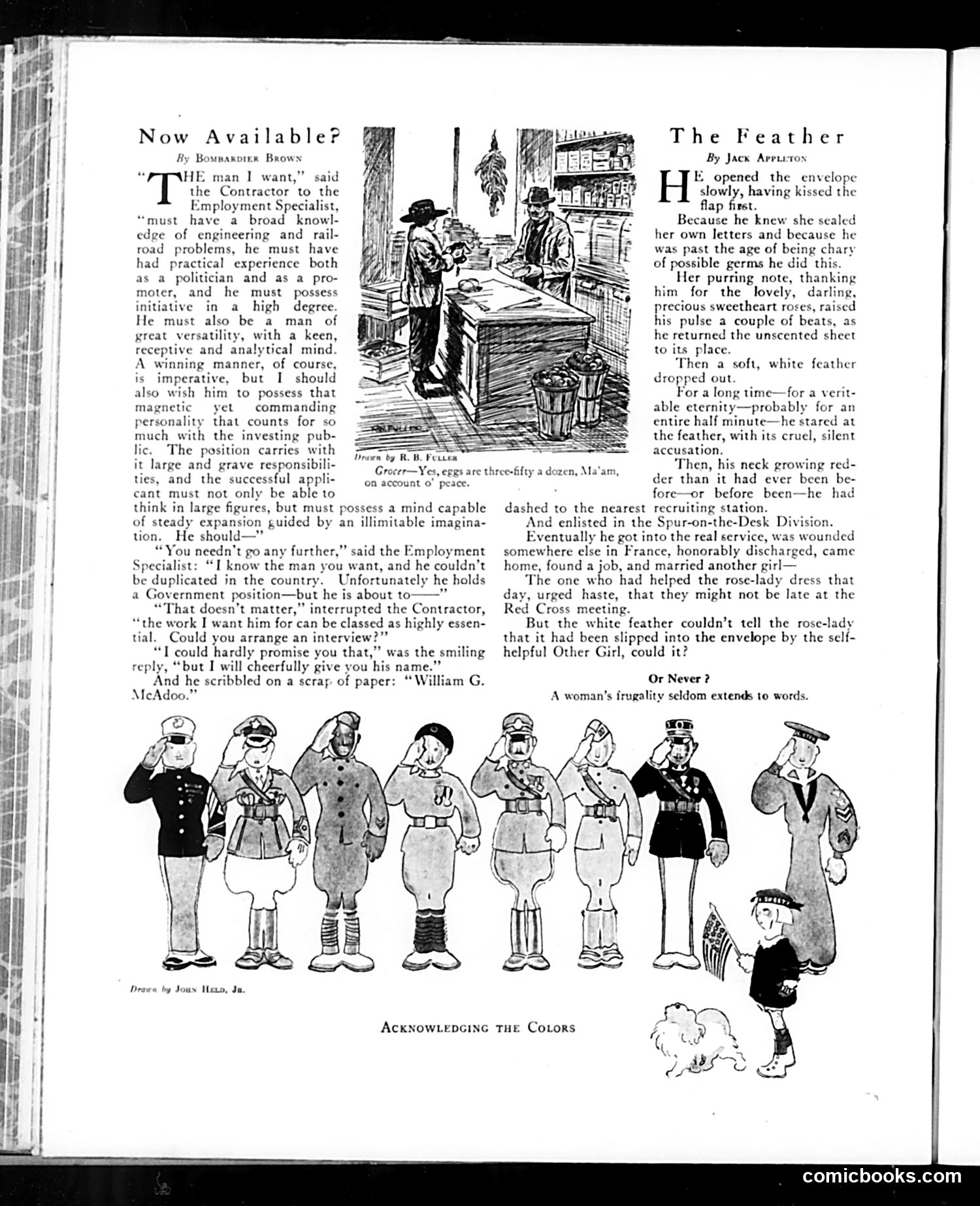
This page contains two separate pieces: **"Now Available?"** (left) depicts a job interview between an Employment Specialist and a Contractor seeking skilled workers. The Specialist recommends "William G. McAdoo" — likely referring to William Gibbs McAdoo, a prominent WWI-era political figure. The joke appears to mock suggesting a politician for practical engineering work, satirizing the disconnect between political credentials and actual job qualifications. **"The Feather"** (right) is a short story about a soldier who receives love letters from a woman, symbolized by a white feather (possibly referencing WWI morale or romance). The narrative concludes ambiguously about whether the feather's origins matter. The bottom illustration, "Acknowledging the Colors," shows military and civilian figures saluting, likely referencing patriotic duty during wartime.
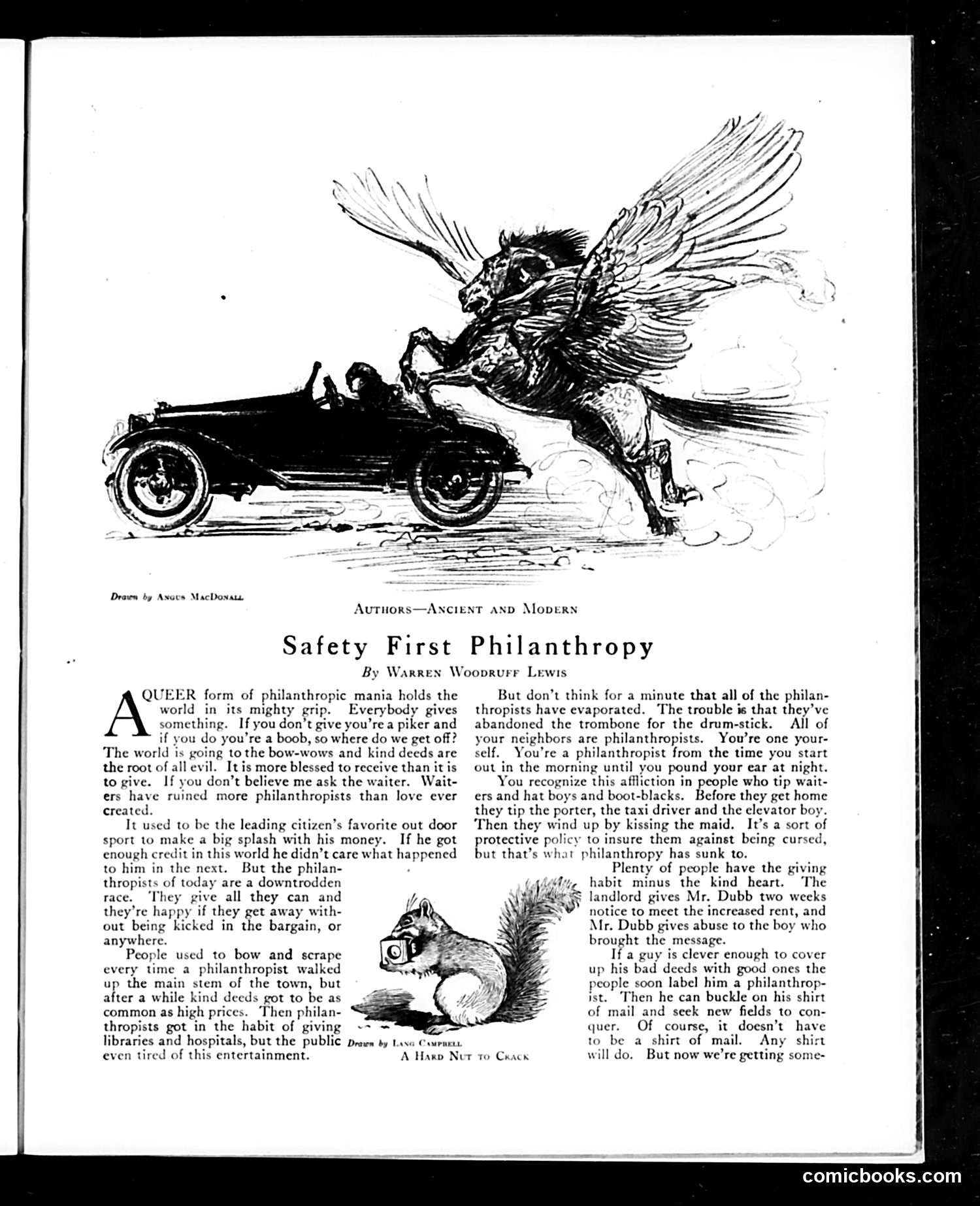
This satirical article by Warren Woodruff Lewis mocks the early 20th-century craze of ostentatious charitable giving. Lewis argues that philanthropy has become performative and hollow—driven by social reputation rather than genuine kindness. The piece critiques how "giving" has become reflexive: wealthy people tip everyone (waiters, porters, taxi drivers, elevator boys) not from generosity but as protective insurance against curses. The humor targets the absurdity that even Mr. Dubb—apparently a working-class tenant—has become a "philanthropist" by abusing a messenger boy while paying increased rent. Lewis suggests philanthropy's "golden age" (when donors received public adulation for libraries and hospitals) has passed, replaced by mandatory tipping and superficial kindness masking selfish motives. The cartoons by MacDonald and Lowe visually reinforce this: a winged figure (likely representing generosity or charity) being dragged by a speeding automobile, and a squirrel operating machinery—both suggesting philanthropy has become mechanical, chaotic, and absurd. The satire reflects anxiety about industrialization eroding authentic human values.
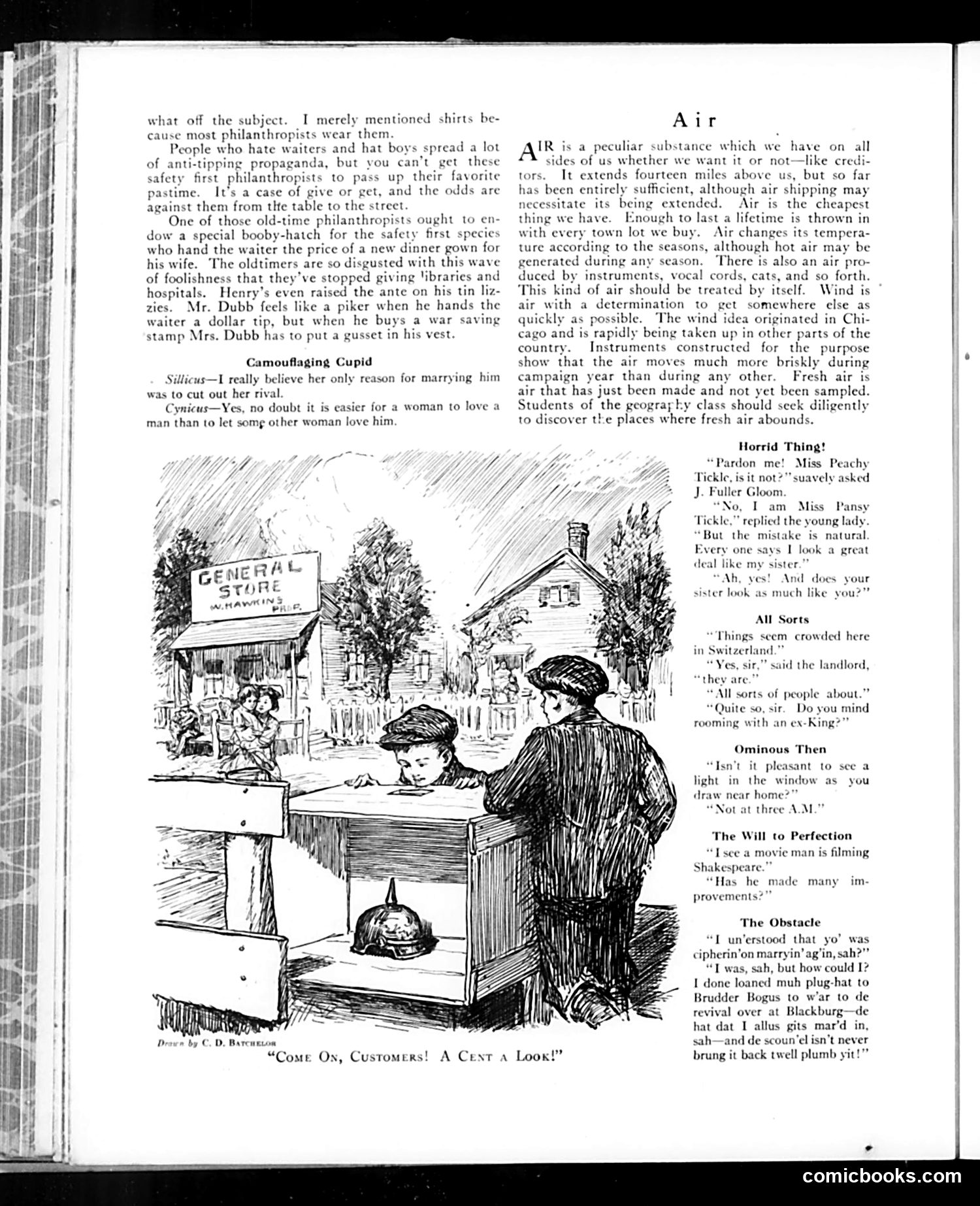
This Judge magazine page contains satirical commentary and humor pieces typical of early 20th-century American magazines. **Main Cartoon**: "Come On, Customers! A Cent a Look!" depicts a traveling showman operating what appears to be a peepshow box outside a general store, attracting curious onlookers. The satire likely mocks both carnival-style entertainment and the gullibility of small-town audiences. **Text Sections**: The page includes brief satirical essays and jokes: - Commentary on tipping culture and "safety first" philanthropists (social criticism of class hypocrisy) - A philosophical piece defining "Air" as an abundant, worthless commodity (metaphorical commentary on empty talk, particularly political speech during "campaign year") - Several short joke exchanges about mistaken identity, Swiss tourism, and African American dialect humor (reflecting period stereotypes) **Overall Tone**: The satire targets philanthropic pretense, social absurdity, and human folly. The African American dialect pieces reflect period racism common to Judge's audience expectations, though presented as comic relief.
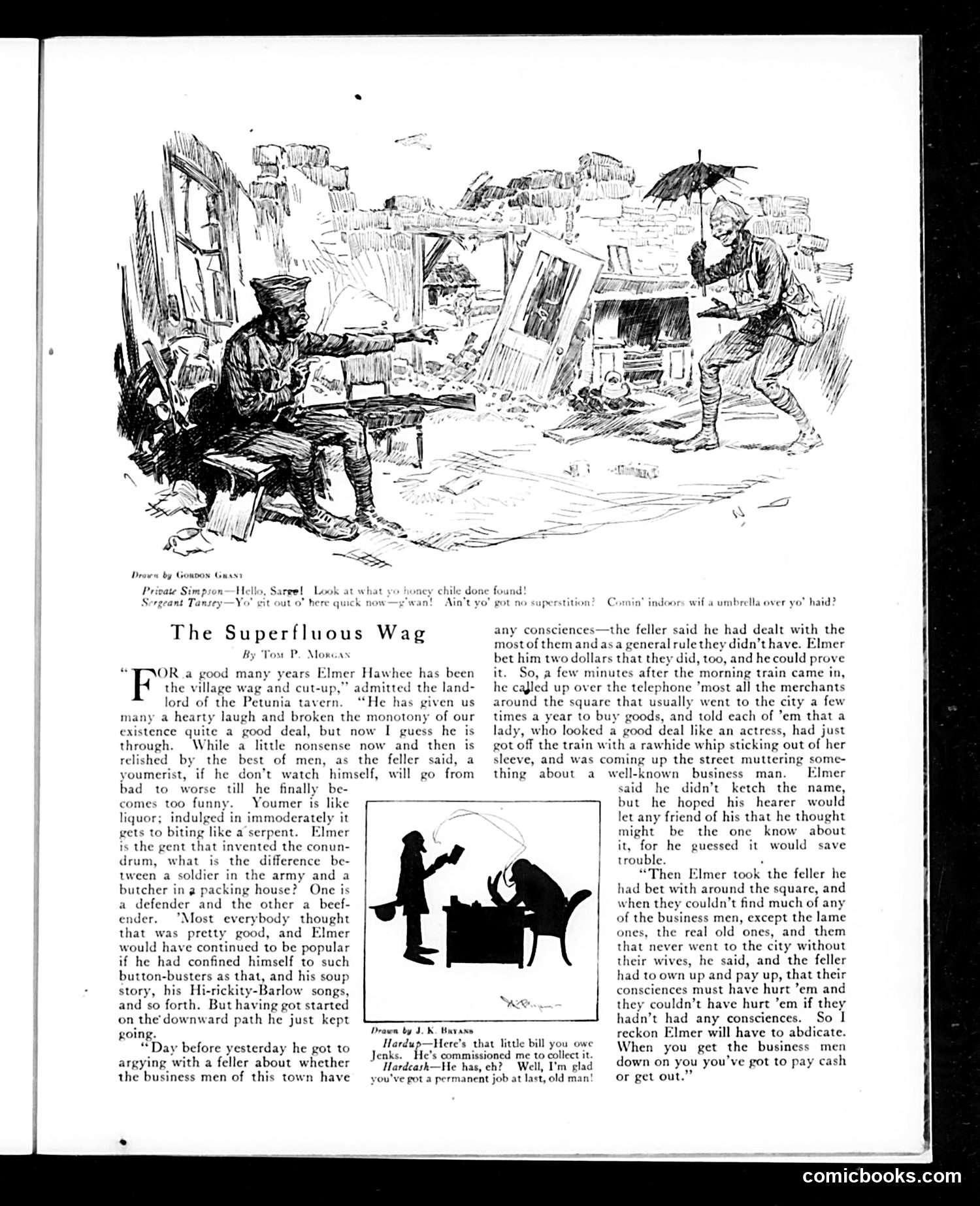
This story satirizes a village prankster named Elmer Hawhee whose practical jokes have gone too far. The tavern keeper explains that while harmless humor once made Elmer popular, he's now become a genuine menace to the town's business community. The satire concerns Elmer's latest scheme: he spreads false rumors about a dangerous woman arriving by train, causing local merchants to avoid their businesses out of fear. When they later learn they were duped, Elmer collects a bet by arguing their guilty consciences prove they *do* have morals—a circular, infuriating logic. The point: excessive joking becomes destructive, and pranksters who antagonize powerful people (business owners) face social exile. The phrase "he will have to abdicate" suggests Elmer's position as the town's entertainer is finished. The accompanying illustrations show rural/small-town settings typical of early 20th-century American humor magazines.
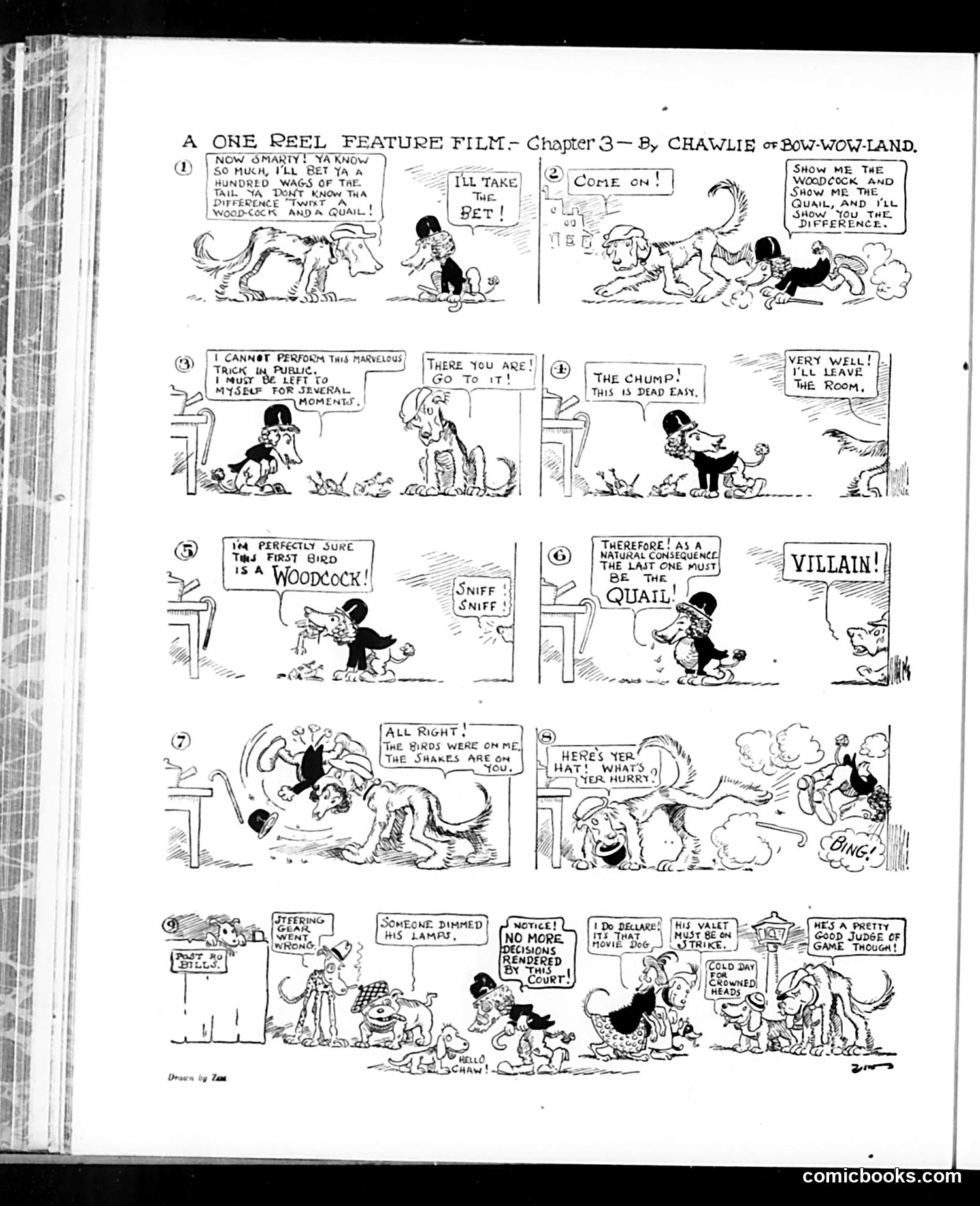
This is a silent-film parody cartoon featuring a character named "Chawlie" (likely a dog character, given "Bow-Wow-Land") attempting to demonstrate the difference between a woodcock and a quail through various comedic mishaps. The humor relies on physical slapstick typical of early cinema: the character claims he can perform tricks only in private, then bundles the attempts in public. The birds escape, causing chaos—shaking, dimmed lamps, and general mayhem. A valet appears confused, and various onlookers react with exaggerated expressions. The satire targets melodramatic silent-film conventions—overwrought titles, dramatic gestures, and elaborate setups that collapse into chaos. The joke is that the character's pompous claims ("I cannot perform this marvelous trick in public") immediately crumble when tested. The comic is primarily entertainment-focused rather than political or social commentary.
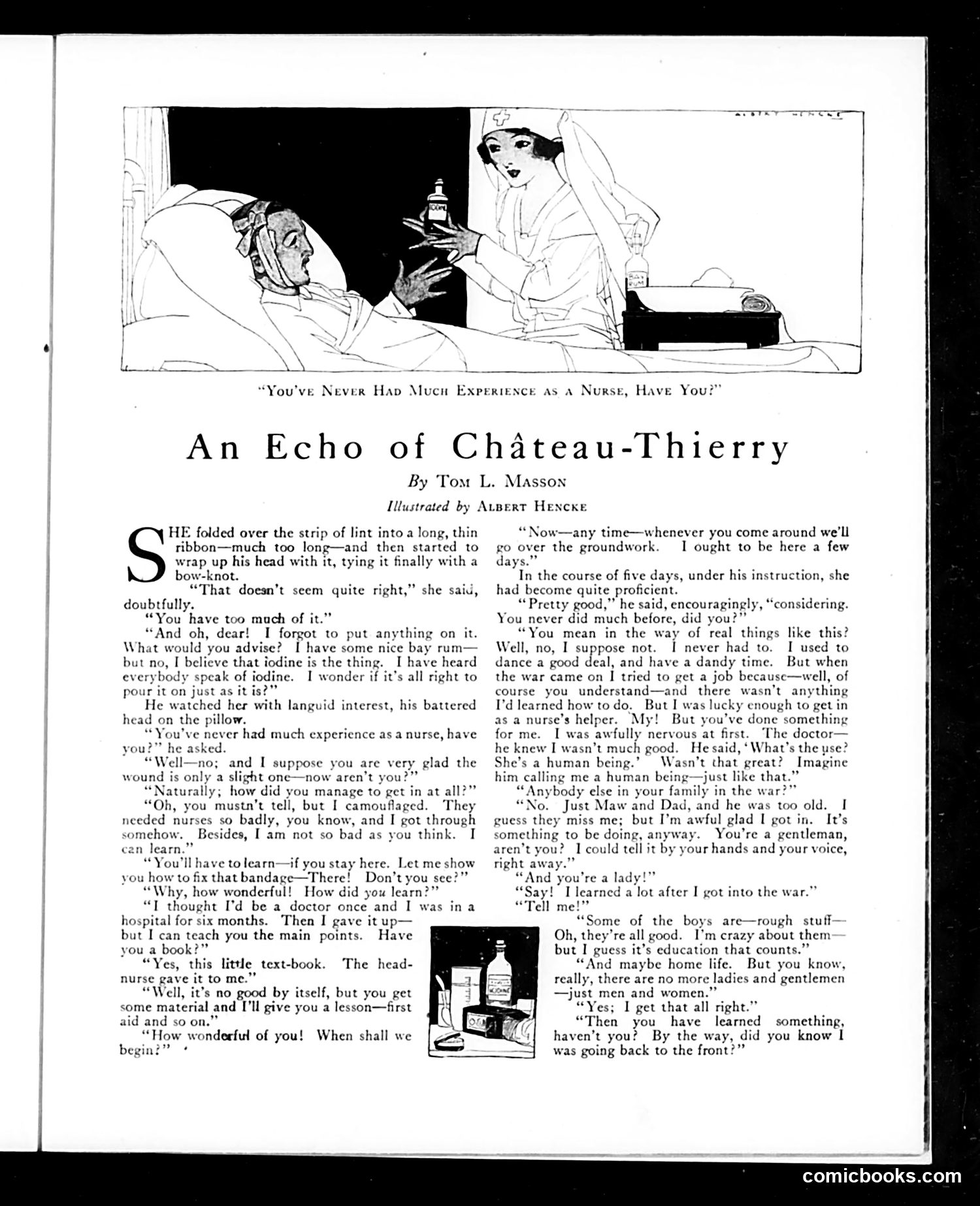
This story depicts a romance between a wounded soldier and an inexperienced female nurse during World War I (Château-Thierry was a major 1918 battle). The satire targets the rapid mobilization of untrained women as nurses due to wartime labor shortages—she admits to "camouflaging" her way into the job despite having no medical experience, only dance training. The social commentary centers on class and gender: the soldier, revealed to be a gentleman through his "hands and voice," teaches her nursing while she gains confidence and purpose. The story's conclusion—his admission he's returning to the front—adds poignancy to their brief connection. The joke is gently ironic: war's chaos forced unqualified women into crucial roles, yet through determination and education, they became competent. The piece romanticizes rather than mocks this situation, suggesting war democratized society ("no more ladies and gentlemen—just men and women").
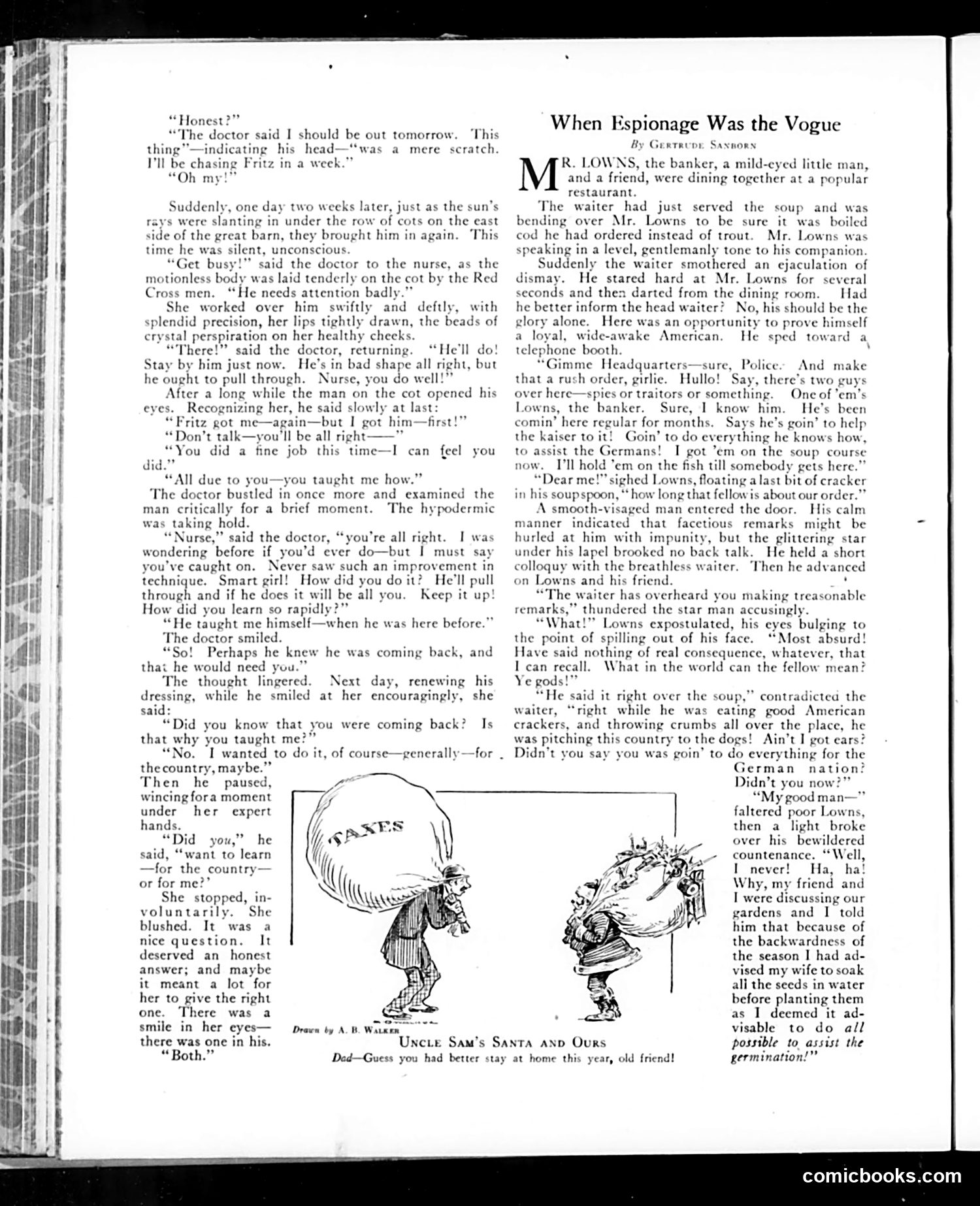
This satirical story mocks the paranoia and zealotry of American civilian spy-catching during World War I. A waiter overhears banker Mr. Lowns casually mention helping "the kaiser" with something—likely a misheard or out-of-context remark about assisting Germany. The waiter, positioning himself as a patriotic vigilante, immediately reports Lowns to police as a spy or traitor, calling it a "rush order." The satire targets two things: (1) the absurdity of untrained civilians making wild espionage accusations based on fragments of conversation, and (2) the bureaucratic eagerness of authorities to investigate such dubious tips. The phrase "When Espionage Was the Vogue" suggests this paranoid accusation-culture was fashionable wartime hysteria rather than serious security work. The cartoon lampoons both misguided patriotism and the invasive surveillance mentality it enabled.
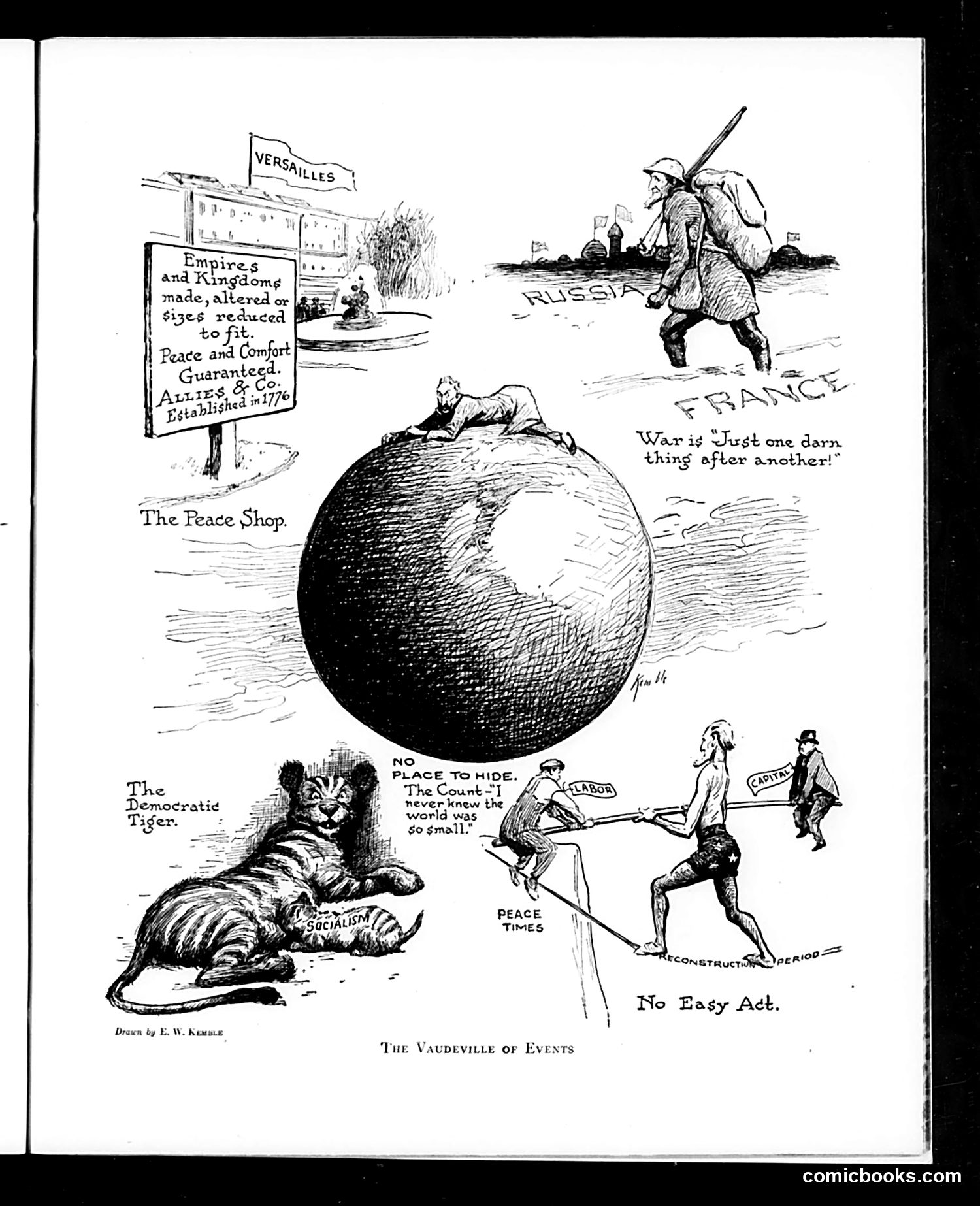
This satirical cartoon critiques post-WWI peacemaking efforts. The central sphere represents the world, with various figures struggling around it, labeled "Labor," "Capital," and "Reconstruction Period." **Key elements:** - **"The Peace Shop"** (upper left): Mocks the 1776 "Allies & Co." establishment, suggesting peace-brokering is mere commerce—empires and kingdoms are simply "altered or reduced" like merchandise. - **"The Democratic Tiger"** (lower left): Labeled "Socialism," this predatory figure lurks amid the chaos, suggesting radical movements threaten stability. - **France and Russia** (upper right): Depicted as armed combatants, showing continued conflict despite official peace. - **"No Easy Act"** (lower right): Men pulling ropes labeled with reconstruction concerns, illustrating that post-war rebuilding requires exhausting effort. The title "Vaudeville of Events" frames world politics as theatrical entertainment—chaotic, absurd performance rather than serious governance. The overall message: peace agreements are superficial; underlying tensions and class conflict persist.
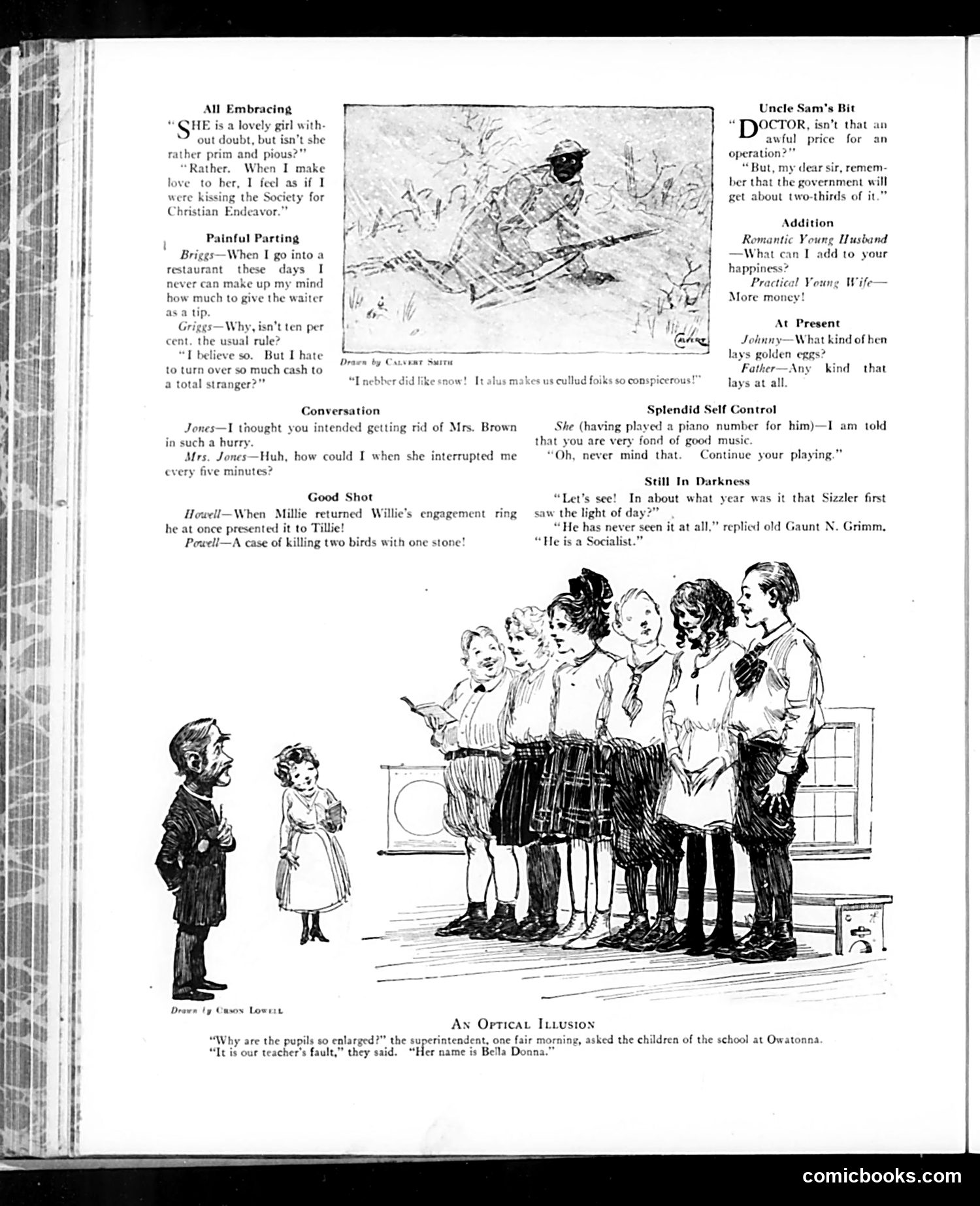
This page contains multiple brief satirical jokes typical of early 20th-century American humor: **"Uncle Sam's Bit"** jokes about war profiteering—a doctor charges an exorbitant surgical fee, justifying it because the government will claim two-thirds as taxes, satirizing how WWI created financial windfalls for some professionals. **"Still In Darkness"** mocks Socialists, suggesting they lack enlightenment or awareness of reality—a common conservative jab at Socialist ideology. **"An Optical Illusion"** puns on "Bella Donna" (belladonna), a plant that dilates pupils. Children's pupils appear enlarged because their teacher has this name—a visual joke playing on the chemical effects of the plant extract. Other jokes address genteel social anxieties: tipping etiquette, romantic propriety, spousal dynamics, and domestic expectations. The humor relies on period-specific concerns about class, gender roles, and social propriety rather than current political events.
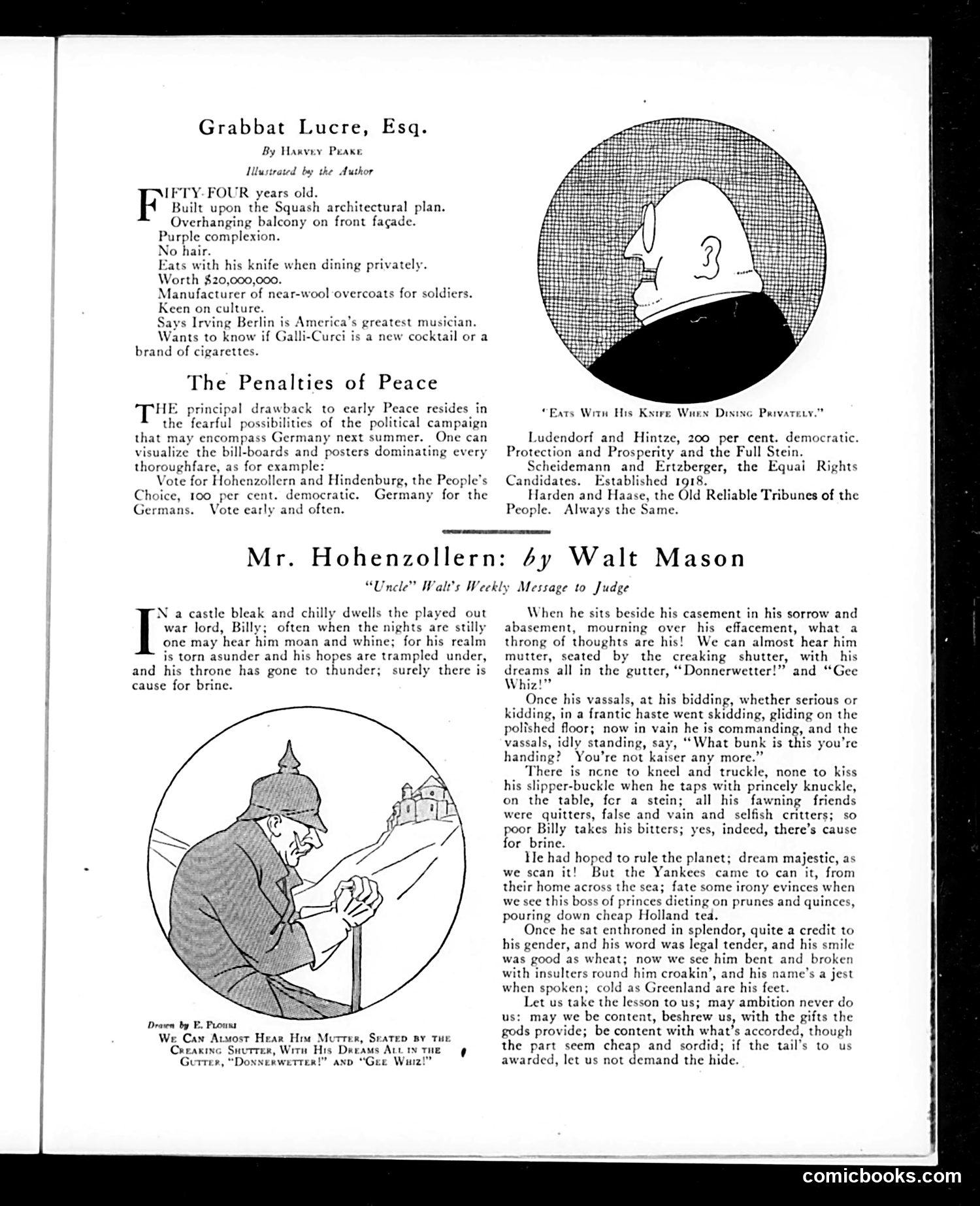
This page contains two satirical pieces about post-WWI German politics and Kaiser Wilhelm II's fall from power. **"Grabbat Lucre, Esq."** mocks an American war profiteer—a wealthy manufacturer ($20 million) of inferior military overcoats for soldiers. The satire highlights his cultural ignorance (confusing famous soprano Galli-Curci with a cocktail) while accumulating vast wealth from the war effort. **"Mr. Hohenzollern"** by Walt Mason depicts the deposed Kaiser Wilhelm II in exile, mourning his lost power. The verses mock his complete reversal of fortune: his obedient vassals now ignore him, his threats carry no weight, and he's reduced to drinking cheap Dutch tea and eating prunes. The accompanying political satire imagines post-war German elections featuring candidates across the political spectrum—from monarchists (Hohenzollern) to democrats (Scheidemann)—all claiming legitimacy. Both pieces satirize the consequences of WWI: war profiteering at home and the humiliation of defeated autocrats abroad.
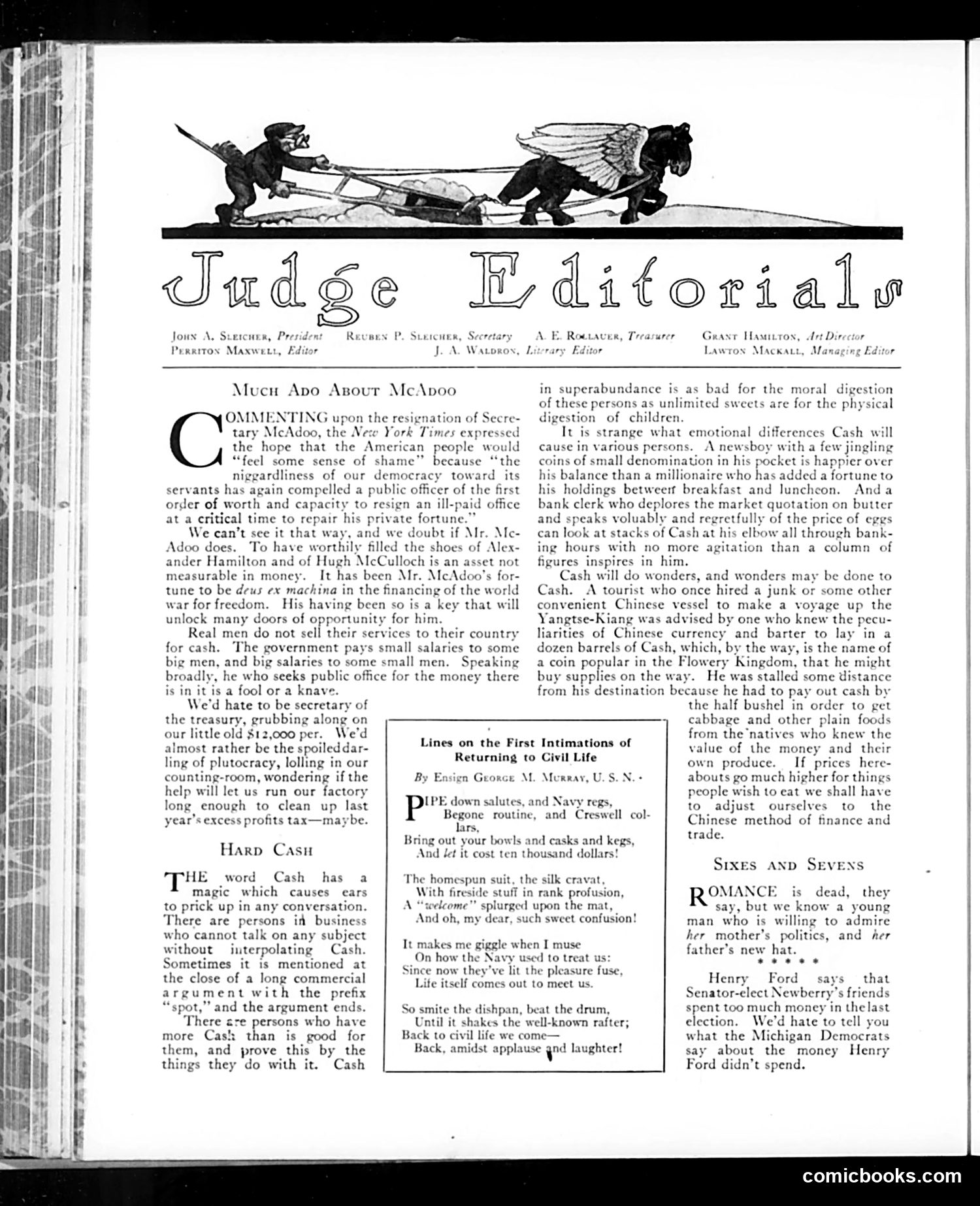
This page satirizes Secretary of the Treasury **William Gibbs McAdoo's resignation** (referenced in the opening editorial). The piece critiques the common assumption that he left office to repair his private fortune—a scandal-worthy implication in American democracy. The editorial argues the opposite: that McAdoo's wartime service as Treasury Secretary (managing U.S. financing during World War I) has given him *opportunity*, not the reverse. Real statesmen serve for duty, not salary, the piece insists. The "Hard Cash" section that follows uses McAdoo's name ironically, exploring how Americans obsess over money. It contrasts emotional responses to wealth: a newsboy's joy with coins versus a millionaire's indifference; a bank clerk's anxiety over egg prices while unmoved by stacks of cash nearby. The accompanying poem celebrates returning servicemen leaving naval life for civilian comfort—relevant to post-WWI demobilization. The satire targets both McAdoo's critics (for assuming greed) and American society's peculiar relationship with money.
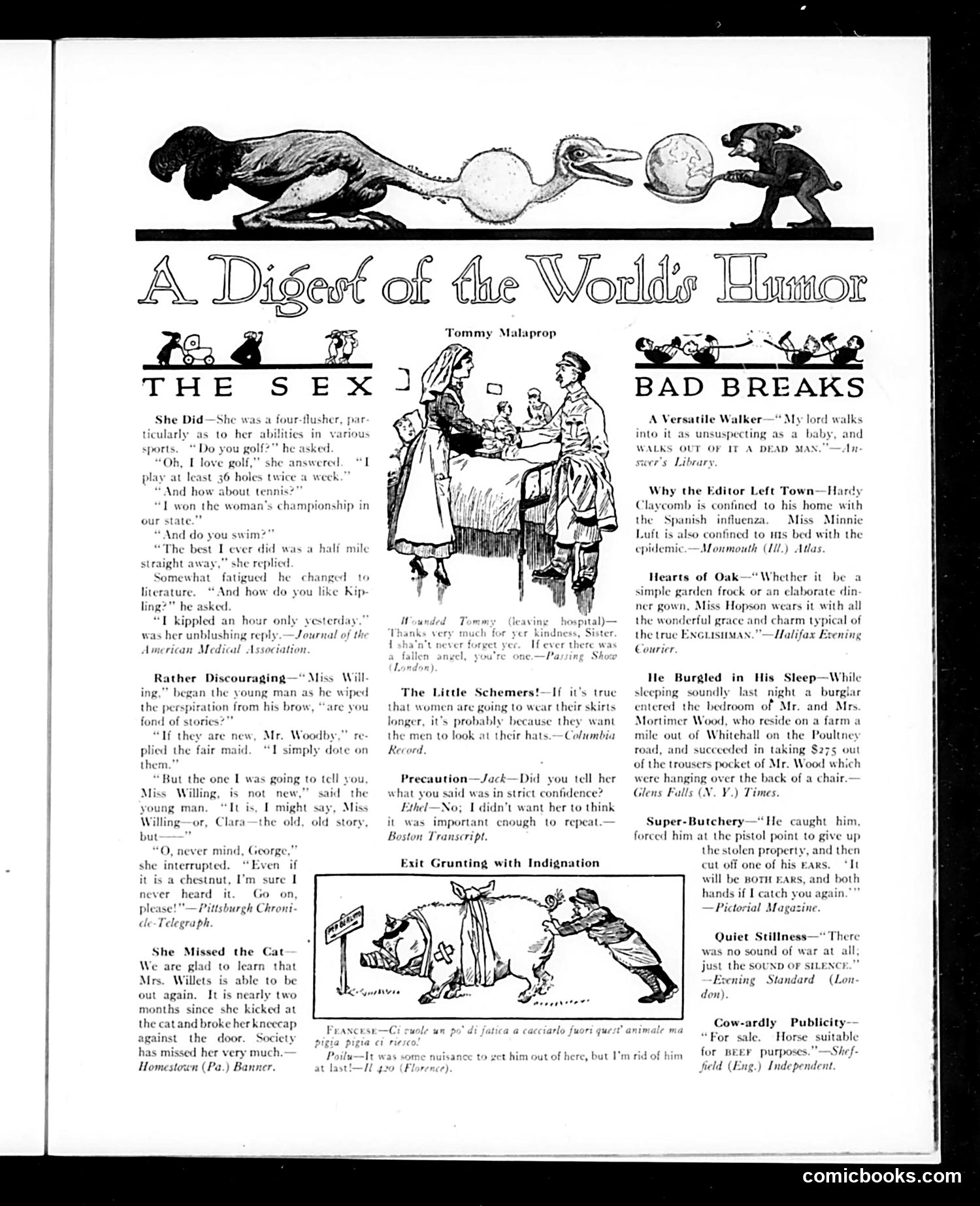
This is a humor compilation page from *Judge* magazine featuring short jokes and amusing newspaper clippings organized by theme. **The cartoons** show two scenes: one depicting a woman with an impossibly long neck (illustrating absurd exaggeration), and another showing a man and woman in conflict over a pig. **The content** consists largely of wordplay and malapropisms. "Tommy Malaprop" features a woman who misuses literary and sporting terms ("kippled" for "read Kipling"). Other items include mild domestic situations (a woman kicking a cat and breaking her knee), absurd newspaper headlines presented as humor (a burglar stealing from a sleeping man's pocket), and puns on double meanings ("Cow-ardly Publicity" advertising a horse "for BEEF purposes"). **The humor style** reflects early 20th-century sensibilities: gentle domestic comedy, linguistic mistakes, and ironic newspaper excerpts. The Spanish influenza reference suggests this is from around 1918-1920. The satire targets everyday life rather than politics.
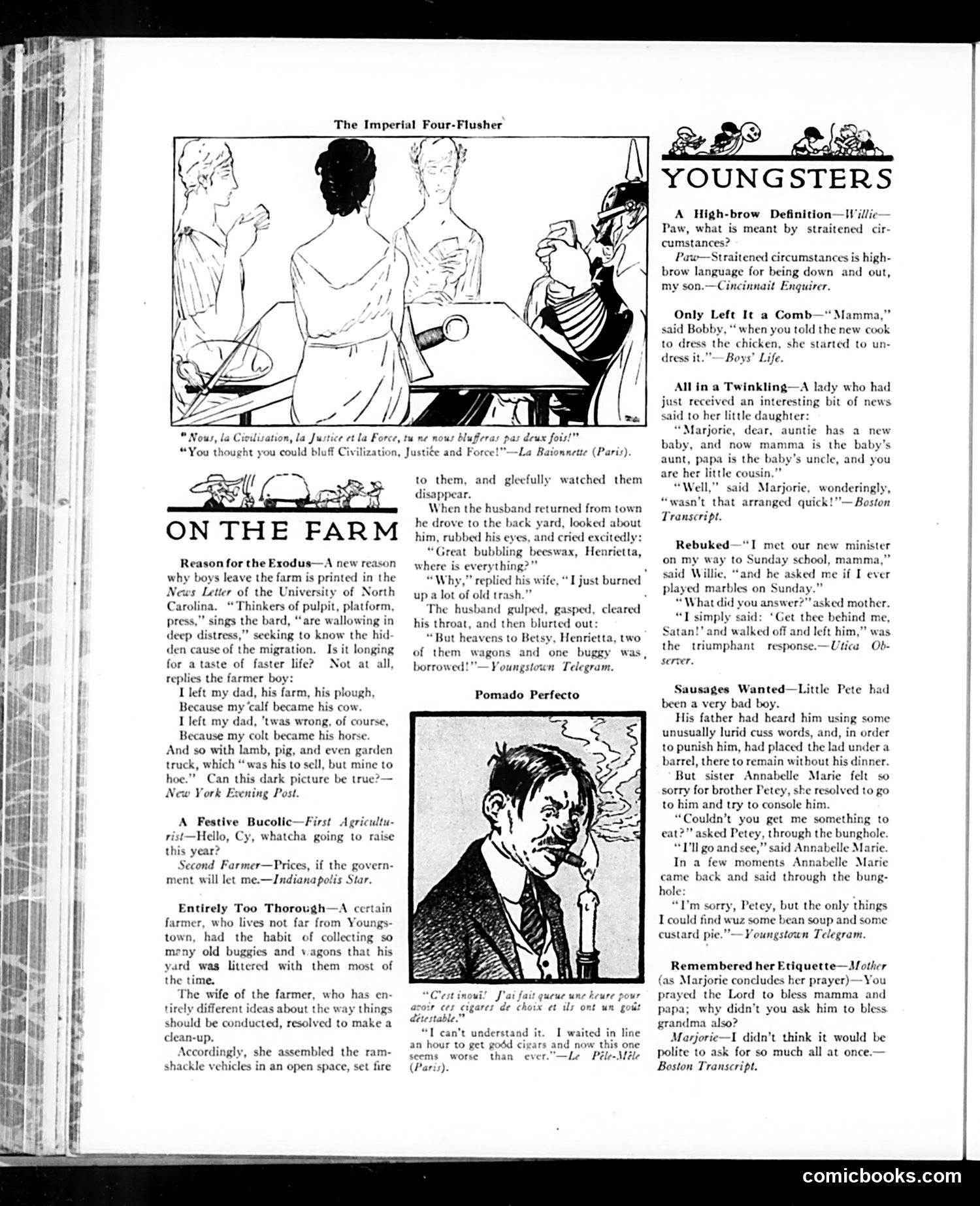
This Judge magazine page contains satirical humor pieces about rural and domestic life, plus a political cartoon about French politics. **The top cartoon**, "The Imperial Four-Flusher," references French political figures (identities unclear from the image alone) and criticizes someone accused of bluffing about civilization, justice, and force—likely commentary on a French political scandal or diplomatic controversy. **The farm section** consists of four jokes mocking rural life: a boy leaving farming because property becomes his father's, a farmer hoping to "raise prices" (economic satire), a wife burning old farm equipment (creating an ironic situation), and a Frenchman complaining about cigar quality after waiting in line. **The "Youngsters" section** offers light humor about children's misunderstandings and misbehavior—typical period family comedy. The overall tone satirizes both rural agricultural economics and urban/European sophistication, reflecting early-20th-century American magazine humor targeting educated city readers.
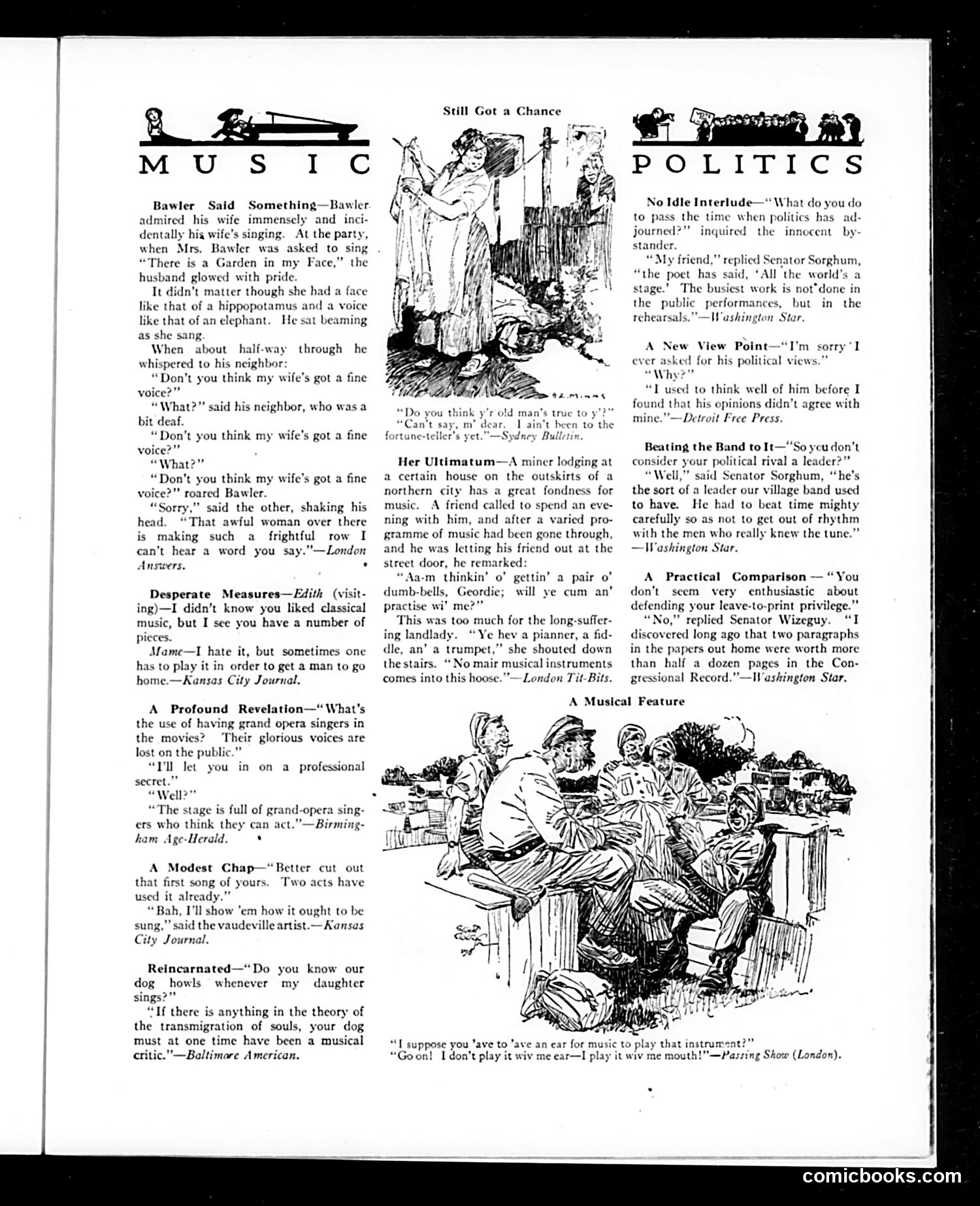
This page combines humor columns about music (left) and politics (right), typical of Judge's satirical format. **Music Section**: Multiple brief anecdotes mock tone-deaf singers and music lovers. The recurring joke: people with poor musical taste or ability remain oblivious to their own inadequacy. Examples include a husband proud of his wife's terrible singing voice, and a miner so musically enthusiastic his landlady threatens to ban instruments from her house. **Politics Section**: Features Senator Sorghum (a recurring Judge character) and Senator Wizeguy in commentary on political conduct. The satire suggests politicians view public performance as secondary to private "rehearsals" (backroom dealing), that political leaders lack genuine ability, and that newspaper coverage matters more than congressional records. These pieces mock political hypocrisy and the gap between public rhetoric and private behavior. **Bottom Cartoon**: A working-class musician jokes about playing a wind instrument "with me mouth" rather than "an ear"—a pun on musical aptitude versus physical technique. The page's unified theme: people's self-delusion about their talents, whether musical or political.
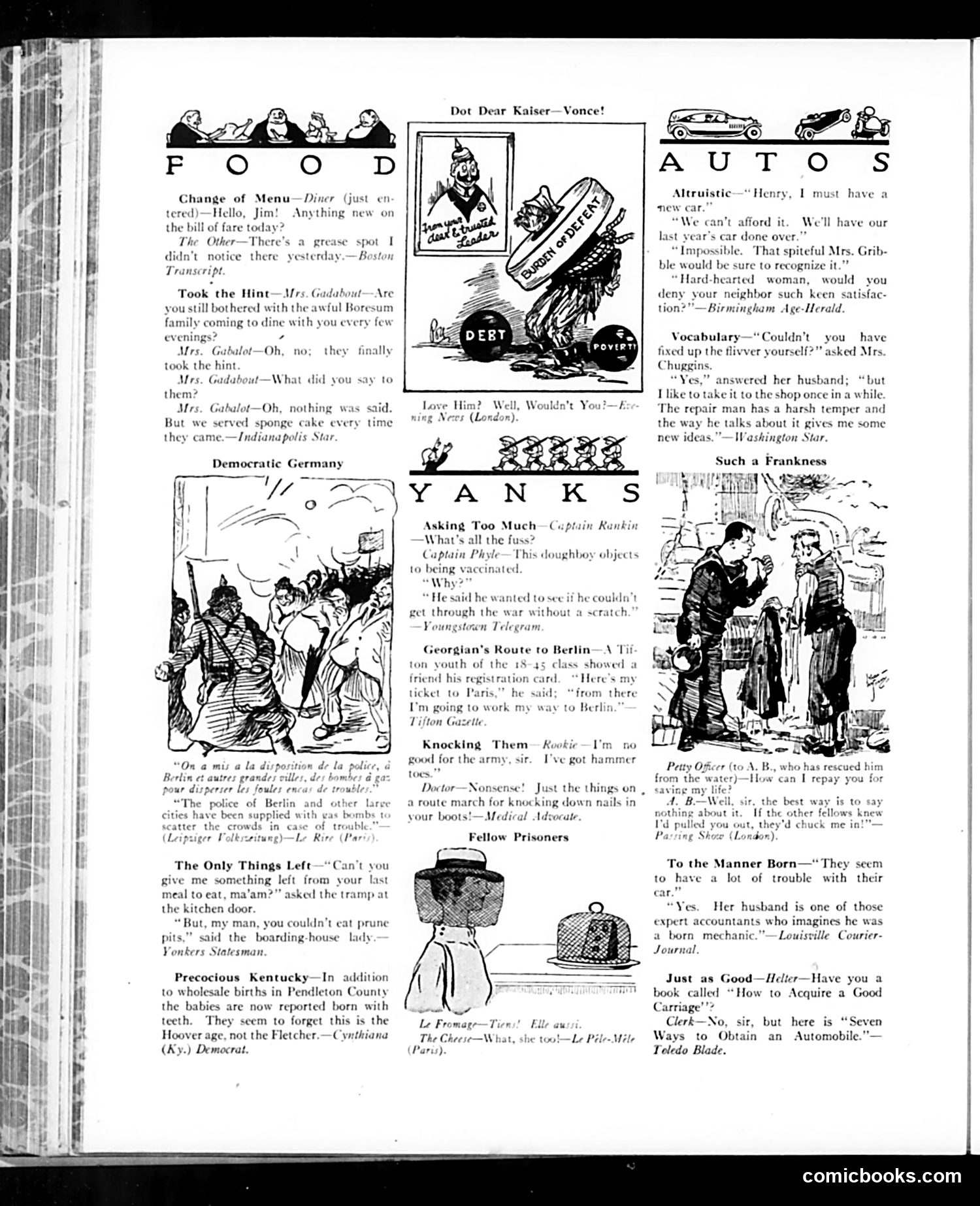
This page from Judge combines humor sections with satirical commentary on post-WWI American life and international politics. **"Democratic Germany"** depicts chaos in Weimar Germany following WWI, with figures in disarray—satirizing the political instability and disorder afflicting the defeated nation. The **"Yanks"** section mocks American military preparedness through jokes about soldiers reluctant to serve (one claiming "hammer toes" to avoid the army) and draftees uncertain about their deployment. **Food and Auto sections** use domestic humor to critique American consumer culture and class anxieties. The "Autos" jokes highlight status-consciousness—a woman refusing to repair her old car lest a neighbor recognize it—and marital tensions over spending. Throughout, the satire reflects 1920s concerns: post-war economic adjustment, class mobility, gender dynamics in marriage, and American military involvement. The humor is period-specific, relying on contemporary anxieties about automobiles as status symbols and unstable international conditions following the Great War.
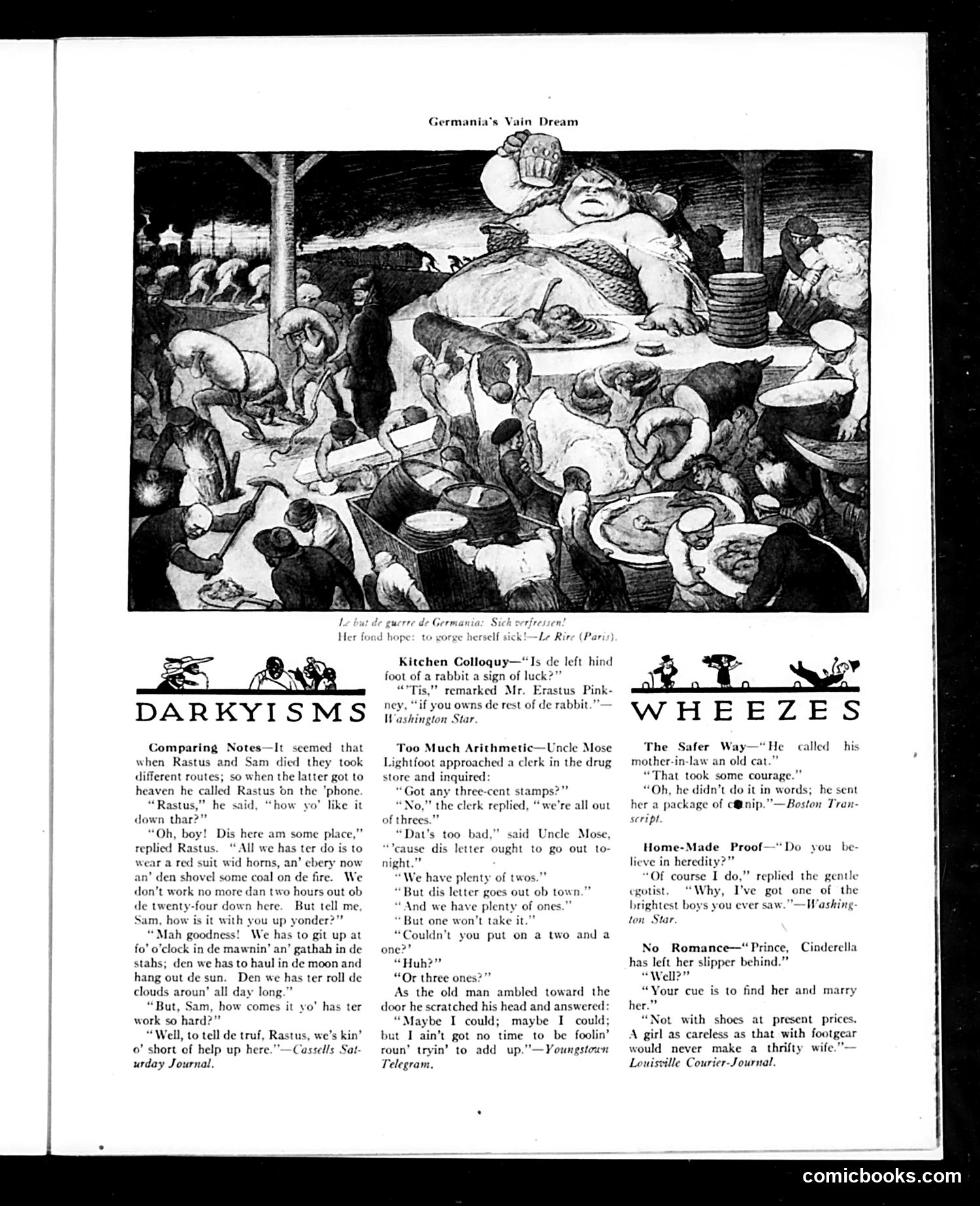
This page from *Judge* presents racist humor typical of early 20th-century American satire. The content relies on crude ethnic stereotypes and dialect caricature. **The Main Cartoon** ("Germania's Vain Dream") depicts a grotesque figure representing Germany feasting amid chaos—likely WWI-era political commentary on German imperial ambitions, though the image's crude style obscures precise details. **"Darkyisms" Section**: A collection of jokes featuring African American characters (Rastus, Sam, Uncle Mose) speaking in exaggerated dialect. The humor trades on racial stereotypes: one joke contrasts "heaven" (hard labor) with hell (easier work), playing on racist assumptions about Black workers. Another features an elderly Black man struggling with simple arithmetic regarding postage stamps. **Other Jokes**: Generic period humor about rabbit's feet, mother-in-laws, and heredity—unrelated to the racial content but typical of the page's miscellaneous "humor" format. The entire "Darkyisms" section represents deeply offensive historical racism presented as entertainment, reflecting the magazine's casual prejudice toward Black Americans.
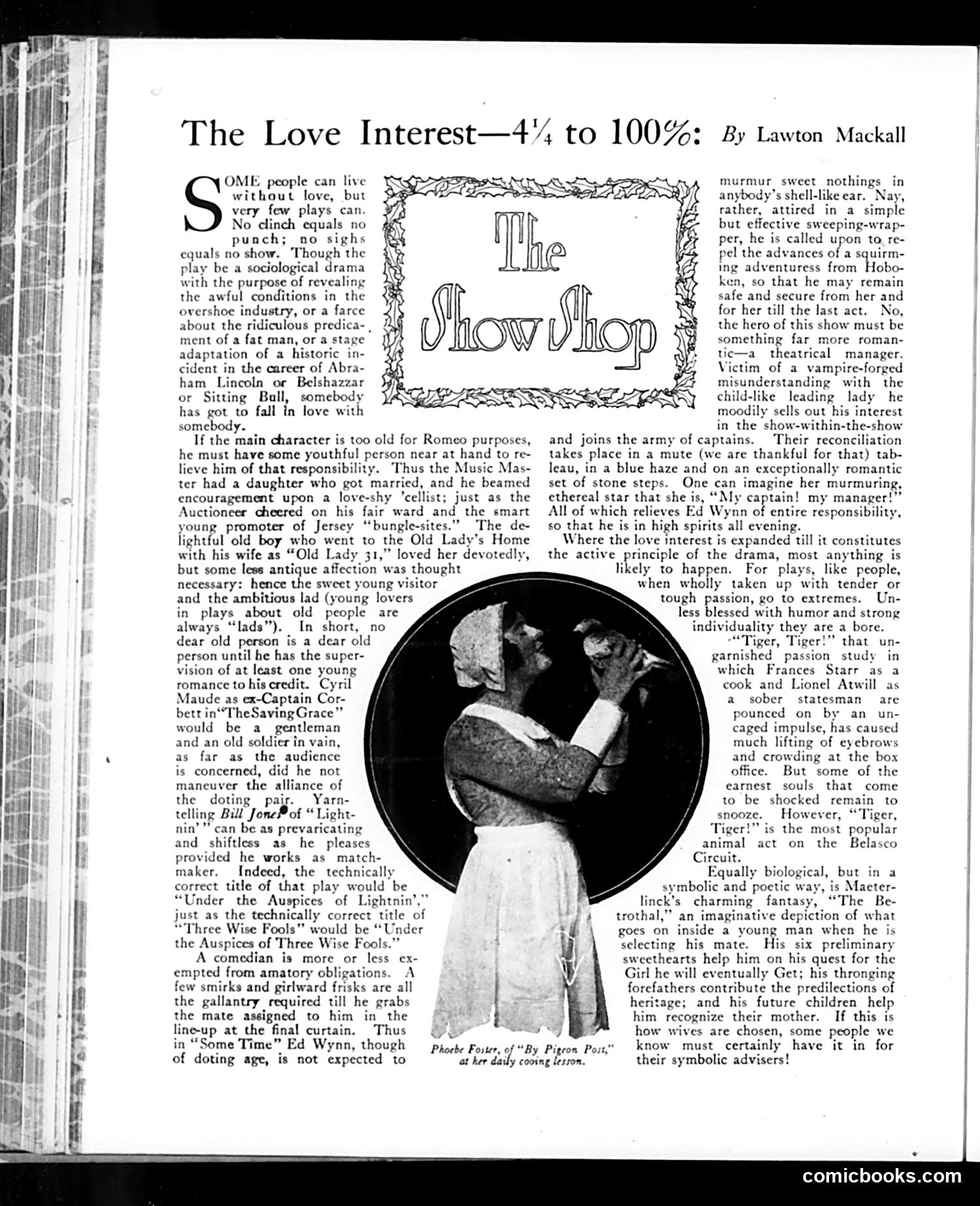
This is a theater criticism essay by Lawton Mackall examining why romantic subplots are essential to dramatic works—even plays ostensibly about other subjects. The author argues that audiences expect "love interest" to drive theatrical engagement. The piece references contemporary Broadway productions to illustrate his point: *The Music Master*, *The Auctioneer*, *Old Lady 31*, *The Saving Grace* (starring Cyril Maude), *Lightnin'* (with Bill Jones), *Three Wise Fools*, and *Some Time* (featuring Ed Wynn). The photograph shows two performers in an intimate scene, exemplifying the romantic tableau the essay discusses. Mackall's argument: playwrights automatically inject young lovers into plots regardless of subject matter—even historical dramas about Abraham Lincoln or farces about fat men require romantic elements. Even comedians like Wynn get exempted from actively pursuing romance; instead, amatory plots happen *around* them. The essay suggests this convention, while sometimes clichéd, remains theatrically necessary for audience satisfaction.
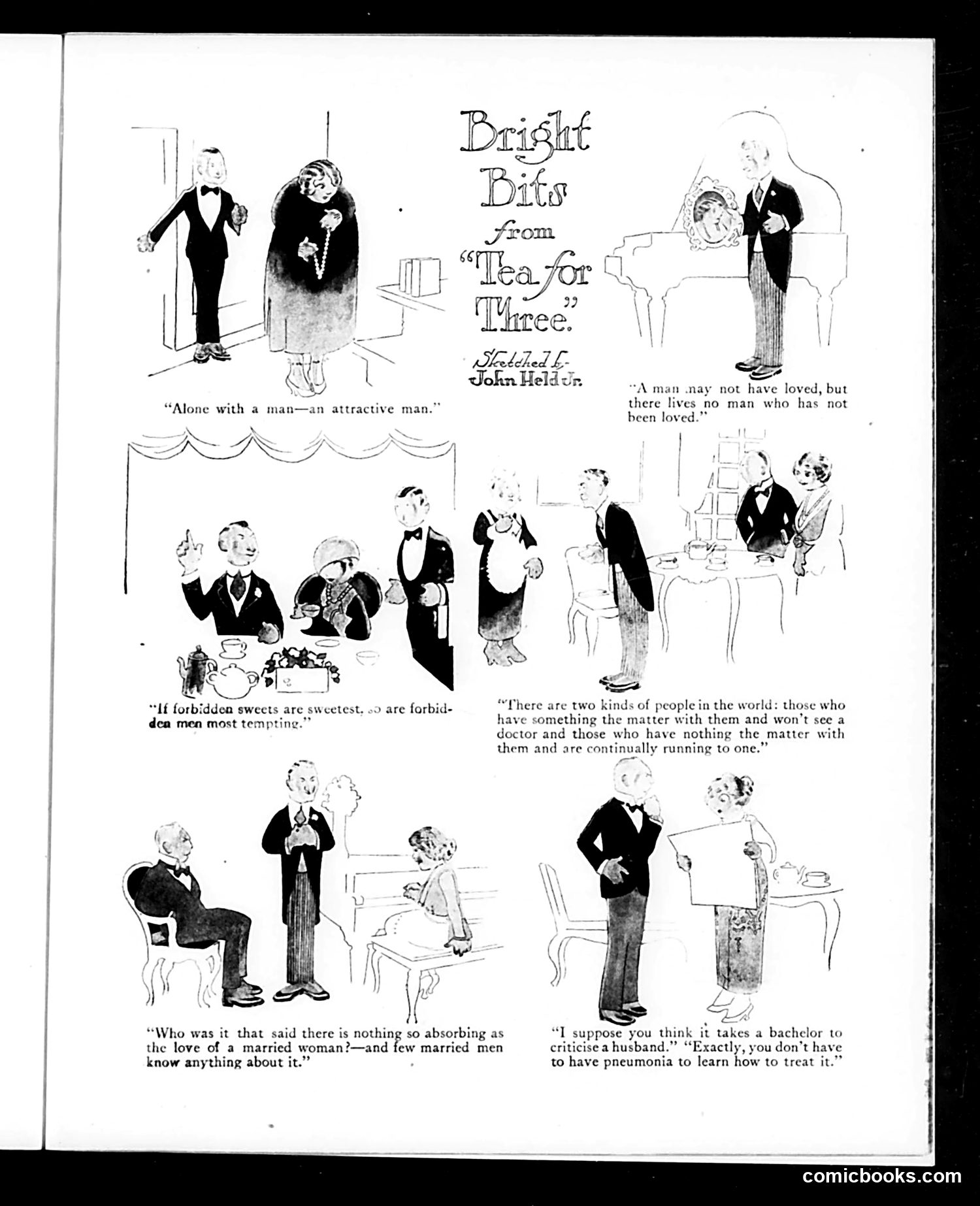
This is a humor page by John Held Jr. featuring six satirical vignettes about romance, marriage, and social behavior—common Judge magazine fare of the 1920s-30s. The jokes target predictable human behaviors: forbidden romance's allure, hypochondriacs versus stoic sufferers, married men's ignorance of women's feelings, and armchair critics. One panel mocks bachelors presuming to judge husbands without experience—"you don't need pneumonia to criticize treatment." The cartoon style and social commentary reflect Jazz Age attitudes: urbane, cynical observations about relationships and gender dynamics presented as witty one-liners. The illustrations depict well-dressed figures in formal settings, emphasizing the upper-class audience Judge targeted. No specific political figures or events are referenced; this is pure social satire on universal human folly.
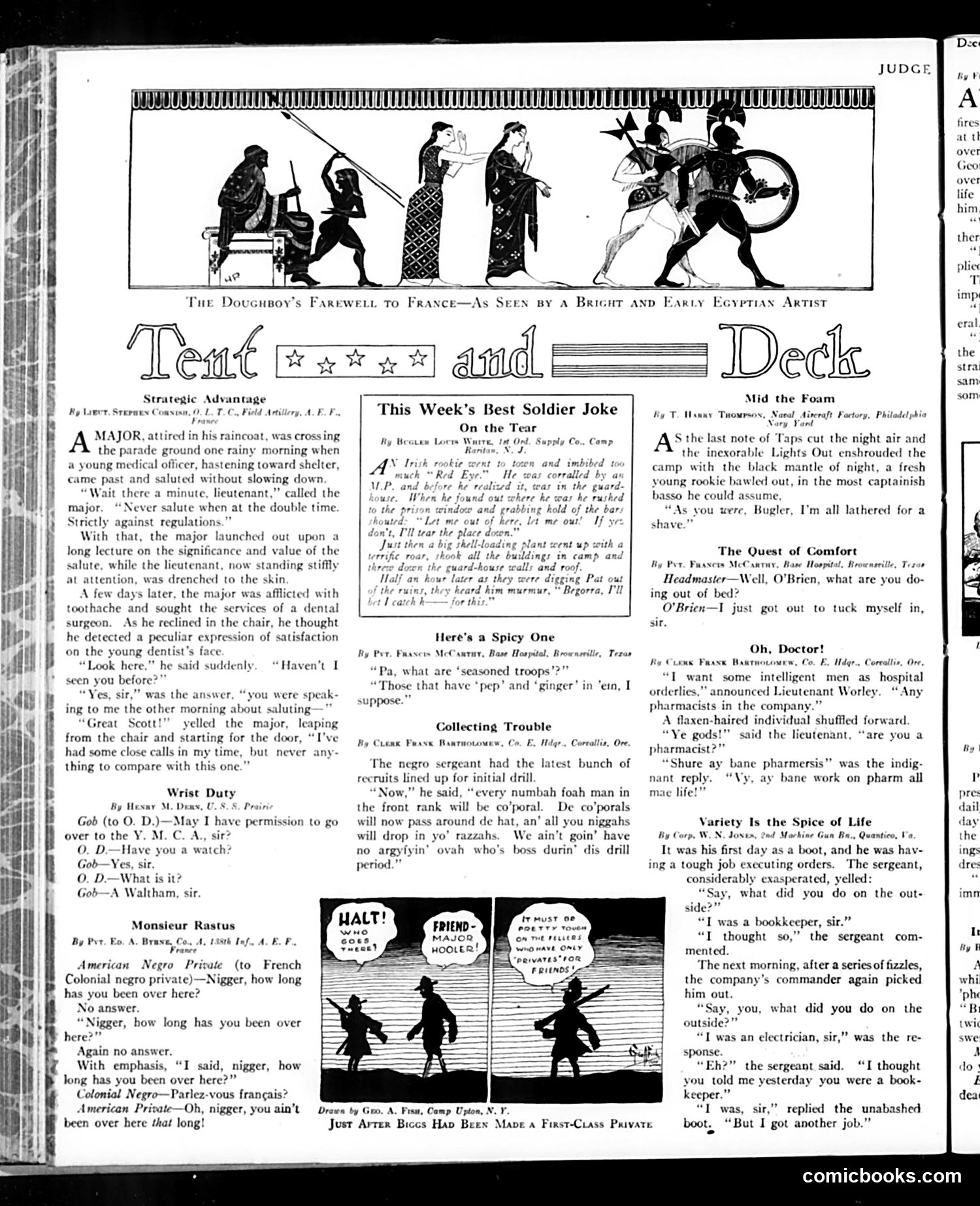
This page from *Judge* presents military humor from the World War I era, featuring anecdotes and jokes about soldiers and officers. **Main Cartoons/Stories:** The header illustration depicts "The Doughboy's Farewell to France" in Egyptian art style—likely satirizing overly-artistic war romanticization. **Key Pieces:** - **"Strategic Advantage"**: A major lectures a drenched lieutenant about proper saluting; later, the same lieutenant (now a dentist) extracts the major's teeth without saluting—poetic revenge. - **Racial/Ethnic Humor**: Several jokes use racial epithets and stereotypes (including caricatures of Black soldiers), reflecting deeply offensive period attitudes. These include jokes about "seasoned troops" and a Black sergeant organizing recruits. - **"Wrist Duty"**: A sailor's watch becomes a running joke about military procedure. - **Hospital/Medical Anecdotes**: Various barracks humor about confused recruits and military life. **Context**: This represents typical WWI-era military magazine humor—crude by modern standards, with heavy reliance on stereotypes, hierarchy-based comedy, and enlisted men's perspectives on officer absurdity.
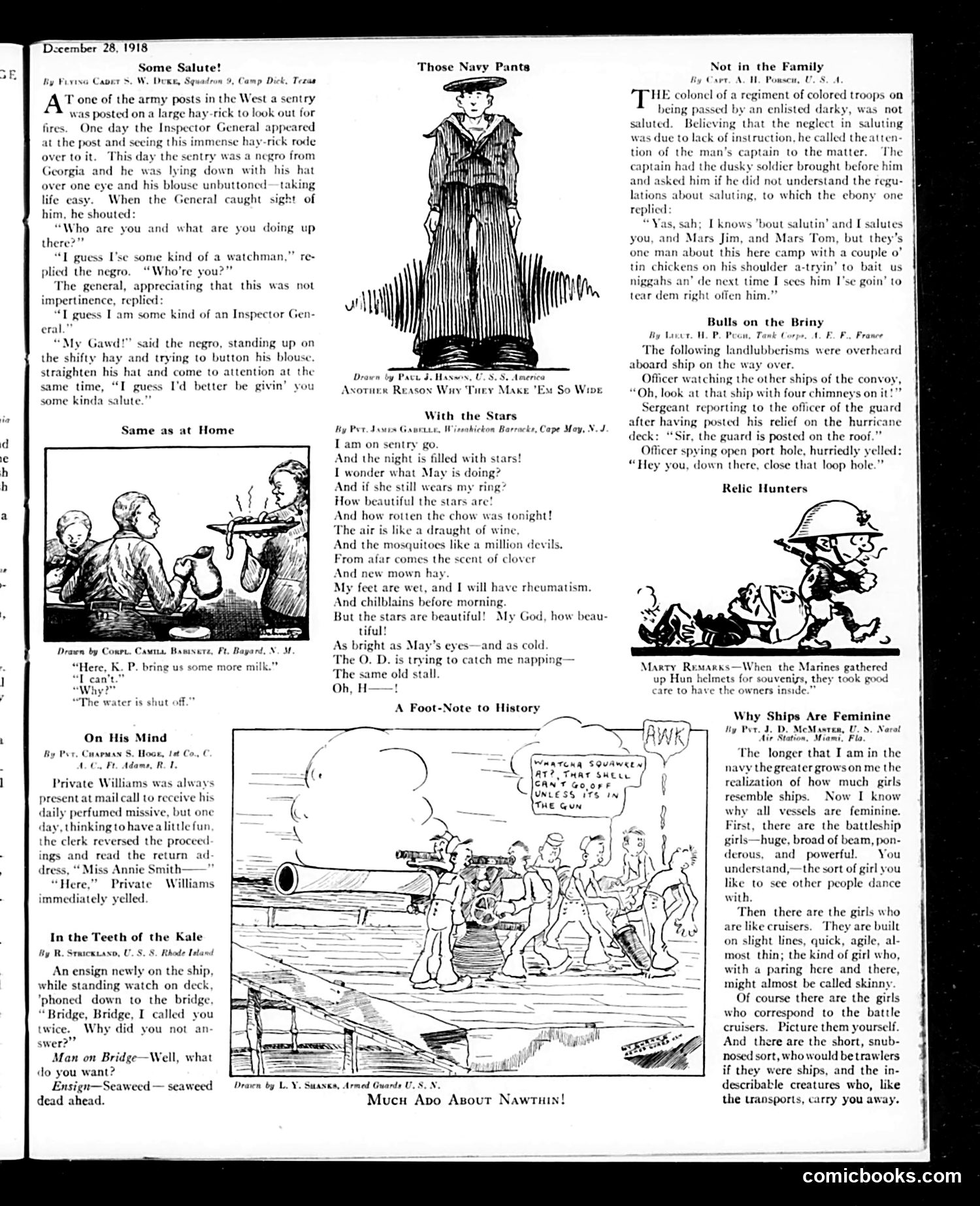
This December 1918 issue of *Judge* contains humor reflecting post-WWI military life. The main pieces satirize soldiers' experiences: **"Some Salute!"** presents a racial stereotype—a Black Georgia soldier casually addressing an Inspector General with exaggerated dialect. The humor relies on period racist caricature and mock-reverent behavior. **"With the Stars"** depicts a sentimental soldier on night watch balancing romantic thoughts of "May" with complaints about chow, mosquitoes, and wet feet—capturing the mundane reality beneath military romance. **"Bulls on the Briny"** mocks landlubbers' naval terminology mistakes aboard a transport ship. **"Not in the Family"** again uses racial caricature, showing a Black soldier refusing to salute a particular officer while respecting others—the humor hinging on dialect and implied insubordination. The magazine reflects 1918 attitudes: casual racism in military humor was normalized and considered acceptable for public consumption. These pieces document period prejudices rather than challenge them.
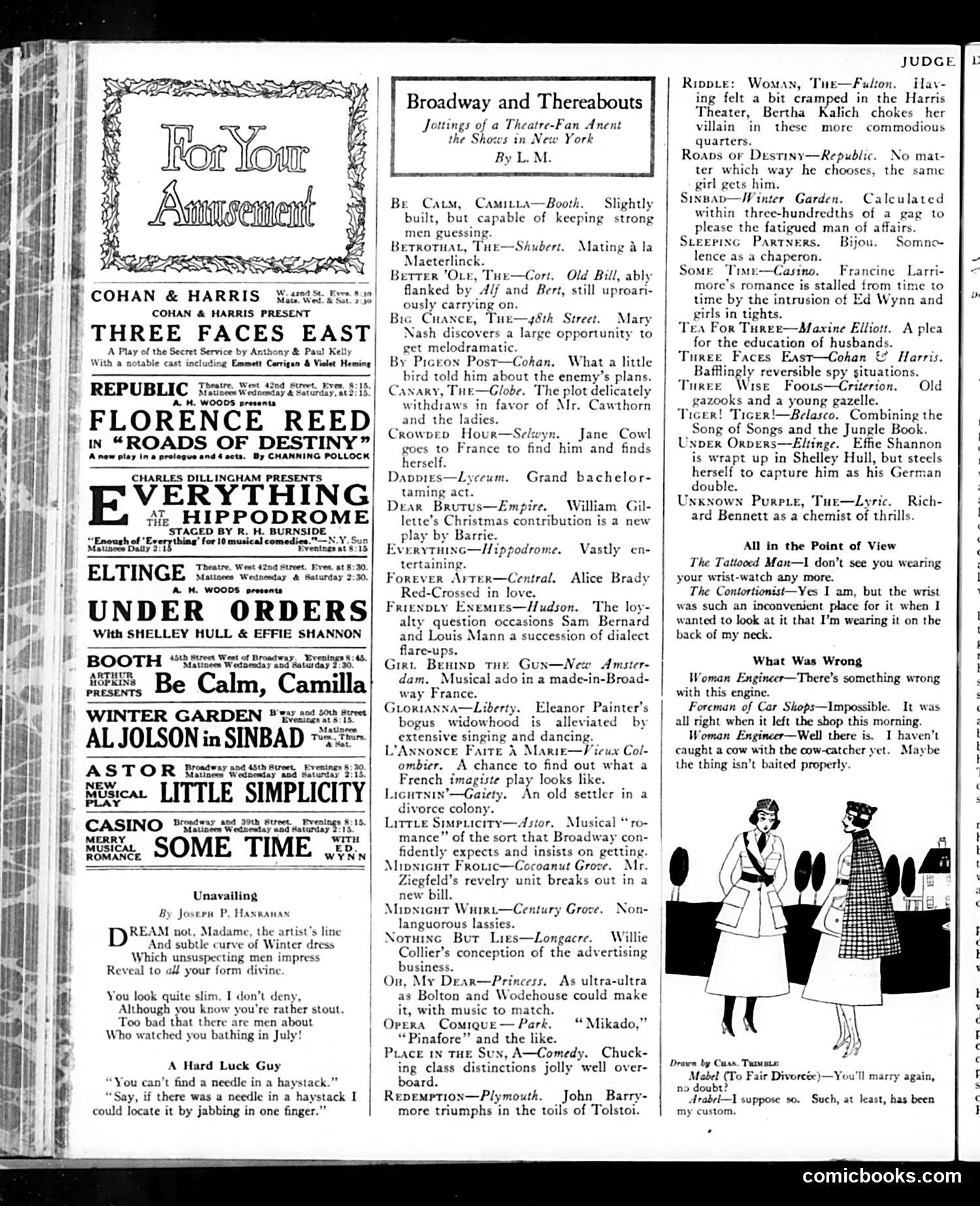
This is primarily a **theater listings and reviews page** from Judge magazine, not a political cartoon page. The content consists of: **Theater Reviews Section** ("Broadway and Thereabouts"): Brief, witty synopses of current Broadway shows with sarcastic commentary. For example, "Be Calm, Camilla" features a "slightly built" woman who can "keep strong men guessing," and "Dear Brutus" is described as "William Gillette's Christmas contribution." **Two Minor Cartoons/Jokes**: 1. "Unavailing"—mocks women's fashion, suggesting corsets deceive men about women's actual figures 2. "A Hard Luck Guy"—a simple pun about finding needles in haystacks **Extensive Theater Advertisements** dominating the page, promoting shows like "Three Faces East," "Florence Reed," and "Al Jolson in Sinbad." The page reflects 1910s-era Broadway culture and Judge's focus on satirizing contemporary entertainment and social pretensions, particularly around fashion and theater.
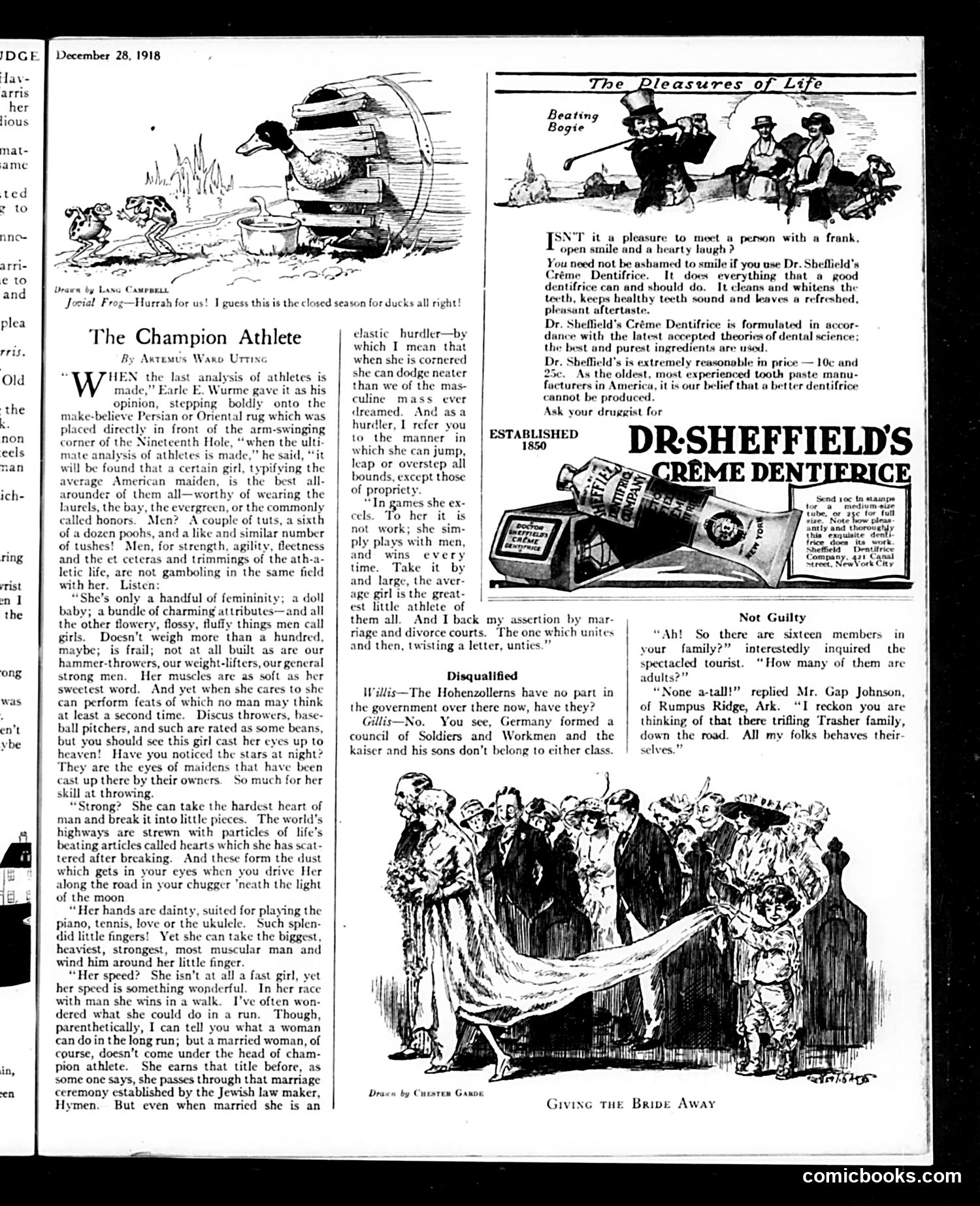
**The duck cartoon** (top left): A frog celebrates the hunting season's closure, protecting ducks from being shot. This is a simple nature joke with no political significance. **"The Champion Athlete"** (main article): A satirical defense of women's athletic abilities, disguised as praise but ultimately condescending. The author argues women outperform men in "feminine" skills—emotional manipulation, breaking hearts, wrapping men around their fingers—using exaggerated romantic language. The joke targets both women (stereotyping them as manipulative) and men (as weak-willed). Published in December 1918, just as women gained voting rights, this reflects anxiety about changing gender roles. **"Disqualified"** (bottom): A brief topical joke referencing Germany's recent post-WWI revolution (November 1918). The Kaiser and his sons are excluded from the new government because they belong to neither the "Soldiers and Workmen" councils nor the working class—a dark joke about their sudden irrelevance. **The advertisement** for Dr. Sheffield's Creme Dentifrice is standard product promotion.
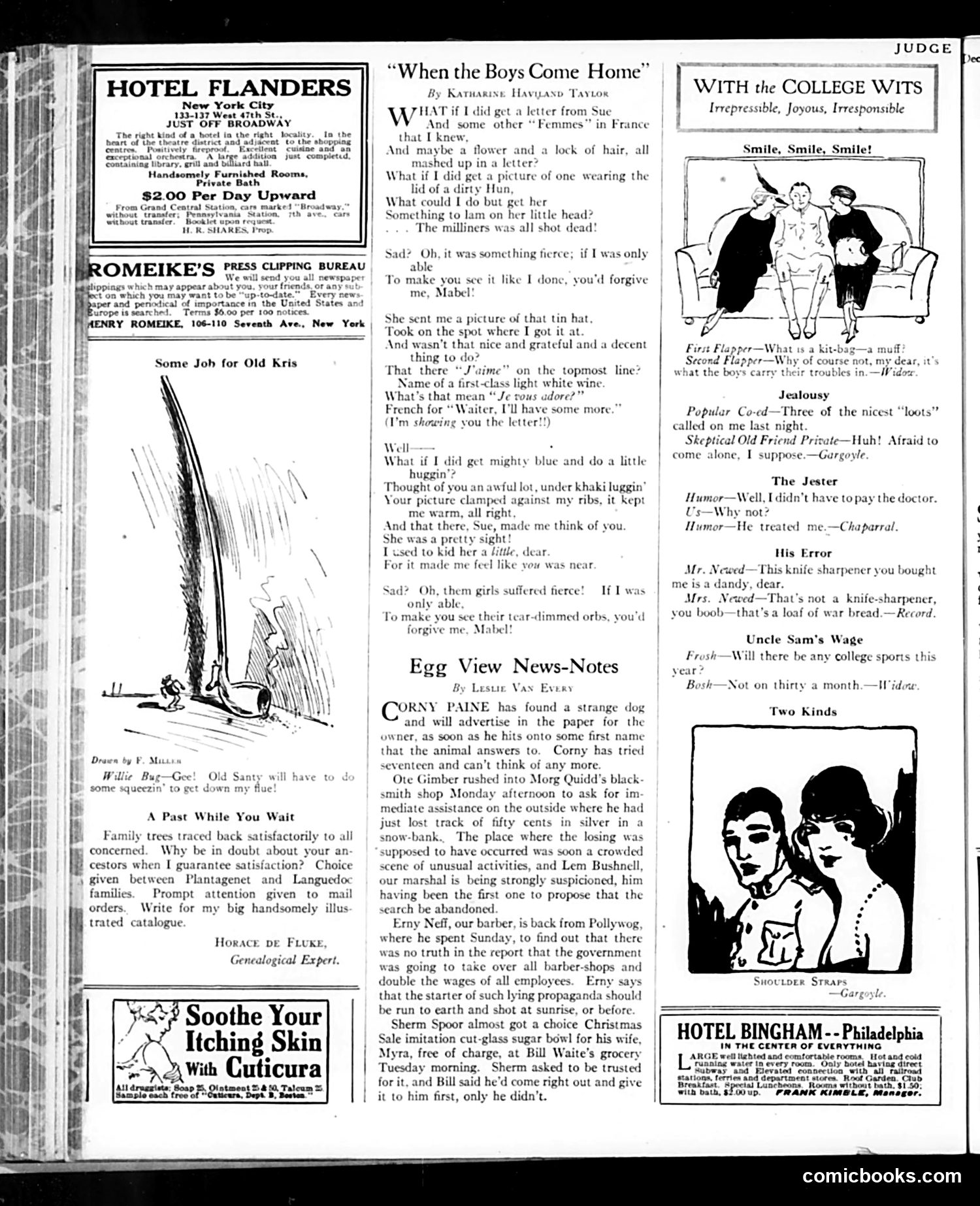
This page from Judge magazine mixes advertising with social commentary typical of the 1920s post-WWI era. **Main Content—"When the Boys Come Home":** A soldier's humorous monologue justifies his romantic correspondence with French women ("Femmes") while deployed abroad. He received a photo showing a woman wearing a captured German military helmet, which he took as a romantic gesture. The poem addresses his sweetheart Mabel back home, explaining these letters were innocent wartime companionship, not infidelity. The satire gently mocks soldiers' tendency to rationalize their overseas dalliances and the awkward explanations they'd offer their stateside girlfriends. **"Egg View News-Notes":** A rural gossip column mixing absurd small-town anecdotes—a lost dog, missing coins, false rumors about government barber-shop takeovers. This satirizes provincial life's petty dramas and unreliable rumor mills. **Advertisements:** The page includes hotel and genealogical expert ads—typical period advertising—and a Cuticura skin remedy ad. The overall tone reflects post-WWI American humor about soldiers returning home and readjusting civilian life.
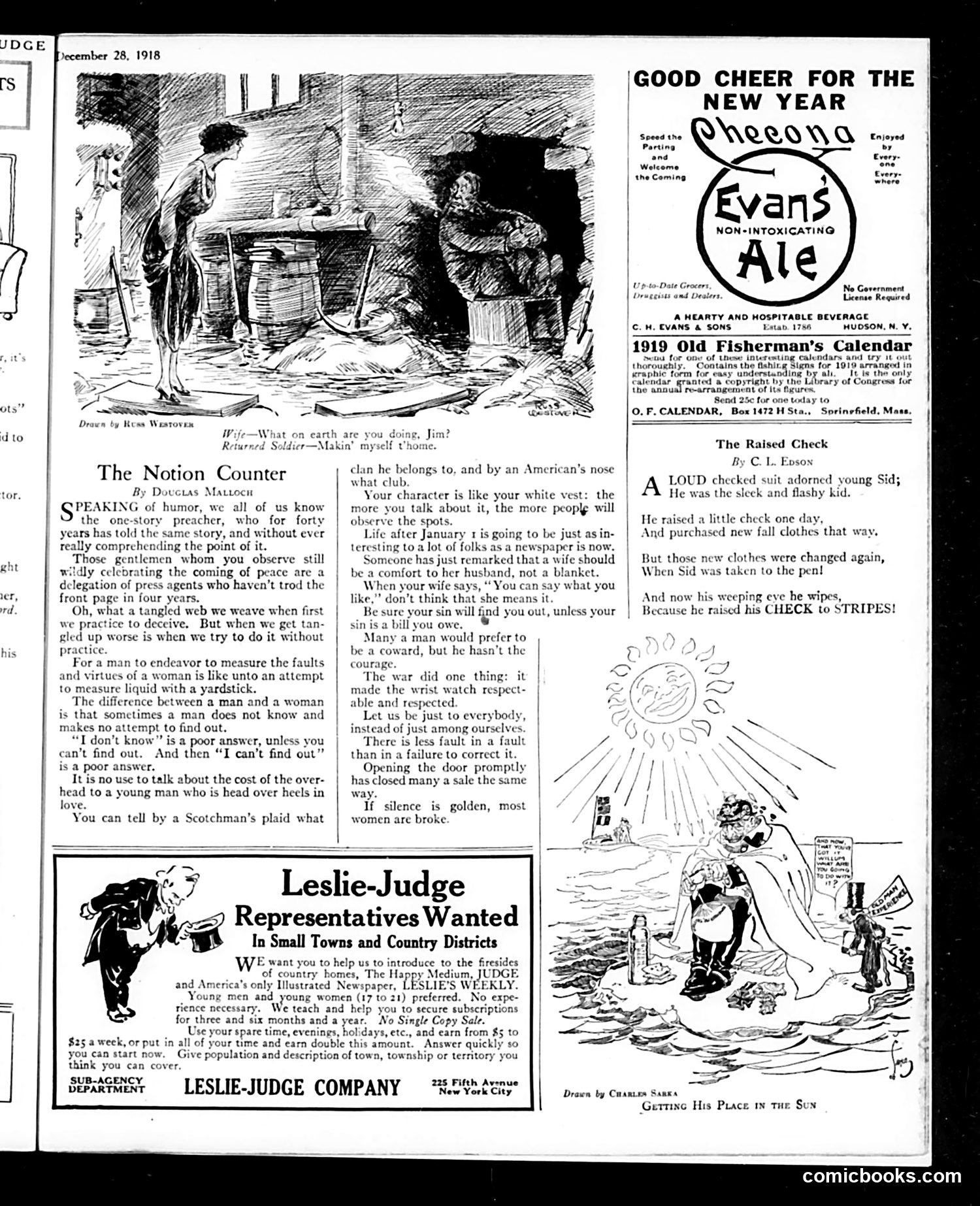
This page contains humor essays and advertisements reflecting post-WWI America (just weeks after the Armistice of November 11, 1918). **"The Notion Counter"** satirizes shallow observations about human nature—marriages, character, and social pretense. The accompanying sketch shows a returned soldier and his wife; the caption jokes about the soldier "making himself at home," likely referencing the adjustment difficulties soldiers faced returning from four years of war. **"The Raised Check"** is a cautionary verse about fraud: young "Sid" forges a check to buy fancy clothes, gets caught, and ends up in prison ("STRIPES"). The joke plays on "raised check" (altering a check's amount) versus literal striped prison uniforms. **Advertisements** include Oheona Evans non-intoxicating ale (ironic timing, as Prohibition began in January 1919) and a Leslie-Judge subscription recruitment drive targeting rural agents. The date and content reflect immediate post-war society: soldiers reintegrating, economic uncertainty, and moral tales for a general audience.
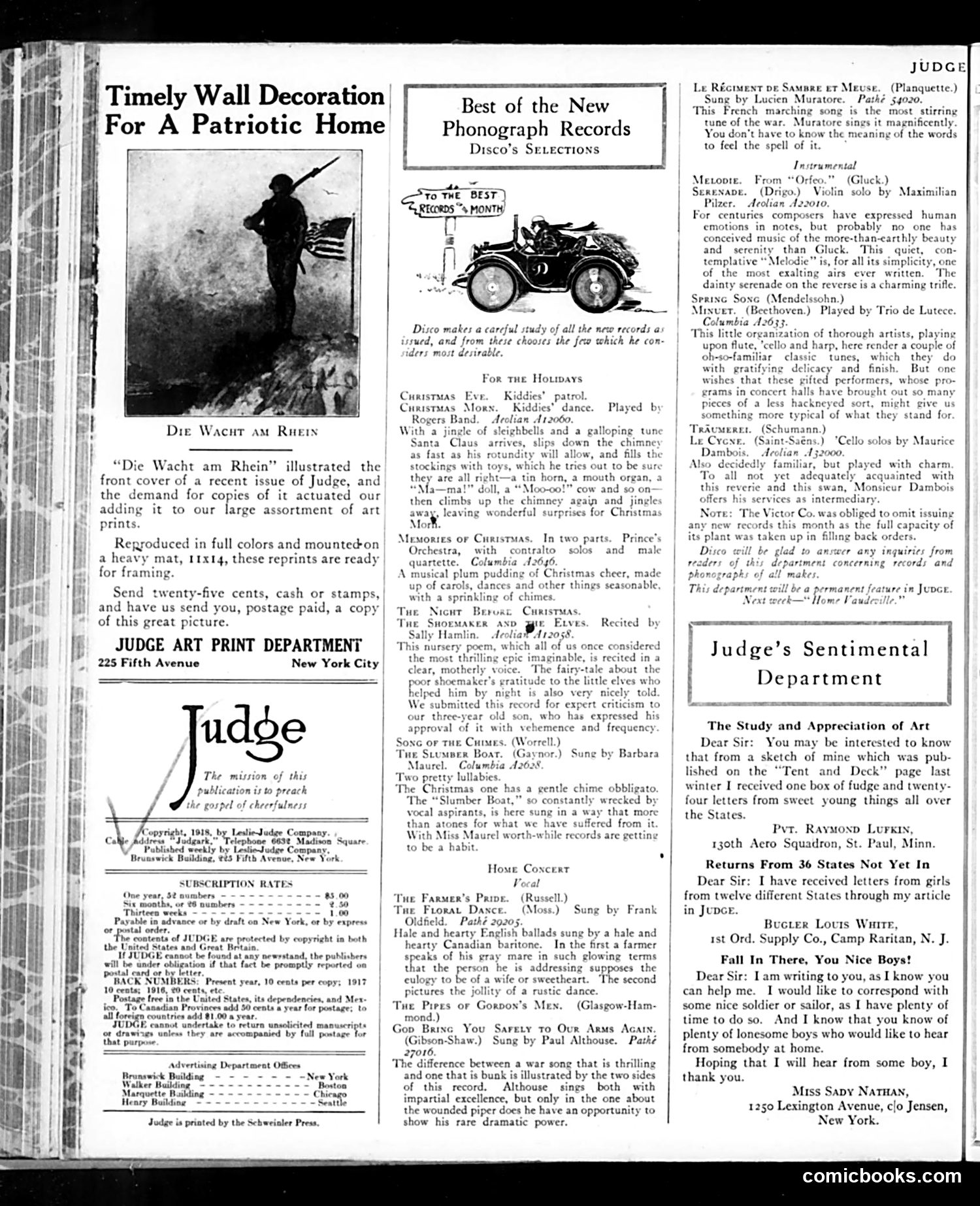
This page advertises a colored art print of "Die Wacht am Rhein" (The Watch on the Rhine), a famous German patriotic song. Judge magazine is selling reproductions for 25 cents. The irony here is striking: this is an **American** satirical magazine during World War I (the page is dated 1918), yet it's marketing a German nationalist anthem as "Timely Wall Decoration For A Patriotic Home." The reference is likely satirical—Judge may be mocking either German-American sentiment or the absurdity of the war itself. "Die Wacht am Rhein" celebrated German defense of the Rhine River and was deeply tied to German nationalism. Selling it as "patriotic" American home décor during American-German conflict represents either dark humor or commentary on divided American loyalties regarding the war.
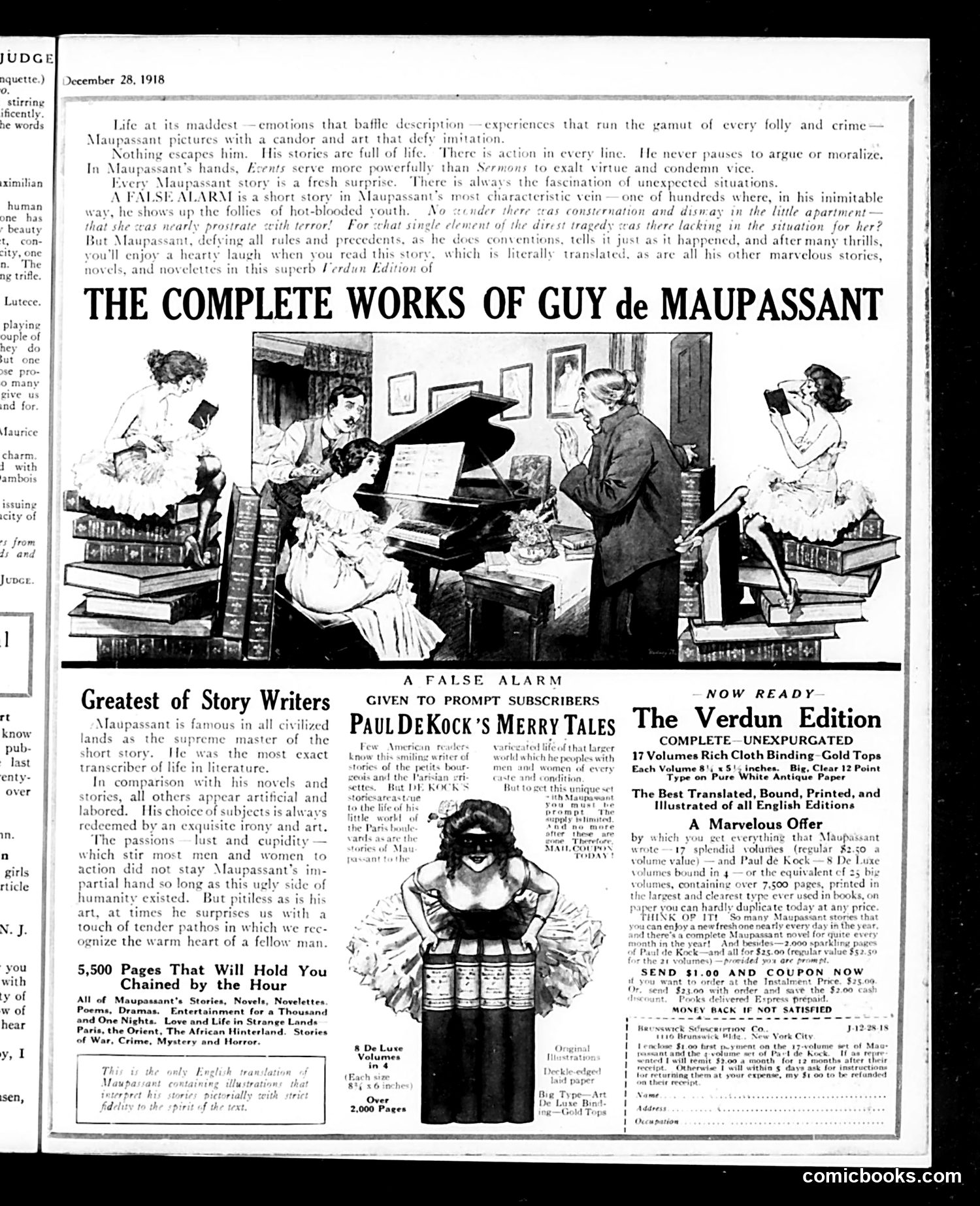
This is primarily a **book advertisement**, not a political cartoon. The page promotes "The Complete Works of Guy de Maupassant" and a companion collection of Paul De Kock's stories in the "Verdun Edition" (published December 28, 1918—just after World War I ended). The top illustration shows genteel domestic scenes—people reading, at pianos, in drawing rooms—meant to appeal to middle-class subscribers. The central image depicts a woman alarmed by something (illustrating "A False Alarm," one of Maupassant's stories). **The satire is subtle**: the ad celebrates Maupassant as capturing "life at its maddest" with unflinching realism, yet the illustrations show refined, comfortable domestic settings—the opposite of the gritty human drama Maupassant actually depicted. This contrast between marketing aspiration and literary content is the joke: promising sophisticated readers access to "pitiless" social observation while showing them cozy parlor scenes. The $1.00 coupon offer targets cost-conscious consumers in post-WWI America.
I can see this is a Judge magazine cover featuring patriotic American imagery—stars, flags (both American and British), and decorative wreaths with "1861" and "MAX" visible. The layout appears designed as a commemorative or special edition piece given the formal heraldic elements and national symbols prominently displayed. However, the OCR text provided only shows "comicbooks.com" (a modern website attribution), which doesn't help identify the specific satirical content or context. Without legible text explaining the cartoon's point, I cannot reliably identify which historical figures or political events this references, what the satire targets, or why the American-British flag pairing appears significant. To properly explain this to a modern reader, I would need clearer OCR text or additional publication details.

I can see this is a page from Judge magazine (as indicated by the watermark at bottom), but the page appears to be almost entirely blank or very faintly printed, making it impossible to discern any cartoon imagery, text content, or satirical commentary. Without visible content to analyze, I cannot identify any figures, caricatures, political references, or satirical points. The page may be: - A blank page between sections - A title/separator page - Improperly scanned or archived To provide meaningful historical analysis of the cartoon or content, a clearer image would be needed showing actual text and illustrations.