
Judge, 1918-12-28 · page 12 of 33
Judge — December 28, 1918 — page 12: what you’re looking at
What you’re looking at
This satirical story mocks the paranoia and zealotry of American civilian spy-catching during World War I. A waiter overhears banker Mr. Lowns casually mention helping "the kaiser" with something—likely a misheard or out-of-context remark about assisting Germany. The waiter, positioning himself as a patriotic vigilante, immediately reports Lowns to police as a spy or traitor, calling it a "rush order." The satire targets two things: (1) the absurdity of untrained civilians making wild espionage accusations based on fragments of conversation, and (2) the bureaucratic eagerness of authorities to investigate such dubious tips. The phrase "When Espionage Was the Vogue" suggests this paranoid accusation-culture was fashionable wartime hysteria rather than serious security work. The cartoon lampoons both misguided patriotism and the invasive surveillance mentality it enabled.
📄 Transcribed text from this page (OCR, searchable)
Machine-transcribed from the original scan — historical spelling and the odd misread are preserved.
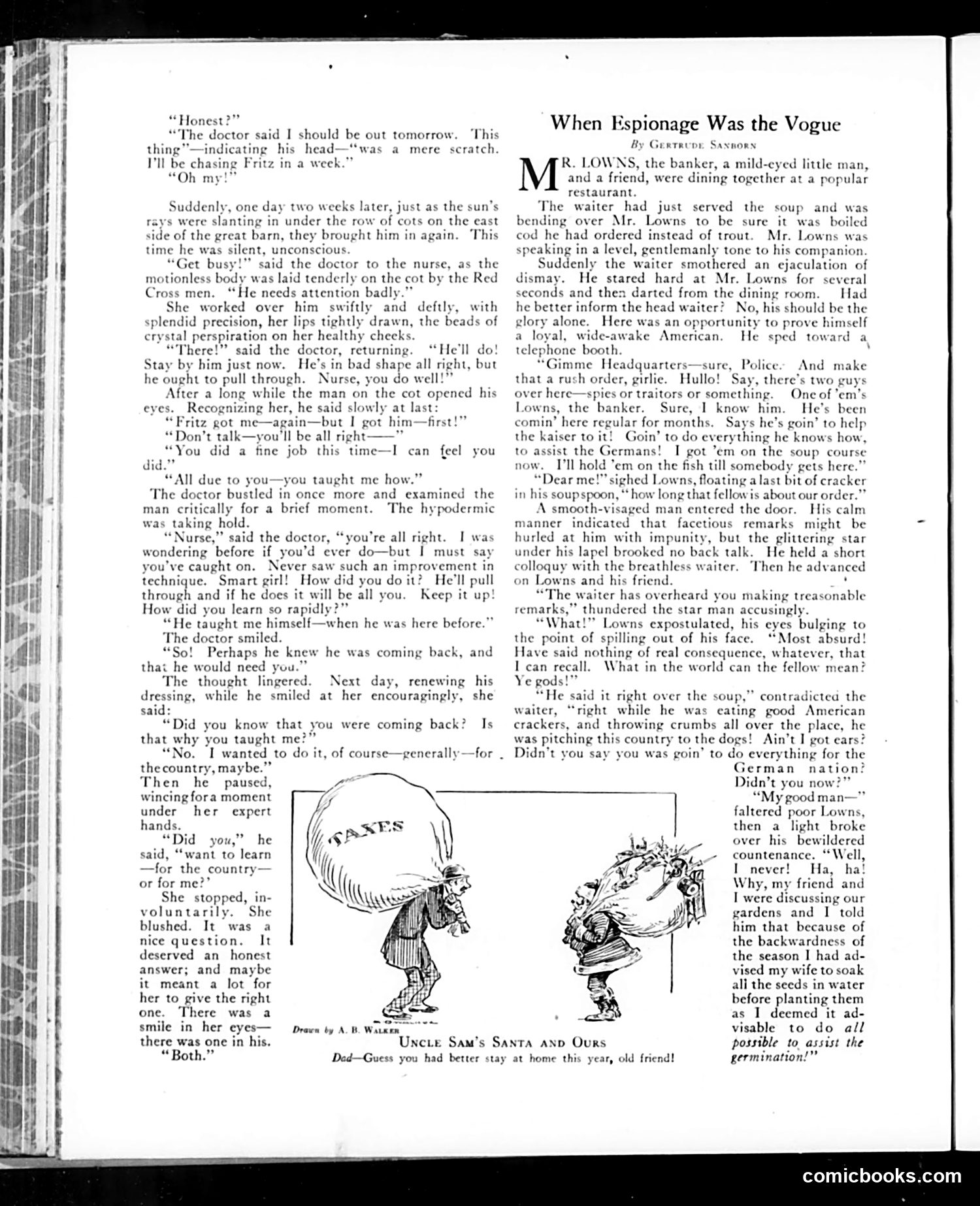
“Honest?” “The doctor said I should be out tomorrow. ‘This thing’’—indicating his head—‘twas a mere scratch. I'll be chasing Fritz in a week.’ “Oh my!” Suddenly, one day two weeks later, just as the sun’s rays were slanting in under the row of cots on the east side of the great barn, they brought him in again. This time he was silent, unconscious. “Get busy!" said the doctor to the nurse, as the motionless body was laid tenderly on the cot by the Red Cross men. “He needs attention badly. She worked over him swiftly and deftly, with splendid precision, her lips tightly drawn, the beads of crystal perspiration on her healthy cheeks. “There!” said the doctor, returning. “He'll do! Stay by him just now. He's in bad shape all right, but he ought to pull through. Nurse, you do well!” After a long while the man on the cot opened his eyes. Recognizing her, he said slowly at last: *Fritz got me—again—but | got him—first!” “Don’t talk—you'll be all right id “You did a fine job this time—I can feel you did.” “All due to you—you taught me ho The doctor bustled in once more and examined the man critically for a brief moment. The hypodermic was taking hold. “Nurse,” said the doctor, “you're all right. I was wondering before if you’d ever do—but | must say you've caught on. Never saw such an improvement in technique. Smart girl! How did you do it? He'll pull through and if he does it will be all you. Keep it up! How did you learn so rapidly?” “He taught me himself—when he was here before.” The doctor smiled. “Si Perhaps he knew he was coming back, and that he would need you.” The thought lingered. Next day, renewing his dressing, while he smiled at her encouragingly, she said: “Did you know that that why you taught me? “No. thecountry, maybe.” Then he paused, wincing fora moment under her expert hands. “Did you,” he said, “‘want to learn —for the country or for me?’ She stopped, in- voluntarily. She blushed. It was a nice question. It deserved an honest answer; and maybe it meant a lot for her to give the right one. There was a smile in her eyes— pu were coming back? Is I wanted to do it, of course—generally—for . When Espionage Was the Vogue By Geetevpr Saxnorn R. LOWNS, the banker, a mild-cyed little man, and a friend, were dining together at a popular restaurant. The waiter had just served the soup and was bending over Mr. Lowns to be sure it was boiled cod he had ordered instead of trout. Mr. Lowns was speaking in a level, gentlemanly tone to his companion. Suddenly the waiter smothered an ejaculation of dismay. He stared hard at Mr. Lowns for several seconds and then darted from the dining room. Had he better inform the head waiter? No, his should be the glory alone. a loyal, wide-awake American. telephone booth. “Gimme Headquarters—sure, Polices And make that a rush order, girlie. Hullo! Say, there’s two guys over here—spies or traitors or something. One of °em’s Lowns, the banker. Sure, 1 know him. He’s been comin’ here regular for months. Says he’s goin’ to help the kaiser to it! Goin’ to do everything he knows how, to assist the Germans! I got ’em on the soup course now. I'll hold ‘em on the fish till somebody gets here Dear me!” sighed Lowns, floating alast bit of cracker in his soup spoon, “ how long that fellowis about our order.” A smooth-visaged man entered the door. His calm manner indicated that facetious remarks might be hurled at him with impunity, but the glittering star under his lapel brooked no back talk. He held a short colloquy with the breathless waiter. ‘Then he advanced on Lowns and his friend. : “The waiter has overheard you making treasonable remarks,” thundered the star man accusingly. “What!” Lowns expostulated, his eyes bulging to the point of spilling out of his face. “Most absurd! Have said nothing of real consequence, whatever, that I can recall. What in the world can the fellow mean? Ye gods!” “He said it right over the soup,” contradicted the waiter, “right while he was eating good American crackers, and throwing crumbs all over the place, he was pitching this country to the dogs! Ain’t I got ears? Didn't you say you was goin’ to do everything for the German nation? Didn’t you now?” “My good man—” faltered poor Lowns, then a light broke over his bewildered countenance. “Well, I never! Ha, ha! Why, my friend and I were discussing our gardens and I told him that because of the backwardness of the season | had ad- vised my wife to soak all the seeds in water before planting them as I deemed it ad- visable to do all Here was an opportunity to prove himself He sped toward a possible to assist the yy germination! Uncre Sam’s Santa anv Ours Ded—Guess you had better stay at home this year, old friend! there was one in his. “Both.” comicbooks.com