
Judge, 1918-12-28 · page 9 of 33
Judge — December 28, 1918 — page 9: what you’re looking at
What you’re looking at
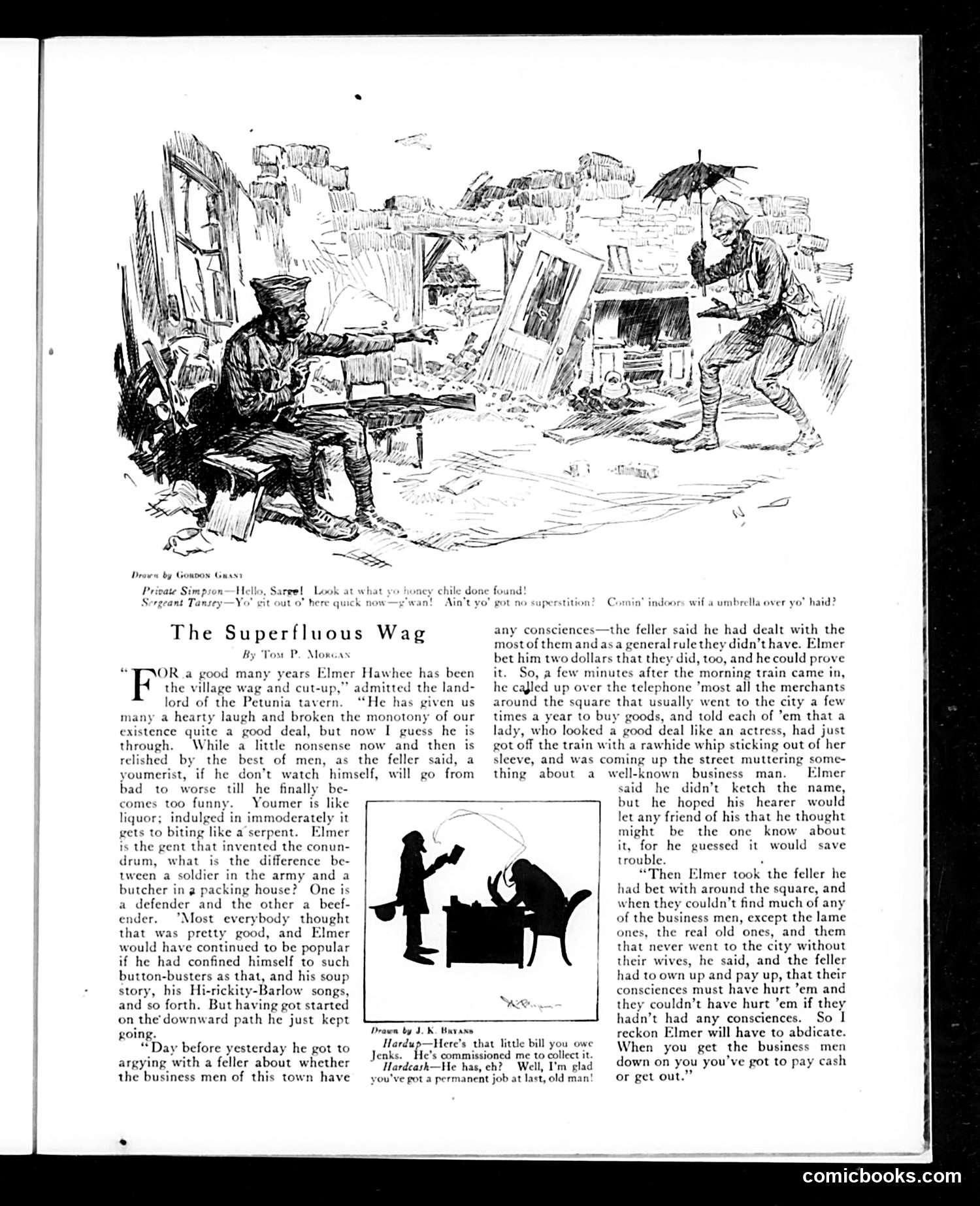
This story satirizes a village prankster named Elmer Hawhee whose practical jokes have gone too far. The tavern keeper explains that while harmless humor once made Elmer popular, he's now become a genuine menace to the town's business community. The satire concerns Elmer's latest scheme: he spreads false rumors about a dangerous woman arriving by train, causing local merchants to avoid their businesses out of fear. When they later learn they were duped, Elmer collects a bet by arguing their guilty consciences prove they *do* have morals—a circular, infuriating logic. The point: excessive joking becomes destructive, and pranksters who antagonize powerful people (business owners) face social exile. The phrase "he will have to abdicate" suggests Elmer's position as the town's entertainer is finished. The accompanying illustrations show rural/small-town settings typical of early 20th-century American humor magazines.
📄 Transcribed text from this page (OCR, searchable)
Machine-transcribed from the original scan — historical spelling and the odd misread are preserved.
rit out o” here quick now The Superfluous Wag By 1 P. Morcan “ F’ a good many years Elmer Hawhee has been the village wag and cut-up,” admitted the land- lord of the Petunia tavern. “He has given us many a hearty laugh and broken the monotony of our existence quite a good deal, but now I guess he is through. While a little nonsense now and then is relished by the best of men, as the feller said, a youmerist, if he don’t watch himself, will go from bad to worse till he finally be- chile done found! Ain’t yo’ got no superstition? GC: in’ indoors wif a umbrella over yo" haid? any consciences—the feller said he had dealt with the most of themand asa general rule they didn’t have. Elmer bet him two dollars that they did, too, and he could prove it. So, a few minutes after the morning train came in, he cajled up over the telephone ’most all the merchants around the square that usually went to the city a few times a year to buy goods, and told each of ’em that a lady, who looked a good deal like an actress, had just got off the train with a rawhide whip sticking out of her sleeve, and was coming up the street muttering some- comes too funny. Youmer is like liquor; indulged in immoderately it gets to biting like a’serpent. Elmer is the gent that invented the conun- drum, what is the difference be- tween a soldier in the army and a butcher in a packing house? One is a defender and the other a beef- ender. ’Most everybody thought that was pretty good, and Elmer would have continued to be popular if he had confined himself to such button-busters as that, and his soup story, his Hi-rickity-Barlow songs, and so forth. But having got started on the’ downward path he just kept going. “Day before yesterday he got to argying with a feller about whether the business men of this town have Prawn by JK. Buvans Hardup—Here’s that little bill you owe Jenks. He’s commissioned me to collect it Hardcash—He has, ch? you've got a permanent job at last, old man! thing about a well-known business man. Elmer said he didn’t ketch the name, but he hoped his hearer would let any friend of his that he thought might be the one know about it, for he guessed it would save trouble. % “Then Elmer took the feller he had bet with around the square, and when they couldn’t find much of any of the business men, except the lame ones, the real old ones, and them that never went to the city without their wives, he said, and the feller had to own up and pay up, that their consciences must have hurt ’em and they couldn’t have hurt ’em if they hadn’t had any consciences. So I reckon Elmer will have to abdicate. When you get the business men down on you you've got to pay cash or get out.” Well, I'm glad comicbooks.com