
Judge, 1918-12-28 · page 22 of 33
Judge — December 28, 1918 — page 22: what you’re looking at
What you’re looking at
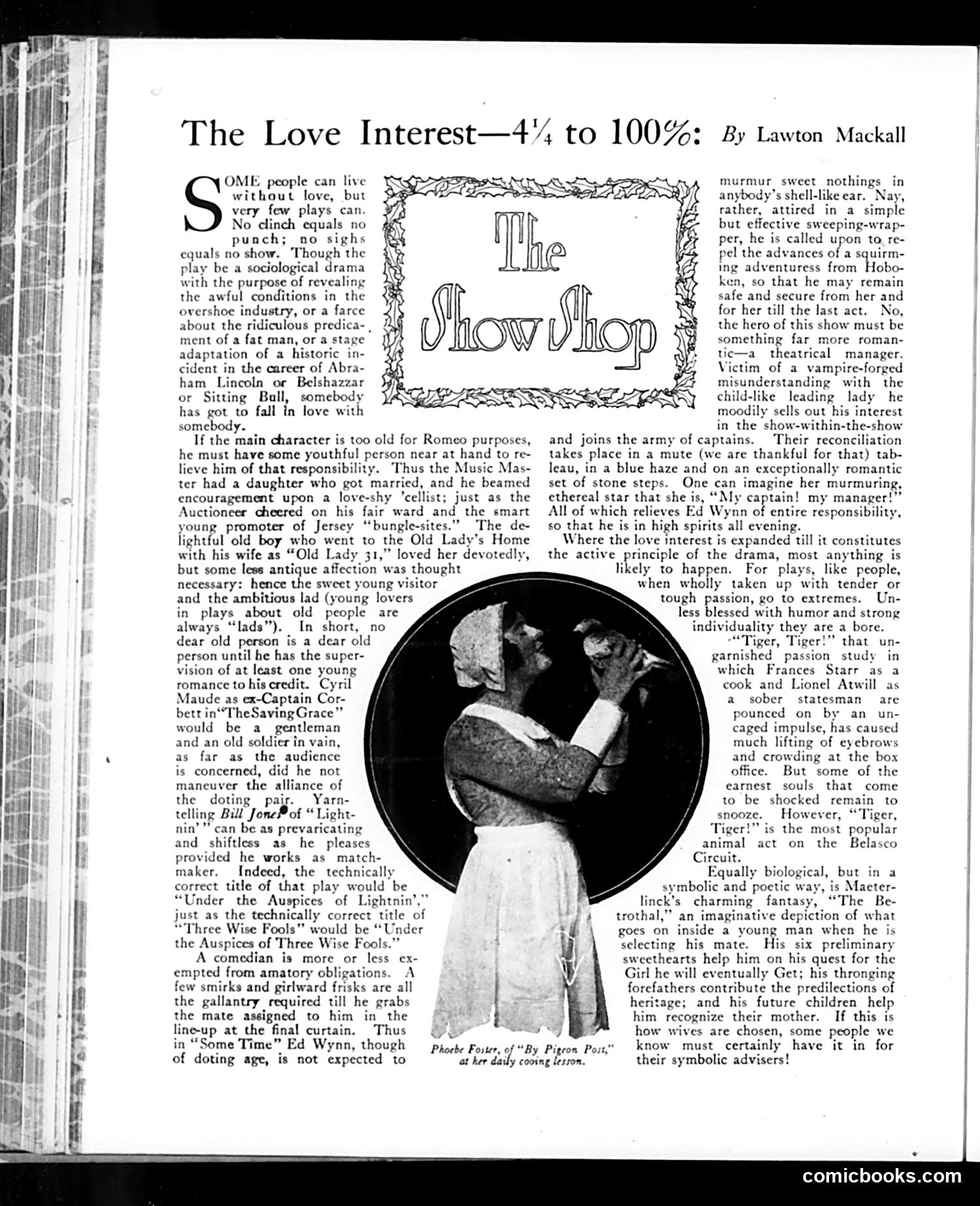
This is a theater criticism essay by Lawton Mackall examining why romantic subplots are essential to dramatic works—even plays ostensibly about other subjects. The author argues that audiences expect "love interest" to drive theatrical engagement. The piece references contemporary Broadway productions to illustrate his point: *The Music Master*, *The Auctioneer*, *Old Lady 31*, *The Saving Grace* (starring Cyril Maude), *Lightnin'* (with Bill Jones), *Three Wise Fools*, and *Some Time* (featuring Ed Wynn). The photograph shows two performers in an intimate scene, exemplifying the romantic tableau the essay discusses. Mackall's argument: playwrights automatically inject young lovers into plots regardless of subject matter—even historical dramas about Abraham Lincoln or farces about fat men require romantic elements. Even comedians like Wynn get exempted from actively pursuing romance; instead, amatory plots happen *around* them. The essay suggests this convention, while sometimes clichéd, remains theatrically necessary for audience satisfaction.
📄 Transcribed text from this page (OCR, searchable)
Machine-transcribed from the original scan — historical spelling and the odd misread are preserved.
OME people can live without love, but very few plays can. No clinch equals no punch; no sighs equals no show. Though the play be a sociological drama with the purpose of revealing the awful conditions in the overshoe industry, or a farce about the ridiculous predica- , ment of a fat man, or a stage adaptation of a historic in- cident in the career of Abra- ham Lincoln o¢ Belshazzar or Sitting Bull, somebody has got to fall in love with somebody. If the main character is too old for Romeo purposes, he must have some youthful person near at hand to re- lieve him of that responsibility. Thus the Music Mas- ter had a daughter who got married, and he beamed encouragement upon a love-shy ’cellist; just as the Auctioneer cheered on his fair ward and the smart young promoter of Jersey “‘bungle-sites.””. The de- lightful old boy who went to the Old Lady’s Home with his wife as “Old Lady 31,” loved her devotedly, but some less antique affection was thought necessary: hence the sweet young visitor and the ambitious lad (young lovers in plays about old people are always “lads”). In short, no dear old person is a dear old person until he has the super- vision of at least one young romance to his credit. Cyril Maude as ex-Captain Cor- bett in“TheSaving Grace” would be a_ gentleman and an old soldier in vain, as far as the audience is concerned, did he not maneuver the alliance of the doting pair. Yarn- telling Bill Jone®of “Light- nin’” can be as prevaricating and shiftless as he pleases provided he works as match- maker. Indeed, the technically correct title of that play would be “Under the Auspices of Lightnin’,” just as the technically correct title of “Three Wise Fools" would be “Under the Auspices of Three Wise Fools.” A comedian is more or less ex- empted from amatory obligations. A i few smirks and girlward frisks are all the gallantry required till he grabs the mate assigned to him in the line-up at the final curtain. Thus ¢ in “Some Time” Ed Wynn, though of doting age, is not expected to v The Love Interest—4% to 100%: By Lawton Mackall murmur sweet nothings in anybody’s shell-like ear. Nay, rather, attired in a simple but effective sweeping-wrap- per, he is called upon to re- pel the advances of a squirm- ing adventuress from Hobo- ken, so that he may remain safe and secure from her and for her till the last act. No, the hero of this show must be something far more roman- tic—a_ theatrical manager. Victim of a vampire-forged misunderstanding with the child-like leading lady he moodily sells out his interest in the show-within-the-show and joins the army of captains. Their reconciliation takes place in a mute (we are thankful for that) tab- leau, in a blue haze and on an exceptionally romantic set of stone steps. One can imagine her murmuring, ethereal star that she is, “My captain! my manager!” All of which relieves Ed Wynn of entire responsibility, so that he is in high spirits all evening. Where the love interest is expanded till it constitutes the active principle of the drama, most anything is likely to happen. For plays, like people, when wholly taken up with tender or tough passion, go to extremes. Un- less blessed with humor and strong individuality they are a bore. “Tiger, Tiger!” that un- garnished passion study in which Frances Starr as a cook and Lionel Atwill as a sober statesman are pounced on by an un- caged impulse, has caused much lifting of eyebrows and crowding at the box office. But some of the earnest souls that come to be shocked remain to snooze. However, “Tiger, Tiger!” is the most popular animal act on the Belasco Circuit. Equally biological, but in a symbolic and poetic way, is Macter- linck’s charming fantasy, “The Be- trothal,” an imaginative depiction of what goes on inside a young man when he is selecting his mate. His six preliminary sweethearts help him on his quest for the Girl he will eventually Get; his thronging forefathers contribute the predilections of heritage; and his future children help him recognize their mother. If this is how wives are chosen, some people we he eae: ] ; Phoebe Foster, of “By Pigeon Post,” know must certainly have it in for at her daily cooing lesson. their symbolic advisers! comicbooks.com