
A complete issue · 32 pages · 1918
Judge — September 7, 1918
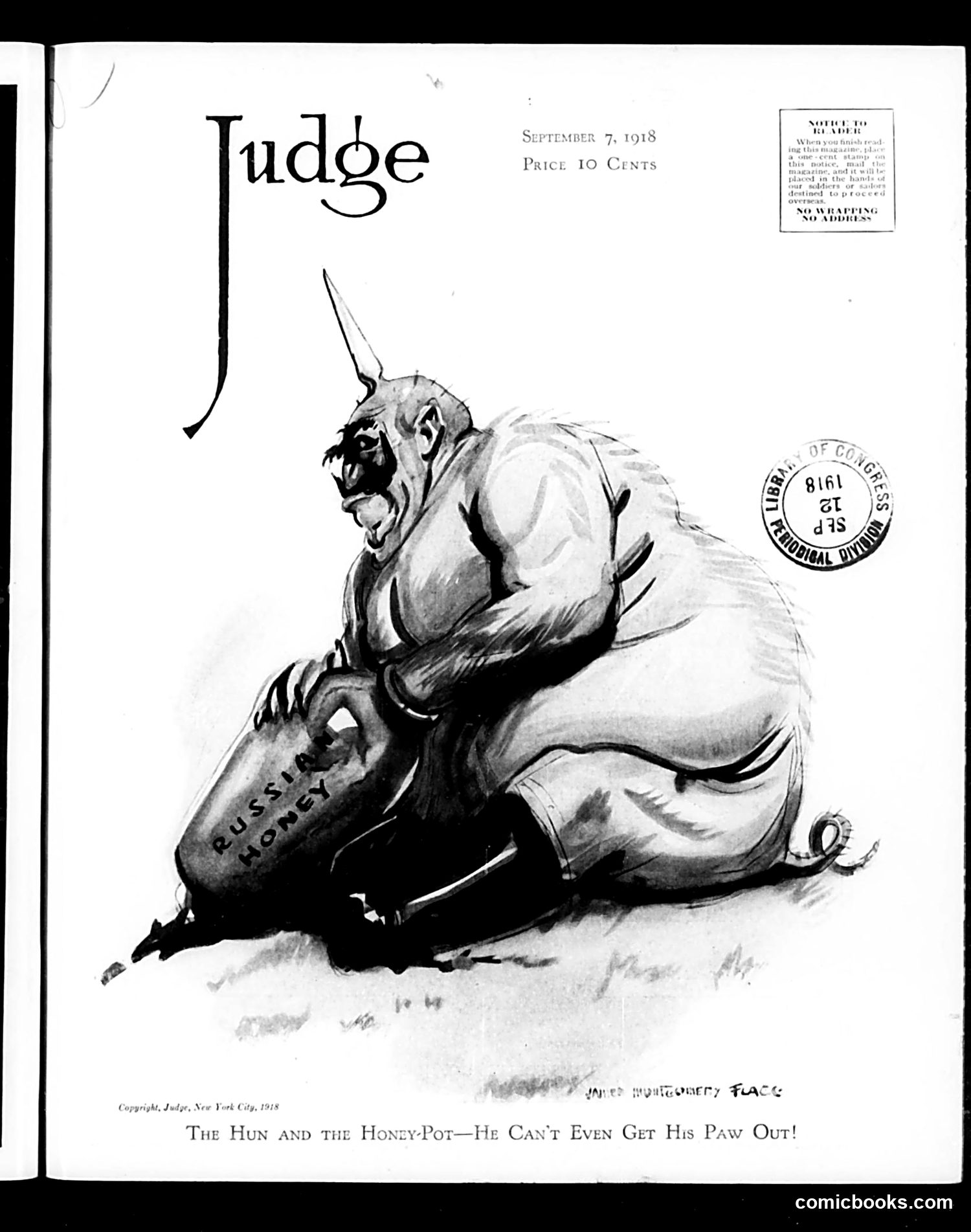
This political cartoon depicts "The Hun and the Honey-Pot—He Can't Even Get His Paw Out!" The "Hun" refers to Germany, depicted as a grotesque demon-like creature with horns, stuck in a large pot labeled "U.S.A. PROPERTY." Published during World War I (note the 1918 date), this is American propaganda satirizing Germany's military entrapment. The honey-pot symbolizes a trap—Germany is caught and cannot escape American military/economic power. The grotesque caricature dehumanizes the enemy, a common wartime tactic. The cartoon expresses American confidence in eventual victory and mocks German military prospects as hopeless. This reflects the historical moment when American forces were actively engaged in France during the war's final phase.
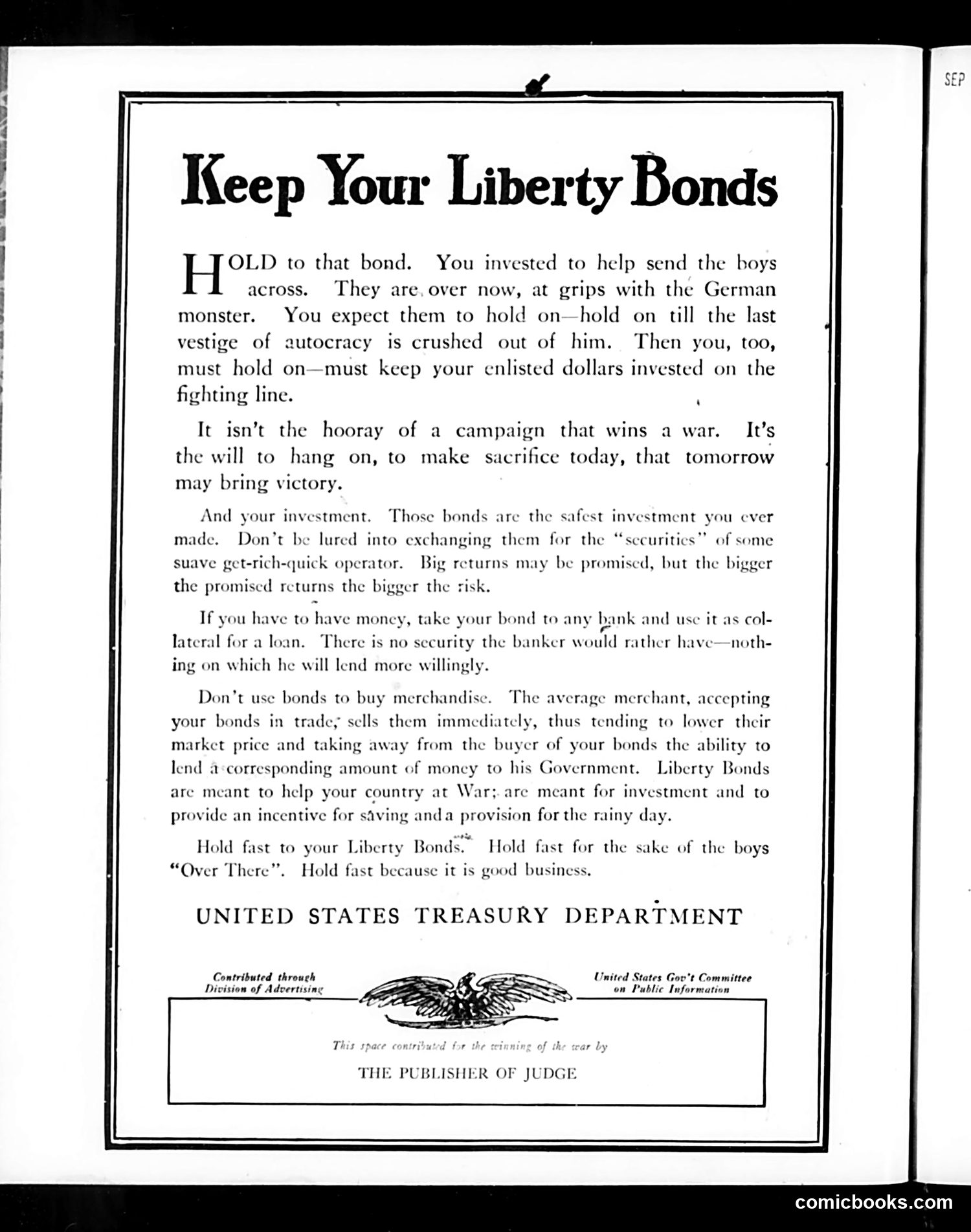
This is a **public service advertisement**, not satire or political cartoon. It's a Treasury Department message urging Americans to retain their Liberty Bonds—government securities sold to finance World War I. The ad targets bond owners who might be tempted to sell or trade their bonds. It warns against: - Selling bonds to speculators ("get-rich-quick operators") - Using bonds as collateral for loans - Trading bonds for merchandise The rhetoric emphasizes patriotic duty ("the boys 'Over There'") and financial prudence, framing bond-holding as both a moral obligation to soldiers and sound investment. The eagle seal and government attribution establish official authority. This reflects American homefront mobilization during WWI, when sustained public investment mattered strategically.
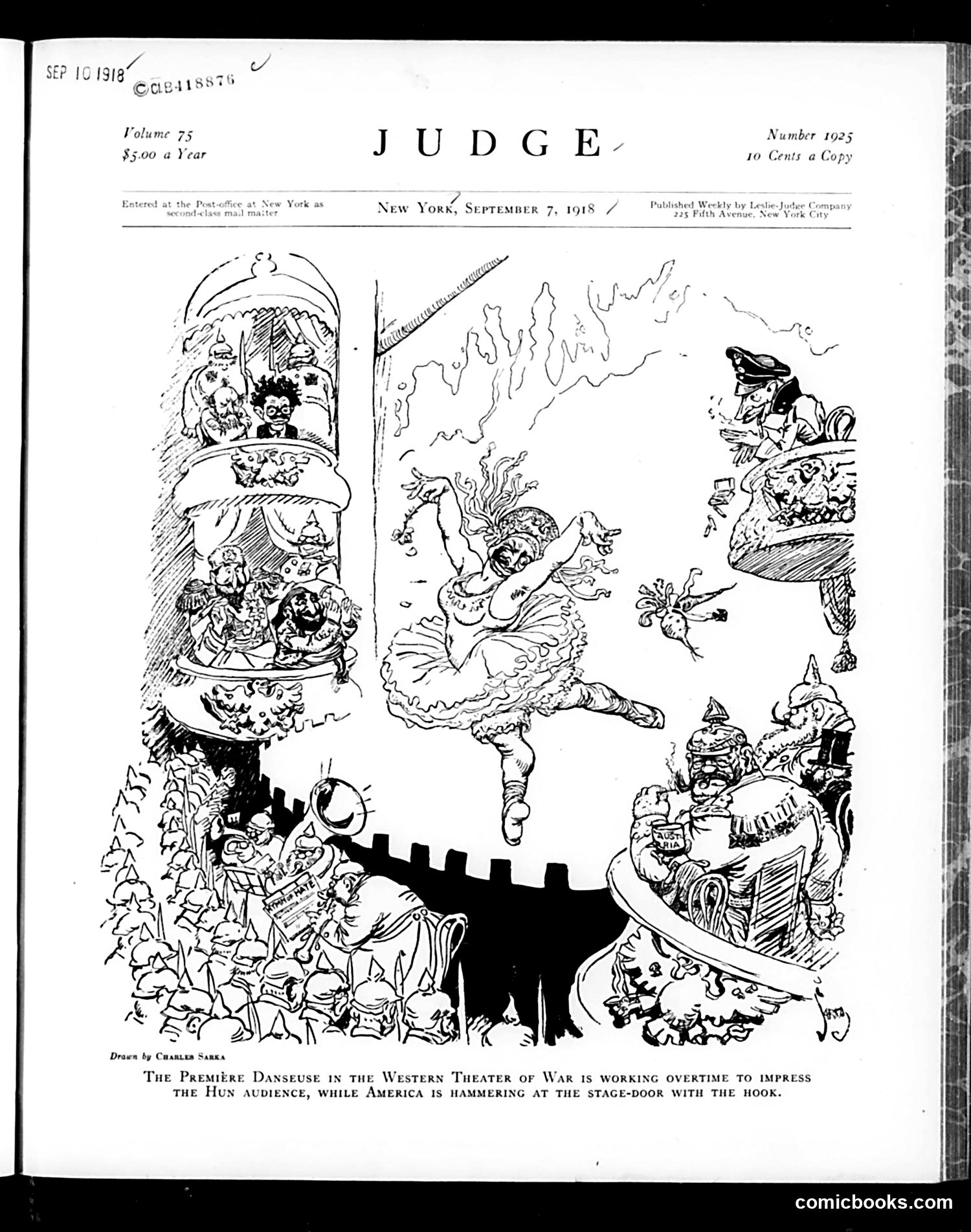
This September 7, 1918 *Judge* cartoon satirizes the contrast between European and American war efforts during World War I's final phase. The left side depicts a tall tower of German military and political leadership (identifiable by Prussian military uniforms and spiked helmets—the "Hun audience") performing elaborate theater to maintain morale. The center shows a female figure (likely "Liberty" or "Democracy") being attacked or tormented. The right side shows American military/political figures hammering at a stage door, suggesting America is using direct force rather than propaganda. The caption's point: while Germany exhausts itself with theatrical pageantry to impress its people, America aggressively pursues victory through action—"hammering at the stage-door with the hook" (removing false pretense).
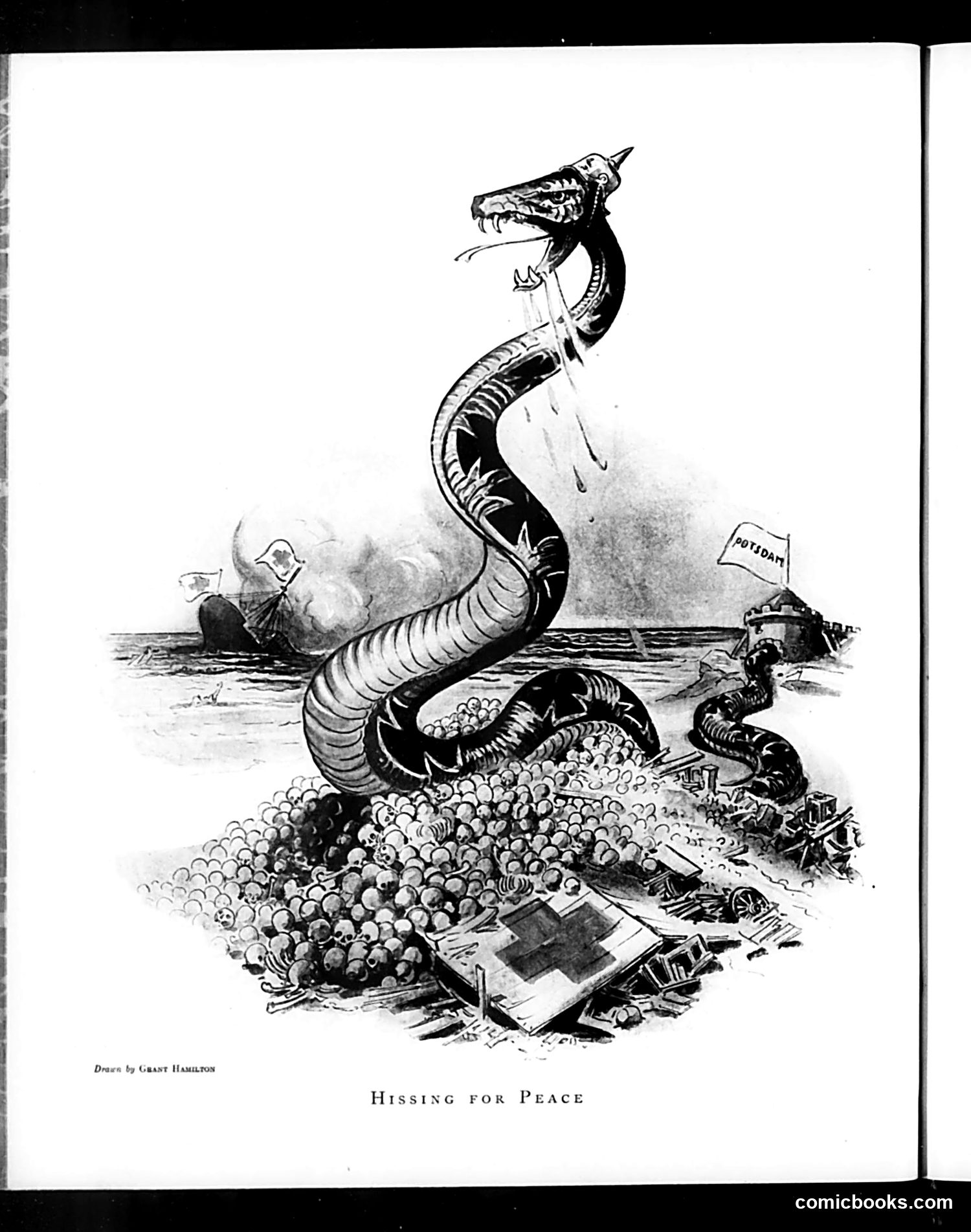
This political cartoon by Grant Hamilton depicts a dragon—a traditional symbol of chaos and danger—coiled around a pile of skulls and military wreckage. The dragon's menacing posture and open mouth contrast ironically with the title "Hissing for Peace." A flag marked "PATRIOT" appears in the background, suggesting nationalist sentiment. The imagery satirizes how appeals for peace may mask underlying violence and militarism. The skulls represent war's death toll, while the dragon embodies destructive force disguised as something else—likely critiquing politicians or nations who claim peaceful intentions while maintaining military aggression or warmongering rhetoric. The cartoon appears to date from an era of international conflict, possibly related to World War I or similar period tensions.
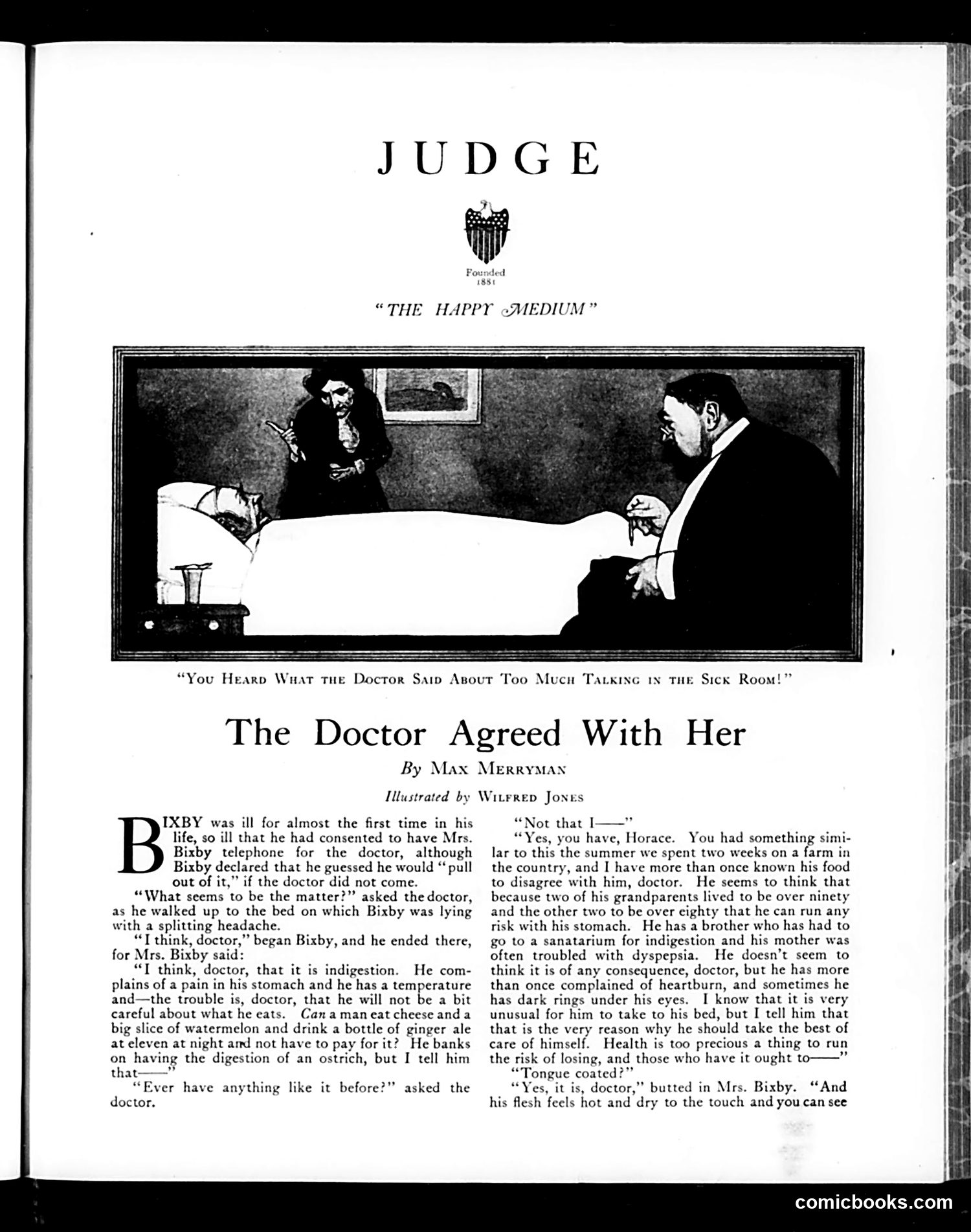
This is a humorous short story by Max Merryman (illustrated by Wilfred Jones) about a man named Bixby who is ill and complaining of stomach troubles. His wife summoned a doctor, but—according to the story's setup—she monopolizes the conversation, talking excessively about Bixby's various ailments and family medical history. The illustration shows the doctor at the bedside with both Bixby and his wife present. The caption quotes someone saying the doctor warned against "too much talking in the sick room"—a dig at Mrs. Bixby's chattiness. The satire targets wives who over-manage their husbands' medical care and dominate doctor visits with excessive commentary, while the patient himself cannot get a word in. It's domestic humor typical of early 20th-century magazines.
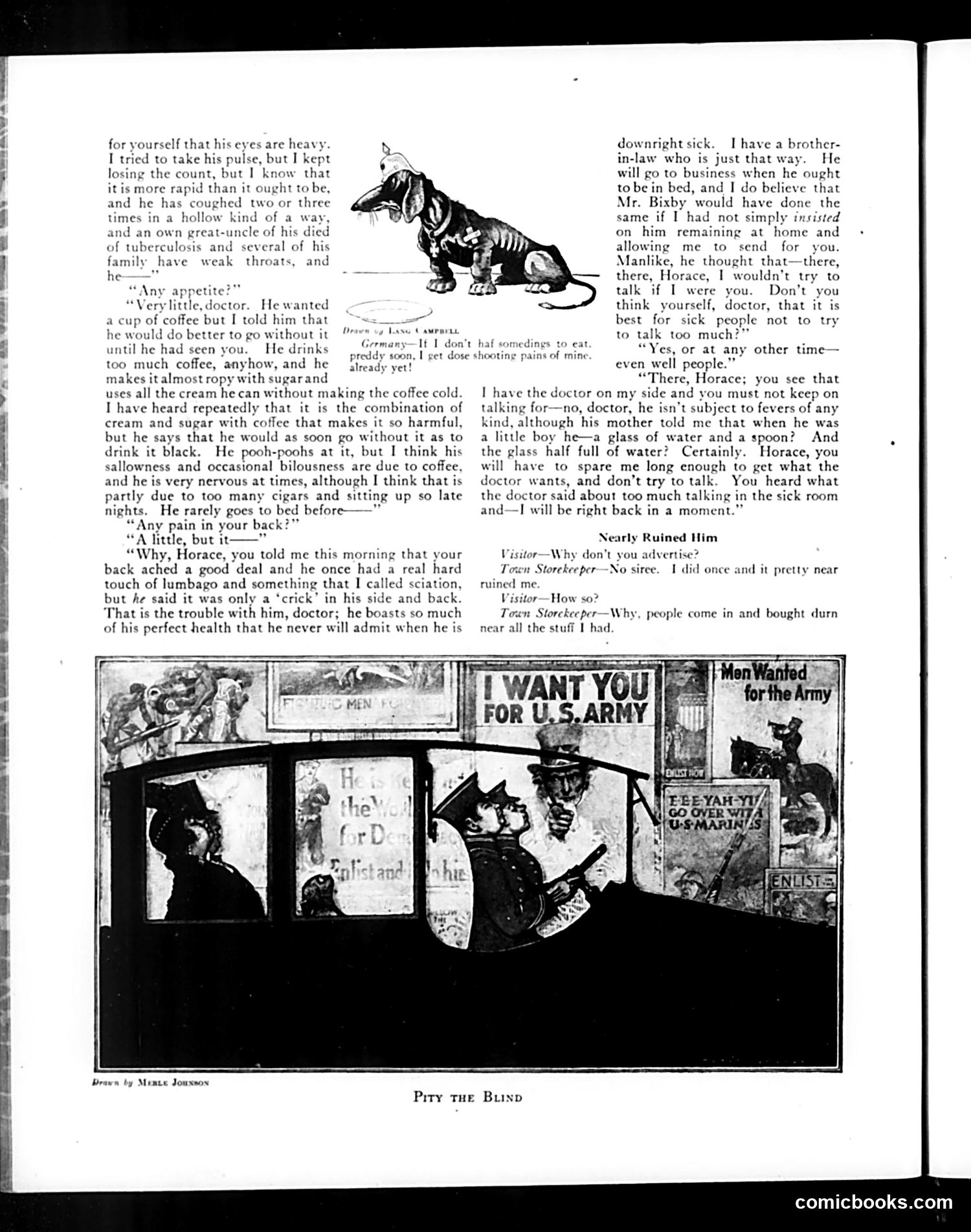
This cartoon satirizes wartime recruitment propaganda during what appears to be World War I. The illustration shows a blind man walking past storefront windows plastered with military recruitment posters ("I Want You for U.S. Army," "Men Wanted for the Army"). The satire's point: The blind pedestrian cannot see these ubiquitous recruitment appeals—hence the title "Pity the Blind." The joke works on two levels: literally, he cannot view the posters, and figuratively, it suggests that those *not* blind are perhaps willfully ignoring the government's aggressive recruitment messaging surrounding them. The accompanying dialogue appears to be unrelated medical conversation, suggesting this was a multi-panel editorial page typical of Judge magazine.
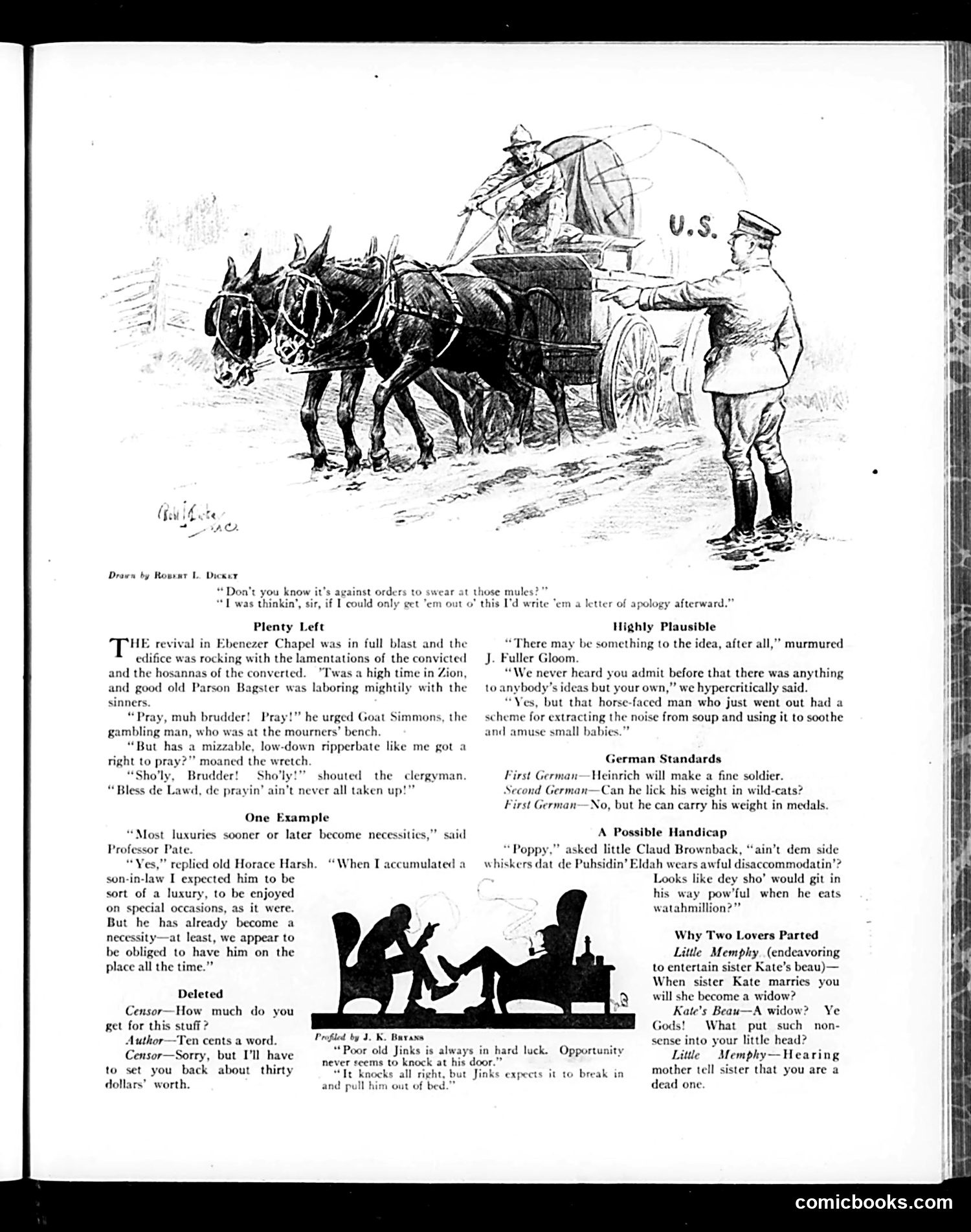
This page contains multiple brief humorous sketches typical of early 20th-century American satire. The main cartoon depicts a U.S. soldier struggling with mules, illustrating military frustration through exaggerated dialect humor. The text selections mock various social types: revival meeting fervor among African Americans ("Ebenezer Chapel"), wealthy men burdened by sons-in-law as "necessities," and Germans' militaristic obsession with physical prowess and medals. One sketch satirizes German militarism by suggesting that a soldier's qualification is carrying medals rather than combat ability. Other brief jokes target: opportunism ("knocks all right, but Jinks expects it"), absurd inventions (extracting noise from soup), and children's naive observations about adult relationships. The "Deleted" section shows a censor removing material deemed too provocative—the author valued his content at "thirty dollars' worth." The humor relies on period stereotypes and social commentary typical of Judge's irreverent approach to American institutions and pretension.
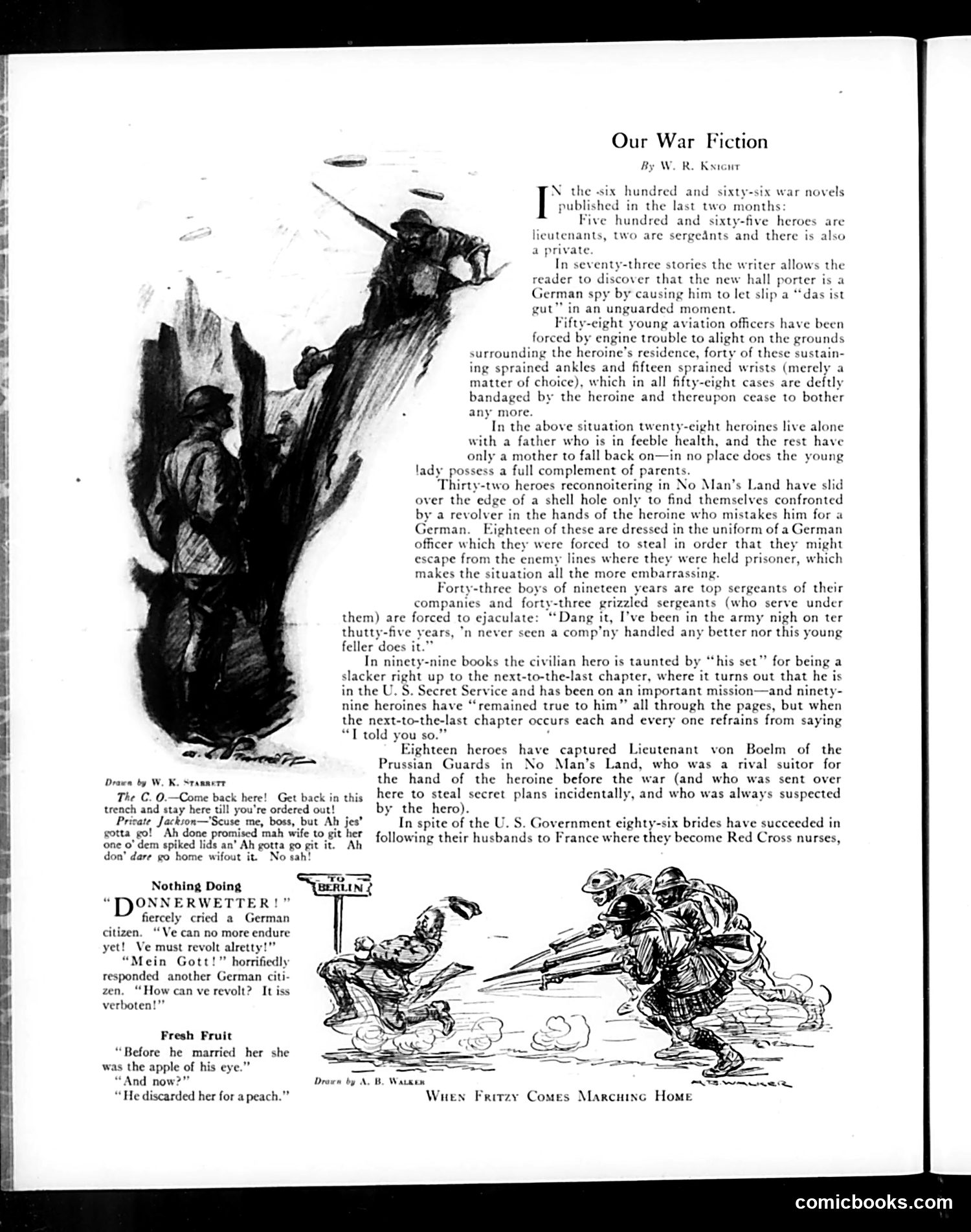
This article by W.R. Knight mocks the formulaic clichés flooding American war fiction during World War I. Knight catalogs absurd recurring plot elements: nearly all heroes are officers (665 out of 666), German spies reveal themselves through careless German phrases, aviation officers conveniently crash near heroines' homes (who then nurse their sprains), and civilian "slackers" are secretly government agents all along. The satire targets both lazy literary conventions and wartime propaganda. The repetitive tropes—lone heroines with absent fathers, mistaken-identity scenes, captured German officers as rival suitors, wives following husbands to become Red Cross nurses—reveal how war novels reduced complex human experience to predictable formulas. The accompanying cartoons offer lighter humor: a soldier defying orders to retrieve a spiked helmet, and Germans comically paralyzed by their own obedience to authority ("How can we revolt? It is forbidden!"). Together, the page critiques American popular culture's simplistic romanticization of modern warfare.
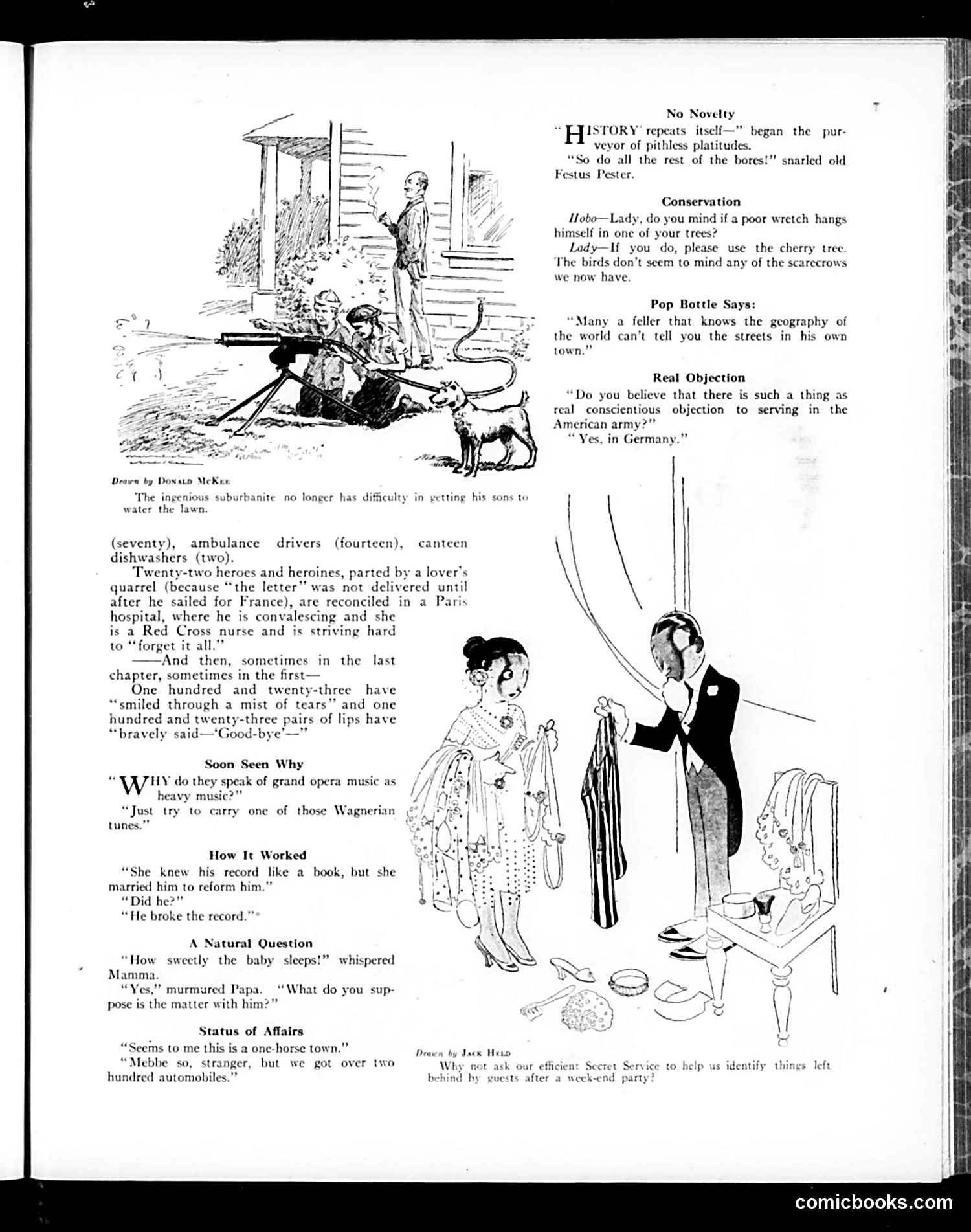
This page contains multiple brief satirical jokes and two illustrated cartoons, typical of Judge magazine's format. **Top cartoon** (by Donald McKee): Shows a suburban father using an ingenious contraption to water the lawn while his sons operate it—satirizing both suburban laziness and parental ingenuity during the early 20th century. **Bottom cartoon** (by Jack Heald): Depicts a well-dressed man showing a woman clothing or linens, likely satirizing post-party cleanup or domestic management—the caption references using "Secret Service" to identify items left behind. **The text jokes** mock various targets: - Bores repeating themselves - Conservation efforts (sarcastically suggesting a poor wretch use a tree with scarecrows) - Geographic knowledge without local knowledge - Conscientious objectors to WWI military service (suggesting Germans had "real" objections) - Opera's heaviness - Reform through marriage - Small-town pretensions about automobiles The magazine satirizes everyday American life, wartime attitudes (apparent WWI references), and social pretensions with period-appropriate humor.
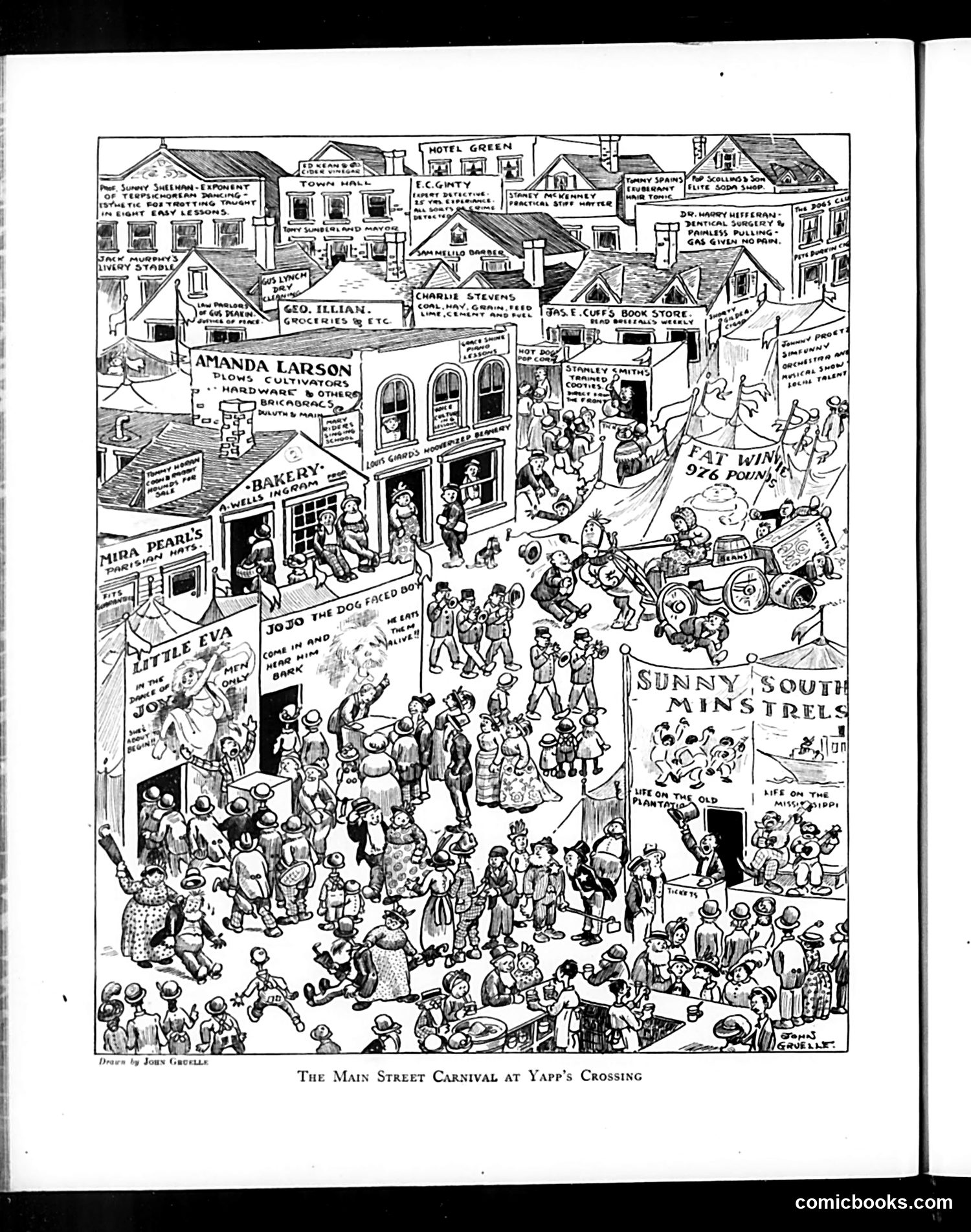
This is a detailed satirical street scene depicting a crowded small-town carnival or fair. The illustration labels various local businesses and services—a hotel, grocery store, bakery, dentist, book store, and theatrical performances ("Little Eva," "Sunny South Minstrels")—arranged around a central square filled with townspeople engaged in typical carnival activities: games, eating, socializing, and entertainment. The satire appears to mock small-town American life: the commercialism of local businesses capitalizing on the carnival, the crude entertainment options (including period minstrel shows), and the earnest crowds enjoying modest amusements. The crowded, chaotic composition emphasizes both the vitality and the somewhat provincial, unsophisticated nature of rural American commerce and entertainment circa the early 20th century.
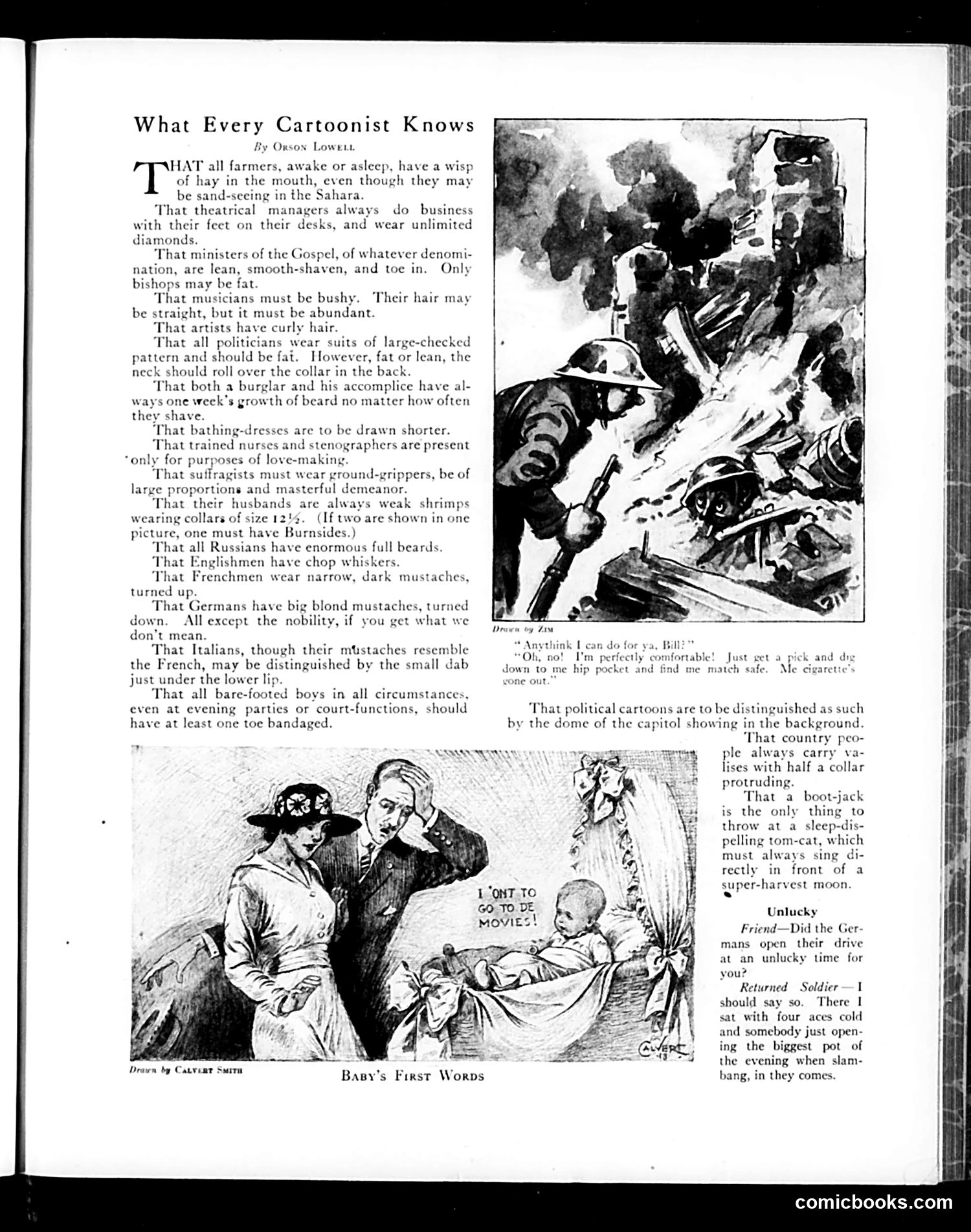
This is a satirical essay by Orson Lowell mocking the visual clichés cartoonists relied upon to instantly communicate character types to readers. It's meta-humor about cartooning conventions themselves. Lowell catalogs tired stereotypes: farmers always have hay in their mouths; politicians wear large-checked suits and are fat; Russians have enormous beards; Frenchmen wear narrow upturned mustaches; suffragists are large and masterful; nurses exist only for romance subplot purposes. The piece continues through dozens of such visual shorthand devices. The accompanying cartoons illustrate this mockery. "Baby's First Words" shows a domestic scene where a child's first utterance is movie-related slang, satirizing how cartoonists depicted modern urban culture. For modern readers: this reveals how heavily pre-film-era cartooning depended on visual stereotypes and stock characters—the audience needed instant visual recognition since there was no dialogue. The satire exposes how lazy and formulaic these conventions had become by this magazine's era.
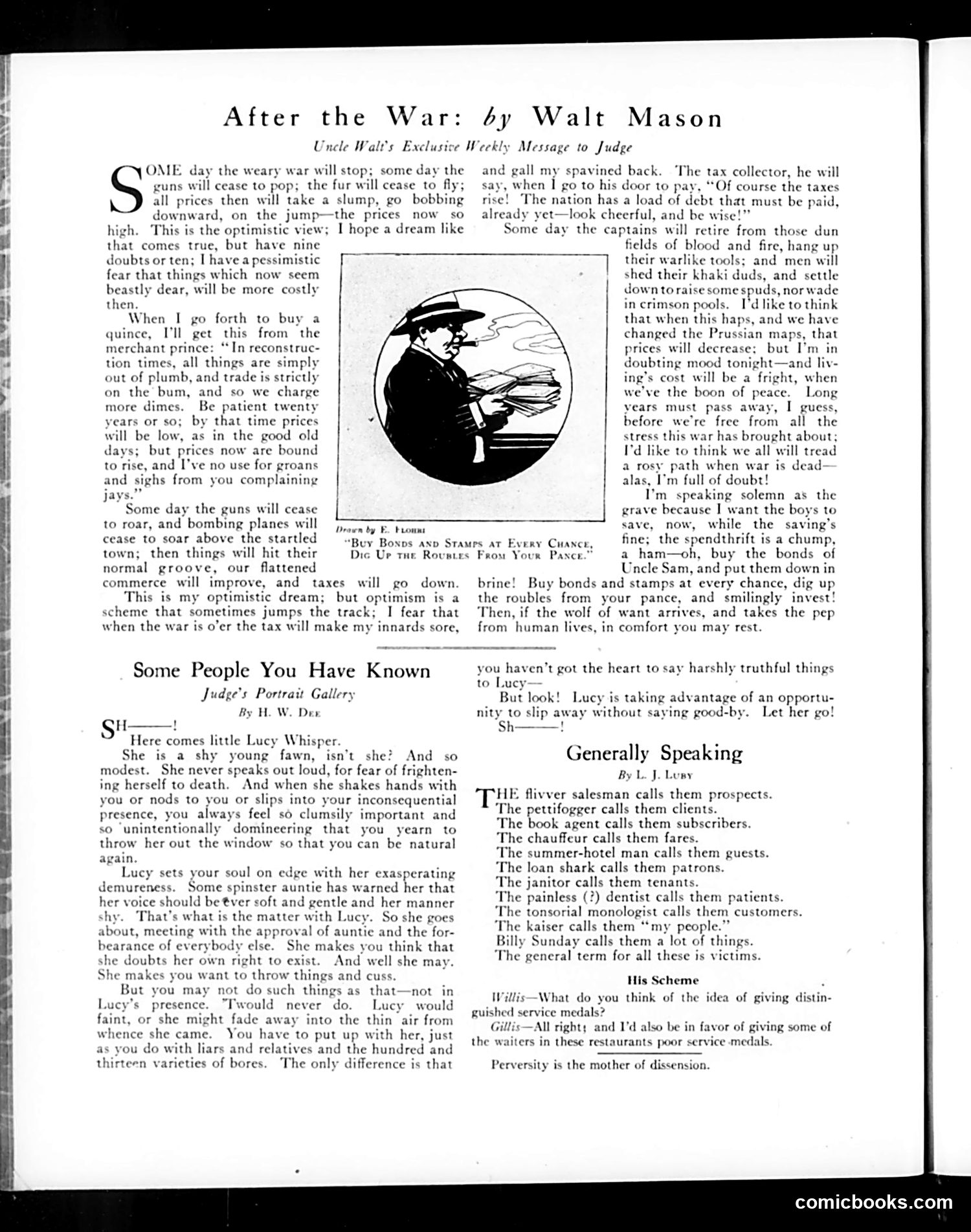
This page contains two distinct pieces from Judge magazine: **"After the War" by Walt Mason**: A pessimistic poem disguised as optimism about post-WWI economics. Mason warns that while warfare will end, inflation and taxes will persist or worsen. The accompanying illustration shows a merchant or profiteer. The satire targets economic opportunists who exploited wartime scarcity—Mason predicts they'll continue raising prices during "reconstruction," claiming shortages justify high costs. The piece also urges readers to buy war bonds to reduce national debt. **"Some People You Have Known" portrait**: A character sketch of "Lucy Whisper," a painfully shy young woman whose excessive modesty and meekness make others uncomfortable. The satire ridicules both Lucy's affected femininity (coached by disapproving aunties to be soft-spoken and demure) and society's expectation that women behave this way—suggesting such enforced passivity is absurd and annoying rather than virtuous. Both pieces critique post-WWI anxieties: economic instability and restrictive gender norms.
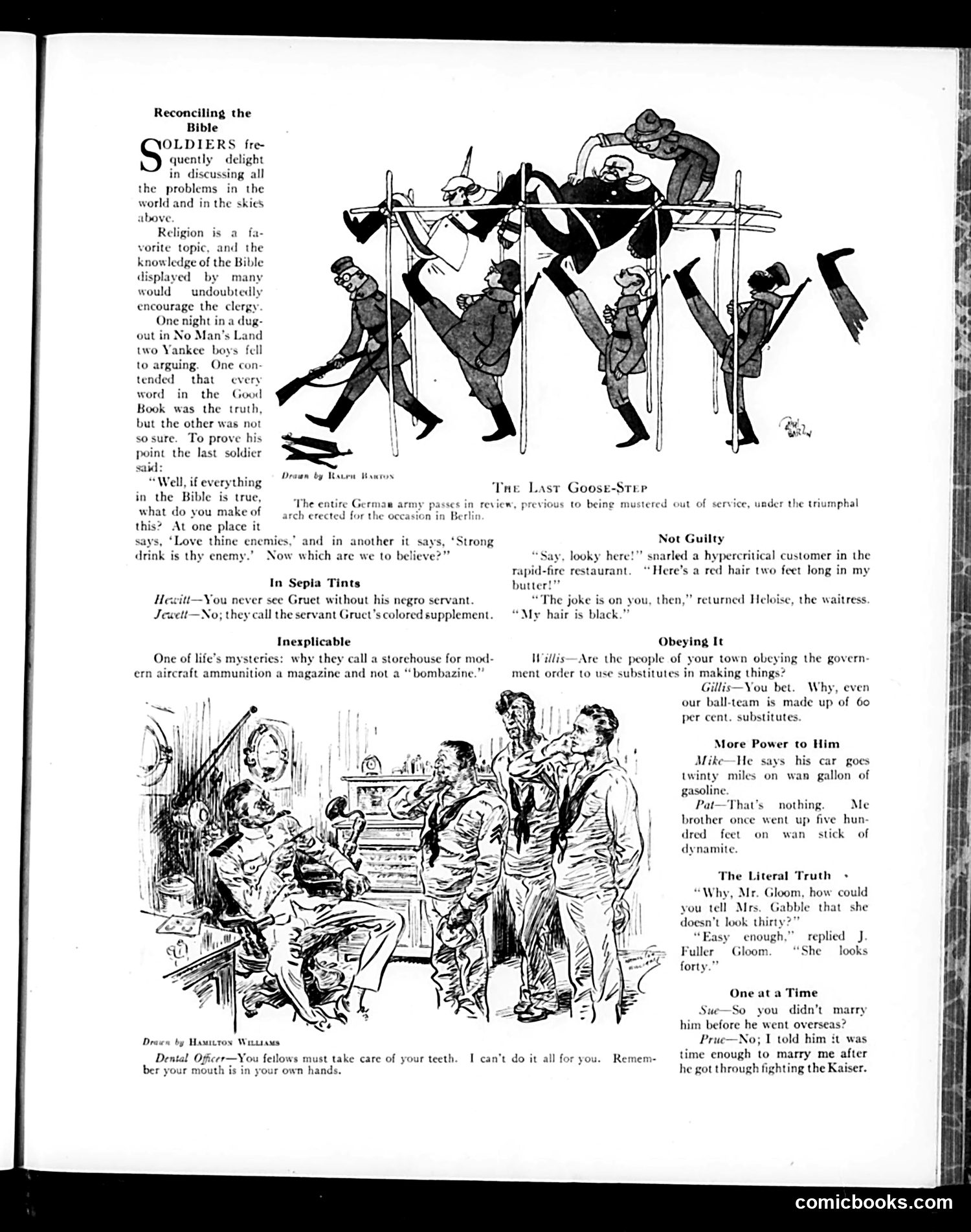
This WWI-era page contains multiple short humor pieces and cartoons: **Main Feature ("The Last Goose-Step")**: A satirical drawing showing German soldiers in exaggerated, high-kicking formation during a military review in Berlin. The caption references Germany being "mustered out of service"—likely commentary on Germany's military defeat and demilitarization following WWI's end. **"Reconciling the Bible"**: Two American soldiers in a trench debate biblical contradictions (loving vs. hating enemies; loving vs. hating strong drink), illustrating soldiers' casual theological arguments during wartime. **Smaller jokes** mock: dental hygiene for soldiers, confusion over military terminology ("magazine" for ammunition storage), substitutes during wartime rationing, exaggerated boasts, and romantic timing during wartime. The page reflects American popular attitudes toward the recent war's conclusion—mockery of defeated Germans mixed with homefront observations about military life, rationing, and soldiers' perspectives. The humor is broadly patriotic and domestic in focus.
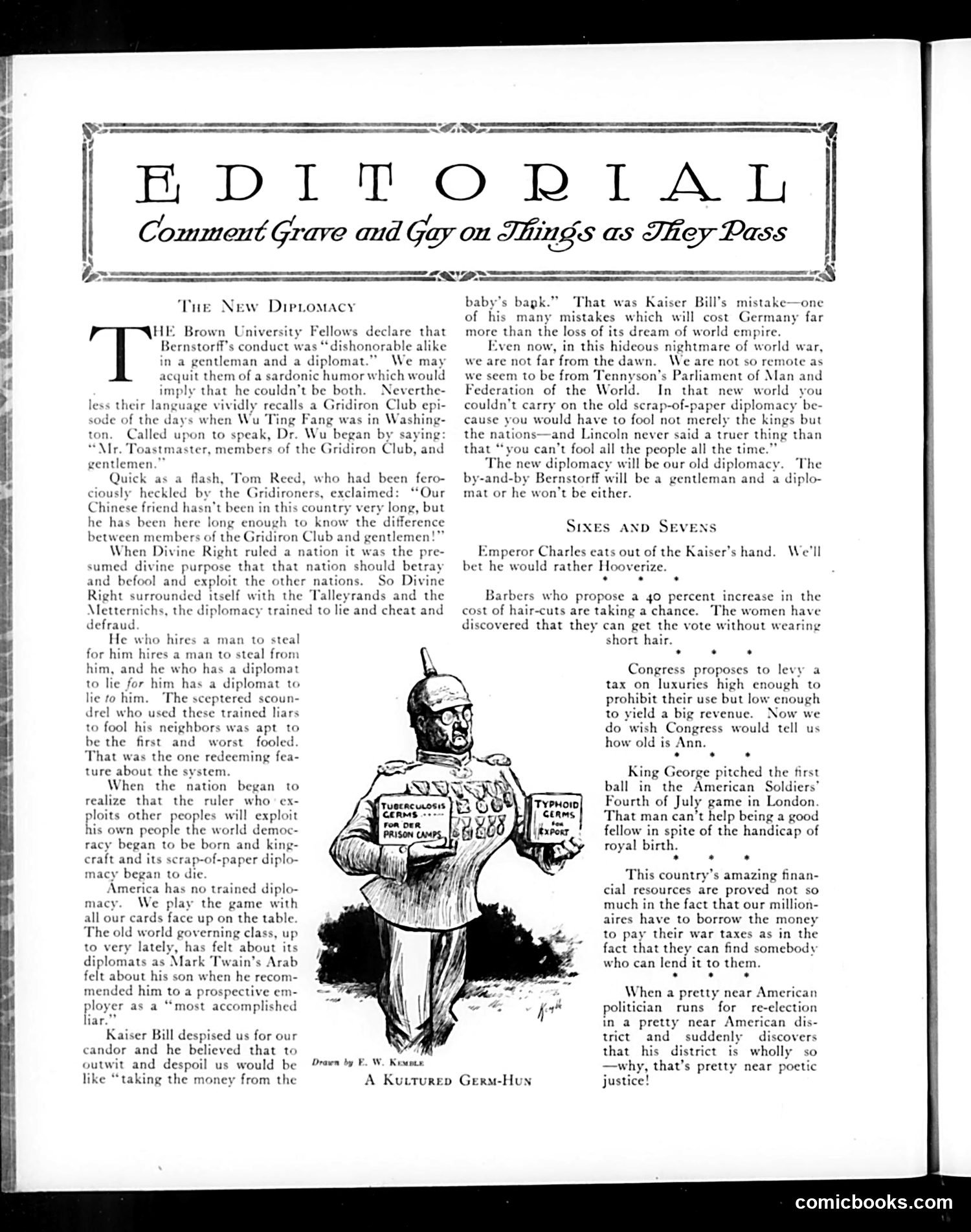
This editorial page satirizes diplomatic duplicity and wartime politics during World War I. **Main Cartoon:** "A Kultured Germ-Hun" depicts the Kaiser as a bloated, militaristic figure covered with labels representing German traits and deceptions—visual mockery of German "culture" and militarism. **Key Targets:** - **Bernstorff**: The German ambassador to the US, criticized by Brown University Fellows for dishonorable conduct. The editorial argues America's "new diplomacy" operates with transparency ("cards face up"), unlike old-world deceptive practices. - **Kaiser Bill**: Depicted as underestimating American candor; believed he could outwit Americans like stealing "money from a baby's bag"—his fatal strategic error. **Political Points:** The piece celebrates American honesty versus European diplomatic manipulation, suggesting post-war international governance ("Parliament of Man") will require truth rather than deception. Appears written pre-US entry or early war period, emphasizing American moral superiority. **Brief jokes** mock wartime rationing ("Hooverize"), taxation, and King George's attendance at American soldiers' events.
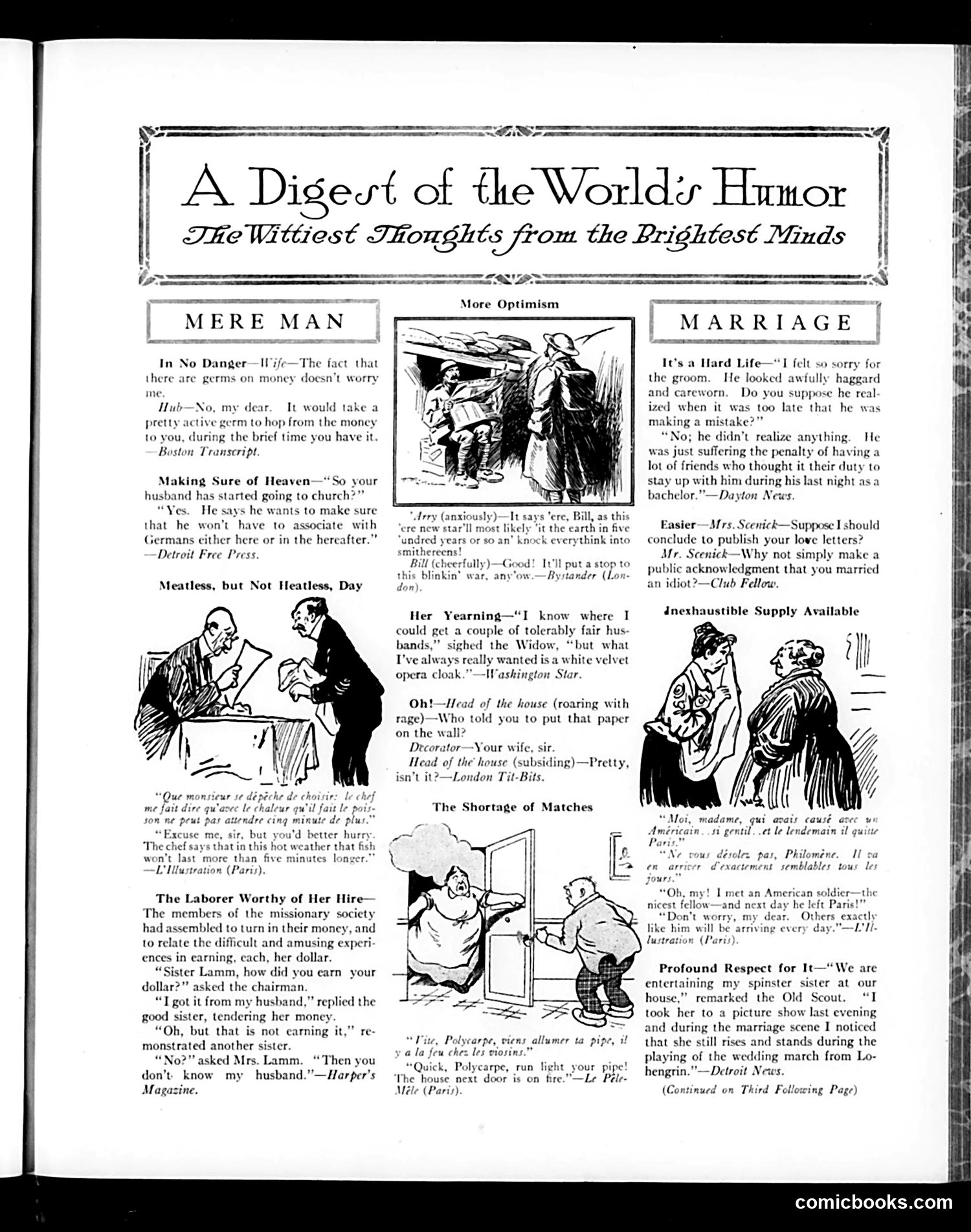
This is a humor compilation page mixing American and European jokes. The cartoons and quips satirize everyday social life during the World War I era. Key themes include: **Marriage**: Jokes mock husbands as hapless, careworn figures suffering through bachelor parties and marital embarrassment. One cartoon shows a decorator caught between angry husband and wife over wallpaper—typical domestic friction humor. **Gender dynamics**: A missionary society woman earning money from her husband gets criticized for not truly "earning" it—mocking both women's economic dependence and their charitable pretensions. **War-era references**: British soldiers discuss a meteor strike as potentially ending "this blinkin' war," reflecting widespread wartime anxiety. A husband boasts he'll attend church to avoid associating with Germans "in the hereafter"—expressing anti-German sentiment common during WWI. **Class humor**: Satire targets both working-class laborers and wealthy spinsters, with the latter expected to stand during wedding marches. The mixed European sources (Paris, London) indicate Judge's cosmopolitan audience.
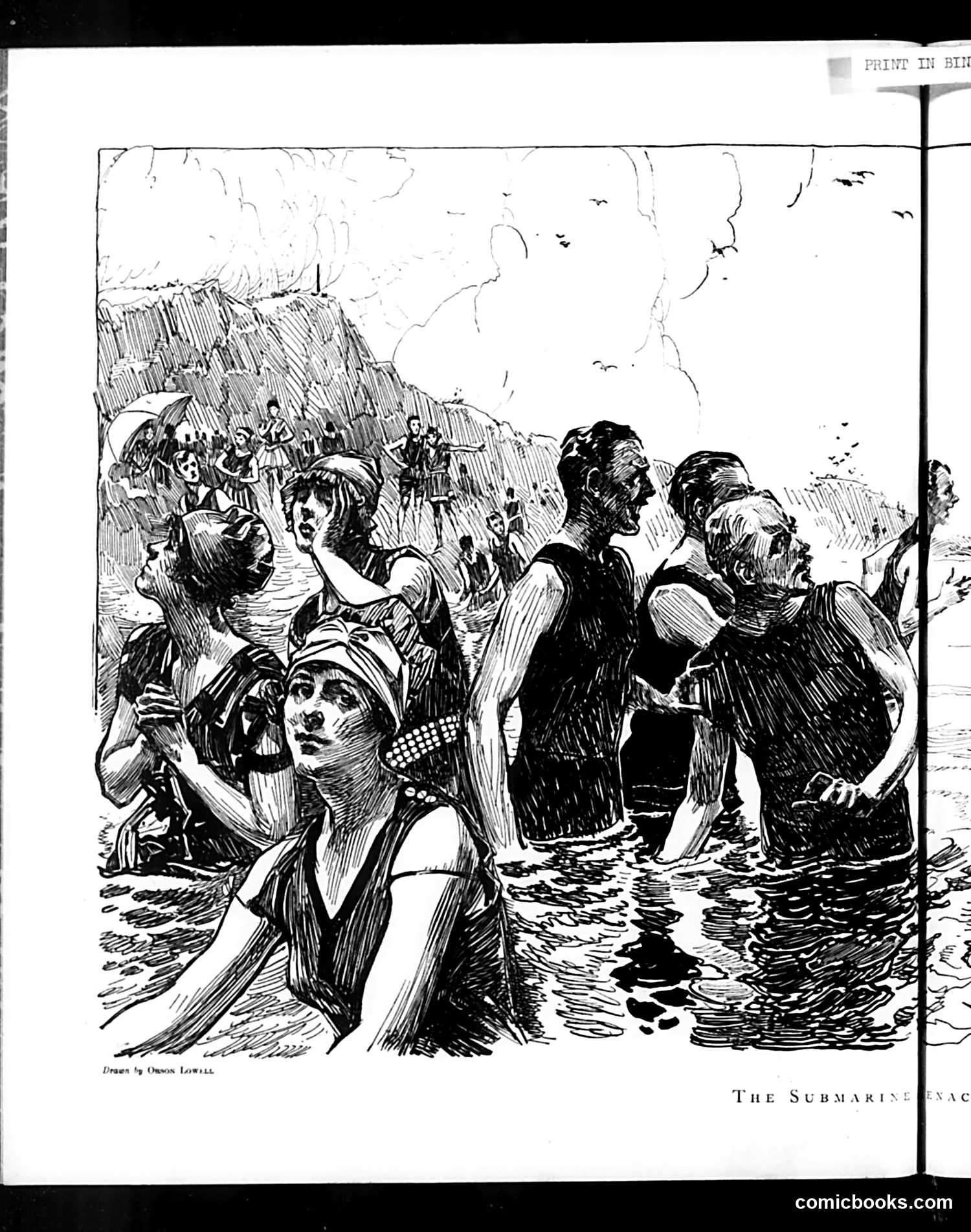
This political cartoon by Orison Lowell depicts a crowd of people, apparently civilians, wading in water near a hillside. The title "The Submarine Sac" suggests commentary on submarine warfare or naval threats. Given Judge magazine's American satirical focus, this likely references early 20th-century anxieties about German U-boats, particularly relevant during World War I era when submarine warfare was a major concern for American shipping and public safety. The crowded, chaotic scene of ordinary people in water appears to satirize either panic about submarine attacks or perhaps public response to naval incidents. The woman in the foreground wears a distinctive headwrap, suggesting this may reference a specific historical event or casualty, though the exact reference remains unclear without additional context.
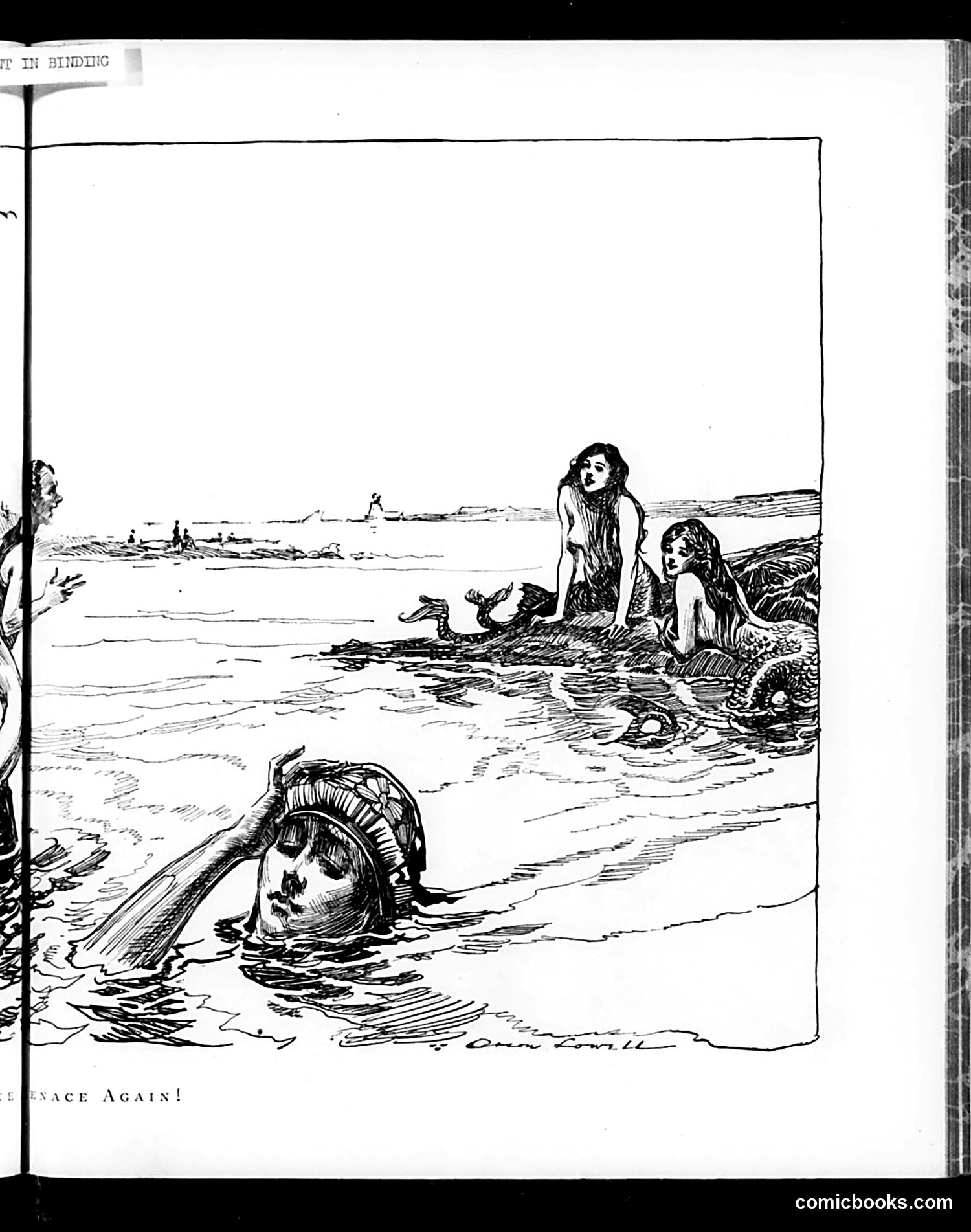
This cartoon appears to depict a drowning figure in the foreground wearing what looks like a bonnet or cap, while two children observe from the beach in the background. The caption reads "PEACE AGAIN!" The image likely satirizes a contemporary political situation involving failed peace negotiations or a broken peace agreement—the drowning figure suggests peace itself is dying or has been abandoned. The children watching passively may represent the public or future generations witnessing this failure. However, **without additional context about the specific historical moment Judge published this**, I cannot definitively identify which conflict or political figures this references. The style suggests early-to-mid 20th century, but the exact satirical target remains unclear from the image and OCR text alone.
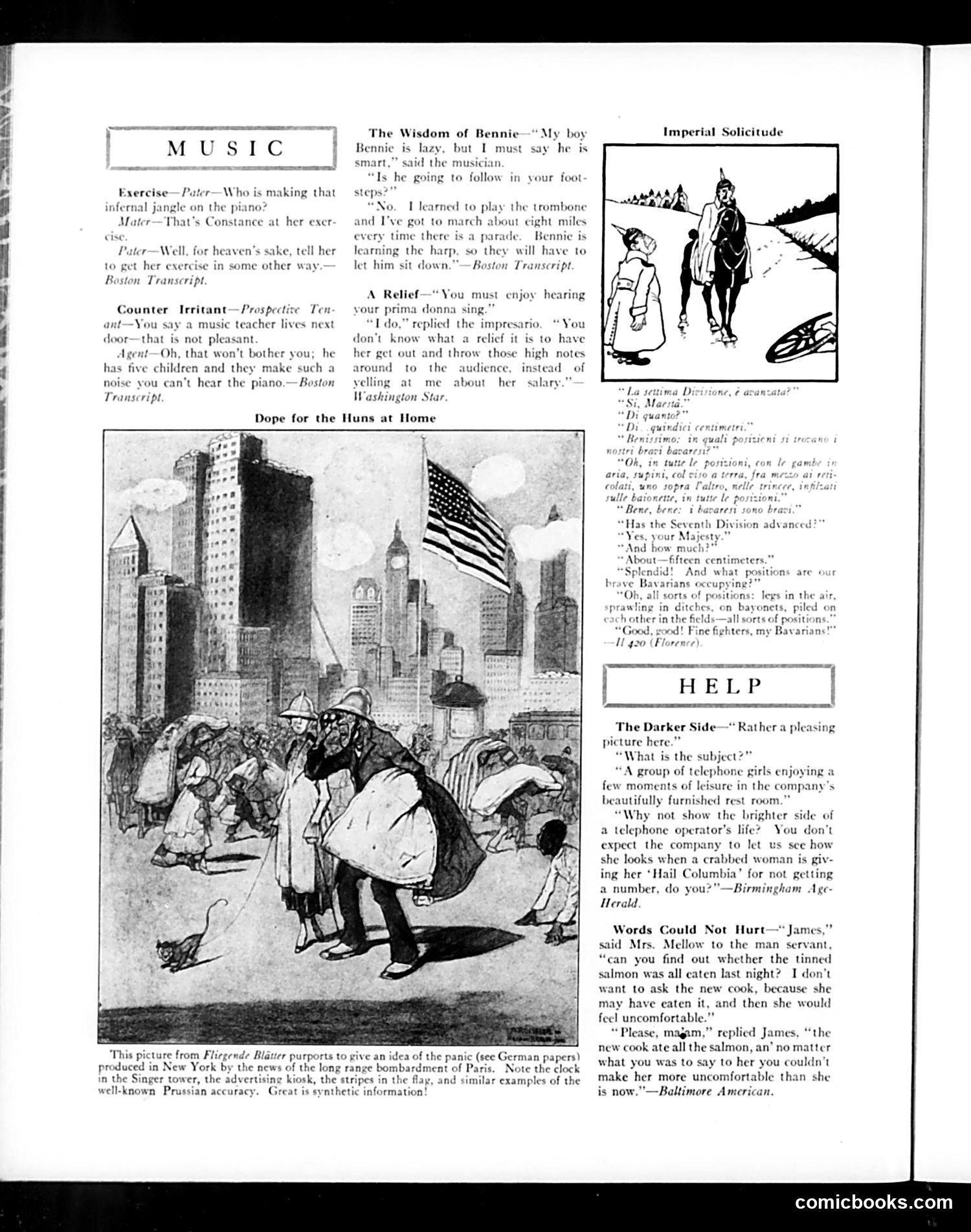
This page contains several brief humorous anecdotes typical of early 20th-century American humor magazines. **"Dope for the Huns at Home"** is the most significant piece—a political cartoon satirizing German propaganda. It depicts New York City in apparent panic from news of German long-range bombardment of Paris. The caption notes this image comes from *Fliegende Blätter* (a German publication) and was circulated by German newspapers to suggest American fear. Judge's republication with commentary mocks this propaganda effort, pointing out the image is obviously synthetic ("Great is synthetic information!"). This reflects WWI-era tensions and American skepticism of German claims. The remaining content consists of light domestic humor: complaints about piano students and noise, a music impresario relieved when his prima donna stops singing, and servant-employer awkwardness about eaten salmon. These are formulaic joke exchanges with no political content, typical filler for the magazine. The "Imperial Solicitude" illustration shows a German officer questioning troop positions—dark military humor appropriate to wartime.
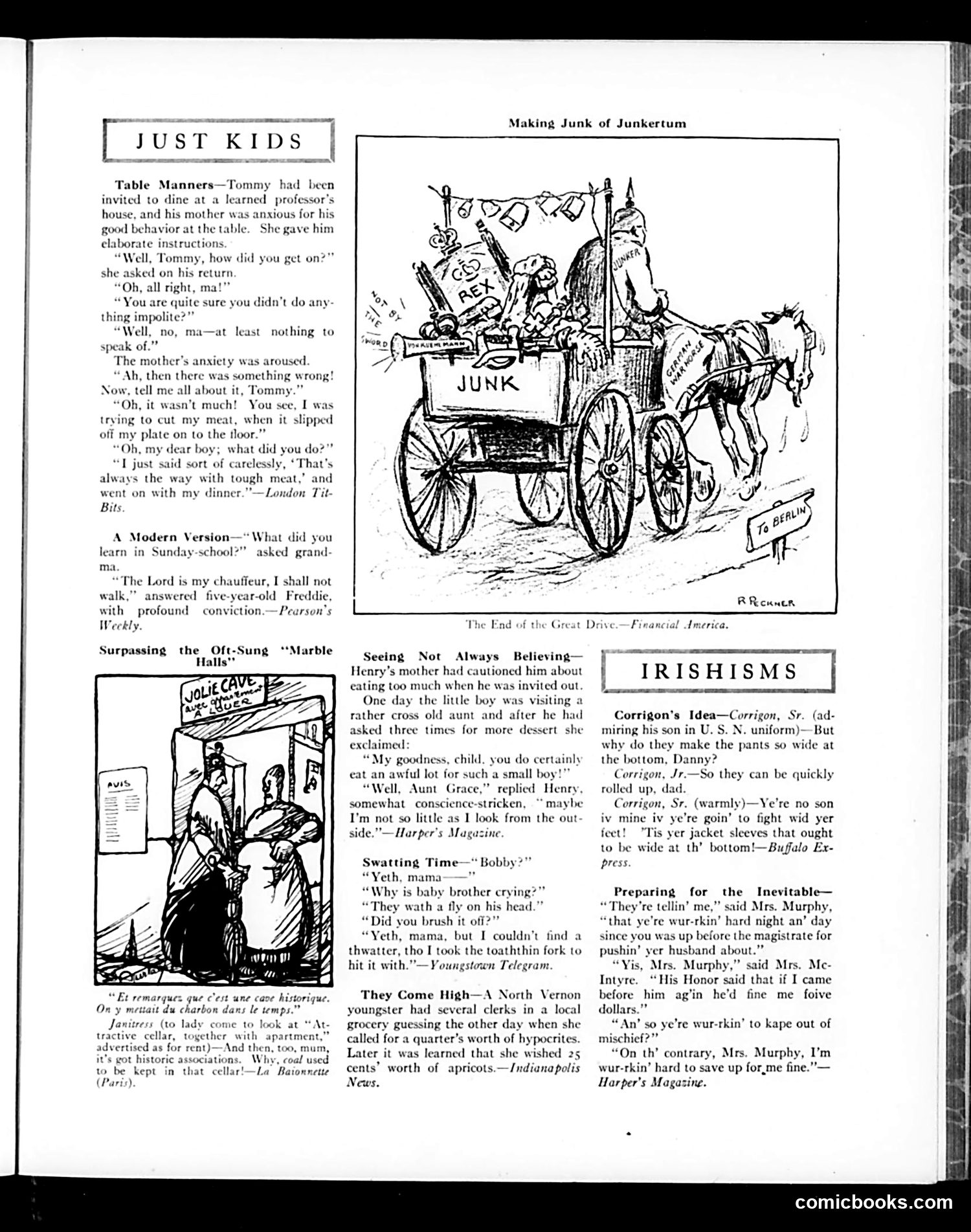
This page from the satirical magazine *Judge* contains three main humor sections: **"Just Kids"** presents humorous anecdotes about children's literal interpretations and modern irreverence. In "Table Manners," a boy's polite deflection of an accident becomes funny through understatement. The "Modern Version" satirizes contemporary children by having a five-year-old mock religious instruction, replacing "shepherd" with "chauffeur"—mocking both automobile culture and declining religious devotion among youth. **The cartoon** (top right) titled "Making Junk of Junkertum" depicts a horse-drawn cart overloaded with junk, labeled as commentary on German militarism ("Junkertum" refers to Prussian aristocratic military class). The caption "The End of the Great Drive" likely references WWI, satirizing the collapse of German military power. **"Irishisms"** stereotypes Irish immigrants through dialect humor, depicting them as working-class, prone to legal troubles, and financially struggling—common ethnic caricature typical of early 20th-century American humor magazines. The overall page reflects period attitudes toward children, immigrants, and contemporary social anxieties about modernity and war.
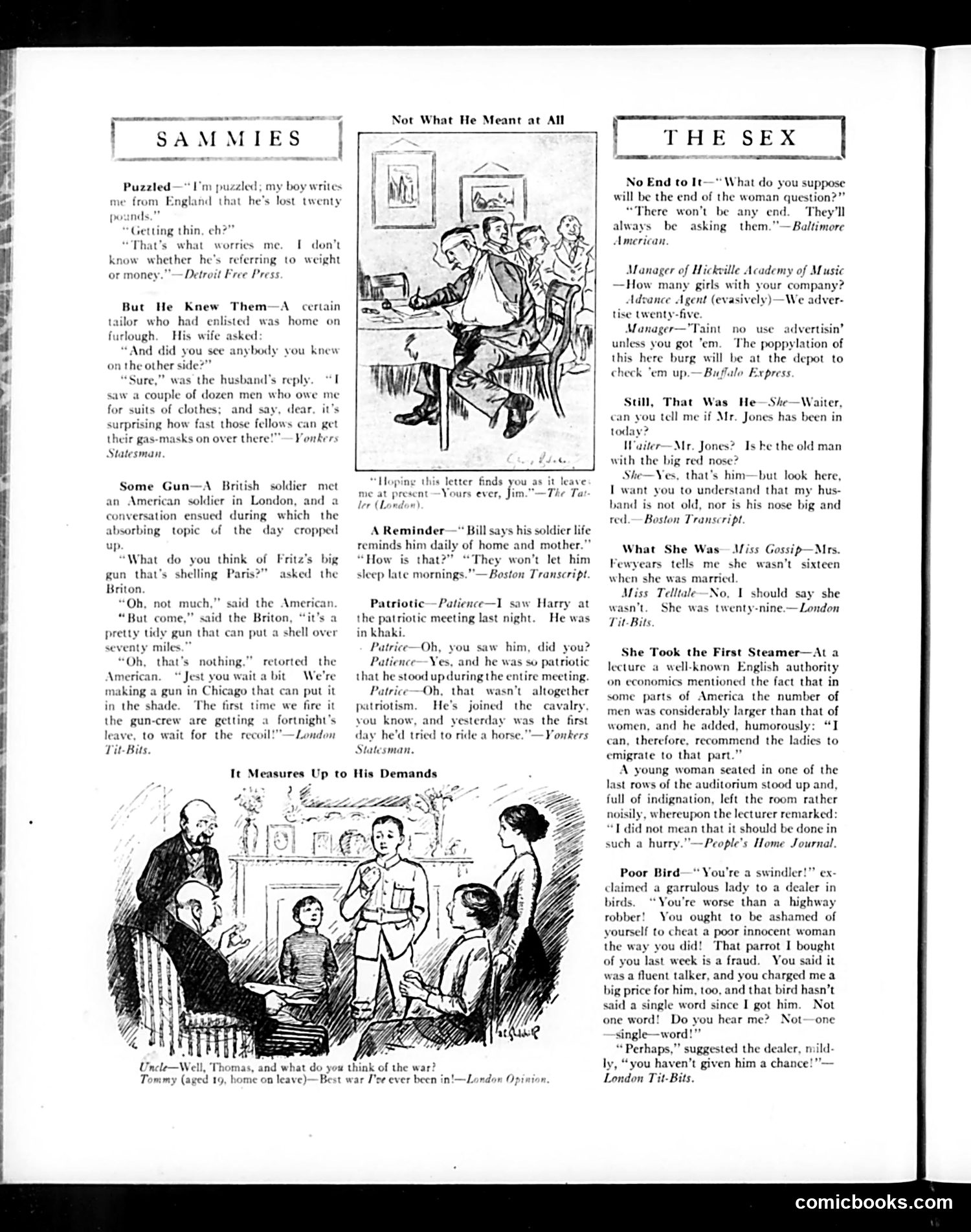
This page from *Judge* contains WWI-era humor organized into three sections: "Sammies" (jokes about American soldiers), "Not What He Meant at All" (a cartoon), and "The Sex" (jokes about women). The central cartoon depicts an uncle asking a young soldier about the war, with family members present. The joke plays on double meanings and miscommunication typical of the period. The "Sammies" section jokes about American soldiers abroad—their weight loss, encounters with creditors in Europe, and exaggerated boasts about American military technology (a Chicago gun outdoing German artillery). These reflect American participation in WWI and the contemporary stereotype of braggadocious Americans. "The Sex" section contains predominantly anti-woman humor: jokes about women asking endless questions, lying about age at marriage, and aggressively pursuing emigration to America for its male surplus. This reflects 1910s-era sexism and anxiety about women's increasing social visibility during wartime. The humor is consistently dated, relying on period-specific references and attitudes now considered offensive.
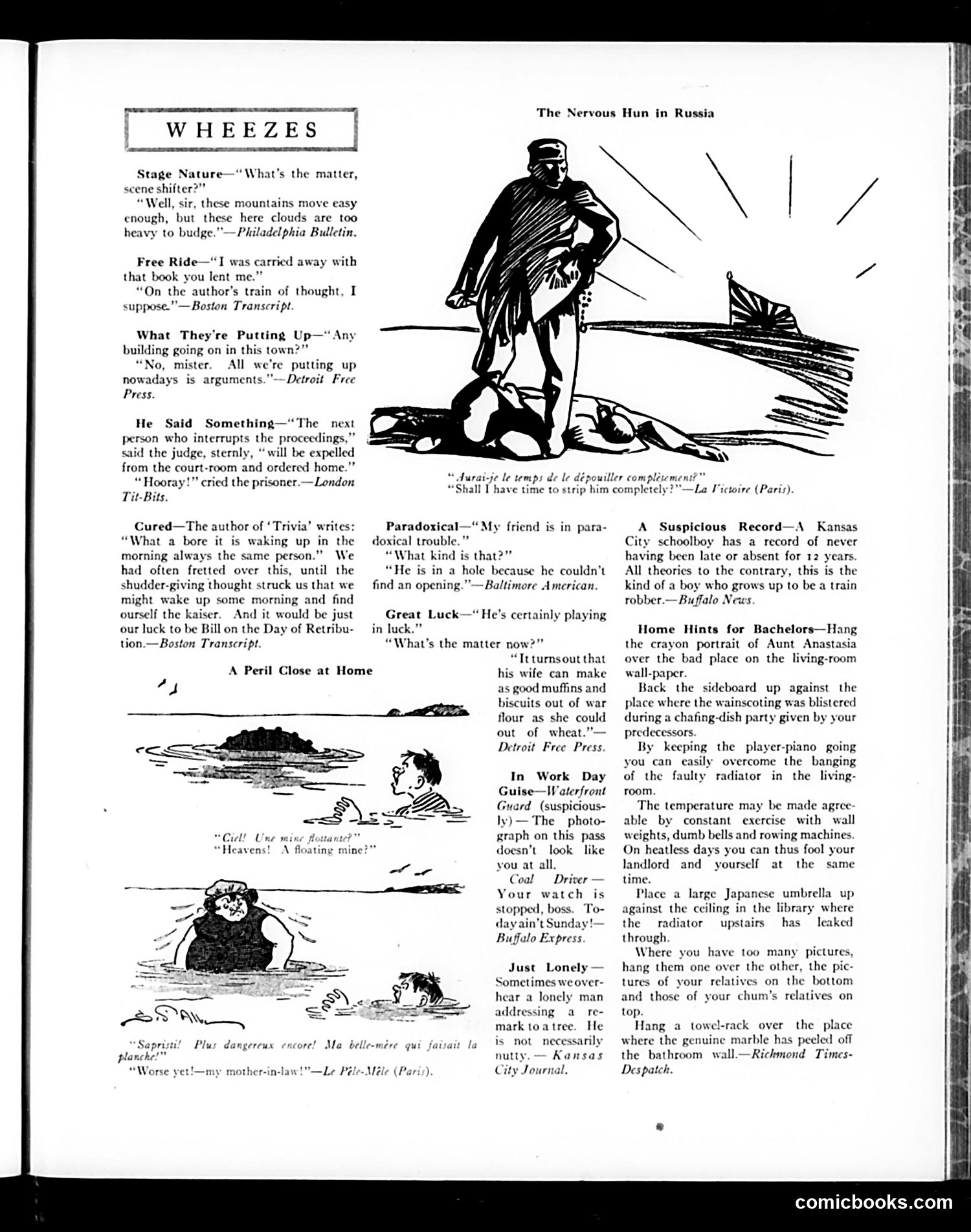
This page contains brief humorous quips and cartoons typical of Judge's satirical format: **The "Wheezes" section** offers short jokes on everyday topics—theater production, book recommendations, construction/arguing, courtroom disruption, and the Kaiser (German leader). The Kaiser reference suggests this was published during or shortly after WWI, when anti-German sentiment was common. **"A Peril Close at Home"** shows a man drowning, with the caption (in French) saying his mother-in-law is worse—a standard joke about difficult in-laws. **"The Nervous Hun in Russia"** depicts a German soldier ("Hun" was WWI slang for Germans) stripping a Russian soldier, asking if he has time to complete the robbery. This reflects the brutal Eastern Front violence and German aggression. **"Home Hints for Bachelors"** offers humorous domestic advice: hiding wall damage with furniture and portraits, using exercise to stay warm without heat, masking radiator noise with a player-piano. The overall tone is light satirical humor focused on domestic life, relationships, and wartime references typical of American magazines during the WWI era.
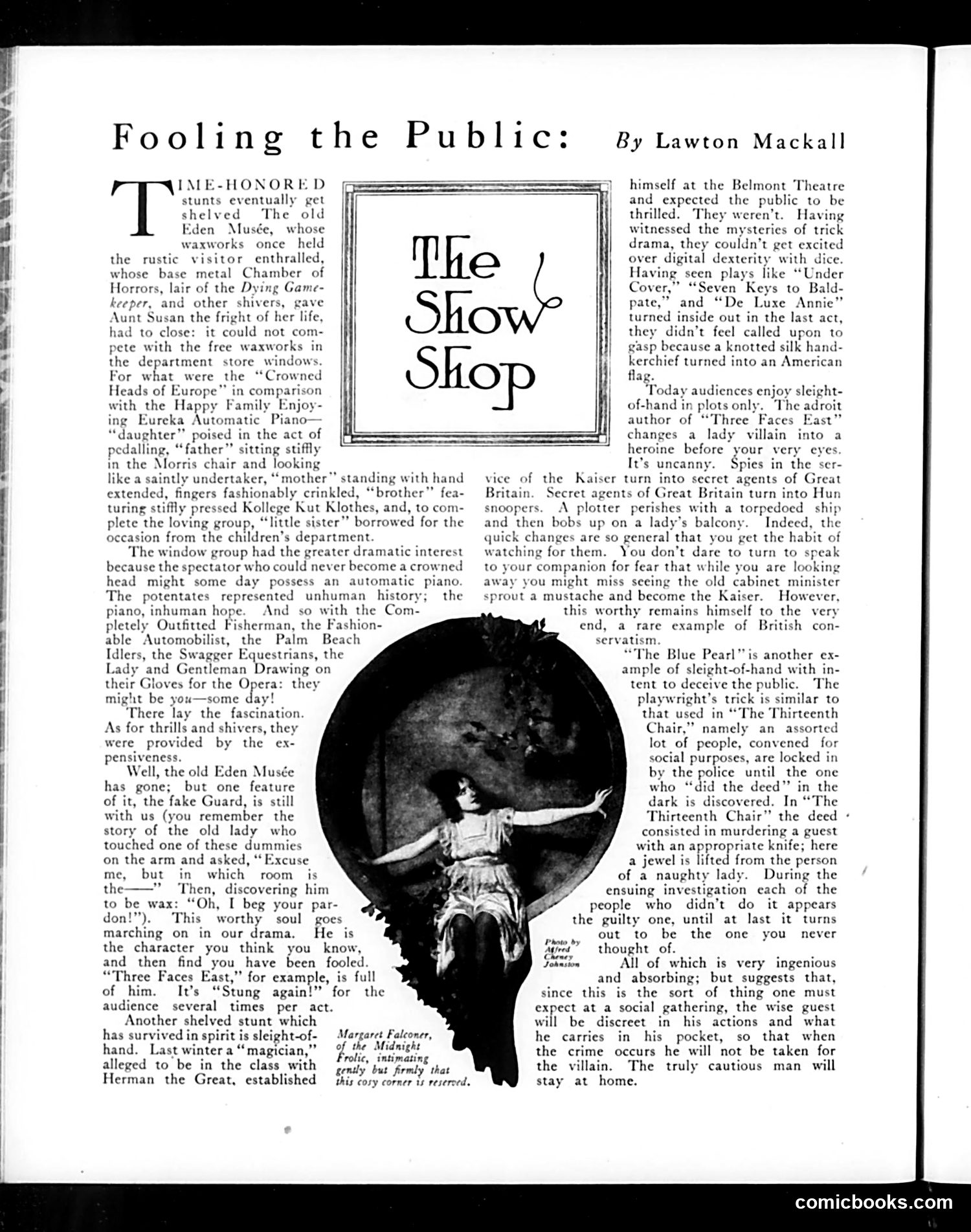
This article by Lawton Mackall critiques how modern theater audiences have become sophisticated enough to anticipate plot tricks, rendering traditional stagecraft ineffective. The piece uses the **Eden Musée** (a wax museum attraction) as its central metaphor. Once thrilling to audiences, it closed because it couldn't compete with free department-store window displays—similarly, theatrical "stunts" (fake guards, sleight-of-hand plot devices, quick costume changes) that once amazed viewers now fall flat. Mackall argues modern audiences, having seen plays like "Under Cover" and "Seven Keys to Baldpate" with their elaborate third-act reversals, can no longer be fooled by transparent theatrical tricks. They appreciate cleverness only in *plot construction* itself, not obvious stage mechanics. Examples cited include "Three Faces East" and "The Blue Pearl"—plays relying on character disguises and deceptions. The point: audiences now watch *for* the trick rather than being surprised by it, making traditional illusions obsolete. The satire targets both theater's creative exhaustion and audiences' jaded sophistication in the 1920s.
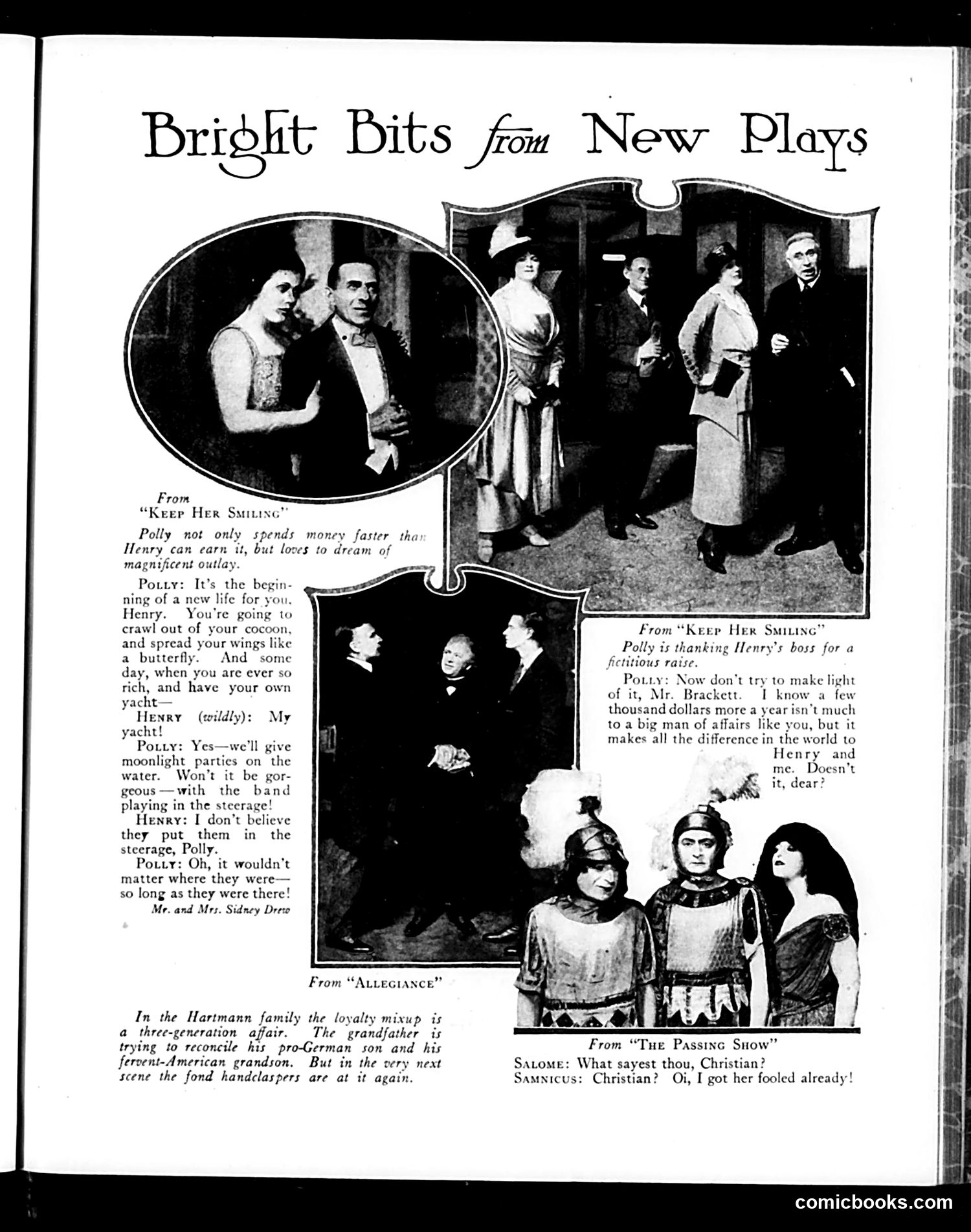
This page excerpts comedic scenes from contemporary theatrical productions, presented as entertainment content rather than satire. **"Keep Her Smiling"** depicts marital comedy: Polly dreams of extravagant wealth while Henry struggles to provide, with fantasy sequences showing yacht parties and lavish spending. The humor relies on the familiar domestic conflict of wives' expensive tastes versus husbands' modest earnings. **"Allegiance"** references World War I tensions: the Hartmann family experiences conflict between a pro-German father, his patriotic American son, and the grandfather attempting reconciliation—reflecting real American anxieties about divided immigrant loyalties during the war period. **"The Passing Show"** appears to be a classical or historical drama scene with minimal context provided. The page serves as theatrical promotion rather than political commentary, though the "Allegiance" reference obliquely touches on wartime identity questions relevant to Judge's contemporary readership.
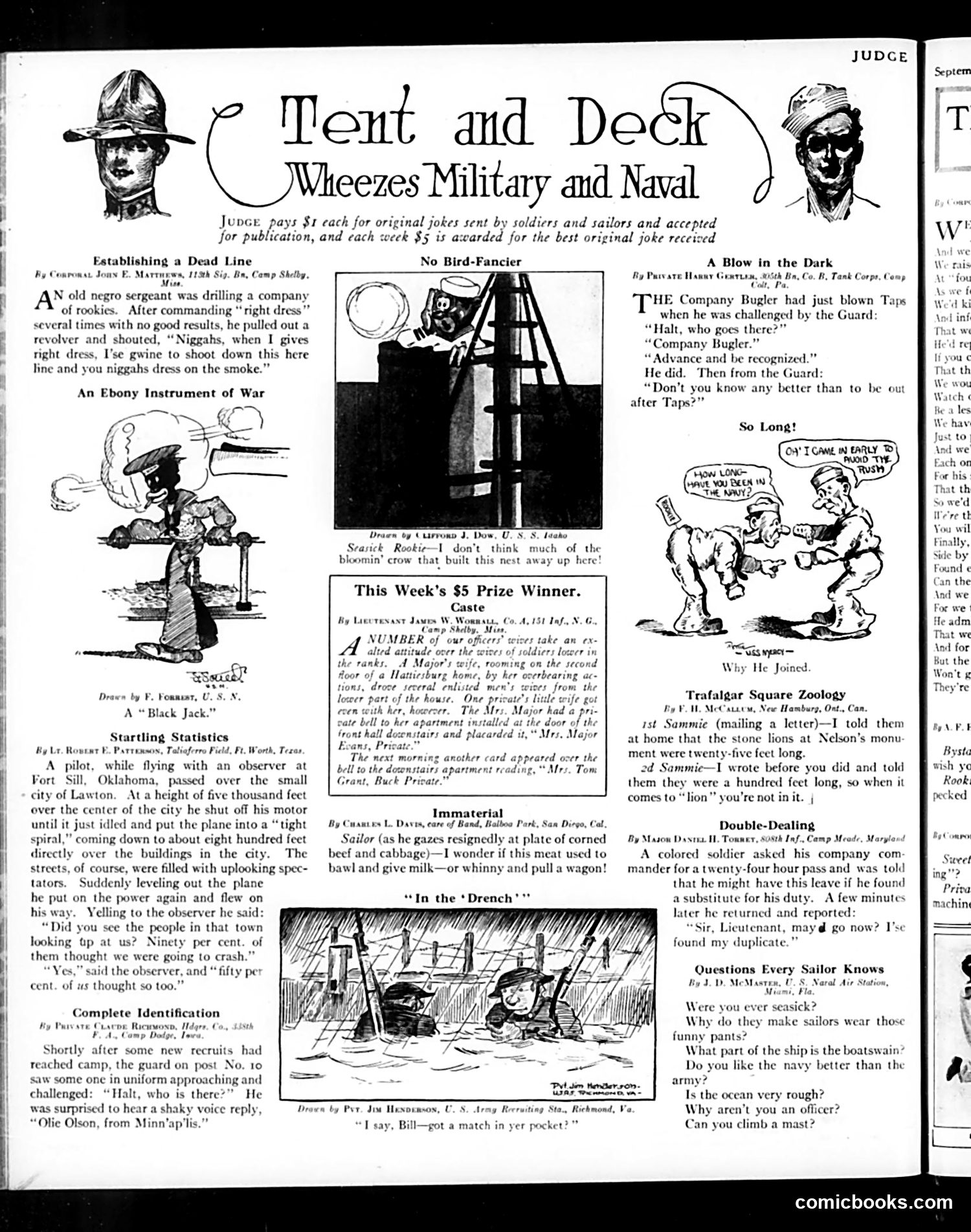
This is a collection of brief jokes and cartoons submitted by soldiers and sailors during World War I, published in Judge magazine as part of a contest (offering $1 per accepted joke, $5 for the best weekly submission). The humor reflects military life: racial stereotypes appear in dialect-heavy jokes about Black soldiers; aviation humor mocks pilot recklessness; and barracks humor focuses on recruit confusion, military protocol violations, and food complaints. One cartoon shows a soldier claiming to have found his "duplicate" to cover his duty—implying attempted deception. The content is typical of early-20th-century military humor: self-deprecating anecdotes about army life, slapstick scenarios, and casual racism reflecting the era's attitudes. The jokes emphasize hierarchy, discipline, and the gap between officers and enlisted men. Modern readers should note these represent period attitudes, not current values.
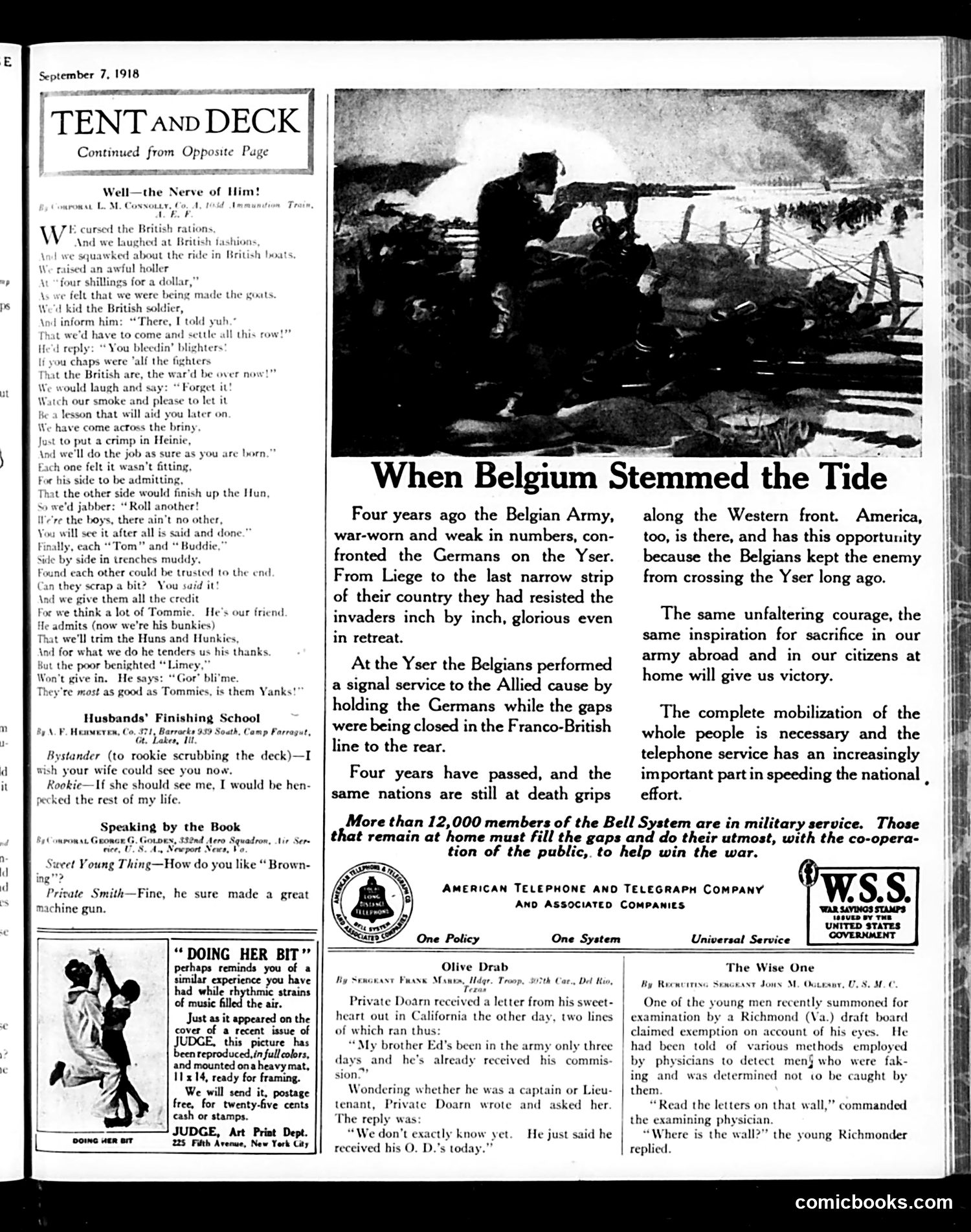
This September 1918 Judge page contains wartime content reflecting America's involvement in World War I's final months. **"Well—the Nerve of Him!"** is a humorous poem about American and British soldiers' friendly rivalry. It depicts Yanks and Tommies (British soldiers) good-naturedly mocking each other's nations, rations, and fighting abilities—while ultimately acknowledging mutual respect. The joke turns on the "Limey's" reluctant admission that Americans are "most as good as Tommies," presented as ultimate British grudging praise. **"When Belgium Stemmed the Tide"** is a propaganda advertisement by American Telephone & Telegraph. It commemorates Belgium's 1914 resistance at the Yser River, arguing this sacrifice enabled Allied victory and justifies current American mobilization. The ad claims 12,000 Bell System employees are in military service, urging remaining workers to maintain telephone infrastructure supporting the war effort. The three brief comic sketches ("Husbands' Finishing School," etc.) are light military humor about soldiers' domestic anxieties and communication mishaps—typical wartime morale content for Judge's audience.
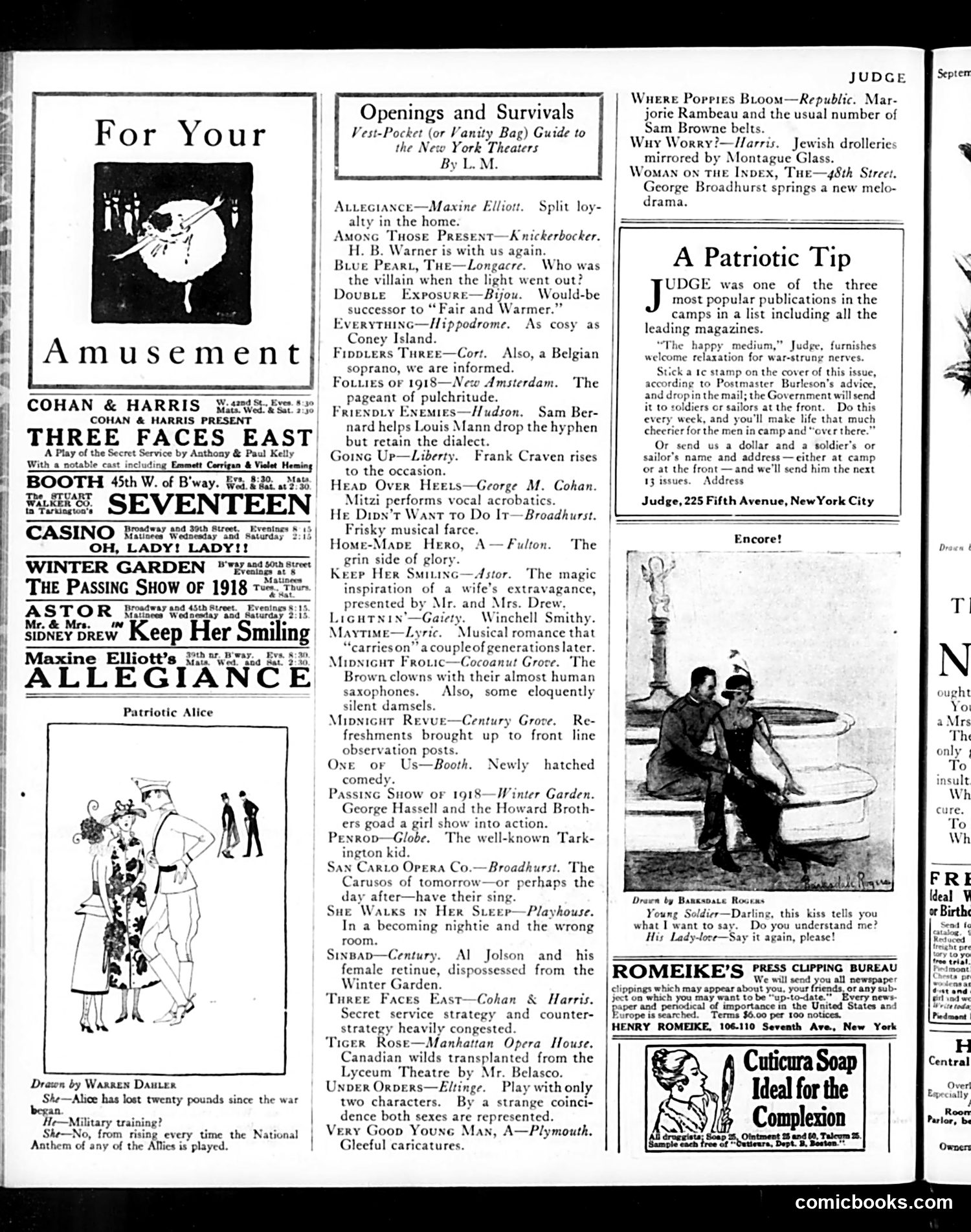
This is primarily a theatrical advertising and review page from Judge magazine during World War I. The main cartoon, titled "Patriotic Alice," depicts a woman who has lost twenty pounds. The joke: she's not dieting for health—she's losing weight by repeatedly standing up every time the national anthem of any Allied nation is played. With multiple Allied countries in the war, this happens constantly. The humor satirizes excessive patriotic display during wartime. It mocks performative patriotism—the woman's physical exhaustion from constant standing symbolizes how tiresome and absurd such demonstrations can become. The page also includes a "Patriotic Tip" promoting Judge magazine's distribution to soldiers, capitalizing on the magazine's wartime popularity in military camps.
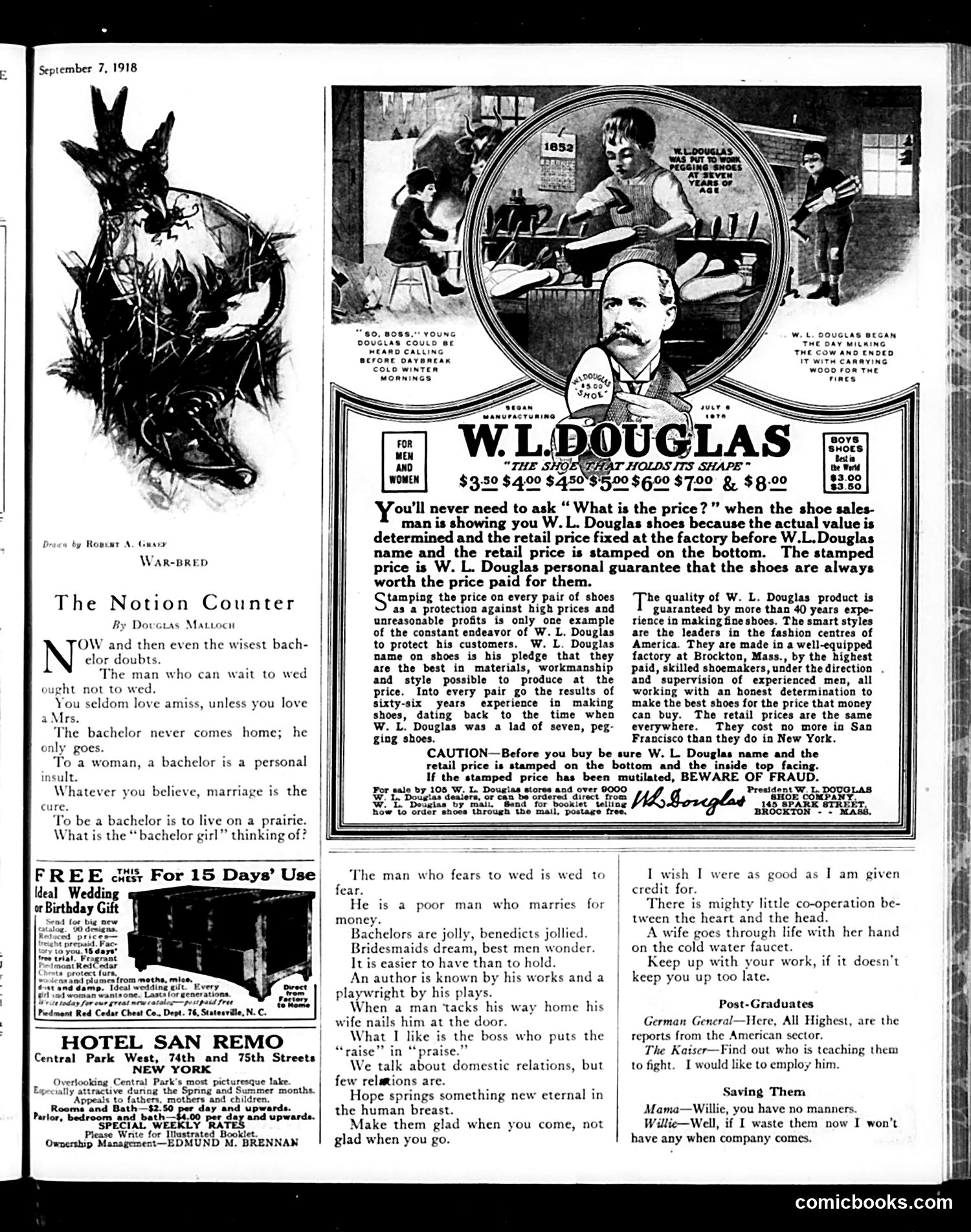
**Left side:** Robert A. Gaar's political cartoon titled "War-Bred" depicts a grotesque, spiky creature—likely representing German militarism or Prussian aggression—emerging from or surrounded by thorns and warfare imagery. Published during WWI's final months, this caricature embodies anti-German sentiment prevalent in American media at the time. **Right side:** Douglas Malogh's "The Notion Counter" presents witty, cynical aphorisms about bachelor life versus marriage ("The bachelor never comes home; he only goes"). Written during wartime, some barbs appear gender-critical ("To a woman, a bachelor is a personal insult"). These are satirical observations on domestic relations and male reluctance toward matrimony. **The page's tone** reflects 1918 America: wartime patriotism combined with social commentary on traditional gender roles and marriage customs. The advertisements (W.L. Douglas shoes, Hotel San Remo) anchor this to everyday commercial life during the Great War's conclusion.
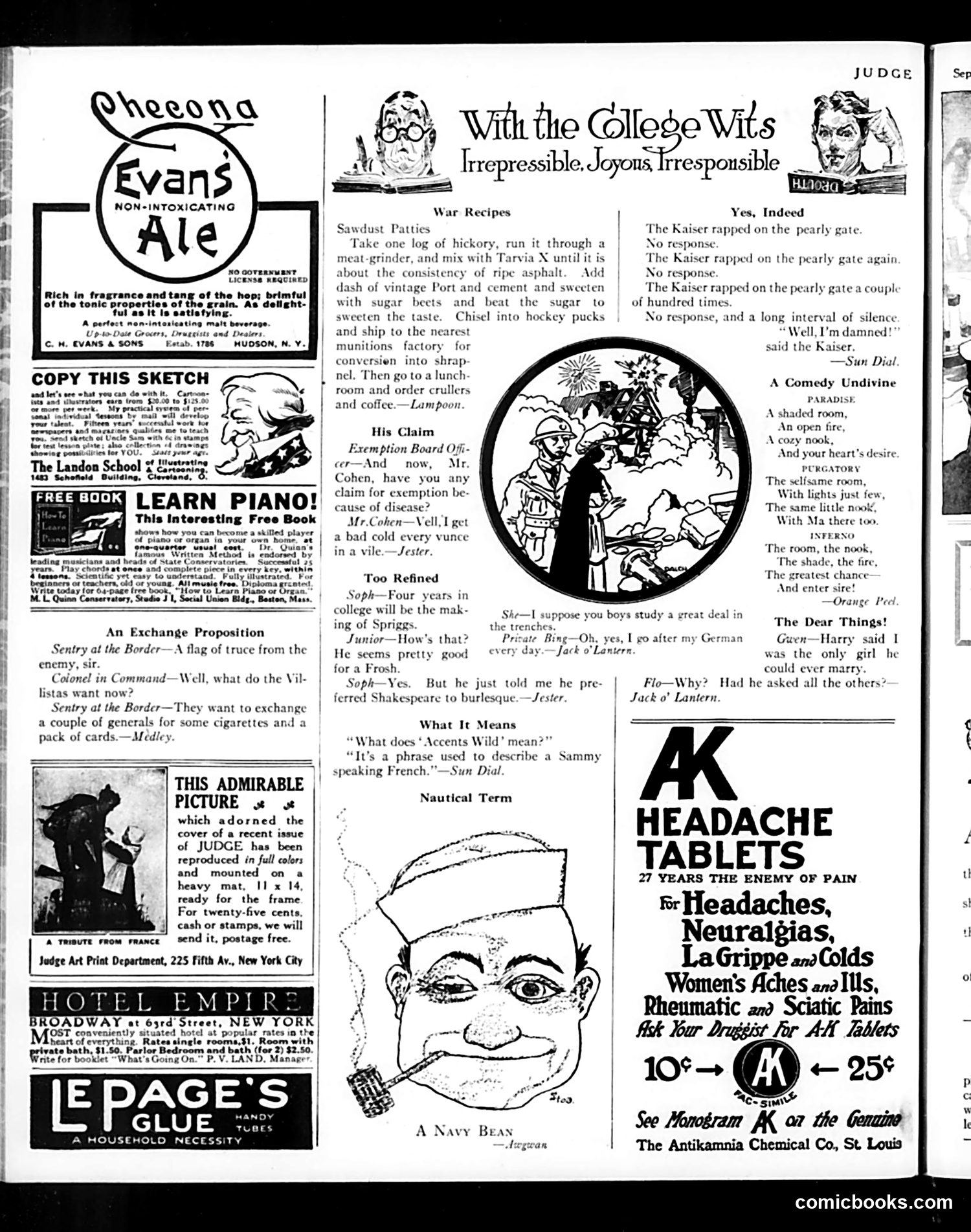
This is primarily an **advertising page** with scattered comic content typical of early 20th-century Judge magazine. The main satirical content includes: **"War Recipes"** — A joke about WWI-era food shortages, mocking substitute ingredients by suggesting ridiculous combinations (sawdust, asphalt, cement) for munitions production. **"Yes, Indeed"** — A dark humor piece about Kaiser Wilhelm repeatedly knocking on heaven's gate, apparently being rejected entry to the afterlife—reflecting American anti-German sentiment during WWI. **College humor sketches** about exemption board claims and romantic misunderstandings among students. The page is dominated by **product advertisements** for Cheona Evans Ale, piano lessons, hotel accommodations, and notably **AK Headache Tablets**, which occupies substantial space claiming to cure headaches, neuralgia, colds, rheumatism, and various women's ailments—typical exaggerated medical advertising of the era. The overall tone reflects a wartime American publication mixing patriotic satire with commercial messaging.
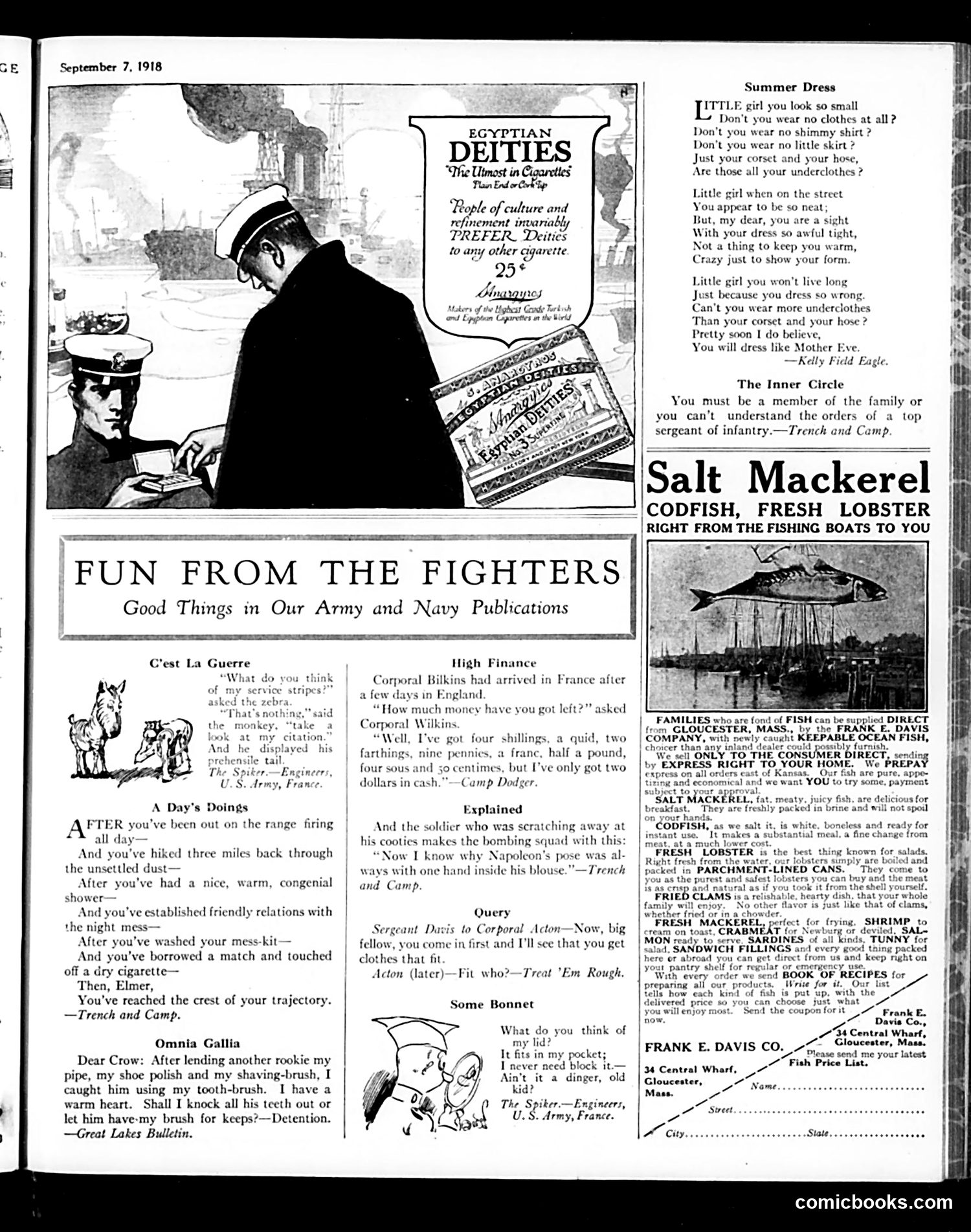
This page from Judge (September 7, 1918) contains WWI-era military humor and period advertisements. **The Cartoons:** "Fun from the Fighters" collects humorous anecdotes from Army and Navy publications. The jokes reflect soldiers' experiences: exhaustion after training, confusion over foreign currency in France, lice infestations ("cooties"), and ill-fitting uniforms. References to "Trench and Camp" and "Great Lakes Bulletin" indicate these are reprinted from military newspapers. **"Summer Dress"** is a moralistic poem criticizing women's fashions—specifically the trend toward shorter skirts and less restrictive clothing. It reflects anxieties about changing women's fashion during WWI, warning that immodest dress leads to moral and physical decline. **The Advertisements** (Egyptian Deities cigarettes, Salt Mackerel fish) are period-typical. The fish company emphasizes direct-to-home delivery during wartime rationing. **Context:** This reflects 1918 America—mid-WWI, with soldiers abroad and domestic concerns about both military life and evolving social norms.
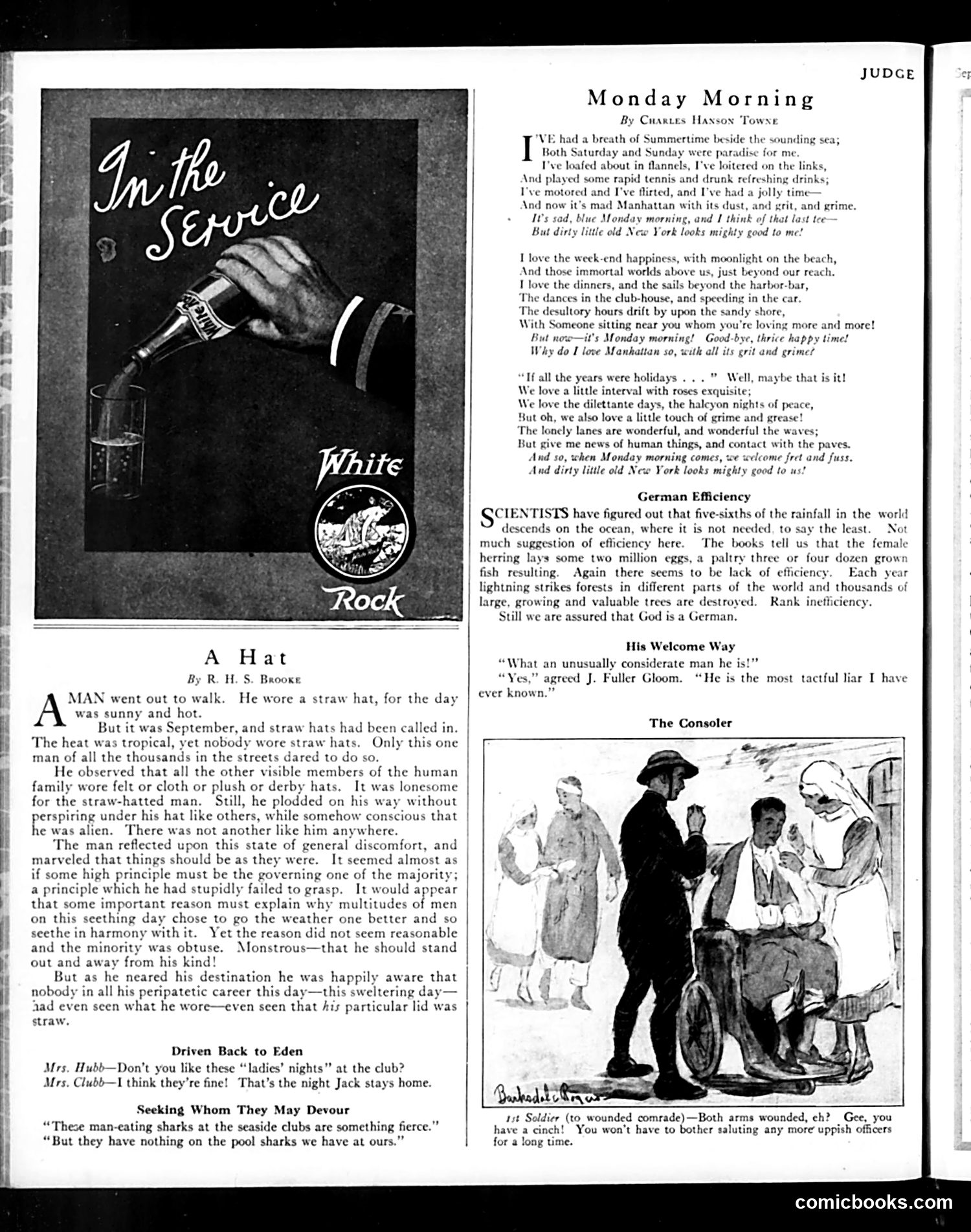
This page contains three distinct pieces of social satire from Judge magazine: **"A Hat"** mocks conformity and social anxiety. A man wearing a practical straw hat in September is the only one doing so—everyone else wears felt or derby hats despite the tropical heat. The satire critiques how people follow arbitrary fashion rules even when uncomfortable, and how nonconformity, though sensible, creates social alienation. The irony: nobody even notices his hat. **"Monday Morning"** is a nostalgic poem contrasting weekend leisure (beach, golf, romance) with returning to gritty Manhattan. It satirizes the urban worker's love-hate relationship with city life—they escape to paradise but ultimately prefer the "grit and grime" of home and human connection over endless vacation. **"German Efficiency"** is a brief satirical quip about scientific inefficiency: five-sixths of rainfall is "wasted" on oceans; animals reproduce inefficiently. The punchline "God is a German" sardonically suggests only Germans achieve true efficiency—likely topical commentary on German industrial reputation circa publication.
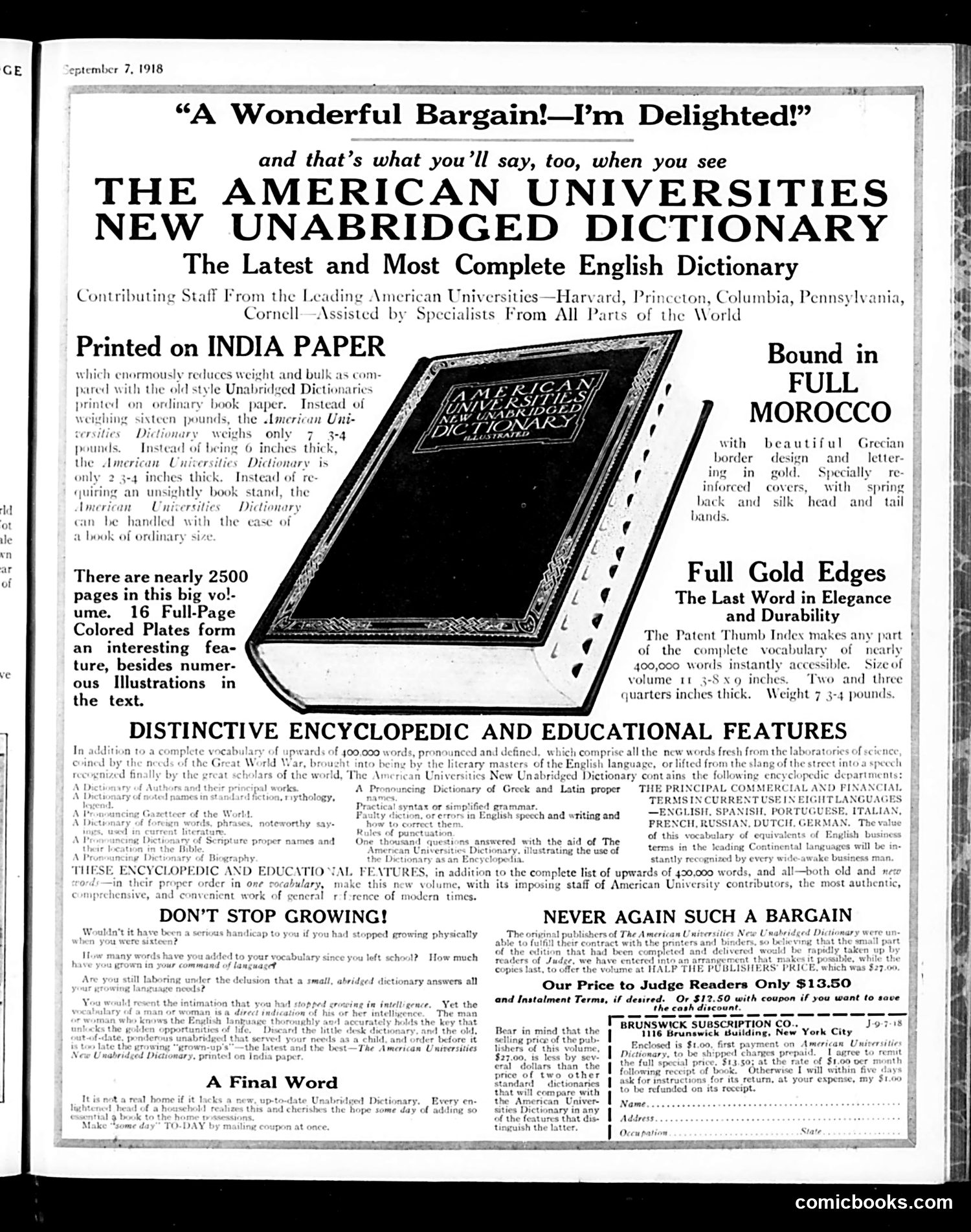
This page is primarily a **commercial advertisement**, not a political cartoon. It promotes a new dictionary published by the American Universities, dated September 7, 1918. The ad emphasizes the dictionary's practical advantages: it uses lightweight India paper (reducing weight from 16 to 7.75 pounds), is thinner than competitors, yet contains nearly 2,500 pages with 400,000 words and colored illustrations. It's bound in full Morocco leather with gold edges and a patent thumb index. The central marketing hook is the headline "Don't Stop Growing!"—suggesting self-education and vocabulary expansion. The price ($13.50, or $12.50 with a coupon) is presented as exceptional value. There's a small order form at bottom for *Judge* magazine readers. This appears to be a standard commercial placement rather than satirical content; the magazine likely ran such advertisements for revenue. The elaborate binding and prestigious university contributors suggest it targets educated, middle-class readers.
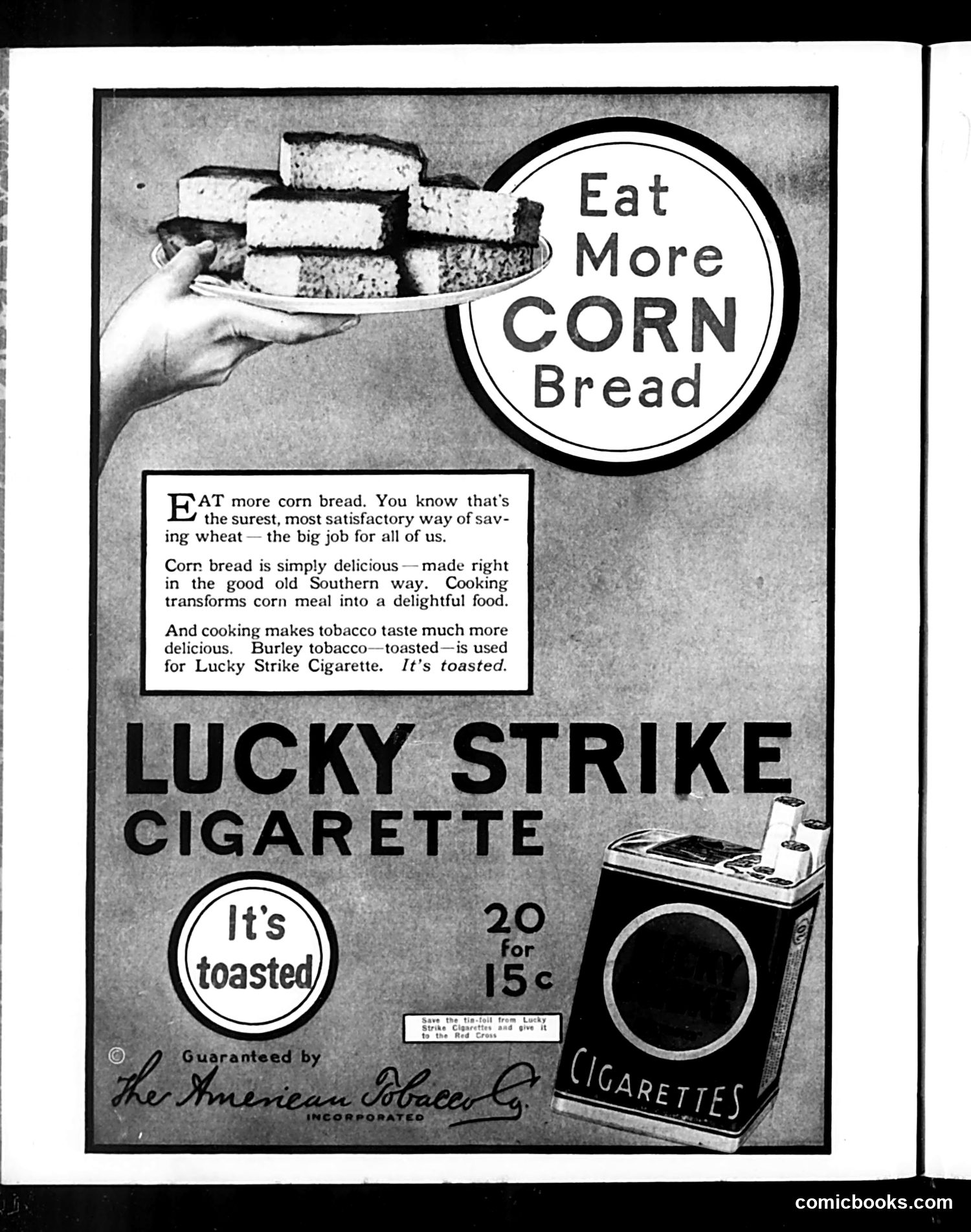
This is a **Lucky Strike cigarette advertisement**, not political satire. The ad promotes corn bread consumption as wheat-saving (likely World War I–era rationing messaging), then makes an odd parallel: just as cooking improves corn meal, toasting improves tobacco flavor in Lucky Strikes. The "joke" is the jarring non-sequitur connecting unrelated foods. The hand holds a plate of corn bread; below sits a cigarette package. There's no caricature or political commentary—merely an attempt to associate eating wholesome Southern food with smoking cigarettes as equally patriotic or sensible acts. The appeal to wartime sacrifice ("saving wheat") lends the ad moral authority while promoting a commercial product.