
Judge, 1918-09-07 · page 9 of 32
Judge — September 7, 1918 — page 9: what you’re looking at
What you’re looking at
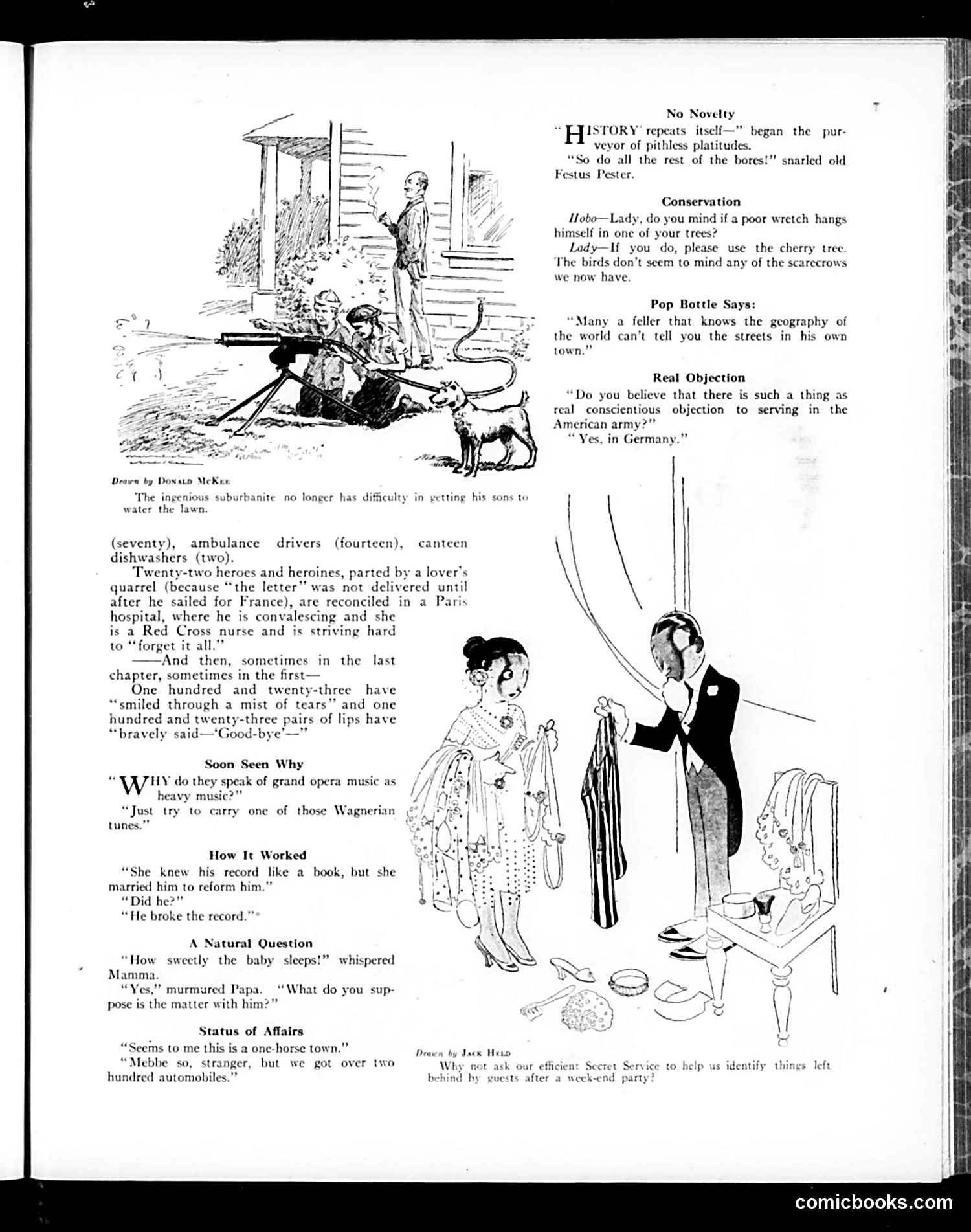
This page contains multiple brief satirical jokes and two illustrated cartoons, typical of Judge magazine's format. **Top cartoon** (by Donald McKee): Shows a suburban father using an ingenious contraption to water the lawn while his sons operate it—satirizing both suburban laziness and parental ingenuity during the early 20th century. **Bottom cartoon** (by Jack Heald): Depicts a well-dressed man showing a woman clothing or linens, likely satirizing post-party cleanup or domestic management—the caption references using "Secret Service" to identify items left behind. **The text jokes** mock various targets: - Bores repeating themselves - Conservation efforts (sarcastically suggesting a poor wretch use a tree with scarecrows) - Geographic knowledge without local knowledge - Conscientious objectors to WWI military service (suggesting Germans had "real" objections) - Opera's heaviness - Reform through marriage - Small-town pretensions about automobiles The magazine satirizes everyday American life, wartime attitudes (apparent WWI references), and social pretensions with period-appropriate humor.
📄 Transcribed text from this page (OCR, searchable)
Machine-transcribed from the original scan — historical spelling and the odd misread are preserved.
No Novelty * FAISTORY repeats itsel—" began the pur- veyor of pithless platitudes. “So do all the rest of the bores!” snarled old Festus Pester. Conservation Hobo—Lady, do you mind if a poor wretch hangs himself in one of your trees? Lady—I{ you do, please use the cherry tree. The birds don’t seem to mind any of the scarecrows we now have. Pop Bottle Says: “Many a feller that knows the geography of the world can’t tell you the streets in his own town.” Real Objection “Do you believe that there is such a thing as real conscientious objection to serving in the American army?” “Yes, in Germany.’ Drown by Doxato McKne The ingenious suburbanite no longer has difficulty in yetting his sons to water the lawn. (seventy), ambulance drivers (fourteen), canteen dishwashers (two). Twenty-two heroes and heroines, parted by a lover's quarrel (because “the letter” was not delivered until after he sailed for France), are reconciled in a Paris hospital, where he is convalescing and she is a Red Cross nurse and is striving hard orget it all.” ——And then, sometimes in the last chapter, sometimes in the first— One hundred and twenty-three have “smiled through a mist of tears’? and one hundred and twenty-three pairs of lips have “bravely said—'Good-bye’—” Soon Seen Why * HY do they speak of grand opera music as heavy music?” ust try to carry one of those Wagnerian tunes.” How It Worked “She knew his record like a book, but she married him to reform him.” “Did he?” “He broke the record.” A Natural Question “How sweetly the baby sleeps!’” whispered Mamma. “Yes,” murmured Papa. “What do you sup- pose is the matter with him?” Status of Affairs “Seems to me this is a one-horse town.” “Mebbe so, stranger, but we got over two ger Sacron. Servigwstw: help us identity le hundred automobiles.” chind guests after a week-end party? comicbooks.com