
Judge, 1918-09-07 · page 8 of 32
Judge — September 7, 1918 — page 8: what you’re looking at
What you’re looking at
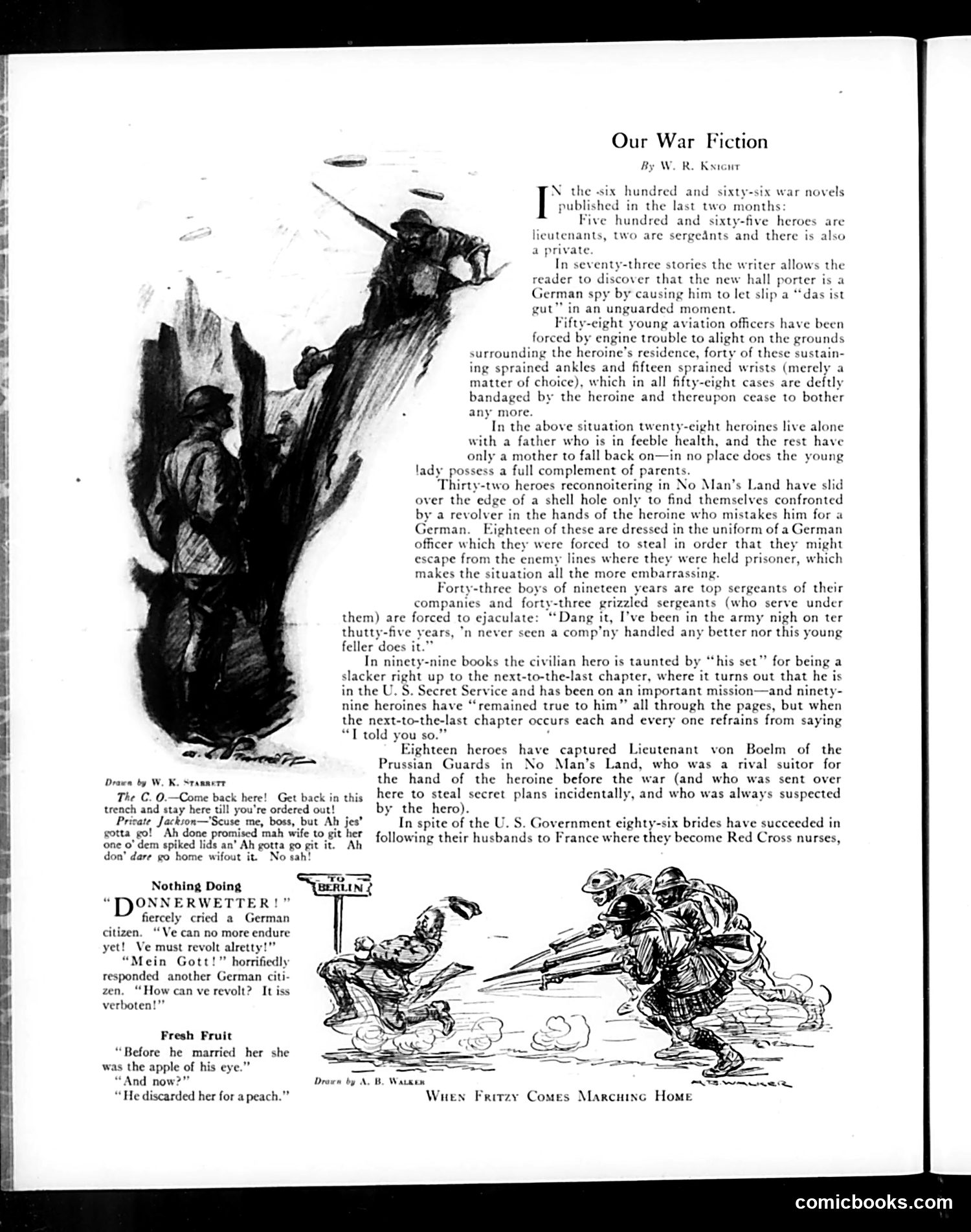
This article by W.R. Knight mocks the formulaic clichés flooding American war fiction during World War I. Knight catalogs absurd recurring plot elements: nearly all heroes are officers (665 out of 666), German spies reveal themselves through careless German phrases, aviation officers conveniently crash near heroines' homes (who then nurse their sprains), and civilian "slackers" are secretly government agents all along. The satire targets both lazy literary conventions and wartime propaganda. The repetitive tropes—lone heroines with absent fathers, mistaken-identity scenes, captured German officers as rival suitors, wives following husbands to become Red Cross nurses—reveal how war novels reduced complex human experience to predictable formulas. The accompanying cartoons offer lighter humor: a soldier defying orders to retrieve a spiked helmet, and Germans comically paralyzed by their own obedience to authority ("How can we revolt? It is forbidden!"). Together, the page critiques American popular culture's simplistic romanticization of modern warfare.
📄 Transcribed text from this page (OCR, searchable)
Machine-transcribed from the original scan — historical spelling and the odd misread are preserved.
Our War Fiction By W. R. Kier N the six hundred and sixty-six war novels I published in the last two months Five hundred and sixty-five heroes are lieutenants, two are sergeants and there is also a private In seventy-three stories the writer allows the reader to discover that the new hall porter is a German spy by causing him to let slip a “das ist gut" in an unguarded moment. Fifty-eight young aviation officers have been forced by engine trouble to alight on the grounds surrounding the heroine’s residence, forty of these sustain- ing sprained ankles and fifteen sprained wrists (merely a matter of choice), which in all fifty-eight cases are deftly bandaged by the heroine and thereupon cease to bother any more. In the above situation twenty-eight heroines live alone with a father who is in feeble health, and the rest have only a mother to fall back on—in no place does the young lady possess a full complement of parents. Thirty-two heroes reconnoitering in No Man’s Land have slid over the edge of a shell hole only to find themselves confronted by a revolver in the hands of the heroine who mistakes him for a German. Eighteen of these are dressed in the uniform of aGerman officer which they were forced to steal in order that they might escape from the enemy lines where they were held prisoner, which makes the situation all the more embarrassing. Forty-three boys of nineteen years are top sergeants of their companies and forty-three gri nzled sergeants (who serve under them) are forced to ejaculate ‘Dang it, I've been in the army nigh on ter thutty-five years, *n never seen a comp’ny handled any better nor this young feller does it. In ninety-nine books the civilian hero is taunted by “his set” for being a slacker right up to the next-to-the-last chapter, where it turns out that he is in the U. S. Secret Service and has been on an important mission—and ninety- nine heroines have “remained true to him” all through the pages, but when the next-to-the-last chapter occurs each and every one refrains from saying “T told you so. Eighteen heroes have captured Lieutenant von Boelm of the Prussian Guards in No Man’s Land, who was a rival suitor for Drawn by W. K. Stannert the hand of the heroine before the war (and who was sent over The C. O.—Come back here! Get back in here to steal secret plans incidentally, and who was always suspected trench and stay here till you're ordered ou! by the hero). Private Jackson—'Scuse me, boss, but Ab jes’ In spite of the U. S. Government eighty-six brides have succeeded in gotta gol Ah done promised mah wife to, following their husbands to France where they become Red Cross nurses, one o' dem spiked lids an’ Ah gotta go git it. . don’ dare go home wifout it. No sah! Nothing Doing ONNERWETT fiercely cried a German citizen. “Ve can no more endure yet! Ve must revolt alretty!"” “Mein Gott!” horrifiedly responded another German c zen. “ How can ve revolt? It iss verboten! Fresh Fruit “Before he married her she was the apple of his eye.” “And now?” Drown by A. BL Watgen “ He discarded her for a peach.” Wuen Frerzy Comes Marcuinc Home comicbooks.com