
Judge, 1918-09-07 · page 22 of 32
Judge — September 7, 1918 — page 22: what you’re looking at
What you’re looking at
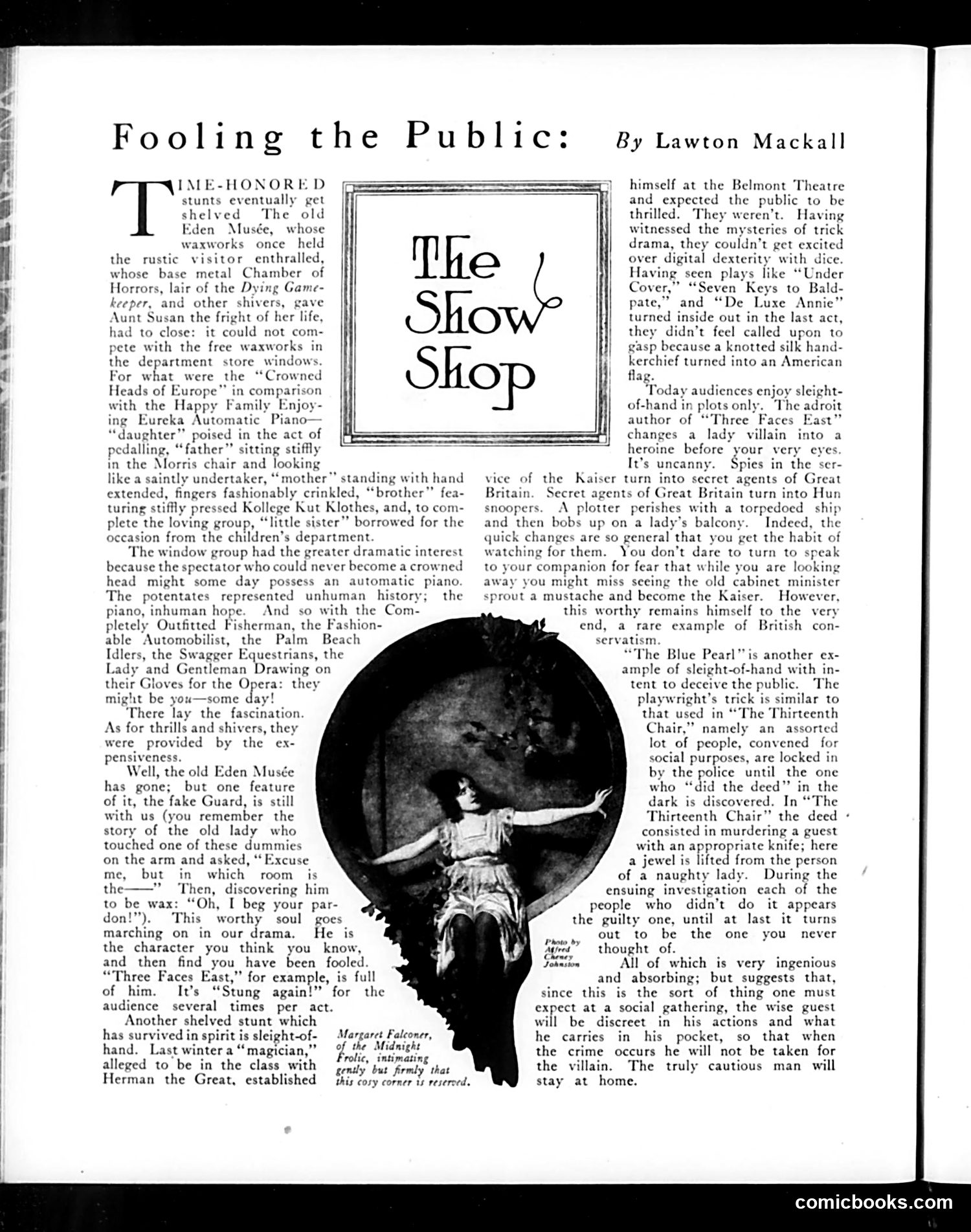
This article by Lawton Mackall critiques how modern theater audiences have become sophisticated enough to anticipate plot tricks, rendering traditional stagecraft ineffective. The piece uses the **Eden Musée** (a wax museum attraction) as its central metaphor. Once thrilling to audiences, it closed because it couldn't compete with free department-store window displays—similarly, theatrical "stunts" (fake guards, sleight-of-hand plot devices, quick costume changes) that once amazed viewers now fall flat. Mackall argues modern audiences, having seen plays like "Under Cover" and "Seven Keys to Baldpate" with their elaborate third-act reversals, can no longer be fooled by transparent theatrical tricks. They appreciate cleverness only in *plot construction* itself, not obvious stage mechanics. Examples cited include "Three Faces East" and "The Blue Pearl"—plays relying on character disguises and deceptions. The point: audiences now watch *for* the trick rather than being surprised by it, making traditional illusions obsolete. The satire targets both theater's creative exhaustion and audiences' jaded sophistication in the 1920s.
📄 Transcribed text from this page (OCR, searchable)
Machine-transcribed from the original scan — historical spelling and the odd misread are preserved.
ee Se See | Fooling the Public: IME-HONORED By Lawton Mackall himself at the Belmont Theatre stunts eventually get shelved The old Eden Musée, whose waxworks once held the rustic visitor enthralled, whose base metal Chamber of Horrors, lair of the Dying Game- keeper, and other shivers, gave Aunt Susan the fright of her life, to close: it could not com- pete with the free waxworks in the department store windows. For what were the “Crowned Heads of Europe” in comparison with the Happy Family Enjoy- ing Eureka Automatic Piano— and expected the public to be thrilled. They weren’t. Having witnessed the mysteries of trick drama, they couldn’t get excited over digital dexterity with dice. Having seen plays like ‘Under Cover,” “Seven Keys to Bald- pate,” and “De Luxe Annie” turned inside out in the last act, they didn’t feel called upon to gasp because a knotted silk hand- kerchief turned into an American flag. ‘Today audiences enjoy sleight- of-hand in plots only. The adroit author of “Three Faces East” “daughter” poised in the act of changes a lady villain into a pedalling, “father” sitting stiffly in the Morris chair and looking like a saintly undertaker, “mother” standing with hand extended, fingers fashionably crinkled, “brother” fea- turing stiffly pressed Kollege Kut Klothes, and, to com- plete the loving group, “little sister’ borrowed for the occasion from the children’s department. The window group had the greater dramatic interest because the spectator who could never become a crowned head might some day possess an automatic piano. The potentates represented unhuman history; the piano, inhuman hope. And so with the Com- pletely Outfitted Fisherman, the Fashion- able Automobilist, the Palm Beach Idlers, the Swagger Equestrians, the Lady and Gentleman Drawing on their Gloves for the Opera: they might be you—some day! There lay the fascination. As for thrills and shivers, they were provided by the ex- pensiveness. Well, the old Eden Musée has gone; but one feature of it, the fake Guard, is still with us (you remember the story of the old lady who touched one of these dummies on the arm and asked, “Excuse me, but in which room is the——” Then, discovering him to be wax: “Oh, [ beg your par- don!” This worthy soul goes marching on in our drama. He is the character you think you know, and then find you have been fooled. “Three Faces East,” for example, is full of him. It’s “Stung again!” for the audience several times per act. Another shelved stunt which has survived in spirit is sleight-of- Margaret Falconer, hand. Last winter a “ magician,’ yA Midnight + -. lic, intimas: alleged to be in the class with nly Me femly’ that Herman the Great, established this cosy corner is reserved. heroine before your very eyes It’s uncanny. Spies in the ser- vice of the Kaiser turn into secret agents of Great Britain. Secret agents of Great Britain turn into Hun snoopers. A plotter perishes with a torpedoed hip and then bobs up on a lady's balcony. Indeed, the quick changes are so general that you get the habit of watching for them. You don’t dare to turn to speak to your companion for fear that while you are looking away you might miss seeing the old cabinet minister sprout a mustache and become the Kaiser. However, this worthy remains himself to the very end, a rare example of British con- servatism “The Blue Pearl” is another ex- ample of sleight-of-hand with in- tent to deceive the public. The playwright’s trick is similar to that used in “The Thirteenth Chair,” namely an assorted lot of people, convened for social purposes, are locked in by the police until the one who ‘did the deed”’ in the dark is discovered. In “The Thirteenth Chair” the deed consisted in murdering a guest with an appropriate knife; here a jewel is lifted from the person of a naughty lady. During the ensuing investigation each of the people who didn’t do it appears the guilty one, until at last it turns out to be the one you never thought of. Fohasion All of which is very ingenious and absorbing; but suggests that, since this is the sort of thing one must expect at a social gathering, the wise guest will be discreet in his actions and what he carries in his pocket, so that when the crime occurs he will not be taken for the villain. The truly cautious man will stay at home. comicbooks.com