
A complete issue · 36 pages · 1918
Judge — June 22, 1918
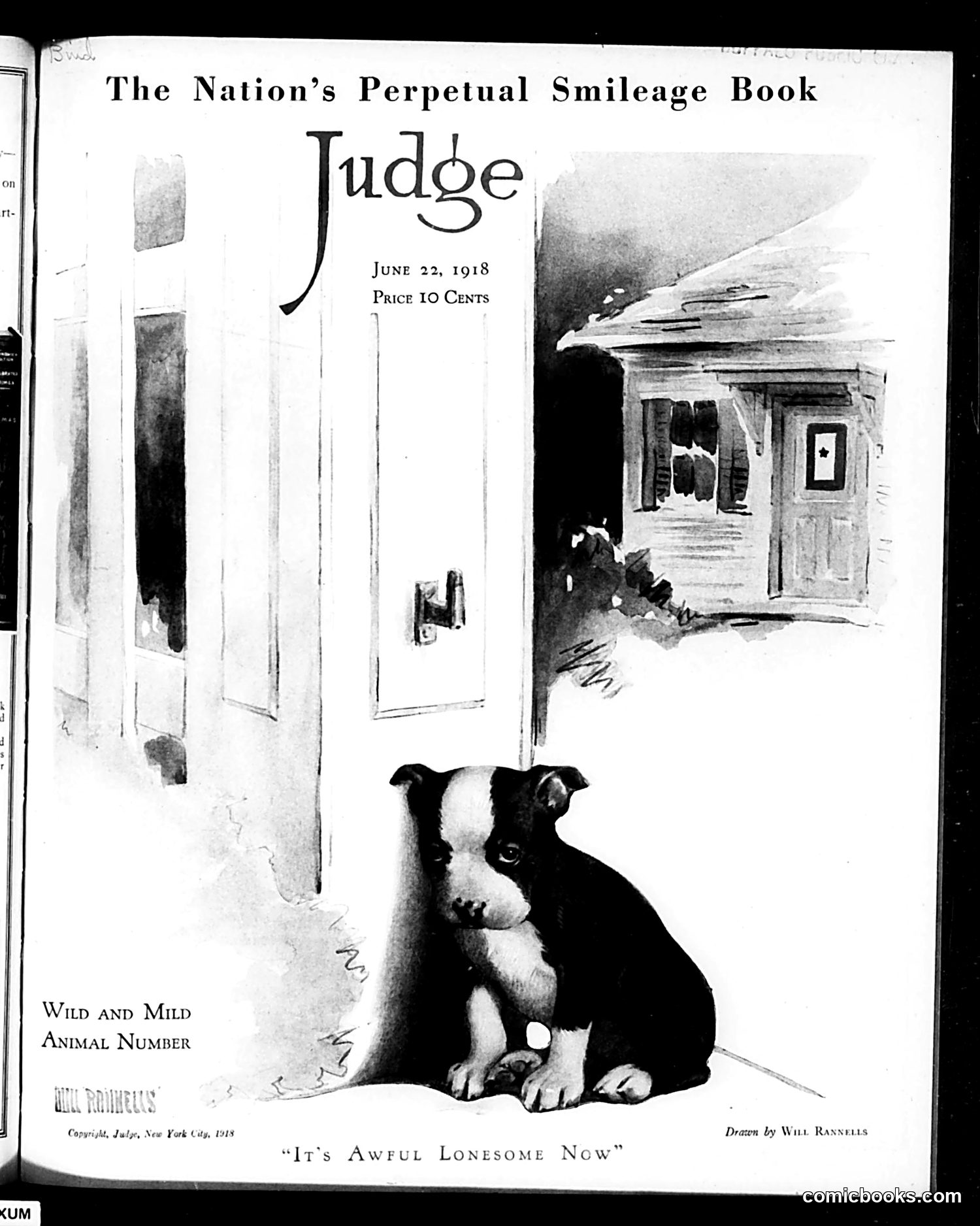
This cover depicts a small black-and-white dog sitting alone outside a house, with the caption "It's Awful Lonesome Now." The title "Wild and Mild Animal Number" suggests a humorous animal-themed issue. The likely reference is to World War I—the United States entered the war in 1917, and by June 1918, many men had been drafted or volunteered for military service. The dog's loneliness probably represents the pets (and families) left behind by departing soldiers. This sentiment was a common theme in wartime humor, playing on the domestic impact of the war by personifying animals awaiting their absent owners' return. The illustration is by Will Rannells, a Judge contributor.
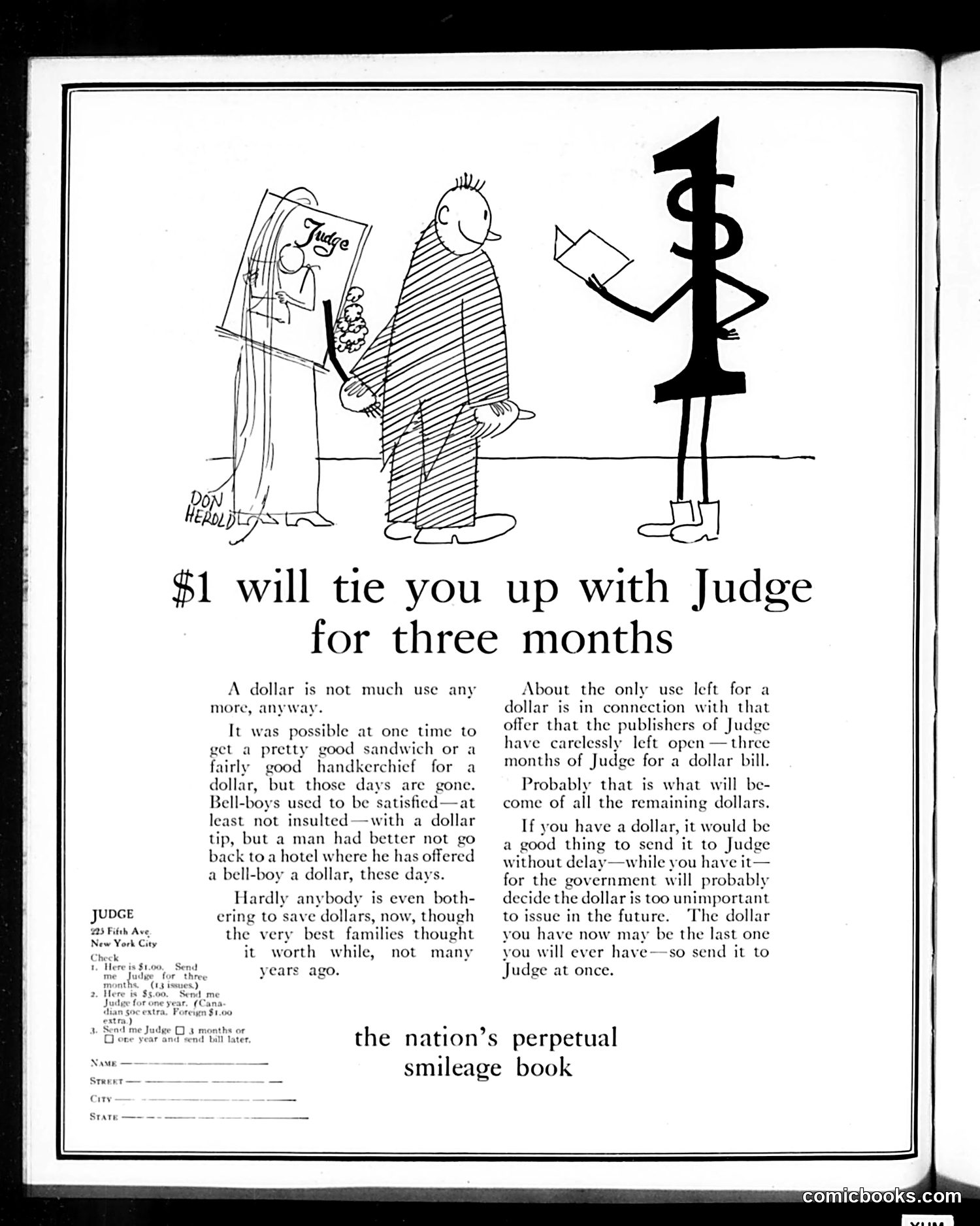
This page satirizes the declining value of American currency during what appears to be the early 20th century. The advertisement humorously proposes that one dollar—nearly worthless for practical purchases—is only useful as a subscription payment to *Judge* magazine for three months. The cartoon depicts three figures: a bride (labeled "Judge"), a groom in striped clothing, and a tall personified dollar sign acting as minister, "tying up" the marriage. The accompanying text laments inflation, noting that dollars once bought sandwiches or handkerchiefs but have become so valueless that readers should simply send their remaining dollars to *Judge* rather than hoard them. This is mock-serious advertising disguised as economic commentary, exploiting public frustration with currency devaluation to promote magazine subscriptions.
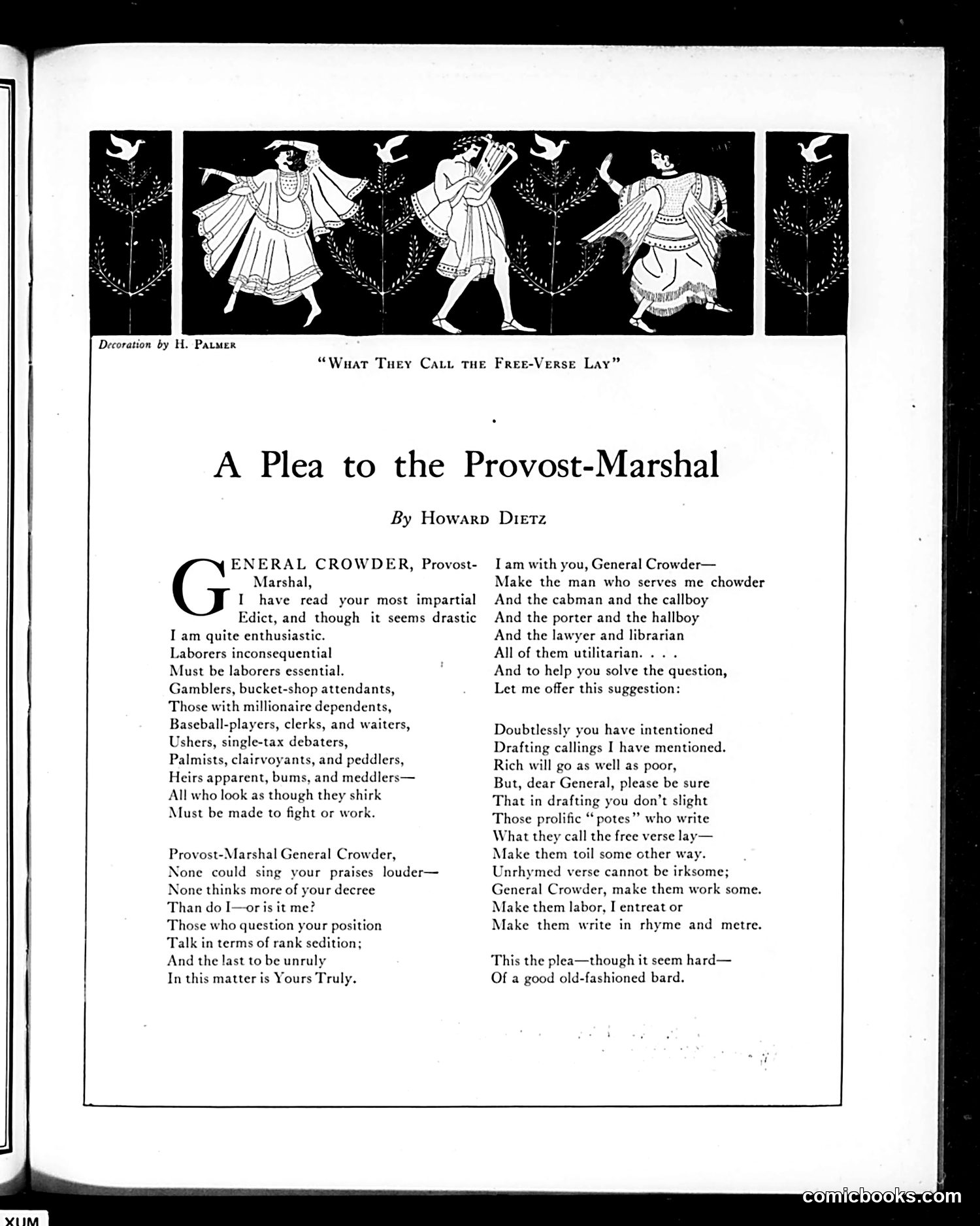
This poem by Howard Dietz addresses General Crowder, the U.S. Provost-Marshal during World War I, who oversaw military draft administration. The satire targets Crowder's draft policies by cataloging occupations the author claims shouldn't be conscripted—gamblers, baseball players, clerks, waiters, peddlers, and others deemed "unessential" but who "look as though they shirk." The final plea is sarcastic: don't draft these "prolific 'potes' who write / What they call the free verse lay." Instead, make them do labor or write in traditional "rhyme and metre"—a jab at modernist free verse poetry as frivolous compared to wartime sacrifice. The author positions himself as this "old-fashioned bard" pleading for exemption. The decoration features figures in classical dress, referencing artistic/literary tradition.
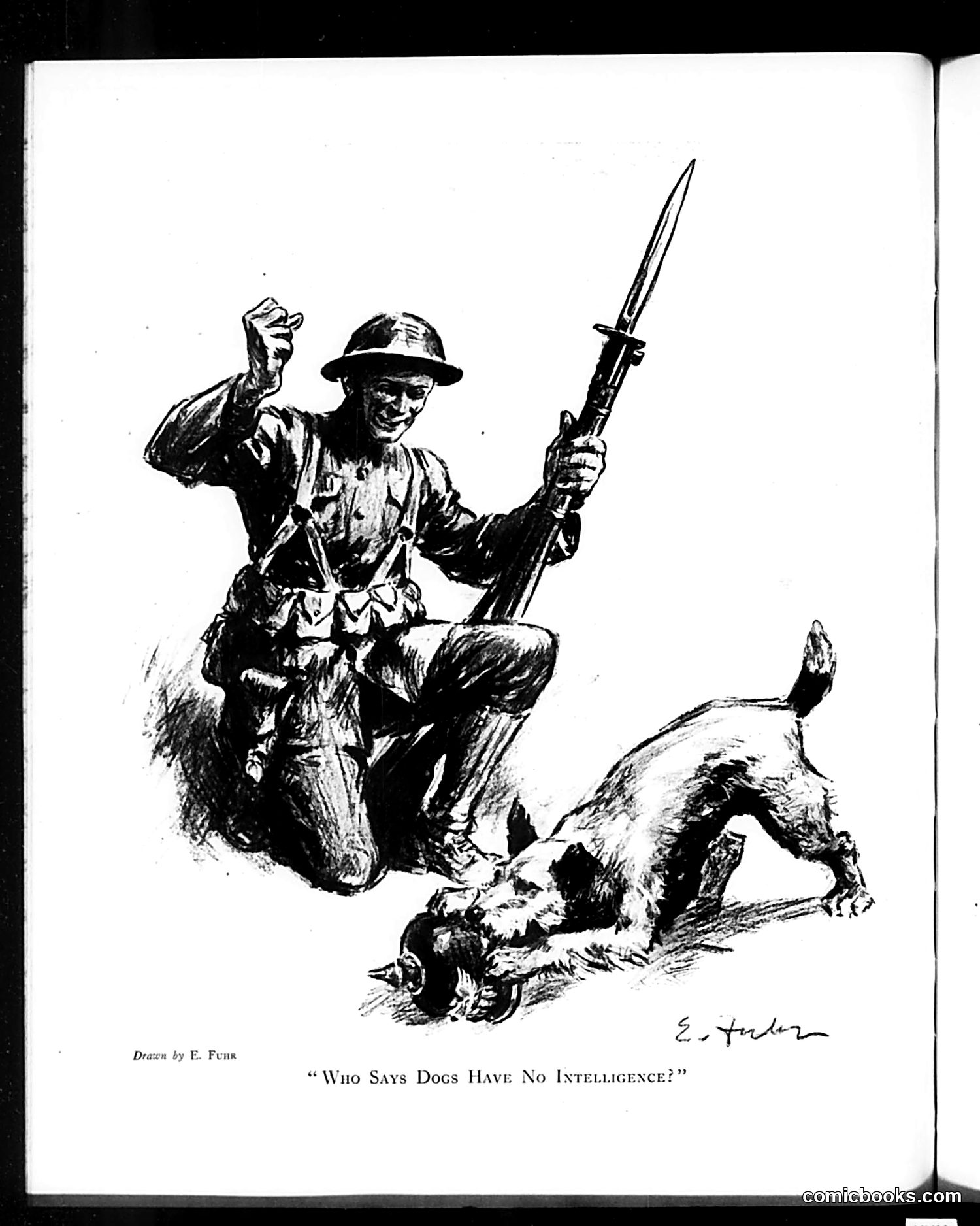
This cartoon by E. Fuhr, published in *Judge* magazine, uses a soldier with a rifle and bayonet as the central figure, with a dog beside him appearing to assist or work alongside him. The caption's rhetorical question defends canine intelligence by depicting a dog in a military context—likely referencing World War I, when dogs were actively employed by armies for messenger service, scouting, and other combat roles. The satire appears to argue that skeptics underestimated dogs' capabilities; the image demonstrates practical intelligence through the dog's apparent military utility. The soldier's triumphant pose reinforces that dogs proved themselves valuable wartime assets, thereby answering the question affirmatively.
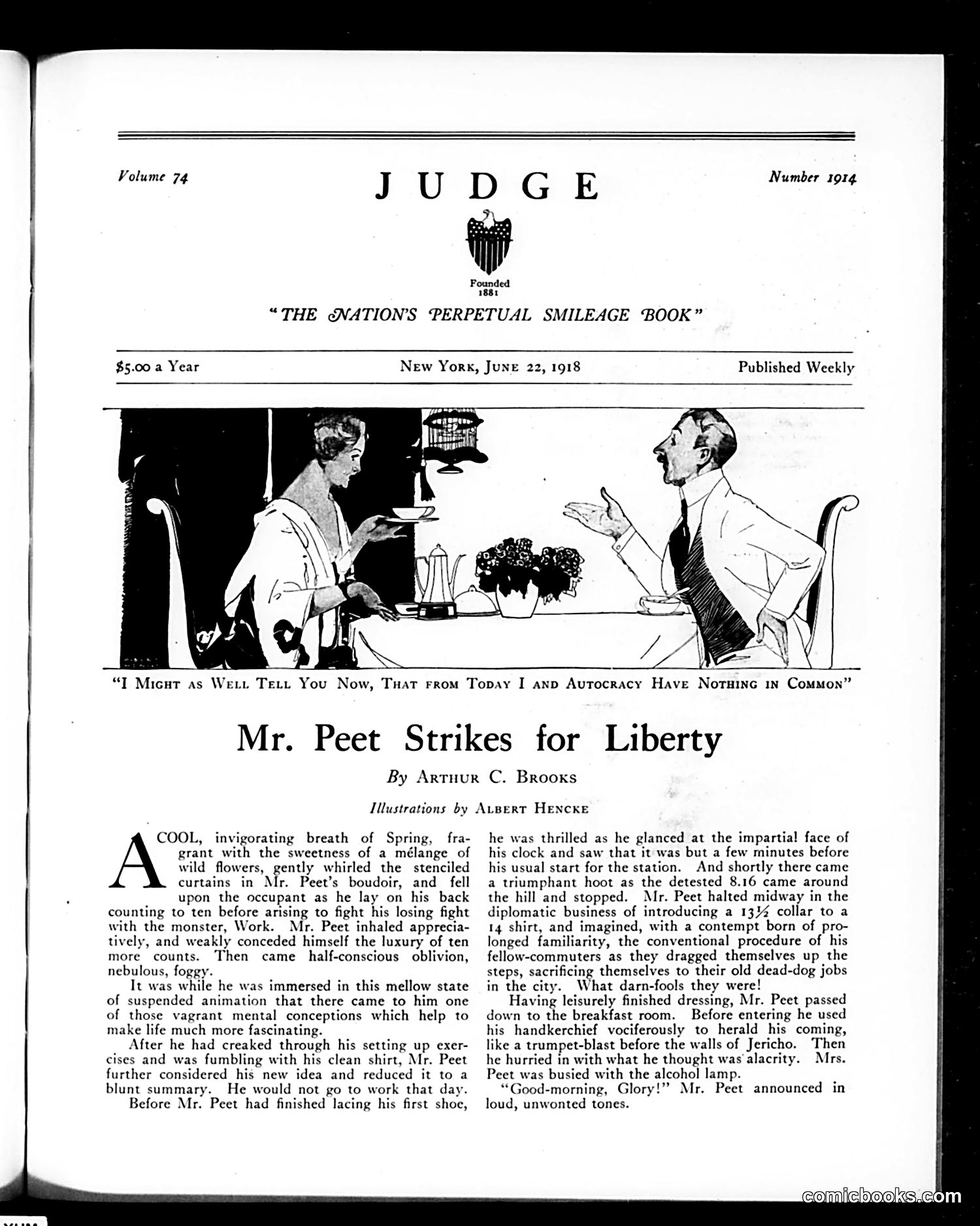
The cartoon illustrates "Mr. Peet Strikes for Liberty," a story by Arthur C. Brooks. The illustration shows a man and woman in an interior scene with the caption: "I Might as Well Tell You Now, That from Today I and Autocracy Have Nothing in Common." The satire appears to reference World War I-era themes. "Autocracy" likely refers to German imperial rule, while "Mr. Peet" represents an everyman American rejecting authoritarian systems. The domestic setting—where a man declares independence from autocracy to a woman—suggests the story uses personal liberty as a metaphor for America's broader rejection of autocratic government during WWI, when the U.S. entered the war partly framed as opposing imperial autocracy.
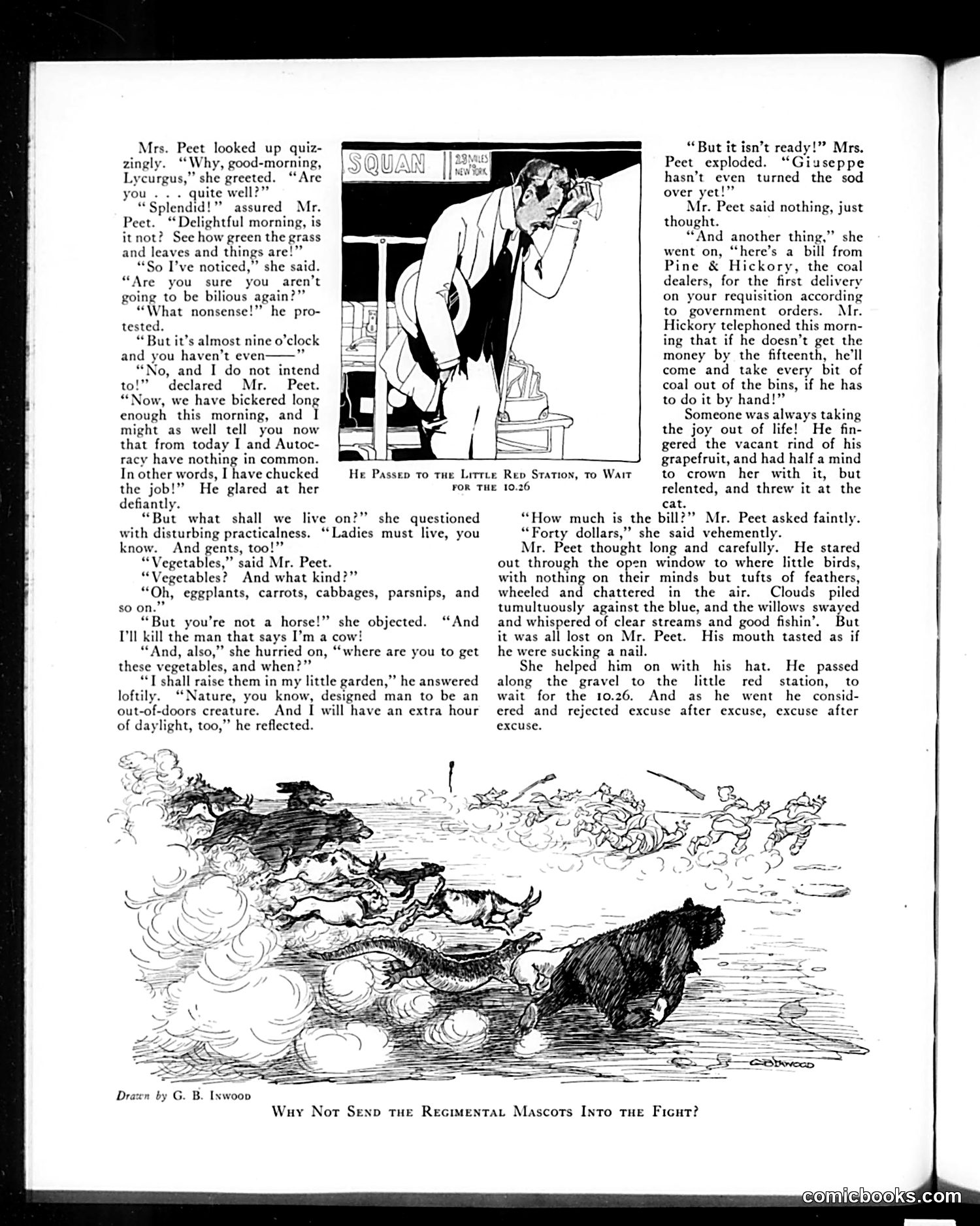
This page contains a narrative story (left and right columns) about Mr. and Mrs. Peet's domestic dispute, accompanied by two illustrations. The main cartoon at bottom, titled "Why Not Send the Regimental Mascots Into the Fight?", depicts soldiers and animals in combat, likely satirizing WWI military strategy. The story mocks Mr. Peet's procrastination about home improvements—Mrs. Peet demands vegetables be grown and coal bills paid, while he makes excuses about daylight hours. The narrative then shifts to him waiting at a train station, appearing dejected. The cartoon's title suggests criticism of wasteful military decisions, possibly questioning why animals were deployed in combat rather than being spared. The exact historical reference remains unclear without additional context.
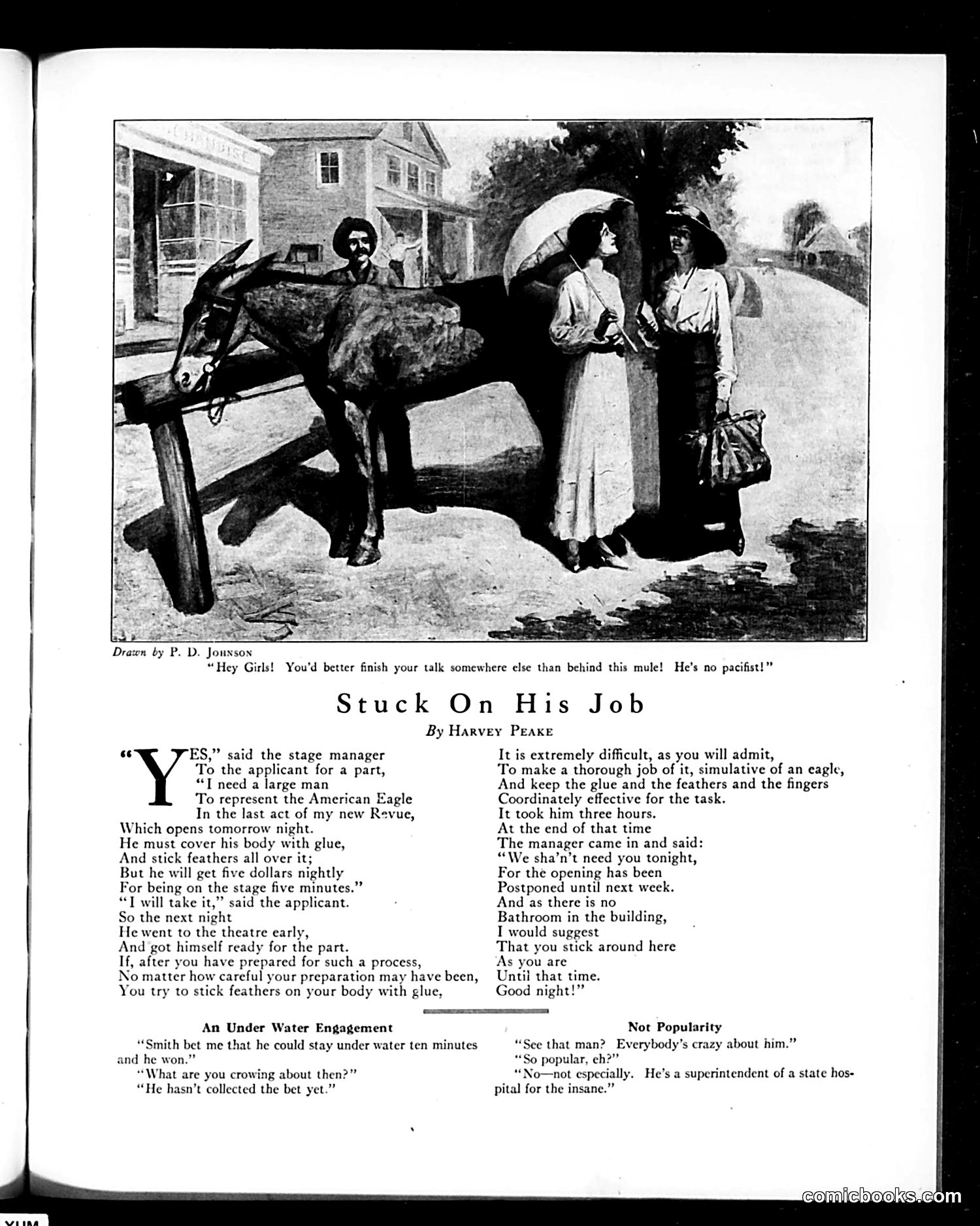
The main cartoon illustrates "Stuck On His Job," a humorous story about theatrical absurdity. A stage manager hires an extra to play an American Eagle by covering his body with glue and attaching feathers—a grueling three-hour process for five dollars and five minutes of stage time. When finished, the manager postpones the show and dismisses the actor, suggesting he remain glued to his costume in the building (lacking bathroom facilities) until needed later. The joke satirizes exploitative theater practices and the desperation of struggling performers accepting ridiculous conditions. The illustration captures the actor mid-ordeal, awkwardly rigid with feathers, illustrating his literal commitment to an absurd job. The page includes two brief comic anecdotes: one about an underwater bet, another about a hospital superintendent's unpopularity despite public fascination with him. These filler jokes were typical magazine content of this era.
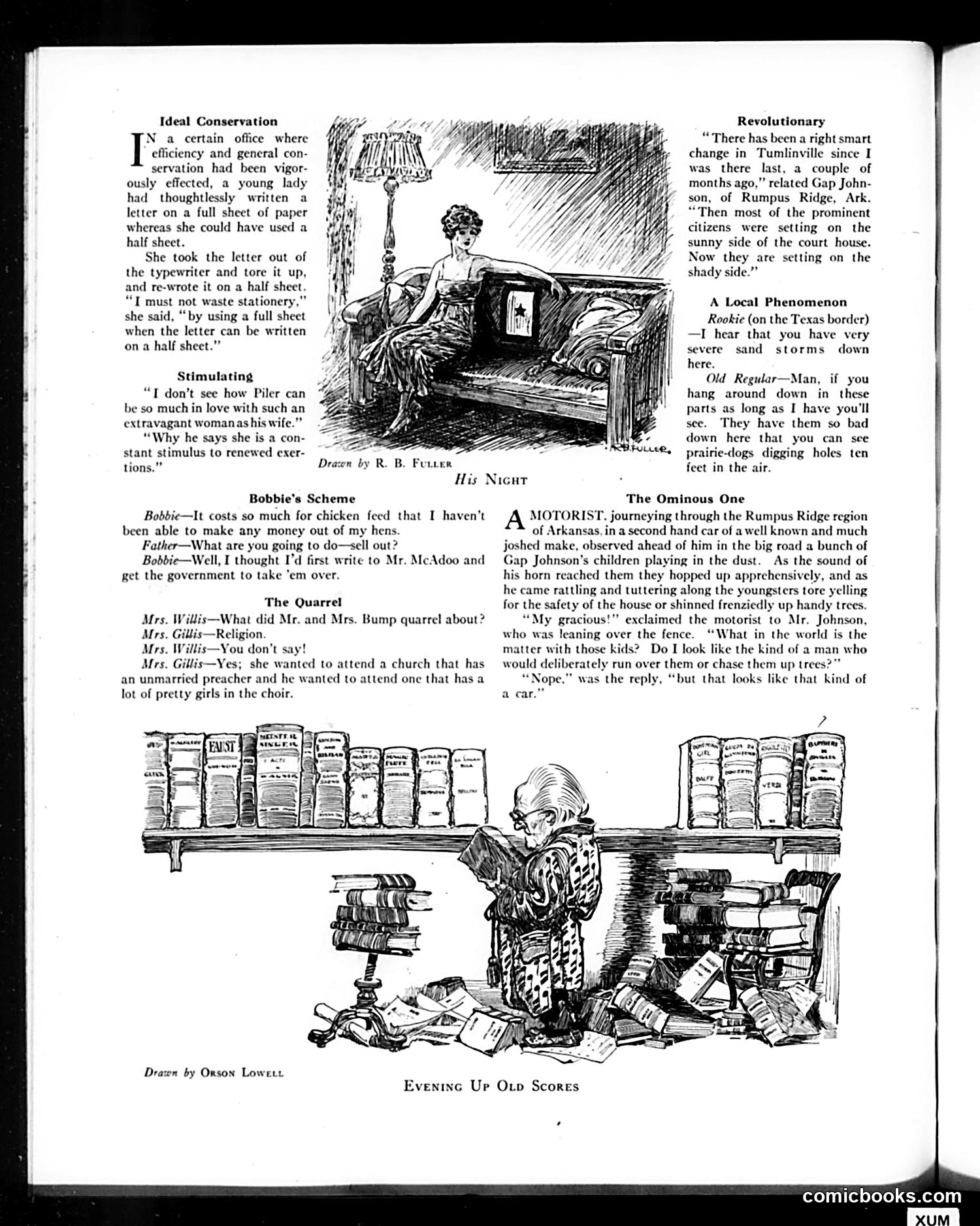
This page contains several brief humorous anecdotes satirizing American society circa early 20th century. **"Ideal Conservation"** mocks excessive efficiency obsession—a young woman rewrites a letter to use less paper, demonstrating how conservation-minded thinking becomes absurdly wasteful of time. **"Stimulating"** jokes that a husband loves his extravagant wife because her spending forces him to work harder—turning financial burden into motivation. **"Revolutionary" and "A Local Phenomenon"** are rural tall tales: one about a Southern town's seating preferences shifting, another exaggerating Texas sandstorms so severe prairie-dogs dig holes in mid-air. **"Bobbie's Scheme"** references Secretary McAdoo (likely William McAdoo, WWI-era Treasury Secretary) and government agricultural takeovers, satirizing a boy's expectation that Washington will manage his chicken farm. **"The Ominous One"** jokes that a secondhand car is so disreputable-looking that children flee from it in terror—the car's appearance, not the driver, causes alarm. These are gentle social satire and rural humor typical of Judge's satirical approach.
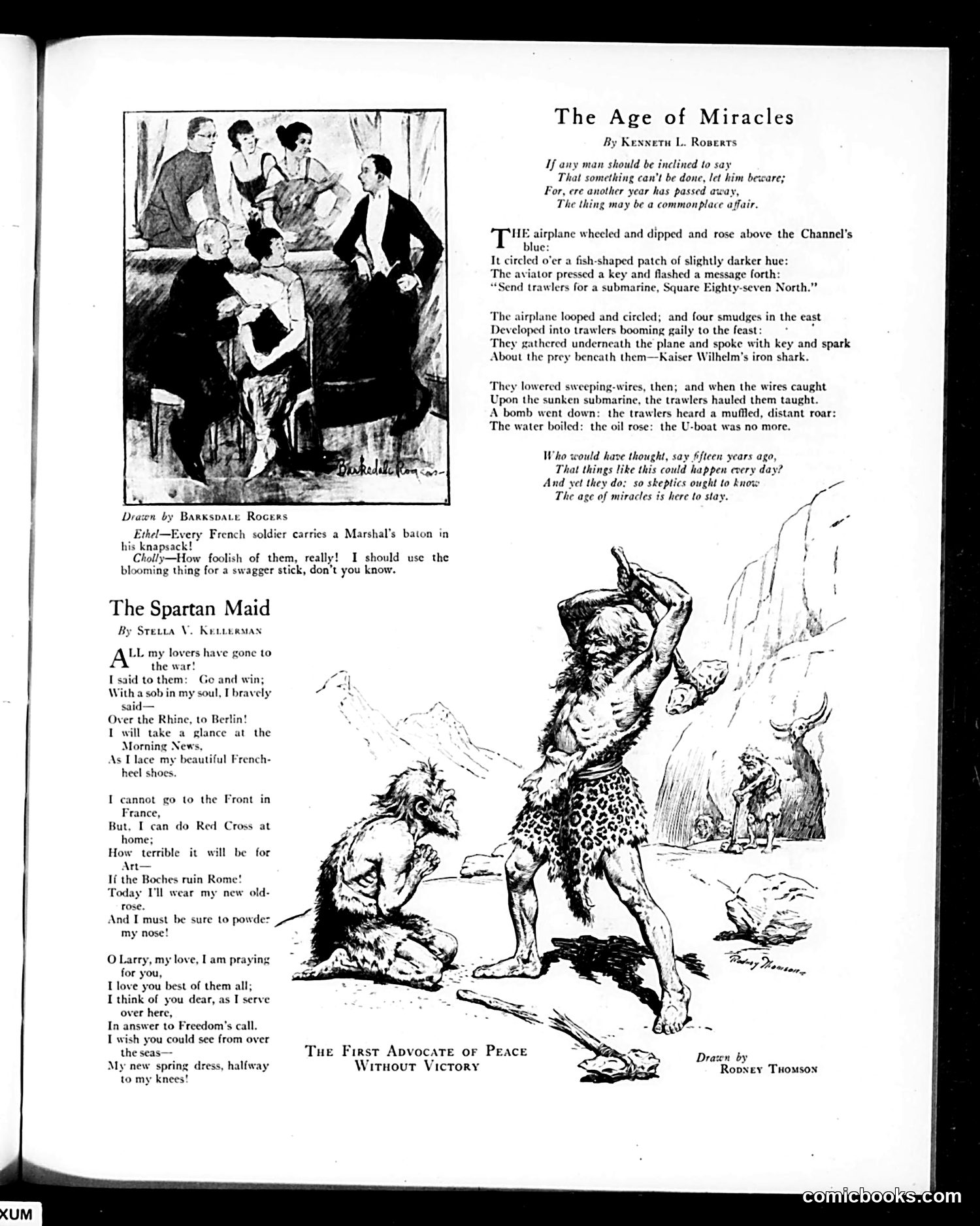
This page from *Judge* magazine contains WWI-era satirical content: **"The Age of Miracles"** celebrates modern military technology—specifically an airplane coordinating with trawlers to locate and destroy a German U-boat ("Kaiser Wilhelm's iron shark"). The poem marvels at such feats as miraculous modern achievements, contrasting present-day capabilities with skepticism from fifteen years prior. **The upper cartoon** (drawn by Barraksdale Rogers) depicts a humorous exchange between French and British characters about Marshal's batons, mocking British affectation. **"The Spartan Maid"** satirizes American women's patriotic pretense during WWI. The poem presents a woman claiming noble sacrifice—sending lovers to war, serving Red Cross "in answer to Freedom's call"—while actually preoccupied with fashion, powder, and her new spring dress. The satire targets shallow patriotism and vanity masquerading as wartime commitment. **"The First Advocate of Peace Without Victory"** (drawn by Rooney Thomson) shows primitive cavemen, likely referencing pacifist sentiment—perhaps mocking peace advocates as backward or primitive.
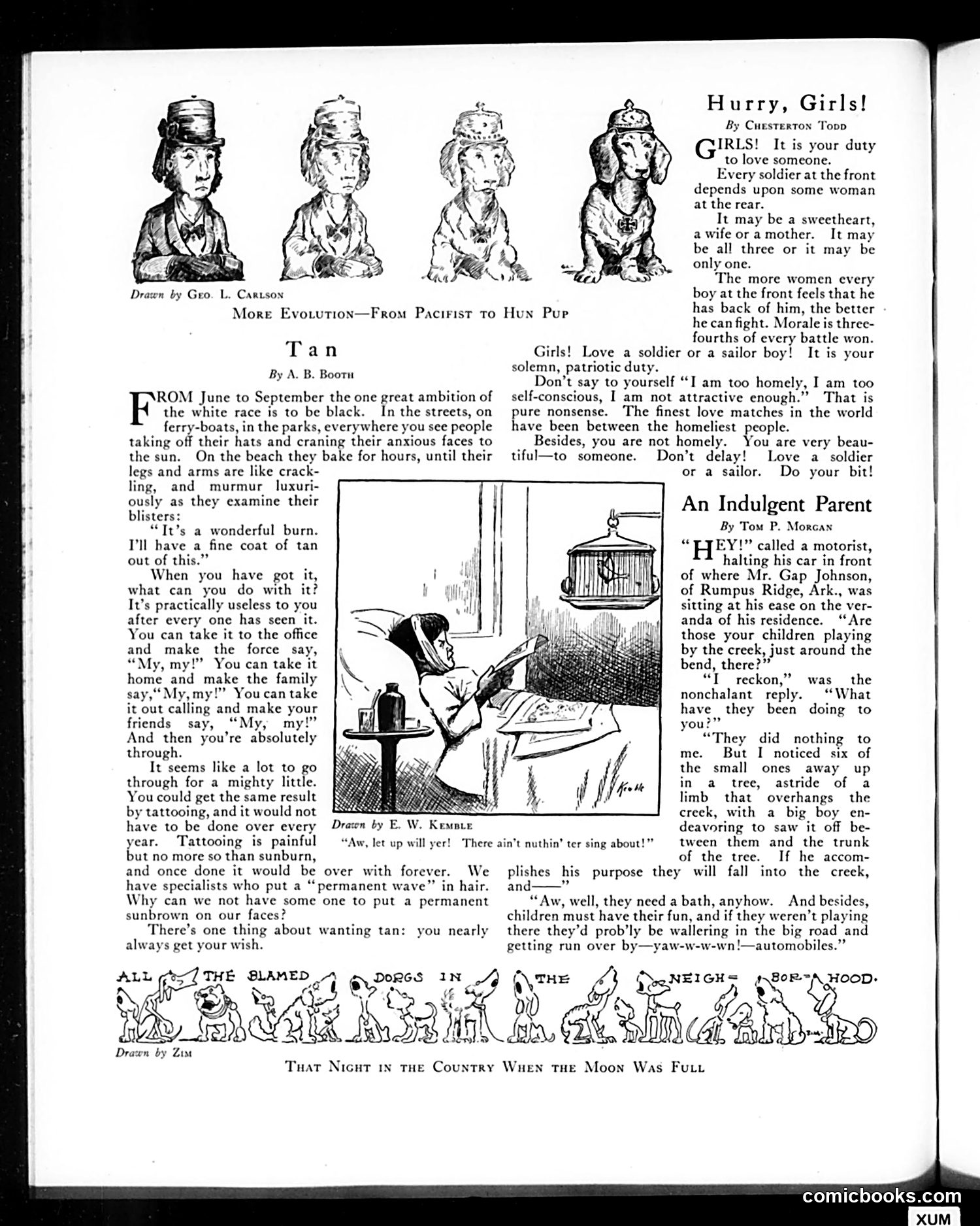
This page contains three distinct pieces of satirical content: **"Hurry, Girls!"** (top right) is WWI-era propaganda urging women to romantically support soldiers, framing it as patriotic duty. It dismisses women's self-doubt about appearance, arguing that morale supports military success. **"Tan"** (left) satirizes the summer fashion obsession with acquiring dark skin. The author mocks the impracticality of tanning—visible only briefly before everyone sees it—suggesting permanent tattooing would be more efficient. It's social satire about vanity and seasonal status-seeking. **"More Evolution—From Pacifist to Hun Pup"** (top) appears to show dog illustrations suggesting some evolution or transformation, likely anti-German propaganda (given "Hun" reference to Germans), though details are unclear from the image alone. **"An Indulgent Parent"** (bottom right) humorously depicts a negligent Arkansas farmer unbothered that his children are sawing a tree limb over a creek—he dismisses the danger, preferring they stay occupied rather than play in roads. The page reflects 1910s American concerns: wartime patriotism, fashion trends, and rural parenting attitudes.
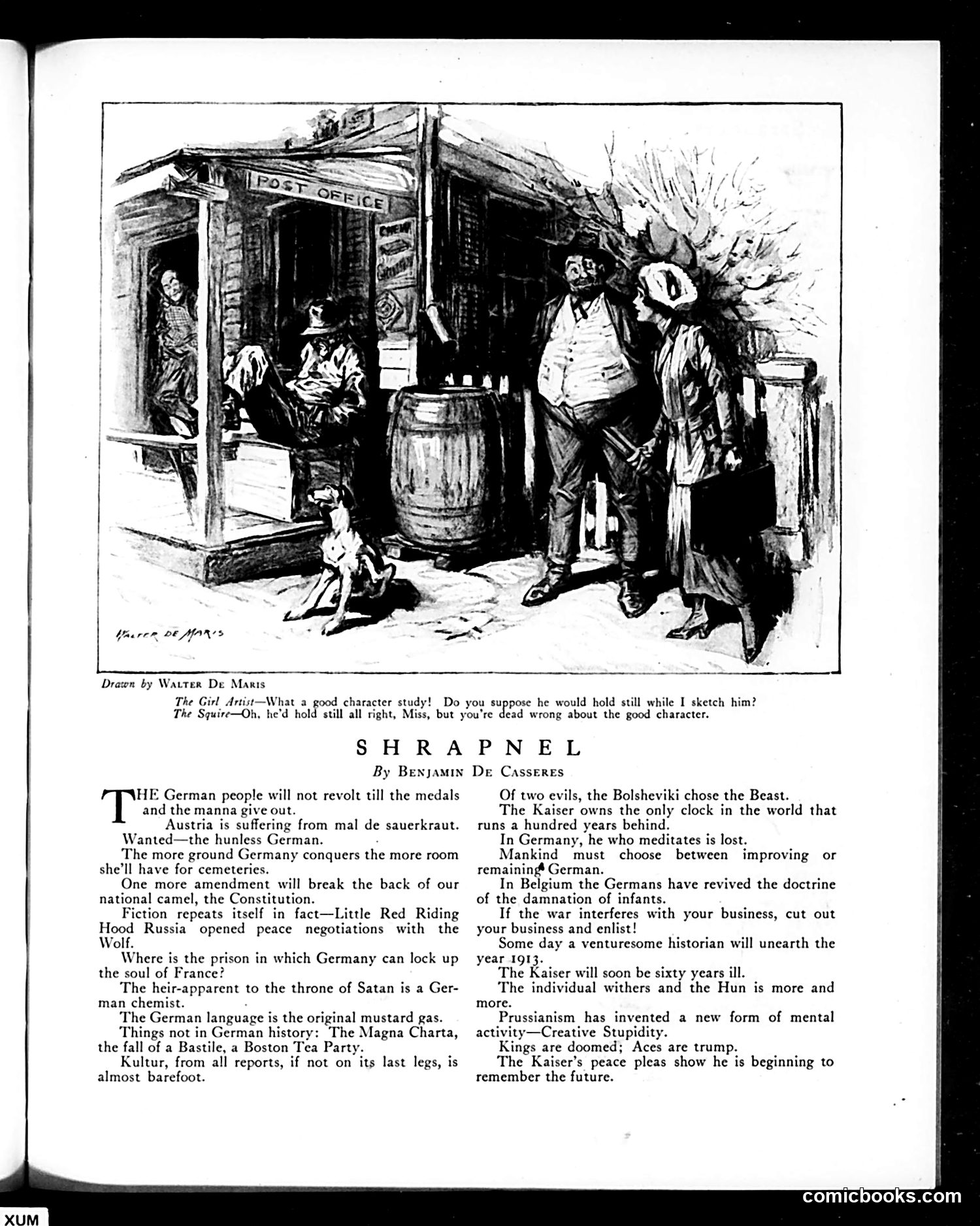
This page contains two elements: a small cartoon sketch at top and a satirical poem below. The **cartoon** shows a street scene at a post office with a girl artist attempting to sketch a rough-looking man. The joke plays on "character"—she assumes his appearance reflects moral character, while the squire corrects her, implying the man is actually disreputable despite looking sturdy. **"Shrapnel"** is a collection of anti-German barbs written during World War I. De Casseres launches bitter attacks on Germany, the Kaiser, and Prussian militarism through sharp one-liners. Key targets include: German ambitions ("conquers the more room she'll have for cemeteries"), the Kaiser's authoritarianism and age, alleged German atrocities in Belgium, Prussian "Kultur," and German historical claims. References to Austria's hardship, Russian peace negotiations with Germany ("the Wolf"), and Bolshevism appear alongside mockery of German language and philosophy. The poem drips with American wartime propaganda sentiment.
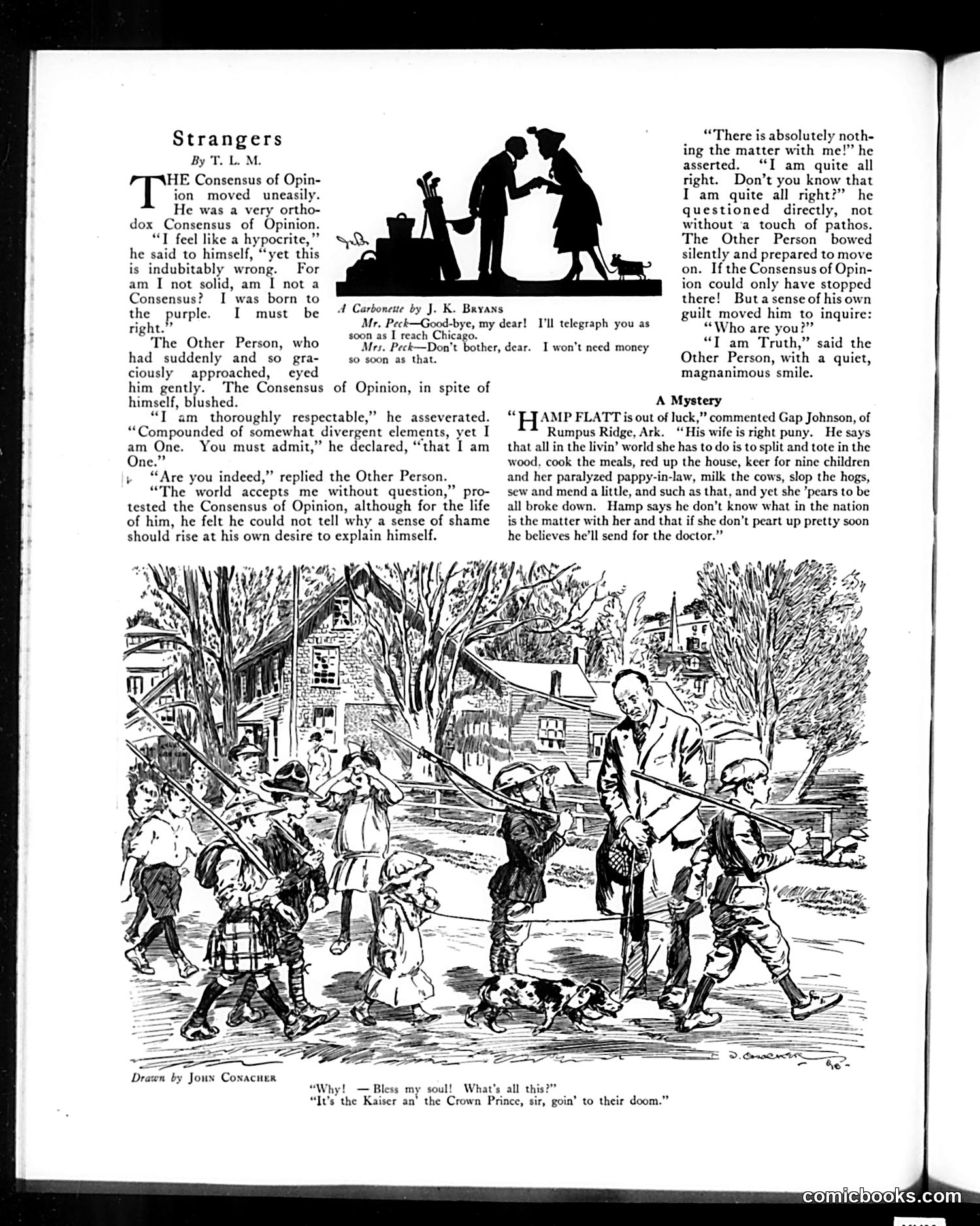
The page contains three distinct pieces: **"Strangers"** (top): An allegorical dialogue where "Consensus of Opinion"—a personified, self-important figure representing conventional wisdom—encounters "The Other Person," revealed to be "Truth." The satire mocks how established consensus resists questioning and becomes defensive when challenged, suggesting that mainstream opinion is fundamentally uncomfortable with truth-telling. **"A Mystery"** (middle right): Rural satire about "Hamp Flatt," whose wife is overworked (splitting wood, cooking, childcare, farm labor) yet blamed for being "puny" and potentially needing a doctor. The joke exposes the absurdity of male indifference to women's exhaustion from impossible domestic burdens. **Bottom cartoon** (by John Conacher): Children playing soldiers imagine they're the Kaiser and Crown Prince "goin' to their doom"—likely referencing World War I, with children's war games reflecting real military conflict and anticipated enemy defeat. All three pieces use humor to critique: institutional complacency, gender injustice, and wartime sentiment.
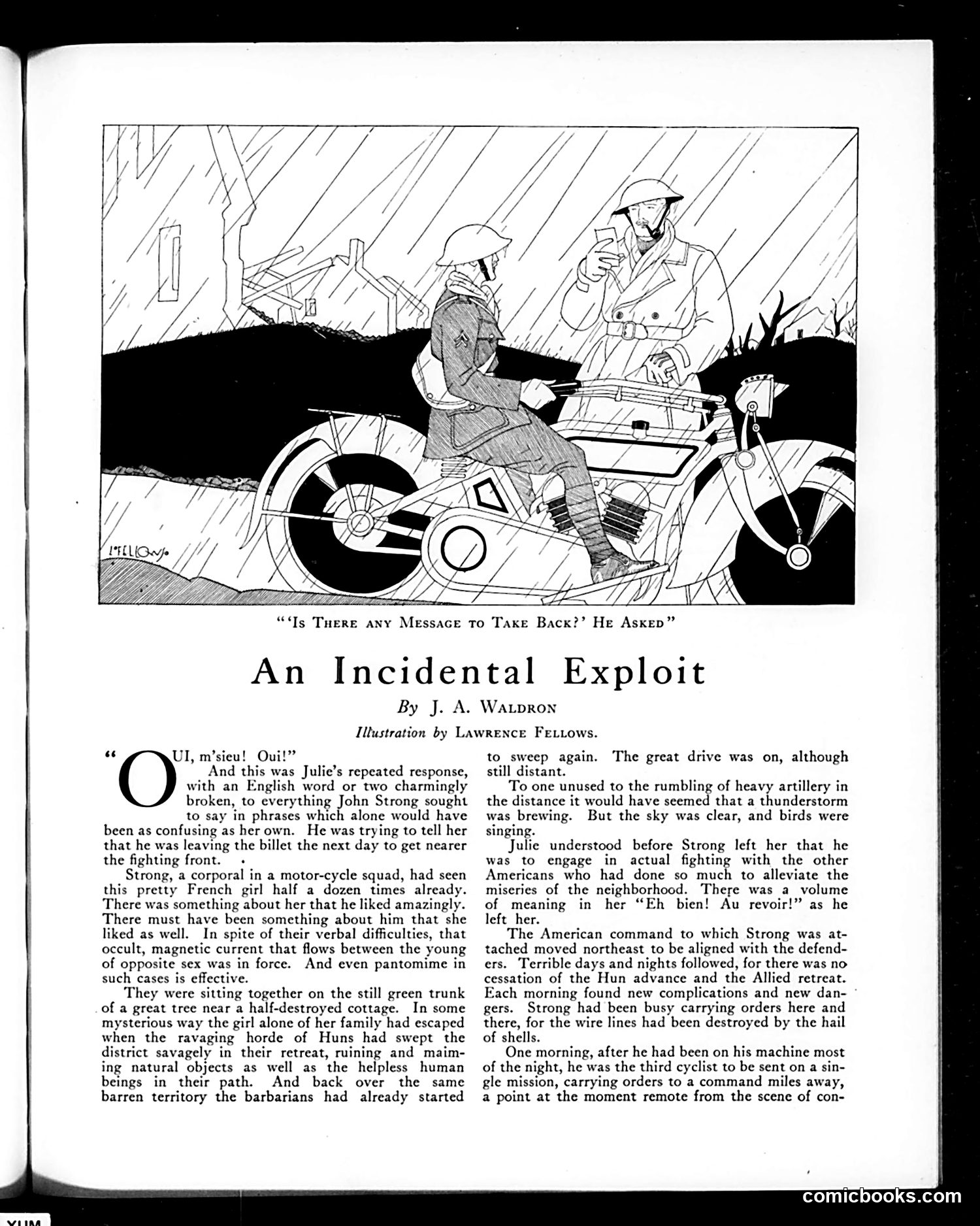
This is a romantic wartime story (not satire) set during World War I, illustrated by Lawrence Fellows. The narrative concerns Corporal John Strong, an American soldier in a motor-cycle squad, who has met and fallen for Julie, a French girl whose family was devastated during the German retreat. The illustration shows Strong on his motorcycle with two other soldiers in rain, establishing the military setting. The story depicts their brief romance interrupted by Strong's orders to move to the front lines. The text emphasizes the "occult, magnetic current" between them despite language barriers, and Julie's meaningful farewell ("Eh bien! Au revoir!"). The narrative then follows Strong as he engages in actual combat during the Allied advance, carrying orders on his motorcycle through dangerous conditions. This appears to be the opening of a longer story celebrating American soldiers' contributions to the war effort and romantic sacrifice.
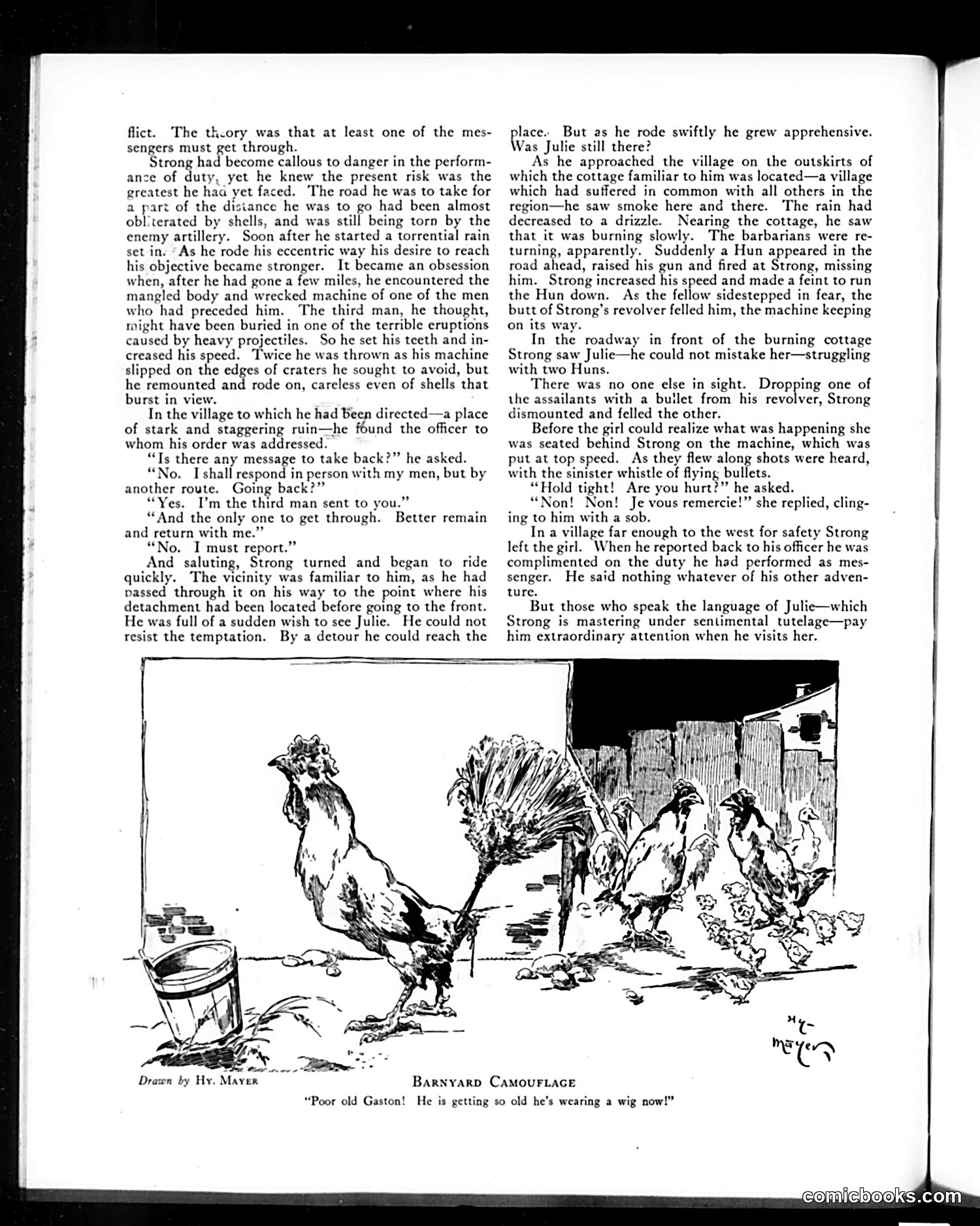
This page contains two elements: a World War I narrative excerpt and an unrelated cartoon below it. The **narrative text** describes a soldier named Strong on a dangerous WWI messenger mission through heavily shelled territory. He discovers his comrade Julie—a French woman—is being assaulted by "Huns" (Germans) at a burning cottage. He rescues her and escapes on his motorcycle. The story emphasizes his heroism and suggests a romantic relationship; the final paragraph hints that French speakers ("those who speak the language of Julie") notice his increased attention to visiting her. The **cartoon titled "Barnyard Camouflage"** appears entirely unrelated. It shows farm animals (rooster, chickens, and other birds) with a joke about an old rooster named Gaston wearing a "wig"—likely meaning his feathers are disheveled or graying with age. The humor is simple barnyard comedy with no apparent political content. The cartoon's relevance to the facing page's WWI content is unclear.
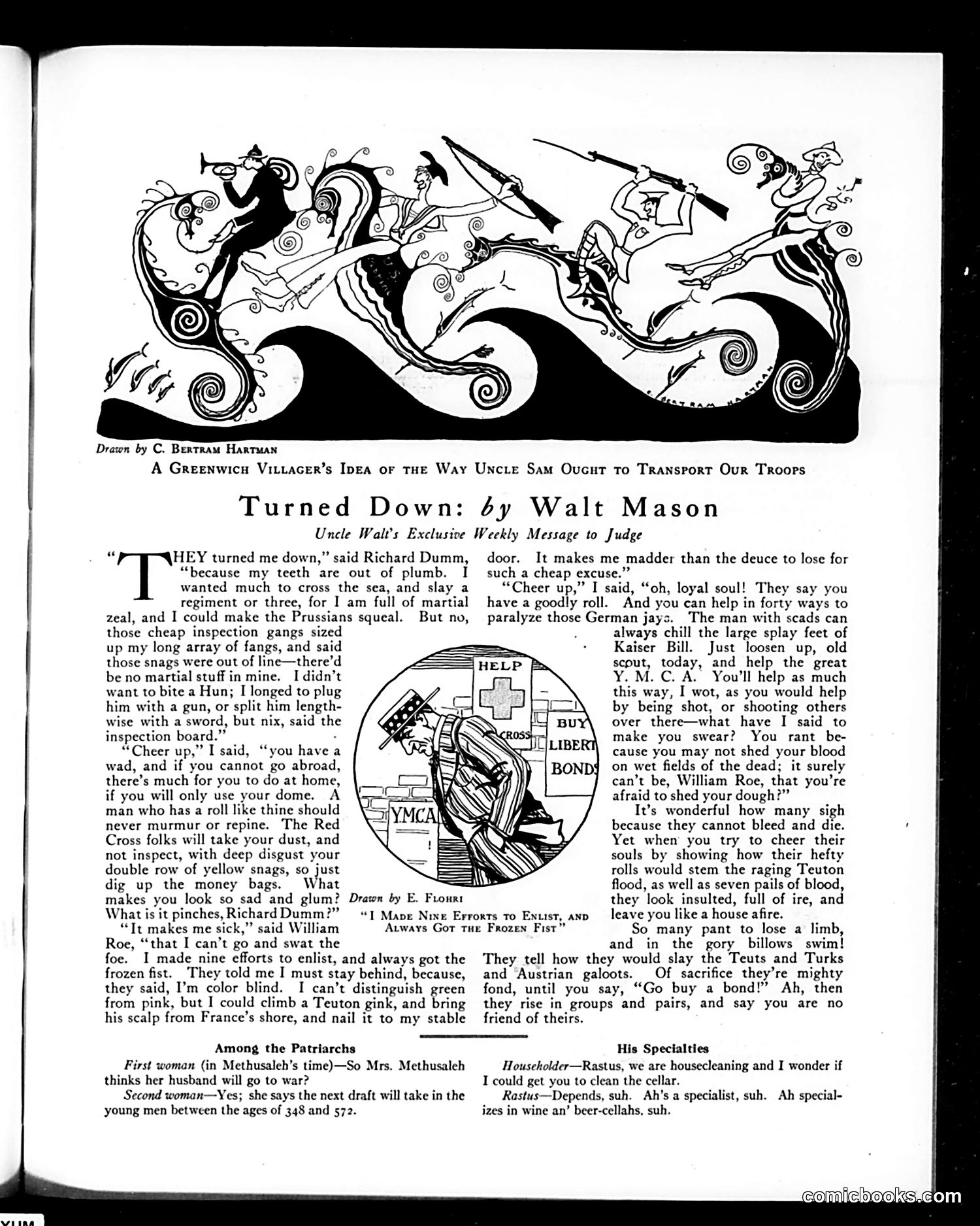
This World War I-era satirical piece uses two distinct commentaries on American home-front attitudes toward the war effort. **Top cartoon & story**: "Turned Down" by Walt Mason mocks men rejected from military service who then refuse to contribute financially to war relief organizations like the YMCA and Red Cross. Two characters—Richard Dumm (rejected for bad teeth) and William Roe (rejected for color blindness)—complain they cannot fight, yet when encouraged to donate money instead, they become insulted and angry. Mason's satire targets their hypocrisy: they claim to want martial glory but won't sacrifice wealth when given the chance. The message: patriotic talk without financial backing is worthless. **Bottom cartoon**: A brief joke about age eligibility, using Methuselah (biblical figure who lived 969 years) to humorously suggest conscription might reach extremely old men. **Decorative header**: C. Bertram Hartman's whimsical illustration shows fantastical methods for transporting troops—a Greenwich villager's absurd idea contrasting with serious wartime logistics.
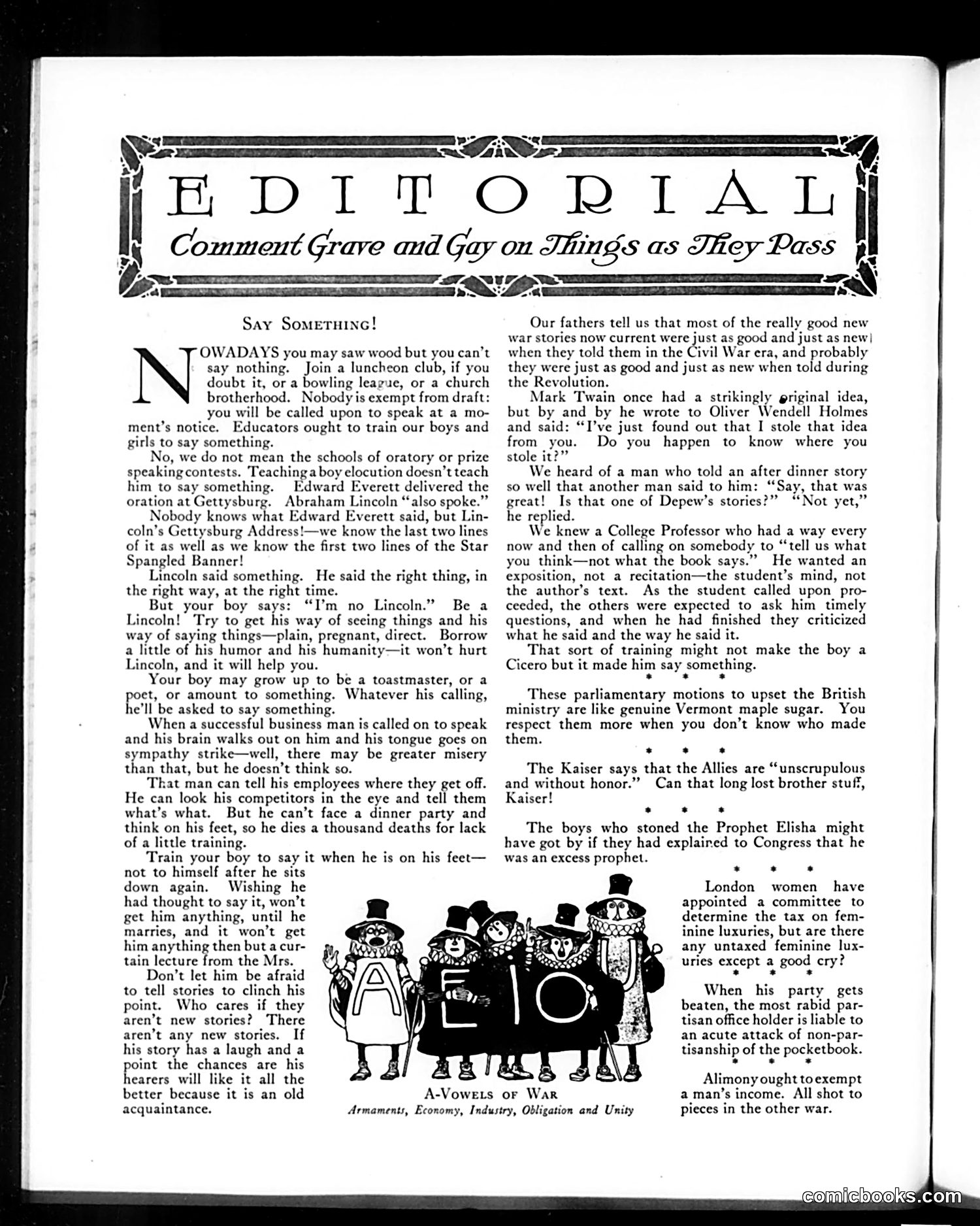
This editorial page from Judge magazine addresses public speaking during World War I. The main article, "Say Something!", urges parents to train boys in effective communication—citing Lincoln's Gettysburg Address as an exemplary model of substance over oratory flourish. The piece emphasizes practical speech skills for everyday situations: business, social gatherings, and civic participation. The accompanying cartoon, "A-Vowels of War," depicts five figures labeled **Armaments, Economy, Industry, Obligation, and Unity**—representing the five pillars the U.S. government promoted as essential to wartime mobilization. This visual metaphor suggests these concepts are fundamental "vowels" (basic building blocks) of the war effort. The editorial's emphasis on training youth to "say something" reflects broader WWI-era concerns about civic duty and national mobilization. Additional satirical commentary mocks British parliamentary procedures and the German Kaiser's characterization of the Allies. The page reflects America's wartime messaging priorities circa 1917-1918.
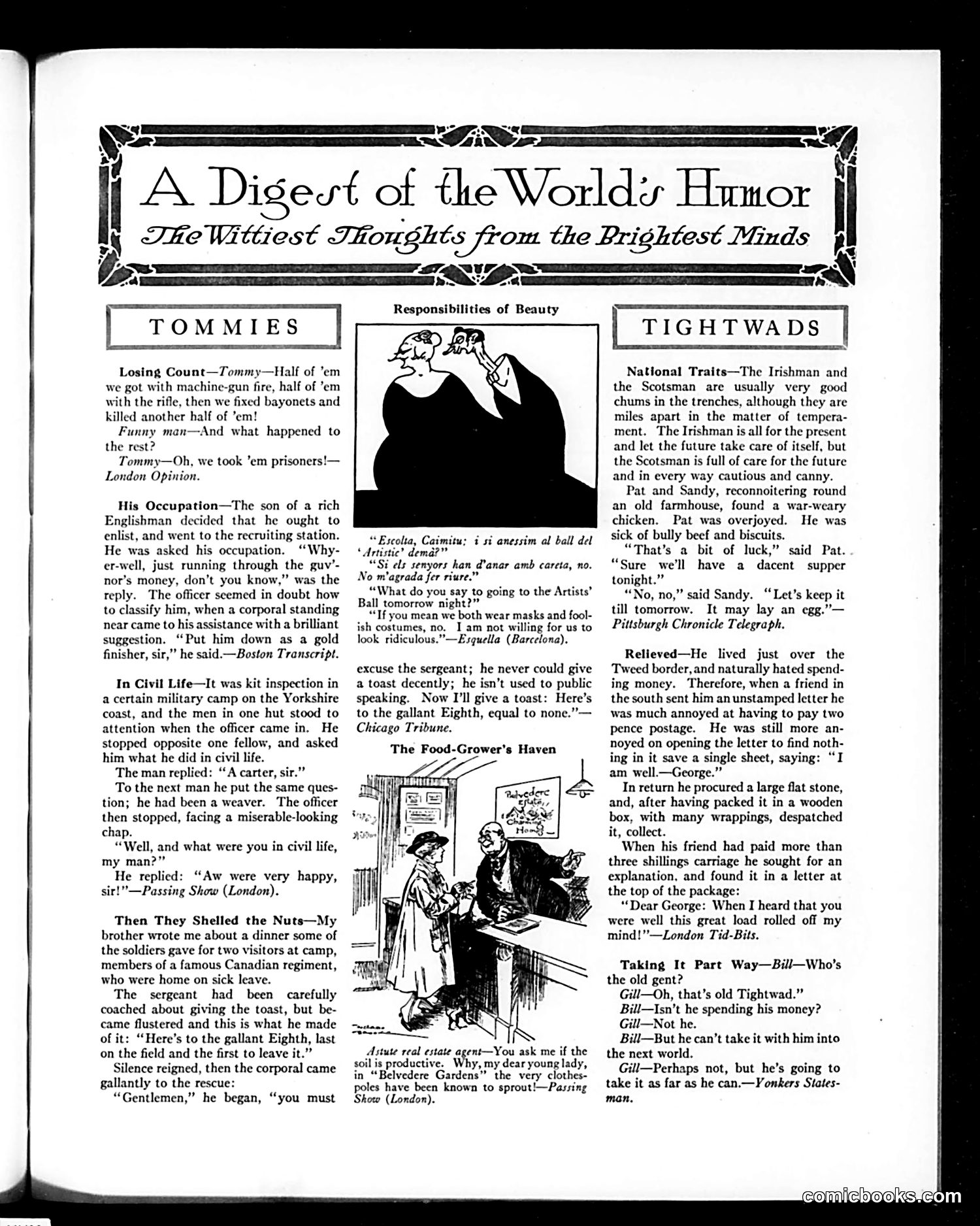
This page collects brief humorous anecdotes from WWI-era publications, grouped under "Tommies" (British soldiers) and "Tightwads" (misers). The **Tommies** section satirizes military life and recruitment. One joke plays on a soldier's absurdly inflated casualty count; another mocks a wealthy recruit whose only "occupation" is spending his father's money—classified as a "gold finisher" by a quick-thinking corporal. A third ridicules a sergeant's bungled toast at a regimental dinner, nearly insulting the honored guests before a corporal saves face. The **Tightwads** section contrasts Irish and Scottish temperaments (the Irishman wants immediate gratification from a found chicken; the Scot wants to keep it for eggs), and ends with a joke about a Scottish miser angered by paying postage on an unstamped letter containing only "I am well." The cartoon shows a food-grower's agent making an absurd sales pitch about productive soil. These are lightweight, accessible gags reflecting wartime attitudes and ethnic stereotypes typical of period humor magazines.
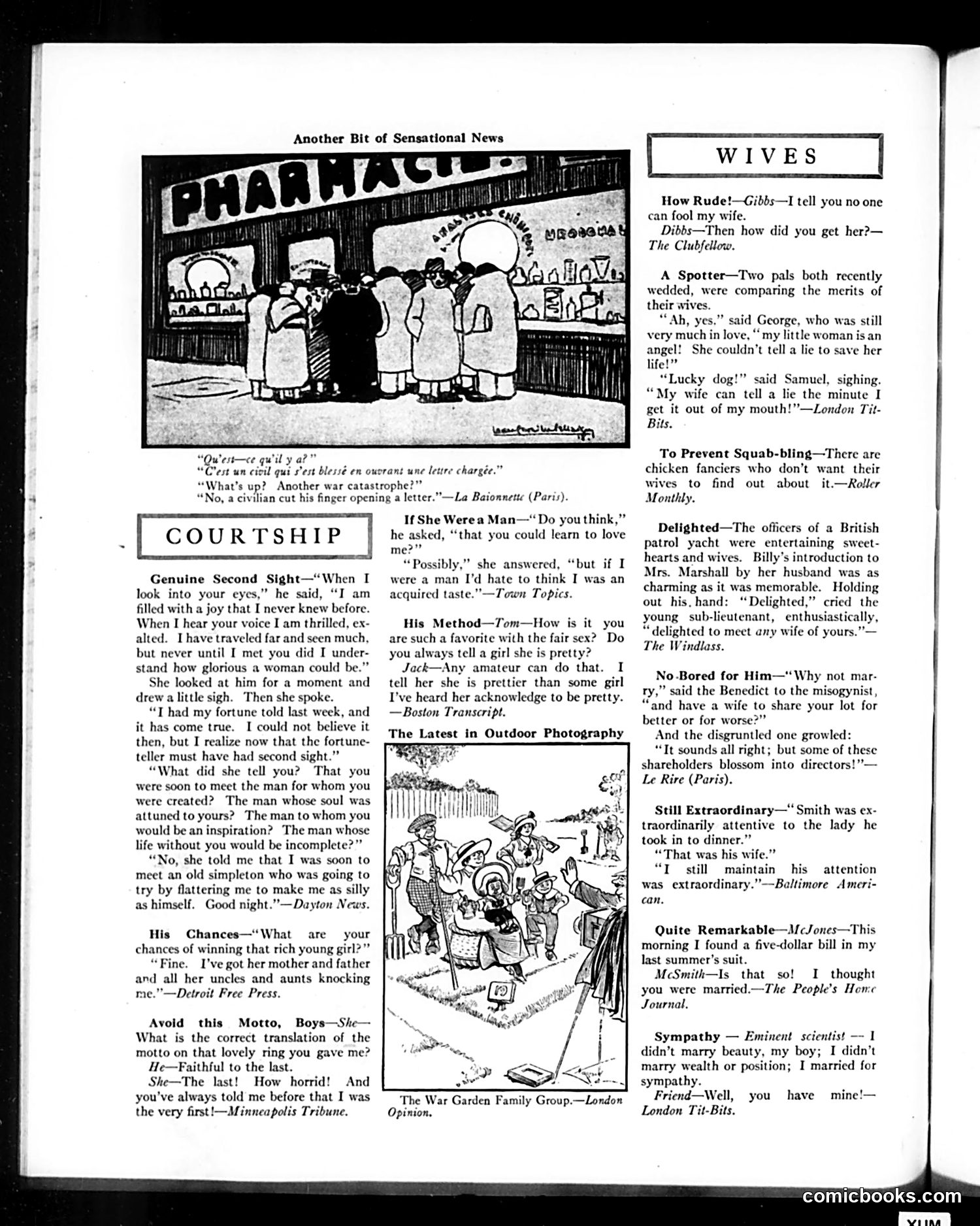
This page from *Judge* contains satirical humor about courtship and marriage, typical of early 20th-century American comedy. **The cartoons and jokes mock romantic clichés and marital realities:** The opening cartoon shows a pharmacy scene with a French caption about a civilian injuring himself opening a letter—a absurdist non-sequitur playing on wartime anxieties. **Courtship section** presents cynical takes on romance: a woman rejects a man's flowery declarations by revealing a fortune-teller predicted she'd meet "an old simpleton"; another joke shows a woman unimpressed by flattery about her beauty. **The marriage jokes** express tired domesticity: wives are portrayed as shrewd or controlling (one can "tell a lie the minute" her husband speaks), money mysteriously disappears into marriage, and husbands become inattentive. The humor assumes male readers expect wives to frustrate or diminish them. **Overall tone:** Pre-marital romance is exposing delusion; marriage is a trap where honeyed words meet practical reality. The satire targets both genders' pretenses, though skepticism about women's honesty and intelligence runs throughout.
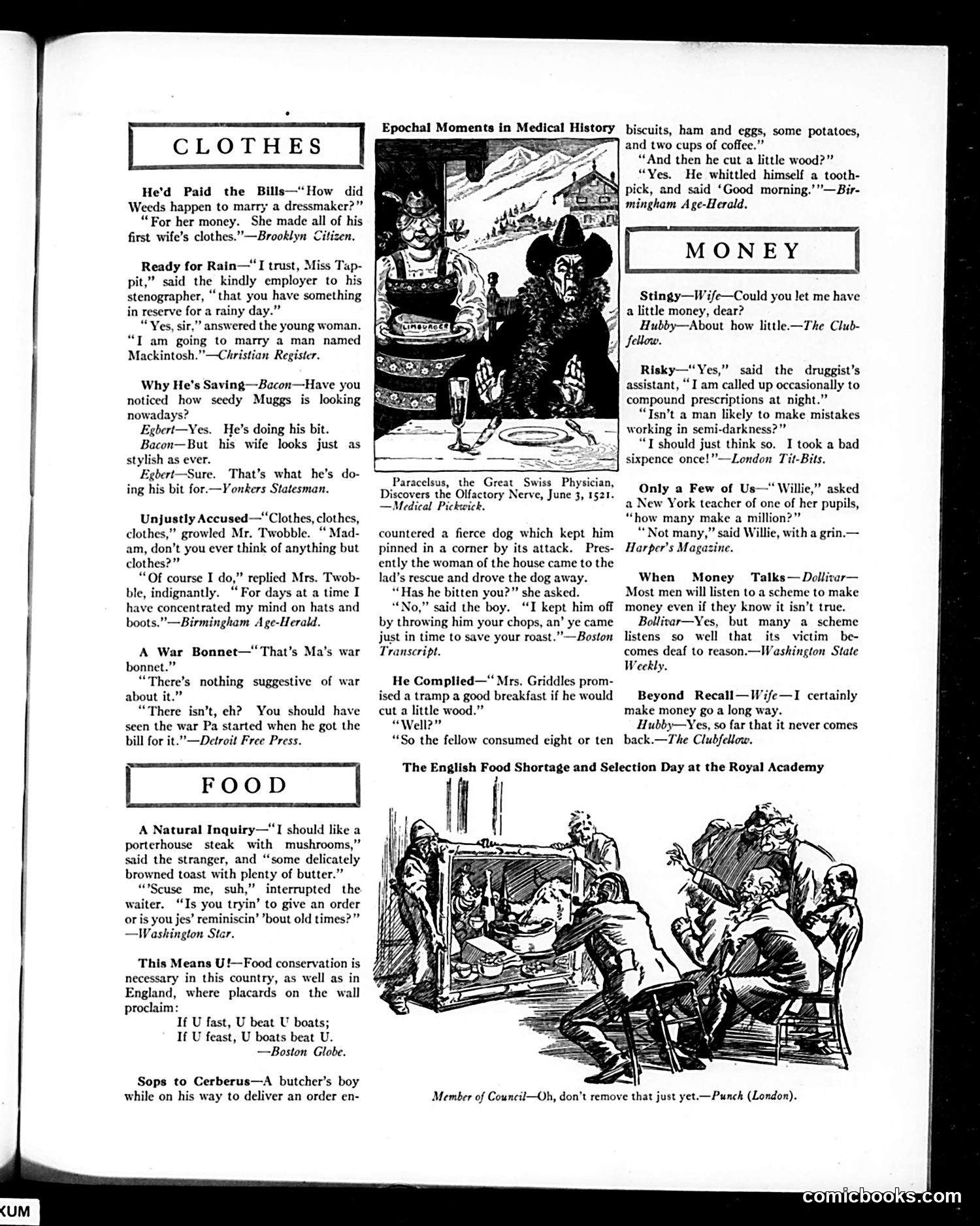
This page collects brief humorous anecdotes organized by topic (Clothes, Food, Money), typical of Judge's format. The jokes target early-20th-century domestic life and wartime conditions. **Key themes:** The **Clothes** section satirizes marriage and women's spending habits—wives marrying for money, husbands sacrificing to fund wives' fashions, and women obsessing over appearance. The **Food** section reflects **World War I rationing**. "This Means U!" references food conservation propaganda and German U-boats threatening food supplies. Other jokes mock wartime scarcity: a waiter questions whether a customer is ordering or reminiscing about pre-rationing meals; a tramp consumes an entire breakfast after promising to chop wood. The **Money** section mocks stingy husbands and wives' spending—standard marital humor. The **Medical History** cartoon appears decorative, unrelated to surrounding text. The **final illustration** shows the "Royal Academy" discussing food selection during England's shortage, reinforcing wartime deprivation as a contemporary concern. Overall, these are gentle domestic satires exploiting period anxieties about marriage finances and wartime hardship.
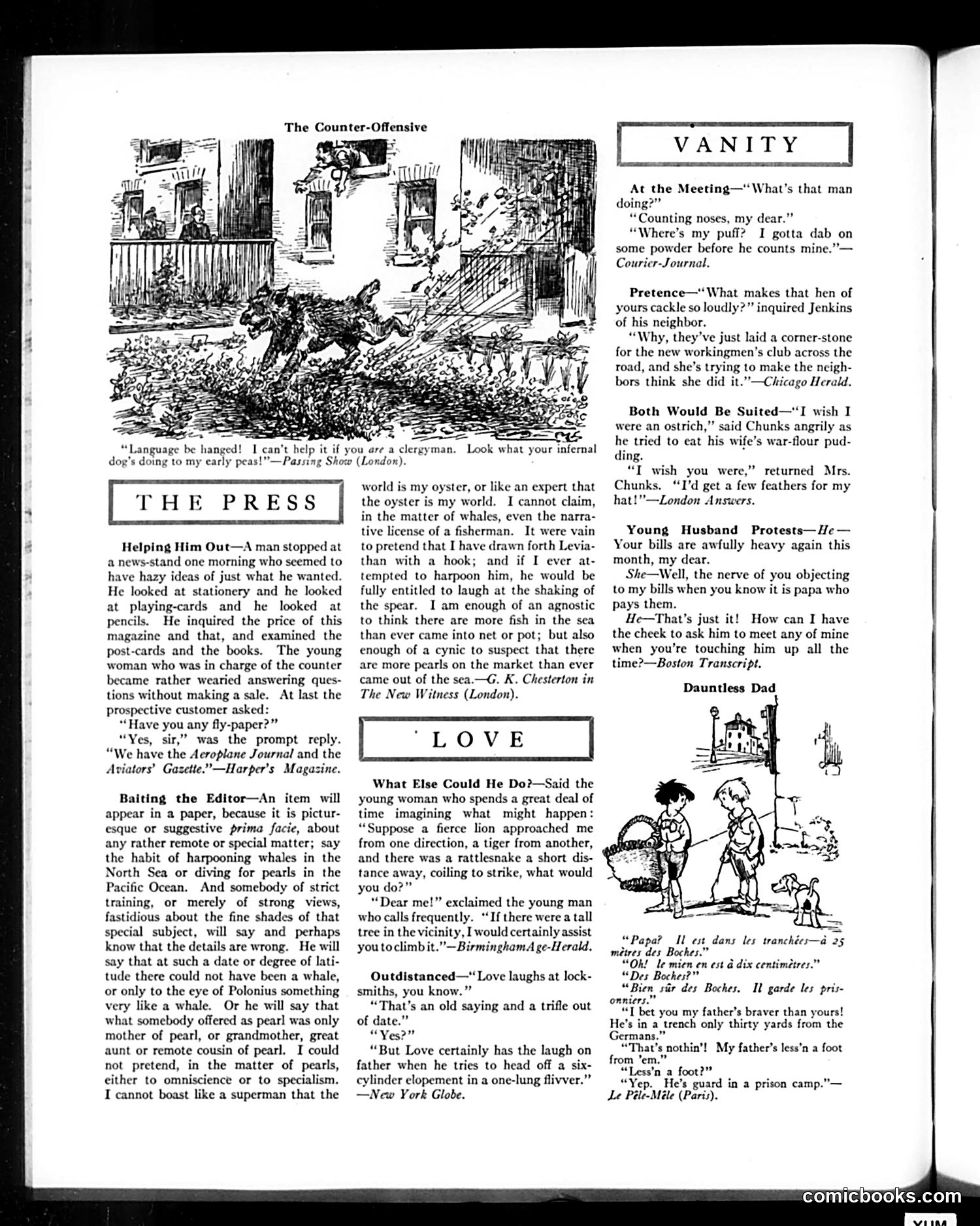
**"The Counter-Offensive"** (top cartoon): A clergyman's dog destroys a man's vegetable garden. The satire mocks clerical hypocrisy—the man cannot openly complain to a man of the cloth despite the damage, illustrating how social deference to clergy members silences legitimate grievances. **"The Press" section**: These are editorial anecdotes satirizing journalism and reader complaints. "Helping Him Out" jokes that sensationalist publications like the *Aeroplane Journal* are as worthless as fly-paper. "Baiting the Editor" (by G.K. Chesterton) defends journalistic license against pedantic readers who obsess over minor factual errors in colorful stories. **"Love" and "Vanity" sections**: These are humorous domestic and social observations about courtship, marriage, and vanity—typical Judge magazine light satirical fare mocking middle-class behavior, gender relations, and pretense. The page reflects early 20th-century concerns about aviation, automobiles ("flivvers"), wartime food rationing, and social hierarchy.
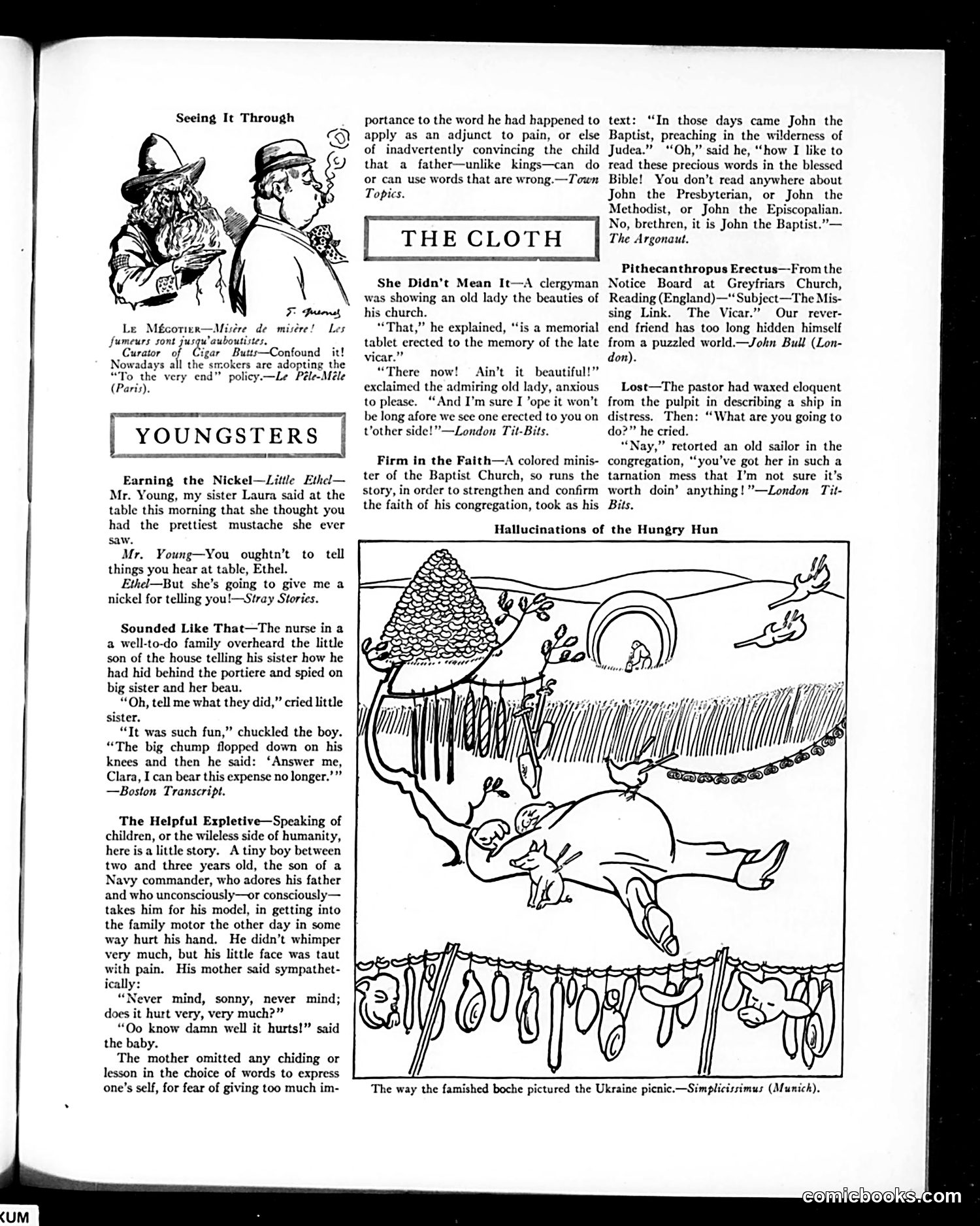
This page comprises brief humorous anecdotes and one political cartoon, typical of Judge's satirical format. **The main cartoon**, titled "Hallucinations of the Hungry Hun," depicts a German soldier's fantasy of Ukrainian abundance—a grotesque landscape overflowing with food (sausages, produce, grain). This is wartime propaganda satirizing German hunger and territorial ambitions. "Boche" was a derogatory WWI-era term for Germans. The cartoon mocks German soldiers' desperation and coveting of eastern European resources. **The text sections** are brief jokes about clergy, children, and social propriety—typical Judge humor. Notable: "Firm in the Faith" gently mocks a Black Baptist minister's denominational boasting; "Pithecanthropus Erectus" makes a crude joke about a vicar being a "missing link" (referencing evolution debates of the era). The page reflects early-20th-century American attitudes: wartime German mockery, casual racial humor, and middle-class preoccupations with manners and clergy.
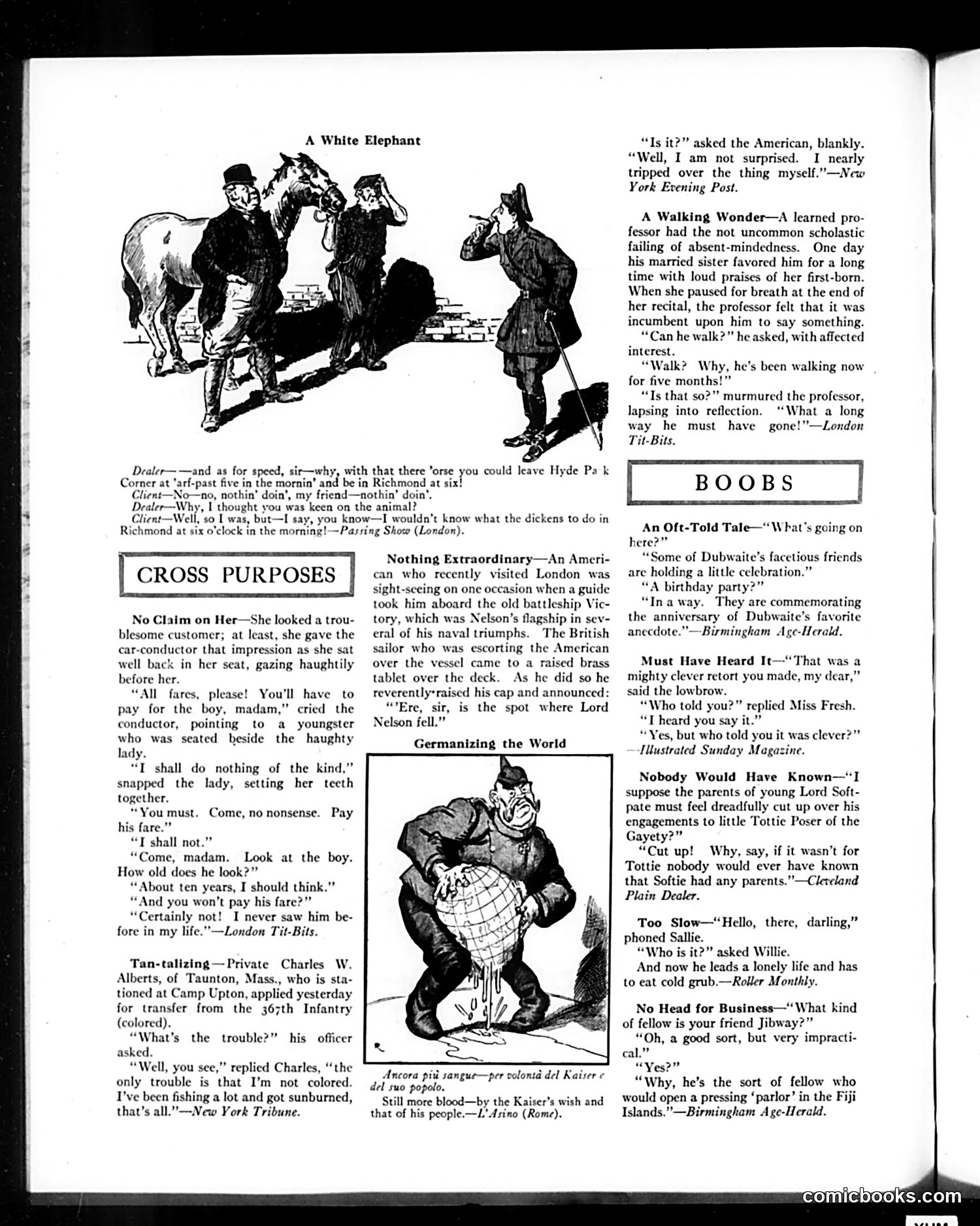
This page contains five brief humorous anecdotes typical of Judge magazine's satirical style: **"A White Elephant"** depicts a horse dealer's pitch gone wrong—the client loses interest when told he'd arrive in Richmond at an absurdly early hour, finding the destination pointless. **"No Claim on Her"** mocks a woman's refusal to pay fare for a child she's never met, exposing class-based rudeness on public transport. **"Tan-talizing"** satirizes military segregation: a soldier requests transfer from a colored regiment because he's actually white, merely sunburned—a dark joke about racial classification. **"Nothing Extraordinary"** plays on American tourist obliviousness: a guide reverently marks where Nelson fell; the American assumes it's an obstacle he nearly tripped over. **"Germanizing the World"** references Kaiser Wilhelm's expansionist militarism, with an Italian source warning of bloodshed. The remaining items are brief romantic/social comedy quips about absent-minded professors, gossip, and misunderstandings. Overall, these represent typical early 20th-century Judge humor: class commentary, mild xenophobia, and domestic comedy.
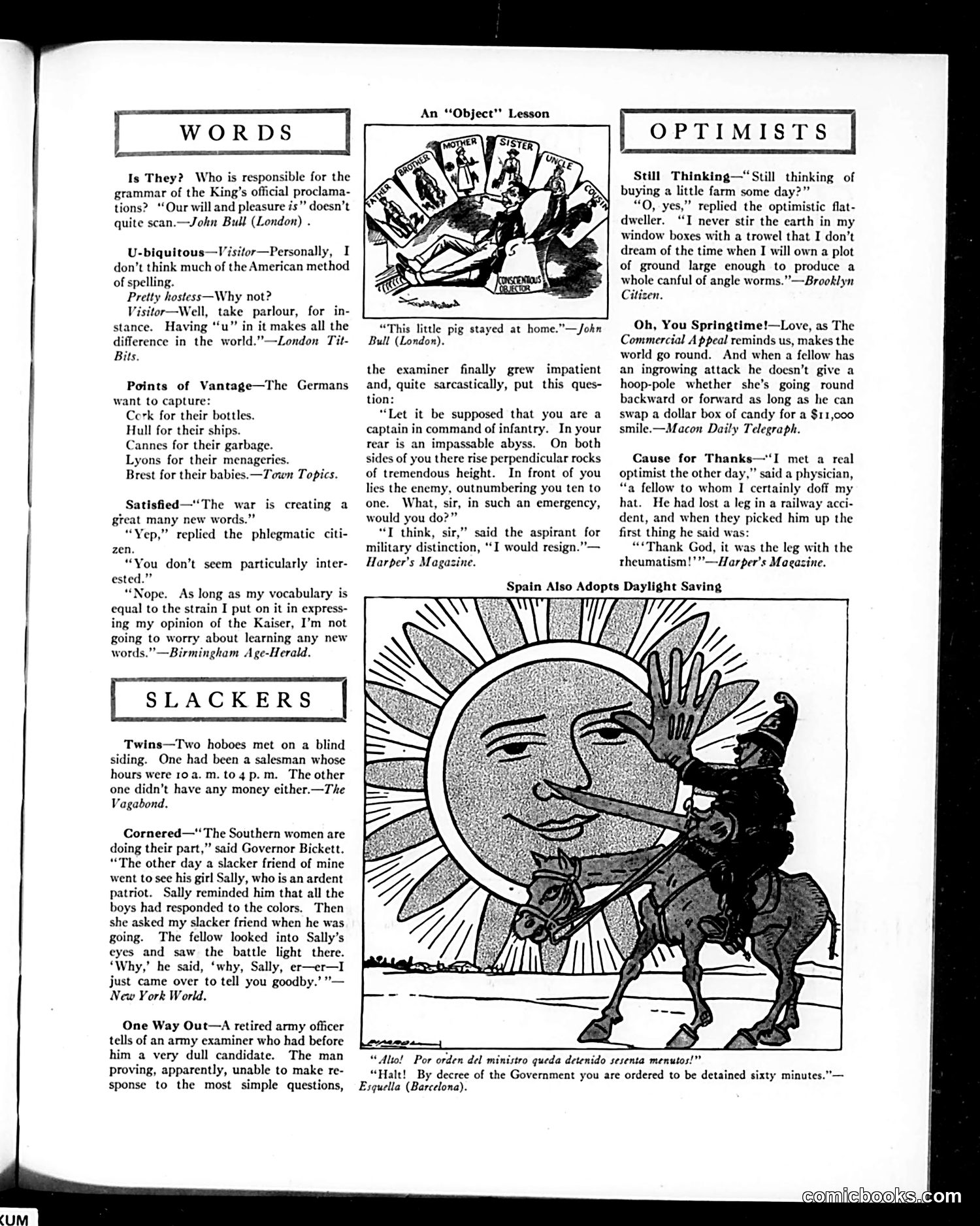
This page contains satirical humor columns and one political cartoon, all commentary on World War I era issues. The **main cartoon** depicts Spain's adoption of daylight saving time. A Spanish official on horseback stops a man, announcing he's "detained" for sixty minutes by government decree—a joke about the absurdity of the time shift. The cartoon mocks bureaucratic overreach and Spain's neutral status mimicking wartime measures. The text sections mock different groups: "WORDS" ridicules grammar and spelling; "SLACKERS" attacks men avoiding military service (a major WWI concern), including one who invents excuses to avoid enlisting; "OPTIMISTS" offers lighthearted takes on positive thinking. The "Object Lesson" anecdote about a dull military candidate who, when asked what he'd do in an impossible tactical situation, responds "I would resign"—satirizing both military incompetence and defeatism during wartime. The page reflects American WWI anxieties: draft evasion, military readiness, and patriotic obligation.
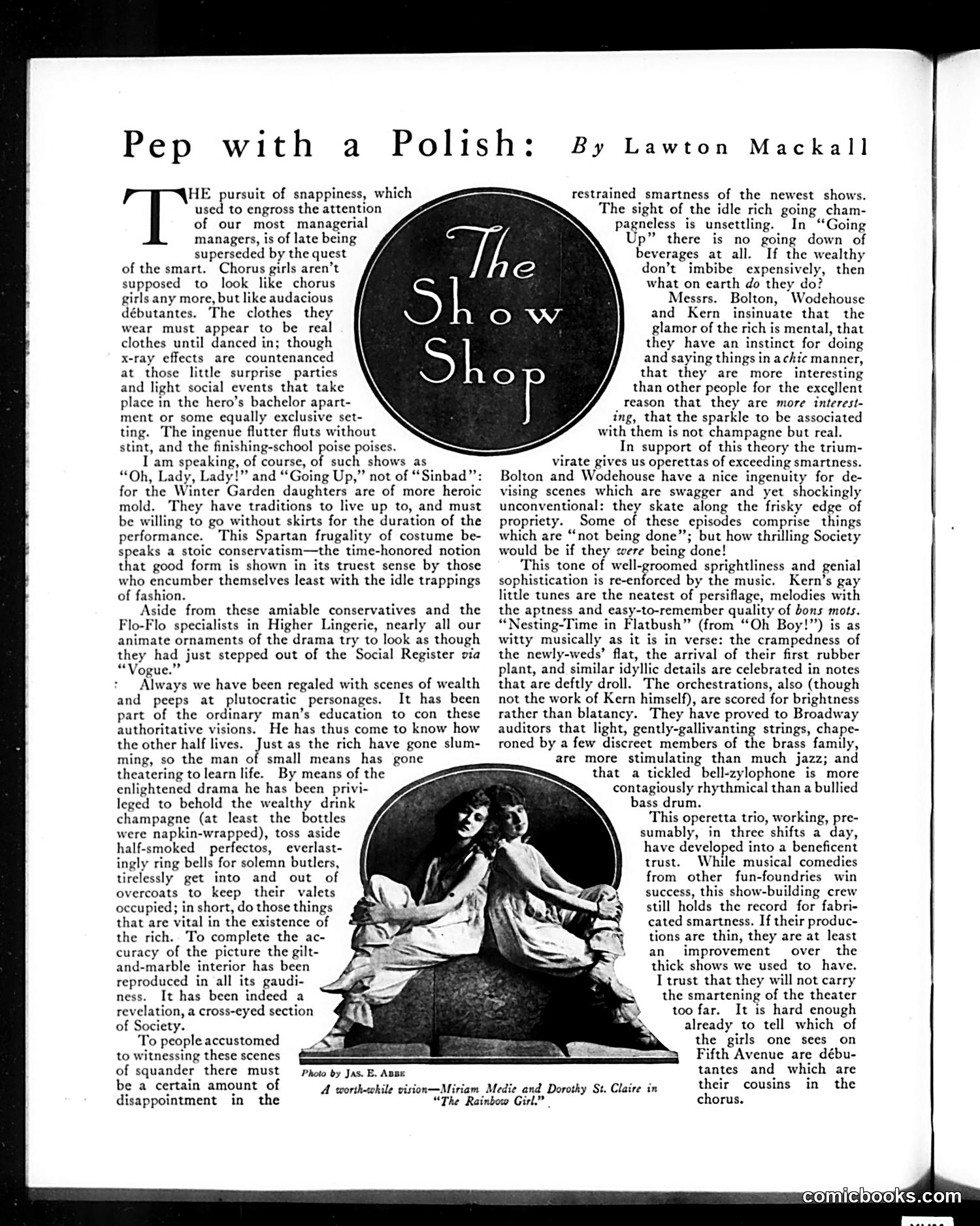
This essay by Lawton Mackall critiques how Broadway musicals are shifting their portrayal of wealth. Traditionally, shows depicted the rich through obvious luxury: champagne-drinking, bell-ringing for servants, marble interiors—allowing working-class audiences voyeuristic access to aristocratic excess. The "newest shows" (particularly those by Bolton, Wodehouse, and Kern, likely referencing *Going Up*) now present wealth differently: understated sophistication and "mental glamor" rather than conspicuous consumption. Mackall finds this disappointing—audiences expect spectacle, not restraint. The photograph shows performers from *The Rainbow Girl*, illustrating the "refined" aesthetic being discussed. The satire mocks both the new shows' attempt at elegant subtlety and audiences conditioned to expect extravagance. The point: Broadway is pretending the rich are *interesting* rather than merely *ostentatious*.
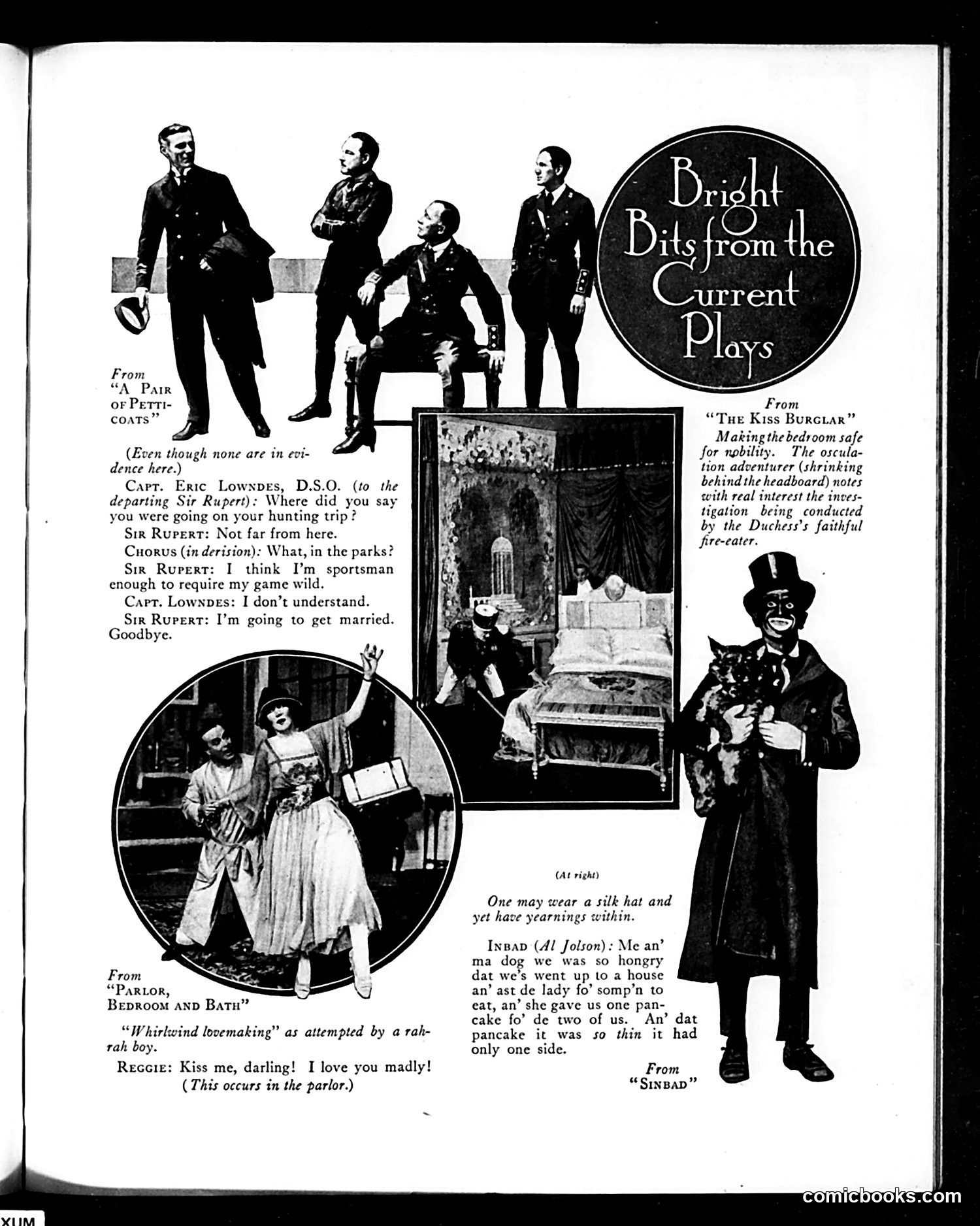
This page presents "bright bits" from contemporary theatrical productions, mixing theatrical excerpts with visual gags. The top section satirizes a play ("A Pair of Petti-Coats") with a joke about marriage: a captain asks Sir Rupert about his hunting trip; Rupert replies he's going to "get married"—implying courtship is as dangerous and unpredictable as wild game hunting. Below are snippets from other plays: "Parlor, Bedroom and Bath" shows a "rah-rah boy" attempting clumsy seduction ("Whirlwind lovemaking"), while "The Kiss Burglar" depicts a bedroom burglary interrupted by investigation. The "Sinbad" section features dialect humor (likely Al Jolson-style blackface performance conventions of the era), recounting a story about sharing an impossibly thin pancake—the punchline being its thinness. These are theatrical humor pieces typical of *Judge* magazine's entertainment coverage, relying on then-current Broadway productions and performance styles now historically distant.
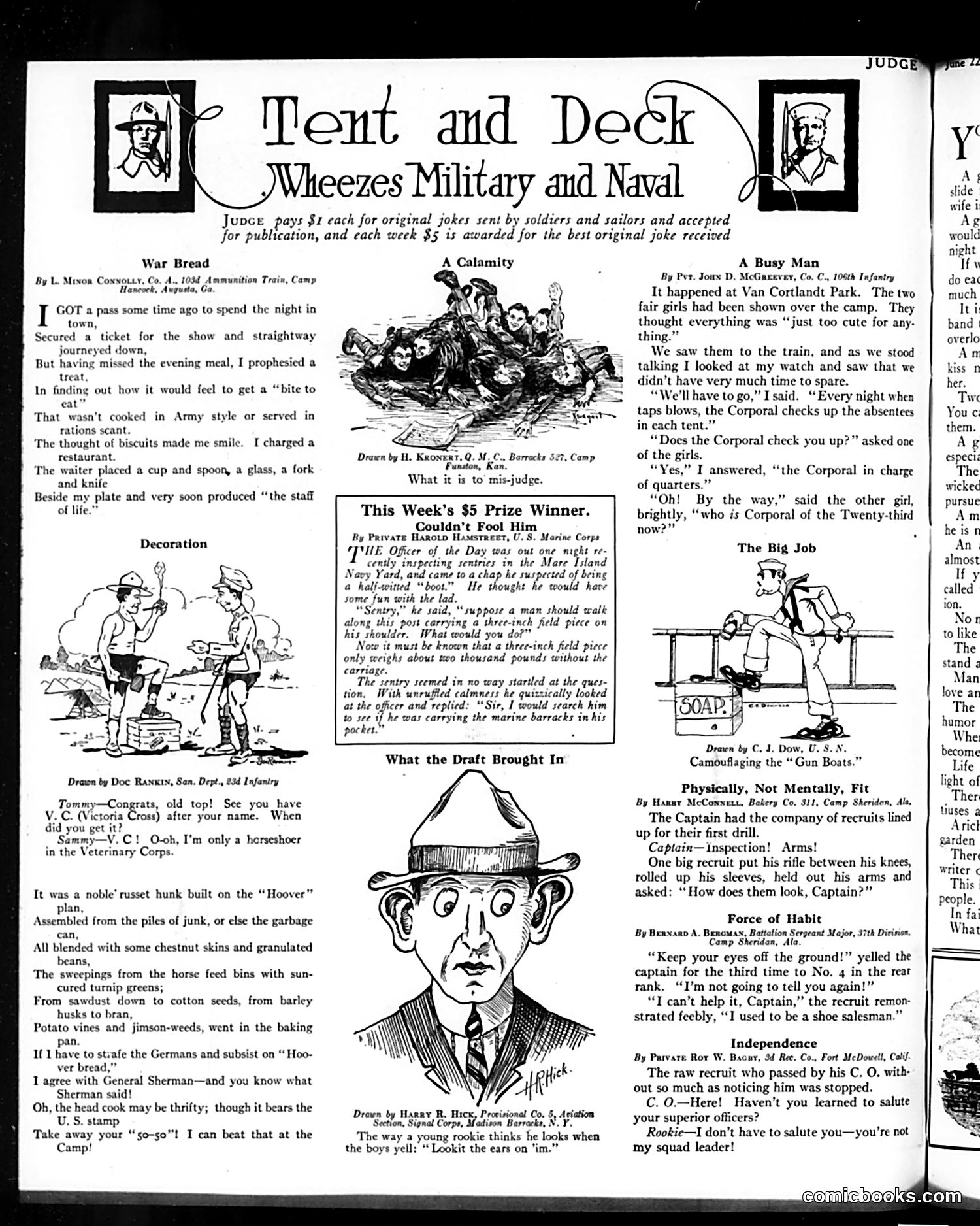
This is a humor page from *Judge* magazine featuring jokes submitted by soldiers and sailors during World War I. The content satirizes military life through soldiers' firsthand experiences. Key themes include: poorly-made military rations ("War Bread"—a complaint about the "Hoover bread" made from garbage and sawdust); the absurdity of military hierarchy and inspections; and the contrast between recruits' incompetence and their unwarranted confidence. One joke mocks a naive recruit who thinks a three-inch field piece weighs 10,000 pounds. Another jokes about a young soldier so busy with duties he can't visit girlfriends. The overall tone is good-natured ribbing of military inefficiency, food quality, and the culture clash between civilian recruits and military discipline. These were reader-submitted jokes competing for a $5 prize, providing authentic soldier perspectives on wartime camp life's mundane frustrations and absurdities.
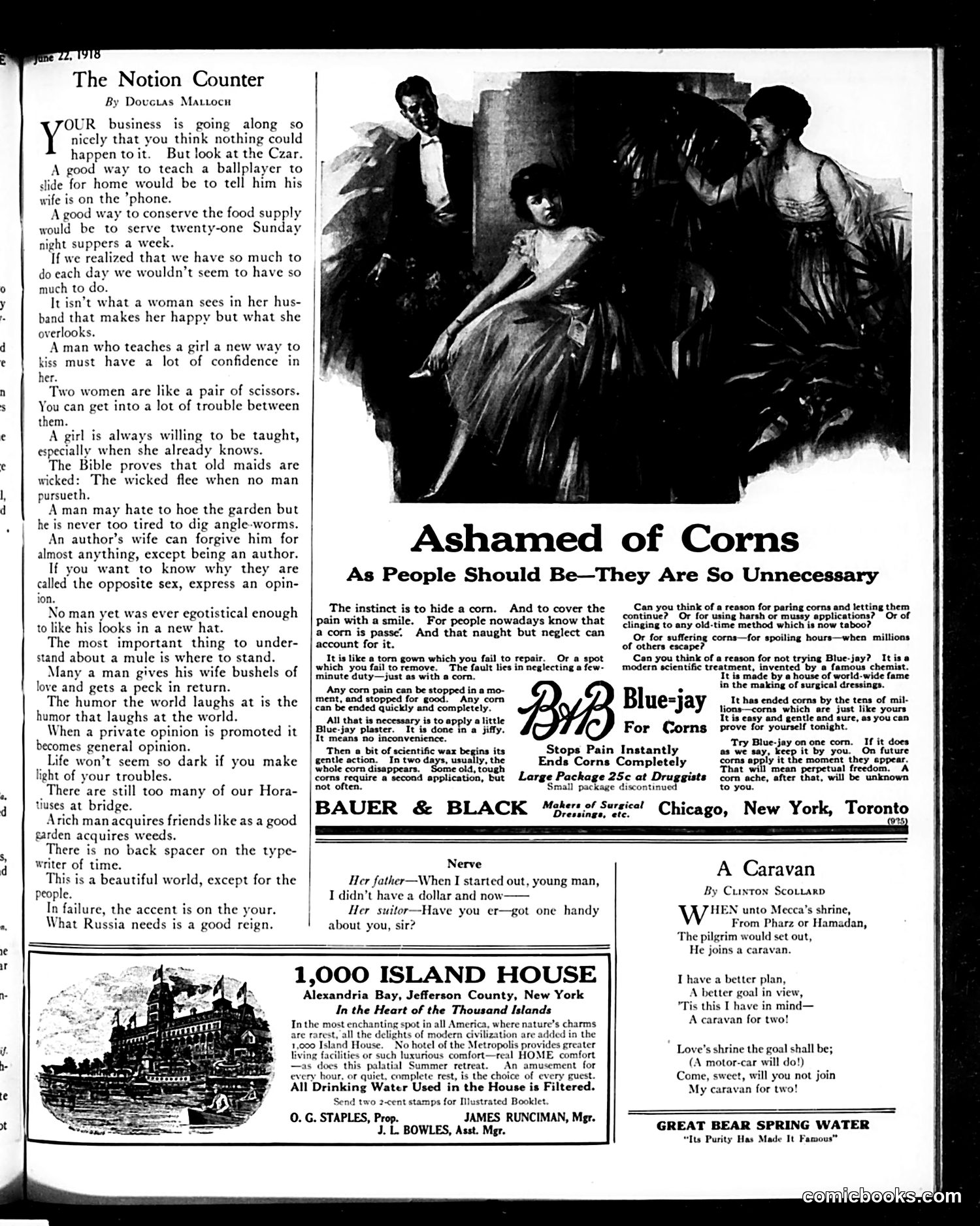
This page is primarily **advertising and humor columns**, not political satire. **"The Notion Counter"** by Douglas Malloch is a **lighthearted aphorism column** offering domestic and social observations—mostly jokes about marriage, women, and everyday life. The references to "the Czar" and "Russia needs a good reign" appear to be generic examples of misfortune, not specific political commentary (though the 1918 date suggests awareness of Russian upheaval). The dominant content is a **full-page advertisement for Blue-jay corn plasters**. The accompanying illustration shows women discovering this "modern scientific treatment" for corns—positioning the product as progressive and embarrassment-free compared to older, messier remedies. The headline "Ashamed of Corns—As People Should Be" plays on social shame to market the solution. Additional small ads include **1,000 Island House** (resort), **Great Bear Spring Water**, and a brief **"Nerve"** joke column. This is essentially a **commercial magazine page** with light humor, not satirical commentary.
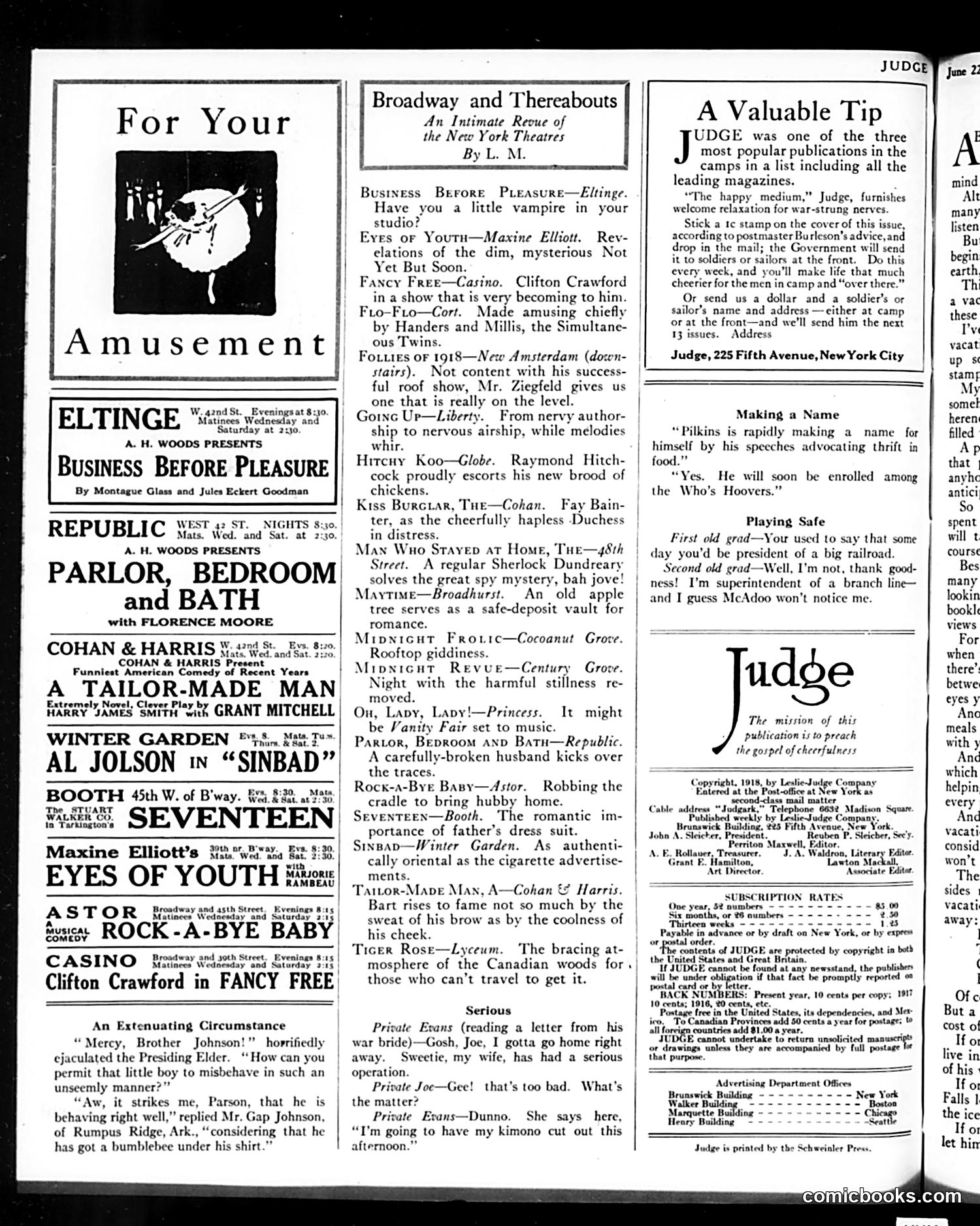
This page from *Judge* magazine (dated June 22, as visible in the header) is primarily a theater-listing and advertising section typical of the era. The main content reviews Broadway shows, with brief witty descriptions by "L.M." The humor is light: shows are critiqued for their topicality or appeal (e.g., "Business Before Pleasure," "Sinbad" starring Al Jolson). One joke mocks a play called "Seventeen" as about "the romantic importance of father's dress suit" — commentary on post-WWI youth culture. The "Extenuating Circumstance" cartoon depicts a preacher criticizing a man's misbehaving child. The punchline: the father excuses the boy's behavior because he has a bumblebee under his shirt — absurdist humor. Below, under "Serious," soldiers exchange dark wartime humor: one dreads his war bride's "serious operation" — but she only needs her kimono altered, not surgery. The joke plays on wartime anxiety and marriage strain. The page also plugs *Judge* as valuable morale-boosting reading for soldiers at the front.
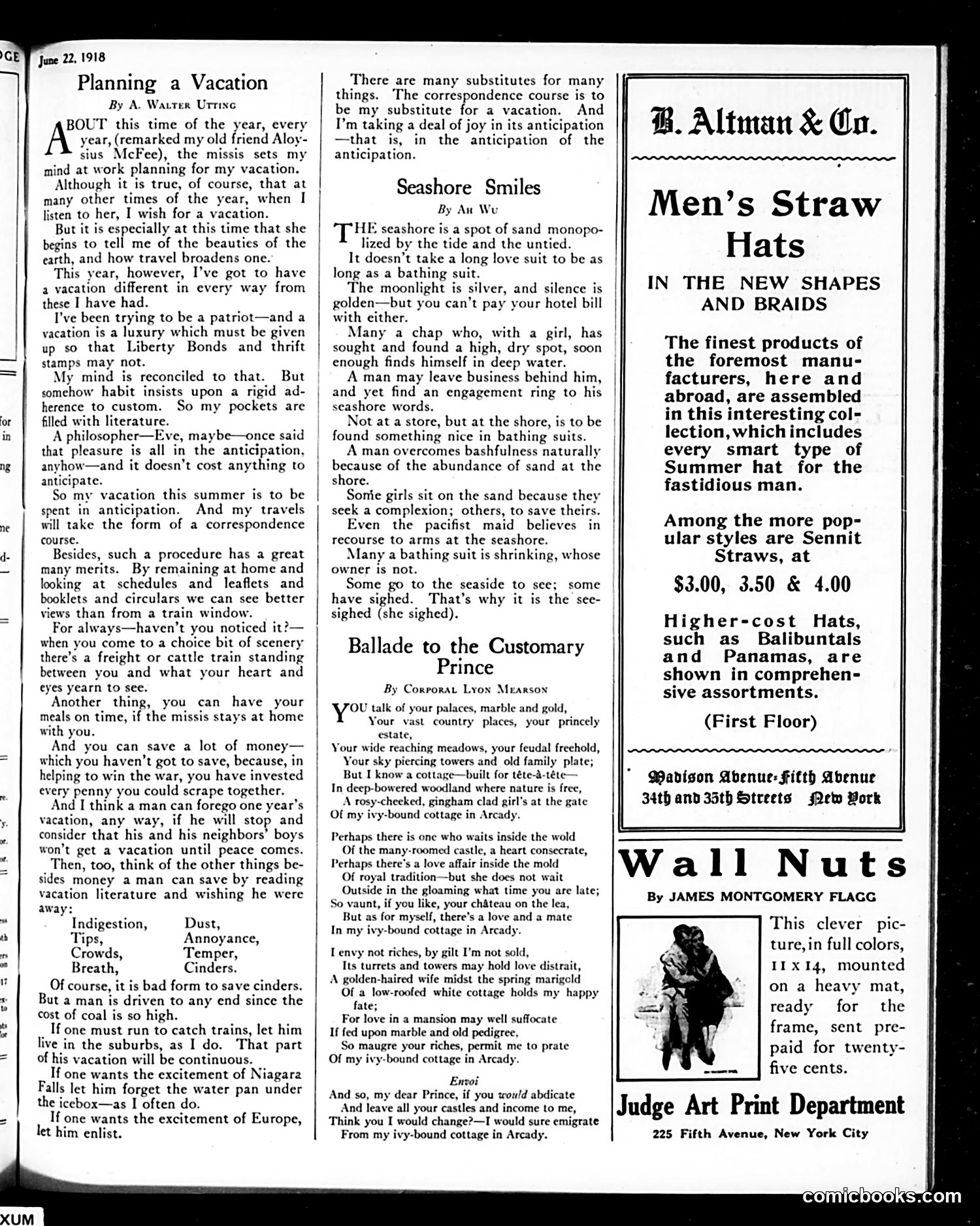
This page contains three separate pieces of humor reflecting World War I-era American attitudes: **"Planning a Vacation"** satirizes wartime sacrifice. The author humorously proposes taking a "vacation" entirely through correspondence courses and literature at home, arguing that actual travel is unpatriotic when Liberty Bonds and war effort demand resources. The joke targets both the guilt-ridden middle class and the absurdity of finding entertainment through mere anticipation rather than experience—a gentle mockery of enforced thrift during wartime. **"Seashore Smiles"** and **"Ballad to the Customary Prince"** are lighthearted romantic/social commentary with no obvious political content. The **B. Altman & Co. advertisement** for straw hats and the **Judge Art Print Department** ad occupy the right column. The page reflects 1918 anxieties about civilian patriotic duty, economic sacrifice during WWI, and the tension between leisure desires and wartime obligations.
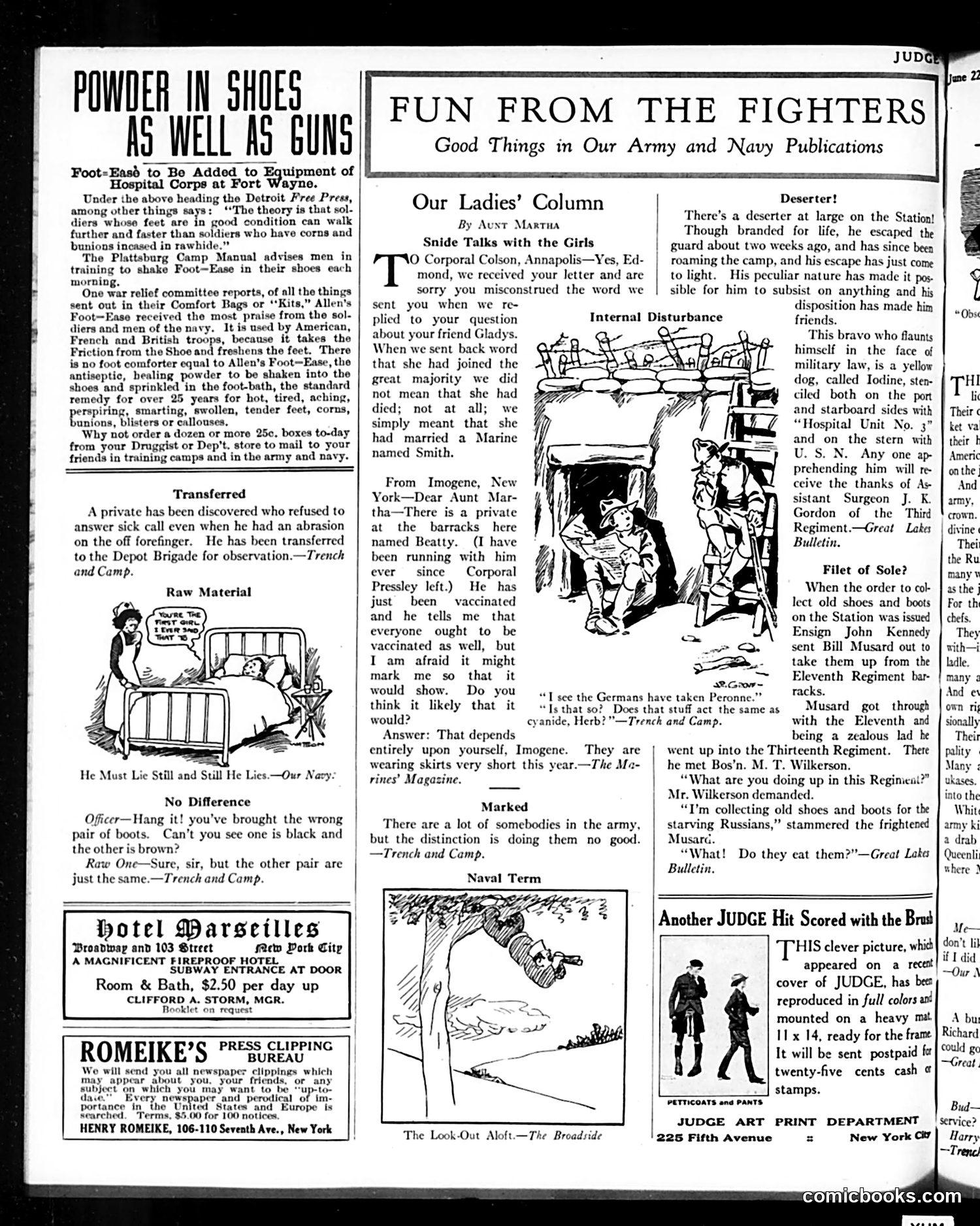
This page from Judge magazine contains WWI-era military humor and advertisements. The main content includes: **"Fun from the Fighters"** — A column reprinting jokes from Army and Navy publications. The humor targets military life: a joke about German-captured towns causing digestive upset; an "Our Ladies' Column" with advice to soldiers' girlfriends about vaccination marks and short skirts; and a quip about a deserter's escape. **Advertisement content** dominates: Allen's Foot-Ease powder (promoted as essential military equipment), Hotel Marseilles, and Romeike's press clipping service. The cartoons are simple, supporting the text: one shows military barracks life; another depicts a lookout soldier. **The satire's point**: This page mocks both military bureaucracy (the obsession with foot powder as war equipment) and soldiers' romantic anxieties during WWI. The humor is gentle, patriotic — designed to entertain soldiers and home-front readers rather than critique the war itself. The overall tone assumes a audience familiar with military camp life and contemporary social attitudes about courtship and appearance.
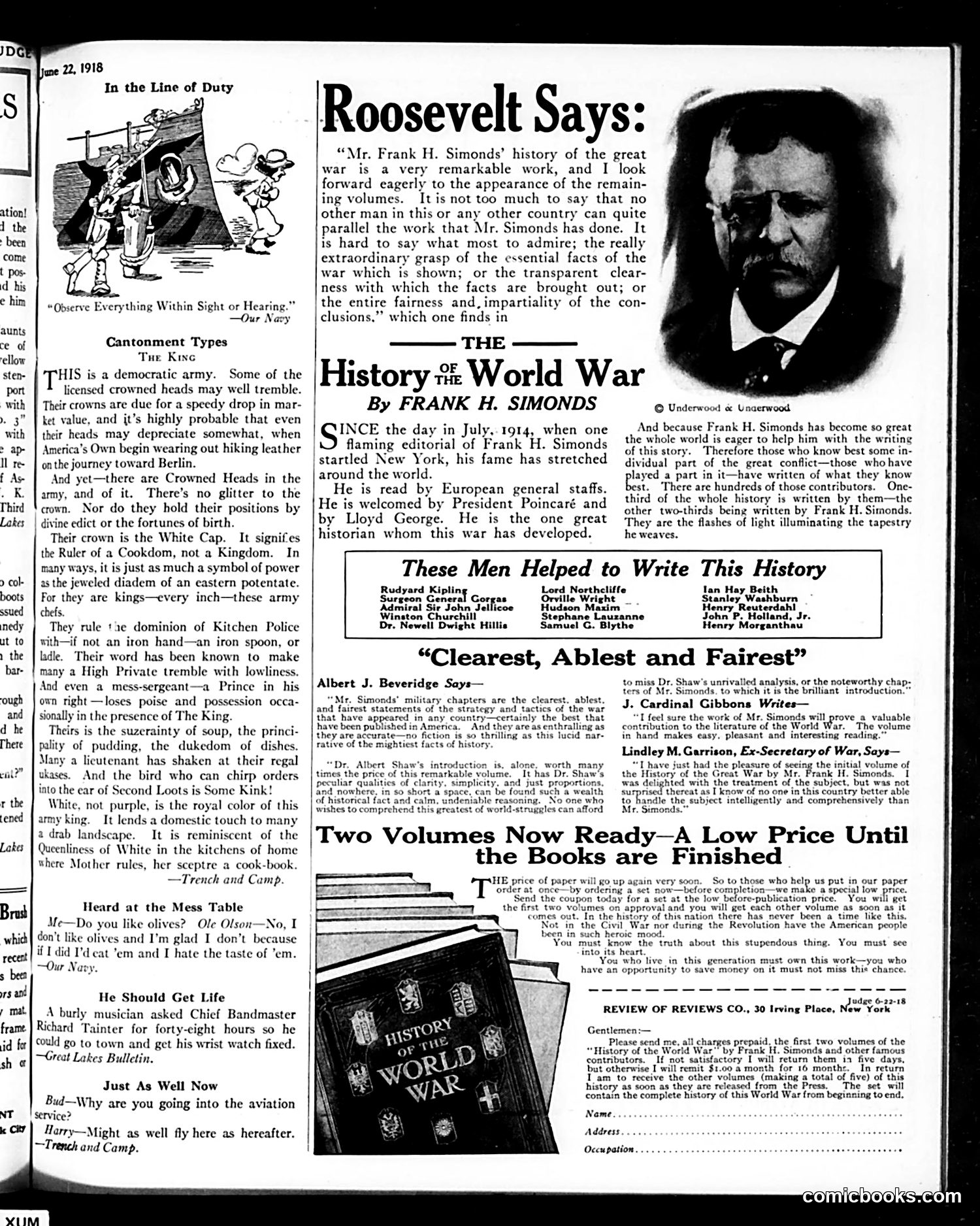
This page mixes satirical commentary on military life with advertising for Frank H. Simonds' "History of the World War." **The Cartoons:** The top cartoon ("In the Line of Duty") depicts Navy personnel observing "everything within sight or hearing"—likely satirizing military surveillance or intelligence-gathering during WWI. **"Cantonment Types: The King"** is humorous social satire about Army cooks. The piece celebrates kitchen staff as "kings" ruling their domain with iron ladles, joking that even lieutenants "tremble" before them. It's gentle mockery of military hierarchy and the unexpected power wielded by those controlling food—a precious resource. **The brief jokes** ("Heard at the Mess Table," "He Should Get Life") are typical period barracks humor about olives and wrist watches. **The Advertisement:** The bulk of the page promotes Simonds' war history, featuring Roosevelt's endorsement and quotes from notable contributors (Kipling, Churchill, etc.), emphasizing its authority and completeness as the definitive WWI account.
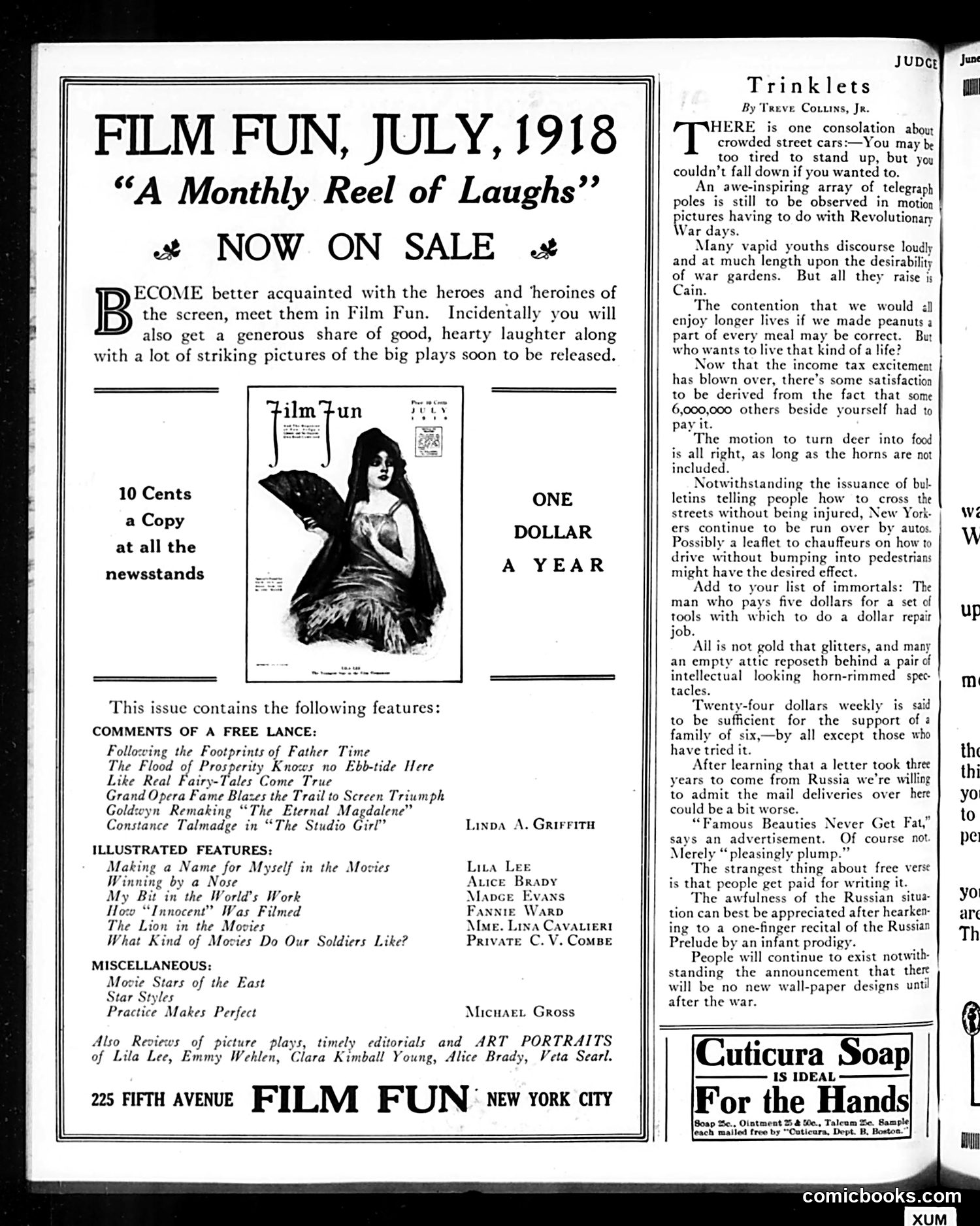
This is primarily a **title/contents page** for *Film Fun*, a monthly cinema magazine supplement. The main content is advertising and promotional material, not political satire. The page announces *Film Fun*'s July 1918 issue (10 cents, or $1/year), featuring articles and photos of silent film stars including Lila Lee, Alice Brady, and Constance Talmadge. It lists upcoming content about actors' lives and film reviews. The right column contains "Trinklets"—brief humorous observations on contemporary life by Treve Cortins Jr. These touch on WWI-era concerns: crowded streetcars, war gardens, income taxes, and a reference to Russian mail delivery delays (likely alluding to post-Revolution chaos). The jokes are mild social commentary typical of the era's light humor magazines, with no specific political targets visible. The page reflects 1918 American popular culture during the final year of World War I.
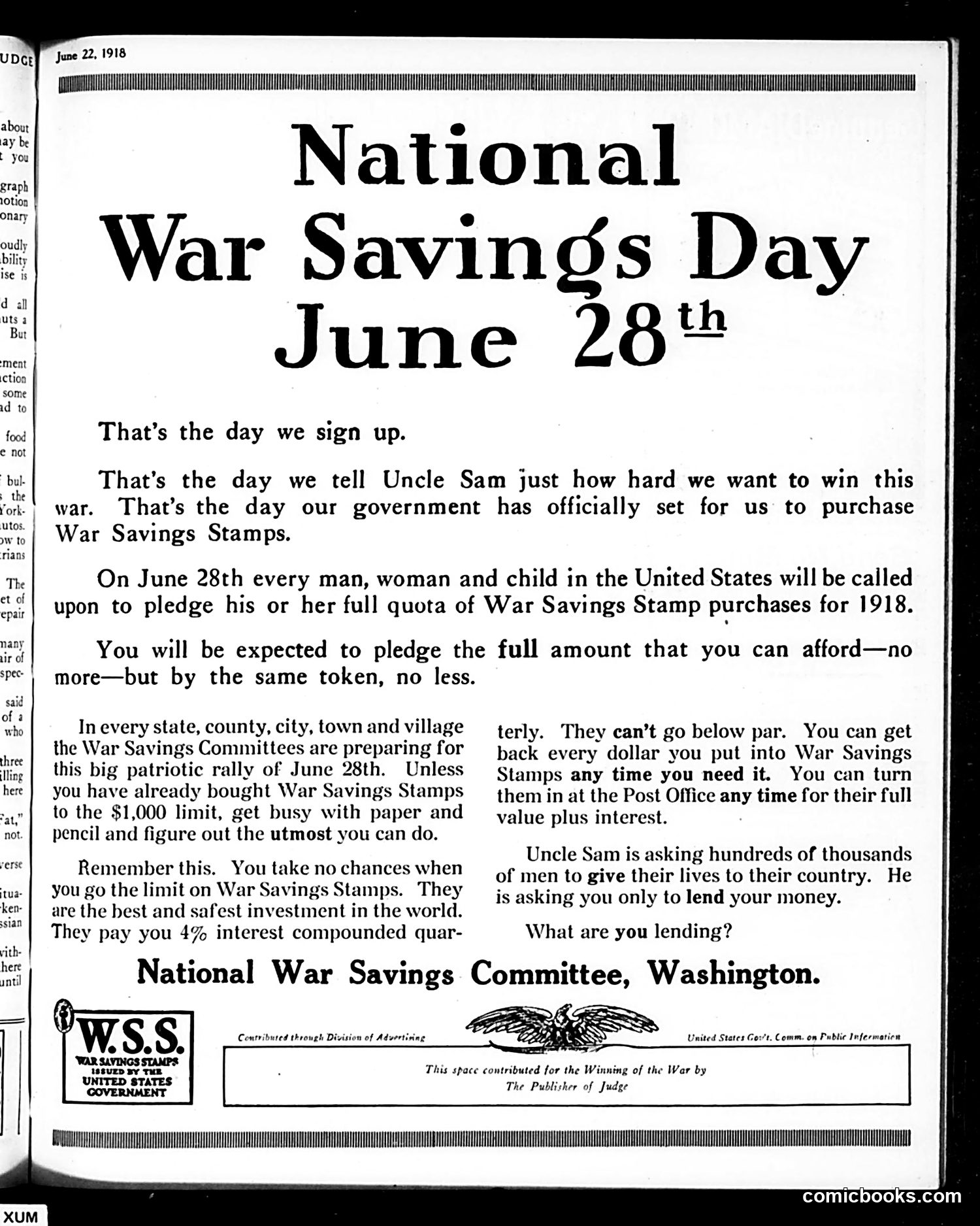
This is a government propaganda advertisement, not satire, published during World War I. It announces June 28th as "National War Savings Day"—a coordinated national campaign to pressure Americans into purchasing War Savings Stamps (bonds). The appeal uses patriotic rhetoric and emotional manipulation: it frames buying stamps as supporting soldiers who are "giving their lives," positioning financial contributions as a moral obligation. The advertisement emphasizes the investment is "safe" (4% interest, redeemable at post offices), attempting to overcome public hesitation. The phrase "What are you lending?" is the key rhetorical move—reframing compulsory financial pressure as voluntary patriotic duty. Local "War Savings Committees" would organize the "rally" to ensure widespread participation, suggesting social coercion was built into the campaign structure. Published in *Judge* (a humor magazine), this appears as serious wartime messaging rather than satirical content.
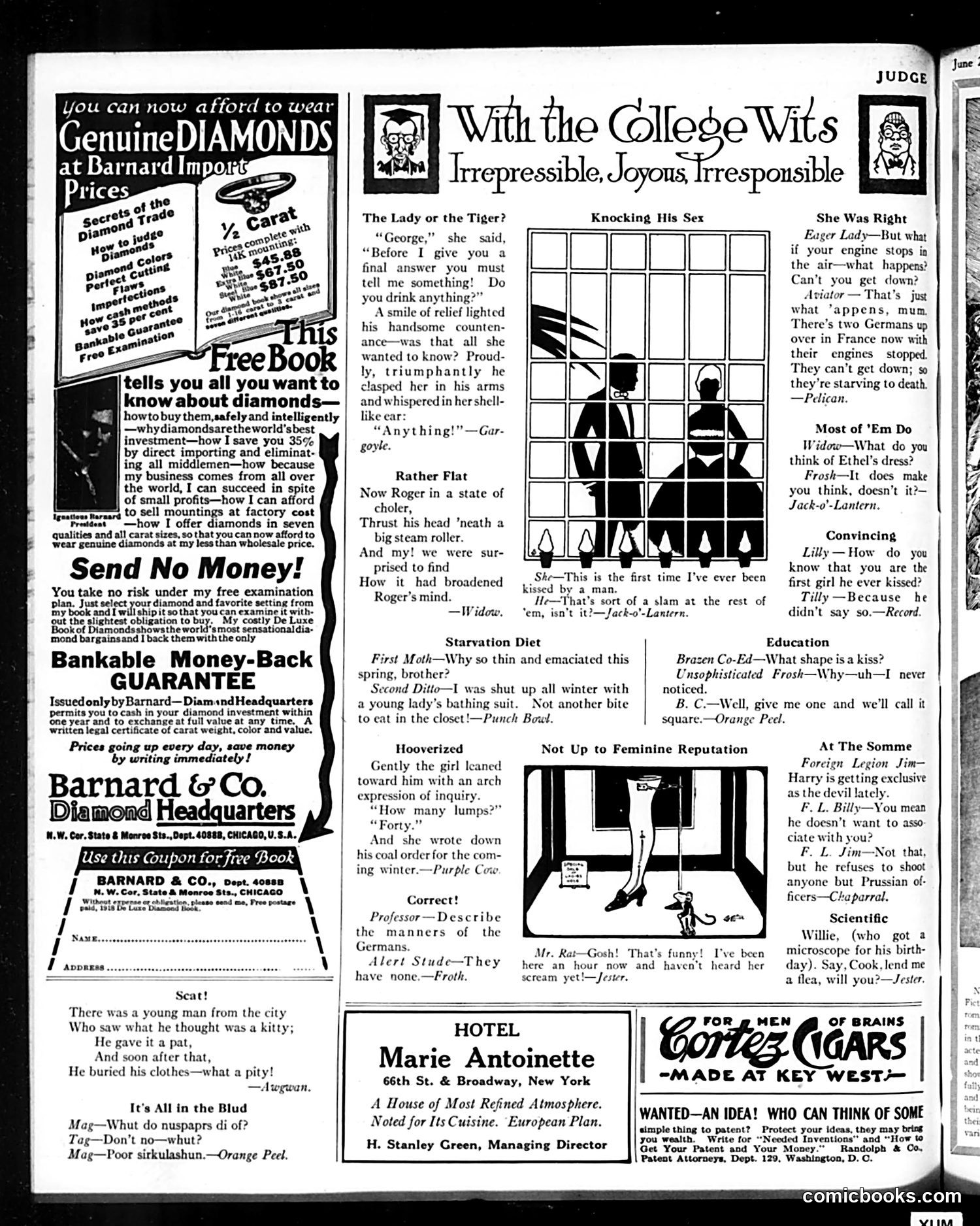
This is primarily a **diamond advertisement page** with decorative humor scattered throughout—typical of Judge's format mixing commerce with jokes. The main content is a Barnard & Co. diamond advertisement using aggressive sales tactics: promising 35% savings through "direct importing," offering risk-free examination, and emphasizing a "Money-Back GUARANTEE." This reflects early 20th-century mail-order commerce. The surrounding humor includes: - Short jokes about courtship and romance ("The Lady or the Tiger?") - A "Hooverized" joke referencing wartime rationing under President Hoover - Aviation humor about WWI ("two Germans up over in France") - Puns and absurdist comedy typical of the era The cartoons show young couples in dating scenarios—standard Judge content. One comic strip uses a grid format showing romantic interaction. The **political/social context**: These pieces reflect 1920s concerns (WWI aftermath, rationing memories, courtship customs) alongside consumer culture's rise. The ads and jokes together illustrate how magazines monetized leisure reading while maintaining entertainment value for advertisers' target audience—relatively affluent American men.
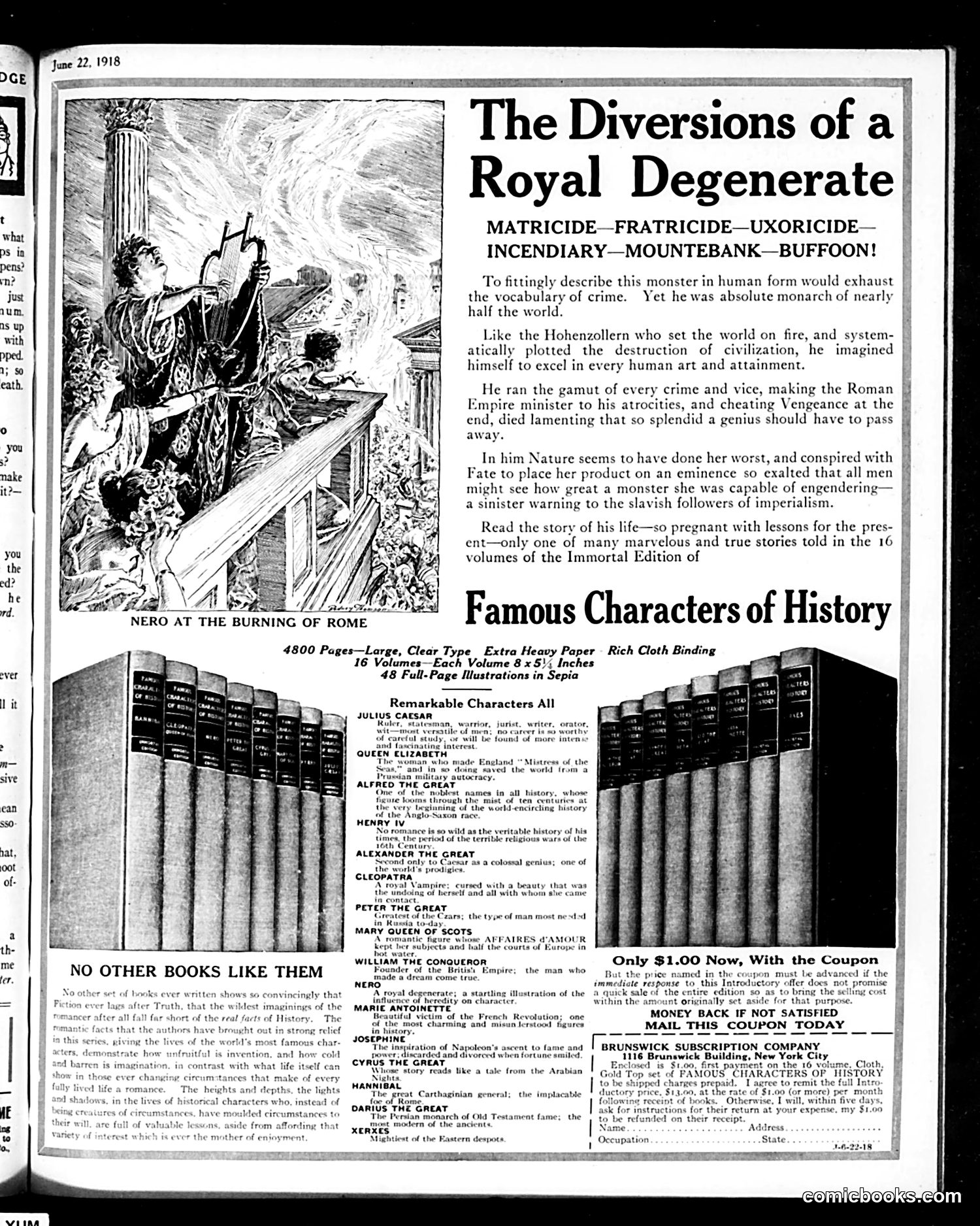
This page advertises a 16-volume book series called *Famous Characters of History*. The main illustration depicts **Nero at the Burning of Rome**—a historical reference to the Roman emperor infamous for alleged atrocities. The text's pointed language—calling him a "royal degenerate" guilty of "matricide, fratricide, uxoricide, incendiary" crimes—uses Nero as a cautionary tale. The editorial voice explicitly states the story serves as "a sinister warning to the slavish followers of imperialism." **The satire's target**: Given the 1918 date (near WWI's end), this appears to critique imperial autocracy broadly, likely comparing historical tyrants to contemporary monarchs. The book series leverages public appetite for sensational historical narratives while framing such stories as moral instruction against authoritarian excess. The advertisement is primarily commercial, but the framing of Nero's tale as a warning against imperialism suggests contemporary political commentary embedded in the book promotion.
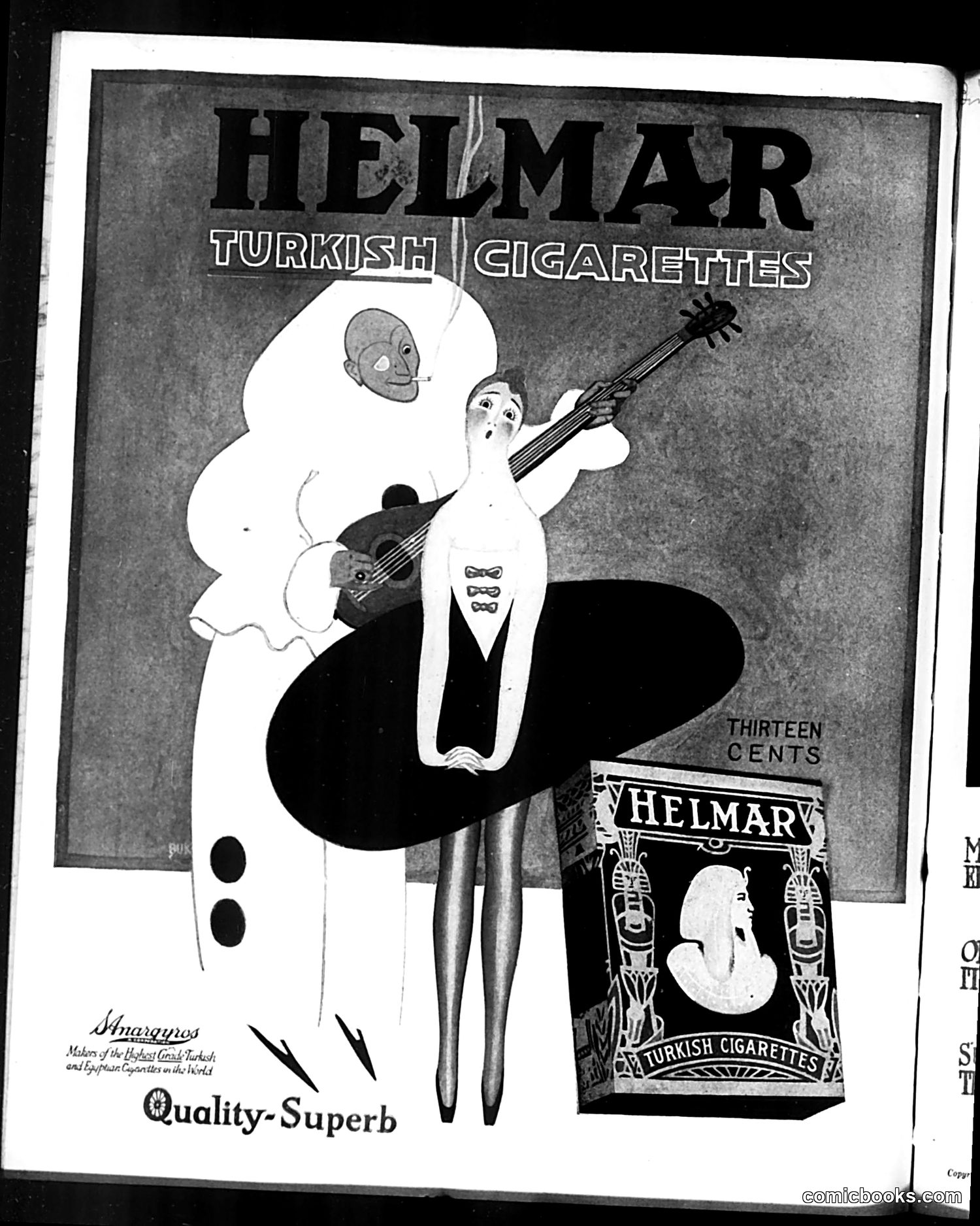
This is a cigarette advertisement for Helmar Turkish Cigarettes, priced at thirteen cents. The ad features an Art Deco-style illustration of a fashionable woman in white clothing with a large black hat, holding a violin. A skeleton's head appears behind/above her shoulder, and she displays a somewhat knowing expression. The skeleton imagery likely plays on the period's ironic or darkly humorous advertising aesthetics. The woman's sophisticated pose with the violin suggests cultural refinement and elegance—qualities cigarette manufacturers marketed to appeal to upscale consumers, particularly women. The "Quality-Superb" tagline emphasizes premium positioning. This reflects early-20th-century advertising practices before health warnings, when cigarettes were marketed as sophisticated lifestyle products associated with cosmopolitan culture and refined taste.