
Judge, 1918-06-22 · page 16 of 36
Judge — June 22, 1918 — page 16: what you’re looking at
What you’re looking at
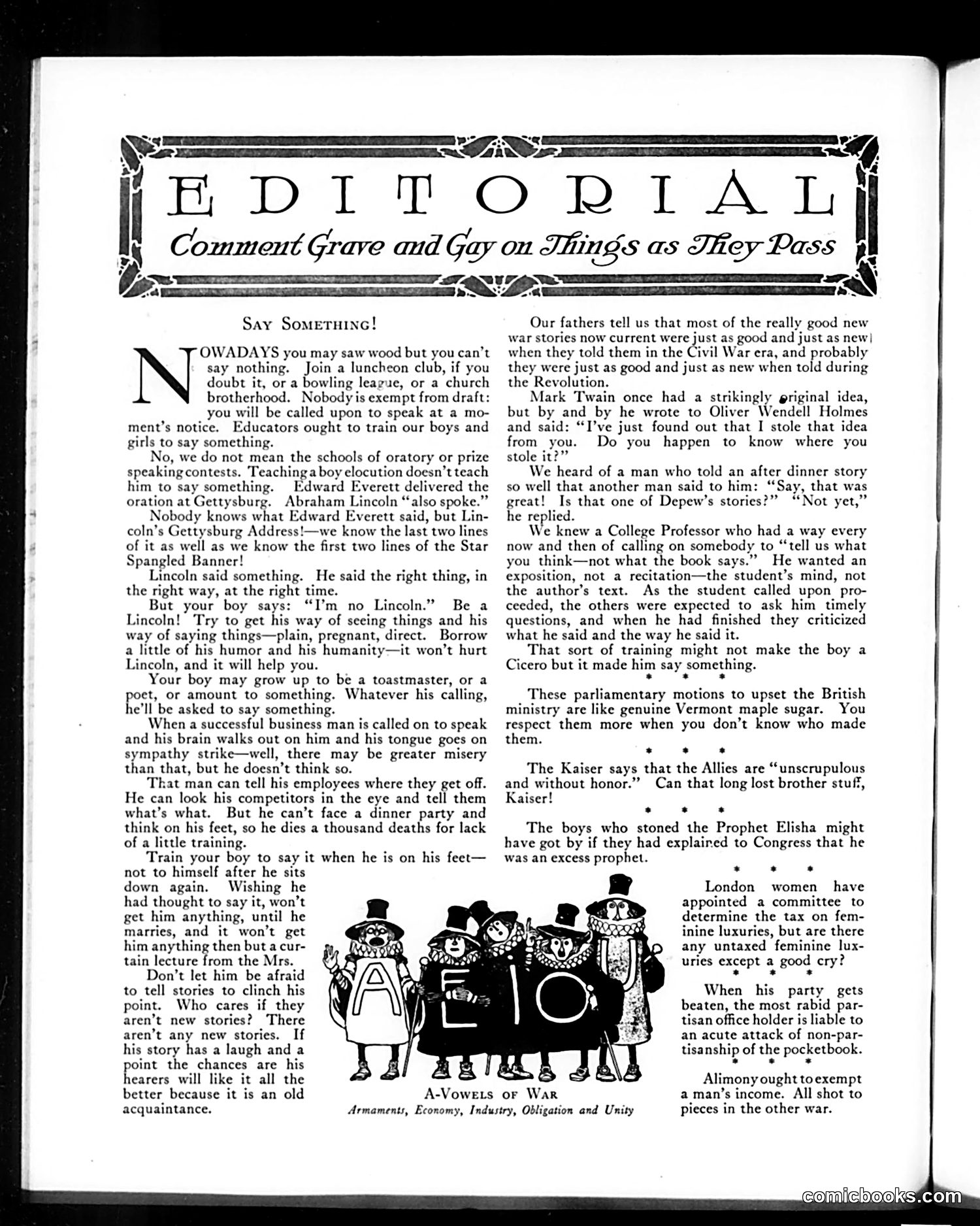
This editorial page from Judge magazine addresses public speaking during World War I. The main article, "Say Something!", urges parents to train boys in effective communication—citing Lincoln's Gettysburg Address as an exemplary model of substance over oratory flourish. The piece emphasizes practical speech skills for everyday situations: business, social gatherings, and civic participation. The accompanying cartoon, "A-Vowels of War," depicts five figures labeled **Armaments, Economy, Industry, Obligation, and Unity**—representing the five pillars the U.S. government promoted as essential to wartime mobilization. This visual metaphor suggests these concepts are fundamental "vowels" (basic building blocks) of the war effort. The editorial's emphasis on training youth to "say something" reflects broader WWI-era concerns about civic duty and national mobilization. Additional satirical commentary mocks British parliamentary procedures and the German Kaiser's characterization of the Allies. The page reflects America's wartime messaging priorities circa 1917-1918.
📄 Transcribed text from this page (OCR, searchable)
Machine-transcribed from the original scan — historical spelling and the odd misread are preserved.
oa ee je DITORIAL , Comment Grave and Gay on Things as They Pass 5 Tx. Say Sometuinc! OWADAYS you may saw wood but you can’t say nothing. Join a luncheon club, if you doubt it, or a bowling league, or a church brotherhood. Nobody is exempt from draft: you will be called upon to speak at a mo- ment’s notice. Educators ought to train our boys and girls to say something. No, we do not mean the schools of oratory or prize speaking contests. Teaching a boy elocution doesn’t teach him to say something. Edward Everett delivered the oration at Gettysburg. Abraham Lincoln “also spoke.” Nobody knows what Edward Everett said, but Lin- coln’s Gettysburg Address!—we know the last two lines of it as well as we know the first two lines of the Star Spangled Banner! Lincoln said something. He said the right thing, in the right way, at the right time. But your boy says: “I’m no Lincoln.” Be a Lincoln! Try to get his way of seeing things and his way of saying things—plain, pregnant, direct. Borrow a little of his humor and his humanity—it won’t hurt Lincoln, and it will help you. Your boy may grow up to be a toastmaster, or a et, Or amount to something. Whatever his calling, e’ll be asked to say something. When a successful business man is called on to speak and his brain walks out on him and his tongue goes on sympathy strike—well, there may be greater misery than that, but he doesn’t think so. That man can tell his employees where they get off. He can look his competitors in the eye and tell them what’s what. But he can’t face a dinner party and think on his feet, so he dies a thousand deaths for lack of a little training. Train your boy to say it when he is on his feet— not to himself after he sits down again. Wishing he had thought to say it, won’t get him anything, until he marries, and it won’t get him anything then but a cur- tain lecture from the Mrs. Don’t let him be afraid to tell stories to clinch his point. Who cares if they aren’t new stories? There aren’t any new stories. If his story has a laugh and a point the chances are his hearers will like it all the better because it is an old acquaintance. NY A-Vowets or War Armaments, Economy, Industry, Obligation and Unity = AAO. =A Our fathers tell us that most of the really good new war stories now current were just as good and just as new| when they told them in the Civil War era, and probably they were just as good and just as new when told during the Revolution. Mark Twain once had a strikingly griginal idea, but by and by he wrote to Oliver Wendell Holmes and said: “I’ve just found out that I stole that idea from you. Do you happen to know where you stole it?” We heard of a man who told an after dinner story so well that another man said to him: “Say, that was great! Is that one of Depew’s stories?” ‘‘Not yet,” he replied. We knew a College Professor who had a way every now and then of calling on somebody to “tell us what you think—not what the book says.” He wanted an exposition, not a recitation—the student’s mind, not the author’s text. As the student called upon pro- ceeded, the others were expected to ask him timely questions, and when he had finished they criticized what he said and the way he said it. That sort of training might not make the boy a Cicero but it made him say something. * e * These parliamentary motions to upset the British ministry are like genuine Vermont maple sugar. You respect them more when you don’t know who made them. * * «8 The Kaiser says that the Allies are “unscrupulous and without honor.” Can that long lost brother stuf, Kaiser! * * * The boys who stoned the Prophet Elisha might have got by if they had explained to Congress that he was an excess prophet. * * * London women have appointed a committee to determine the tax on fem- inine luxuries, but are there any untaxed feminine lux- uries except a good cry? . + * When his party gets beaten, the most rabid par- tisan office holder is liable to an acute attack of non-par- tisanship of the pocketbook. * . * Alimony ought toexempt aman’s income. All shot to pieces in the other war.