
Judge, 1918-06-22 · page 5 of 36
Judge — June 22, 1918 — page 5: what you’re looking at
What you’re looking at
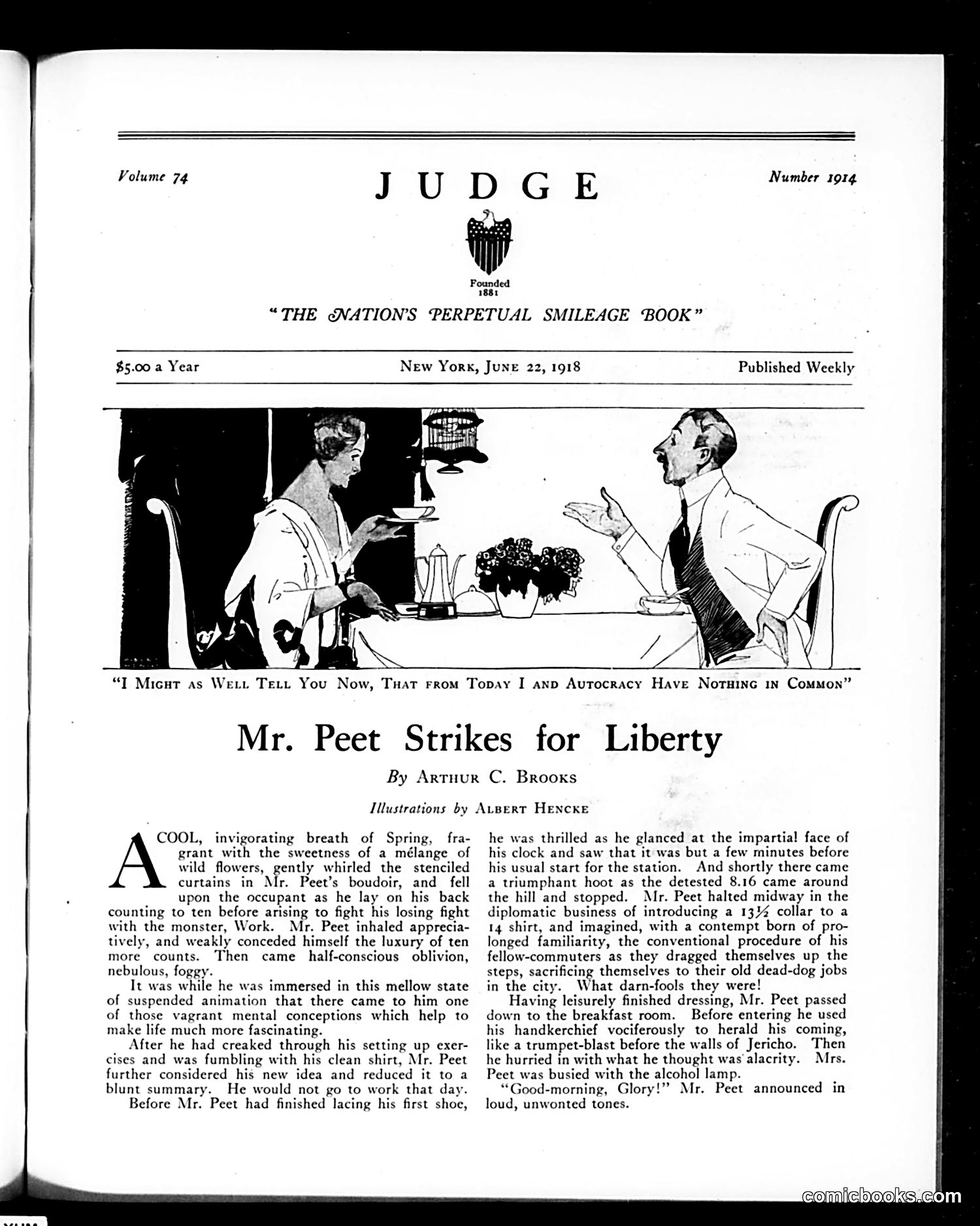
The cartoon illustrates "Mr. Peet Strikes for Liberty," a story by Arthur C. Brooks. The illustration shows a man and woman in an interior scene with the caption: "I Might as Well Tell You Now, That from Today I and Autocracy Have Nothing in Common." The satire appears to reference World War I-era themes. "Autocracy" likely refers to German imperial rule, while "Mr. Peet" represents an everyman American rejecting authoritarian systems. The domestic setting—where a man declares independence from autocracy to a woman—suggests the story uses personal liberty as a metaphor for America's broader rejection of autocratic government during WWI, when the U.S. entered the war partly framed as opposing imperial autocracy.
📄 Transcribed text from this page (OCR, searchable)
Machine-transcribed from the original scan — historical spelling and the odd misread are preserved.
Volume 74 JUDGE Number 1914 Founded 1881 “THE NATION'S PERPETUAL SMILEAGE BOOK” $5.00 a Year New York, June 22, 1918 Published Weekly “I Micut as Wett Teri You Now, Tuat rrom Topay I anp Autocracy Have Norsinc in Common” ? Mr. Peet Strikes for Liberty By Artuur C. Brooxs Illustrations by Aupert HeNcKE COOL, invigorating breath of Spring, fra- grant with the sweetness of a mélange of wild flowers, gently whirled the stenciled curtains in Mr. Peet’s boudoir, and fell upon the occupant as he lay on his back counting to ten before arising to fight his losing fight with the monster, Work. Mr. Peet inhaled apprecia- tively, and weakly conceded himself the luxury of ten more counts. Then came _half-conscious oblivion, nebulous, foggy. It was while he was immersed in this mellow state of suspended animation that there came to him one of those vagrant mental conceptions which help to make life much more fascinating. After he had creaked through his setting up exer- cises and was fumbling with his clean shirt, Mr. Peet further considered his new idea and reduced it to a blunt summary. He would not go to work that day. Before Mr. Peet had finished lacing his first shoe, he was thrilled as he glanced at the impartial face of his clock and saw that it was but a few minutes before his usual start for the station. And shortly there came a triumphant hoot as the detested 8.16 came around the hill and stopped. Mr. Peet halted midway in the diplomatic business of introducing a 13% collar to a 14 shirt, and imagined, with a contempt born of pro- longed familiarity, the conventional procedure of his fellow-commuters as they dragged themselves up the steps, sacrificing themselves to their old dead-dog jobs in the city. What darn-fools they were! Having leisurely finished dressing, Mr. Peet passed down to the breakfast room. Before entering he used his handkerchief vociferously to herald his coming, like a trumpet-blast before the walls of Jericho. Then he hurried in with what he thought was'alacrity. Mrs. Peet was busied with the alcohol lamp. “‘Good-morning, Glory!” Mr. Peet announced in loud, unwonted tones.