
Judge, 1918-06-22 · page 19 of 36
Judge — June 22, 1918 — page 19: what you’re looking at
What you’re looking at
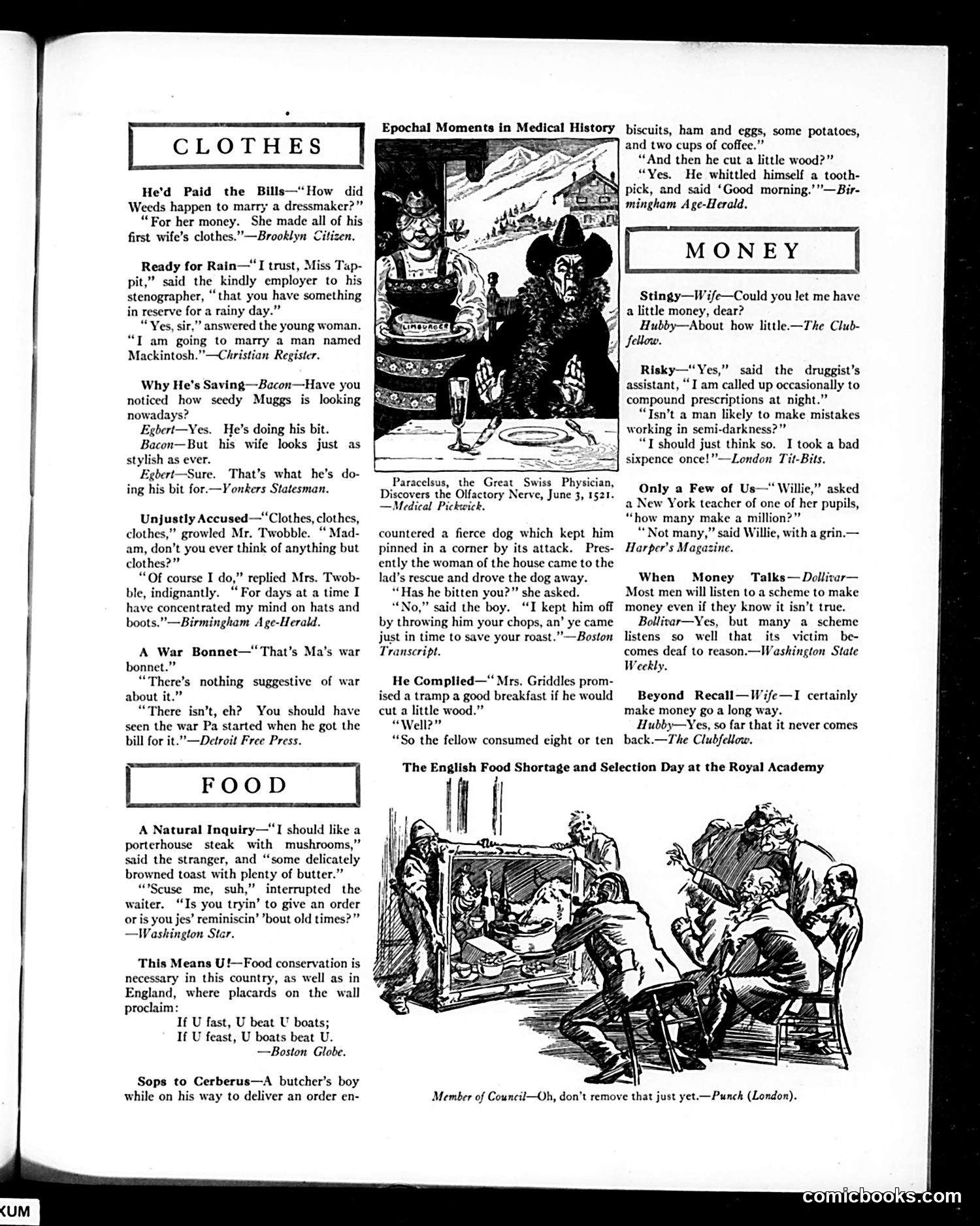
This page collects brief humorous anecdotes organized by topic (Clothes, Food, Money), typical of Judge's format. The jokes target early-20th-century domestic life and wartime conditions. **Key themes:** The **Clothes** section satirizes marriage and women's spending habits—wives marrying for money, husbands sacrificing to fund wives' fashions, and women obsessing over appearance. The **Food** section reflects **World War I rationing**. "This Means U!" references food conservation propaganda and German U-boats threatening food supplies. Other jokes mock wartime scarcity: a waiter questions whether a customer is ordering or reminiscing about pre-rationing meals; a tramp consumes an entire breakfast after promising to chop wood. The **Money** section mocks stingy husbands and wives' spending—standard marital humor. The **Medical History** cartoon appears decorative, unrelated to surrounding text. The **final illustration** shows the "Royal Academy" discussing food selection during England's shortage, reinforcing wartime deprivation as a contemporary concern. Overall, these are gentle domestic satires exploiting period anxieties about marriage finances and wartime hardship.
📄 Transcribed text from this page (OCR, searchable)
Machine-transcribed from the original scan — historical spelling and the odd misread are preserved.
] CLOTHES | He'd Paid the Bills—‘*How did Weeds happen to marry a dressmaker?” “For her money. She made all of his first wife’s clothes.”—Brooklyn Citizen. Ready for Rain—“I trust, Miss Tap- pit,” said the kindly employer to his stenographer, “that you have something in reserve for a rainy day.” “Yes, sir,” answered the young woman. “T am going to marry a man named Mackintosh.” —Christian Register. Why He's Saving—Bacon—Have you noticed how seedy Muggs is looking nowadays? Egbert—Yes. He's doing his bit. Bacon—But his wife looks just as stylish as ever. Egbert—Sure. That’s what he’s do- ing his bit for.—Yonkers Statesman. Unjustly Accused—‘‘Clothes, clothes, clothes,” growled Mr. Twobble. “‘ Mad- am, don’t you ever think of anything but clothes?” “Of course I do,” replied Mrs. Twob- ble, indignantly. “For days at a time I have concentrated my mind on hats and boots.”—Birmingham A ge-Herald. A War Bonnet—“That’s Ma’s war bonnet.” “There’s nothing suggestive of war about it.” “There isn’t, ch? You should have seen the war Pa started when he got the bill for it.” —Detroit Free Press. | FOOD A Natural Inquiry—‘I should like a porterhouse steak with mushrooms,” said the stranger, and “some delicately browned toast with plenty of butter.” “’Scuse me, suh,” interrupted the waiter. “Is you tryin’ to give an order or is you jes’ reminiscin’ ’bout old times?” —Washington Star. This Means U!—Food conservation is necessary in this country, as well as in England, where placards on the wall proclaim: If U fast, U beat U boats; If U feast, U boats beat U. —Boston Globe. Sops to Cerberus—A butcher’s boy while on his way to deliver an order en- Epochal Moments in Medical History Paracelsus, the Great Si Discovers the Olfactory Nerve, June 3, 1521. —Medical Pickwick. countered a fierce dog which kept him pinned in a corner by its attack. Pres- ently the woman of the house came to the lad’s rescue and drove the dog away. “Has he bitten you?” she asked. “No,” said the boy. “I kept him off by throwing him your chops, an’ ye came just in time to save your roast.”"—Boston Transcript. He Complied—“ Mrs. Griddles prom- ised a tramp a good breakfast if he would cut a little wood.” “Well?” “So the fellow consumed eight or ten The English Food Shortage and Selection Day at the Royal Academy Member of Council—Oh, don’t remove that just yet.—Punch (London). biscuits, ham and eggs, some potatoes, and two cups of coffee.” “And then he cut a little wood?” “Yes. He whittled himself a tooth- pick, and said ‘Good morning.’”—Bir- mingham A ge-Herald. MONEY Stingy—W ife—Could you let me have a little money, dear? Hubby—About how little —The Club- fellow. Risky—‘‘Yes,” said the druggist’s assistant, “I am called up occasionally to compound prescriptions at night.” “Tsn’t a man likely to make mistakes working in semi-darkness?” “T should just think so. I took a bad sixpence once!”"—London Tit-Bits. Only a Few of Us—“ Willie,” asked a New York teacher of one of her pupils, “how many make a million?” “Not many,” said Willie, with a grin.— Harper's Magazine. When Money Talks— Dollivar— Most men will listen to a scheme to make money even if they know it isn’t true. Bollitar—Yes, but many a scheme listens so well that its victim be- comes deaf to reason.—Washington State Weekly. Beyond Recall—Wife—I certainly make money go a long way. Hubby—Yes, so far that it never comes back.—The Clubfellow.