
Judge, 1918-06-22 · page 17 of 36
Judge — June 22, 1918 — page 17: what you’re looking at
What you’re looking at
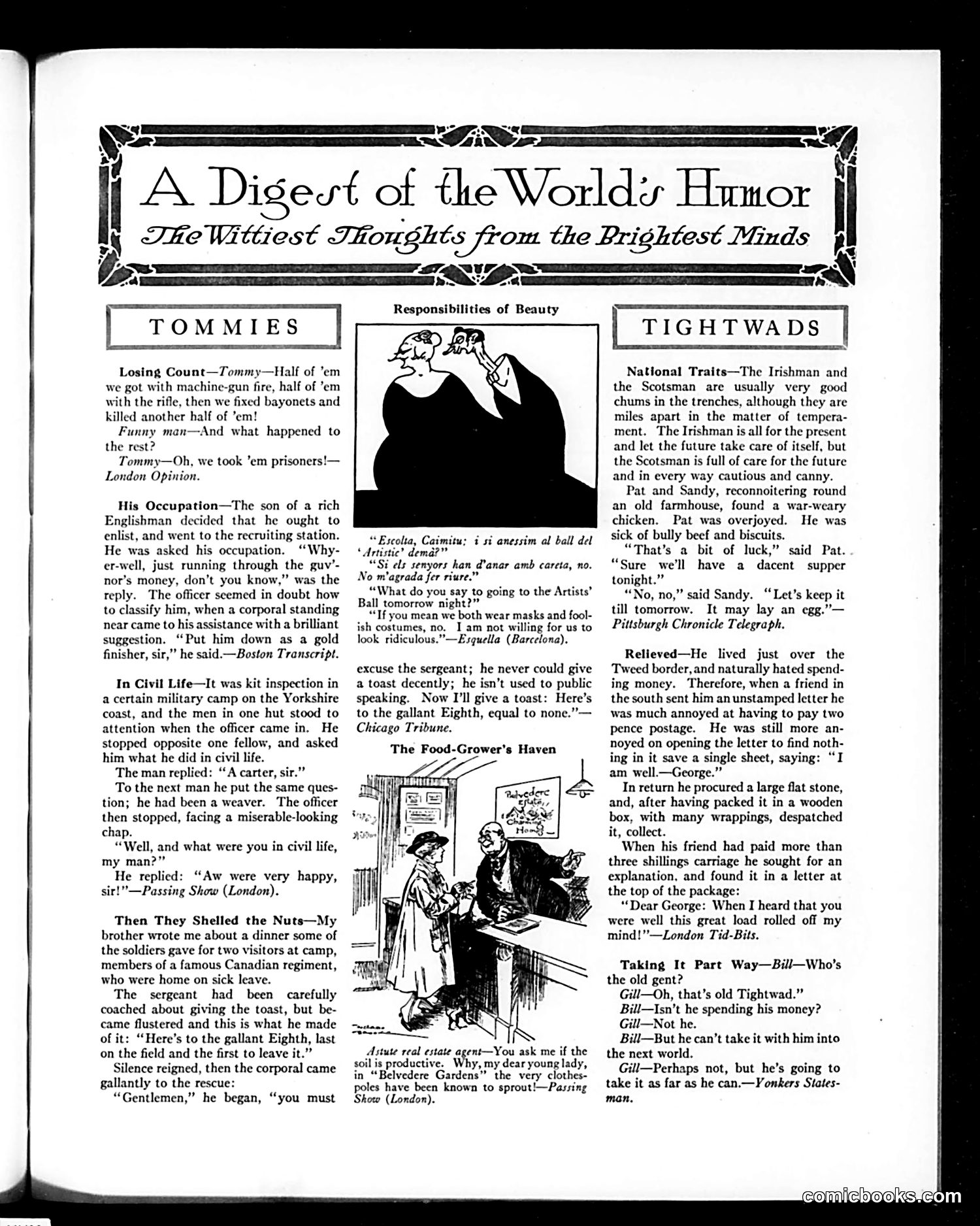
This page collects brief humorous anecdotes from WWI-era publications, grouped under "Tommies" (British soldiers) and "Tightwads" (misers). The **Tommies** section satirizes military life and recruitment. One joke plays on a soldier's absurdly inflated casualty count; another mocks a wealthy recruit whose only "occupation" is spending his father's money—classified as a "gold finisher" by a quick-thinking corporal. A third ridicules a sergeant's bungled toast at a regimental dinner, nearly insulting the honored guests before a corporal saves face. The **Tightwads** section contrasts Irish and Scottish temperaments (the Irishman wants immediate gratification from a found chicken; the Scot wants to keep it for eggs), and ends with a joke about a Scottish miser angered by paying postage on an unstamped letter containing only "I am well." The cartoon shows a food-grower's agent making an absurd sales pitch about productive soil. These are lightweight, accessible gags reflecting wartime attitudes and ethnic stereotypes typical of period humor magazines.
📄 Transcribed text from this page (OCR, searchable)
Machine-transcribed from the original scan — historical spelling and the odd misread are preserved.
y= A Digest of the Worldis lsbion | Ry The Wittiest Thoughts Ss from the Prightest Minds tx | TOMMIES Losing Count—Tommy—Half of ’em we got with machine-gun fire, half of ’em with the rifle, then we fixed bayonets and killed another half of ’em! Funny man—And what happened to the ? Tommy—Oh, we took ‘em prisoners!— London Opinion. His Occupation—The son of a rich Englishman decided that he ought to enlist, and went to the recruiting station. He was asked his occupation. ‘“Why- er-well, just running through the guv’- nor’s money, don’t you know,” was the reply. The officer seemed in doubt how to classify him, when a corporal standing near came to his assistance with a brilliant suggestion. “Put him down as a gold finisher, sir,” he said.—Boston Transcript. In Civil Life—It was kit inspection in a certain military camp on the Yorkshire coast, and the men in one hut stood to attention when the officer came in. He stopped opposite one fellow, and asked him what he did in civil life. The man replied: “A carter, sir.” To the next man he put the same ques- tion; he had been a weaver. The officer then stopped, facing a miserable-looking chap. Vell, and what were you in civil life, my man?” He replied: “Aw were very happy, sir!"—Passing Show (London). Then They Shelled the Nuts—My brother wrote me about a dinner some of the soldiers gave for two visitors at camp, members of a famous Canadian regiment, who were home on sick leave. The sergeant had been carefully coached about giving the toast, but be- came flustered and this is what he made of it: “Here's to the gallant Eighth, last on the field and the first to leave it.” Silence reigned, then the corporal came gallantly to the rescue: “Gentlemen,” he began, “you must “I; NTs ABS LE, ok NY jes an) Responsibilities of Beauty “Escolta, Caimitu; i si anessim al ball del * Artistic’ dema?”” “Si els senyors han d'anar amb careta, no. No m'agrada fer riure.” “What do you say to going to the Artists’ Ball tomorrow night?” “Tf you mean we both wear masks and fool- ish costumes, no. I am not willing for us to look ridiculous.”—Exsquella (Barcelona), excuse the sergeant; he never could give a toast decently; he isn’t used to public speaking. Now I'll give a toast: Here’s to the gallant Eighth, equal to none.” — Chicago Tribune. The Food-Grower'’s Haven Astute real estate ‘ ent—You ask me if the soil is productive. Why, my dear young lady, in “Belvedere Gardens” the very clothes- poles have been known to sprout!—Passing Show (London). ( zl | TIGHTWADS National Traits—The Irishman and the Scotsman are usually very good chums in the trenches, although they are miles apart in the matter of tempera- ment. The Irishman is all for the present and let the future take care of itself, but the Scotsman is full of care for the future and in every way cautious and canny. Pat and Sandy, reconnoitering round an old farmhouse, found a war-weary chicken. Pat was overjoyed. He was sick of bully beef and biscuits. “That’s a bit of luck,” said Pat. “Sure we'll have a dacent supper tonight.” “No, no,” said Sandy. “‘Let’s keep it till tomorrow. It may lay an egg.”— Pittsburgh Chronicle Telegraph. Relieved—He lived just over the Tweed border, and naturally hated spend- ing money. Therefore, when a friend in the south sent him an unstamped letter he was much annoyed at having to pay two pence postage. He was still more an- noyed on opening the letter to find noth- ing in it save a single sheet, saying: “I am well.—George.”” In return he procured a large flat stone, and, after having packed it in a wooden box, with many wrappings, despatched it, collect. When his friend had paid more than three shillings carriage he sought for an explanation, and found it in a letter at the top of the package: “Dear George: When I heard that you were well this great load rolled off my mind!"’—London Tid-Bits. Taking It Part Way—Bill—Who’s the old gent? Gill—Oh, that’s old Tightwad.” Bill—Isn’t he spending his money? Gill—Not he. Bill—But he can’t take it with him into the next world. Gill—Perhaps not, but he’s going to take it as far as he can.—Yonkers States- man.