
Judge, 1918-06-22 · page 24 of 36
Judge — June 22, 1918 — page 24: what you’re looking at
What you’re looking at
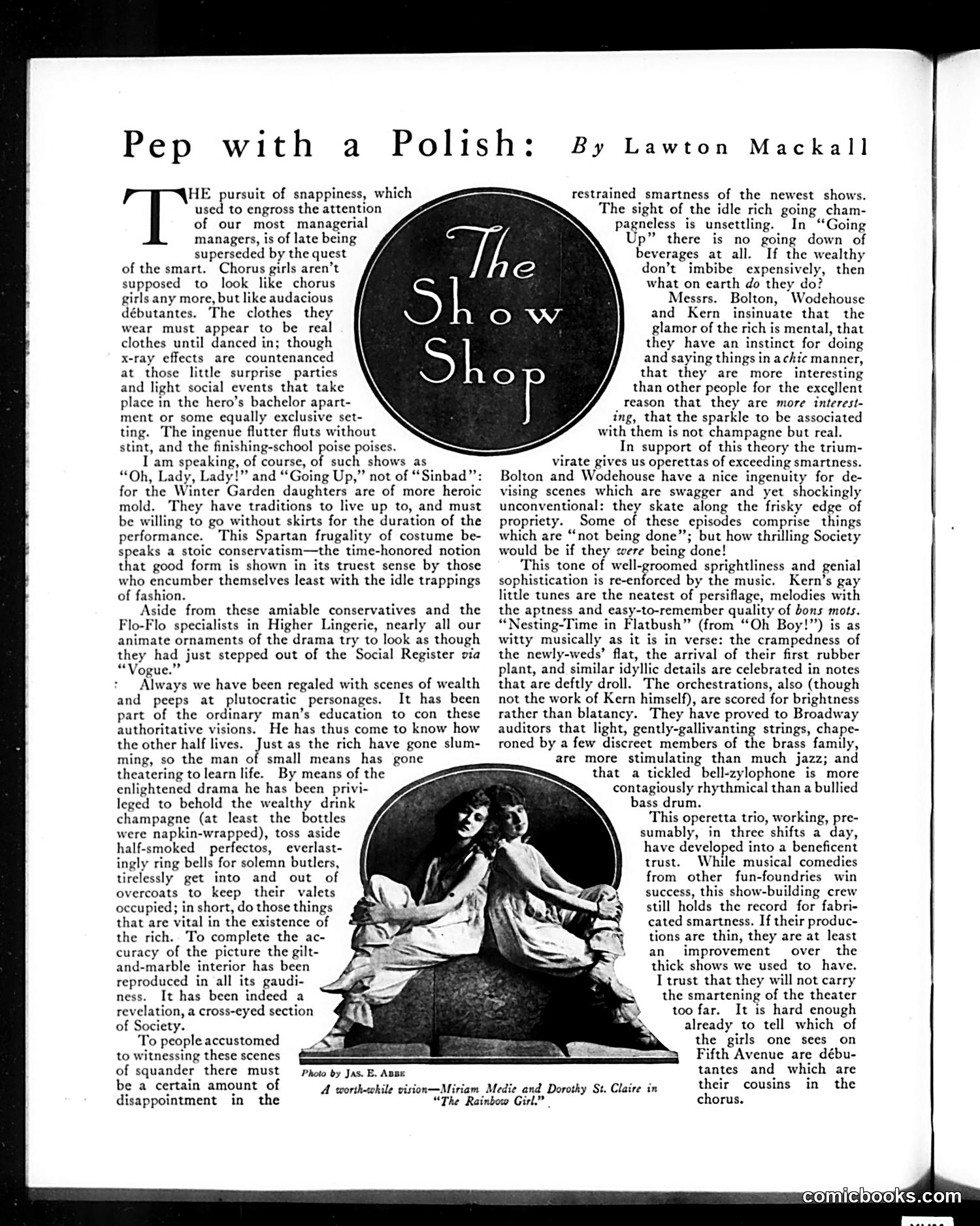
This essay by Lawton Mackall critiques how Broadway musicals are shifting their portrayal of wealth. Traditionally, shows depicted the rich through obvious luxury: champagne-drinking, bell-ringing for servants, marble interiors—allowing working-class audiences voyeuristic access to aristocratic excess. The "newest shows" (particularly those by Bolton, Wodehouse, and Kern, likely referencing *Going Up*) now present wealth differently: understated sophistication and "mental glamor" rather than conspicuous consumption. Mackall finds this disappointing—audiences expect spectacle, not restraint. The photograph shows performers from *The Rainbow Girl*, illustrating the "refined" aesthetic being discussed. The satire mocks both the new shows' attempt at elegant subtlety and audiences conditioned to expect extravagance. The point: Broadway is pretending the rich are *interesting* rather than merely *ostentatious*.
📄 Transcribed text from this page (OCR, searchable)
Machine-transcribed from the original scan — historical spelling and the odd misread are preserved.
Pep with a Polish: HE pursuit of snappiness, which used to engross the attention of our most managerial managers, is of late being superseded by the quest of the smart. Chorus girls aren’t supposed to look like chorus girls any more, but like audacious débutantes. The clothes they wear must appear to be real clothes until danced in; though x-ray effects are countenanced at those little surprise parties and light social events that take place in the hero’s bachelor apart- ment or some equally exclusive set- ting. The ingenue flutter fluts without stint, and the finishing-school poise poises. I am speaking, of course, of such shows as “Oh, Lady, Lady!” and “Going Up,” not of “Sinbad”: for the Winter Garden daughters are of more heroic mold. They have traditions to live up to, and must be willing to go without skirts for the duration of the performance. This Spartan frugality of costume be- speaks a stoic conservatism—the time-honored notion that good form is shown in its truest sense by those who encumber themselves least with the idle trappings of fashion. Aside from these amiable conservatives and the Flo-Flo specialists in Higher Lingerie, nearly all our animate ornaments of the drama try to look as though they had just stepped out of the Social Register ota “Vogue.” Always we have been regaled with scenes of wealth and peeps at plutocratic personages. It has been part of the ordinary man’s education to con these authoritative visions. He has thus come to know how the other half lives. Just as the rich have gone slum- ming, so the man of small means has gone theatering to learn life. By means of the enlightened drama he has been privi- leged to behold the wealthy drink champagne (at least the bottles were napkin-wrapped), toss aside half-smoked _perfectos, everlast- ingly ring bells for solemn butlers, tirelessly get into and out of overcoats to keep their valets occupied; in short, do those things that are vital in the existence of the rich. To complete the ac- curacy of the picture the gilt- and-marble interior has been reproduced in all its gaudi- ness. It has been indeed a revelation, a cross-eyed section of Society. To people accustomed to witnessing these scenes of squander there must be a certain amount of disappointment in the Photo by Jas. E. Anne A worthwhile vision—Miriam Medie and Dorothy St. Claire in “The Rainbow Girl.” By Lawton Mackall restrained smartness of the newest shows. The sight of the idle rich going cham- pagneless is unsettling. In “Going Up” there is no going down of beverages at all. If the wealthy don’t imbibe expensively, then what on earth do they do? Messrs. Bolton, Wodehouse and Kern insinuate that the glamor of the rich is mental, that they have an instinct for doing and saying things in achic manner, that they are more interesting than other people for the excgllent reason that they are more interest- ing, that the sparkle to be associated with them is not champagne but real. In support of this theory the trium- virate gives us operettas of exceeding smartness. Bolton and Wodehouse have a nice ingenuity for de- vising scenes which are swagger and yet shockingly unconventional: they skate along the frisky edge of propriety. Some of these episodes comprise things which are “not being done”; but how thrilling Society would be if they sere being done! This tone of well-groomed sprightliness and genial sophistication is re-enforced by the music. Kern’s gay little tunes are the neatest of persiflage, melodies with the aptness and easy-to-remember quality of bons mots. “Nesting-Time in Flatbush” (from “Oh Boy!”) is as witty musically as it is in verse: the crampedness of the newly-weds’ flat, the arrival of their first rubber plant, and similar idyllic details are celebrated in notes that are deftly droll. The orchestrations, also (though not the work of Kern himself), are scored for brightness rather than blatancy. They have proved to Broadway auditors that light, gently-gallivanting strings, chape- roned by a few discreet members of he brass family, are more stimulating than much jazz; and that a tickled bell-zylophone is more contagiously rhythmical than a bullied bass drum. This operetta trio, working, pre- sumably, in three shifts a day, have developed into a beneficent trust. While musical comedies from other fun-foundries win success, this show-building crew still holds the record for fabri- cated smartness. If their produc- tions are thin, they are at least an improvement over the thick shows we used to have. I trust that they will not carry the smartening of the theater too far. It is hard enough already to tell which of the girls one sees on Fifth Avenue are débu- tantes and which are their cousins in the chorus.