
A complete issue · 28 pages · 1918
Judge — January 5, 1918
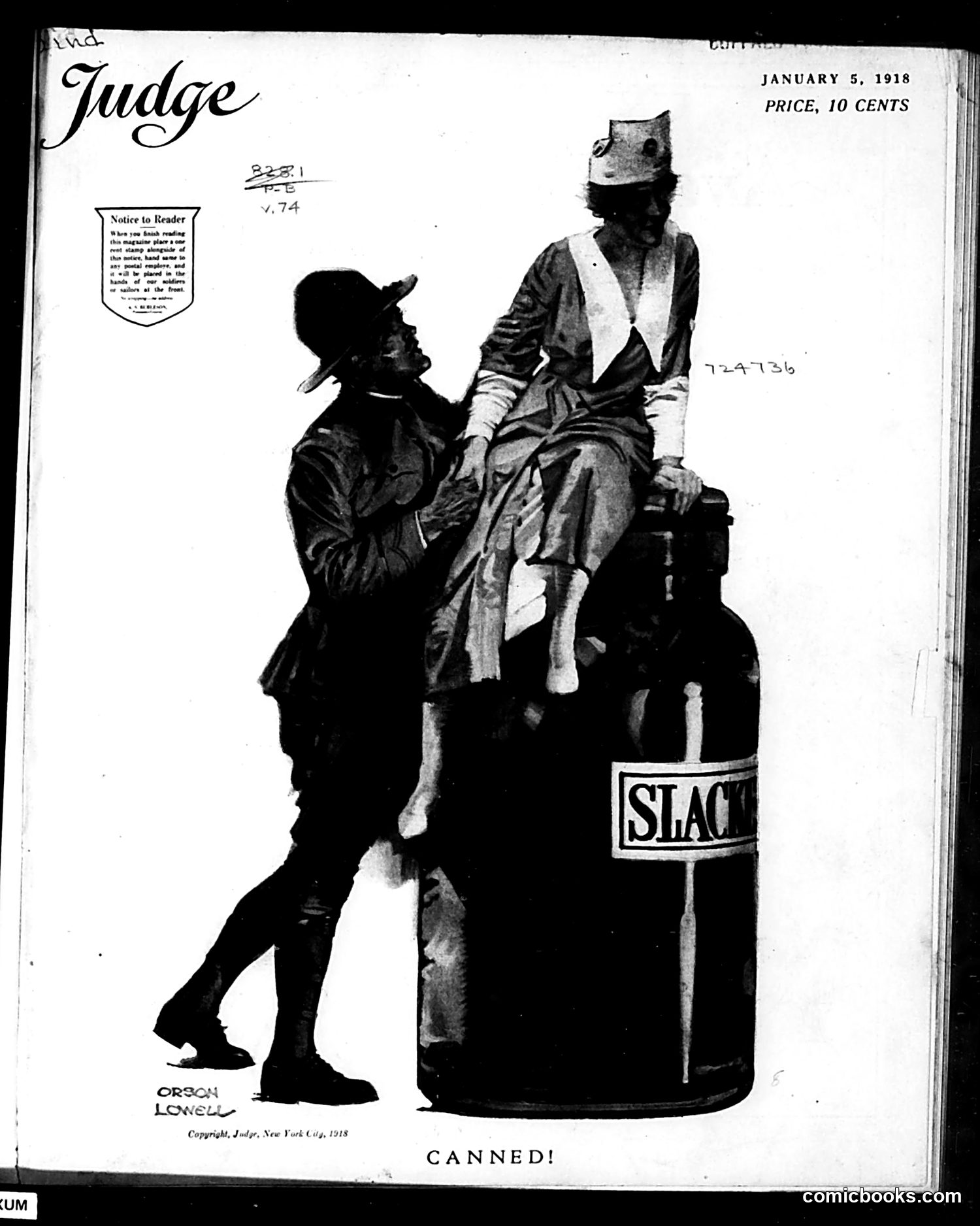
This cartoon by Orson Lowell satirizes wartime labor disputes or military discipline. A soldier (left) appears to be placing a woman into a large barrel labeled "SLACK" — the title "CANNED!" playing on the double meaning of being fired from a job or imprisoned/confined. The woman wears a nurse's or factory worker's uniform with a distinctive white headpiece, suggesting she's a war-effort worker. The cartoon likely critiques women accused of shirking wartime duties or "slacking" — contemporary slang for avoiding work during WWI. The canning imagery suggests swift, decisive punishment for those deemed insufficiently committed to the war effort. The satirical point remains somewhat ambiguous without additional context.
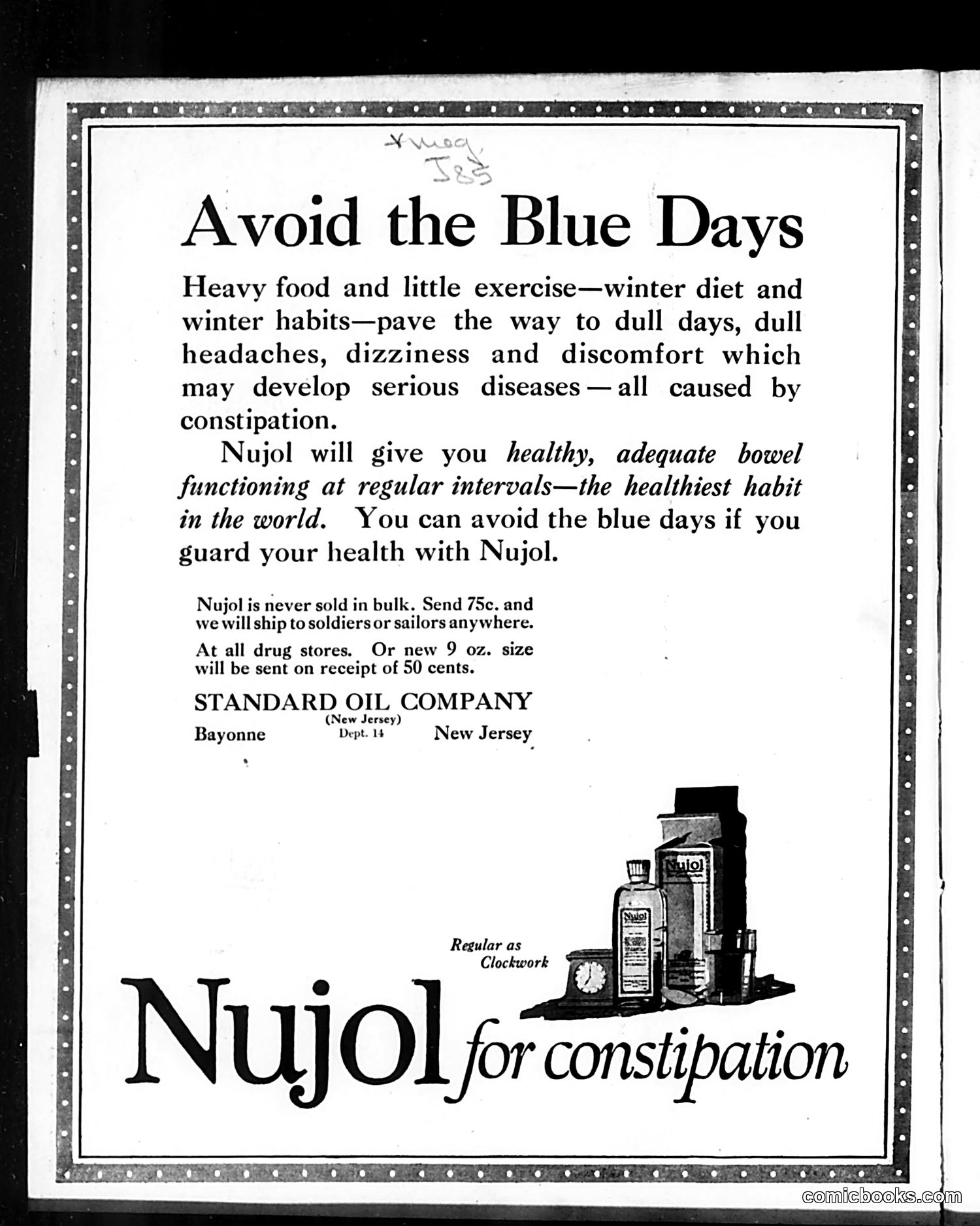
This is **not a cartoon or satire**—it's a straightforward **advertisement** for Nujol, a laxative product made by Standard Oil Company (New Jersey). The ad promotes Nujol as a remedy for constipation and related ailments like headaches and dizziness. The sales pitch claims that winter's "heavy food and little exercise" causes constipation, which leads to serious health problems. Nujol promises "healthy, adequate bowel functioning at regular intervals." The tagline "Regular as Clockwork" (shown with product bottles and a clock) uses wordplay to emphasize the product's regularity-promoting function. Pricing information indicates availability at drug stores or by mail order. This represents typical early-20th-century patent medicine advertising, before modern FDA regulations. The page contains no political content or satire.
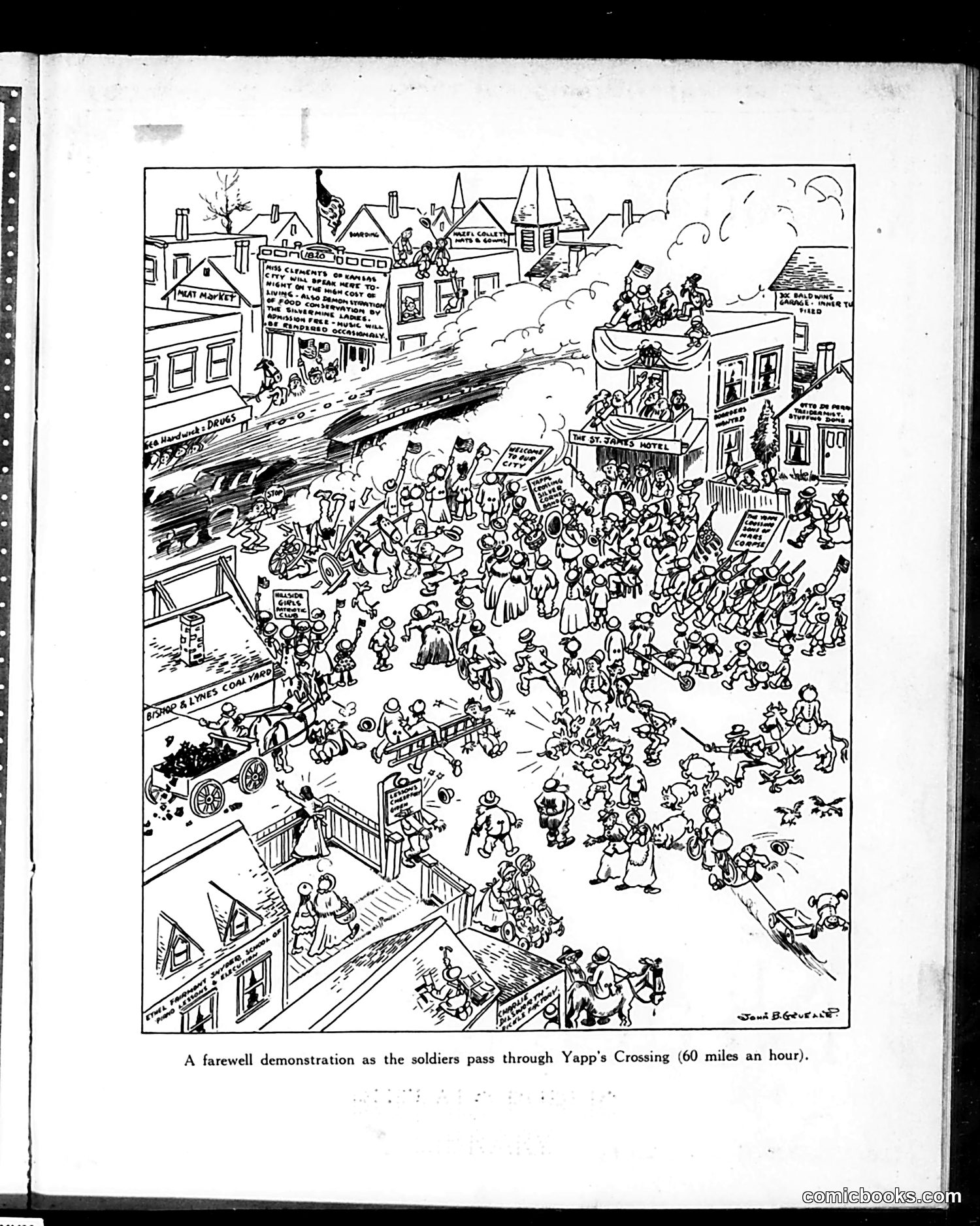
This cartoon depicts a crowded civilian farewell demonstration as soldiers pass through Yapp's Crossing at high speed (60 miles per hour). The detailed scene shows townspeople gathered along the railway route—some waving from buildings, platforms, and street level—to bid goodbye to departing troops. The satire likely comments on the enthusiasm (or chaos) of public military send-offs during wartime. The exaggerated crowds and frantic activity suggest both genuine patriotic fervor and the disruption caused by troop movements through civilian areas. The specific reference to "60 miles an hour" emphasizes the speed at which soldiers pass, making the emotional farewell somewhat absurd—people frantically demonstrating for troops moving too quickly to properly acknowledge them. The exact historical context remains unclear without additional dating information.
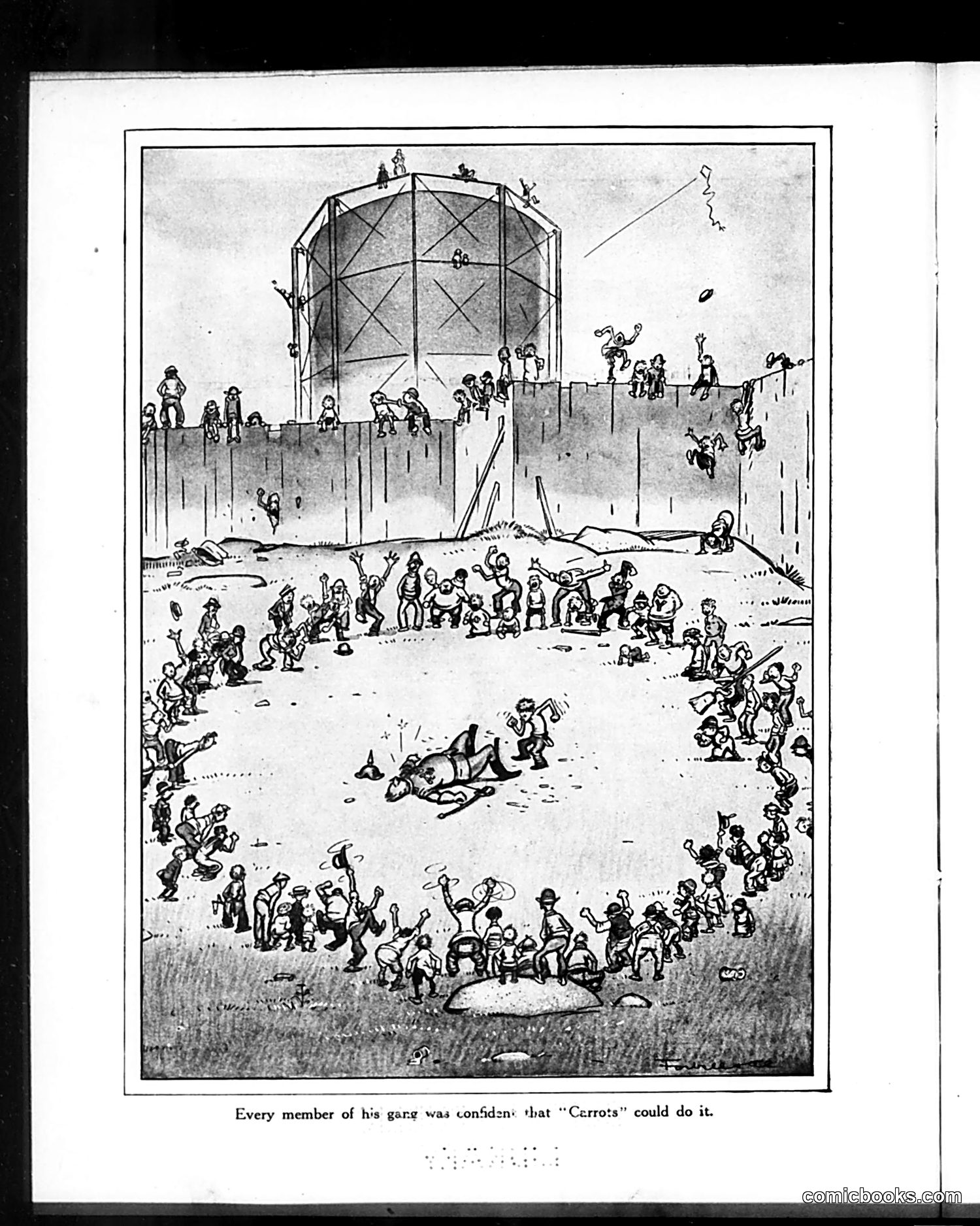
This cartoon depicts a circus or daredevil performance. A large crowd surrounds an arena where a performer (identified as "Cerro's" in the caption) lies on the ground, apparently having fallen or been thrown from a trapeze or similar apparatus suspended in the large structure above. The caption reads: "Every member of his gang was confident that 'Cerro's' could do it." The satire appears to mock overconfidence in a performer's abilities—the gang trusted "Cerro's" could execute a dangerous stunt, but the outcome suggests they were mistaken. The irony lies in the contrast between their certainty and the visible failure occurring before the assembled crowd. Without additional context, the specific identity of "Cerro's" or the date remains unclear, though this represents typical Judge magazine satire about human folly and misplaced confidence.
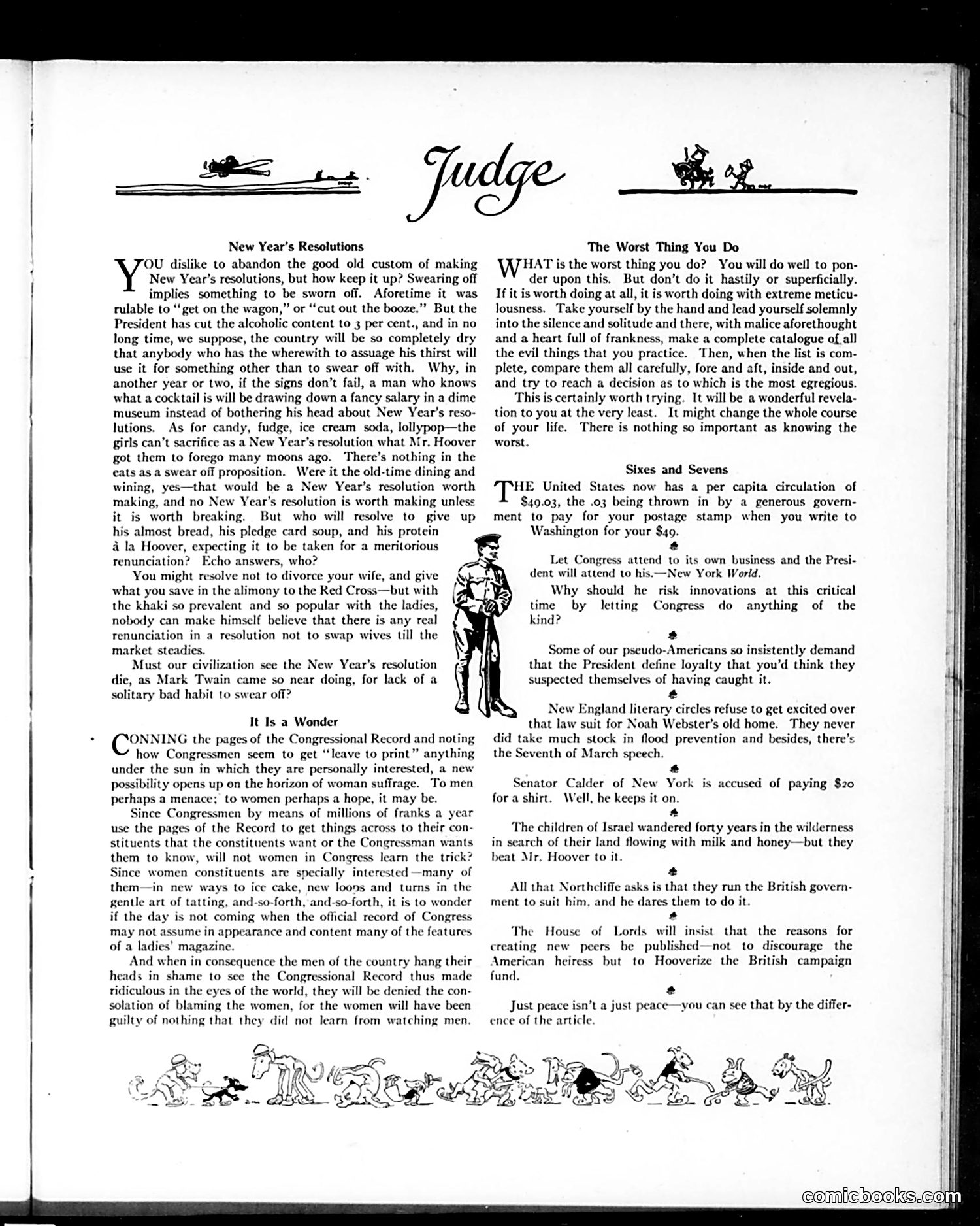
This page contains three satirical columns with social and political commentary: **"New Year's Resolutions"** mocks the impracticality of annual resolutions, particularly regarding alcohol prohibition (references to "getting on the wagon" and swearing off cocktails). The satire suggests such pledges are futile. **"The Worst Thing You Do"** advises self-examination of one's moral failings, advocating honest cataloging of personal evils rather than surface-level reform. **"Sixes and Sevens"** addresses contemporary political issues: Congressional inefficiency, women's suffrage advocacy, New England skepticism about Noah Webster's flood prevention theories, and accusations against Senator Calder. The column criticizes pseudo-Americans questioning presidential loyalty and comments on the British peerage's resistance to American heiresses marrying British peers. The illustrated footer contains generic comic figures in celebratory poses, likely humorous decoration rather than specific political caricatures.
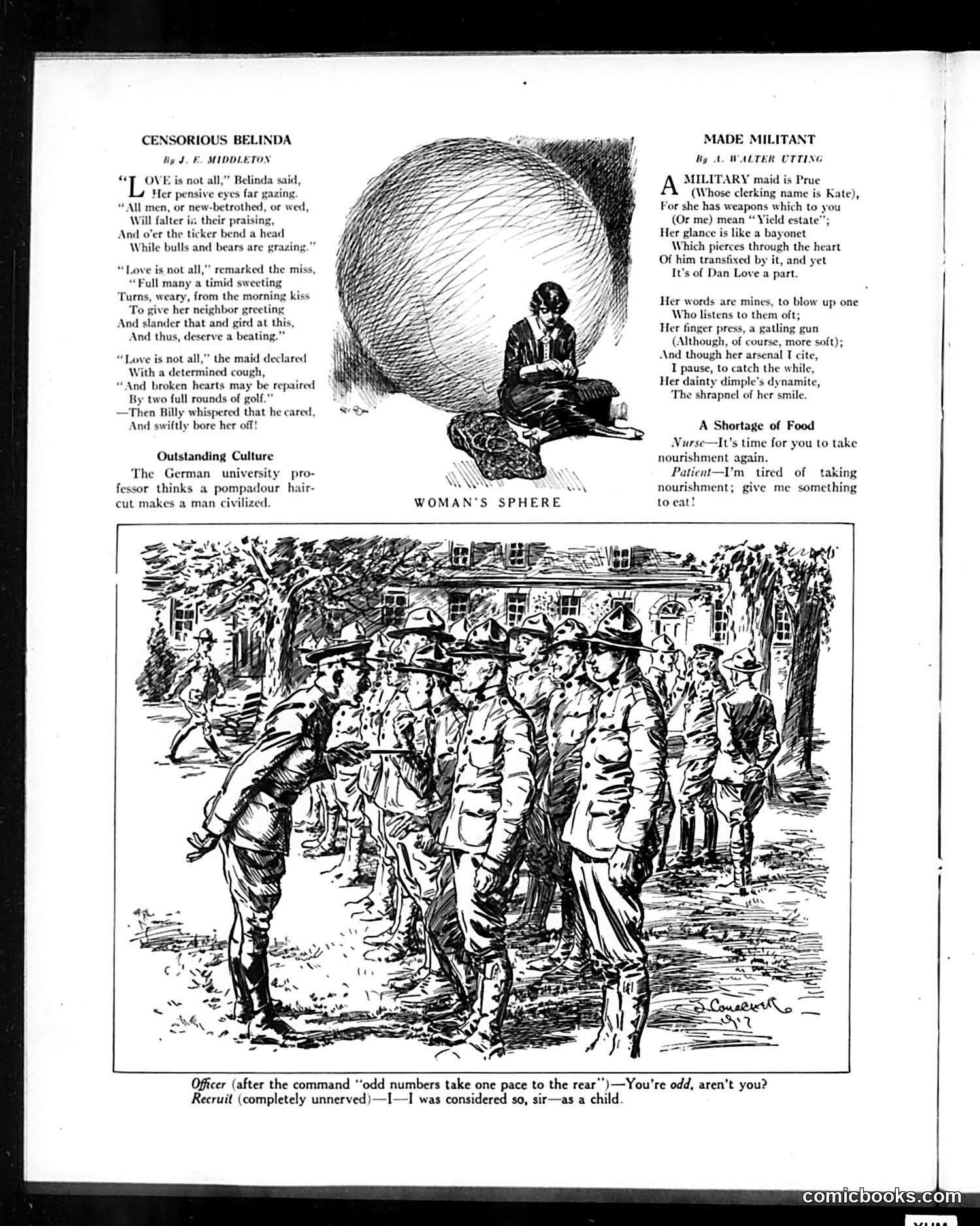
This page from *Judge* magazine contains three distinct pieces: **"Censorious Belinda"** (top left): A poem mocking a prudish woman who condemns love and romance while claiming moral superiority. The satire targets sanctimonious attitudes toward relationships. **"Made Militant"** (top right): A poem about a woman soldier, sarcastically praising her as fearsome—her words "blow up," her finger "a gatling gun." This appears to mock either female military recruitment or feminists adopting militant rhetoric, treating their advocacy as absurdly weaponized. **Bottom cartoon**: An officer commands "odd numbers take one pace to the rear," confusing a new recruit who considers himself "odd" as a child. The joke relies on the double meaning of "odd" (unusual versus mathematical), played for slapstick humor about military confusion. The page reflects early-20th-century attitudes skeptical of women's changing social roles.
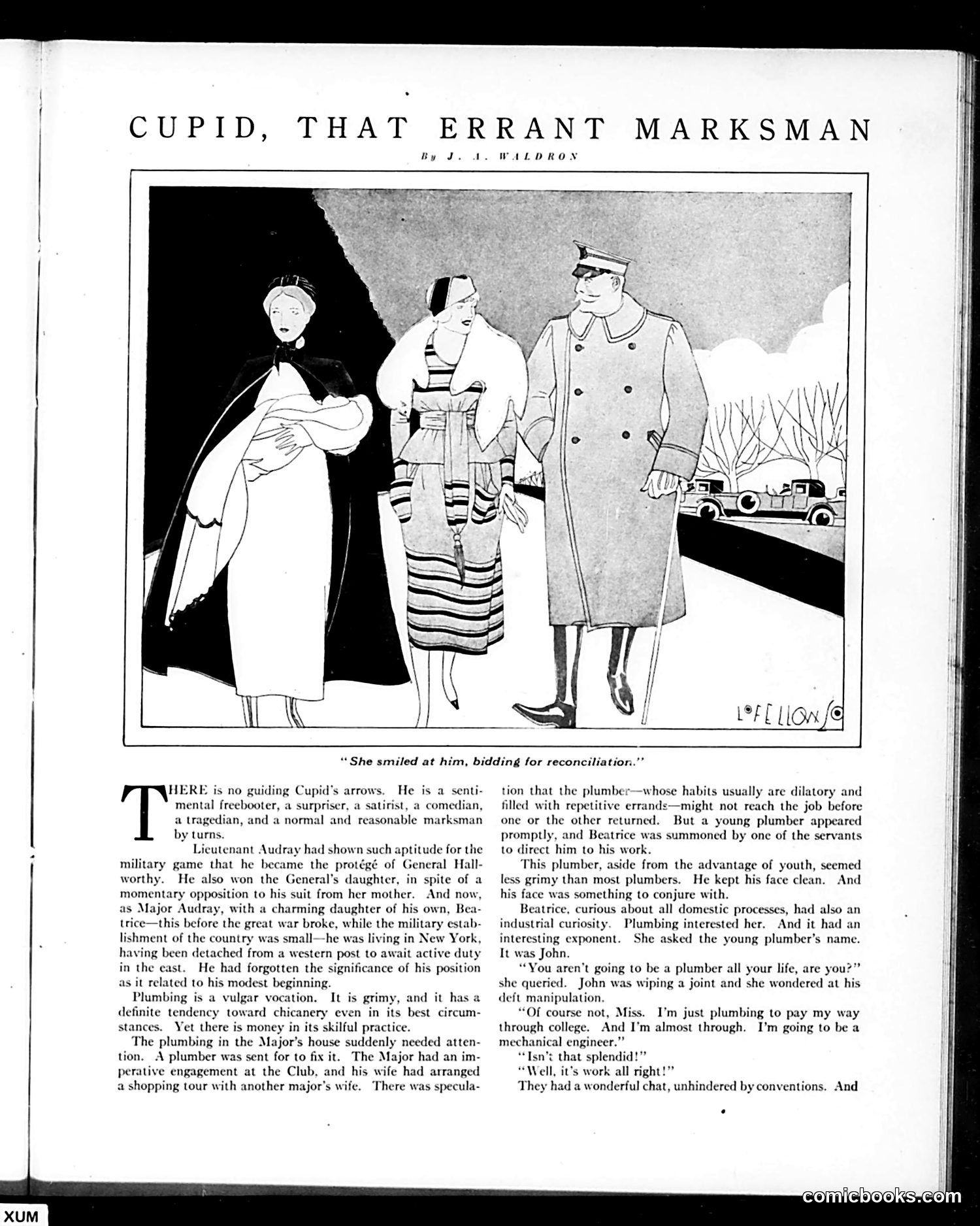
This story-cartoon satirizes romantic class barriers in early 20th-century America. Major Audray, now a gentleman officer, has forgotten his humble origins—his father was a plumber. When a young plumber arrives to fix his house plumbing, the Major's daughter Beatrice chats with him and finds him genteel and ambitious (studying to be a mechanical engineer). The satire's point: Cupid (love) doesn't respect social hierarchies. Despite the plumber's lowly trade, he's intelligent and respectable. Beatrice's friendly, unguarded conversation with him suggests romantic possibility—threatening to a family that has climbed socially and now looks down on plumbing as "vulgar." The "errant marksman" title implies Cupid's arrows will strike unpredictably, potentially uniting Beatrice with someone her snobbish parents would consider beneath her station, much as the General initially opposed the elder Audray's suit.
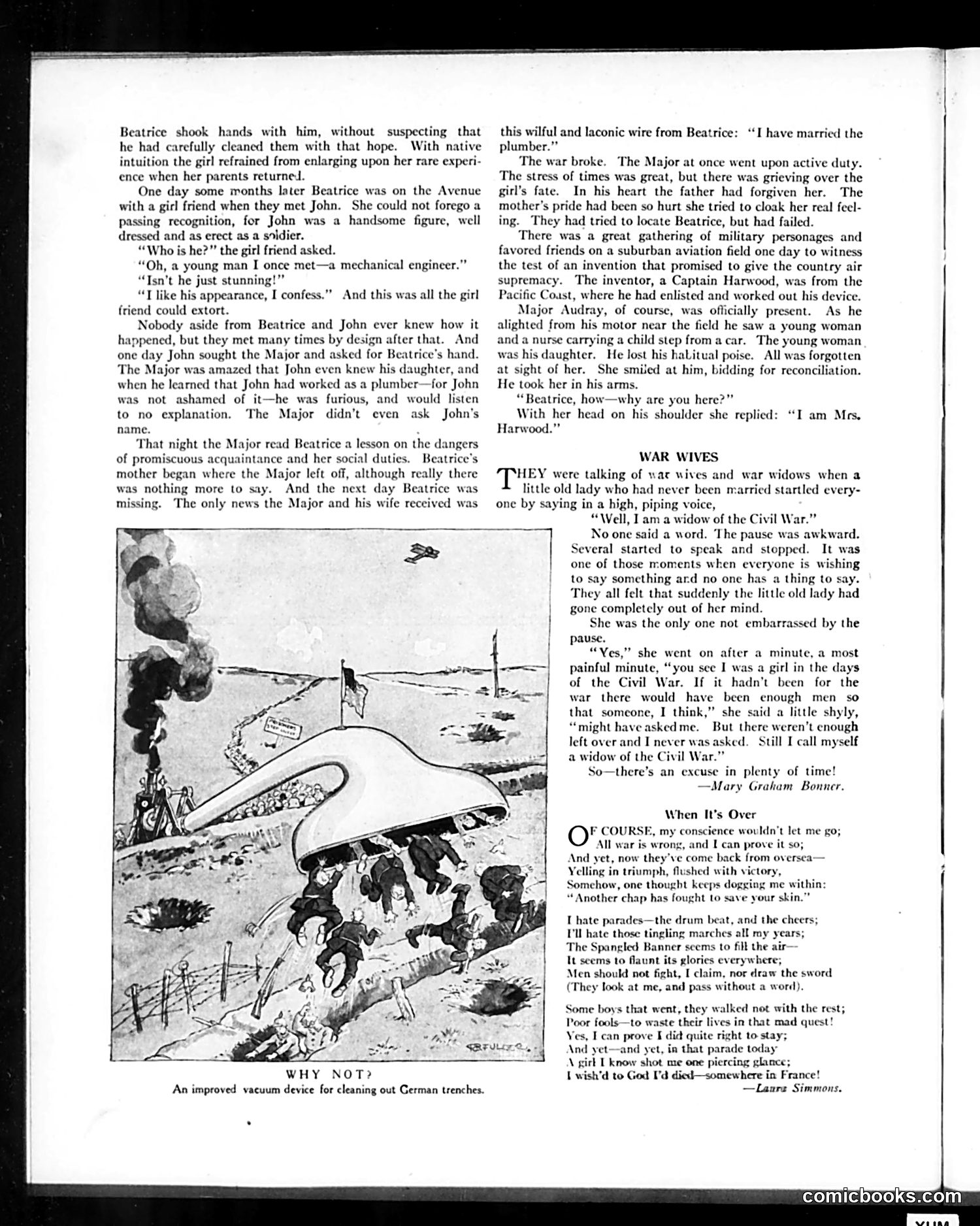
This page contains a romantic short story and humorous anecdotes about World War I-era America. **The main story** depicts a class conflict: Beatrice, from an aristocratic military family, falls in love with John, a working-class plumber. Her father, "the Major," refuses the match because of John's low social status. She elopes. Later, at a military aviation demonstration, the Major discovers John is actually "Captain Harwood," an aircraft inventor whose device promises air superiority—legitimizing him retroactively through wartime achievement and military rank. **"War Wives" section** features a humorous anecdote: an elderly unmarried woman claims to be "a widow of the Civil War" because the shortage of men killed in that conflict prevented her from ever marrying. It's gentle satire on how women's life prospects were entirely dependent on marriage availability. The cartoon "Why Not?" (caption visible) appears to satirize military trench warfare with dark humor about "cleaning out German trenches." The page reflects WWI-era American values: class mobility through military service, women's dependent social status, and dark war humor.
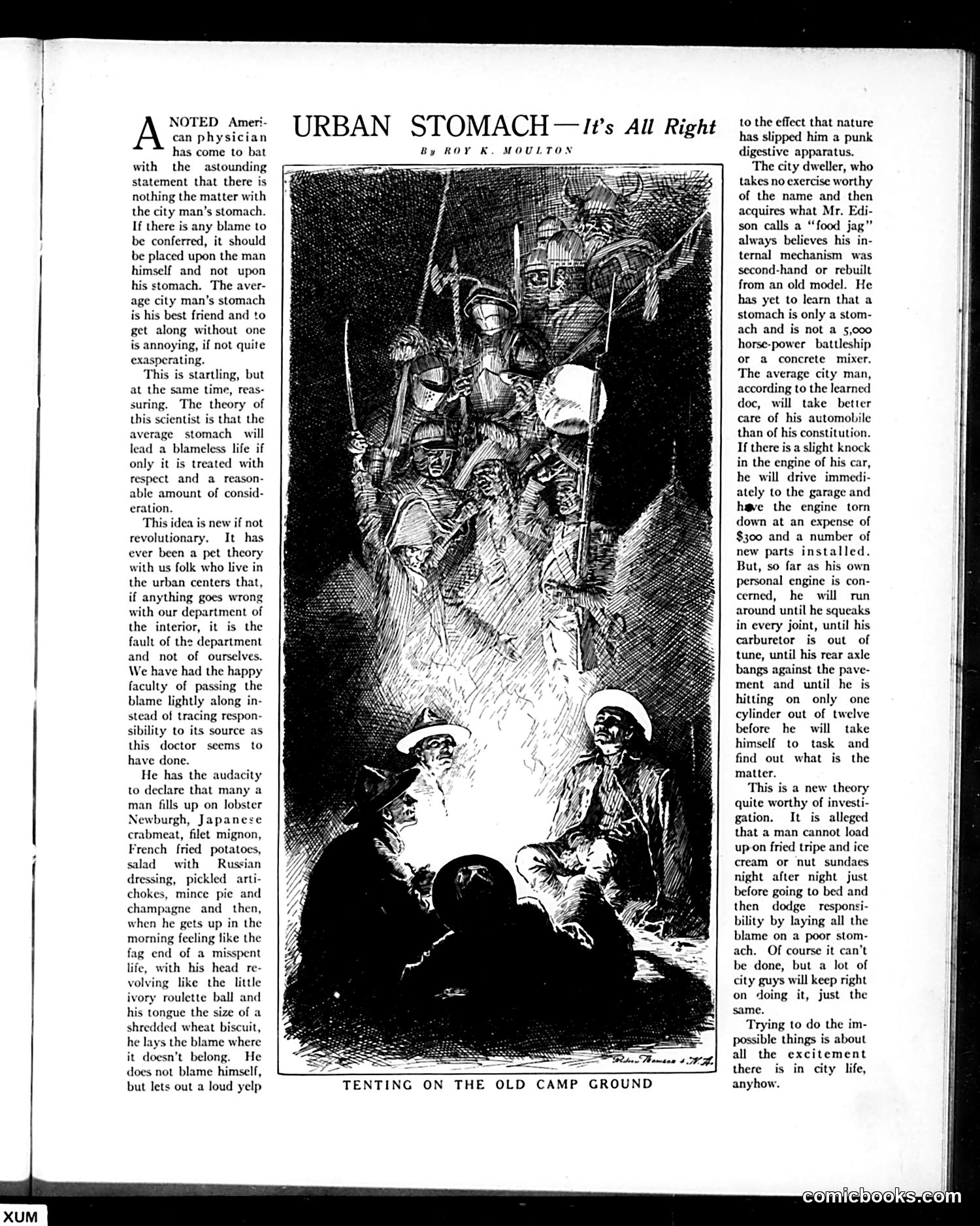
This satirical article critiques urban dwellers' poor self-care habits and tendency to blame external factors rather than themselves. A physician reportedly claimed nothing is inherently wrong with city stomachs—the problem is how people treat them. The satire targets wealthy city men who overindulge in rich foods (lobster Newburgh, filet mignon, champagne) without exercise, then blame their digestive systems when hungover. Moulton argues these men meticulously maintain their automobiles but neglect their own bodies, running themselves "around until he squeaks in every joint" before seeking help. The illustration titled "Tenting on the Old Camp Ground" (a Civil War song reference, unclear in context here) appears to show revelers or campers, likely reinforcing themes of indulgence and poor judgment. The piece is characteristic of Judge's moralizing satire about modern urban excess and personal responsibility.
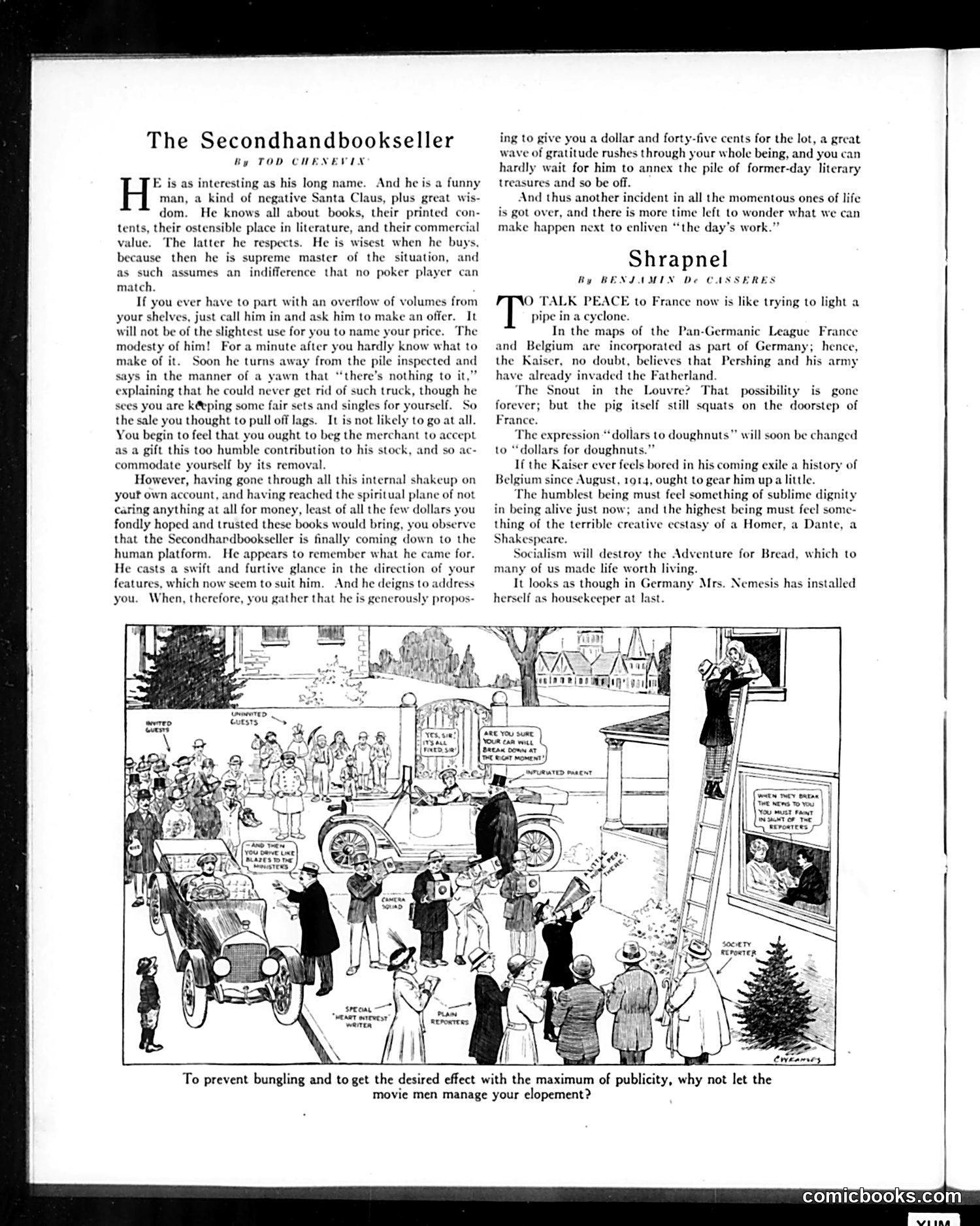
This page contains two distinct pieces of satire: **"The Secondhandbookseller"** by Tod Chenevin is a humorous character sketch about used book dealers who employ psychology in negotiations. The piece satirizes their practiced indifference and bargaining tactics—they feign disinterest in books, claim they can't sell such "truck," then gradually wear down sellers' expectations until they accept pittance (a dollar forty-five cents). It's gentle social satire about commerce and human negotiation. **"Shrapnel"** by Benjamin De Casseres is political commentary on World War I, specifically addressing France. The author dismisses peace talks as futile while the Kaiser threatens, references Belgium's invasion (August 1914), and invokes Mrs. Nemesis as Germany's housekeeper—suggesting divine retribution awaits. He romanticizes wartime nobility while predicting socialism will destroy civilization. **The cartoon** below shows a chaotic street scene with various figures and vehicles, captioned with tongue-in-cheek advice about letting "movie men manage your elopement"—satirizing Hollywood's sensationalism and the era's fascination with publicizing private events.
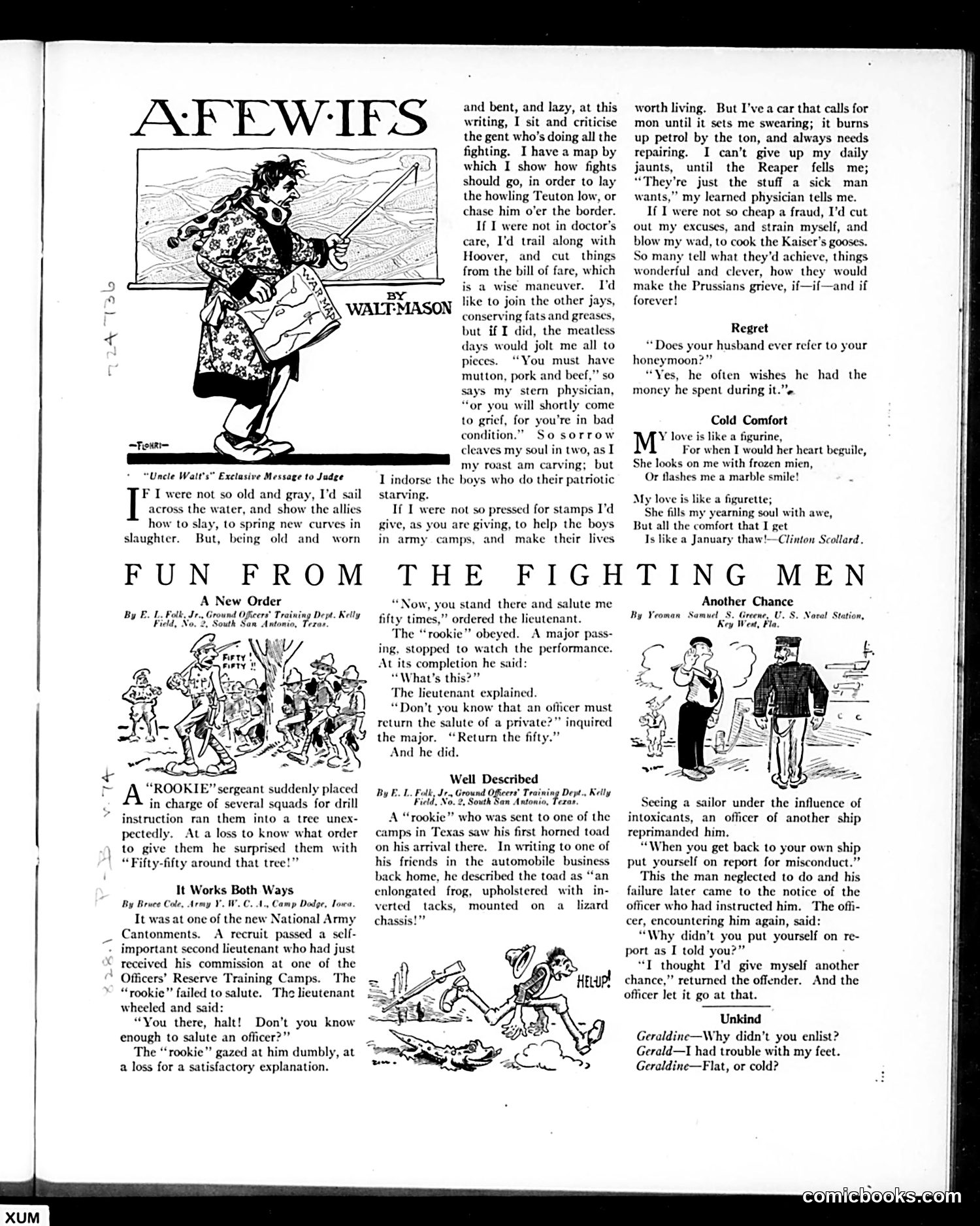
This *Judge* magazine page satirizes WWI-era military life and home-front attitudes. The top section features "Uncle Walt's" monologue—an elderly man explaining why he can't fight overseas despite supporting the war: he's too old, under doctor's orders requiring meat (contradicting food rationing), and too poor to donate. The satire targets armchair patriots who make excuses while promoting sacrifice for others. The "Fun from the Fighting Men" section collects military humor. "A New Order" jokes about a confused rookie sergeant; "It Works Both Ways" mocks an inexperienced officer who doesn't know he must return a private's salute—exposing the absurdity of military hierarchy. "Well Described" laughs at a recruit's malapropism calling a horned toad an "elongated frog...upholstered with inverted tacks, mounted on a lizard chassis." The lighter pieces (poems, one-liners about marriage) provide relief from war commentary. Overall, the page balances patriotic support with gentle mockery of military incompetence and civilian hypocrisy.
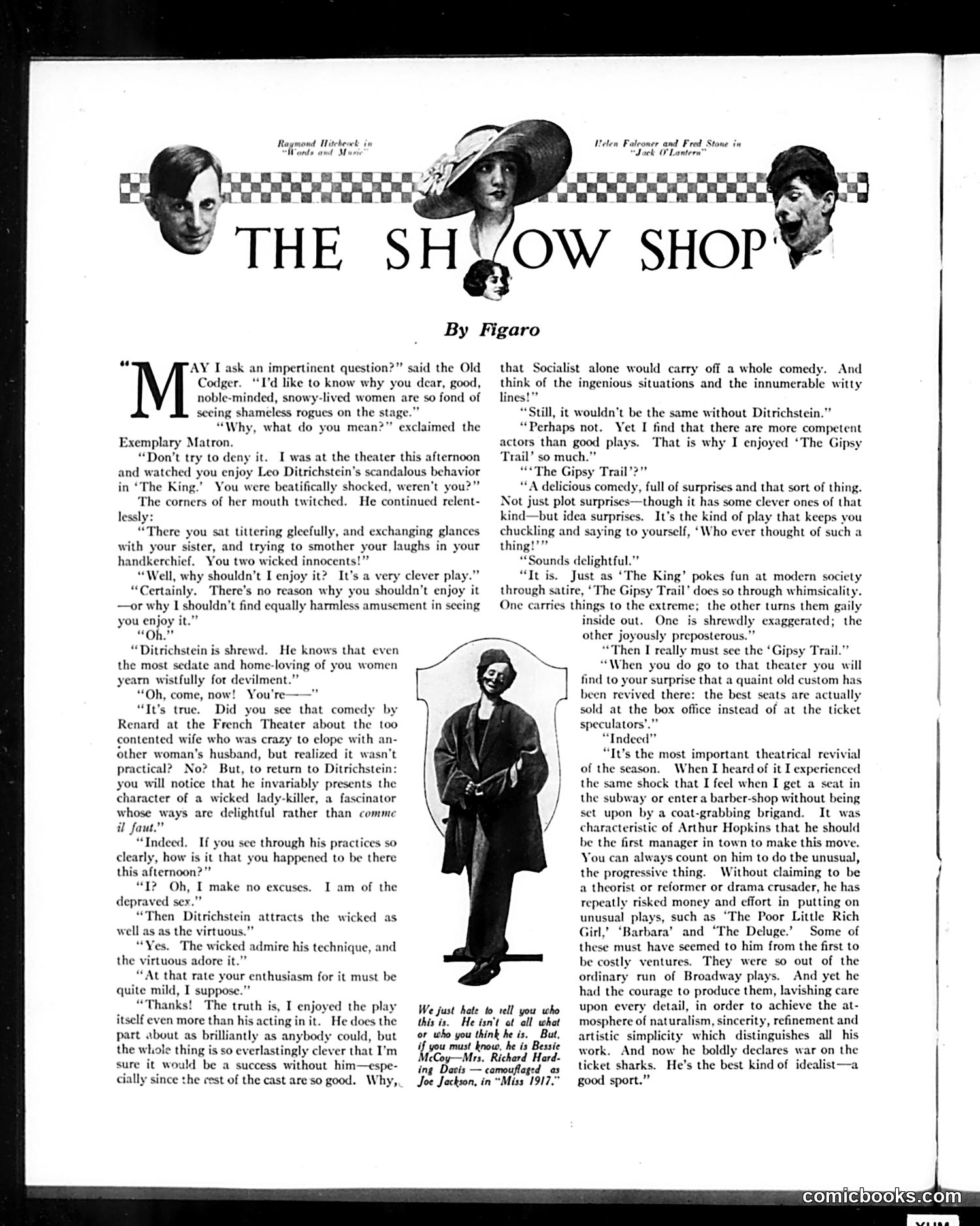
This is a satirical dialogue between an "Old Codger" and an "Exemplary Matron" about theater-going and hypocrisy. The piece mocks respectable Victorian women who publicly claim moral superiority while privately enjoying scandalous stage performances. The satire targets actor Leo Ditrichstein, who apparently specialized in playing charming "wicked" seducers. The Old Codger points out that proper ladies attending his performances—pretending shock while "tittering gleefully"—reveal their actual desires for excitement and "devilment" beneath their pious facades. The dialogue shifts to praise "The Gipsy Trail," contrasting Ditrichstein's extreme satire with its gentler whimsy. The final joke mocks theater box-office practices, sardonically noting that revival of selling premium seats directly (rather than through scalpers) constitutes the season's "most important theatrical revival." The piece satirizes class pretension, female respectability theater, and audience hypocrisy about entertainment.
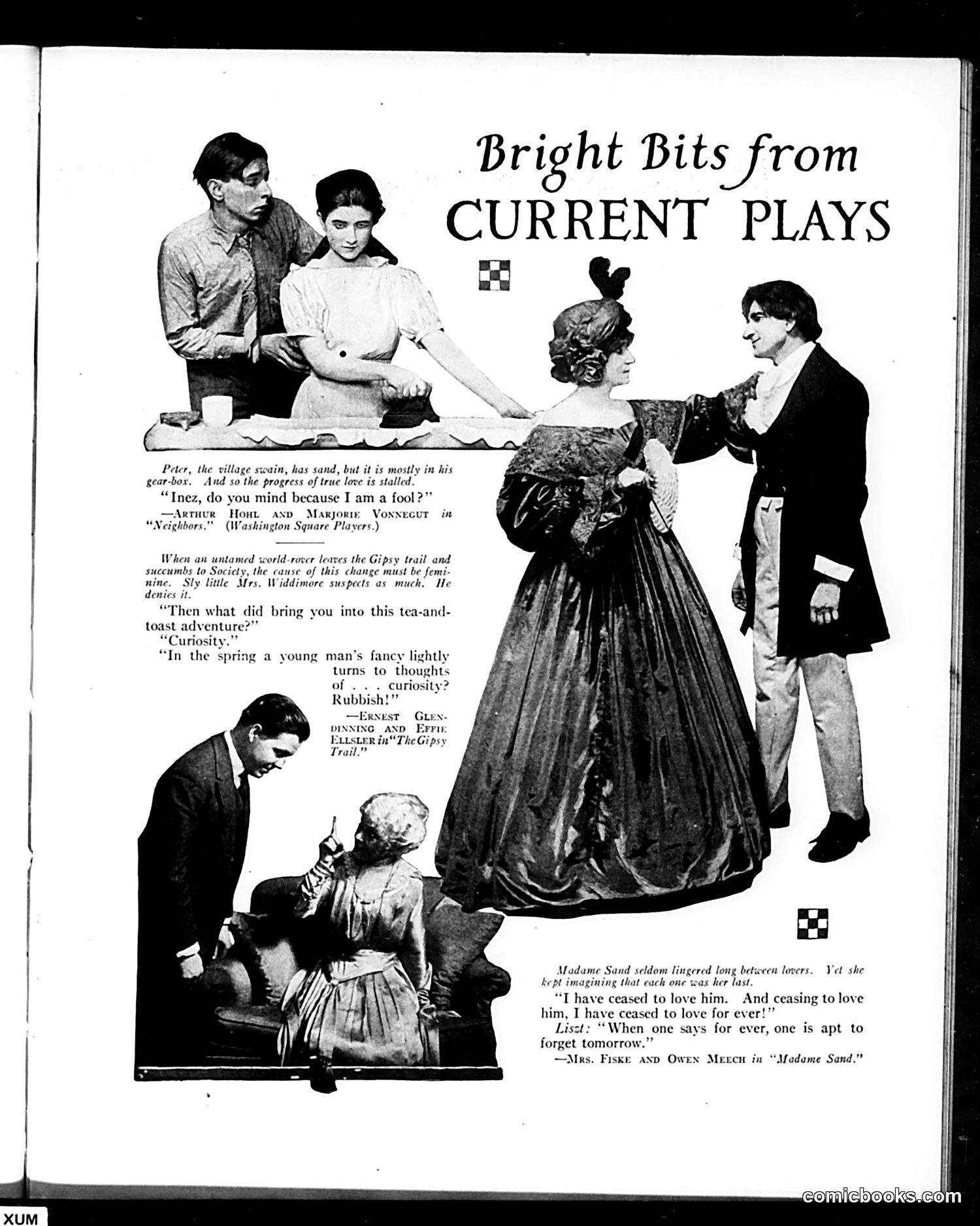
This page showcases theatrical humor from three Broadway productions. Rather than political satire, it presents comedic moments from contemporary plays: 1. **"Neighbors"** (Washington Square Players): A scene mocking a bumbling suitor ("Peter") who lacks romantic competence, with the woman questioning his intelligence. 2. **"The Gipsy Trail"**: A joke about a adventurous man seduced into respectable society by a woman, ironically attributing his transformation to "curiosity." 3. **"Madame Sand"**: A scene between the historical figure George Sand and Franz Liszt, satirizing her romantic fickleness. She declares she's "ceased to love" him "forever," but Liszt cynically observes that people who say "forever" typically forget by tomorrow. The humor trades on contemporary theatrical tropes: fumbling courtship, female manipulation, and satirical portrayals of historical romantic figures. This is entertainment journalism rather than political commentary.
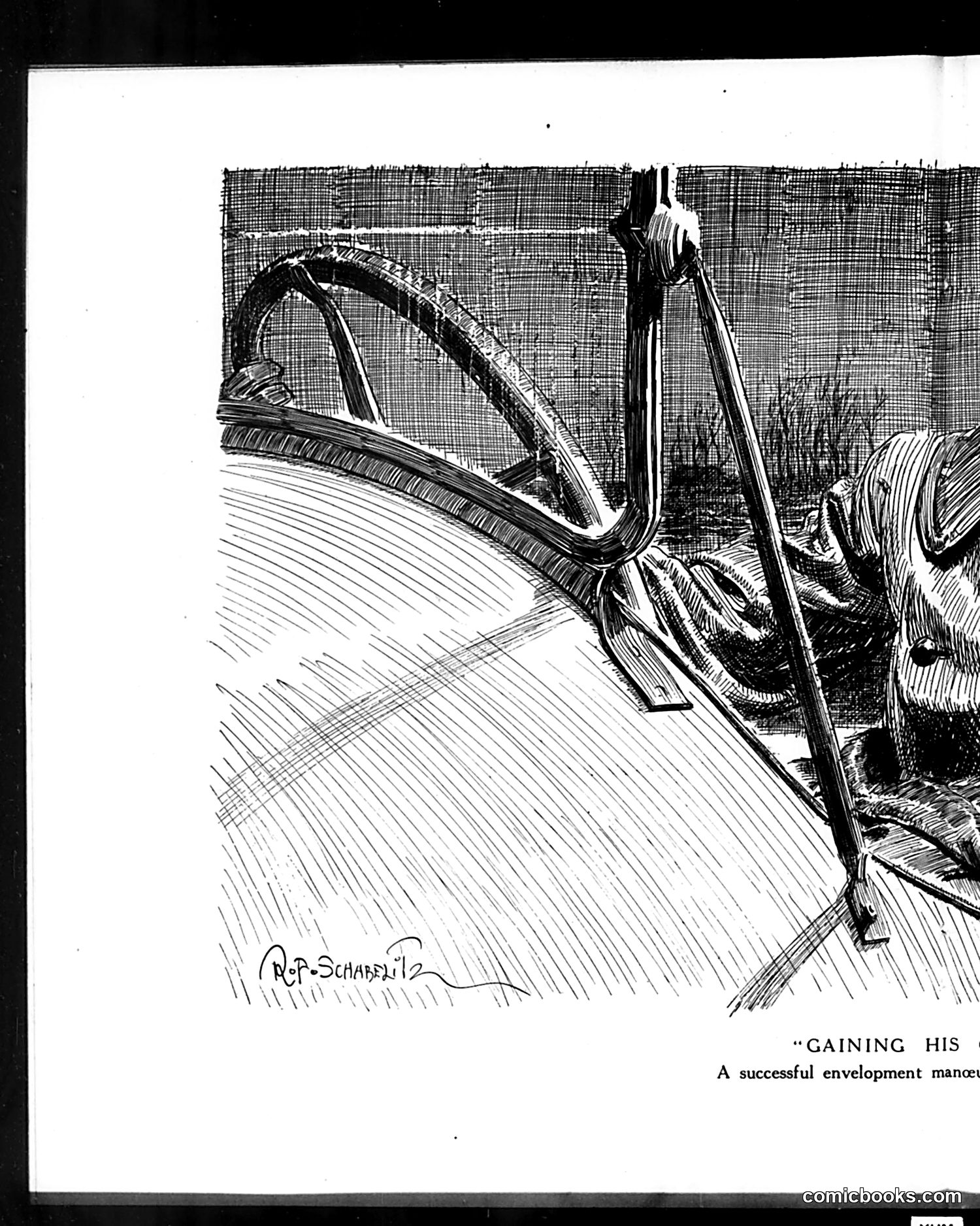
This political cartoon depicts an insect (appears to be a mantis or similar predatory bug) executing what's labeled a "successful envelopment maneuver." The military terminology—"envelopment" being a tactical military strategy—suggests this is a satirical commentary on military strategy or warfare. The cartoon likely uses the insect as a metaphor for a political or military figure employing deceptive or predatory tactics. The predatory nature of the insect reinforces the satire about cunning strategic maneuvers. However, without additional context about Judge magazine's publication date or the specific political situation being referenced, I cannot definitively identify which historical figure or conflict this targets. The style and technique suggest early-to-mid 20th century publication.
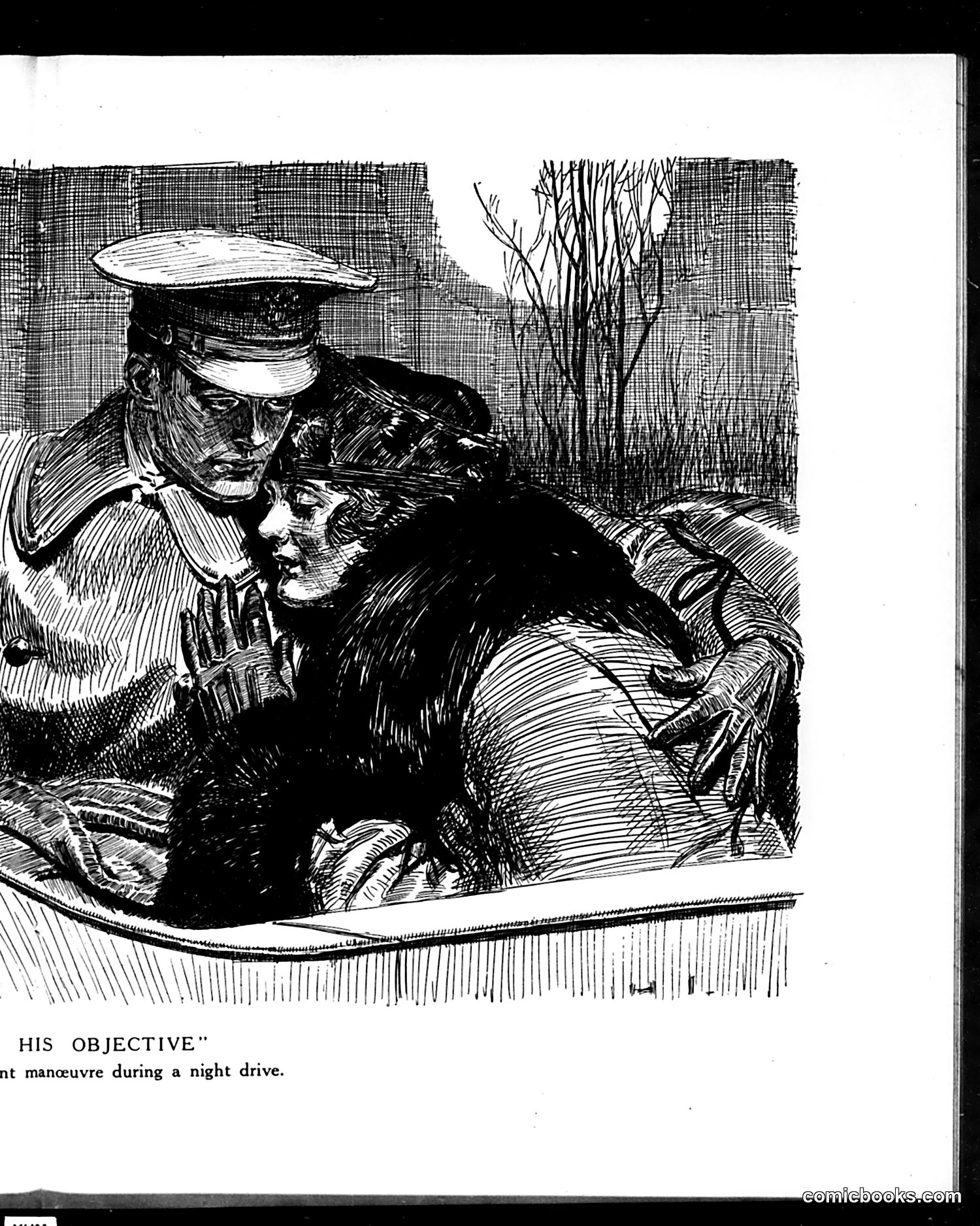
This appears to be a political cartoon from *Judge* magazine satirizing military or law enforcement conduct. The image shows a uniformed officer (identifiable by his cap and insignia) with a civilian during what the caption describes as "a night drive" maneuver. The phrase "His Objective" suggests the cartoon is critiquing either improper conduct or abuse of authority by the uniformed figure toward the civilian. The intimate, compromising positioning and the emphasis on this being a "night" operation imply questionable or coercive behavior. Without the magazine's date or fuller context, the specific historical reference remains unclear, but the satire targets apparent misconduct or corruption by those in uniform abusing their power over civilians during unsupervised nighttime activities.
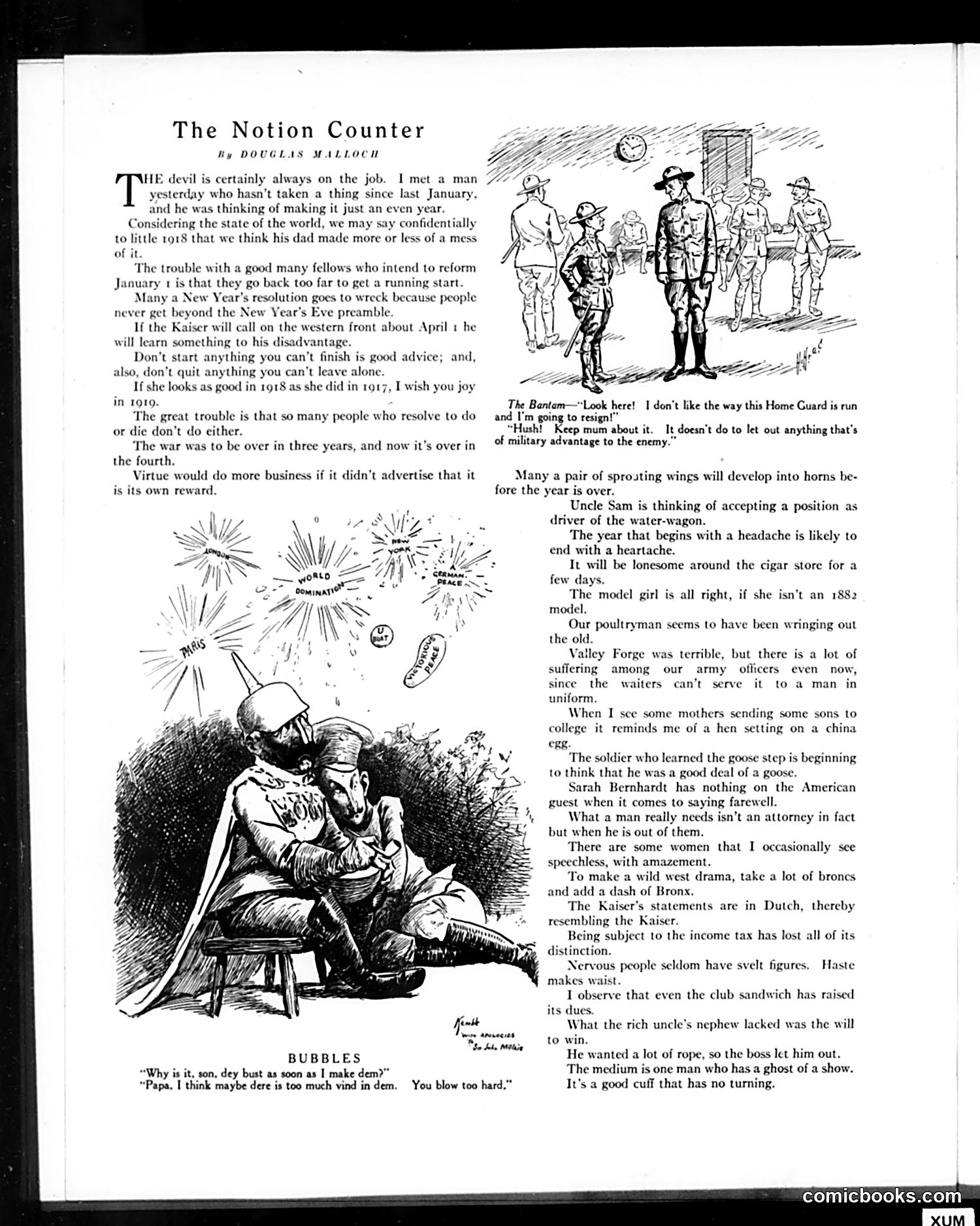
This is a satirical humor column by Douglas Malloch presented as brief, disconnected observations ("notions"). The page's two cartoons mock different targets: **"Bubbles"** depicts a father and son, with the child asking why bubbles burst. The father blames the child's excessive force—a simple domestic joke about physics and parenting. **"The Bantam"** shows a small Home Guard member threatening to resign over management, while a superior officer silences him, warning that complaints give "military advantage to the enemy." This satirizes both wartime censorship and military hierarchy, likely referencing WWI (the text mentions the war ending in its "fourth" year). The surrounding "notions" are brief satirical quips about New Year's resolutions, the war, virtue, morality, and social observations. References to the Kaiser, Valley Forge, and the war's duration confirm WWI-era publication. Overall, the page mocks human folly, military bureaucracy, and failed good intentions through bite-sized humor typical of Judge magazine's satirical style.
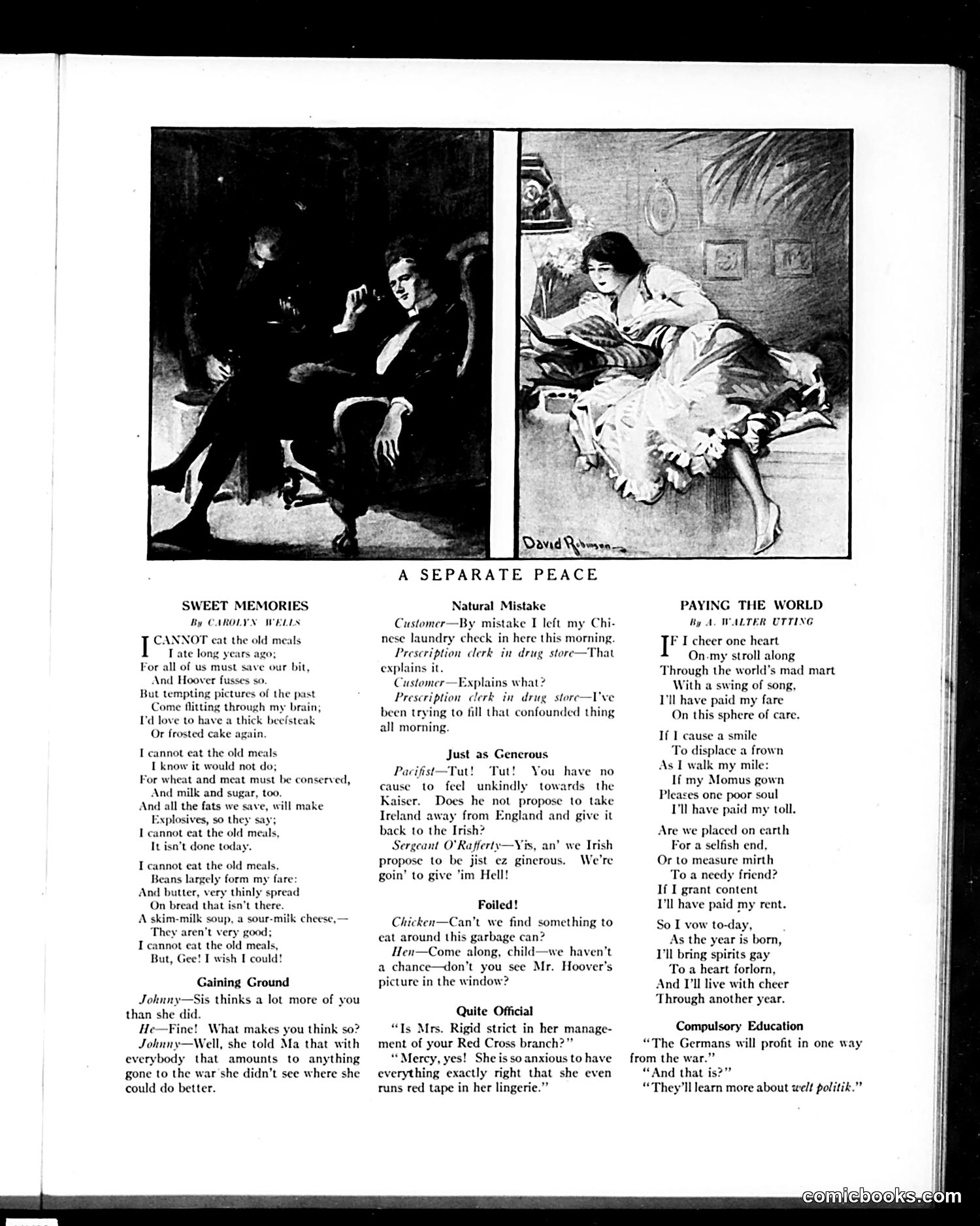
This Judge magazine page contains satirical commentary on American home-front conditions during World War I, particularly food rationing under Herbert Hoover's administration. **Key Content:** The poems mock wartime sacrifice. "Sweet Memories" laments government-mandated rationing—beans replacing beef, thin butter spreads, skim milk soup—while citizens endure privation supposedly for the war effort. "Gaining Ground" jokes that a soldier's absence makes him more appealing to a shallow woman. **Visual Cartoon:** The right illustration depicts a woman reading in a bedroom, signed by David Robinson, accompanying "Paying the World"—a sentimental poem about repaying society through kindness. **Political References:** - "Hoover" appears twice: the chicken cartoon shows his picture deterring scavenging, while rationing poems reference his role overseeing food conservation - The pacifist joke mocks Irish-American reluctance about the war - "Welt politik" joke assumes readers recognize German military-political strategy as a war lesson The satire balances patriotic acceptance of sacrifice with gentle ridicule of actual hardships and Hoover's austere administration of the home front.
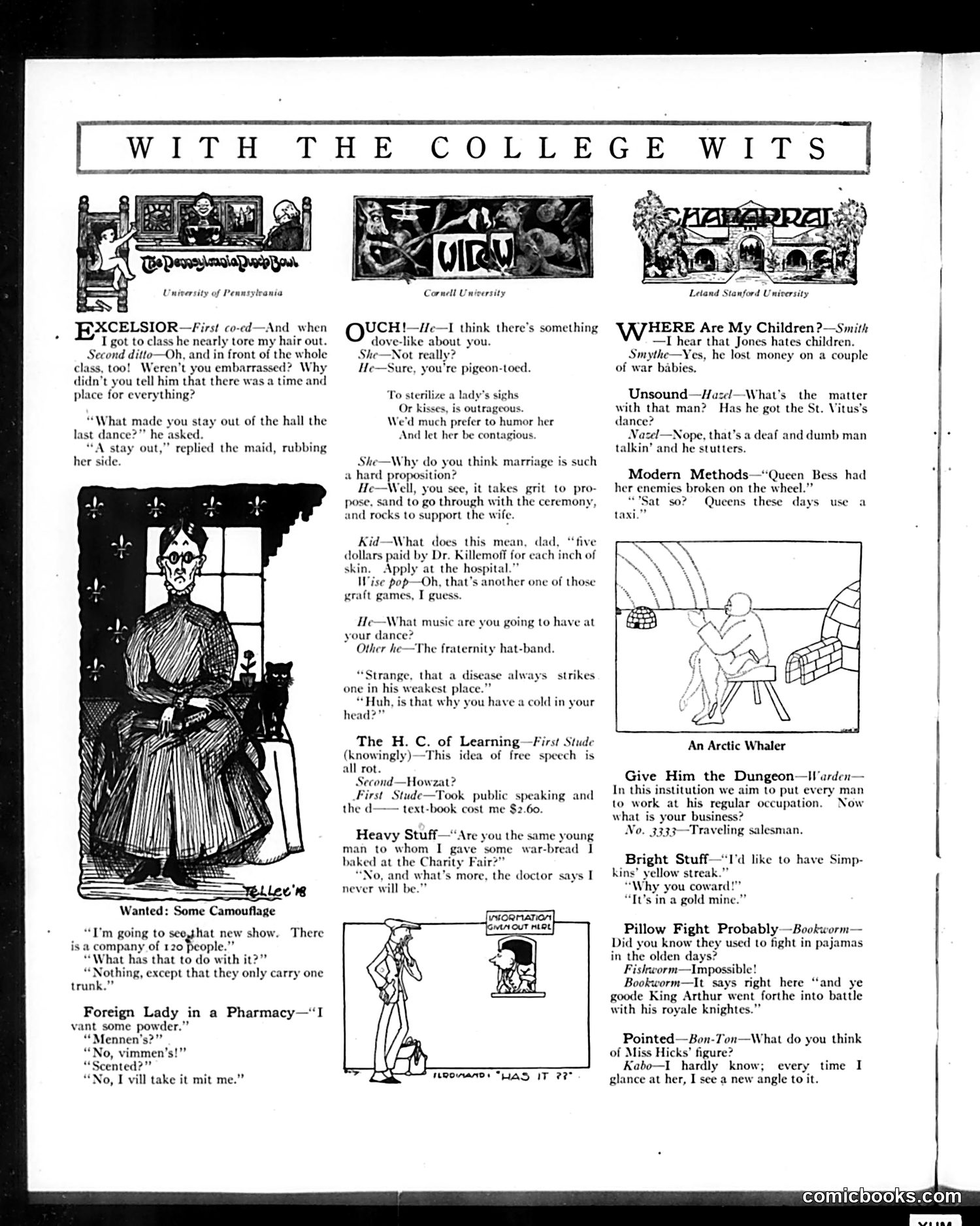
This page collects brief comedic dialogues satirizing early 20th-century college life and social customs. The jokes target: **College courtship**: Mocking awkward co-ed interactions and the physical inadequacies of male suitors ("pigeon-toed"). **Marriage critique**: Suggesting wives are financial burdens ("rocks to support the wife"). **Medical quackery**: Joking about dubious practices like paying doctors per inch of skin grafts. **Class pretension**: A woman trying to appear sophisticated at the theater while bringing minimal luggage; a foreigner requesting generic "powder" at a pharmacy. **Generational humor**: Adults misunderstanding modern slang and historical references (King Arthur in pajamas). The cartoons illustrate specific jokes—a woman in a window, a man in Arctic clothing. Overall, this represents Judge's typical approach: gentle mockery of contemporary social anxieties, dating rituals, and the gap between generations during the Progressive Era.
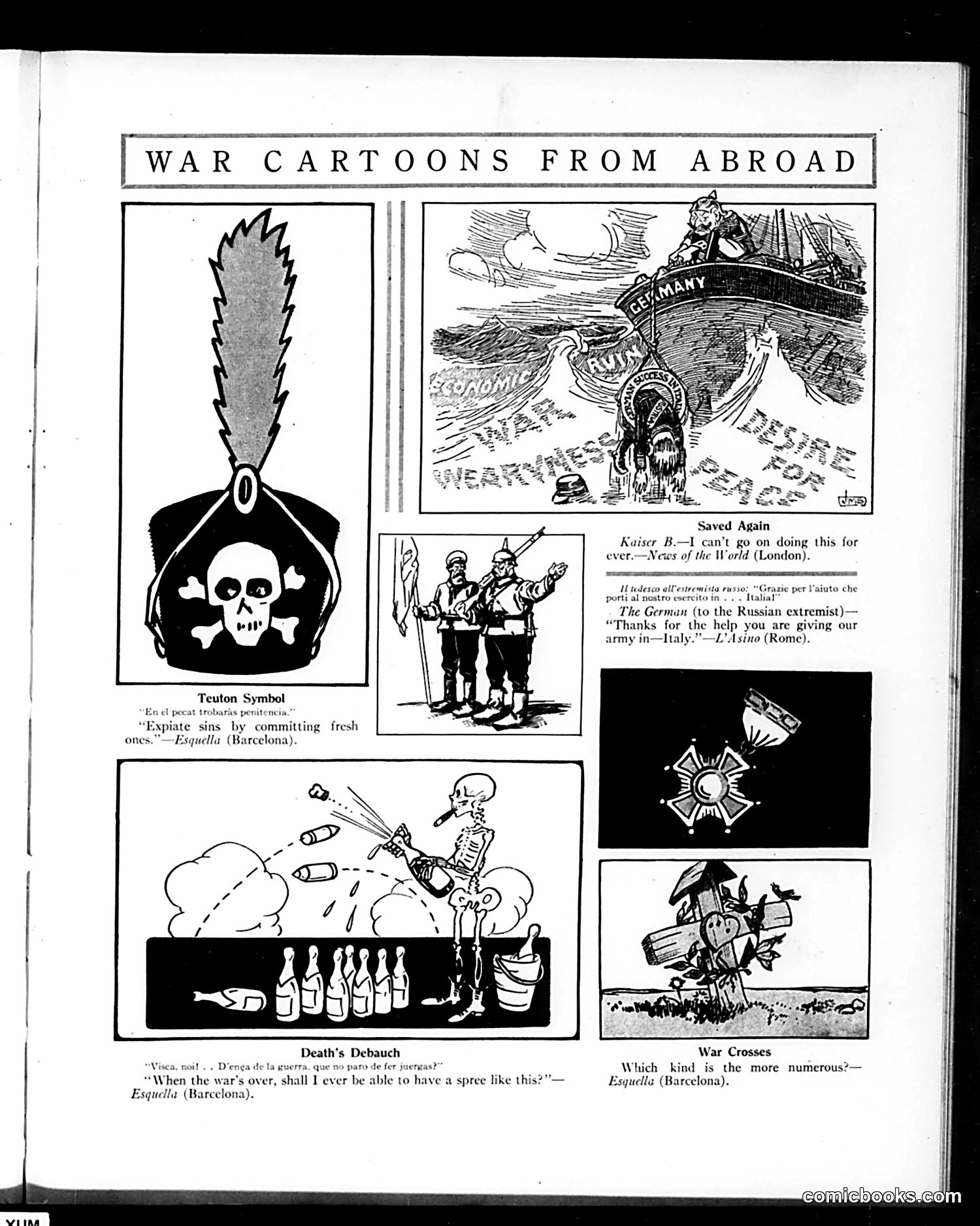
This page collects anti-German propaganda cartoons from Allied newspapers during World War I. The "Teuton Symbol" (top left) depicts a skull-and-crossbones within a crown, representing German militarism and death. The "Saved Again" cartoon (top right) shows Germany's Kaiser repeatedly rescued from drowning—suggesting Germany survives only through others' help, likely referencing Italian and Russian assistance. "Death's Debauch" illustrates a skeleton (Death) presiding over bottles and weapons, satirizing German war profiteering and carnage. "War Crosses" questions which type of military decoration is "more numerous"—implying German casualties. These cartoons, reprinted from Spanish, Italian, and British sources, use dark humor and skeletal imagery to mock German leadership, mock their dependence on allies, and condemn the war's destructiveness. The page demonstrates how Allied nations shared anti-German messaging across borders during the conflict.
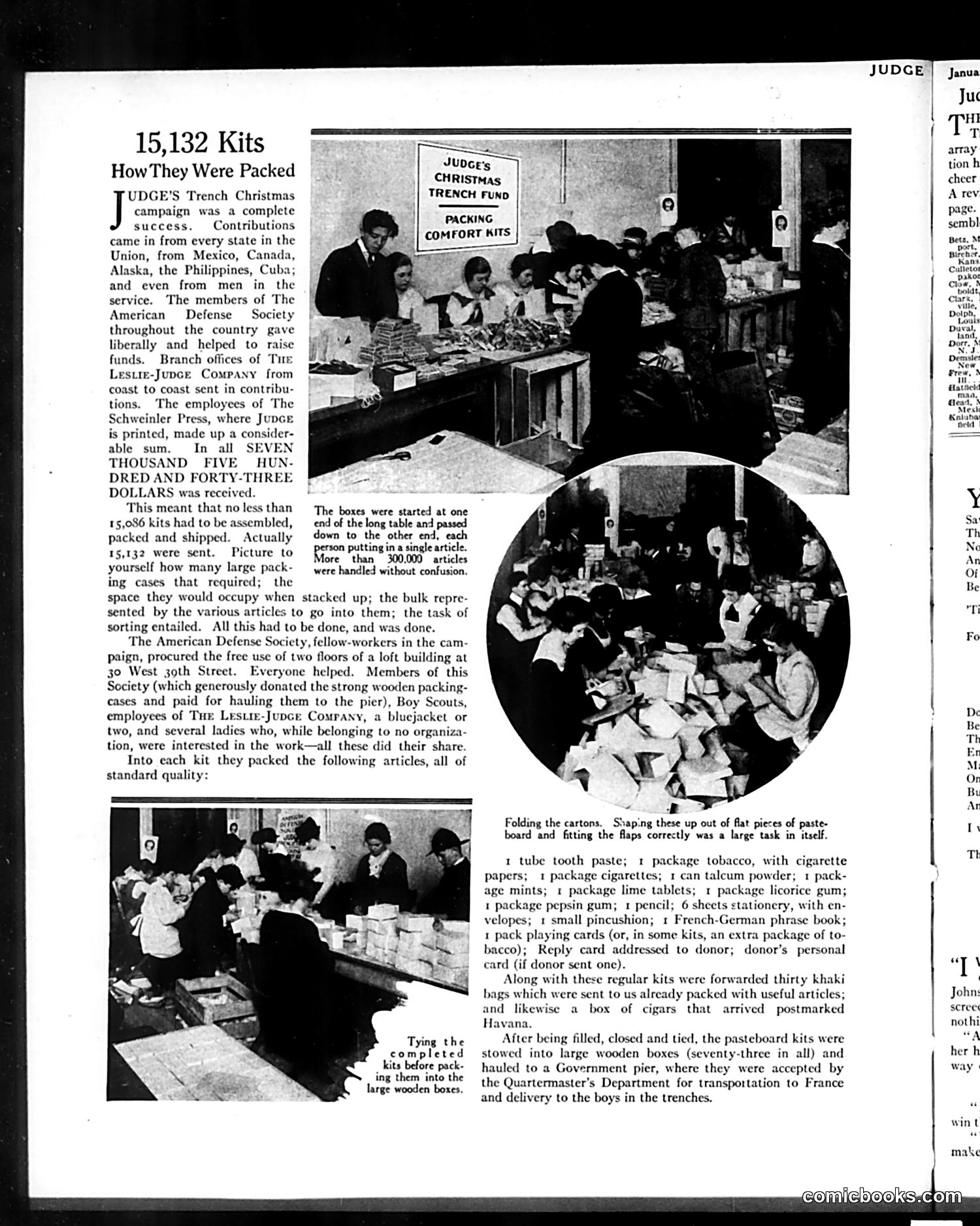
This is **not a cartoon** but a feature article documenting Judge magazine's successful charity drive to assemble comfort kits for American soldiers in World War I trenches. The photographs show the assembly-line operation at a New York loft where volunteers packed 15,132 kits with items like tobacco, candy, stationery, and playing cards—over 300,000 individual articles total. The article celebrates civic participation: the American Defense Society, Leslie-Judge Company employees, Boy Scouts, and unaffiliated volunteers worked together. Each kit was carefully assembled, boxed, and shipped via Government pier to France for trench delivery. This represents Judge's patriotic journalism during the war, promoting national unity and support for troops. The detailed documentation and photographs serve as propaganda showing American organized generosity and home-front mobilization for the war effort.
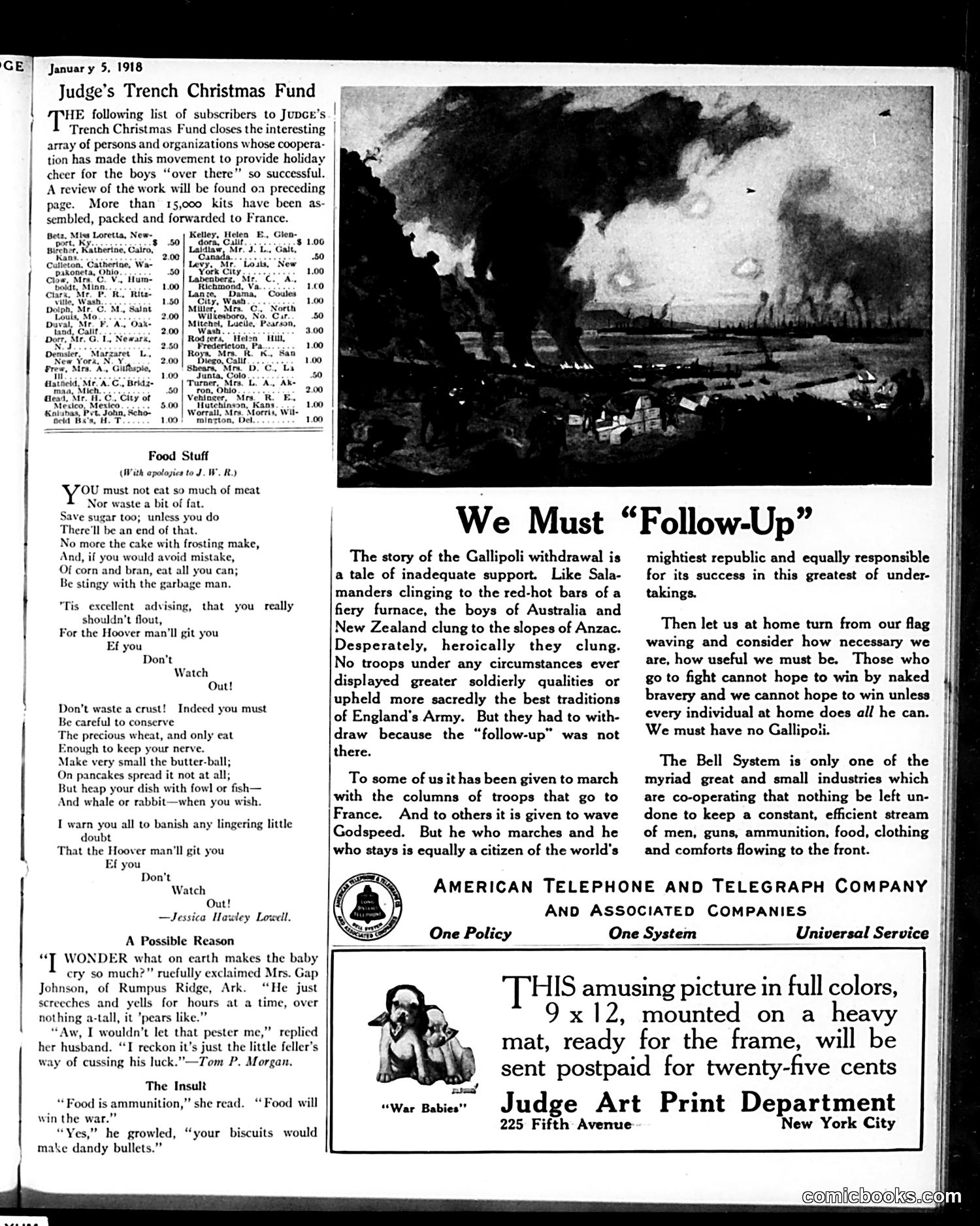
This wartime page reflects American home-front efforts during World War I. The main content includes: **"Judge's Trench Christmas Fund"**: A list of donors who contributed to sending 15,000+ care packages to American soldiers in France—a patriotic fundraising campaign. **"Food Stuff" poem**: A satirical jab at food rationing under Herbert Hoover's Food Administration, warning readers not to waste meat, sugar, and wheat. The repeated threat—"the Hoover man'll git you"—humorously personifies government enforcement of wartime conservation. **"We Must Follow-Up"**: A serious editorial referencing the failed 1915 Gallipoli campaign (where Australian and New Zealand forces were inadequately supported), arguing that American civilians at home must support troops with supplies and sacrifice—not just flag-waving. **AT&T Advertisement**: Presents the telephone company as essential infrastructure supporting the war effort. The page combines patriotic fervor, homefront sacrifice messaging, and gentle mockery of rationing policies—typical of American wartime journalism in 1918.
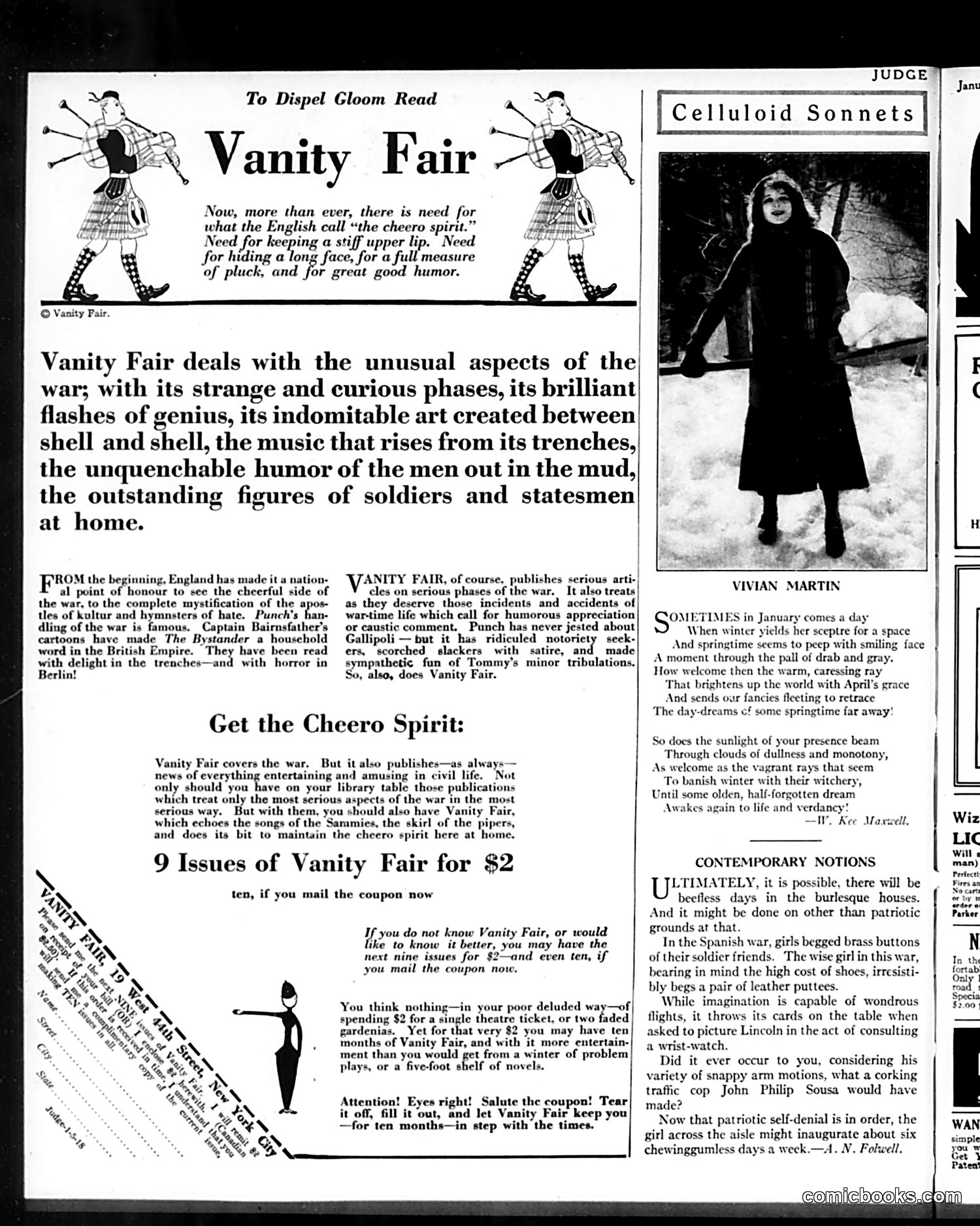
This is primarily advertising for **Vanity Fair magazine**, positioned as patriotic wartime reading. The page argues that England must maintain "the cheero spirit"—stiff upper lip courage—during WWI, and that Vanity Fair uniquely balances serious war coverage with humor and entertaining content about soldiers' experiences in trenches. The satire targets those who take war *too* seriously: the ad jokes that readers shouldn't only read grim war analysis, but should also enjoy lighter material that keeps morale high. References to **Captain Bairnsfather's cartoons** (famous WWI humor) and **Punch magazine** establish Vanity Fair as continuing Britain's tradition of satirical resilience. The right column contains unrelated poetry and brief satirical "Contemporary Notions"—throwaway quips about wartime shortages and absurdities (beefless burlesque houses, girls trading romantic favors for practical shoes). The overall message: humor and entertainment are patriotic duties during wartime.
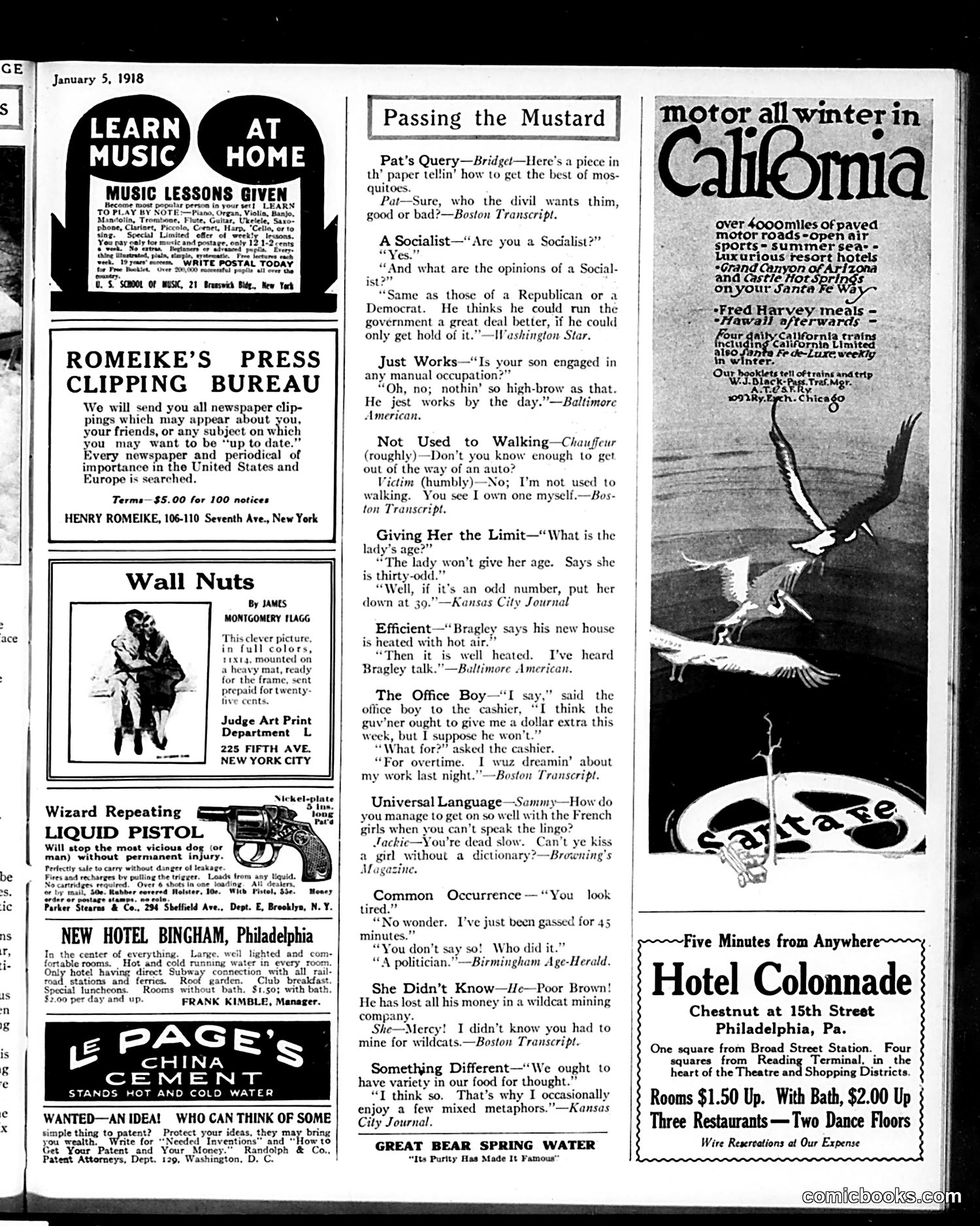
This page is primarily **advertisements and humorous anecdotes**, not political cartoons. The "Wall Nuts" cartoon by James Montgomery Flagg is the only substantial illustration—it appears to be a framed art print available for purchase. The text consists of brief joke exchanges labeled by origin (Boston Transcript, Washington Star, etc.). These reflect early-20th-century concerns: laborers' wages, automobiles (still novel, disruptive), gender relations, and skepticism toward politicians. One anecdote mocks socialists, suggesting they claim superior governance ability despite lacking actual power—likely reflecting anxiety about radical politics during WWI. The ads reflect 1918 priorities: music lessons, press clipping services, early automobiles, hotels, and patent advice. Overall, this is a typical Judge issue: light humor aimed at middle-class readers, mixed with period-relevant commerce.
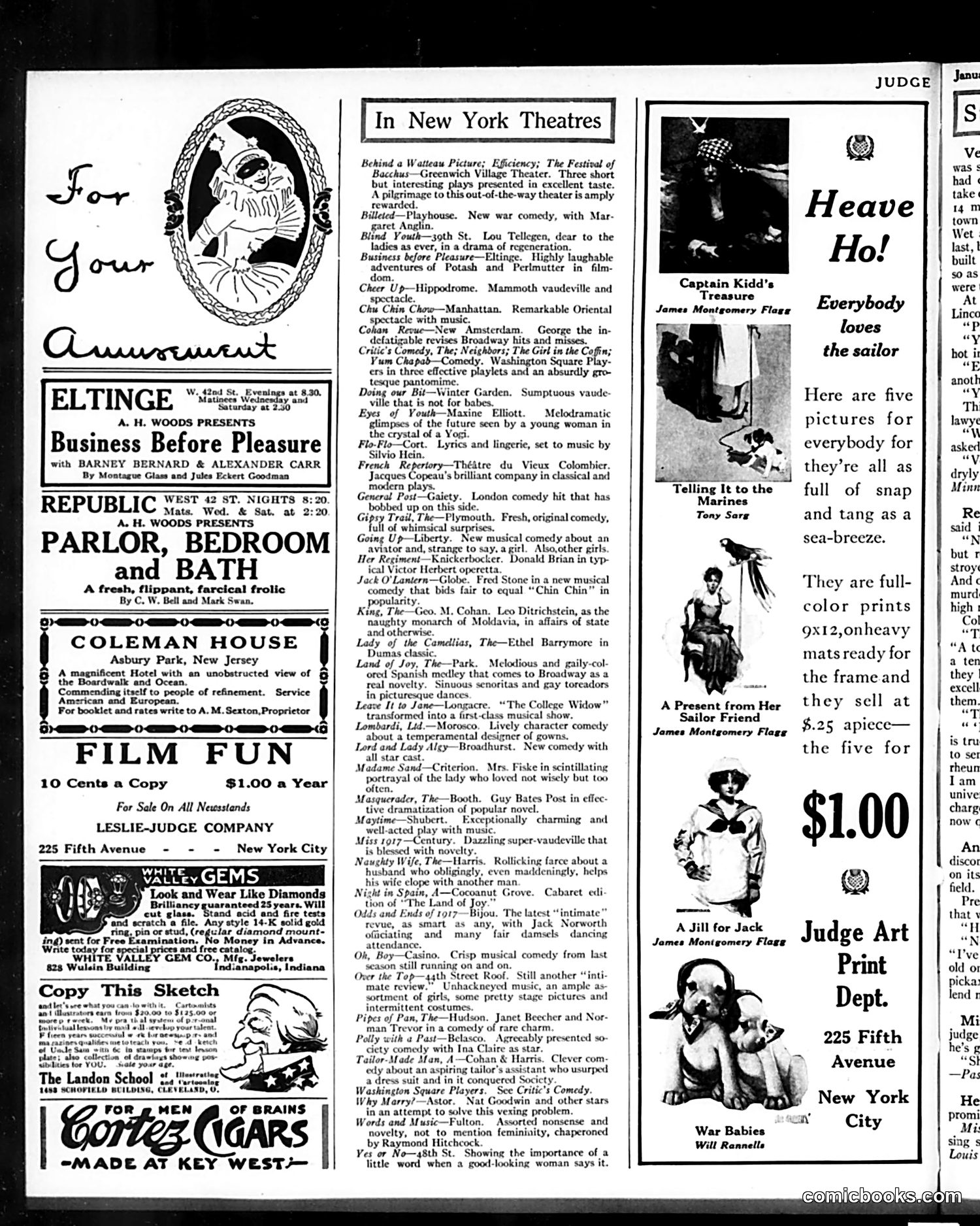
This page is primarily **theatrical advertising and listings** for New York theaters, not political satire. The left side features ads for stage productions ("Business Before Pleasure," "Parlor, Bedroom and Bath") and commercial products (gems, cigars, a hotel). The right side contains an **extended theater review section** cataloging current Broadway shows with brief descriptions—"Chu Chin Chow," "Going Up," "Leave It to Jane," and dozens of others. Below the reviews is a **product advertisement** for "Judge Art Print Dept." offering five full-color maritime prints ("Heave Ho!") featuring sailors and naval scenes, selling for $1.00 for the set. **There is no political cartoon on this page.** It's essentially a theater/entertainment guide with embedded advertising—representative of how Judge magazine monetized space through commercial listings while providing entertainment news to readers. The "For Your Amusement" header suggests this was a regular feature.
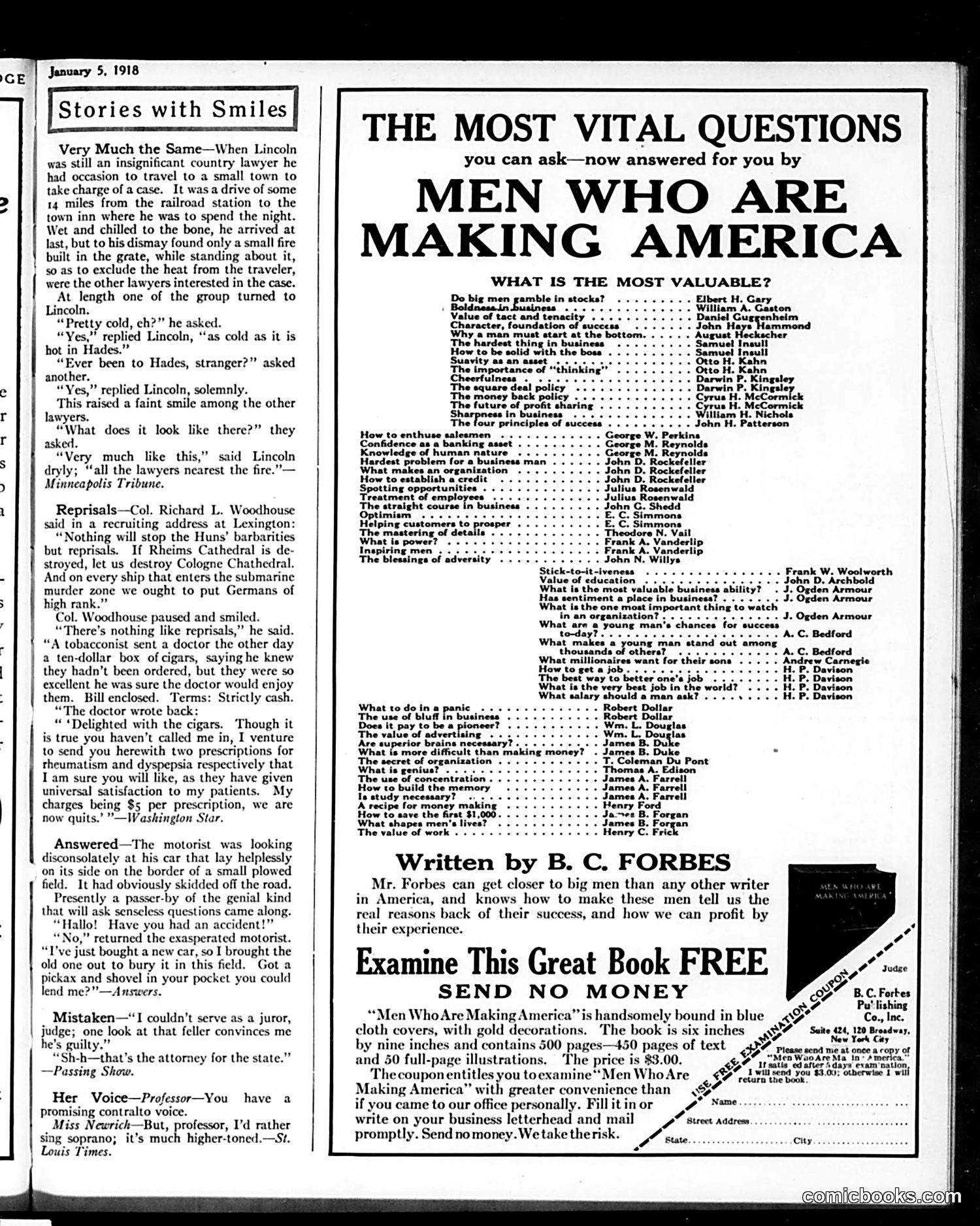
This page combines humor with wartime propaganda. The left side contains "Stories with Smiles"—four brief humorous anecdotes, including a Lincoln joke about lawyers hoarding heat, a recruiting officer's quip about German reprisals during WWI, and witty exchanges about automobiles and singing voice. These are lighthearted filler content typical of Judge's satirical format. The dominant right side advertises B.C. Forbes's book *"Men Who Are Making America,"* listing prominent industrialists (Guggenheim, Rockefeller, Carnegie, etc.) answering "vital questions" about business success. This reflects 1918 American capitalism's veneration of self-made magnates and business wisdom. The wartime context (recruiting references, "Huns," submarine warfare) situates this during U.S. involvement in WWI. The overall page promotes American business enterprise and patriotic duty simultaneously—typical propaganda messaging that conflated capitalist values with national interest during wartime.
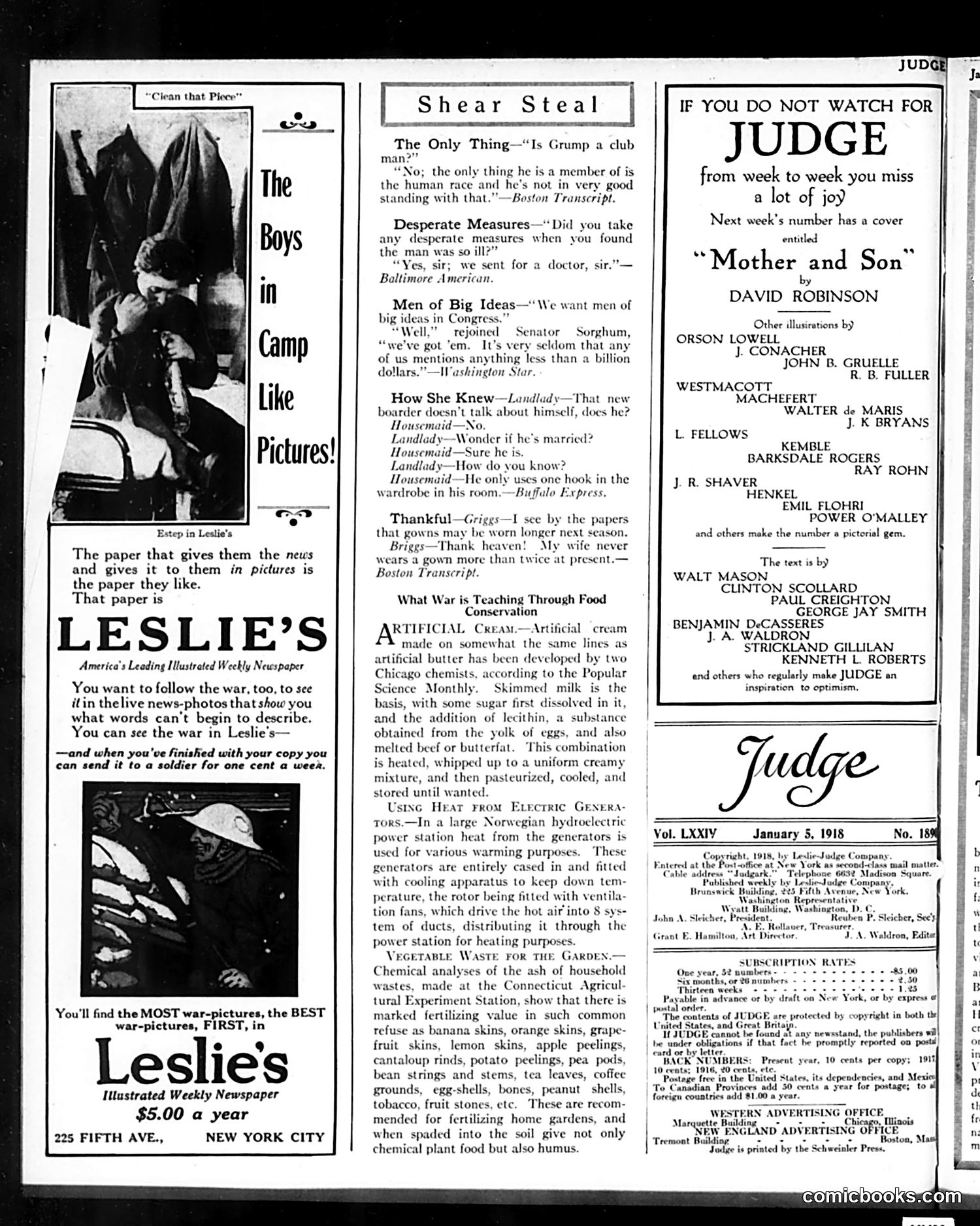
This is primarily a **title/contents page** for *Judge* magazine with advertisements and joke fillers rather than editorial cartoons. The main content includes: **Leslie's Illustrated Weekly Advertisement** (left): Appeals to WWI readers wanting war photographs, positioning Leslie's as superior for visual war coverage—relevant since America had entered the war in 1917. **"Shear Steal" Section** (center): A collection of short jokes satirizing American society. Notable examples mock Congressional vanity ("big ideas in Congress" = billion-dollar spending), marital assumptions, and fashion wastefulness. These reflect typical early-20th-century humor targeting politicians and social pretension. **"What War is Teaching Through Food Conservation"** (lower): Educational content about wartime rationing innovations—artificial cream, waste heat reuse, vegetable scraps as fertilizer. This reflects actual WWI-era conservation efforts Americans faced. The page essentially showcases *Judge*'s mixed editorial approach: light satire combined with practical wartime information and celebrity illustrator credits to attract readers.
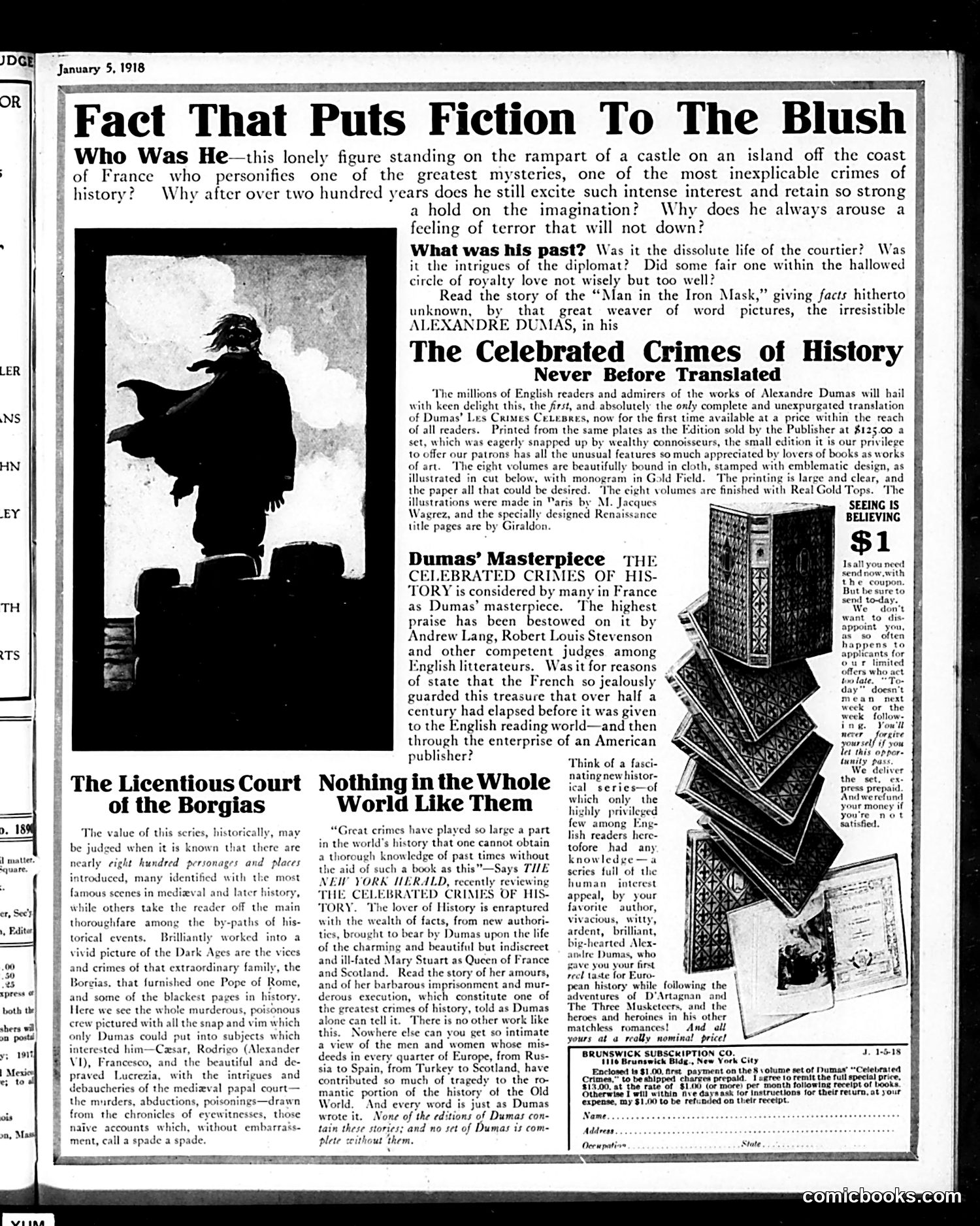
This page is primarily **advertising disguised as editorial content** for Alexandre Dumas's *Celebrated Crimes of History*, a newly translated eight-volume set. The dramatic silhouette illustration depicts "the Man in the Iron Mask"—a historical mystery figure imprisoned in a French castle—which serves as the hook for marketing Dumas's work. The advertisement emphasizes that this is the "first...complete and unexpurgated translation" available to English readers at an affordable price, contrasting it with a prior expensive edition ($125). The copy creates urgency and legitimacy by citing endorsements from respected literary figures (Andrew Lang, Robert Louis Stevenson) and emphasizing the book's historical significance. A sidebar advertisement ("Seeing Is Believing") offers the set for $1 as a trial offer. Rather than satire, this represents **turn-of-century American publishing marketing**—using Judge's prestige to reach affluent readers interested in literature and history during World War I.
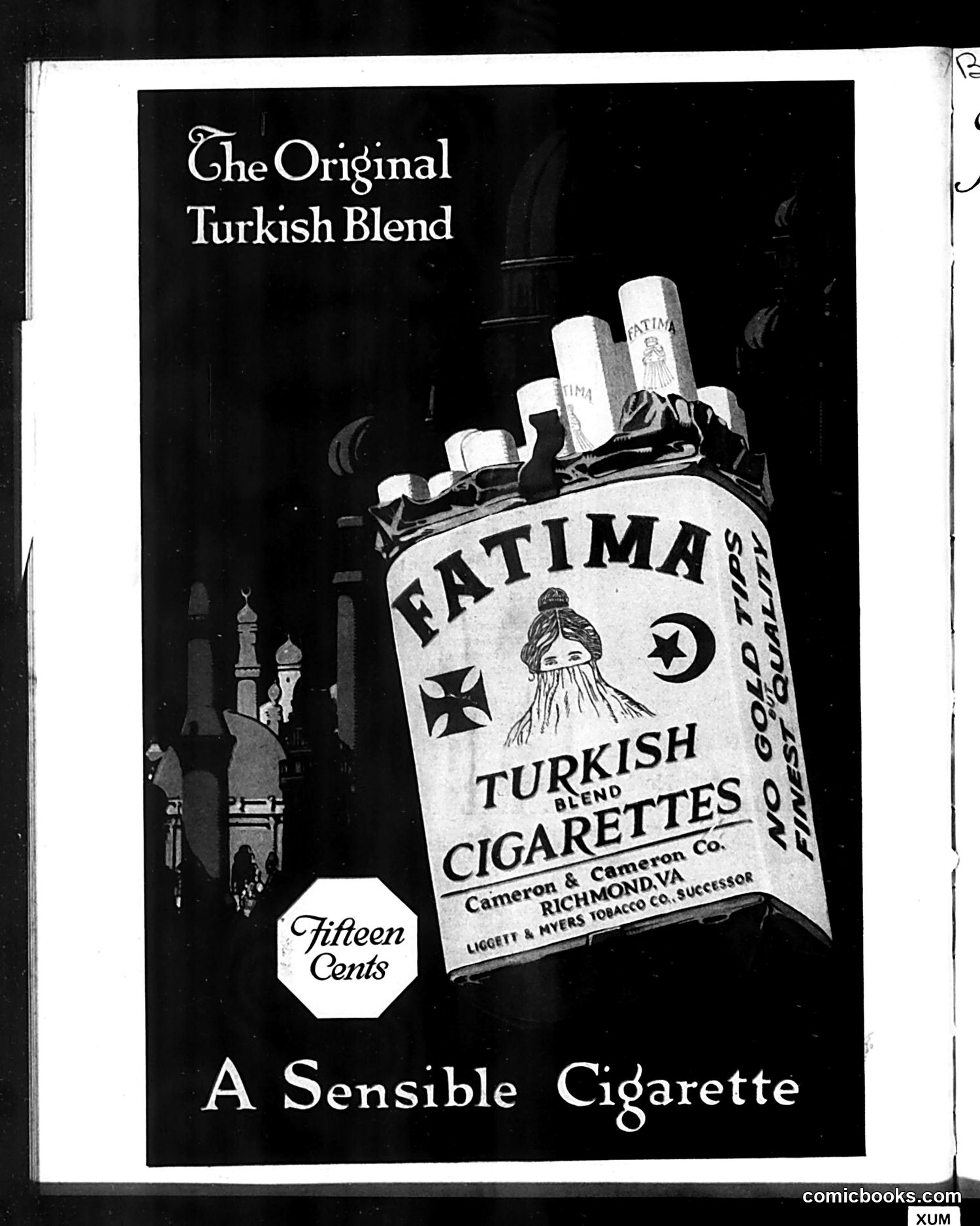
This is a straightforward cigarette advertisement, not political satire. It promotes Fatima brand Turkish cigarettes, manufactured by Cameron & Cameron Co. (Richmond, VA) and distributed by Liggett & Myers Tobacco Co. The ad emphasizes "The Original Turkish Blend" and prices the product at fifteen cents. The imagery includes a stylized woman's face wearing a turban and a crescent moon with a cross symbol—visual markers invoking Turkish/Ottoman exoticism, common in early 20th-century Western marketing. The phrase "A Sensible Cigarette" suggests marketing positioning emphasizing quality or moderation. The page itself appears to be a magazine advertisement rather than editorial commentary or satire.