
Judge, 1918-01-05 · page 26 of 28
Judge — January 5, 1918 — page 26: what you’re looking at
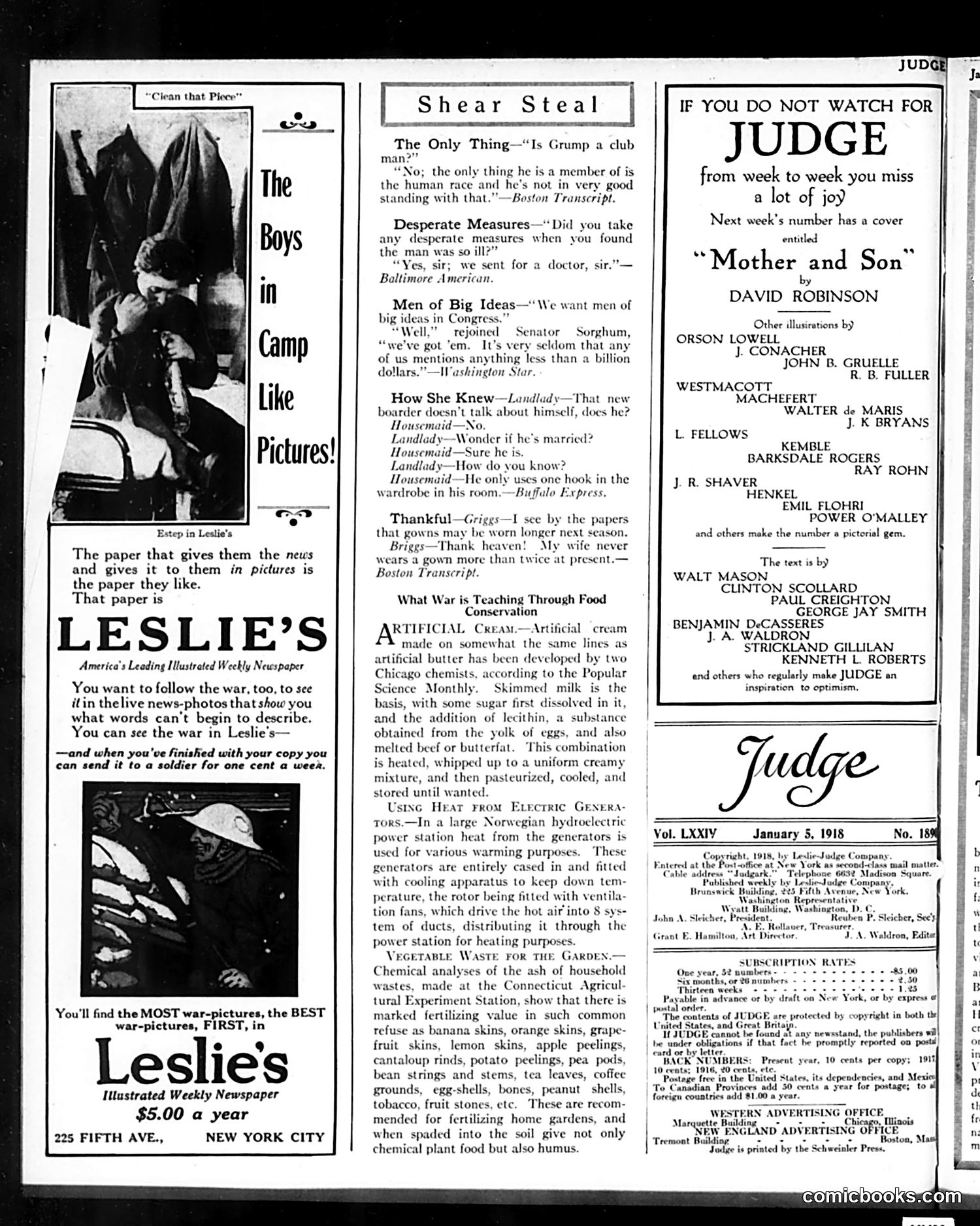
What you’re looking at
This is primarily a **title/contents page** for *Judge* magazine with advertisements and joke fillers rather than editorial cartoons. The main content includes: **Leslie's Illustrated Weekly Advertisement** (left): Appeals to WWI readers wanting war photographs, positioning Leslie's as superior for visual war coverage—relevant since America had entered the war in 1917. **"Shear Steal" Section** (center): A collection of short jokes satirizing American society. Notable examples mock Congressional vanity ("big ideas in Congress" = billion-dollar spending), marital assumptions, and fashion wastefulness. These reflect typical early-20th-century humor targeting politicians and social pretension. **"What War is Teaching Through Food Conservation"** (lower): Educational content about wartime rationing innovations—artificial cream, waste heat reuse, vegetable scraps as fertilizer. This reflects actual WWI-era conservation efforts Americans faced. The page essentially showcases *Judge*'s mixed editorial approach: light satire combined with practical wartime information and celebrity illustrator credits to attract readers.
📄 Transcribed text from this page (OCR, searchable)
Machine-transcribed from the original scan — historical spelling and the odd misread are preserved.
“Clean that Piece” Estep in Leslie's The paper that gives them the news and gives it to them in pictures is the paper they like. That paper is LESLIE’S America’s Leading Illustrated Weekly Newspaper You want to follow the war, too, to see itin thelive news-photos that show you what words can’t begin to describe. You can see the war in Leslie’s— —and when you've finished with your copy you can send it to a soldier for one cent a weer. You'll find the MOST war-pictures, the BEST war-pictures, FIRST, in Leslie's Illustrated Weekly Newspaper $5.00 a year 225 FIFTH AVE., NEW YORK CITY | Shear Steal The Only Thing—‘“Is Grump a club man?” “No; the only thing he is a member of is the human race standing with that.”—Boston Transcript. Desperate Measures—‘Did you take any desperate measures when you found the man was so ill?” “Yes, sir; we sent for a doctor, sir.”— Baltimore American. Men of Big Ideas—* We want men of big ideas in Congress.” “Well rejoined Senator Sorghum, “we've got ‘em. It’s very seldom tha: iy of us mentions anything less than a billion dollars.” —IVashington Star. How She Knew—Landludy—That new boarder doesn’t talk about himself, does he? Housemaid—No. Landlady—W onder if he’s married? Housemaid—Sure he is. Landlady—How do you know? Housemaid—He only uses one hook in the wardrobe in his room.—Buffulo Express. Thankful—Griggs—I sce by the papers that gowns may be worn longer next season. Briggs—Thank heaven! My wife never wears a gown more than twice at present.— Boston Transcript. What War is Teaching Through Food Conservation RTIFICIAL Cream.—Artificial made on somewhat the same lines as. artificial butter has been developed by two Chicago chemists, according to the Popular Science Monthly. Skimmed milk is the basis, with some sugar first dissolved in it, and the addition of lecithin, a substance obtained from the yolk of eggs, and also melted beef or butterfat. This combination is heated, whipped up to a uniform creamy mixture, and then pasteurized, cooled, and stored until wanted. Usinc Heat From Execrric GeNera- rors.—In a large Norwegian hydroelectric power station heat from the generators is used for various warming purposes. ‘These generators are entirely cased in and fitted with cooling apparatus to keep down tem- perature, the rotor being fitted with ventila- tion fans, which drive the hot air into 8 sys- tem of ducts, distributing it through the power station for heating purposes. VEGETABLE WASTE FOR THE GARDE: Chemical analyses of the ash of household wastes, made at the Connecticut Agricul- tural Experiment Station, show that there is marked fertilizing value in such common refuse as banana sl orange skins, grape- fruit skins, lemon skins, apple peelings, cantaloup rinds, potato peelings, pea pods, bean strings and stems, tea leaves, coffee grounds, shells, bones, peanut shells, tobacco, fruit stones, ete. ese are recom- mended for fertilizing home gardens, and when spaded into the soil give not only chemical plant food but also humus. cream IF YOU DO NOT WATCH FOR JUDGE from week to week you miss a lot of joy Next week's number has a cover entitled “Mother and Son” DAVID ROBINSON Other illusirations by ORSON LOWELL J. CONACHER JOHN B. GRUELLE R. B. FULLER WESTMACOTT MACHEFERT WALTER de MARIS J. K BRYANS L. FELLOWS KEMBLE BARKSDALE ROGERS RAY ROHN J. R. SHAVER HENKEL EMIL FLOHRI POWER O'MALLEY and others make the number a pictorial gem. The text is by WALT MASON CLINTON SCOLLARD PAUL CREIGHTON GEORGE JAY SMITH BENJAMIN DeCASSERES J. A. WALDRON STRICKLAND GILLILAN KENNETH L. ROBERTS and others who regularly make JUDGE an inspiration to optimism. Vol. LXXIY January 5, 1918 No. 18! Copyright, 1918, hy Ledie-Judge Company , The cpateats of JUDGE ate protected by « To Canadian Provinces add 1.25 "or by express tal order. right in both the) ay newsstand, the publishers «ill reported om post Great Britain anot be found a igations if that fact be Present year, 10 cents per copy; 1911 dependencies, and Mexic cents a year for postage; to dd $1.00 a year. ge free in the inois AND ADVERTIS ING ¢ Ofte Bostoa, M: ALLL TT USD