
Judge, 1918-01-05 · page 17 of 28
Judge — January 5, 1918 — page 17: what you’re looking at
What you’re looking at
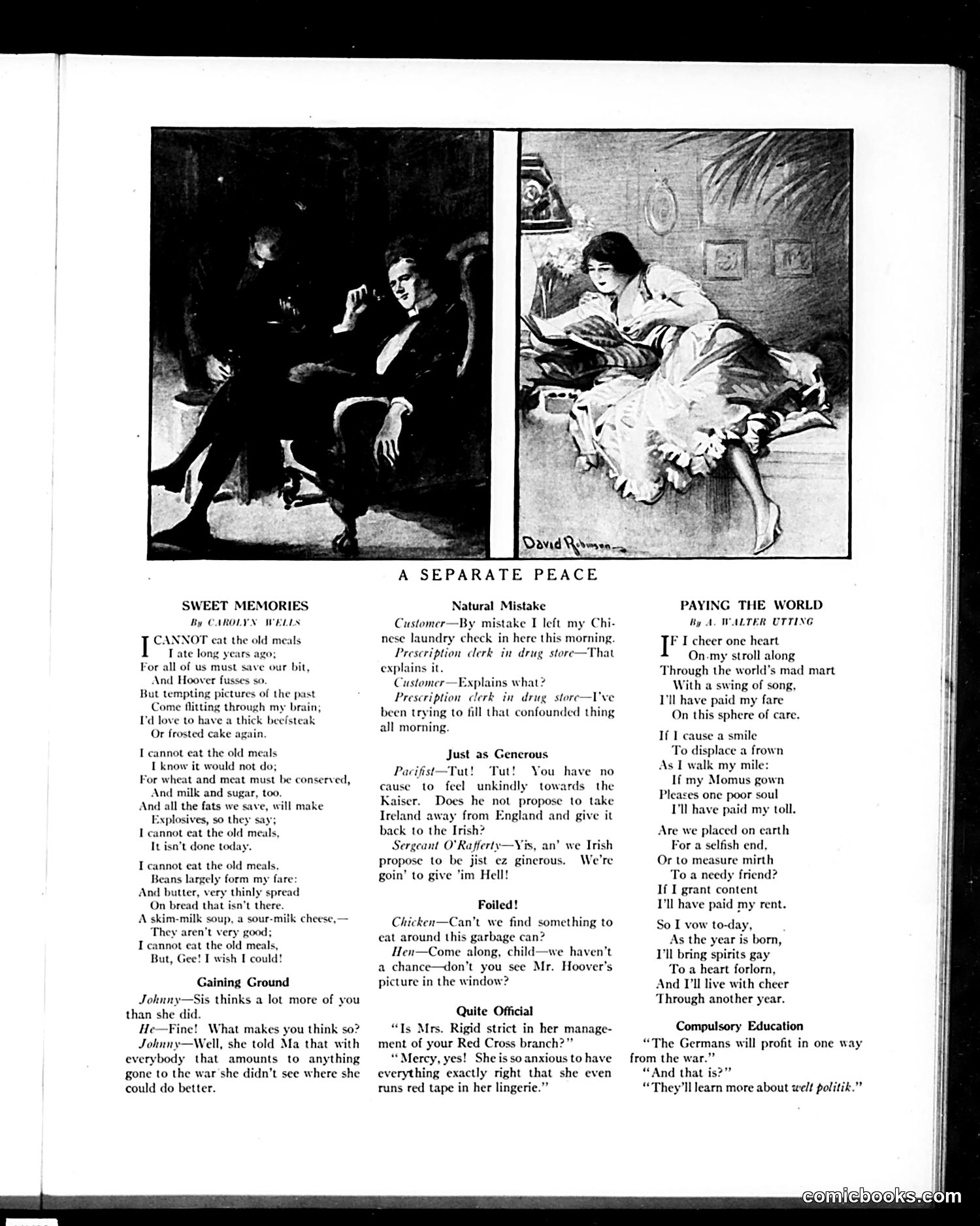
This Judge magazine page contains satirical commentary on American home-front conditions during World War I, particularly food rationing under Herbert Hoover's administration. **Key Content:** The poems mock wartime sacrifice. "Sweet Memories" laments government-mandated rationing—beans replacing beef, thin butter spreads, skim milk soup—while citizens endure privation supposedly for the war effort. "Gaining Ground" jokes that a soldier's absence makes him more appealing to a shallow woman. **Visual Cartoon:** The right illustration depicts a woman reading in a bedroom, signed by David Robinson, accompanying "Paying the World"—a sentimental poem about repaying society through kindness. **Political References:** - "Hoover" appears twice: the chicken cartoon shows his picture deterring scavenging, while rationing poems reference his role overseeing food conservation - The pacifist joke mocks Irish-American reluctance about the war - "Welt politik" joke assumes readers recognize German military-political strategy as a war lesson The satire balances patriotic acceptance of sacrifice with gentle ridicule of actual hardships and Hoover's austere administration of the home front.
📄 Transcribed text from this page (OCR, searchable)
Machine-transcribed from the original scan — historical spelling and the odd misread are preserved.
SWEET MEMORIES By CAROLYN WELLS I CANNOT eat the old meals Tate long years For all of us must save our bit, And Hoover fusses so. But tempting pictures of the past Come flitting through my brain; I'd love to have a thick beef: Or frosted cake again. I cannot eat the old meals I know it would not do; For wheat and meat must be conserved, And milk and sugar, too, the fats we save, will make plosives, so they’ say I cannot eat the old meals, It isn’t done today. I cannot eat the old meals. Beans largely form my fare And butter, very thinly spread On bread that isn’t there. A skim-milk soup, a sour-milk cheese,— They aren't very good; I cannot eat the old meals, But, Gee! I wish I could! Gaining Ground Johnny—Sis thinks a lot more of you than she did. He—Fine! What makes you think so? Johnny—Well, she told Ma that with everybody that amounts to anything gone to the war she didn’t see where she could do better. A SEPARATE PEACE Natural Mistake Customer—By mistake I left my Chi- nese laundry check in here this morni Prescription clerk in drug store explains it. Customer—Explains what? Prescription clerk in drug store—V've been trying to fill that confounded thing all morning. Just as Generous Pacifist—Tut! Tut! You have no cause to f unkindly towards the 's he not propose to take from England and gi Yis, an’ we Irish ¢ to be jist ez ginerous. We're im Hell! Foiled! Chicken—Can’t we find something to eat around this garbage can? Hen—Come along, child—we haven't a chance—don't you see Mr. Hoover's picture in the window? Quite Official “Is Mrs. Rigid strict in her manage- ment of your Red Cross branch?” “Mercy, yes! She is so anxious to have everything exactly right that she even runs red tape in her lingerie.” David Rveren PAYING THE WORLD By A. WALTER UTTING J * I cheer one heart On.my stroll along Through the world’s mad mart With a swing of song, I'll have paid my fare On this sphere of care. If I cause a smile To displace a frown As I walk my mile: If my Momus gown Pleases one poor soul I'll have paid my toll. Are we placed on earth For a selfish end, Or to measure mirth To a needy friend? If I grant content I'll have paid my rent. So I vow to-day, As the year is born, I'll bring spirits gay To a heart forlorn, And I'll live with cheer Through another year. Compulsory Education “The Germans will profit in one way from the war.” “And that is?” “They'll learn more about welt politik.”