
Judge, 1918-01-05 · page 8 of 28
Judge — January 5, 1918 — page 8: what you’re looking at
What you’re looking at
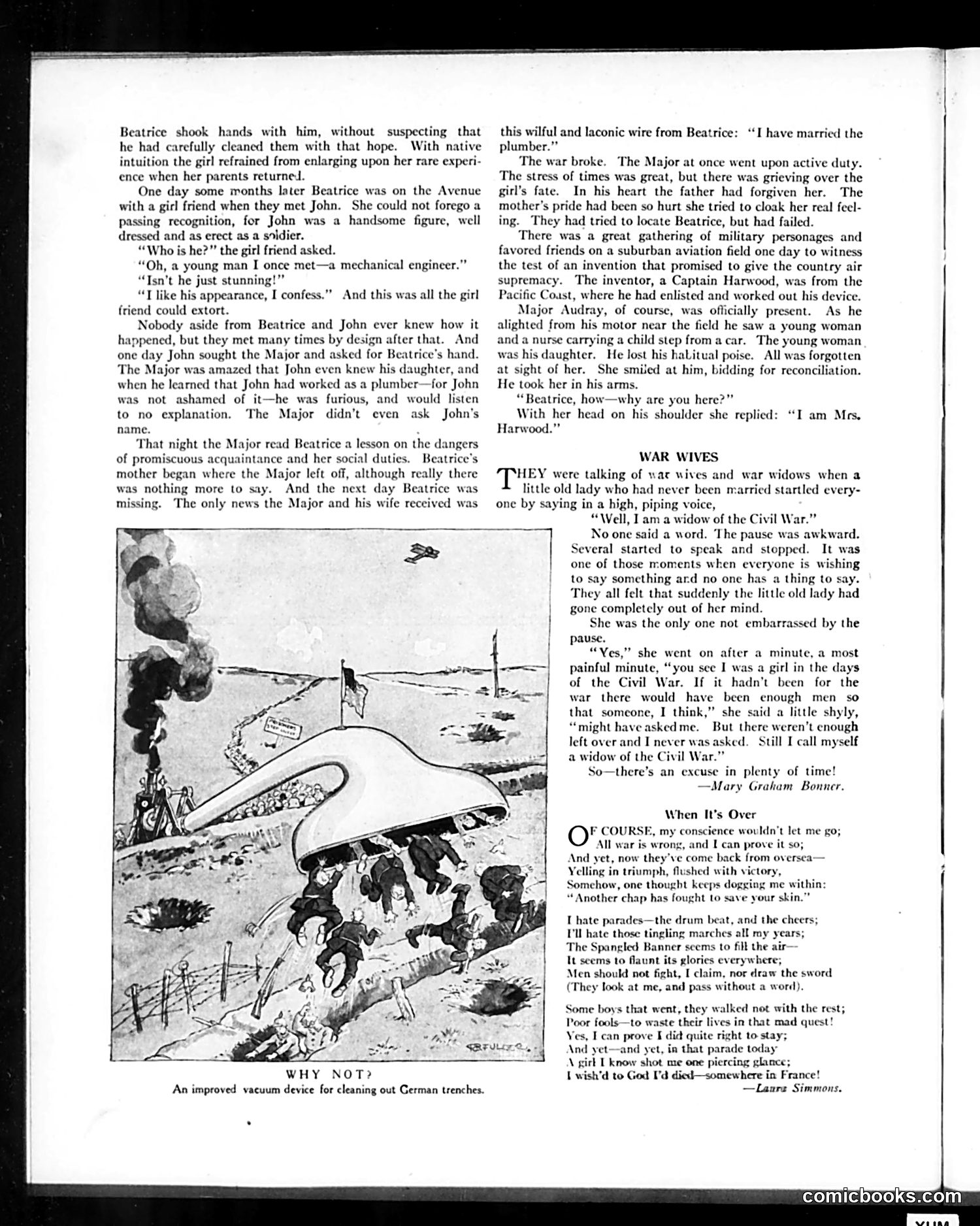
This page contains a romantic short story and humorous anecdotes about World War I-era America. **The main story** depicts a class conflict: Beatrice, from an aristocratic military family, falls in love with John, a working-class plumber. Her father, "the Major," refuses the match because of John's low social status. She elopes. Later, at a military aviation demonstration, the Major discovers John is actually "Captain Harwood," an aircraft inventor whose device promises air superiority—legitimizing him retroactively through wartime achievement and military rank. **"War Wives" section** features a humorous anecdote: an elderly unmarried woman claims to be "a widow of the Civil War" because the shortage of men killed in that conflict prevented her from ever marrying. It's gentle satire on how women's life prospects were entirely dependent on marriage availability. The cartoon "Why Not?" (caption visible) appears to satirize military trench warfare with dark humor about "cleaning out German trenches." The page reflects WWI-era American values: class mobility through military service, women's dependent social status, and dark war humor.
📄 Transcribed text from this page (OCR, searchable)
Machine-transcribed from the original scan — historical spelling and the odd misread are preserved.
Beatrice shook hands with him, without suspecting that he had carefully cleaned them with that hope. With native intuition the girl refrained from enlarging upon her rare experi- ence when her parents returned. One day some months later Beatrice was on the Avenue with a girl friend when they met John. She could not forego a passing recognition, for John was a handsome figure, well dressed and as erect as a snidier. “Who is he?” the girl friend asked. “Oh, a young man I once met—a mechanical engineer.” “Isn't he just stunnin, “T like his appearance, I confess." And this was all the girl friend could extort. Nobody aside from Beatrice and John ever knew how it happened, but they met many times by design after that. And one day John sought the Major and asked for Beatrice’s hand. The Major was amazed that John even knew his daughter, and when he learned that John had worked as a plumber—for John not ashamed of it—he was furious, and would listen to no explanation, The Major didn’t even ask John’s name. That night the Major read Beatrice a lesson on the dangers of promiscuous acquaintance and her social duties. Beatrice’s mother began where the Major left off, although really there nothing more to say. And the next day Beatrice was missing. The only news the Major and his wife received was this wilful and laconic wire from Beatrice: ‘‘I have married the plumber.” The war broke. The Major at once went upon active duty. The stress of times was great, but there was grieving over the girl's fate. In his heart the father had forgiven her. The mother's pride had been so hurt she tried to cloak her real feel- ing. They had tried to locate Beatrice, but had failed. There was a great gathering of military personages and favored friends on a suburban aviation field one day to witne: the test of an invention that promised to give the country air supremacy. The inventor, a Captain Harwood, was from the Pacific Coast, where he had enlisted and worked out his device. Major Audray, of course, was officially present. As he alighted from his motor near the field he saw a young woman and a nurse carrying a child step from a car. The young woman was his daughter. He lost his habitual poise. All was forgotten at sight of her. She smiled at him, bidding for reconciliation. He took her in his arms. Beatrice, how—why are you here?” With her head on his shoulder she replied: Harwood.” Tam Mrs, WAR WIVES HEY were talking of wart wives and war widows when a little old lady who had never been married startled every- one by saying in a high, piping voice, “Well, 1 am a widow of the Civil War.” No one said a word. The pause was awkward. Several started to speak and stopped. It was one of those moments when everyone is wishing to say something ard no one has a thing to say. They all felt that suddenly the little old lady had gone completely out of her mind. She was the only one not embarrassed by the pause. “Yes,” she went on after a minute, a most painful minute, “you sce I was a girl in the days of the Civil War. If it hadn't been for the war there would have been enough men so that someone, I think,” she said a little shyly, “might have askedme. But there weren't enough left over and I never was asked. Still I call myself a widow of the Civil War. So—there’s an excuse in plenty of time! —Mary Graham Bonner. When It’s Over F COURSE, my conscience wouldn't let me go; Al war is wrong, and [can prove it so; And yet, now they've come back from oversea Yelling in triumph, flushed with victory, Somehow, one thought keeps dogging me withi “ Another chap has fought to save your skin.” T hate parades—the drum beat, and the ch T'll hate those tingling marches all my years; The Spangled Banner scems to fill the air— It scems to flaunt its glories everywhere; Men should not fight, I claim, nor draw the sword (They look at me, and pass without a word). Some boys that went, they walked not with the rest; Poor fools—to waste their lives in that mad quest! Yes, I can prove I did quite right to stay; And yet—and yet, in that parade today WHY NOT? An improved vacuum device for cleaning out German trenches. \ girk I know shot me one piercing glance; I wish’d to God I'd died—somewhere in France! —Laare Simmons.