
Judge, 1918-01-05 · page 12 of 28
Judge — January 5, 1918 — page 12: what you’re looking at
What you’re looking at
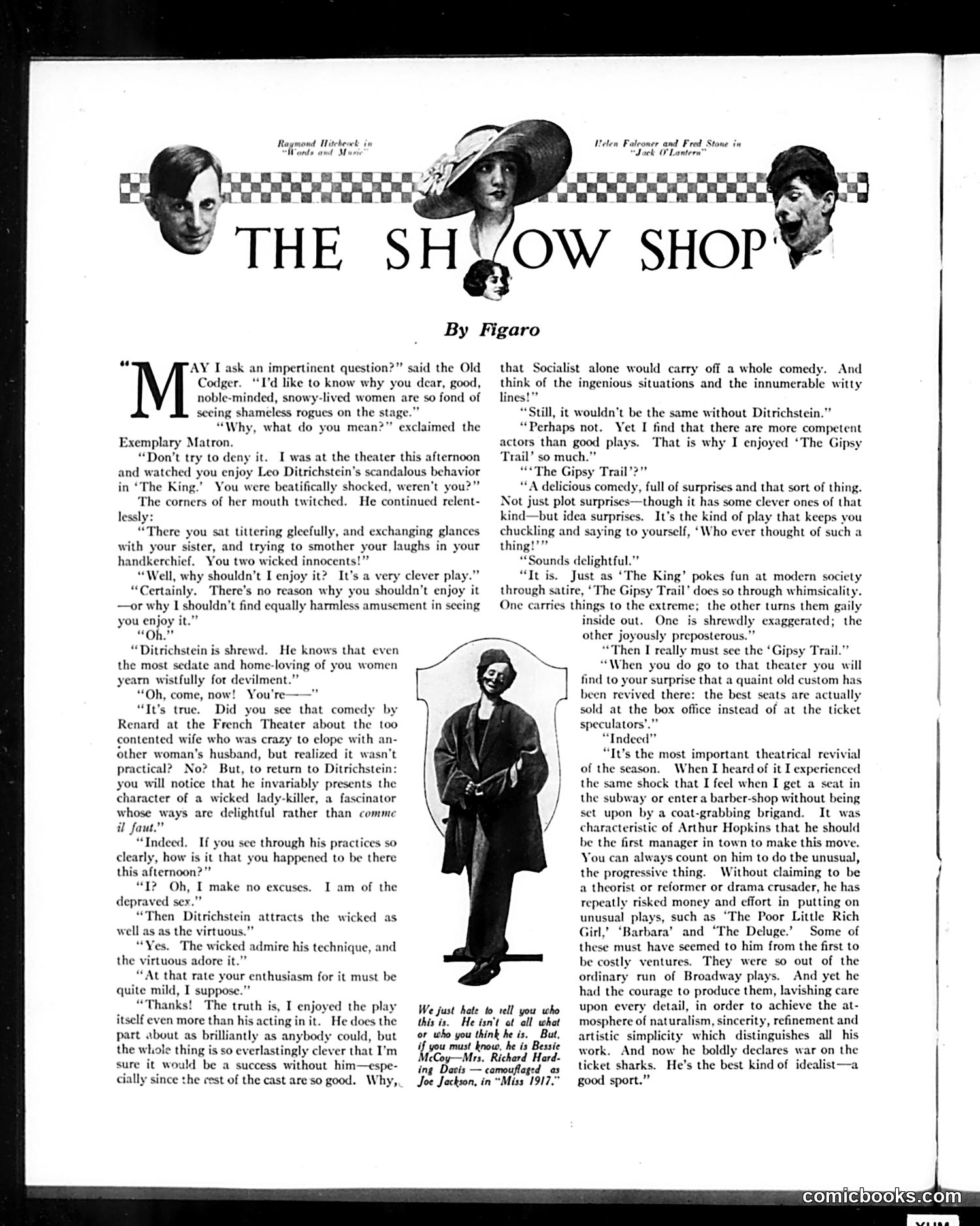
This is a satirical dialogue between an "Old Codger" and an "Exemplary Matron" about theater-going and hypocrisy. The piece mocks respectable Victorian women who publicly claim moral superiority while privately enjoying scandalous stage performances. The satire targets actor Leo Ditrichstein, who apparently specialized in playing charming "wicked" seducers. The Old Codger points out that proper ladies attending his performances—pretending shock while "tittering gleefully"—reveal their actual desires for excitement and "devilment" beneath their pious facades. The dialogue shifts to praise "The Gipsy Trail," contrasting Ditrichstein's extreme satire with its gentler whimsy. The final joke mocks theater box-office practices, sardonically noting that revival of selling premium seats directly (rather than through scalpers) constitutes the season's "most important theatrical revival." The piece satirizes class pretension, female respectability theater, and audience hypocrisy about entertainment.
📄 Transcribed text from this page (OCR, searchable)
Machine-transcribed from the original scan — historical spelling and the odd misread are preserved.
Raymond Hitehevek in Words aud Mue s AY [ask an impertinent question?” said the Old Codger. “I'd like to know why you dear, good, noble-minded, snowy-lived women are so fond of seeing shameless rogues on the re.” “Why, what do you me exclaimed the Exemplary Matron. “Don’t try to deny it. I was at the theater this afternoon and watched you enjoy Leo Ditrichstein’s scandalous behavior in ‘The King.’ You were beatifically shocked, weren't you?” The corners of her mouth twitched. He continued relent- lessly: “There you sat tittering gleefully, and exchanging glances with your sister, and trying to smother your laughs in your Qe handkerchief. You two wicked innocents “Well, why shouldn’t I enjoy “Certainly. There's no re —or why I shouldn't find equally harmless you enjoy it.” “Oh.” “Ditrichstein is shrewd. He knows that even the most sedate and home-loving of you women yearn wistfully for devilment.” “Oh, come, now! You’re——" “It’s true. Did you see that comedy by Renard at the French Theater about the too contented wife who was crazy to elope with an- other woman’s husband, but realized it wasn’t practical? No? But, to return to Ditrichstein: you will notice that he invariably presents the character of a wicked lady-killer, a fascinator whose ways are delightful rather than comme il faut.” “Indeed. If you sce through his practices so clearly, how is it that you happened to be there this afternoon?” “1? Oh, I make no excuses. depraved sex.” “Then Ditrichstein attracts the wicked as well as as the virtuous.”” wy The wicked admire his technique, and the virtuous adore it.” “At that rate your enthusiasm for it must be quite mild, I suppose.” nks! The truth is, I enjoyed the play amusement in seeing I am of the part about as brilli the whole thing is so everlastingly cl sure it would be a success without him—espe- ing Davis — cially since the cest of the cast are so good. Why, Joe Jackson, By Figaro A . A eetaer, We just hate to tell you who . ; itself even more than his acting init. Hedoesthe this is. He isn't of all what mosphere of naturalism, sincerity, ntly as anybody could, but or who you think he is. But, r that I'm {pee mat tro be Bessie work. And now he boldly declares war on the mouflaged as Uelen Falconer and Fred Stone in “Jack O' Lantern” that Socialist alone would carry off a whole comedy. And think of the ingenious situations and the innumerable witty line “Still, it wouldn’t be the same without Ditrichstein.” “Perhaps not. Yet I find that there are more competent ctors than good plays. That is why I enjoyed ‘The Gipsy ail’ so much.” The Gipsy Trail’?” “A delicious comedy, full of surprises and that sort of thing. Not just plot surprises—though it has some clever ones of t kind—but idea surpris It's the kind of play that keeps you chuckling and saying to yourself, ‘Who ever thought of such a thing!’”” Sounds delightful.” “It is. Just as ‘The King’ pokes fun at modern society through satire, ‘The Gipsy Trail’ does so through whimsicalit One carries things to the extreme; the other turns them gaily inside out. One is shrewdly exaggerated; the other joyously preposterous. “Then I really must see the ‘Gipsy Trail.” “When you do go to that theater you will find to your surprise that a quaint old custom has been revived there: the best seats are actually sold at the box office instead of at the ticket “Indeed “It’s the most important theatrical revivial of the season. When I heard of it I experienced the same shock that I feel when I get a seat in the subway or enter a barber-shop without being set upon by a coat-grabbing brigand. It was characteristic of Arthur Hopkins that he should be the first manager in town to make this move. You can always count on him to do the unusual, the progressive thing. Without claiming to be a theorist or reformer or drama crusader, he has repeatly risked money and effort in putting on unusual plays, such as ‘The Poor Little Rich Girl’ ‘Barbara’ and ‘The Deluge.’ Some of these must have seemed to him from the first to be costly ventures. They were so out of the ordinary run of Broadway plays. And yet he had the courage to produce them, lavishing care upon every detail, in order to achieve the at- efinement and inguishes all his artistic simplicity which di: ticket sharks. He’s the best kind of idealist—a ‘Miss 1917." good sport.” SS __ | | |