
A complete issue · 28 pages · 1917
Judge — October 6, 1917
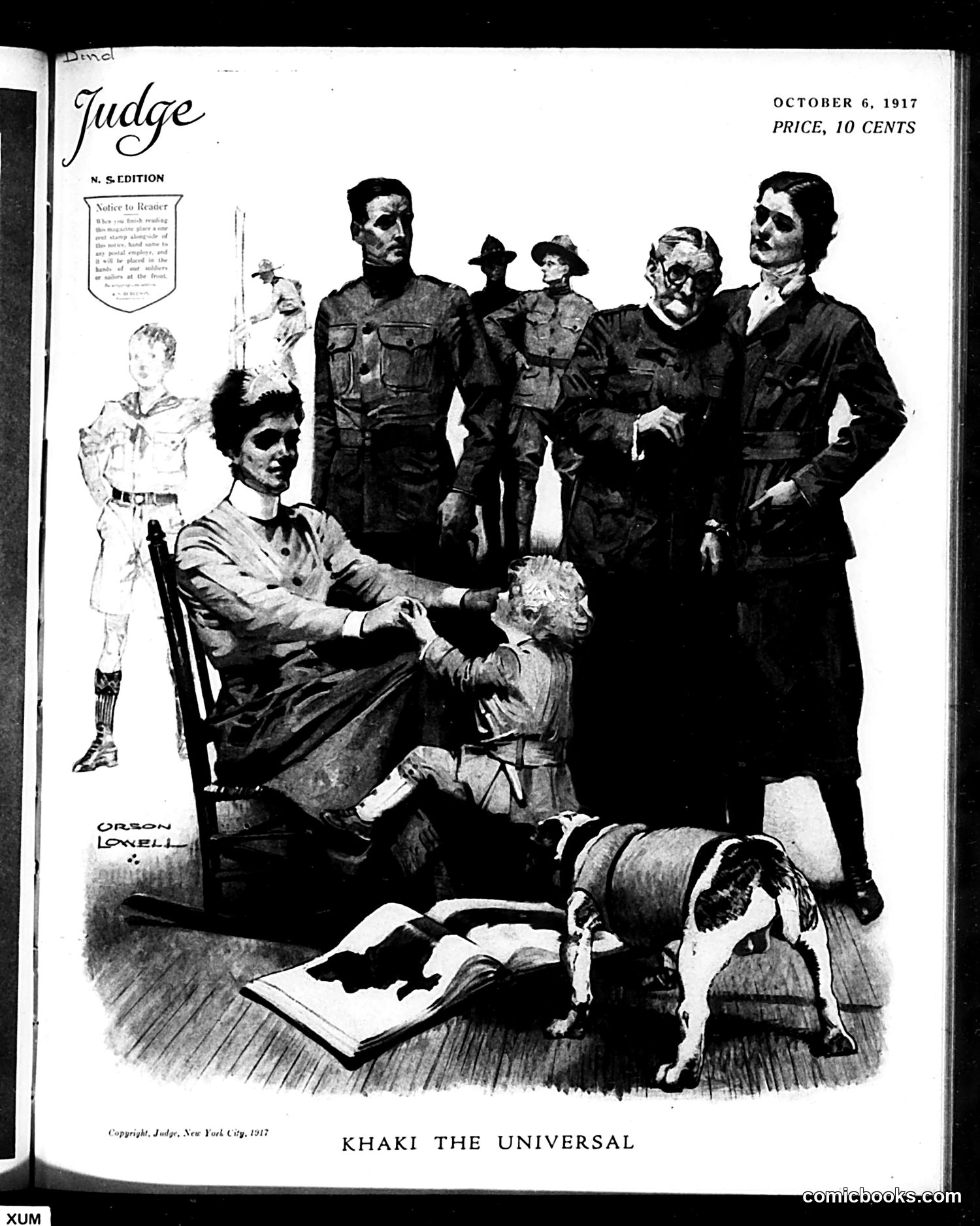
This October 1917 cartoon by Orson Lowell satirizes the widespread adoption of military uniforms during World War I. The image shows a woman seated while various military and civilian figures in khaki uniforms surround her—soldiers, officers, and apparently civilians who've adopted military dress. A small dog also wears khaki coloring. The satire appears to mock how pervasively military uniforms and "khaki" (the standard WWI uniform color) had infiltrated American society, extending even to civilians and animals. The "universal" in the title suggests that khaki had become so commonplace it was everywhere—a commentary on either militarization of civilian life or the fashion trend of adopting military styles during wartime. The cartoon likely critiques this trend as absurd or excessive.
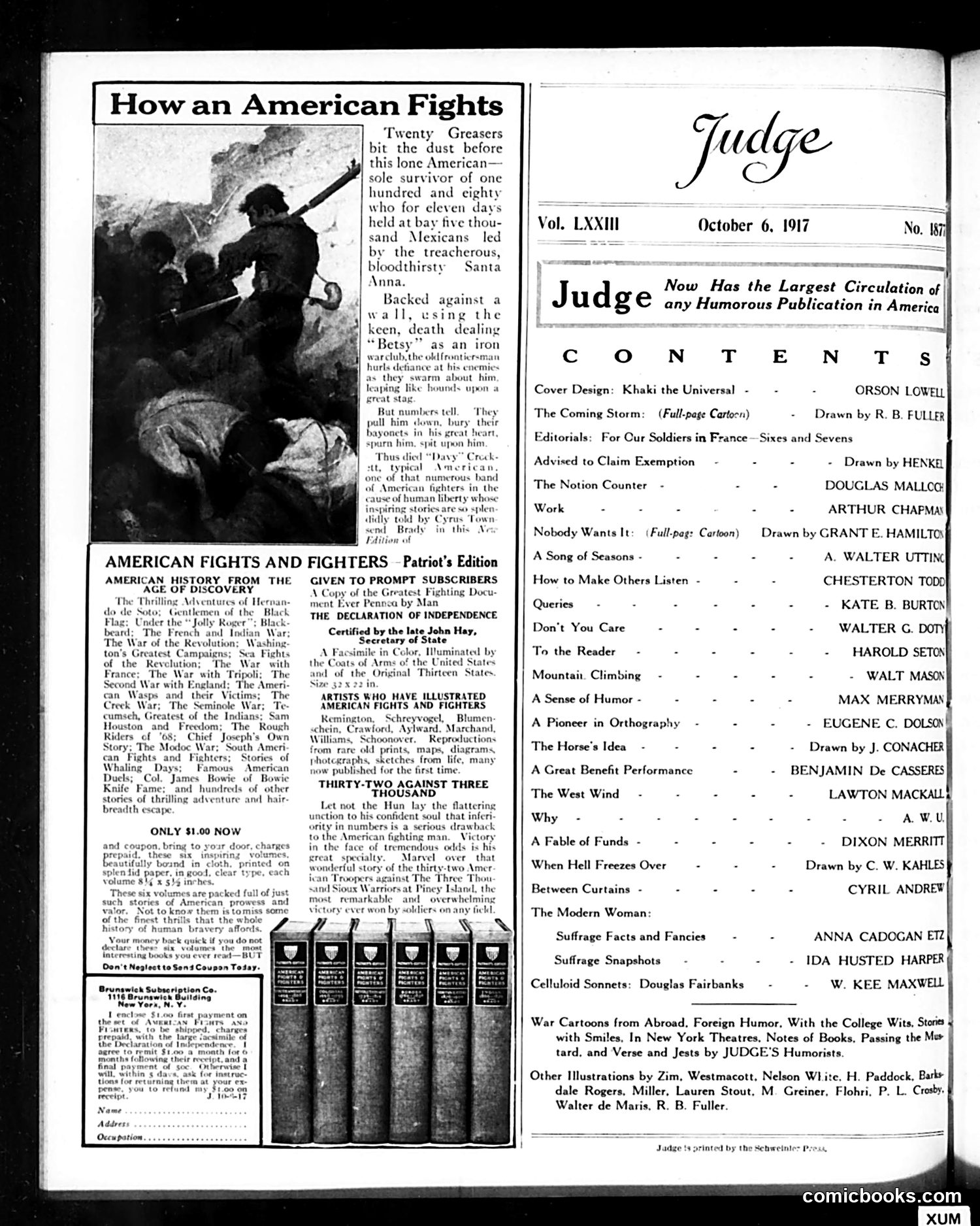
The left page features "How an American Fights," illustrating combat techniques with a soldier using a bayonet against an enemy. The accompanying text describes brutal hand-to-hand combat during what appears to be a skirmish involving Mexican forces ("five thousand Mexicans") and references a character named "Davy Crockett." The right page is a contents listing for Judge magazine's latest issue, which claims the "Largest Circulation of any Humorous Publication in America." It advertises various illustrated articles and cartoons on war-related topics, soldier life in France, and general humor content. The overall context reflects America's 1917 involvement in World War I, with content focused on military action, patriotism, and contemporary combat scenarios for a American readership.
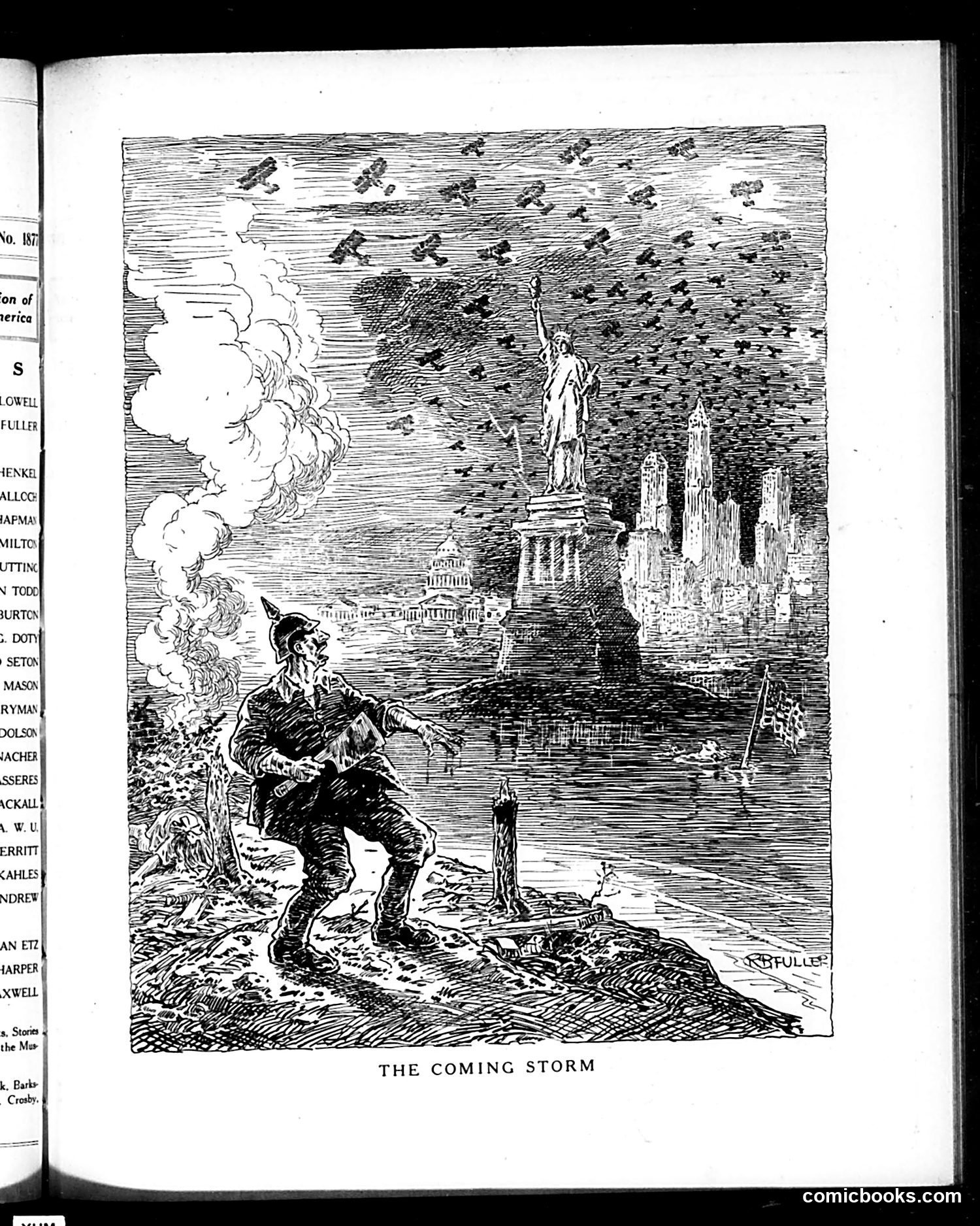
This engraving depicts a figure (likely representing a political leader or statesman) standing on rocky ground near a burning tree, pointing toward a distant city with classical architecture and a statue. Dark storm clouds gather overhead with birds fleeing the scene. The imagery suggests impending political or social crisis—the burning tree symbolizes destruction, the fleeing birds represent panic or exodus, and the threatening storm clouds indicate danger ahead. The pointing gesture suggests warning or prophetic awareness of coming turmoil. Without additional context from the magazine's date and surrounding text, the specific political event or figure referenced remains unclear, though the cartoon employs typical Gilded Age satirical iconography warning of societal upheaval or governmental crisis.
This page combines a charitable appeal with political satire. The main editorial announces Judge's French Christmas Fund for American soldiers in France during World War I, allowing donors to send $1 gift packages (costing 50 cents to assemble) to troops. The right column contains brief satirical jabs at contemporary political figures and issues: references to President Wilson's appointees (termed "prexy"), Ex-Czar Nicholas and Russian elections, national prohibition, Bryan's political activities, and Wilson's power to make Senate appointments. The humor relies on readers' familiarity with these wartime debates. The overall tone mixes patriotic sentiment (supporting troops) with cynicism about domestic politics—a common Judge magazine approach during this period.
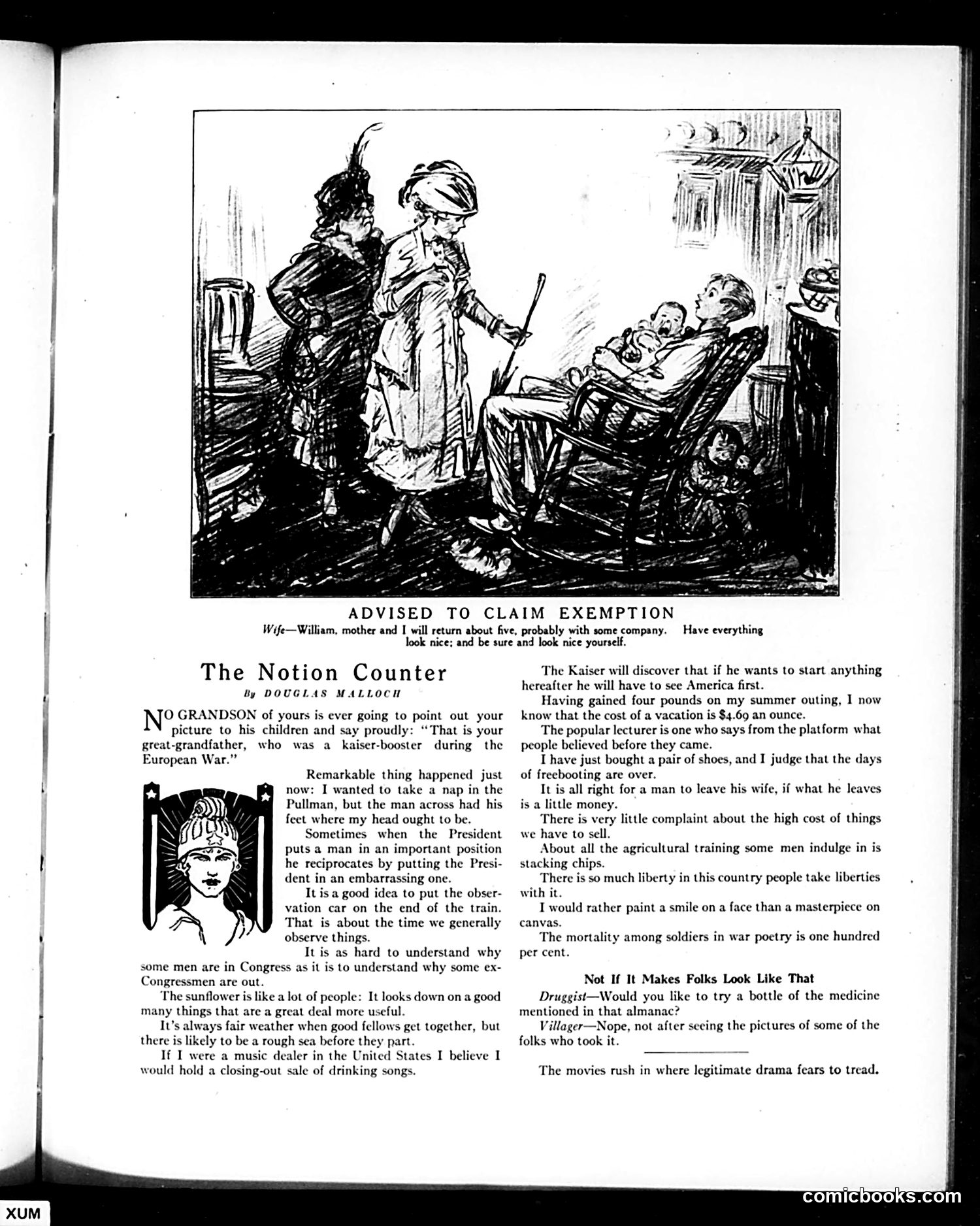
The main cartoon titled "Advised to Claim Exemption" depicts a domestic scene where a man (labeled "Wm") appears to be receiving advice about claiming exemption from military service, likely during World War I. The woman on the left, dressed elaborately with a feathered hat, seems to be coaching him on how to present himself respectfully to avoid conscription. The satire mocks both the effort to evade military duty and the superficiality of using appearance ("look nice") as a strategy. The accompanying column "The Notion Counter" contains various social commentary about war, patriotism, and American life, suggesting the cartoon ridicules those attempting to dodge service through deception rather than legitimate grounds for exemption.
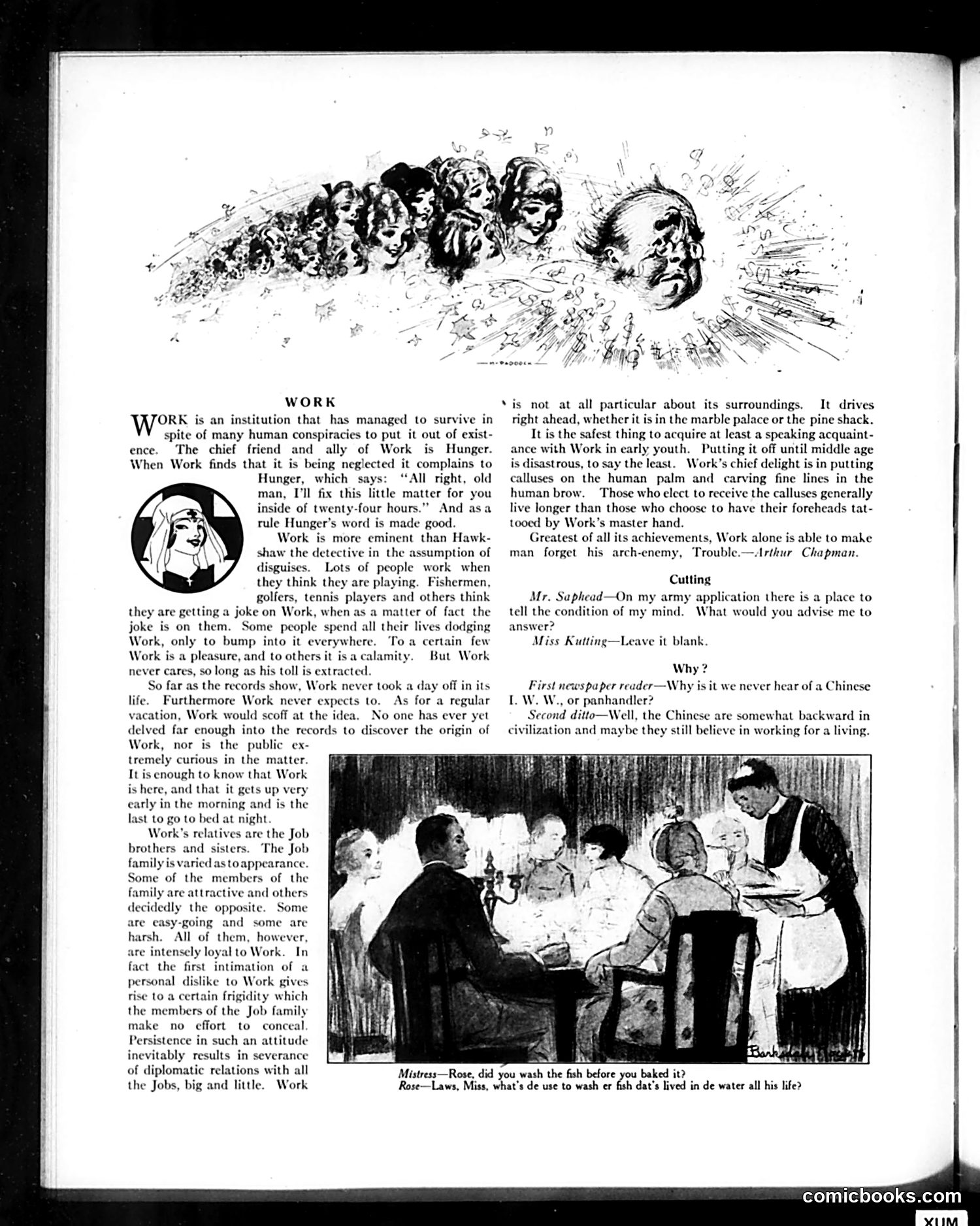
This satirical piece uses personification to mock the institution of Work itself as a demanding master. The illustration shows several faces morphing together, suggesting Work consumes identity. The text presents Work as an all-consuming "chief friend" driven by Hunger, playing on labor's exploitative nature. It satirizes how people justify overwork across professions (fishermen, golfers, tennis players), treating drudgery as noble. The dialogue exchange mocks workplace absurdities: an employee asks about noting "army application" on a form; a supervisor dismissively says "Leave it blank"—suggesting Work's indifference to individual circumstances. The lower illustration shows a domestic scene with a caption about washing fish, likely illustrating how work invades home life. The piece critiques early 20th-century American work culture's relentless demands and workers' resigned acceptance thereof.
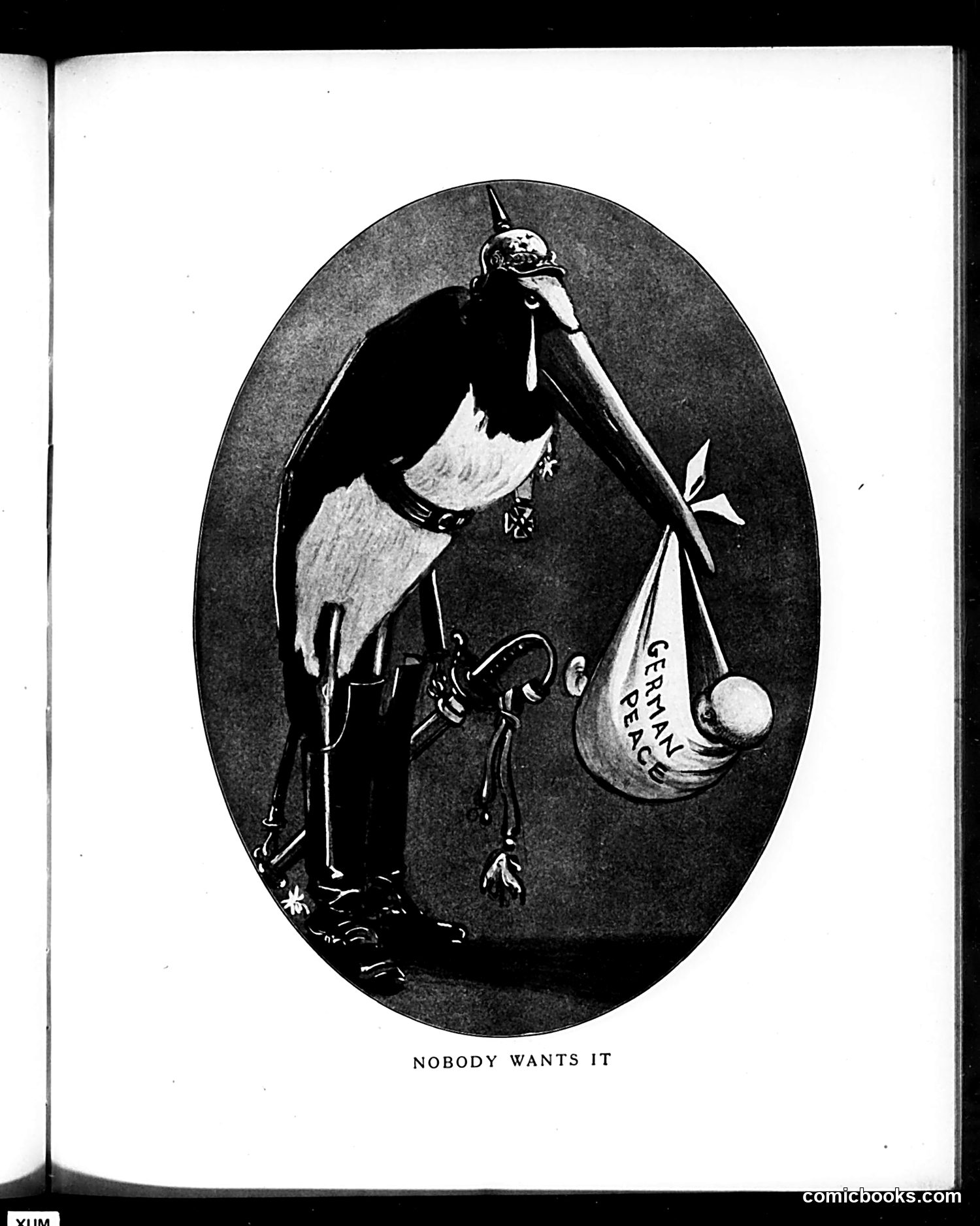
This cartoon depicts a German military figure (identifiable by the spiked Prussian helmet, or "Pickelhaube") carrying a bundle labeled "GERMANY PEACE" while appearing unwanted or rejected. The satire suggests that Germany's peace offerings were not genuinely desired—either by other nations or, ironically, by Germany itself. Given Judge magazine's American perspective and the historical context, this likely comments on failed German peace negotiations or proposals during World War I, suggesting skepticism about German sincerity. The figure's military appearance contrasts with the "peace" message, implying that German military ambitions undermined claims of peaceful intent. The caption "Nobody Wants It" emphasizes the universal rejection of whatever Germany was proposing.
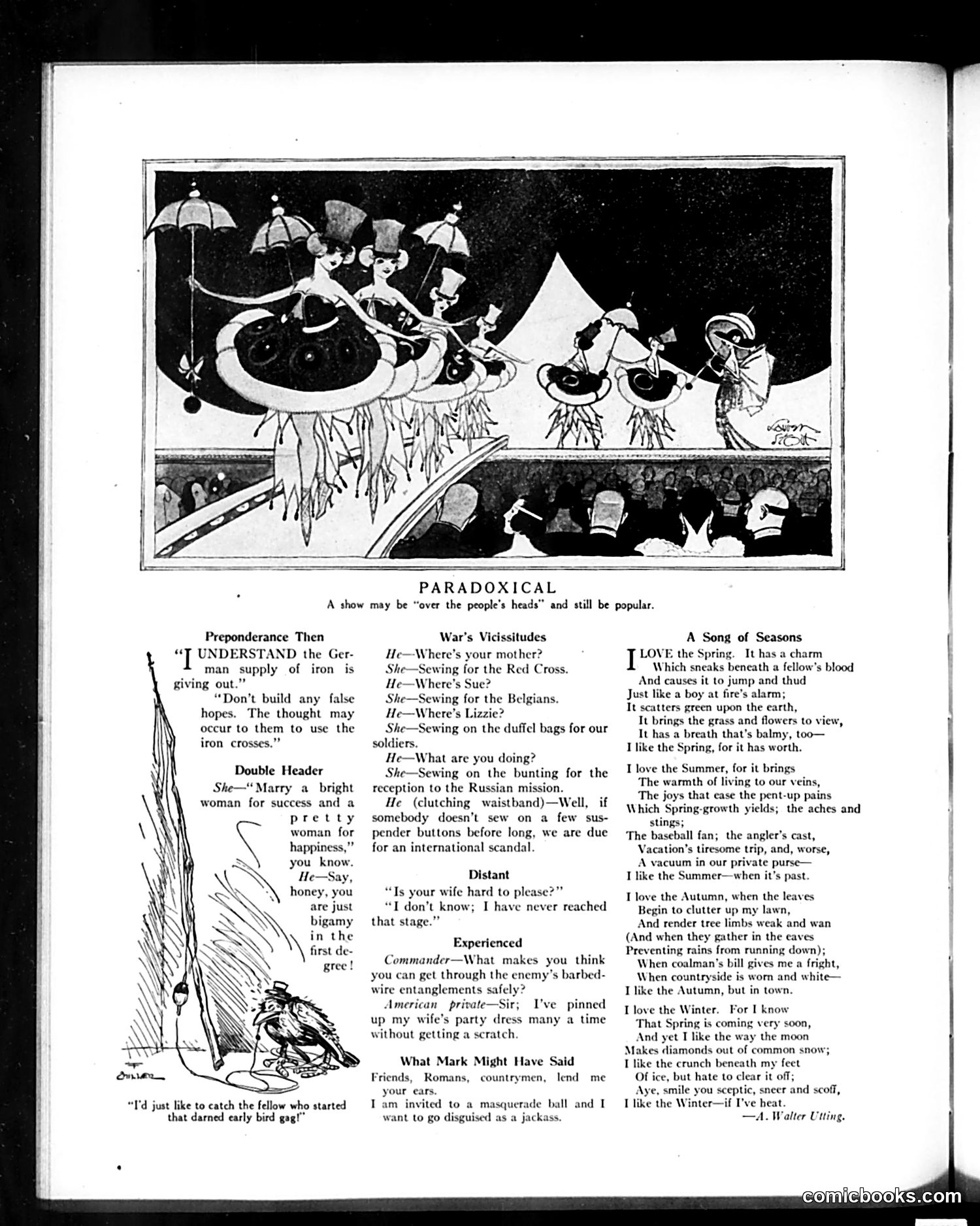
The top cartoon titled "Paradoxical" depicts a theatrical performance viewed from above by an audience below. The joke appears to concern wartime entertainment—the visual shows an elaborate, perhaps absurdist show "over the people's heads" (literally, in the staging) yet remaining popular despite its obscurity. The text sections mock WWI-era life: "War's Vicissitudes" jokes about women constantly sewing for various war efforts (Red Cross, Belgian relief, soldiers' uniforms, Russian mission receptions), leaving husbands without button repairs—threatening "international scandal." "Double Header" satirizes marriage pragmatism. Other brief jokes mock military recruitment ("Experienced" contrasts a commander's concern with an American soldier's mundane domestic experience), and a "Mark Might Have Said" joke plays on Shakespeare while mocking someone attending a masquerade as a donkey. "A Song of Seasons" is a nostalgic poem celebrating each season with humorous caveats—spring and summer idealized, autumn resented for yard work and coal bills, winter tolerable only with heat. The overall page reflects American homefront WWI anxieties mixed with everyman complaints about domestic life.
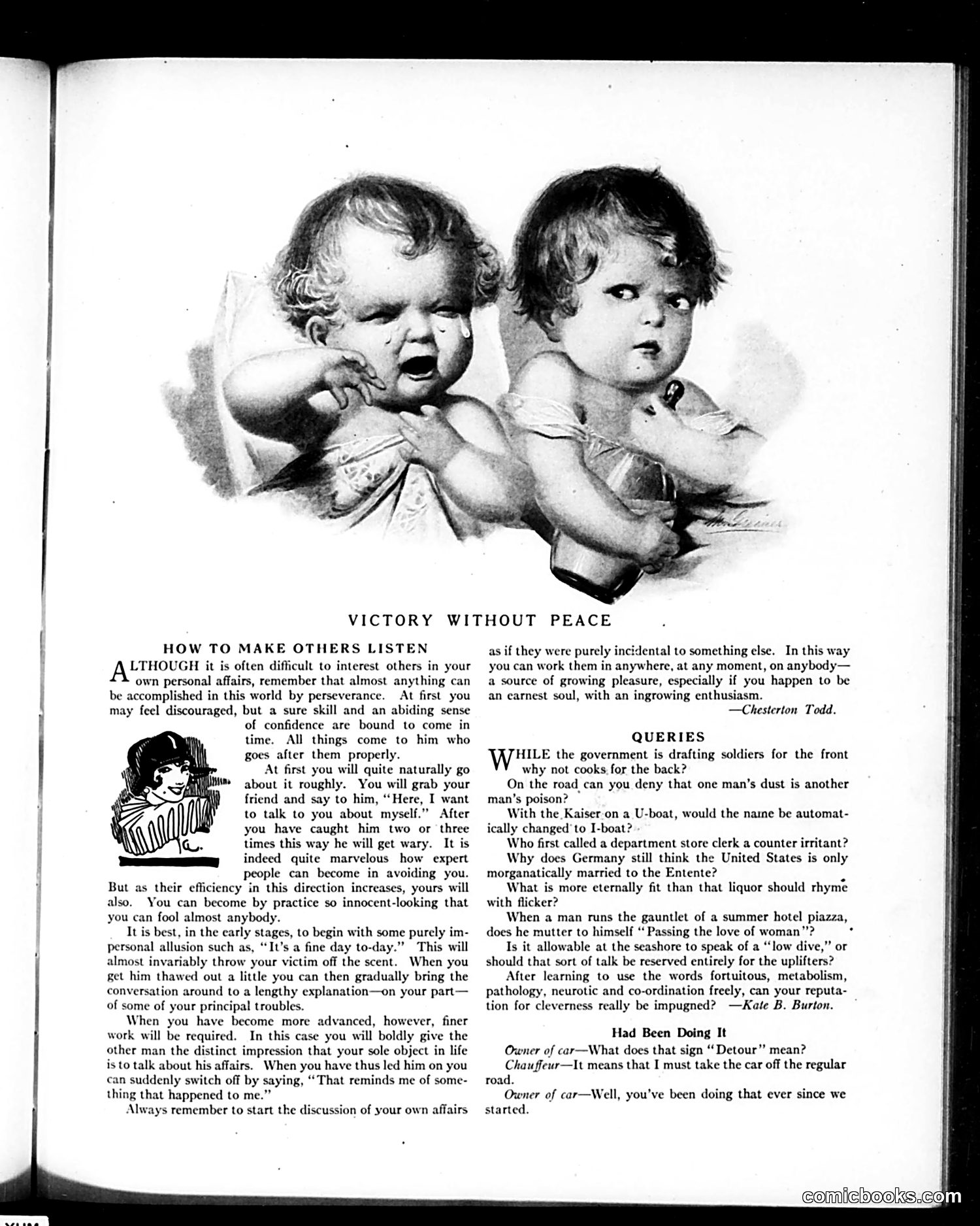
**"Victory Without Peace"** is the page's ironic title, contrasting with the content below—a humorous essay on manipulating others into listening to you talk about yourself. **The main illustration** depicts two toddlers, likely representing the warring nations of World War I (the page references "the Kaiser" and U-boats in the queries section). Their aggressive postures and the title suggest that even after military victory, nations will continue destructive competition and self-interest. **The essay "How to Make Others Listen"** satirizes social selfishness: it describes escalating manipulation tactics—from crude demands for attention to sophisticated deception—to force others to endure your personal complaints. The humor lies in its frank acknowledgment of universal human narcissism. **The "Queries" section** contains wordplay and satirical questions about WWI (drafting soldiers, Germany's relationship with Allied powers) mixed with absurdist humor, typical of Judge magazine's style. The underlying message: humanity's petty selfishness mirrors nations' inability to achieve genuine peace—we're all just trying to make others listen to our grievances.
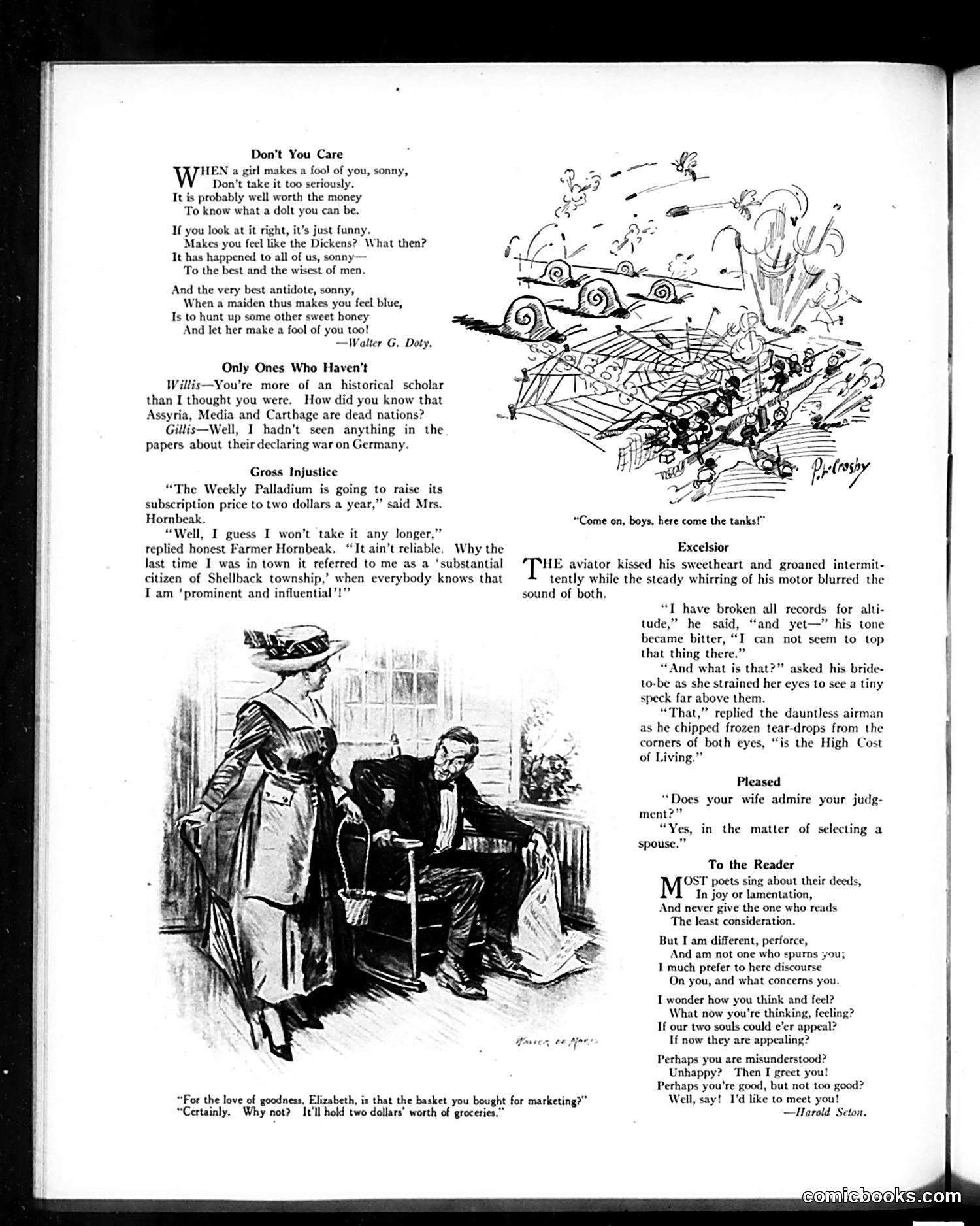
This page contains several satirical pieces typical of early 20th-century American humor: **"Don't You Care"** — A poem by Walter G. Doty offering sardonic advice about romantic rejection, suggesting men console themselves by pursuing other women. The humor lies in treating romantic disappointment as trivial. **"Only Ones Who Haven't"** — A joke where Willis assumes Assyria, Media, and Carthage are "dead nations" because he hasn't read newspaper reports of them declaring war on Germany. This satirizes wartime anxiety and newspaper obsession—the implication being that with so many nations at war, any nation *not* mentioned in war reports must be extinct. **"Gross Injustice"** — Farmer Hornbeak cancels his newspaper subscription because it called him a "substantial citizen" when he considers himself "prominent and influential"—mocking rural vanity and small-town newspaper pomposity. **"Excelsior"** — A romantic aviation story where an aviator laments he cannot overcome "the High Cost of Living," a contemporary economic complaint. The remaining pieces are lighter humor and a poem addressing readers directly.
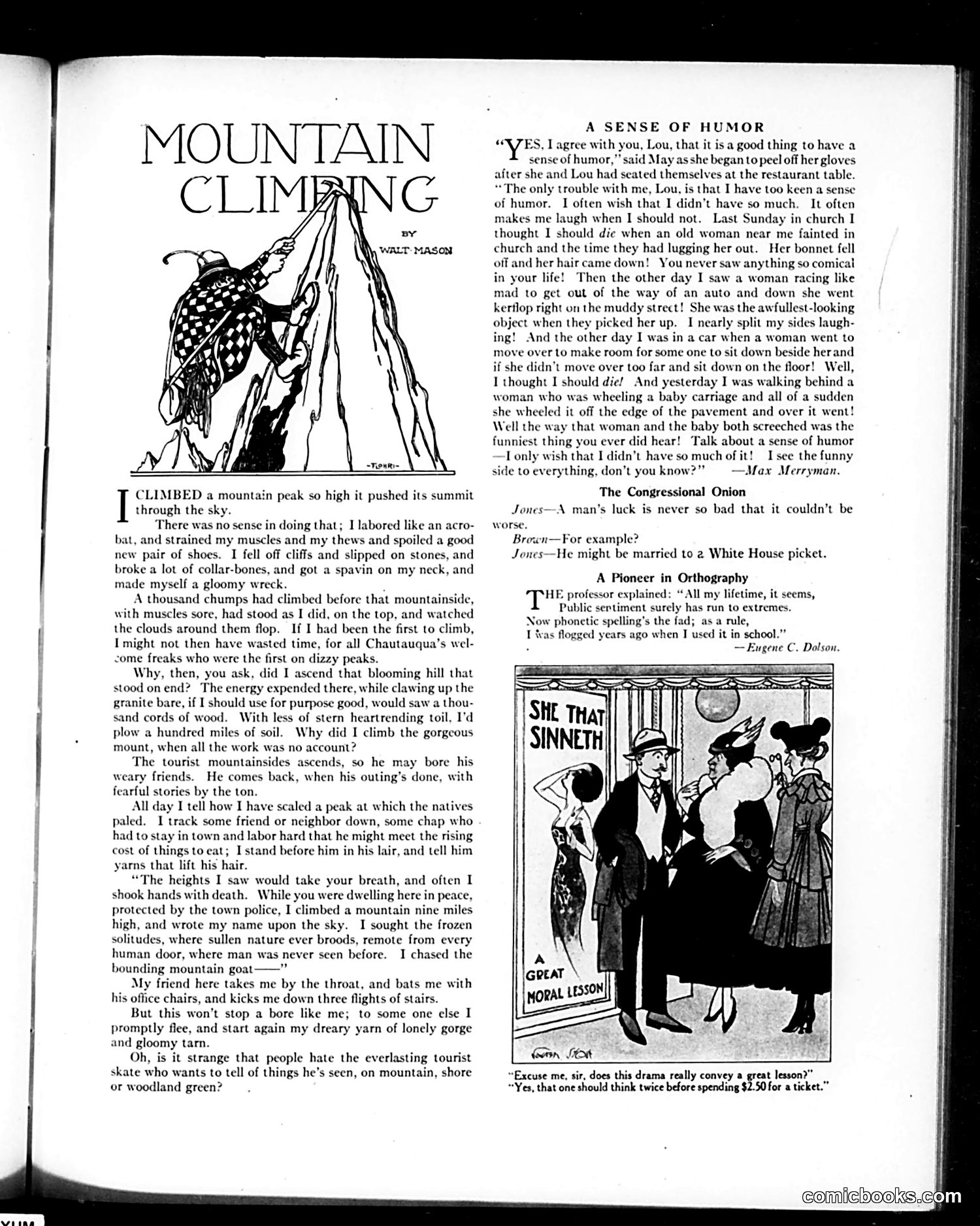
**"Mountain Climbing"** satirizes the tourist boom of the early 20th century. The narrator climbs a difficult peak for no practical purpose—merely to bore friends with exaggerated tales afterward. The joke: tourists waste tremendous effort doing pointless things solely to gain bragging rights, then inflict tedious stories on captive audiences (the friend who "bats me with his office chairs" in frustration). The satire mocks the performative nature of tourism and the social one-upmanship it enabled. **"A Sense of Humor"** presents a woman who finds humor in others' misfortunes—a fainting woman, someone falling in mud, a baby carriage going over a curb. The dialogue satirizes people who mistake schadenfreude (enjoyment of others' suffering) for actual wit or a genuine sense of humor. The humor lies in her obliviousness to how cruel and lacking in actual comedic sensibility her "jokes" are.
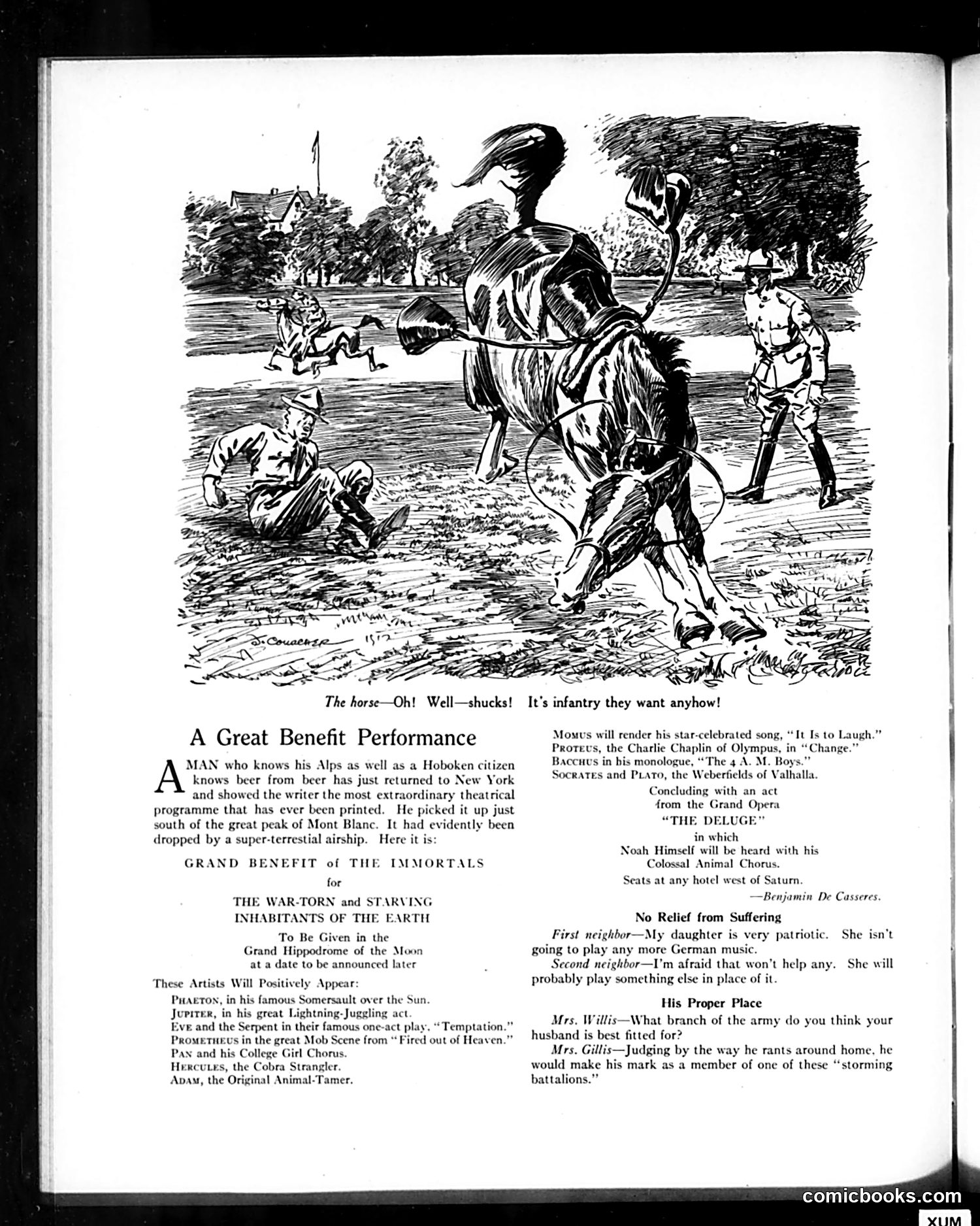
The main cartoon depicts a mounted soldier rejecting an offer of infantry service with "Well—shucks! It's infantry they want anyhow!"—satirizing military recruitment desperation during World War I, when even reluctant or unsuitable soldiers were being conscripted. The "Great Benefit Performance" is a humorous fantasy program attributed to an alien visitor, mocking wartime charitable benefits. It features classical and mythological figures (Pharaoh, Jupiter, Hercules, Noah, Socrates, Plato) performing on the moon to aid "war-torn and starving inhabitants of the earth"—an absurdist critique of how theatrical fundraisers seemed disconnected from actual wartime suffering. The two short joke pieces below address patriotic sacrifice: one jokes that stopping German music won't help the war effort, the other suggests a home-bound complainer belongs in "storming battalions" (aggressive combat units). Both mock civilian attempts at patriotic contribution and domestic discord during the war.
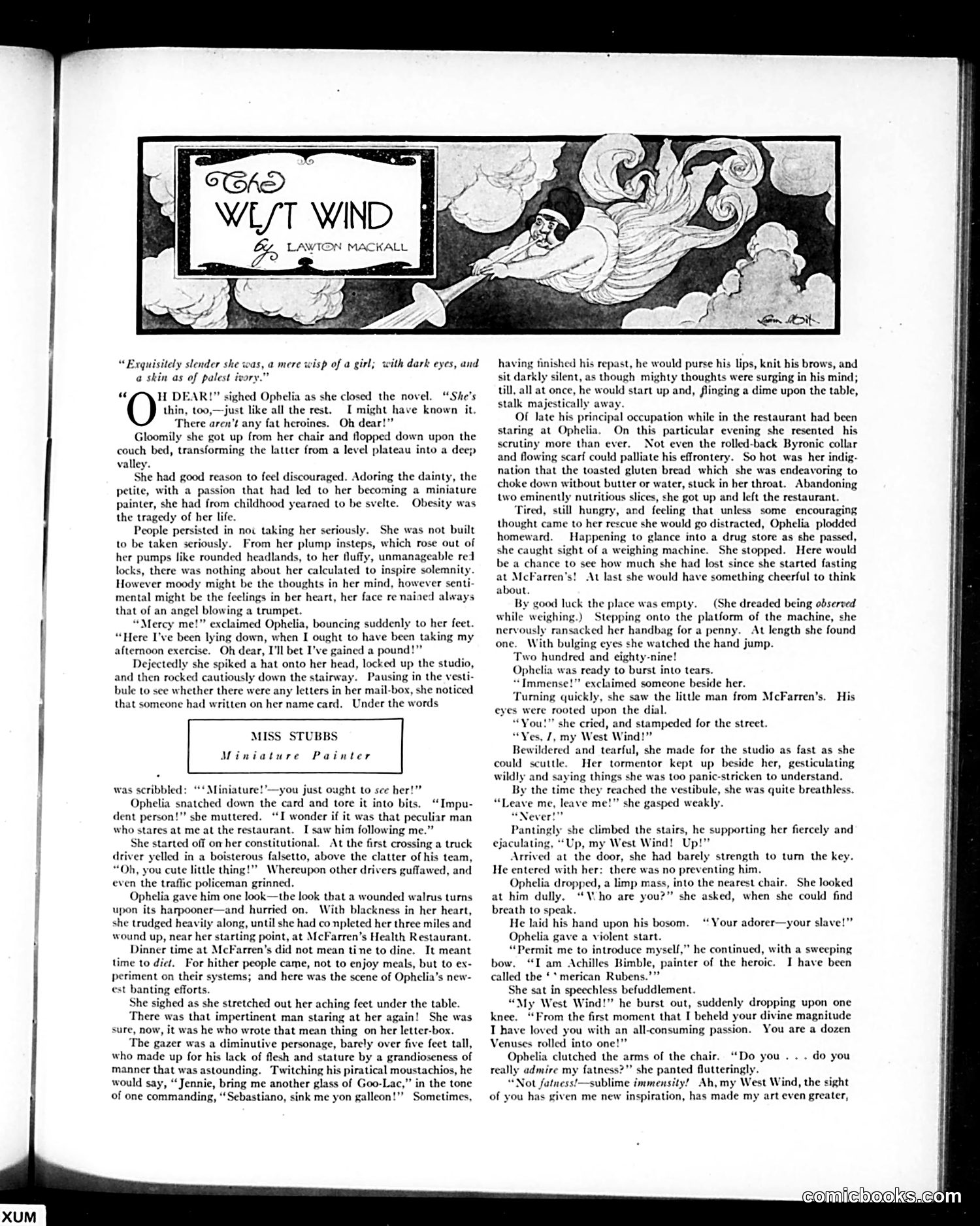
This is a humorous short story about Ophelia, an overweight miniature painter who obsesses over her weight after reading novels featuring impossibly thin heroines. The satire targets early 20th-century beauty standards and women's internalized body anxiety. The cartoon header shows a ethereal, wisp-like figure—the opposite of Ophelia—embodying the unrealistic "West Wind" ideal she yearns for. The story follows her futile diet attempts at "McFarren's Health Restaurant," a weight-loss establishment. A mysterious small man with theatrical mannerisms (described with exaggerated grandeur despite his diminutive stature) becomes her unwitting admirer, watching her intently. The joke is the contrast between Ophelia's despair and her actual desirability—she's so focused on societal beauty standards that she misinterprets romantic interest as mockery. The satire gently mocks both unrealistic feminine ideals and women's self-defeating pursuit of them.
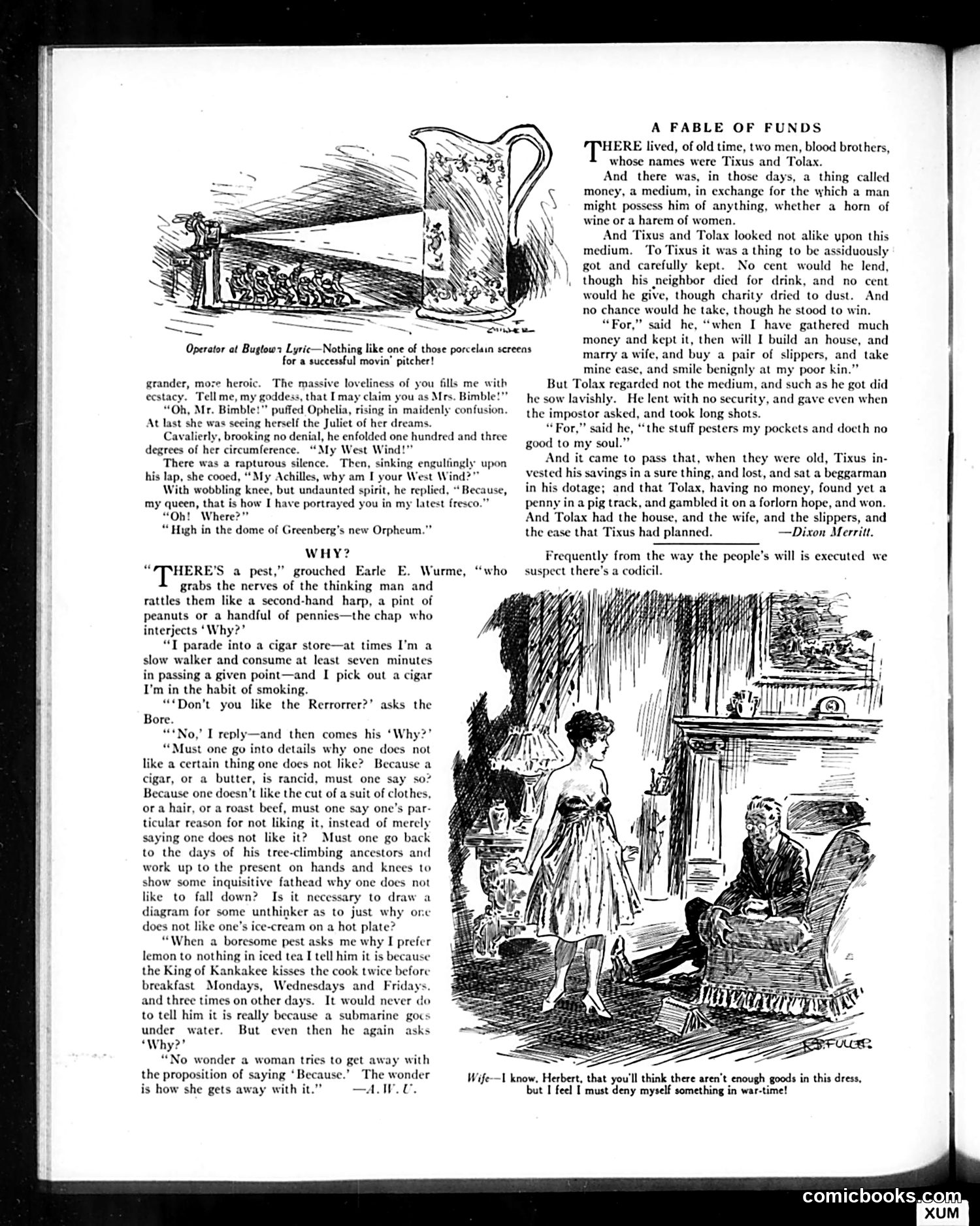
This moral fable contrasts two brothers with opposing attitudes toward money. **Tixus** represents miserly hoarding—he refuses to lend, give charity, or take financial risks, planning to enjoy wealth only in old age. **Tolax** spends and lends freely, viewing money as burdensome rather than precious. The ironic conclusion: Tixus invests his carefully accumulated savings in "a sure thing" and loses everything, becoming a beggar. Tolax, having freely given away his money, apparently achieves a better fate (the text cuts off, but the moral is clear). The satire targets penny-pinching miserliness as self-defeating. The fable suggests that hoarded money offers false security—"sure things" fail—while generosity and circulation of wealth prove wiser. This reflects Progressive Era skepticism toward pure capitalism and accumulation, favoring instead investment in community and social bonds.
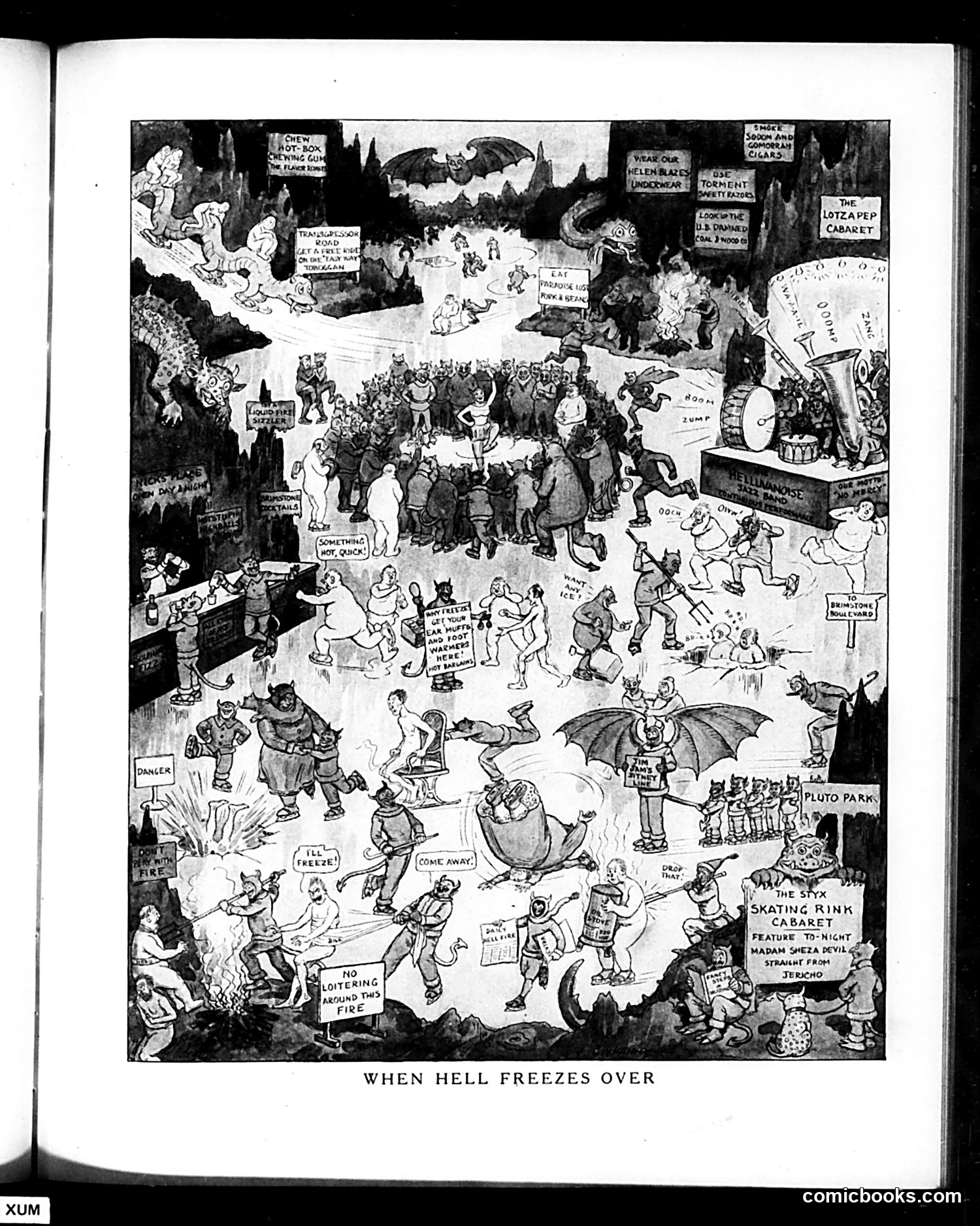
This is a single large satirical cartoon depicting Hell as an amusement park or entertainment district during winter—a visual pun on the phrase "when Hell freezes over" (meaning something impossible or never). The cartoon transforms Hell into a bustling recreation venue with identifiable attractions: a skating rink cabaret, Pluto Park, various shows and bars. Demons and damned souls populate the scene engaged in leisure activities—skating, dancing, drinking—rather than suffering punishment. The satire appears to mock either: - **Entertainment/vice culture** of the era (cabaret shows, drinking, skating rinks as morally questionable venues) - **Prohibition-era speakeasies** operating despite legal bans - Or possibly **corrupt officials/politicians** portrayed as hellish figures now enjoying themselves The detailed labels on various establishments suggest contemporary venues or entertainment trends the cartoonist viewed as disreputable. Without clearer historical context, the precise political target remains unclear, though the work satirizes urban entertainment culture and moral hypocrisy.
This article by Cyril Andrew satirizes the generational divide in theater appreciation circa 1917. An older "Upstate Banker" and his younger, artsy "Washington Square Girl" niece debate a play called "The Masquerader." She dismisses it as conventionally plotted without thematic depth or symbolic staging; he defends it as entertainment that "grips your interest." The cartoon mocks intellectualized theater criticism—the girl represents modernist pretension, while the uncle represents populist pragmatism. The piece references contemporary Broadway productions ("Polly with a Past," David Belasco productions) and suggests theater-goers were divided between those seeking innovative artistic merit versus those seeking engaging entertainment. The satire implies that over-analytical criticism, while sometimes valid, can obscure genuine theatrical power.
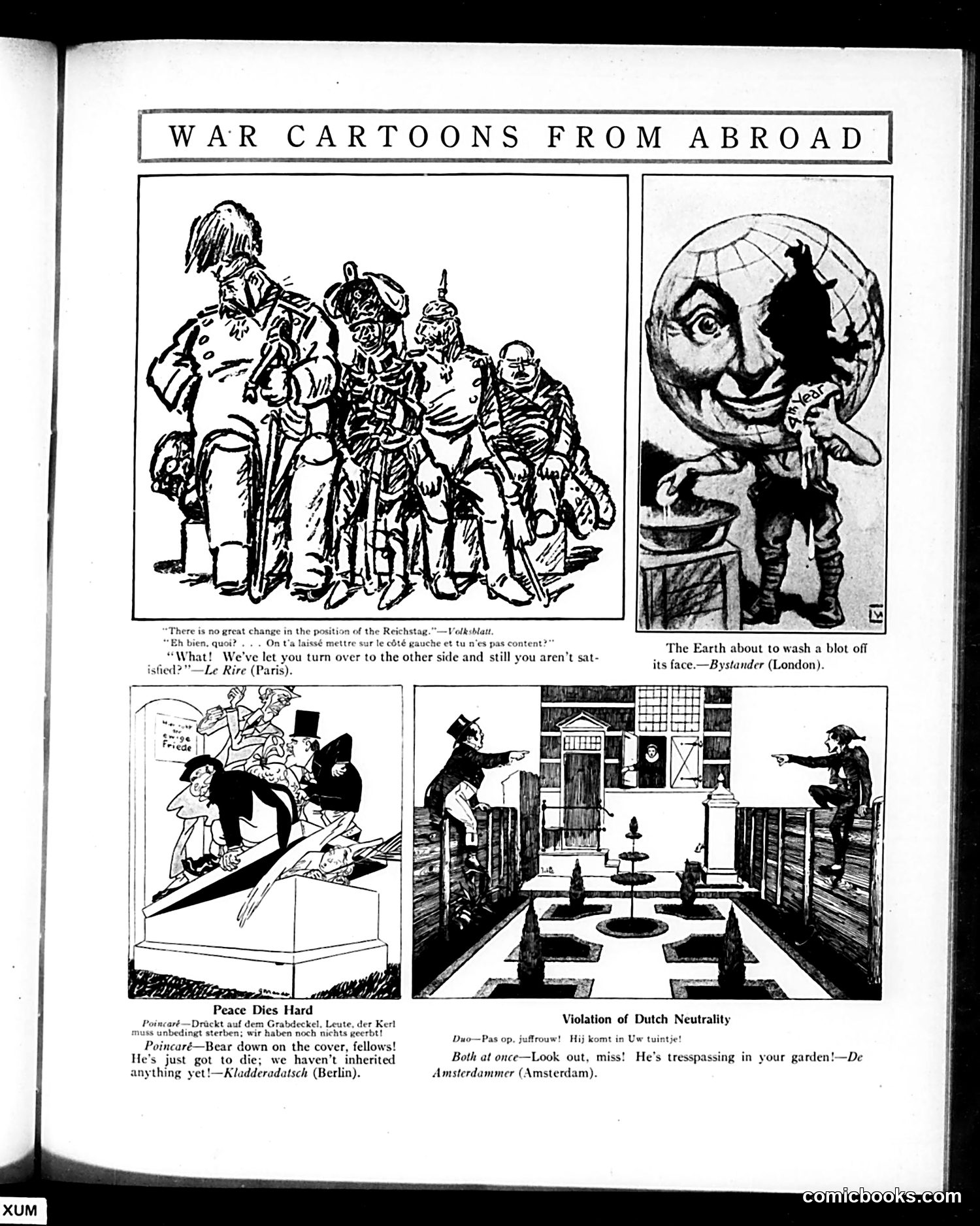
This page collects satirical cartoons from European publications during World War I, critiquing various nations' war conduct: **Top left** (French *Le Rire*): German military leadership, depicted as bloated figures, squabble over territorial gains—mocking their inability to achieve lasting victory despite controlling territory. **Top right** (British *Bystander*): Earth personified, washing away destruction—suggesting the war is obliterating civilization itself. **Bottom left** (German *Kladderadatsch*): "Peace Dies Hard"—French premier Poincaré and others literally crushing peace's coffin, satirizing French resistance to peace negotiations. **Bottom right** (Dutch *Amsterdammer*): A German soldier violates Dutch neutrality by trespassing into a woman's garden—commentary on Germany's disregard for neutral nations' sovereignty during the war. The page demonstrates how Allied and neutral nations used cartoons to criticize German aggression and war aims.
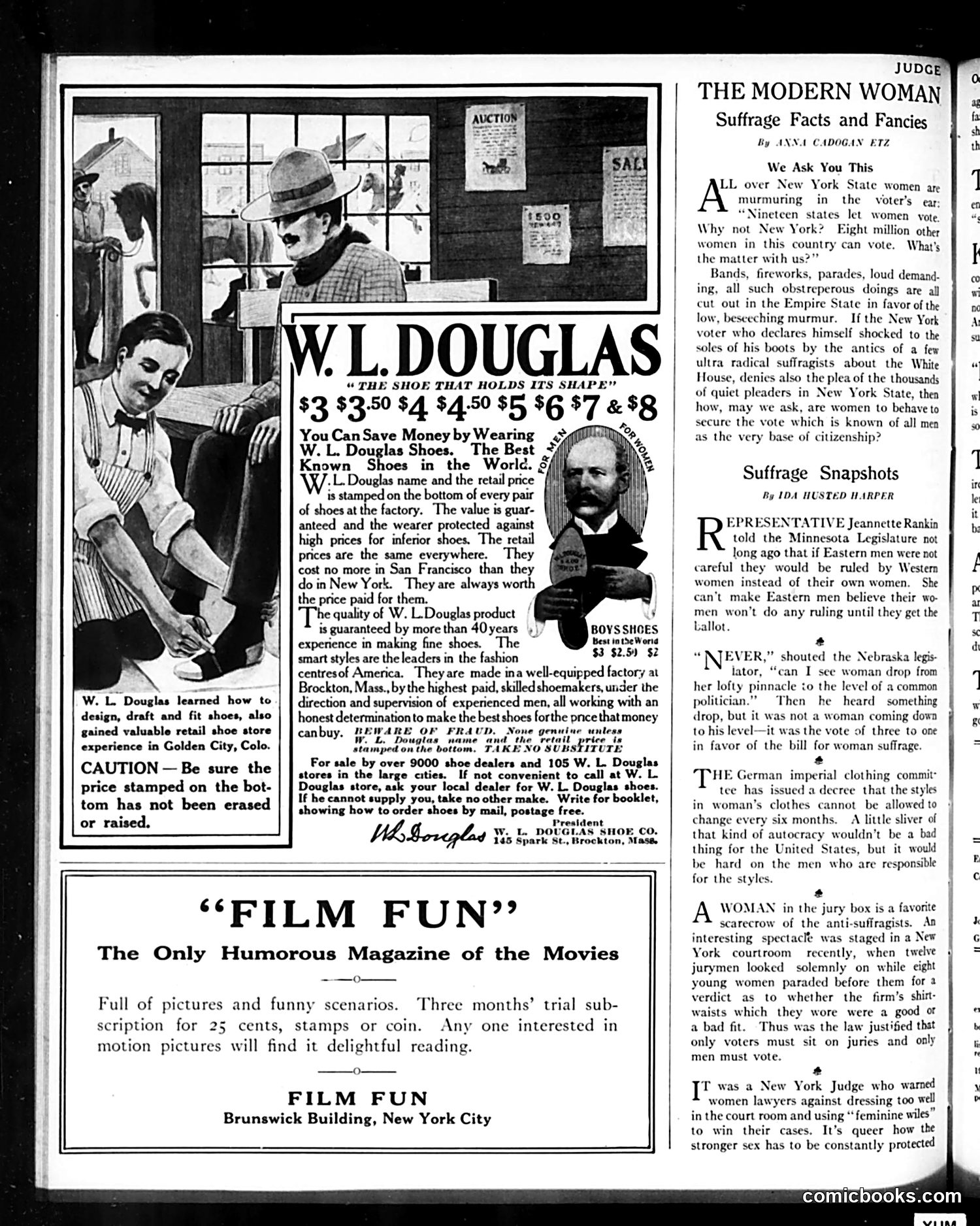
This page combines **advertising** with **pro-suffrage editorial content**, revealing the magazine's mixed messaging about women. The dominant W.L. Douglas shoe advertisement presents a paternalistic image: a woman admiring shoes while a man (presumably Douglas) watches approvingly. The ad emphasizes consumer protection and standardized pricing—framing shoe-buying as a rational, protected activity suitable for women. By contrast, the right column—"The Modern Woman: Suffrage Facts and Fancies"—advocates for women's voting rights across America. It mocks male politicians who oppose suffrage while praising women like Representative Jeannette Rankin. The Nebraska legislator's quote ("woman drop from her lofty pinnacle") is satirized when women gain voting victories anyway. **The irony**: Judge simultaneously depicts women as consumers needing male protection (the shoe ad) while celebrating women's political empowerment (the suffrage column). This reflects early-1910s American ambivalence: willing to sell products to women and acknowledge their growing independence, yet still uncomfortable granting full political equality.
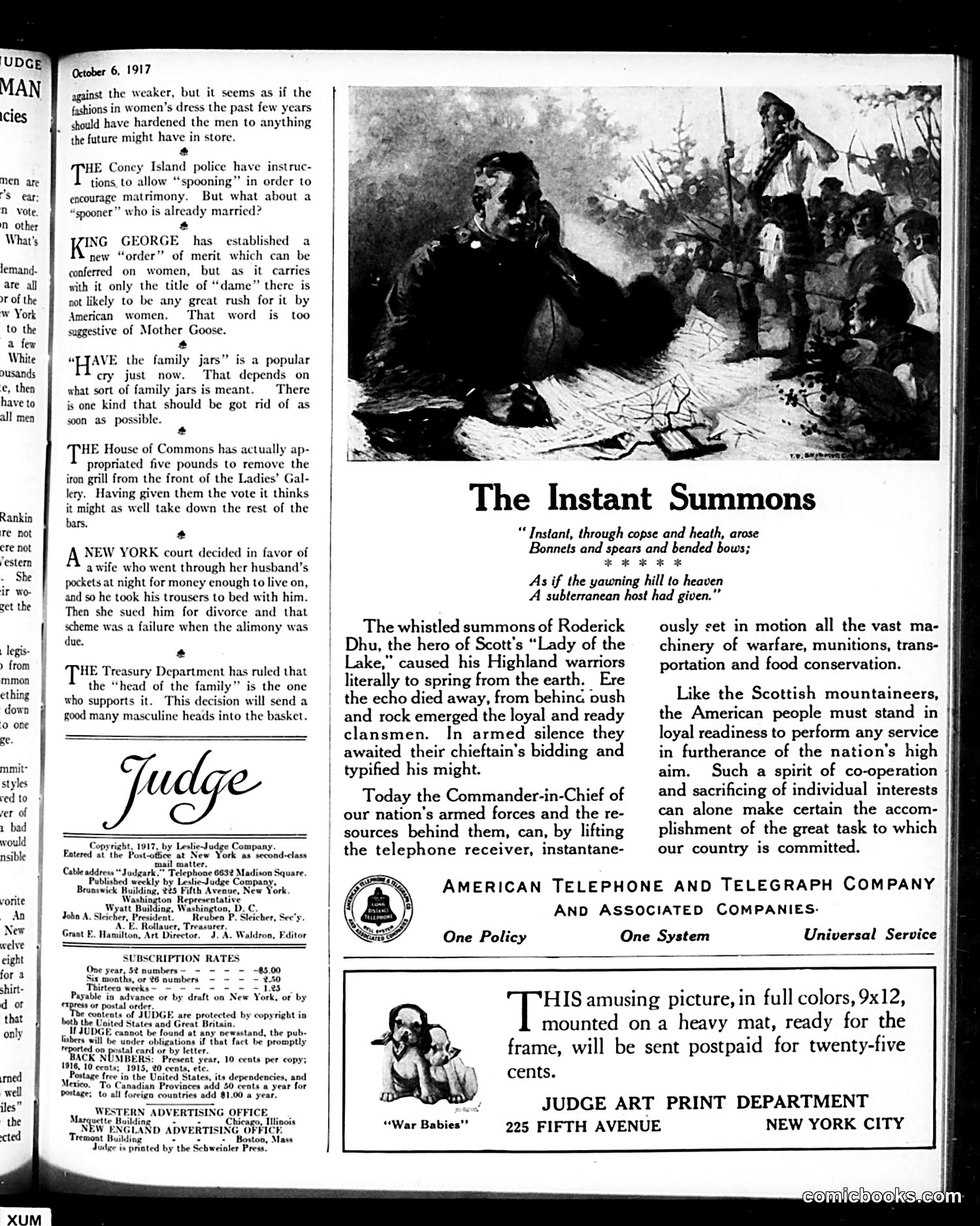
This page contains editorial commentary on contemporary social issues alongside war-related advertising. The left column presents brief satirical observations on topics including: Coney Island police encouraging "spooning" (courtship); King George's new honor of "dame" for women (deemed unappealing to Americans); family disputes; women's suffrage (the House of Commons removing iron grills from the Ladies' Gallery after granting the vote); a wife suing for divorce after searching her husband's pockets; and the Treasury Department ruling on who constitutes a family's "head." The right half features a full-page AT&T advertisement titled "The Instant Summons," comparing the telephone's military utility to Sir Walter Scott's *Lady of the Lake*—where Highland warriors spring instantly to their chieftain's call. The ad argues Americans must show similar readiness to support the war effort through telephone communications infrastructure. This reflects how corporations leveraged World War I patriotism in marketing during 1917.
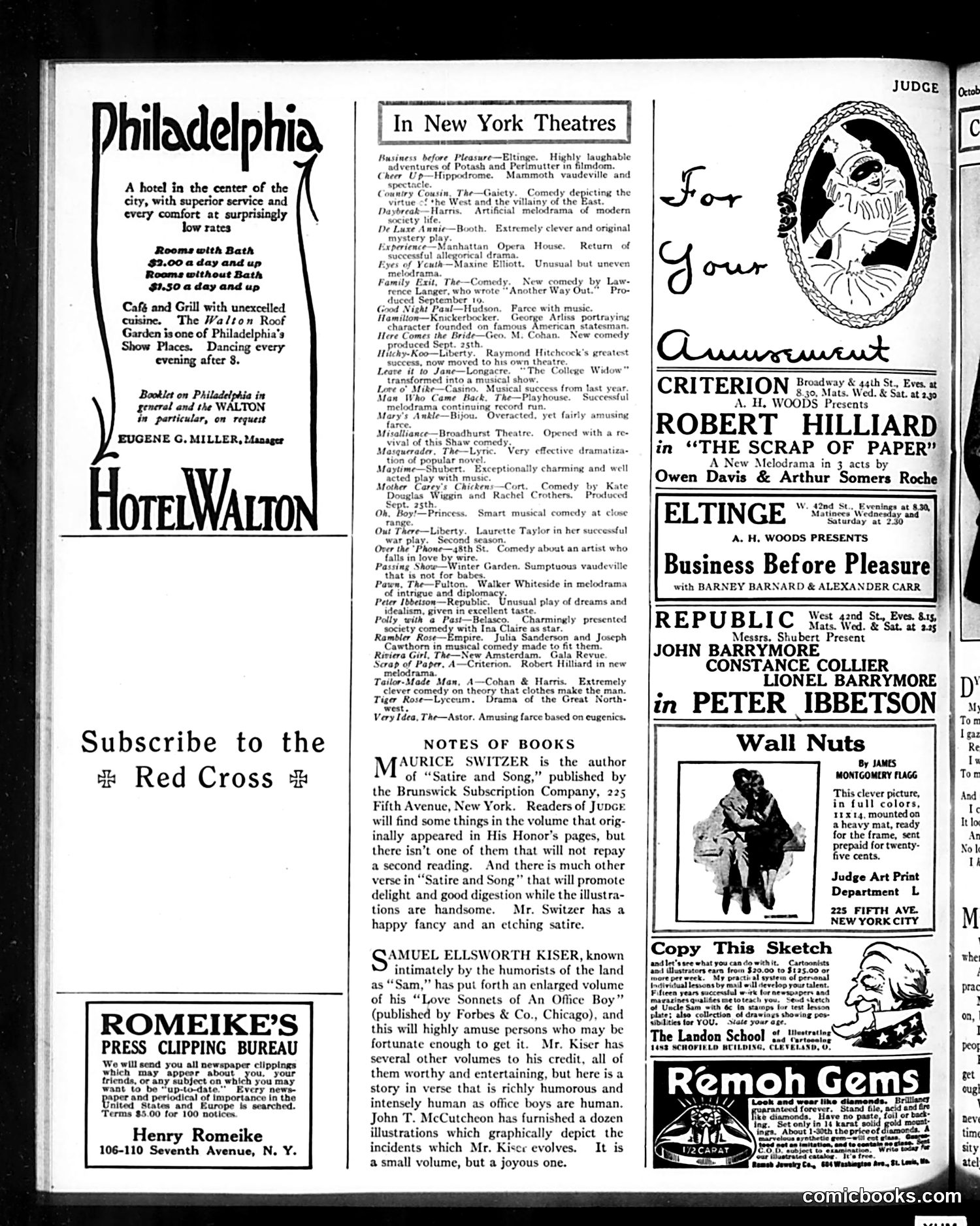
This page is primarily **advertising and theater listings** rather than political satire. The dominant content includes: **Advertisements:** - Hotel Walton (Philadelphia) promoting budget lodging - Romeike's Press Clipping Bureau (a media monitoring service) - Red Cross subscription appeal **Theater Section:** Extensive New York theater reviews of contemporary Broadway productions (with titles like "Business Before Pleasure," "Peter Ibbetson," "Polly with a Past"). These appear to be standard entertainment listings. **Book Reviews:** Brief notes on recent publications by Maurice Switzer, Samuel Ellsworth Kiser, and John T. McCutcheon—praising their humor and illustrations. **Small Illustrations:** Include what appears to be a vintage advertisement for "Wall Nuts" and "Remoh Gems" (jewelry/diamonds). The page lacks obvious political cartooning or satirical commentary. It functions primarily as a **period advertising and entertainment guide**, typical of Judge magazine's commercial content alongside its better-known satirical features.
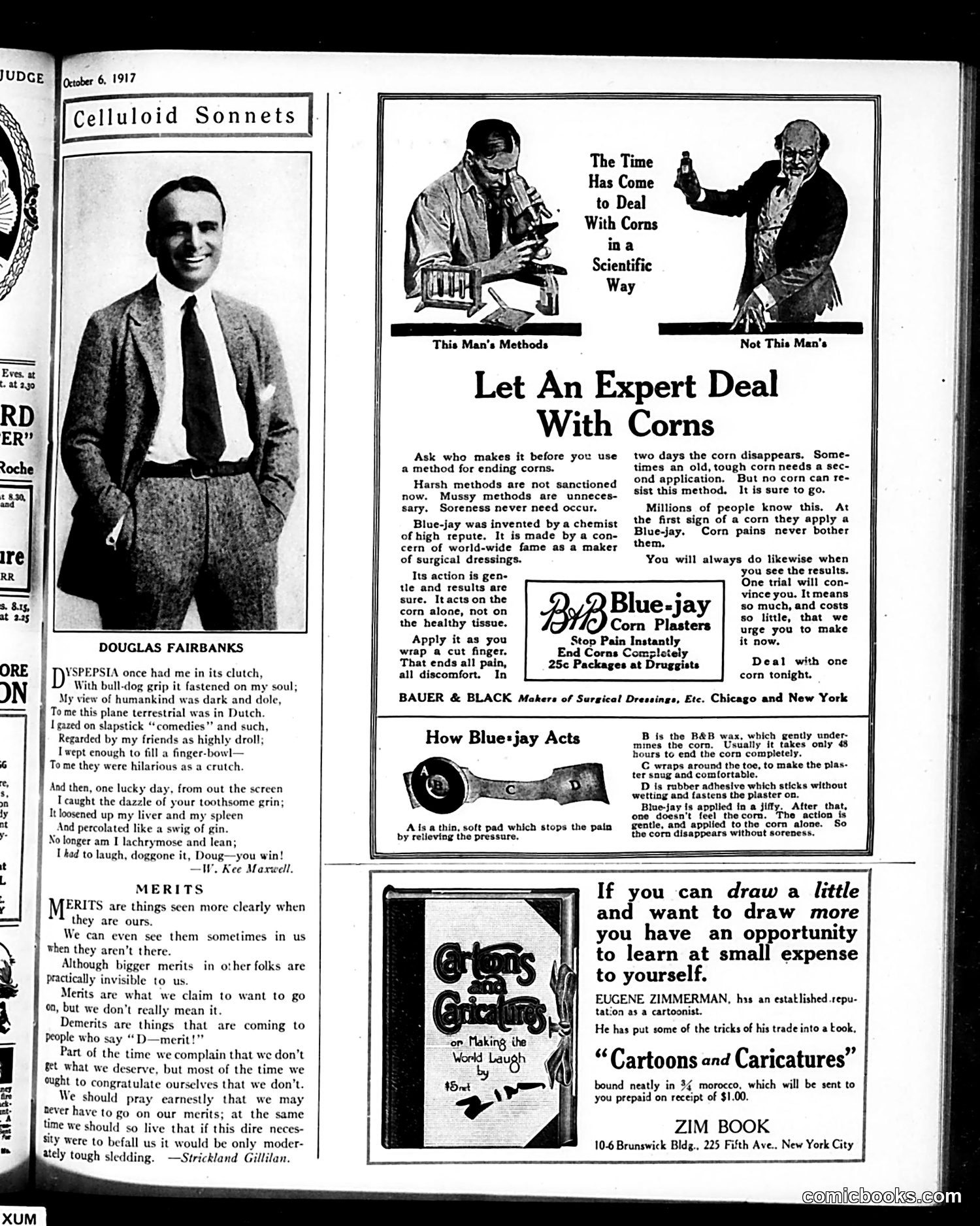
This page contains **advertising and light verse**, not political satire. The **"Celluloid Sonnets"** section features Douglas Fairbanks, the silent film star and heartthrob of the era. The poem jokingly claims that watching Fairbanks' cheerful on-screen grin cured the author's depression and misanthropy—a humorous exaggeration of celebrity appeal. The bulk of the page is **product advertising** for Blue-jay Corn Plasters (made by Bauer & Black, Chicago). The ad contrasts a "scientific" method (the plaster) with old-fashioned harsh corn remedies, using a clean-cut man versus a menacing old figure for visual effect. This reflects early-20th-century marketing that positioned modern commercial products as progressive solutions. A small **advertisement for a cartooning instruction book** by Eugene Zimmerman appears at bottom—typical of Judge's self-promotion to aspiring cartoonists. The page also includes unrelated philosophical musings on "merits" by Strickland Gillilan.
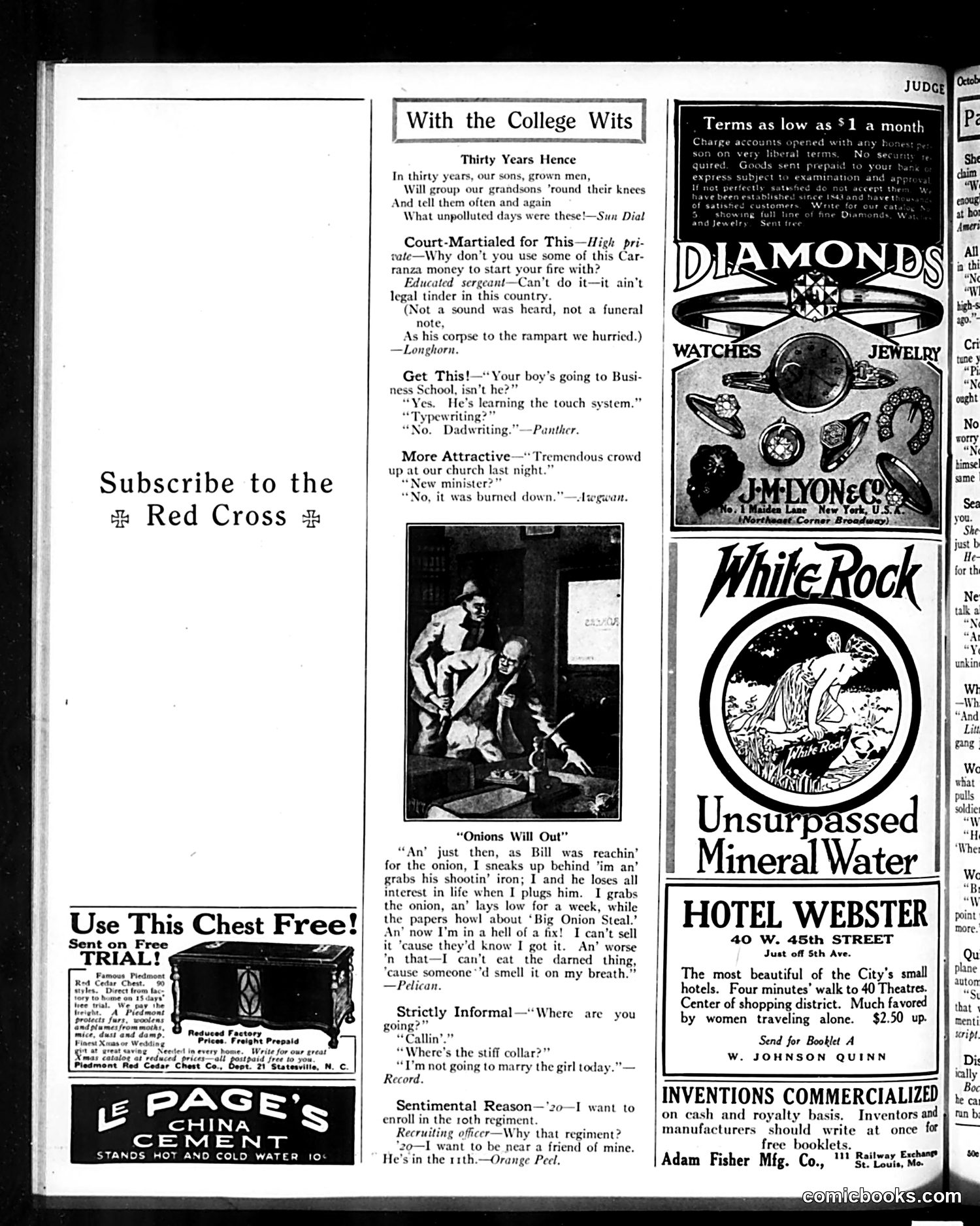
This page collects short humorous anecdotes typical of Judge magazine's satirical humor. The pieces are college-focused jokes, likely intended for a sophisticated 1920s American readership: **Key Content:** - "Thirty Years Hence": Nostalgia about pre-war innocence ("unpolluted days") - "Court-Martialed for This": Military satire about legal/illegal materials during wartime (possibly Prohibition-era or WWI references) - "Get This!": Business school humor about typewriter touch-typing systems - "Onions Will Out": Pulp crime fiction parody about bootlegging or black-market goods and guilt - "Strictly Informal": Dating/courtship humor about removed formal attire - "Sentimental Reason": WWI recruitment joke about enlisting to follow a friend The page also contains advertisements (Red Cross subscription, Page's China Cement, diamonds, mineral water, and Hotel Webster), indicating this is a typical Judge magazine spread mixing satire with commercial messaging. **Overall tone:** Urbane, topical humor reflecting concerns about modernization, military service, and changing social conventions.
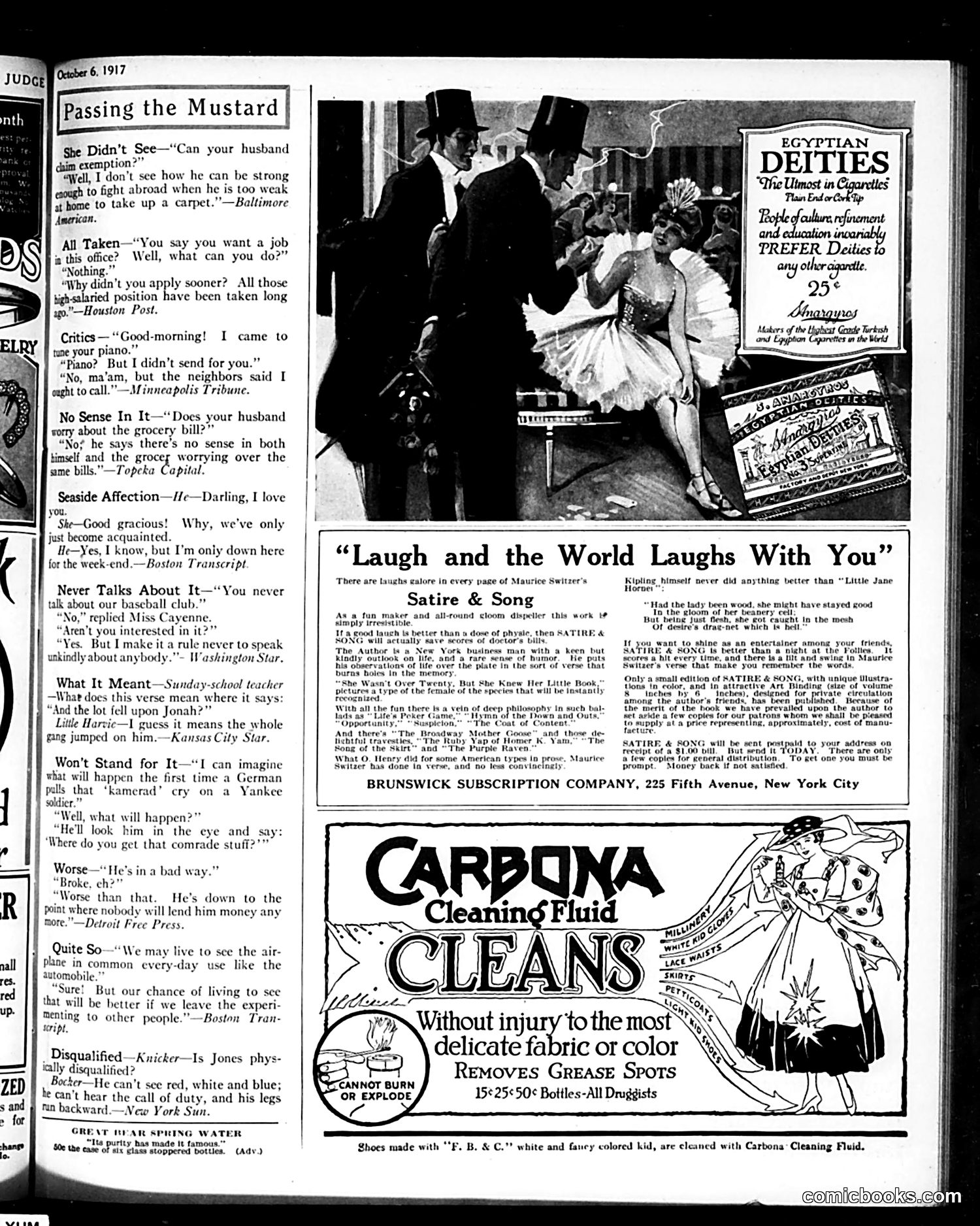
This page is primarily **advertising and humor content** rather than political cartoons. The main elements are: **Advertisements:** - A Red Cross subscription appeal - Leslie's Travel Bureau announcement seeking reader destinations for featured travel information **"Stories with Smiles" humor column** containing brief jokes on various topics: - Scottish children boasting about their war-hero fathers and medals - A woman revealing her fiancé is her tour guide (wordplay on "select party") - A child swallowing a sunbeam and feeling "full of glory" - Various domestic and social humor pieces **Social context:** These appear to be WWI-era jokes (references to medals, Victory Crosses, submarines vs. pirates, soldiers' appearance). The humor reflects period concerns about military service, courtship conventions, and domestic life. The Scottish dialect humor and pun-based jokes were typical Judge magazine fare—light, family-friendly satire without partisan political content on this particular page.
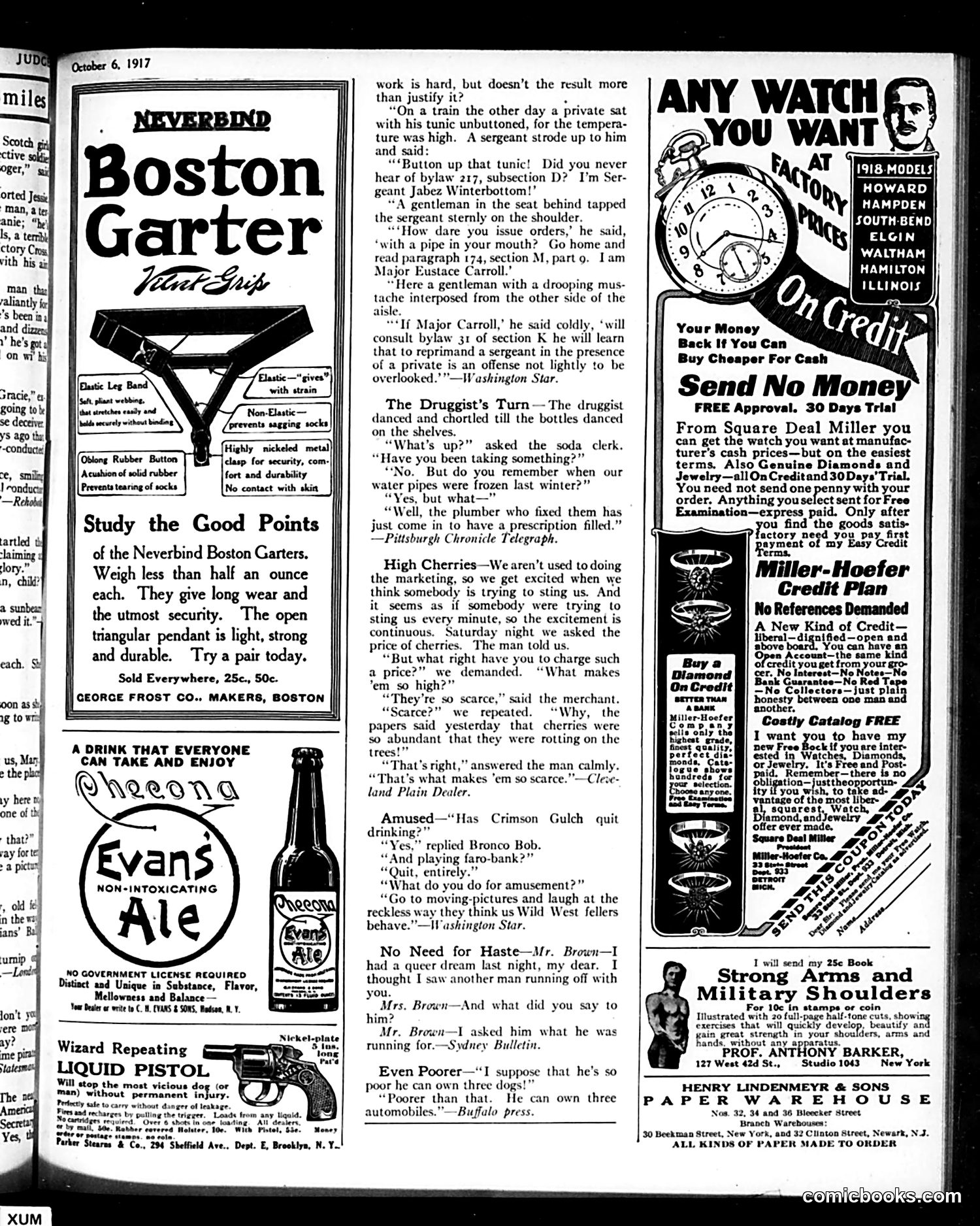
This page is primarily **advertising**, not political satire. It features product advertisements typical of the era: Boston Garters (suspenders), Evans Non-Intoxicating Ale, a "Liquid Pistol" dog deterrent, watches, diamonds, and jewelry. The small humor section contains brief **anecdotal jokes** rather than cartoons: - A military joke mocking bureaucratic rule-citing between a private, sergeant, and major over uniform regulations - A druggist's schadenfreude about a plumber needing a prescription - Observations about cherry prices and bargain-hunting - Jokes about a man quitting drinking/gambling but attending movies instead - A punchline about poverty and automobile ownership None reference specific political figures or events. The humor is genteel, domestic, and circumstantial—typical early-20th-century newspaper comedy. The page reflects wartime 1917 America (note the military joke) but contains no obvious satire of political figures or movements.
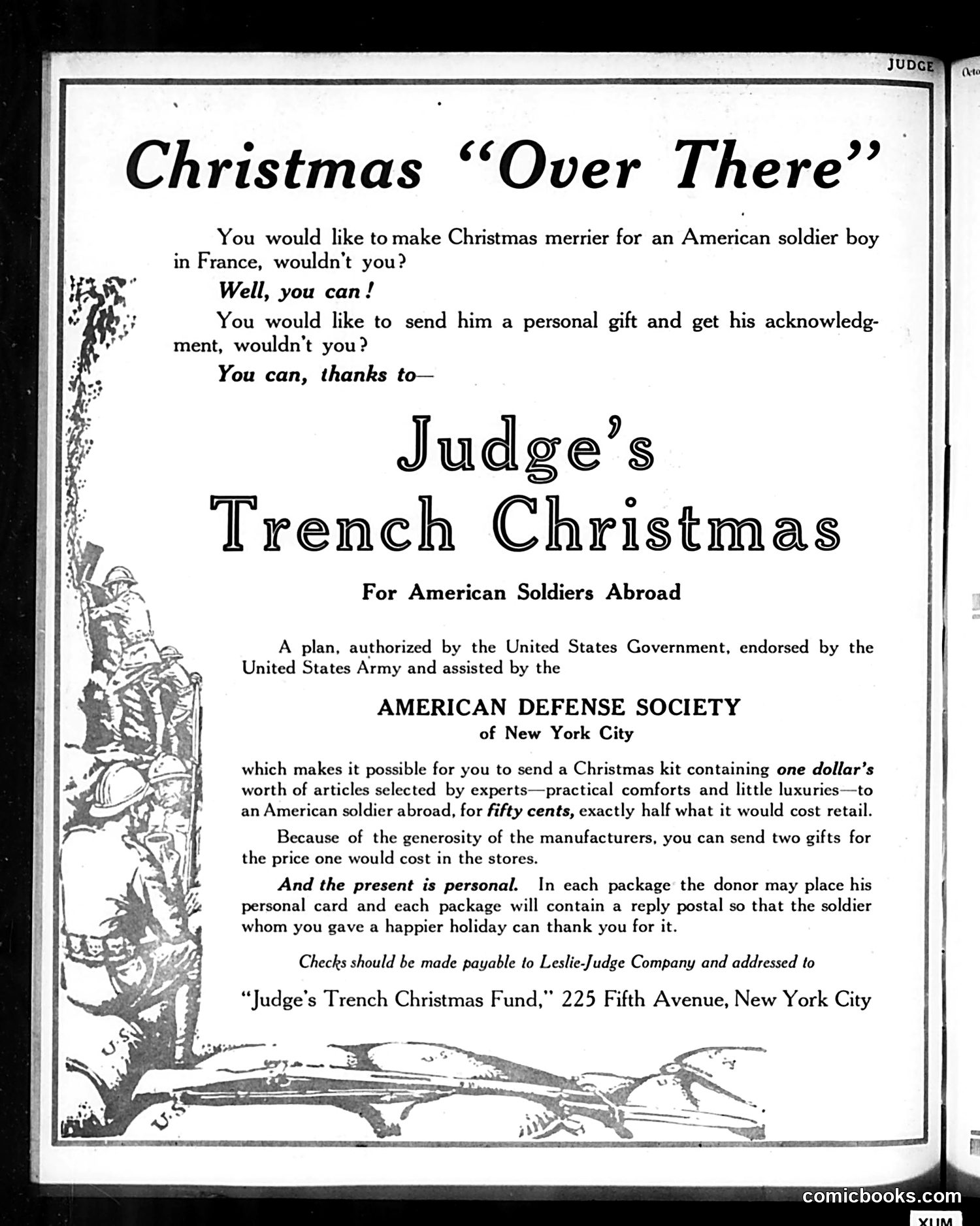
This is a World War I-era charitable appeal, not satire. The page advertises "Judge's Trench Christmas," a fundraising program by the magazine *Judge* partnering with the American Defense Society to send care packages to American soldiers in France. The phrase "Over There" references the popular 1917 George M. Cohan wartime song. The decorative border illustrations show soldiers and military equipment, evoking the conflict. The offer is straightforward: donors send fifty cents to receive a one-dollar Christmas kit to mail to a soldier abroad. Each package includes a personal card and reply postcard, making the gift personal and ensuring acknowledgment. The American Defense Society and manufacturers' "generosity" enabled this half-price arrangement. This represents American civilian mobilization for the war effort—turning patriotic sentiment into charitable action while boosting the magazine's credibility and circulation.
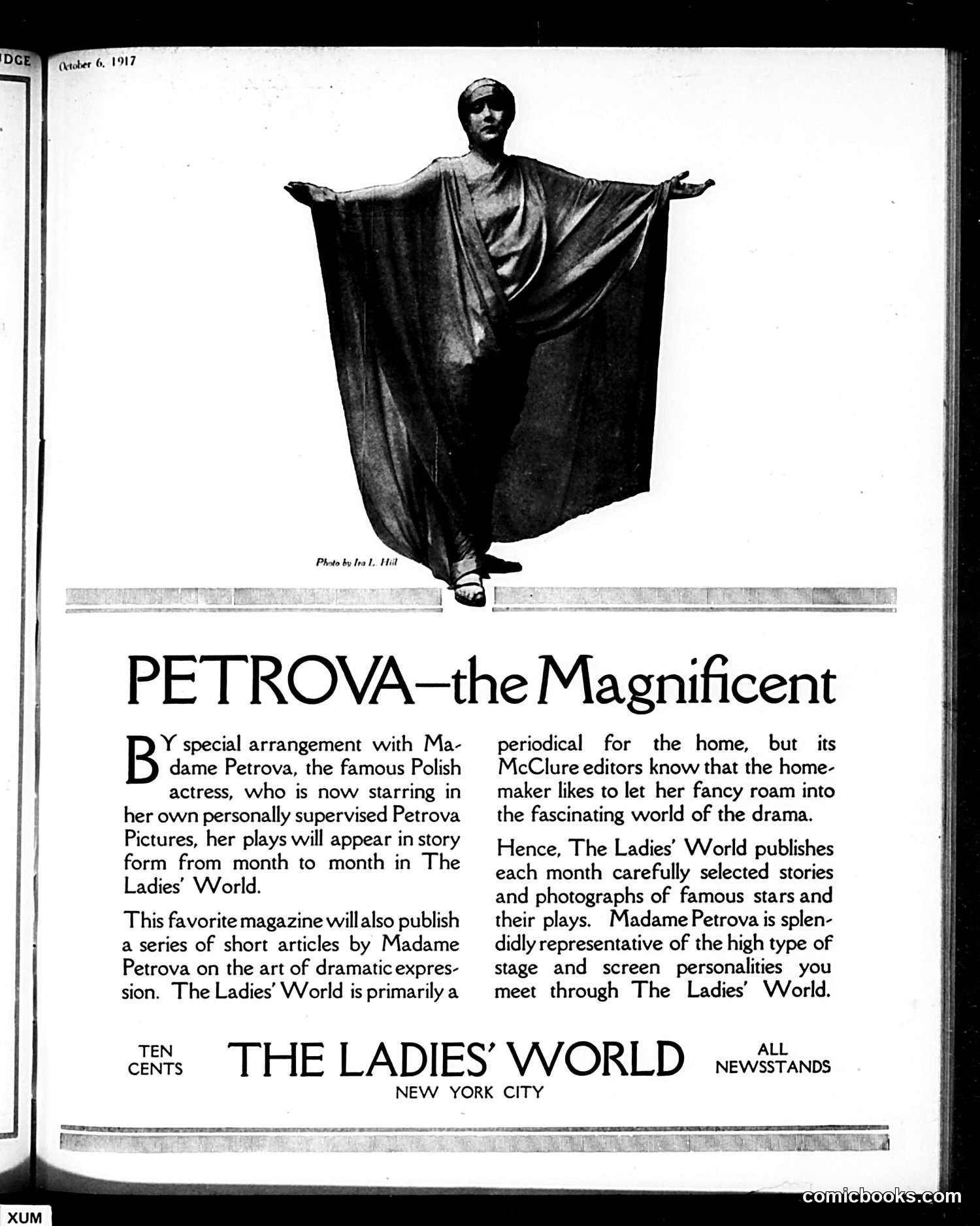
This is **not a cartoon** but a **full-page advertisement** from *Judge* magazine (October 6, 1917). It promotes *The Ladies' World* magazine and announces a partnership with Madame Petrova, a Polish actress and film producer who was starring in her own production company, Petrova Pictures. The ad features a dramatic photograph of Petrova in an elaborate draped costume with outstretched arms—styled to evoke theatrical grandeur and artistic sophistication. The text emphasizes that *The Ladies' World* will serialize her film stories and publish her articles on "dramatic expression," positioning the magazine as offering homemakers access to high-culture entertainment and celebrity lifestyle content. This reflects early 20th-century marketing: film stars were major cultural figures, and magazines leveraged their names to appeal to women readers seeking escapism and sophistication.
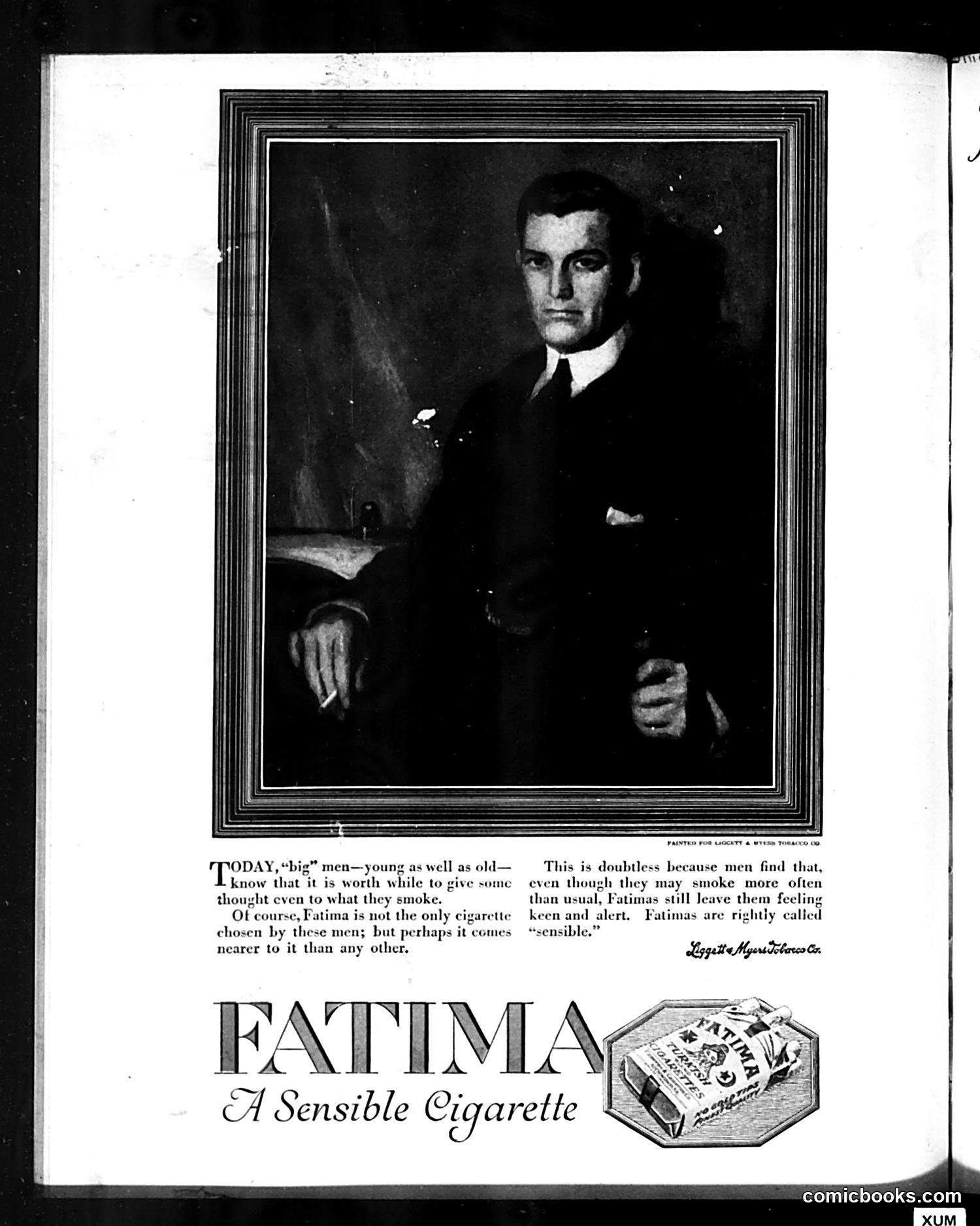
This is primarily a **cigarette advertisement**, not political satire. It features a formal portrait of a well-dressed man in a suit positioned above promotional text for "Fatima: A Sensible Cigarette." The ad's appeal is directed at successful "big men"—both young and old—suggesting that smoking Fatima demonstrates good judgment. The copy claims Fatima's superiority lies in allowing smokers to smoke "more often than usual" while remaining "keen and alert," positioning the cigarette as a rational choice for busy, important men. This reflects **early-20th-century advertising conventions**: using masculine authority figures and pseudo-scientific claims (keeping one "sensible" despite increased smoking) to market tobacco to professional classes. The term "sensible" is ironic by modern standards, given what we now know about cigarette health effects.