
Judge, 1917-10-06 · page 14 of 28
Judge — October 6, 1917 — page 14: what you’re looking at
What you’re looking at
This moral fable contrasts two brothers with opposing attitudes toward money. **Tixus** represents miserly hoarding—he refuses to lend, give charity, or take financial risks, planning to enjoy wealth only in old age. **Tolax** spends and lends freely, viewing money as burdensome rather than precious. The ironic conclusion: Tixus invests his carefully accumulated savings in "a sure thing" and loses everything, becoming a beggar. Tolax, having freely given away his money, apparently achieves a better fate (the text cuts off, but the moral is clear). The satire targets penny-pinching miserliness as self-defeating. The fable suggests that hoarded money offers false security—"sure things" fail—while generosity and circulation of wealth prove wiser. This reflects Progressive Era skepticism toward pure capitalism and accumulation, favoring instead investment in community and social bonds.
📄 Transcribed text from this page (OCR, searchable)
Machine-transcribed from the original scan — historical spelling and the odd misread are preserved.
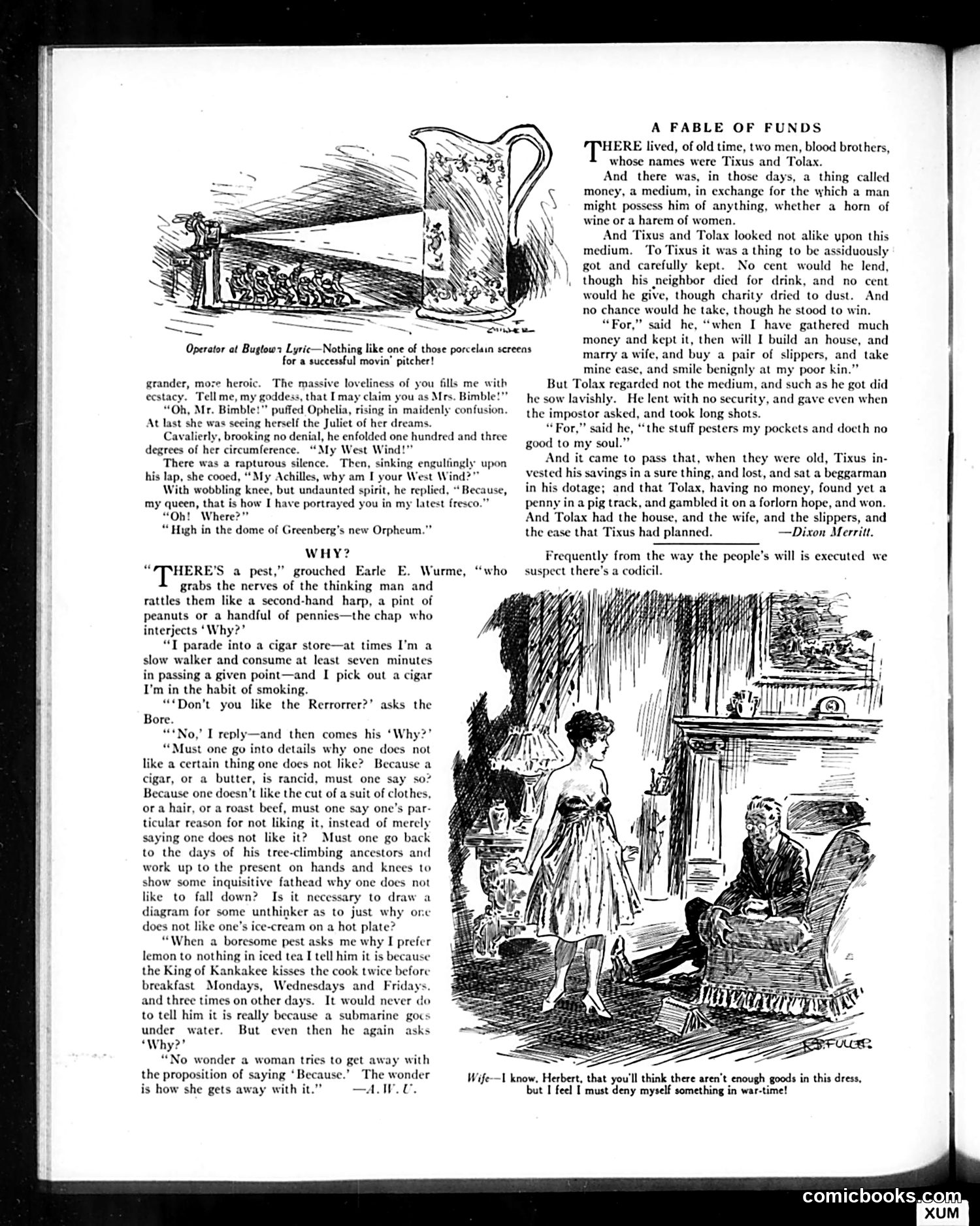
Operator at Bugtow2 Lyric—Nothing like one of those porcelain screens for a successful movin’ pitcher! grander, more heroic. The massive loveliness of you fills me with ecstacy. Tell me, my goddess, that I may claim you as Mrs. Bimble!” “Oh, Mr. Bimble!" puffed Ophelia, rising in maidenly confusion, At last she was seeing herself the Juliet of her dreams. Cavalierly, brooking no denial, he enfolded one hundred and three degrees of her circumference. “My West Wind!” There was a rapturous silence. Then, sinking engulfingly upon his lap, she cooed, “My Achilles, why am I your West Wind?” With wobbling knee, but undaunted spirit, he replied, “ Because, my queen, that is how I have portrayed you in my latest fresco.” “Oh! Where?” “High in the dome of Greenberg’s new Orpheum.” WHY? “TTHERE'S a pest,” grouched Earle E. Wurme, “who grabs the nerves of the thinking man and rattles them like a second-hand harp, a pint of peanuts or a handful of pennies—the chap who interjects ‘Why?’ “T parade into a cigar store—at times I’m a slow walker and consume at least seven minutes in passing a given point—and I pick out a cigar I'm in the habit of smoking. “*Don’'t you like the Rerrorrer?’ asks the Bore. “*No,’ I reply—and then comes his ‘Why?’ “Must one go into details why one does not like a certain thing one does not like? Because a cigar, or a butter, is rancid, must one say so? Because one doesn’t like the cut of a suit of clothes, or a hair, or a roast beef, must one say one’s par- ticular reason for not liking it, instead of merely saying one does not like it? Must one go back to the days of his tree-climbing ancestors and work up to the present on hands and knees to show some inquisitive fathead why one does not like to fall down? Is it necessary to draw a diagram for some unthinker as to just why one does not like one’s ice-cream on a hot plate’ “When a boresome pest asks me why I prefer lemon to nothing in iced tea I tell him it is because the King of Kankakee kisses the cook twice before breakfast Mondays, Wednesdays and Fridays. and three times on other days. It would never do to tell him it is really because a submarine gocs under water. But even then he again asks ‘Why?’ “No wonder a woman tries to get away with the proposition of saying ‘Because.’ The wonder is how she gets away with it.” —A.IV.U. A FABLE OF FUNDS THERE lived, of old time, two men, blood brothers, whose names were Tixus and Tolax. And there was, in those days, a thing called money, a medium, in exchange for the which a man might possess him of anything, whether a horn of wine or a harem of women. And Tixus and Tolax looked not alike ypon this medium. To Tixus it was a thing to be assiduously got and carefully kept. No cent would he lend, though his neighbor died for drink, and no cent would he give, though charity dried to dust. And no chance would he take, though he stood to win. “For,” said he, “when I have gathered much money and kept it, then will I build an house, and marry a wife, and buy a pair of slippers, and take mine ease, and smile benignly at my poor kin.” But Tolax regarded not the medium, and such as he got did he sow lavishly. He lent with no security, and gave even when the impostor asked, and took long shots. “For,” said he, “the stuff pesters my pockets and doeth no good to my soul.” And it came to pass that, when they were old, Tixus in- vested his savings in a sure thing, and lost, and sat a beggarman in his dotage; and that Tolax, having no money, found yet a penny in a pig track, and gambled it on a forlorn hope, and won. And Tolax had the house, and the wife, and the slippers, and the ease that Tixus had planned. —Dixon Merritt. Frequently from the way the people’s will is executed we suspect there's a codicil. —S Wife-—I know, Herbert, that you'll think there aren't enough goods in this dress, but I feel I must deny myself something in war-time! comicbooks, ] com,