
Judge, 1917-10-06 · page 16 of 28
Judge — October 6, 1917 — page 16: what you’re looking at
What you’re looking at
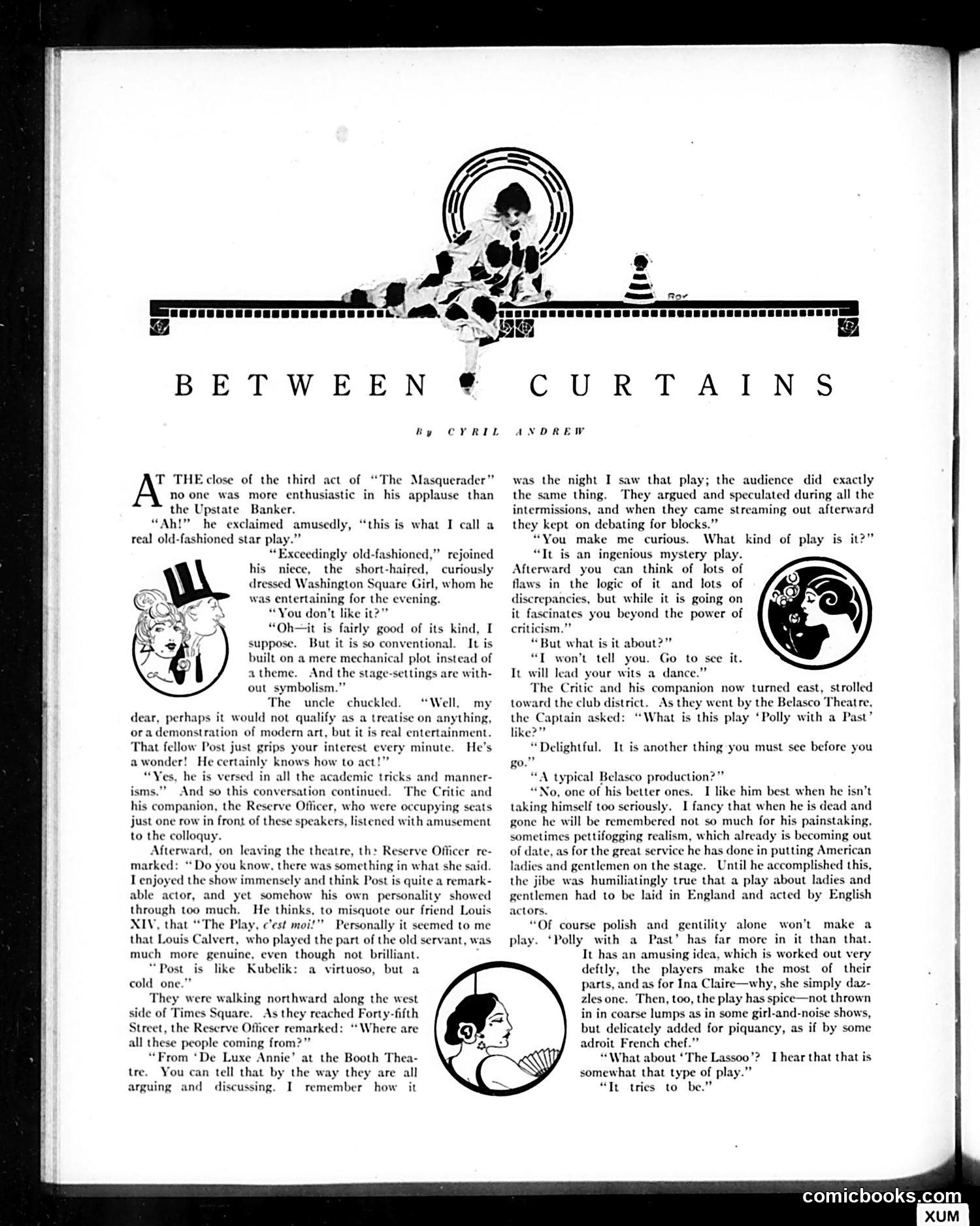
This article by Cyril Andrew satirizes the generational divide in theater appreciation circa 1917. An older "Upstate Banker" and his younger, artsy "Washington Square Girl" niece debate a play called "The Masquerader." She dismisses it as conventionally plotted without thematic depth or symbolic staging; he defends it as entertainment that "grips your interest." The cartoon mocks intellectualized theater criticism—the girl represents modernist pretension, while the uncle represents populist pragmatism. The piece references contemporary Broadway productions ("Polly with a Past," David Belasco productions) and suggests theater-goers were divided between those seeking innovative artistic merit versus those seeking engaging entertainment. The satire implies that over-analytical criticism, while sometimes valid, can obscure genuine theatrical power.
📄 Transcribed text from this page (OCR, searchable)
Machine-transcribed from the original scan — historical spelling and the odd misread are preserved.
BETWEEN ? B v THE close of the third act of “The Masquerader” A no one was more enthusiastic in his applause than the Upstate Banker. “Ah!” he exclaimed amusedly, “this is what I call a real old-fashioned star play.” “Exceedingly old-fashioned,” rejoined his niece, the short-haired, curiously dressed Washington Square Girl, whom he was entertaining for the evening. “You don’t like it?” “Oh—it is fairly good of its kind, I suppose. But it is so conventional. It is built on a mere mechanical plot instead of atheme. And the stage-settings are with- out symbolism.” The uncle chuckled. “Well, my dear, perhaps it would not qualify a tise on anything, orademonstration of modern art, but it is real entertainment. That fellow Post just grips your interest every minute. He's awonder! He certainly knows how to act “Yes, he is versed in all the academic trick: isms.” And so this conversation continued. his companion, the Reserve Officer, who were occupying seats just one row in front of these speakers, listened with amusement to the colloquy. Afterward, on leaving the theatre, th: Reserve Officer re- marked: ** Do you know, there was something in w she said I enjoyed the show immensely and think Post is quite a remark- able actor, and yet somchow his own personality showed through too much. He thinks, to misquote our friend Louis XIV, that “The Play, c’est moi!” Personally it seemed to me that Louis Calvert, who played the part of the old servant, was much more genuine, even though not brilliant. “Post is like Kubelik: a virtuoso, but a cold on They were walking northward along the west side of Times Square. As they reached Forty-fifth Street, the Reserve Officer remarked: “Where are all these people coming from?” rom ‘De Luxe Annie’ at the Booth Thea- You can tell that by the they are all discussing. I remember how it tre. arguing and CYRIL CURTAINS ANDREW the night I saw that play; the audience did exactly the same thing. They argued and speculated during all the intermissions, and when they came streaming out afterward they kept on debating for blocks.” You make me curious. What kind of play is it?” “It is an ingenious mystery play. Afterward you think of lots of flaws in the logic of it and lots of discrepancies, but while it is going on > it fascinates you beyond the power of “But what is it about?” “IT won't tell you. Go to sce it. lead your wits a dance.” The Critic and his companion now turned east, strolled toward the club district. As they went by the Belasco Theatre, the Captain asked: ‘What is this play ‘Polly with a Past’ like?” “Delightful. It is another thing you must see before you “A typical Belasco production?” ‘0, one of his better ones. I like him best when he isn’t taking himself too seriously. I fancy that when he is dead and gone he will be remembered not so much for his painstaking, sometimes pettifogging realism, which already is becoming out of date, as for the great service he has done in putting American ladies and gentlemen on the stage. Until he accomplished this, the jibe was humiliatingly true that a play about ladies and gentlemen had to be laid in England and acted by English actors. “Of course polish and gentility alone won't make a play. ‘Polly with a Past’ has far more in it than that. It has an amusing idea, which is worked out very deftly, the players make the most of their parts, and as for Ina Claire—why, she simply daz- zles one. Then, too, the play has spice—not thrown in in coarse lumps as in some girl-and-noise shows, but delicately added for piquancy, as if by some adroit French chef.” “What about ‘The Lassoo’? I hear that that is somewhat that type of play.” “Tt tries to be.” “ceo ee comicbooks.com