
Judge, 1917-10-06 · page 13 of 28
Judge — October 6, 1917 — page 13: what you’re looking at
What you’re looking at
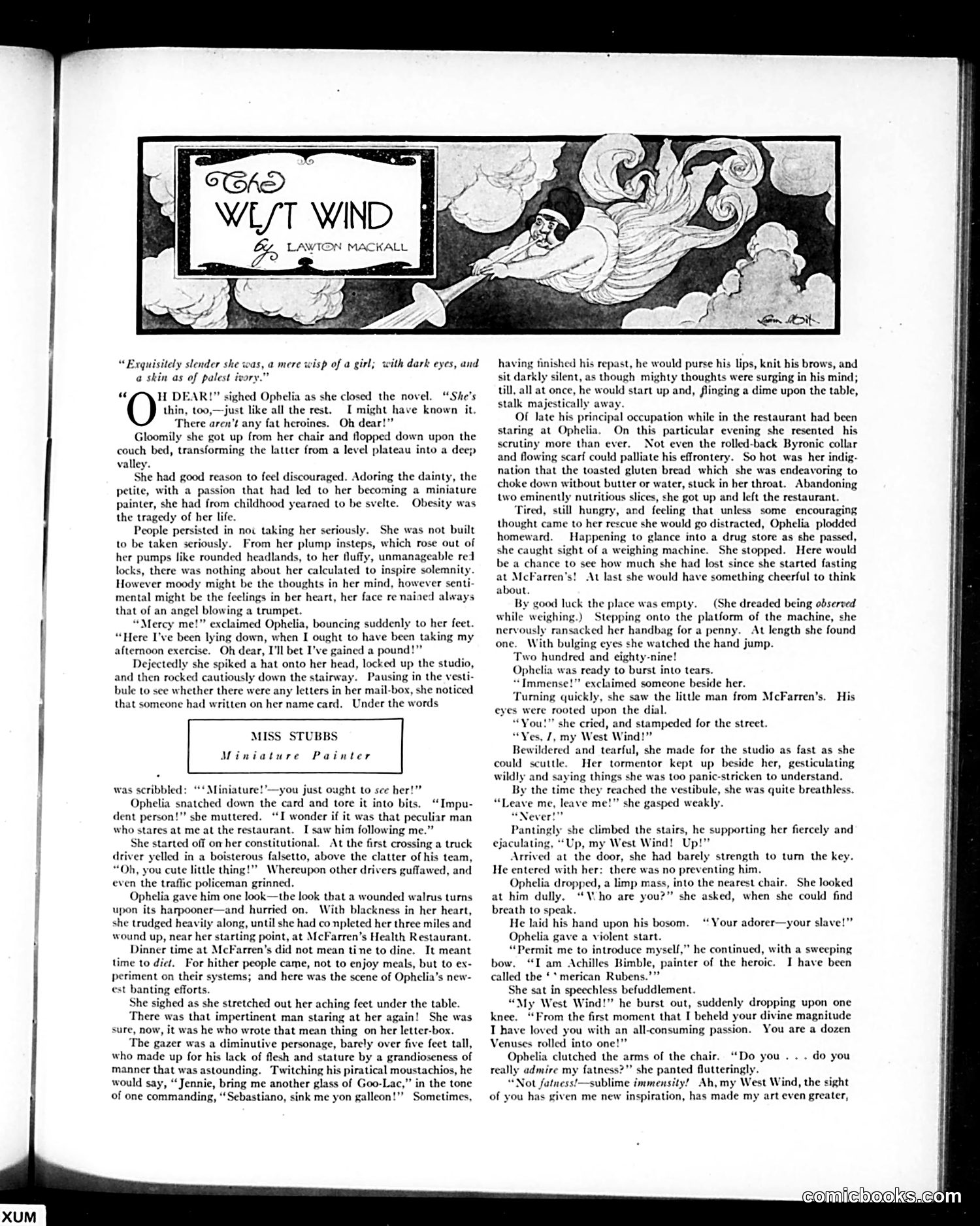
This is a humorous short story about Ophelia, an overweight miniature painter who obsesses over her weight after reading novels featuring impossibly thin heroines. The satire targets early 20th-century beauty standards and women's internalized body anxiety. The cartoon header shows a ethereal, wisp-like figure—the opposite of Ophelia—embodying the unrealistic "West Wind" ideal she yearns for. The story follows her futile diet attempts at "McFarren's Health Restaurant," a weight-loss establishment. A mysterious small man with theatrical mannerisms (described with exaggerated grandeur despite his diminutive stature) becomes her unwitting admirer, watching her intently. The joke is the contrast between Ophelia's despair and her actual desirability—she's so focused on societal beauty standards that she misinterprets romantic interest as mockery. The satire gently mocks both unrealistic feminine ideals and women's self-defeating pursuit of them.
📄 Transcribed text from this page (OCR, searchable)
Machine-transcribed from the original scan — historical spelling and the odd misread are preserved.
XUM STAD WL/T WIND & LAWTON MACKALL “ Exquisitely slender ske was, a mere wisp of a girl; with dark eyes, and bin as of palest ivory.” H DEAR!” sighed Ophelia as she closed the novel. “She's thin, too,—just like all the rest. I might have known it, There aren't any fat heroines. Oh deat Gloomily she got up from her chair and flopped down upon the couch bed, transforming the latter from a level plateau into a deep valley. She had good reason to feel discouraged. Adoring the dainty, the petite, with a passion that had led to her becoming a miniature painter, she had from childhood yearned to be svelte. Obesity was the tragedy of her life. People persisted in noi taking her seriously. She was not built to be taken seriously. From her plump insteps, which rose out of her pumps like rounded headlands, to her fluffy, unmanageable red locks, there was nothing about her calculated to inspire solemnity However moody might be the thoughts in her mind, however sent mental might be the feelings in ber heart, her face re nained always that of an angel blowing a trampe' fercy me!” exclaimed Ophelia, bouncing suddenly to her feet. “Here I've been lying down, when I ought to have been taking my afternoon exercise. Oh dear, I'll bet I've gained a pound!” Dejectedly she spiked a hat onto her head, locked up the studio, and then rocked cautiously down the stairway. Pausing in the vesti- bule to sce whether there were any letters in her mail-box, she noticed that someone had written on her name card. Under the words MISS STUBBS Miniature Painter was scribbled: “‘Miniature!’—you just ought to see her!” Ophelia snatched down the card and tore it into bits. “Impu- dent person!” she muttered. “I wonder if it was that peculiar man who stares at me at the restaurant. I saw him following me.” She started off om her constitutional. At the first crossing a truck driver yelled in a boisterous falsetto, above the clatter of his team, “Oh, you cute little thing!” Whereupon other drivers guffawed, and even the traffic policeman grinned. Ophelia gave him one look—the look that a wounded walrus turns upon its harpooner—and hurried on. With blackness in her heart, she trudged heavily along, until she had co npleted her three miles and wound up, near her starting point, at McFarren’s Health Restaurant. Dinner time at McFarren’s did not mean tine to dine. It meant time to diet. For hither people came, not to enjoy meals, but to ex- periment on their systems; and here was the scene of Ophelia’s new- est banting efforts. She sighed as she stretched out her aching feet under the table. There was that impertinent man staring at her again! She was sure, now, it was he who wrote that mean thing on her letter-box. The gazer was a diminutive personage, barely over five feet tall, who made up for his lack of flesh and stature by a grandioseness of manner that was astounding. Twitching his piratical moustachios, he would say, “Jennie, bring me another glass of Goo-Lac,” in the tone of one commanding, “Sebastiano, sink me yon galleon!”” Sometimes, having finished his repast, he would purse his lips, knit his brov sit darkly silent, as though mighty thoughts were surging in his mind; till, all at once, he would start up and, flinging a dime upon the table, stalk majestically away. Of late his principal occupation while in the restaurant had been staring at Ophelia, On this particular evening she resented his scrutiny more than ever. Not even the rolled-back Byronic collar and flowing scarf could palliate his effrontery. So hot was her indig- nation that the toasted gluten bread which she was endeavoring to choke down without butter or water, stuck in her throat. Abandoning two eminently nutritious slices, she got up and left the restaurant. Tired, still hungry, and feeling that unless some encouraging thought came to her rescue she would go distracted, Ophelia plodded homeward. Happening to glance into a drug store as she passed, she caught sight of a weighing machine. She stopped. Here would be a chance to see how much she had lost since she started fasting at McFarren’s! At last she would have something cheerful to think about. By good luck the place was empty. (She dreaded being observed while weighing.) Stepping onto the platform of the machine, she nervously ransacked her handbag for a penny. At length she found one. With bulging eyes she watched the hand jump. Two hundred and eighty ! Ophelia was ready to burst into tears. “Immense!” exclaimed someone beside her. Tuming quic! she saw the little man from McFarren’s. His eyes were rooted upon the dial. “You!” she cried, and stampeded for the street. “Yes, 7, my West Wind!” Bewildered and tearful, she made for the studio as fast as she could scuttle. Her tormentor kept up beside her, gesticulating wildly and saying things she was too panic-stricken to understand. the time they reached the vestibule, she was quite breathless. “Leave me, leave me!” she gasped weakly. Never!” Pantingly she climbed the stairs, he supporting her fiercely and ejaculating, “Up, my West Wind! Up! Arrived at the door, she had barely strength to tum the key. He entered with her: there was no preventing him. Ophelia dropped, a limp mass, into the nearest chair. She looked at him dully, “Vvho are you?” she asked, when she could find breath to speak. He laid his hand upon his bosom. ‘ Your adorer—your slave!"” Ophelia gave a violent start. “Permit me to introduce myself,” he continued, with a sweeping bow. “Iam Achilles Bimble, painter of the heroic. I have been called the ‘* merican Rubens.’” She sat in speechless befuddlement. “My West Wind!” he burst out, suddenly dropping upon one knee. “From the first moment that I beheld your divine magnitude T have loved you with an all-consuming passion. You are a dozen Venuses rolled into one!” Ophelia clutched the arms of the chair. “Do you . . . do you really admire my fatness?” she panted flutteringly. Not fatness!—sublime immensity! Ah,my West Wind, the sight s given me new inspiration, has made my art even greater, of you ha