
Judge, 1917-10-06 · page 8 of 28
Judge — October 6, 1917 — page 8: what you’re looking at
What you’re looking at
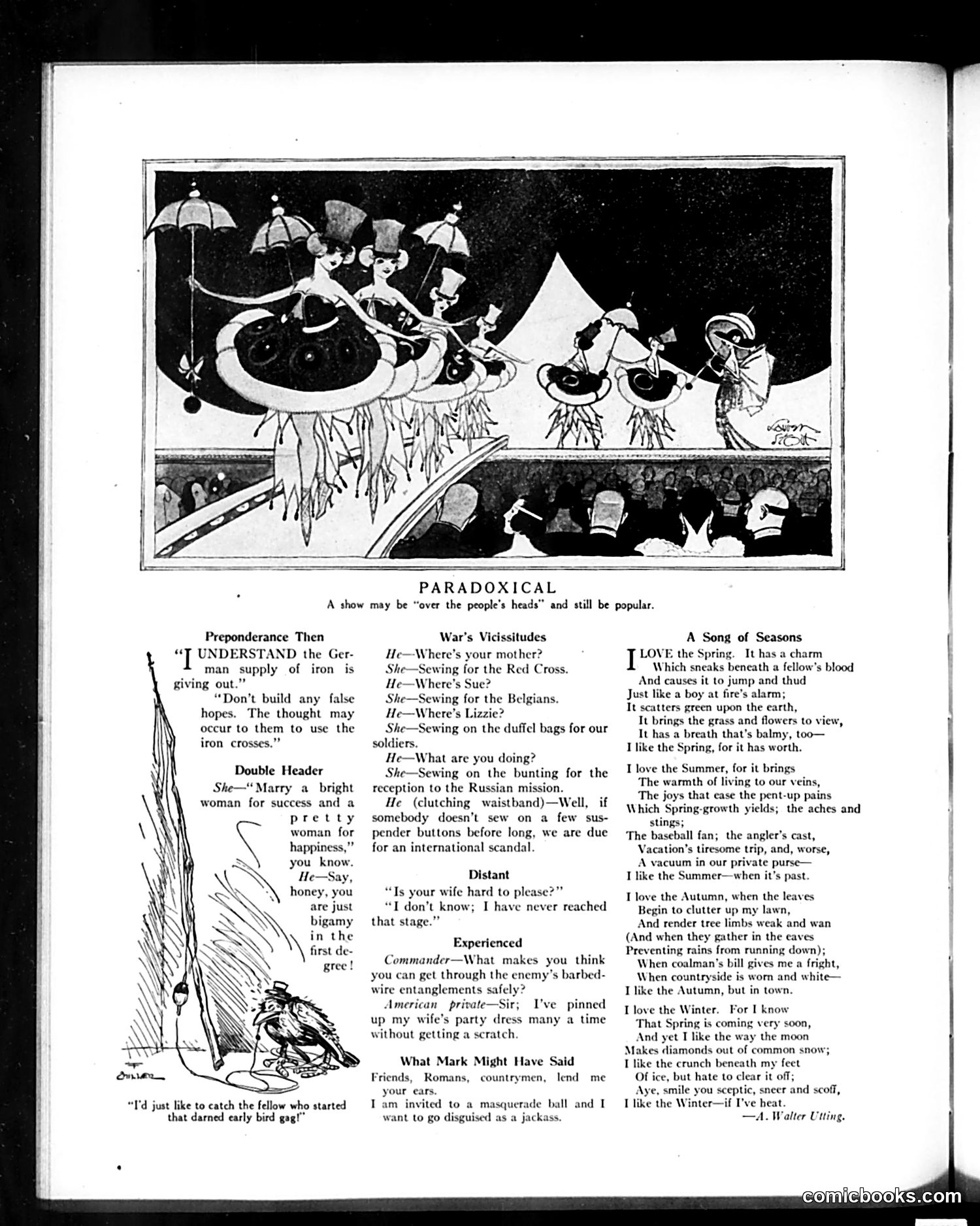
The top cartoon titled "Paradoxical" depicts a theatrical performance viewed from above by an audience below. The joke appears to concern wartime entertainment—the visual shows an elaborate, perhaps absurdist show "over the people's heads" (literally, in the staging) yet remaining popular despite its obscurity. The text sections mock WWI-era life: "War's Vicissitudes" jokes about women constantly sewing for various war efforts (Red Cross, Belgian relief, soldiers' uniforms, Russian mission receptions), leaving husbands without button repairs—threatening "international scandal." "Double Header" satirizes marriage pragmatism. Other brief jokes mock military recruitment ("Experienced" contrasts a commander's concern with an American soldier's mundane domestic experience), and a "Mark Might Have Said" joke plays on Shakespeare while mocking someone attending a masquerade as a donkey. "A Song of Seasons" is a nostalgic poem celebrating each season with humorous caveats—spring and summer idealized, autumn resented for yard work and coal bills, winter tolerable only with heat. The overall page reflects American homefront WWI anxieties mixed with everyman complaints about domestic life.
📄 Transcribed text from this page (OCR, searchable)
Machine-transcribed from the original scan — historical spelling and the odd misread are preserved.
PARADOXICAL A show may be “over the people’s heads” and still be popular. Preponderance Then “7 UNDERSTAND the Ger- man supply of iron is giving out.” “Don’t build any false hopes. The thought may occur to them to use the iron crosses.” Double Header She—" Marry a_ bright woman for success and a pretty woman for first de- ‘ are just \ bigamy NN in the “I'd just like to catch the fellow who started that darned early bird gag!” War's Vicissitudes He—Where’s your mother? She—Sewing for the Red Cross. He—Where’s Suc? She—Sewing for the Belgians. He—Where’s Lizzie? She—Sewing on the duffel bags for our soldiers. He—What are you doing? he—Sewing on the bunting for the reception to the Russ mission. He (clutching waistband)—Well, if somebody doesn’t sew on a few sus- pender buttons before long, we are due for an international scandal. Distant “Is your wife hard to please?” I don’t know; I have never reached that stage.” Experienced Commander—What makes you think you can get through the enemy’s barbed- wire entanglements safely? American private—Sit; I've pinned up my wife’s party dress many a time without getting a scratch. What Mark Might Have Said Friends, Romans, countrymen, lend me your Tam invited to a masquerade ball and I want to go disguised as a jackass. A Song of Seasons LOVE the Spring. It has a charm Which sneaks beneath a fellow’s blood And causes it to jump and thud Just like a boy at fire’s alarm; It scatters green upon the earth, It brings the grass and flowers to view, It has a breath that’s balmy, too— I like the Spring, for it has worth. I love the Summer, for it brings ‘The warmth of living to our veins, The joys that case the pent-up pains Which Spring-growth yields; the aches and stings; ‘The baseball fan; the angler’s cast, Vacation’s tiresome trip, and, worse, A vacuum in our private purse— I like the Summer—when it’s past I love the Autumn, when the leaves Begin to clutter up my lawn, And render tree limbs weak and wan (And when they gather in the caves Preventing rains from running down); When coalman’s bill gives me a fright, When countryside is worn and white— I like the Autumn, but in town. I love the Winter. For I know That Spring is coming very soon, And yet T like the way the moon Makes diamonds out of common snow; I like the crunch beneath my feet Of ice, but hate to clear it off; Aye, smile you sceptic, sneer and scoff, I like the Winter—if I've heat —A. Walter Utting.