
Judge, 1917-10-06 · page 6 of 28
Judge — October 6, 1917 — page 6: what you’re looking at
What you’re looking at
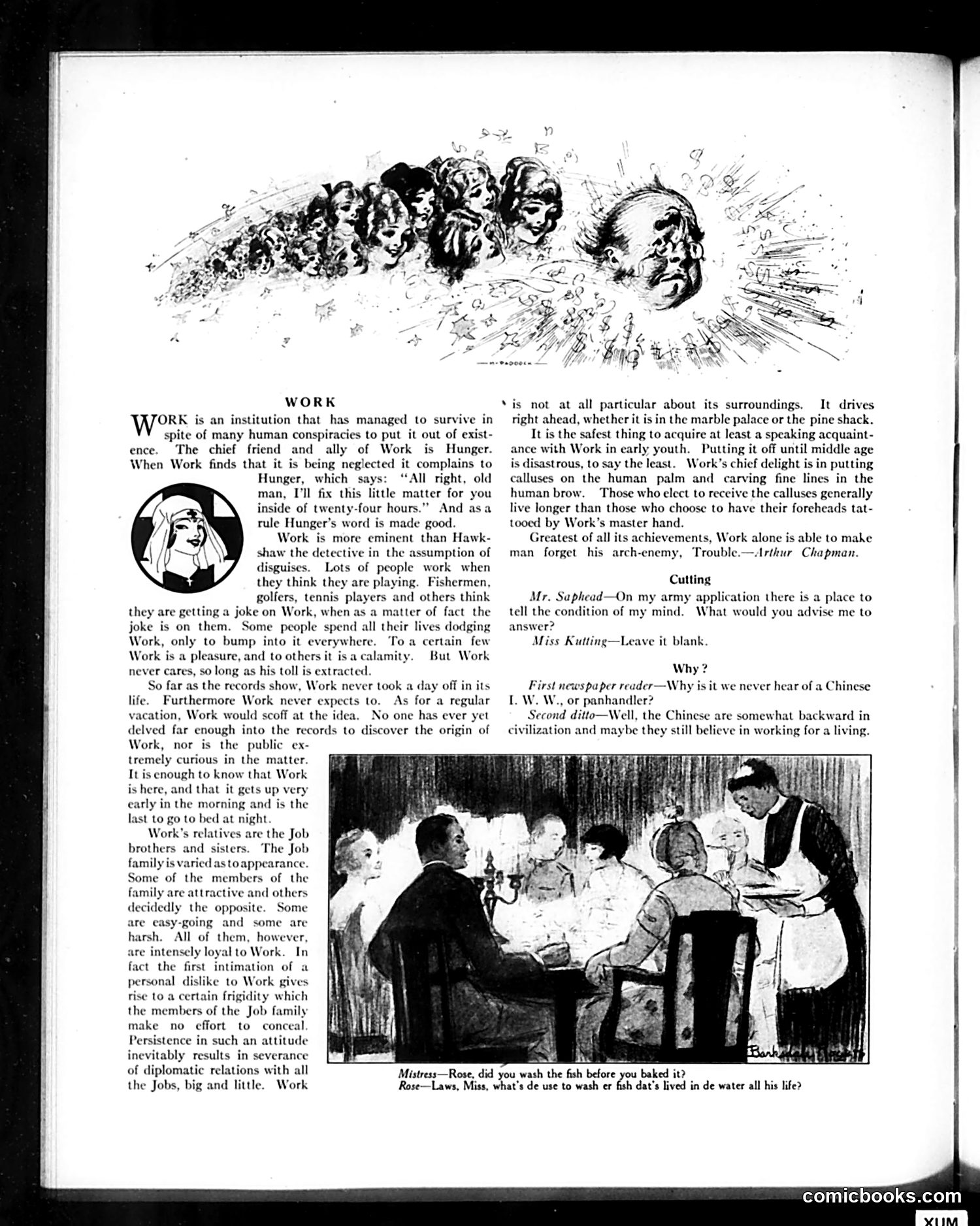
This satirical piece uses personification to mock the institution of Work itself as a demanding master. The illustration shows several faces morphing together, suggesting Work consumes identity. The text presents Work as an all-consuming "chief friend" driven by Hunger, playing on labor's exploitative nature. It satirizes how people justify overwork across professions (fishermen, golfers, tennis players), treating drudgery as noble. The dialogue exchange mocks workplace absurdities: an employee asks about noting "army application" on a form; a supervisor dismissively says "Leave it blank"—suggesting Work's indifference to individual circumstances. The lower illustration shows a domestic scene with a caption about washing fish, likely illustrating how work invades home life. The piece critiques early 20th-century American work culture's relentless demands and workers' resigned acceptance thereof.
📄 Transcribed text from this page (OCR, searchable)
Machine-transcribed from the original scan — historical spelling and the odd misread are preserved.
WORK ORK is an institution that has managed to survive in spite of many human conspiracies to put it out of exis ence. The chief friend and ally of Work is Hunger. When Work finds that it is being neglected it complains to Hunger, which “All right, old man, I'll fix this little matter for you \ inside of twenty-four hours.” And asa rule Hunger’s word is made good. Work is more eminent than Hawk- shaw the detective in the assumption of disguises. Lots of people work when they think they are playing. Fishermen, golfers, tennis players and others think they are getting a joke on Work, when as a matter of fact the joke is on them. Some people spend all their lives dodging Work, only to bump into it everywhere. To a certain few Work is a pleasure, and to others it isa calamity. But Work never cares, so long as his toll is extracted. So far as the records show, Work never took a day off in its life. Furthermore Work never expects to. As for a regular vacation, Work would scoff at the idea, No one has ever yet delved far enough into the records to discover the origin of Work, nor is the public ex- tremely curious in the matter. It is enough to know that Work is here, and that it gets up very early in the morning and is the last to go to bed at night Work’s relatives are the Job brothers and sisters. The Job family is varied as to appearance. Some of the members of the family are attractive and others decidedly the opposite. Some are easy-going and some are harsh. All of them, however, are intensely loyal to Work. In fact the first intimation of a personal dislike to Work gi rise to a certain frigidity whi the members of the Job family make no effort to conceal Persistence in such an attitude inevitably results in severance of diplomatic relations with all the Jobs, big and little. Work not at all particular about its surroundings. It drives right ahead, whether it is in the marble palace or the pine shack. It is the safest thing to acquire at least a speaking acquaint- ance with Work in early youth. Putting it off until middle age is disastrous, to say the least. Work’s chief delight is in putting calluses on the human palm and carving fine lines in the human brow. Those who elect to receive the calluses generally live longer than those who choose to have their foreheads tat- tooed by Work’s master hand. Greatest of all its achievements, Work alone is able to make man forget his arch-enemy, Trouble.—<Arthur Chapman. Cutting Mr. Saphead—On my army application there is a place to tell the condition of my mind. What would you advise me to answer? Miss Kutting—Leave it blank. Why ? First news pa per reader—Why is it we never hear of a Chinese [. W. W., or panhandler? Second ditto—Well, the Chinese are somewhat backward in civilization and maybe they still believe in working for a livii Mistress—Rose, did you wash the fish before you baked it? Rose—Laws, Miss, what's de use to wash er fish dat’s lived in de water all his life? comicbooks.com