
A complete issue · 28 pages · 1917
Judge — September 15, 1917
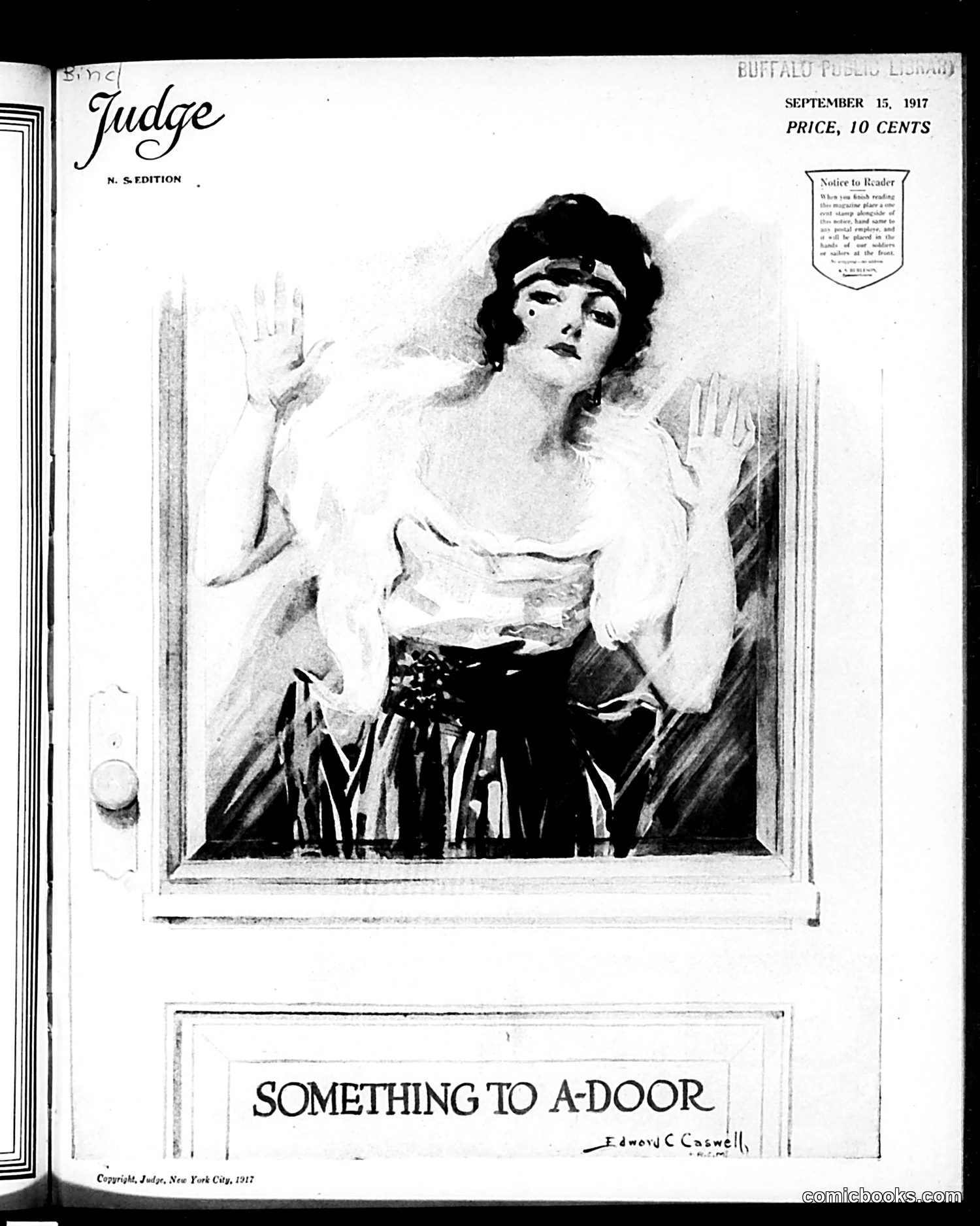
This is the cover of Judge magazine from September 15, 1917. The illustration by Edward C. Caswell shows a woman in period dress looking out a window or doorway, with a flirtatious or suggestive expression. The title "Something to A-Door" is a visual pun playing on the phrase "something to adore." The image appears to be satirizing romantic or domestic themes popular in early 20th-century entertainment and culture. The suggestive pose and the wordplay suggest humor aimed at adult readers regarding attraction or seduction. Without additional context from inside the magazine, the specific social or political satire remains unclear, though the cover exemplifies Judge's typical use of clever visual puns and mildly risqué humor for its contemporary audience.
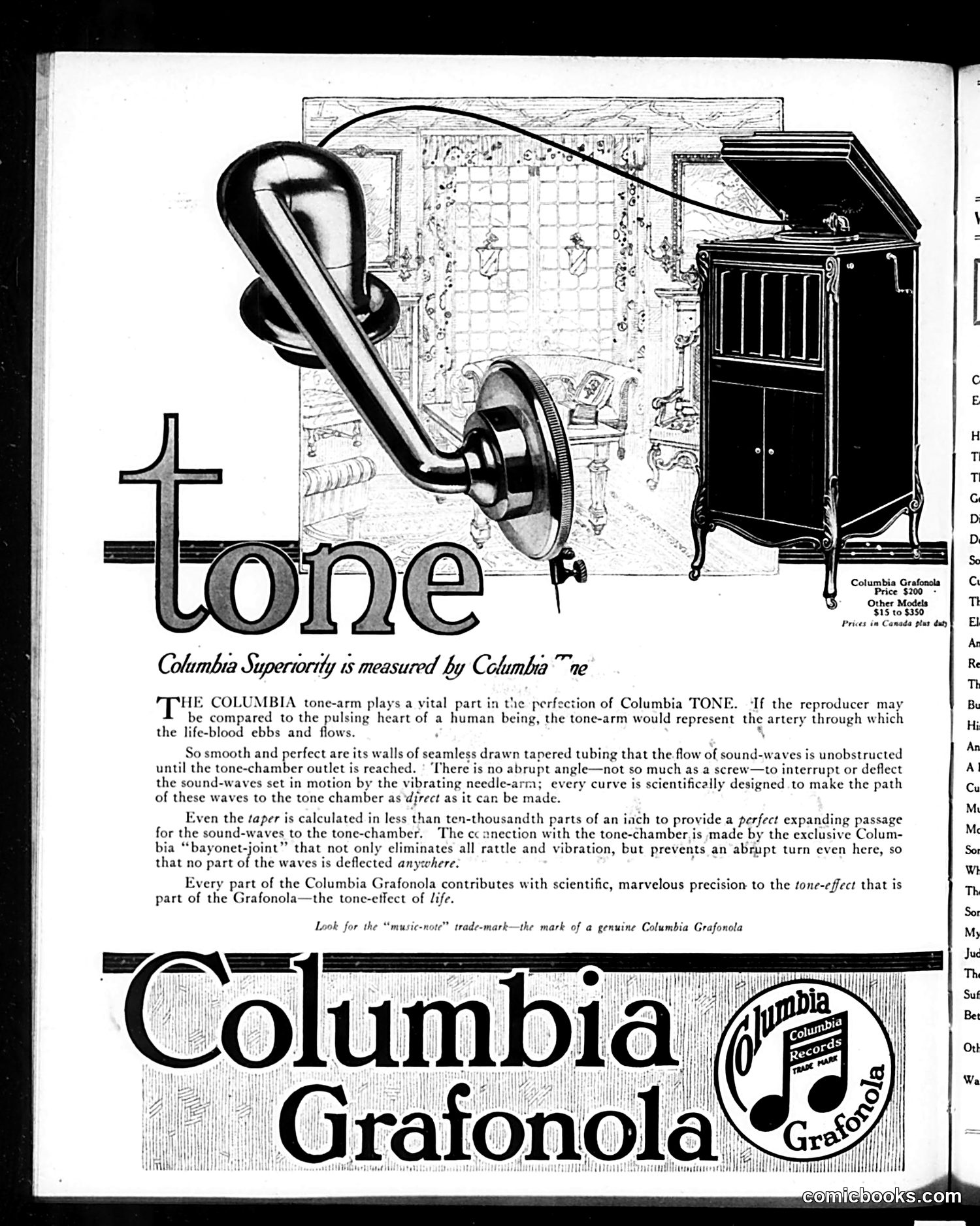
This page is **primarily an advertisement**, not satire or political commentary. It promotes the Columbia Grafonola, a phonograph player, priced at $200. The ad uses technical language to sell the device's superior sound quality, comparing the "tone-arm" to an artery through which blood flows—emphasizing seamless sound transmission. Key selling points include the seamless tubing design, the "bayonet-joint" connection that eliminates vibration, and precise engineering. The illustration shows the Grafonola cabinet (right) with a cutaway diagram displaying its internal mechanics (center). The prominent "tone" text and imagery emphasize that Columbia's superiority is "measured by Columbia Tone." This is straightforward product marketing from the early phonograph era, not political or social satire.
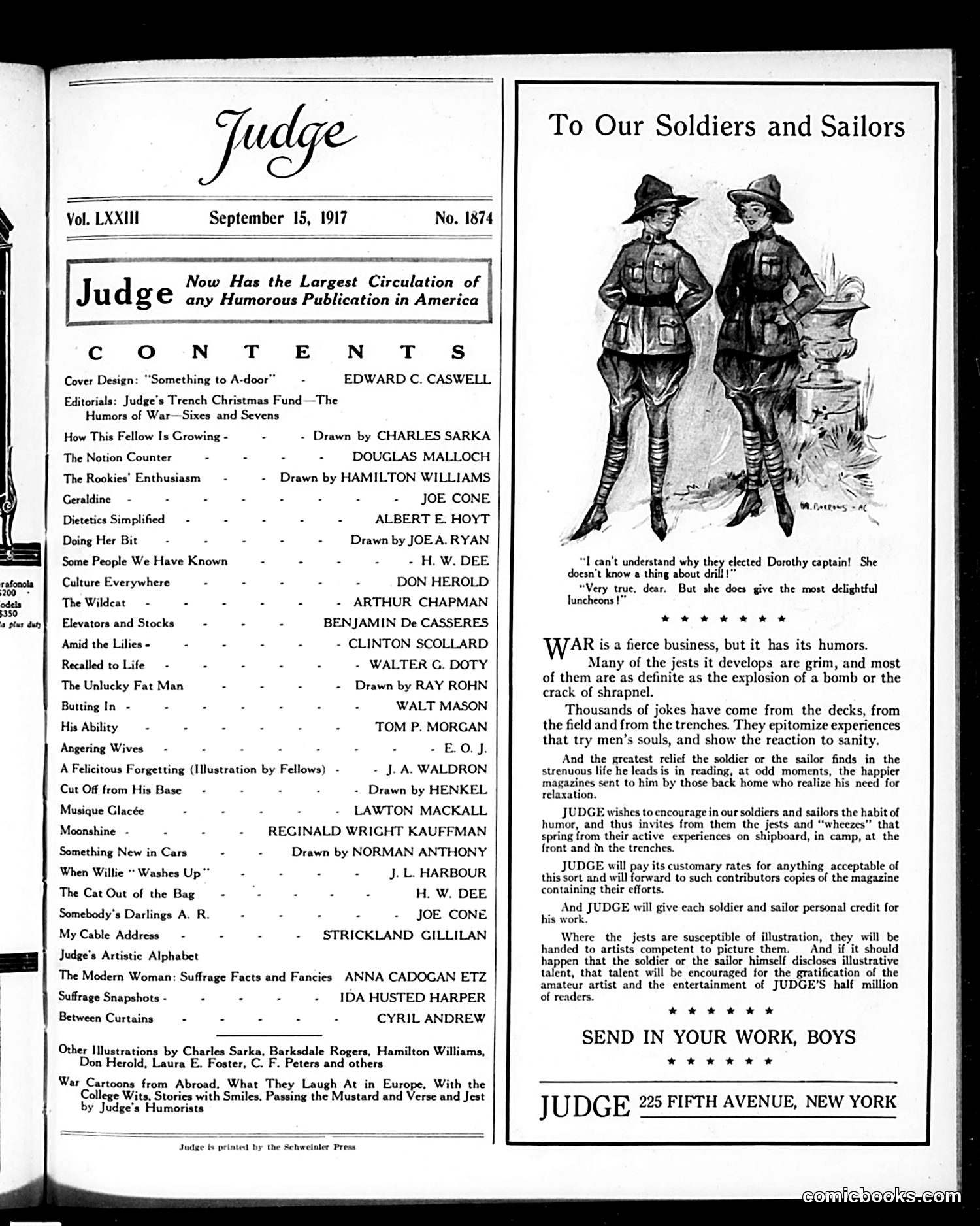
This page is primarily an **advertisement and editorial appeal** rather than political satire. The right page features "To Our Soldiers and Sailors"—a recruitment pitch encouraging servicemen to submit humorous contributions to Judge magazine. The accompanying illustration shows two uniformed soldiers, likely American Expeditionary Forces personnel (World War I era, given the 1917 date and military uniforms). The editorial explains that Judge seeks jokes and illustrations from soldiers and sailors themselves, offering to credit contributors and provide "personal credit for his work." This reflects the magazine's effort to maintain morale during WWI by publishing soldier-submitted content. The left page is a standard table of contents listing various articles and contributors.
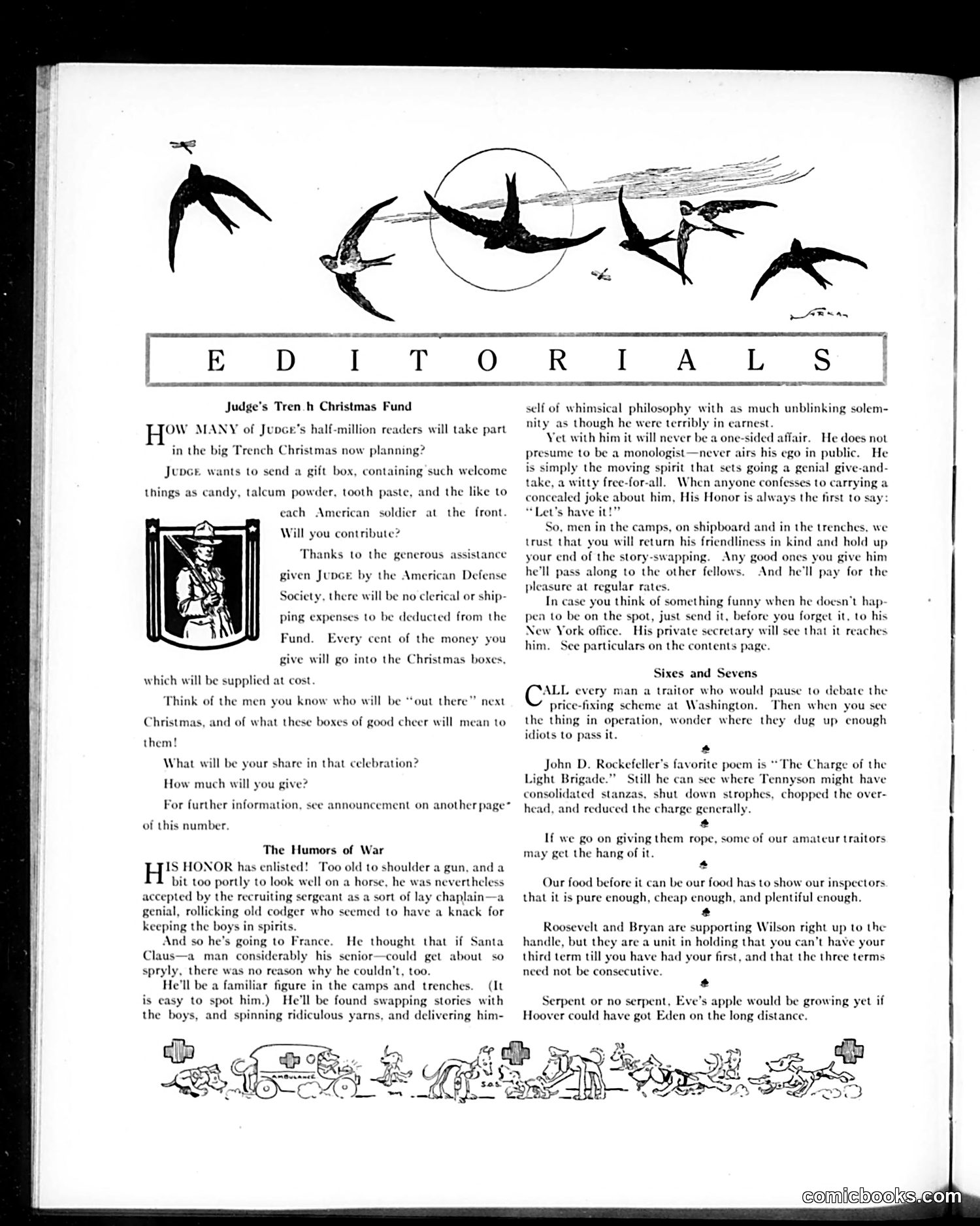
This page contains satirical editorials rather than cartoons. The pieces mock WWI-era politics and society: **"Judge's Trench Christmas Fund"** appeals for donations to send gift boxes to American soldiers, sarcastically suggesting readers contribute while questioning their actual generosity. **"The Humors of War"** ridicules an elderly man enlisting as a chaplain, noting his age makes him unsuitable for combat but useful for morale. The satire suggests the absurdity of elderly volunteers and military desperation. **"Sixes and Sevens"** mocks government price-fixing schemes and incompetence in Washington, implying officials are "idiots" unable to implement basic policies. The editorials reflect wartime cynicism about government competence, military organization, and public charitable commitment—typical Judge magazine irreverence toward authority and contemporary events.
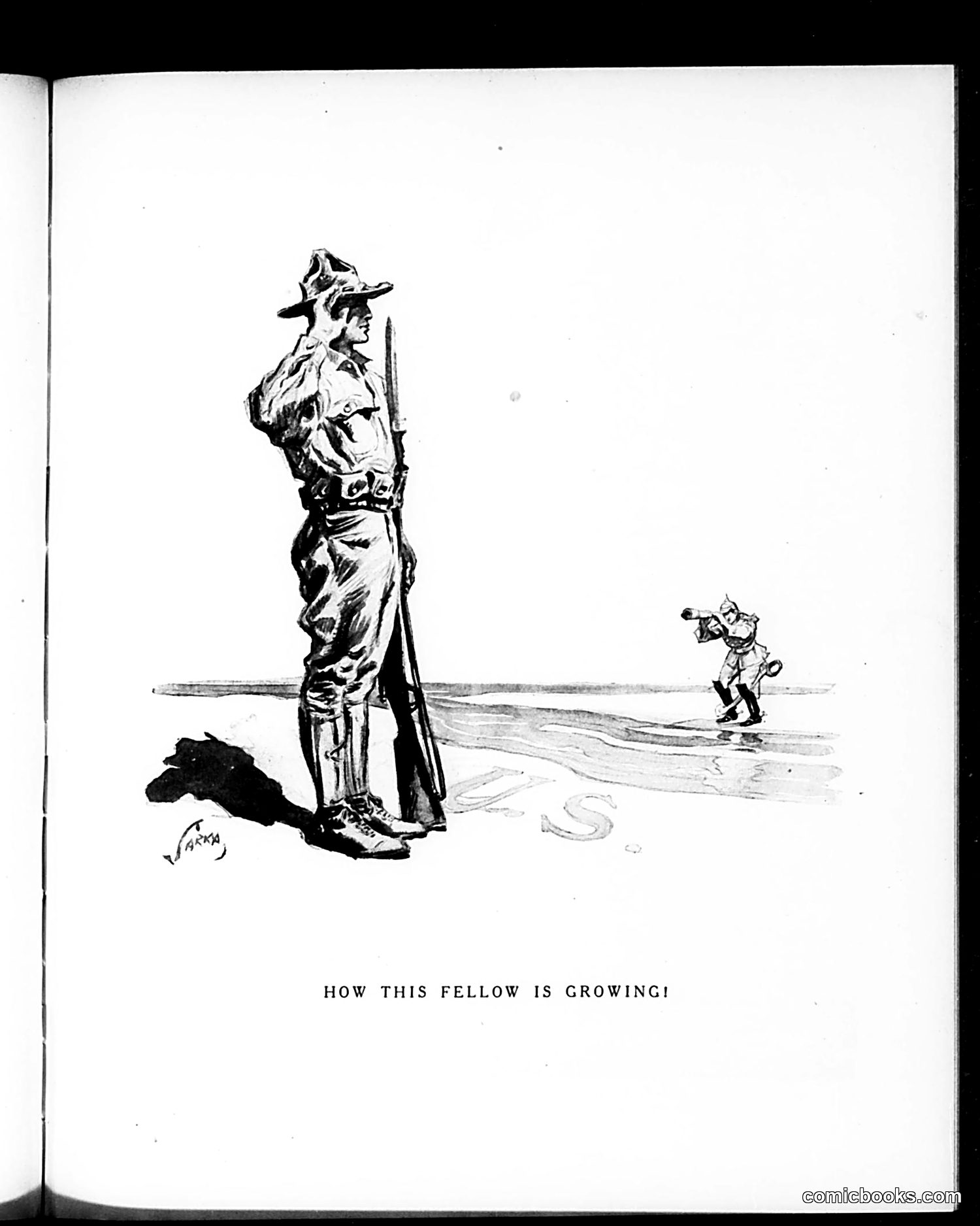
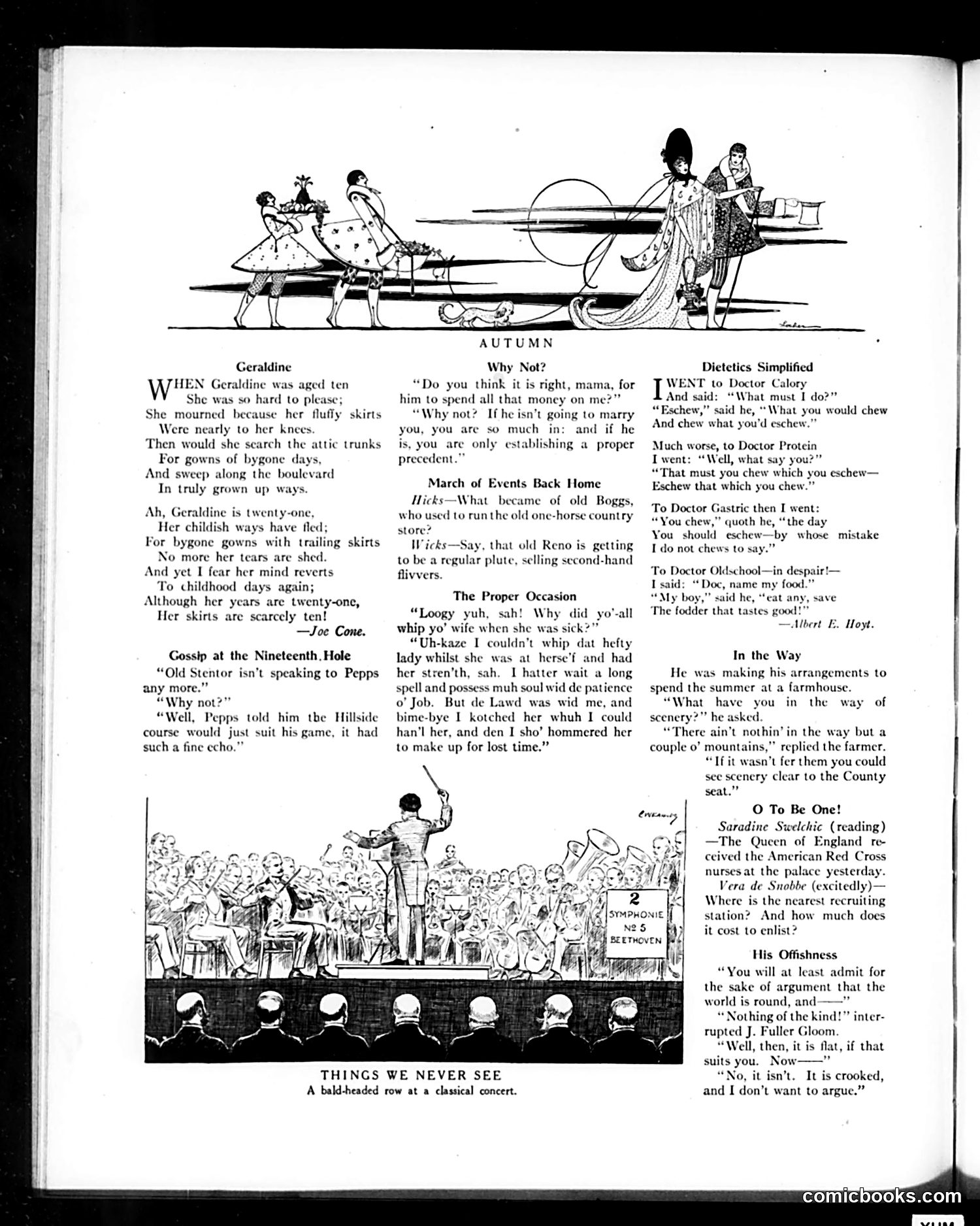
This page contains humorous short pieces and illustrations rather than a single political cartoon. The content includes: **"Geraldine"** — A poem about a ten-year-old girl mourning bygone fashion (long skirts), suggesting commentary on changing women's dress standards. **"March of Events Back Home"** — A gossipy piece about a character named Reno selling "second-hand livers," likely a reference to the Reno divorce scandal that was contemporary scandal fodder. **The main illustration** titled "Things We Never See" depicts "a bald-headed row at a classical concert" — a humor piece suggesting the audience at high-culture events typically includes numerous bald men, playing on contemporary stereotypes about classical music audiences. The remaining items are brief anecdotes and jokes about everyday social situations, typical of Judge's satirical approach to American middle-class life and manners.
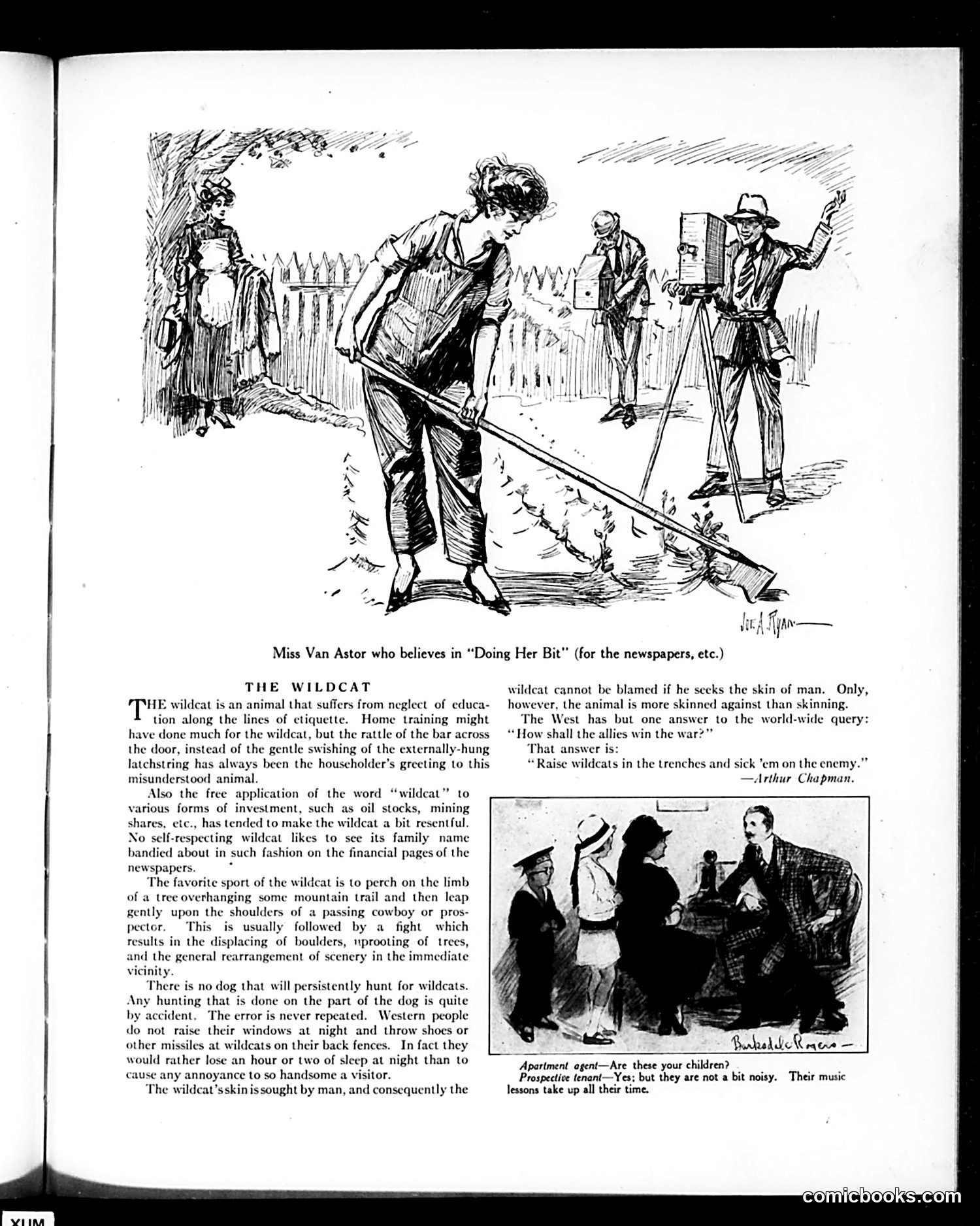
This page satirizes two distinct targets: **"Miss Van Astor" (top cartoon):** References a wealthy socialite performing visible "war work" for newspaper publicity—likely during WWI. The satire mocks upper-class women who perform labor ostentatiously for public relations while actual war efforts continue. "Doing Her Bit" was contemporary slang for contributing to the war effort. **"The Wildcat" (main essay):** A humorous double-meaning piece playing on "wildcat" as both an animal *and* a financial term. The essay pretends to defend the animal's reputation, which has been tarnished by association with risky "wildcat stocks" and "wildcat oil" schemes—fraudulent investments common in early 20th-century finance. The WWI reference suggests using wildcats as weapons—absurdist humor suggesting desperate solutions to the war. **The apartment cartoon (bottom):** A landlord-tenant joke about noisy children; the tenant claims music lessons keep them occupied and quiet—likely satirizing either the expense of such lessons or their ineffectiveness as discipline. The page combines topical war-era satire with financial commentary and domestic humor typical of *Judge* magazine's style.
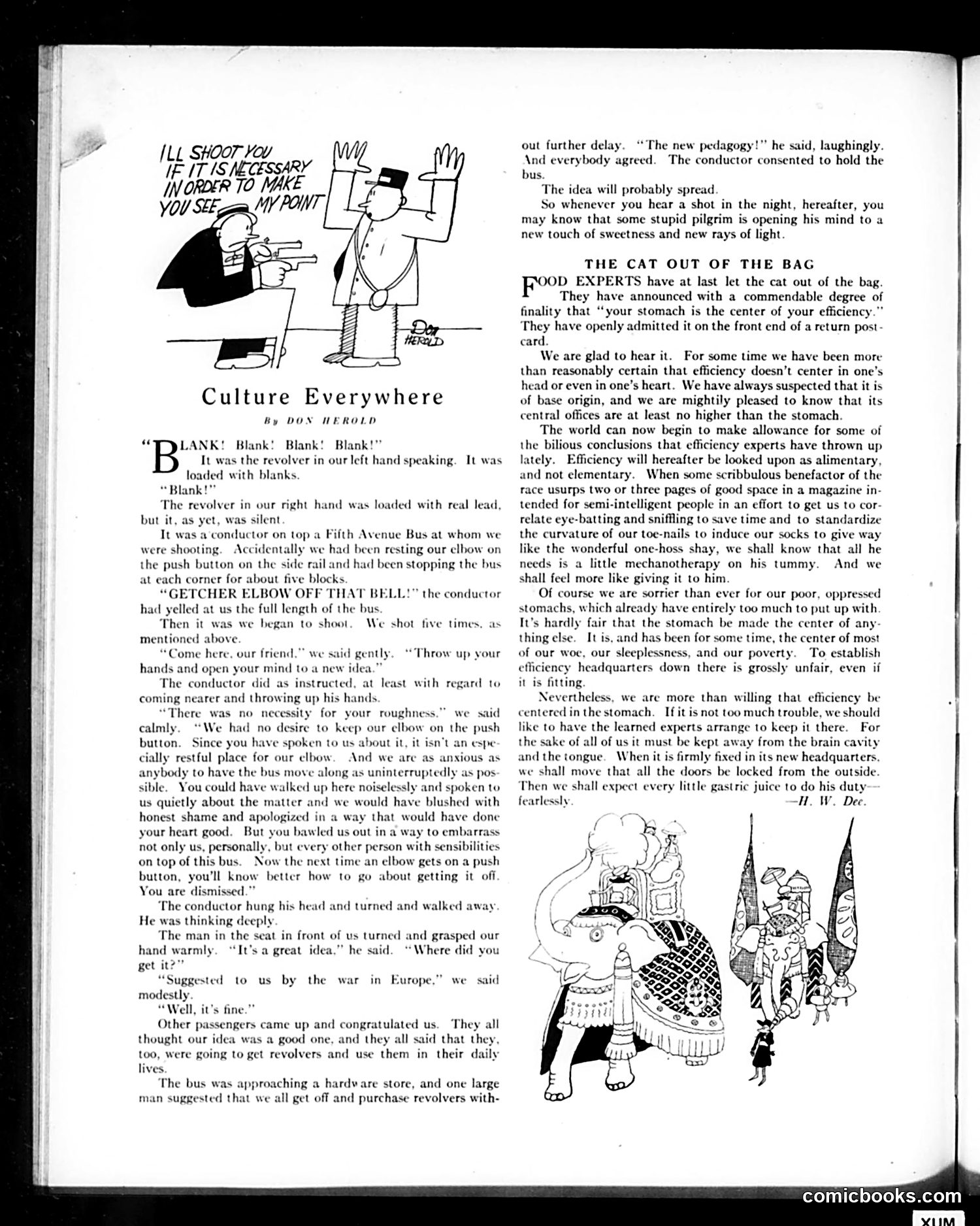
This Don Herold cartoon satirizes the post-WWI vogue for using "efficiency" and "modern pedagogy" (teaching methods) to solve everyday problems. The joke: the narrator shoots a bus conductor five times (with blanks, then threatens with real bullets) to "teach" him manners instead of simply asking politely to move his elbow off the bell. The satire mocks how intellectuals of the 1920s, influenced by wartime brutality and pseudo-scientific management theory, believed aggressive confrontation and force could improve society. Other passengers enthusiastically adopt this absurd "new pedagogy," planning to buy revolvers to "open minds" in daily life. The accompanying essay "The Cat Out of the Bag" continues the mockery, ridiculing efficiency experts who claim the stomach—not intellect or morality—drives human behavior. Herold attacks the era's obsession with pseudo-scientific solutions to fundamentally human problems, suggesting such "culture" is actually barbaric nonsense dressed in modern language.
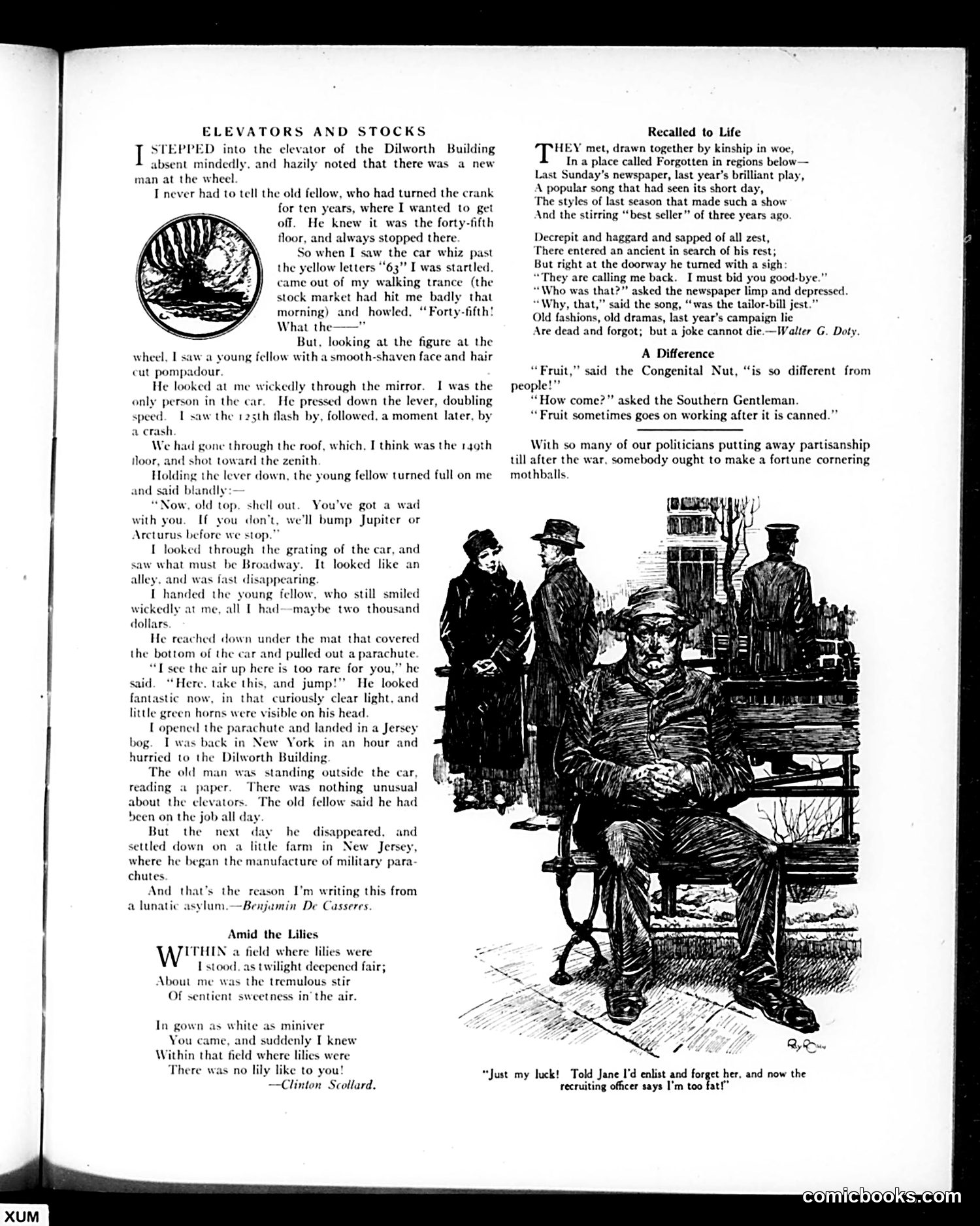
This surreal story by Benjamin De Casseres uses an elevator hijacking as metaphor for stock market chaos. A distracted narrator, preoccupied by morning stock losses, enters an elevator. A young, wickedly grinning operator deliberately overshoots the 45th floor, accelerating upward past the 125th floor through the building's roof into the sky—apparently representing wild, uncontrollable market speculation. The operator demands money ("shell out"), suggesting the predatory nature of market manipulation or fraud. The narrator's forced parachute jump and subsequent discovery that the old elevator operator has disappeared to manufacture parachutes implies that those who orchestrate financial crashes profit from the disaster. The story concludes in a "lunatic asylum," darkly suggesting that witnessing—or experiencing—stock market collapse drives one to madness. This reflects 1920s anxiety about market instability and financial fraud.
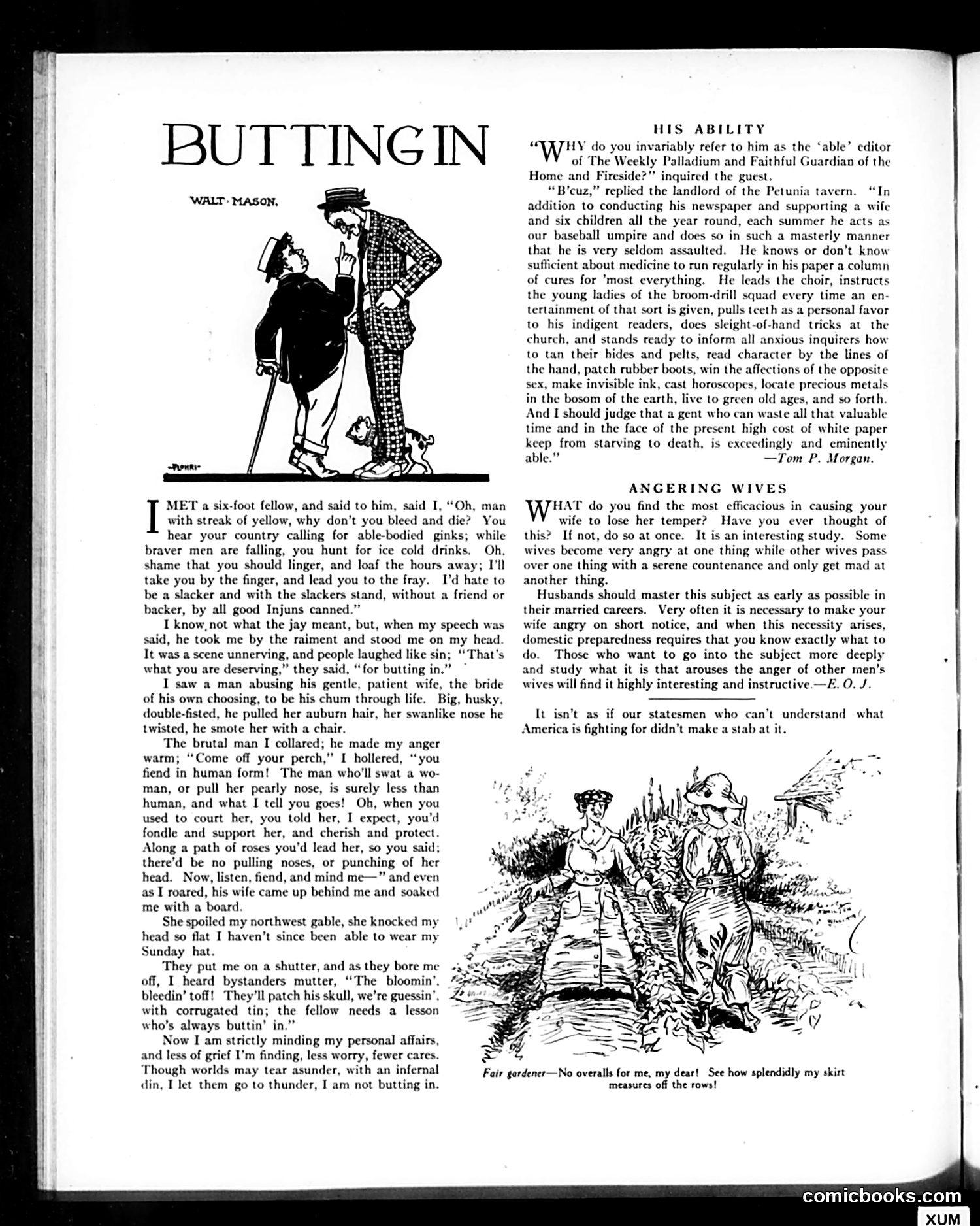
This humorous story by Walt Mason satirizes self-righteous meddling. The narrator, a self-appointed moral crusader, first confronts a young man for not enlisting (likely during WWI, given references to "slackers"), only to be physically humiliated. Undeterred, he then intervenes in a domestic dispute, lecturing a man beating his wife about courtship promises—only to be struck unconscious by the wife herself with a board. The punchline: the narrator learns his lesson. He resolves to stop interfering in others' affairs entirely, accepting that even serious wrongs ("worlds may tear asunder") are none of his business. The satire targets two types: patriotic busybodies pressuring draft-age men, and sanctimonious do-gooders who insert themselves into private matters without understanding the full situation. Mason suggests that unsolicited moral intervention, however well-intentioned, often backfires—a progressive-era critique of paternalism.
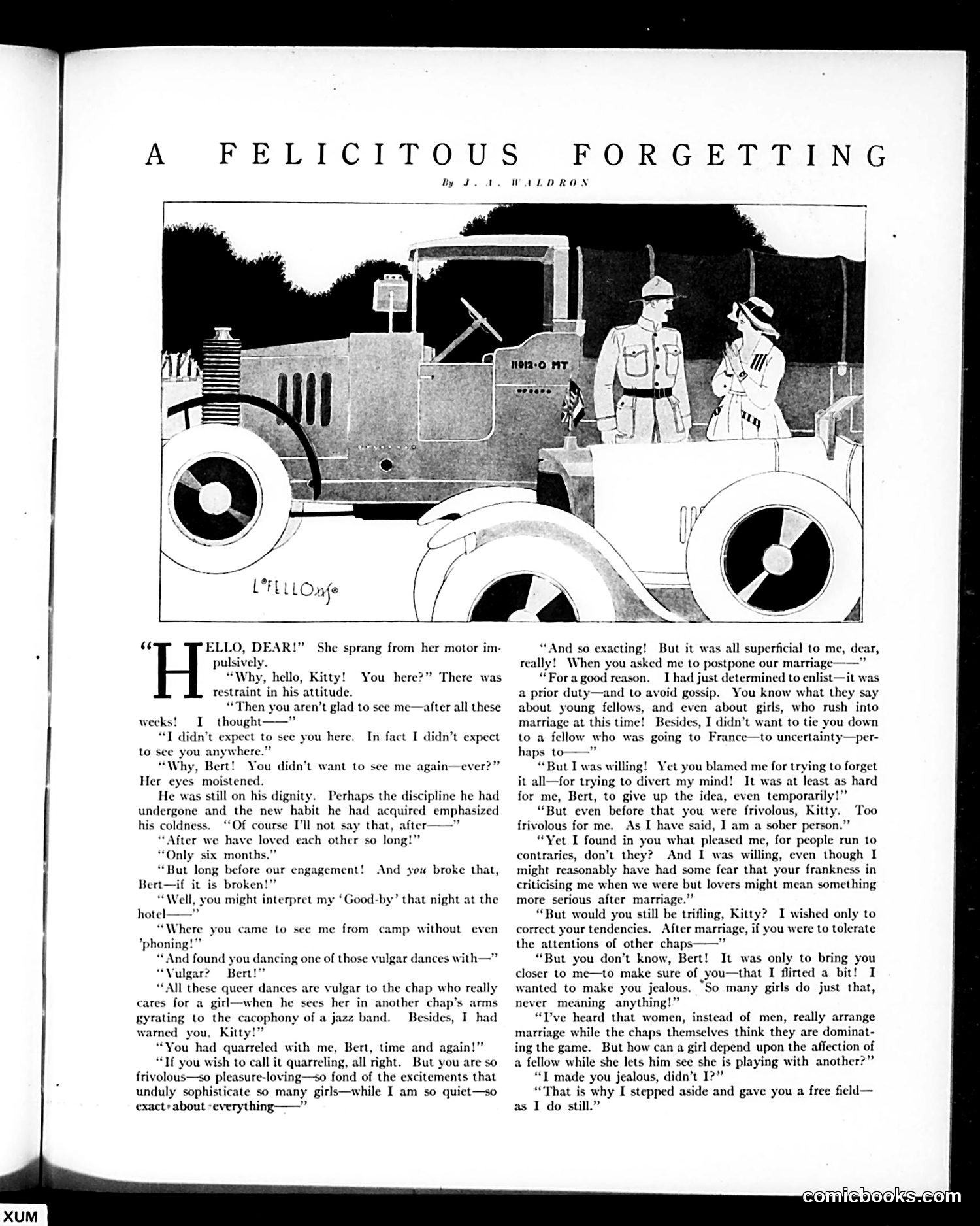
This story-cartoon depicts a post-WWI reconciliation between estranged fiancés. Bert, a soldier (identifiable by his military uniform in the illustration), and Kitty, his girlfriend, confront their relationship's breakdown. The satire targets both characters' war-era relationship anxieties. Bert embodies the stern, duty-bound soldier who enlisted and demanded Kitty postpone marriage—then resented her attempts to enjoy life (dancing, flirting) while he was away. Kitty represents the young woman caught between societal expectations and wartime freedom. The joke turns on their circular argument: Bert criticizes her frivolousness and flirtation as tests of his jealousy, while she defends these behaviors as strategies to keep him emotionally invested. Both claim the moral high ground regarding "correct" wartime behavior. The title suggests they're choosing to forget these grievances and reconcile—though the underlying incompatibility (his sober rigidity versus her social nature) remains unresolved. It's satirical commentary on how war-disrupted relationships attempted reconciliation through willful amnesia rather than genuine understanding.
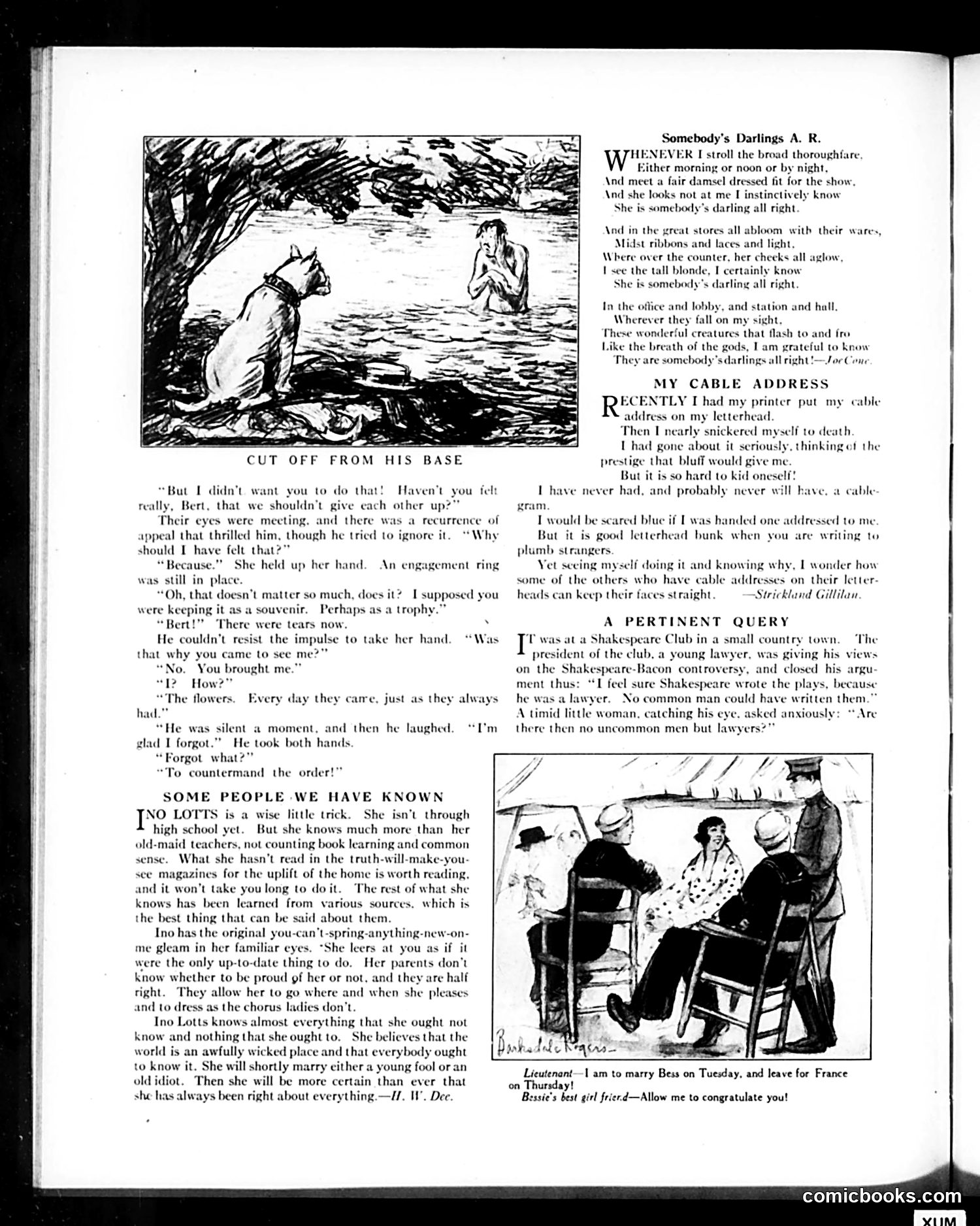
This page contains three separate satirical pieces typical of early 20th-century Judge magazine: **"Cut Off From His Base"** (top): A romantic dialogue between a man named Bert and a woman discussing their engagement. The satire appears to mock sentimental romance and broken engagements—she's trying to convince him not to leave, referencing flowers he brought and an engagement ring, while he attempts to resist emotional manipulation. **"Some People We Have Known"** (left column): A character sketch mocking "Ino Lotts," a teenage girl who reads salacious magazines, dresses like chorus girls, and believes she knows everything despite knowing nothing she "ought to" know. The satire targets both precocious youth and parental permissiveness. **"My Cable Address"** and **"A Pertinent Query"** (right): Brief humorous pieces—one about pretentiously listing a cable address despite never receiving cables; the other poking fun at a lawyer's circular logic that Shakespeare must have written his plays because he was a lawyer, implying no "uncommon men" exist outside the legal profession. The humor relies on social observation and mild mockery of contemporary attitudes.
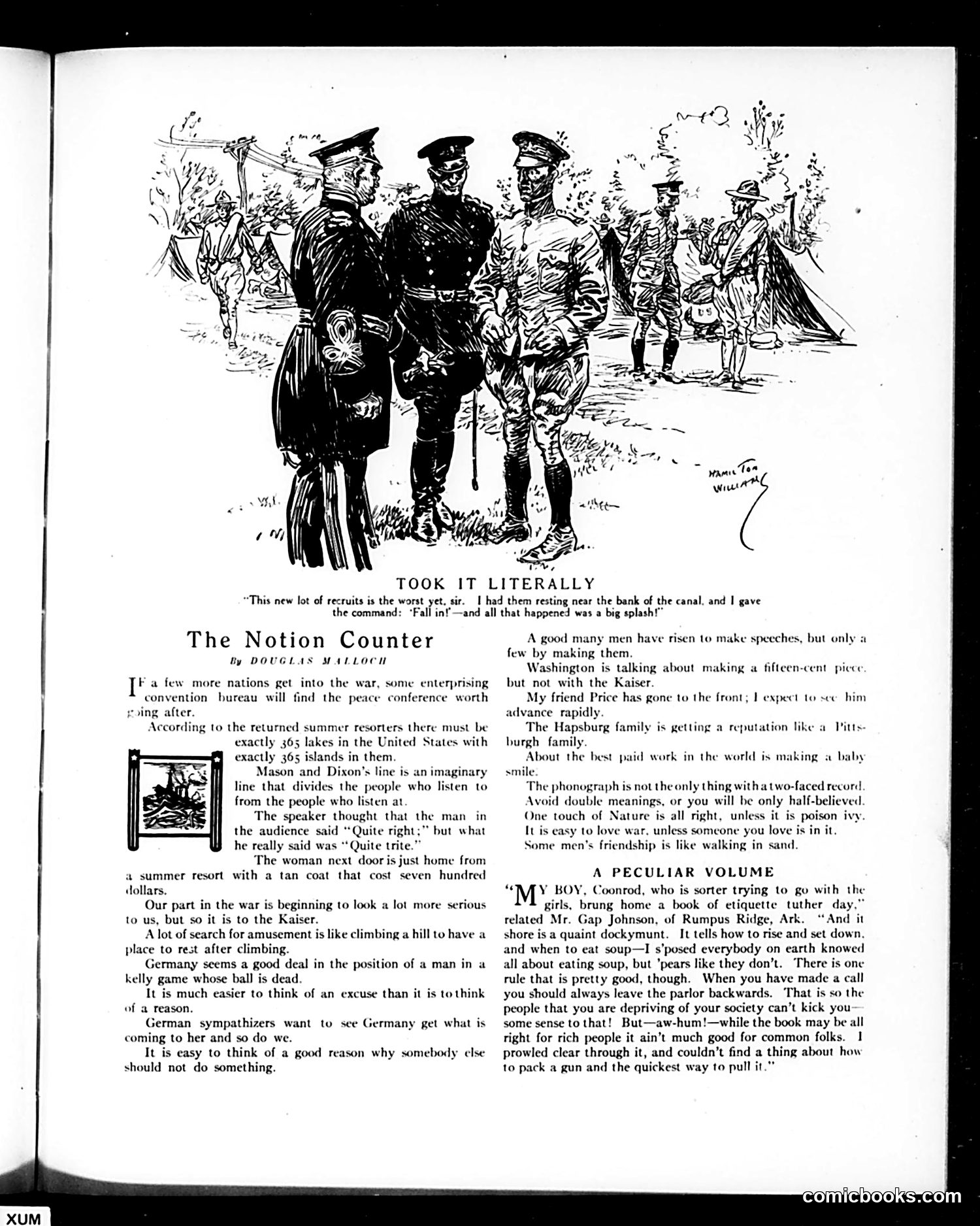
This page contains several satirical short pieces reflecting WWI-era American concerns: **Top Cartoon**: "Took It Literally" depicts a military officer who commanded recruits to "Fall in!" near a canal, resulting in them literally falling into the water. The joke mocks poor training or soldier incompetence. **"The Notion Counter"**: A column of brief satirical observations about American society and the war. Key themes include: - Commentary on the growing seriousness of U.S. involvement in WWI - Social critiques (speakers using clichés, resort fashions, German sympathizers) - Wordplay and philosophical quips typical of magazine humor **"A Peculiar Volume"**: A rural character (Gap Johnson from "Rumpus Ridge") discusses an etiquette book that's useless for working-class people—it teaches parlor manners but nothing practical like "how to pack a gun and the quickest way to pull it." This satirizes the class divide between refined urban society and practical rural/working-class needs during wartime. The overall tone reflects 1917-1918 America adjusting to full war participation.
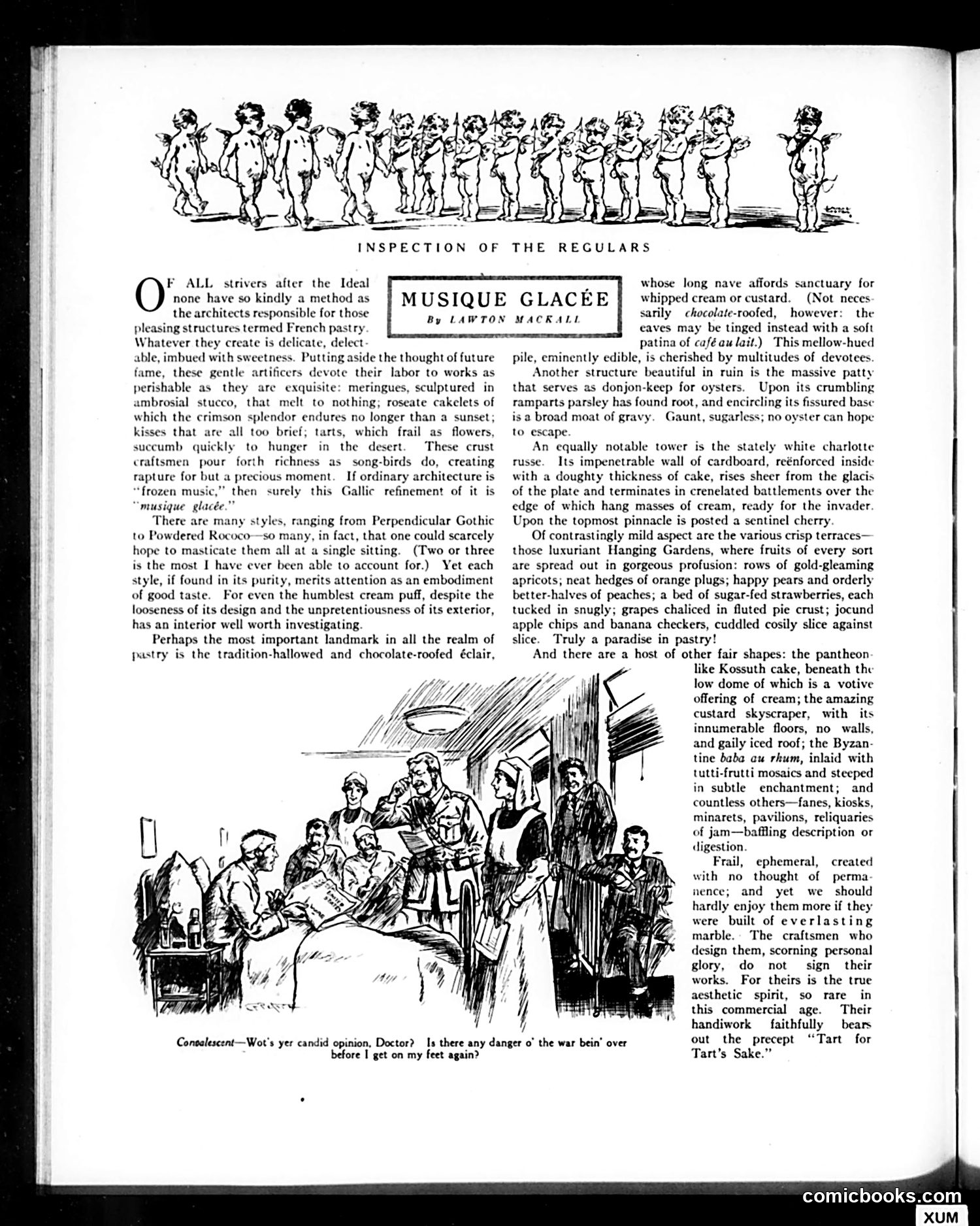
This article by Lawton MacKall uses French pastries as extended metaphors for architectural styles and human endeavor. The piece is primarily a witty food essay rather than direct political satire, but contains subtle critique relevant to WWI-era America. The single cartoon caption at bottom shows a doctor and patient discussing whether "the war" might end—a clear reference to World War I. This frames the article's musings about delicate, temporary creations: pastries "sculptured in ambrosial stucco, that melt to nothing" become symbols of fleeting human achievement and perhaps the fragility of civilization itself during wartime. The comparison of pastry-makers to architects—craftsmen who "devise their labor to works as perishable as they are exquisite"—subtly critiques modern society's tendency to overlook humble artisans' aesthetic contributions. The closing note about craftsmen deserving recognition ("Tart for Tart's Sake") advocates for valuing craftsmanship over commercialism, a common Progressive-era concern.
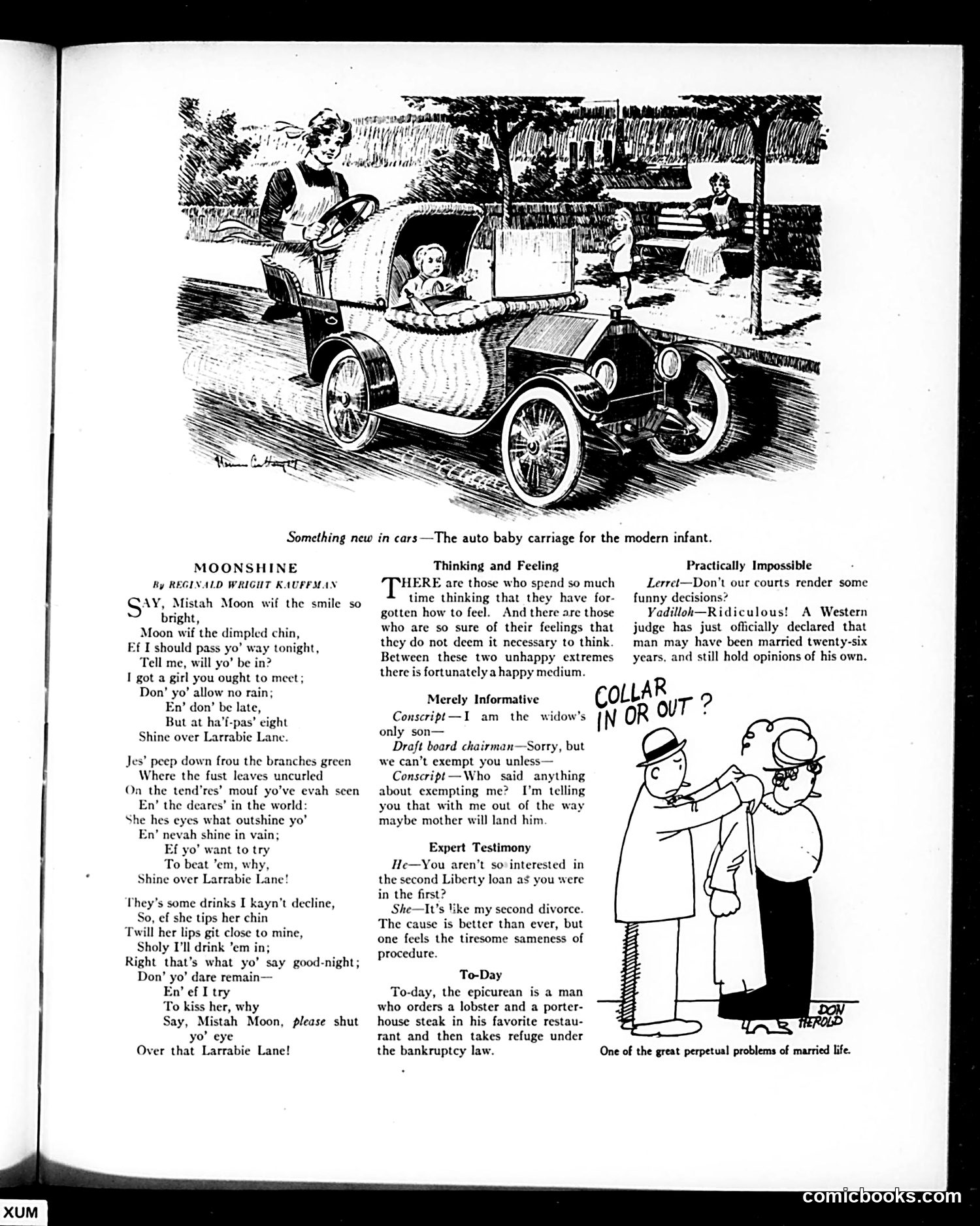
This Judge magazine page contains satirical humor on various topics, circa World War I era (suggested by "Liberty loan" references). **Top illustration**: "Something new in cars" shows an early automobile converted into a baby carriage—satirizing both new automobile culture and modern parenting innovations. **"Moonshine"** poem: A romantic dialect piece (written in exaggerated Southern accent) asking the moon to shine on a romantic encounter at "Larrabie Lane," then requesting the moon "shut yo' eye" to preserve privacy—gentle romantic humor. **Brief humor pieces** mock: - **Draft exemptions**: A conscript clarifies he's not seeking exemption, just informing the board he's the only son—dark WWI-era comedy - **Liberty loans**: Satirizes wealthy men buying war bonds while hiding money under bankruptcy law - **Marriage**: A judge's ruling that a 26-year married man can hold independent opinions is deemed "practically impossible"—mocking both judicial absurdity and marital discord **Right cartoon**: A domestic dispute about "collar in or out?"—trivializing perpetual married arguments. The overall tone: lighthearted social commentary on modernity, war, economics, and marriage.
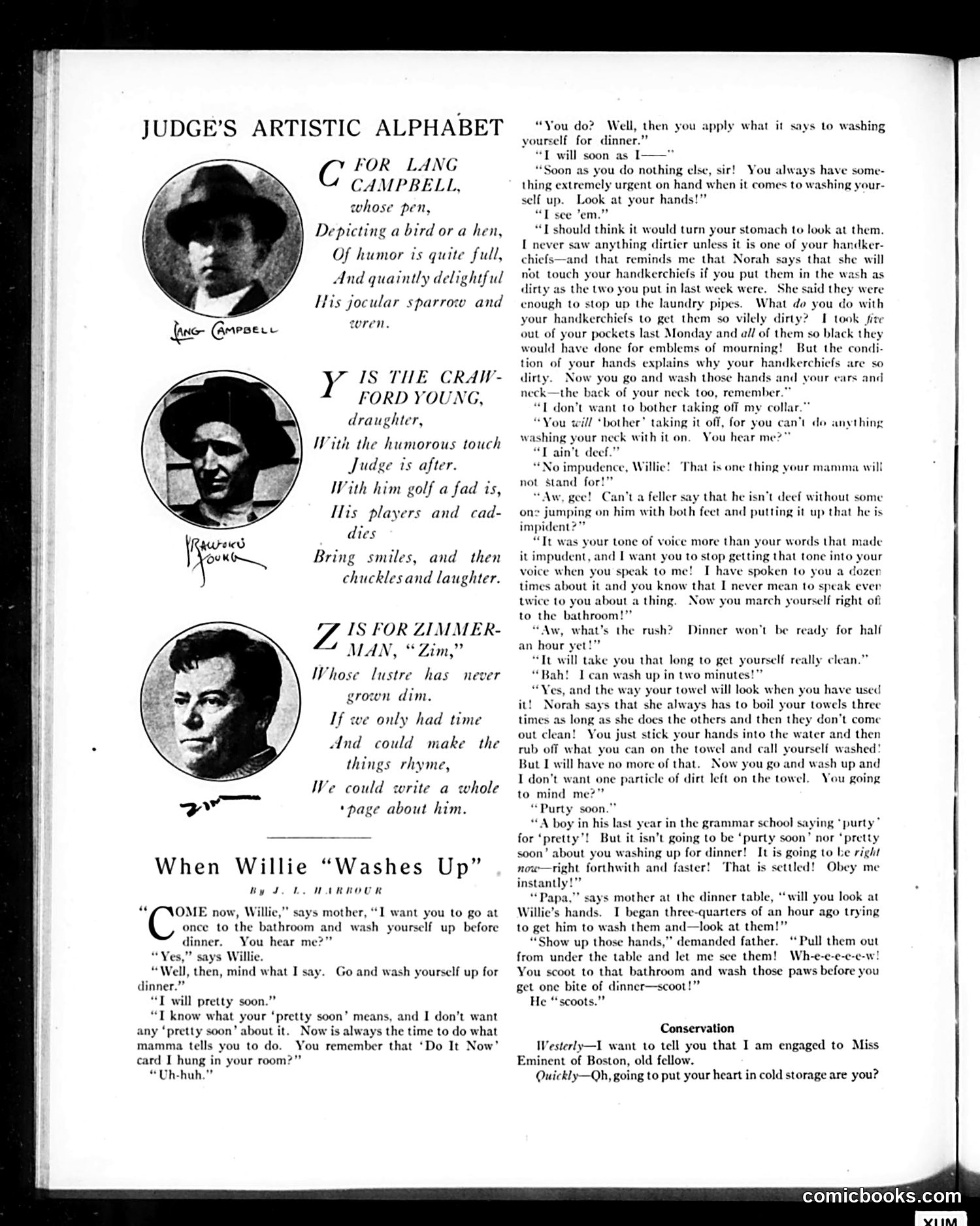
This page contains two distinct pieces: **Left side:** A tribute to three cartoonists/illustrators who work for Judge magazine—Lang Campbell, Crawford Young, and Zimmerman ("Zim")—celebrating their skill at drawing animals and humorous subjects, particularly golf scenes. This is internal magazine promotion. **Right side:** A comedic domestic dialogue where a mother repeatedly orders her reluctant son Willie to wash up before dinner. The humor derives from Willie's evasions ("pretty soon," "Bah! I can wash in two minutes") versus the mother's exasperated insistence on immediate, thorough hygiene. She catalogs his filthy habits: blackened handkerchiefs, dirty hands, improper towel use. The satire targets both childhood resistance to parental authority and early-20th-century middle-class anxieties about cleanliness and proper behavior—the mother's obsessive focus on hygiene and obedience reflects period concerns about child-rearing, morality, and the "Do It Now" efficiency movement. Willie's grammatical slip ("purty" for "pretty") adds class-consciousness to the critique.
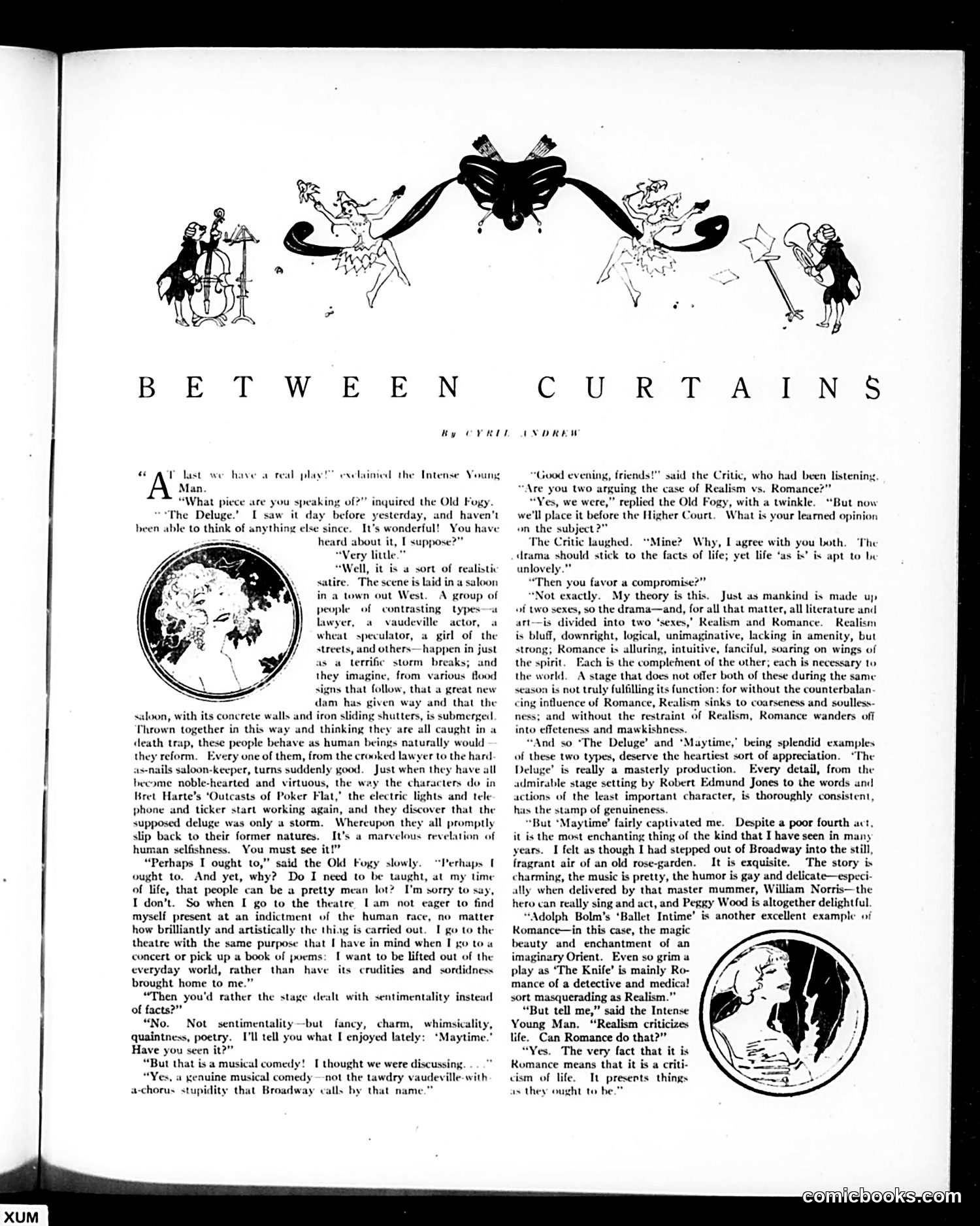
This page presents a theatrical debate between an "Intense Young Man," an "Old Fogy," and a Critic about dramatic art. The discussion contrasts two plays: *The Deluge* (a realistic drama set in a Western saloon where characters reveal their true selfish natures during a flood scare) and *Maytime* (a sentimental musical comedy). The satire mocks both extreme positions. The Young Man champions unflinching Realism—exposing human wickedness—while the Old Fogy rejects such bleakness, preferring escapist Romance. The Critic resolves this by arguing drama needs *both* elements: Realism provides logical truth but risks coarseness; Romance offers beauty and enchantment but risks sentimentality. The illustrations of theatrical figures reinforce this artistic debate. For modern readers, this reflects early-1900s American theater's tension between naturalistic drama (influenced by Ibsen) and popular escapist entertainment—a recurring cultural divide about art's purpose.
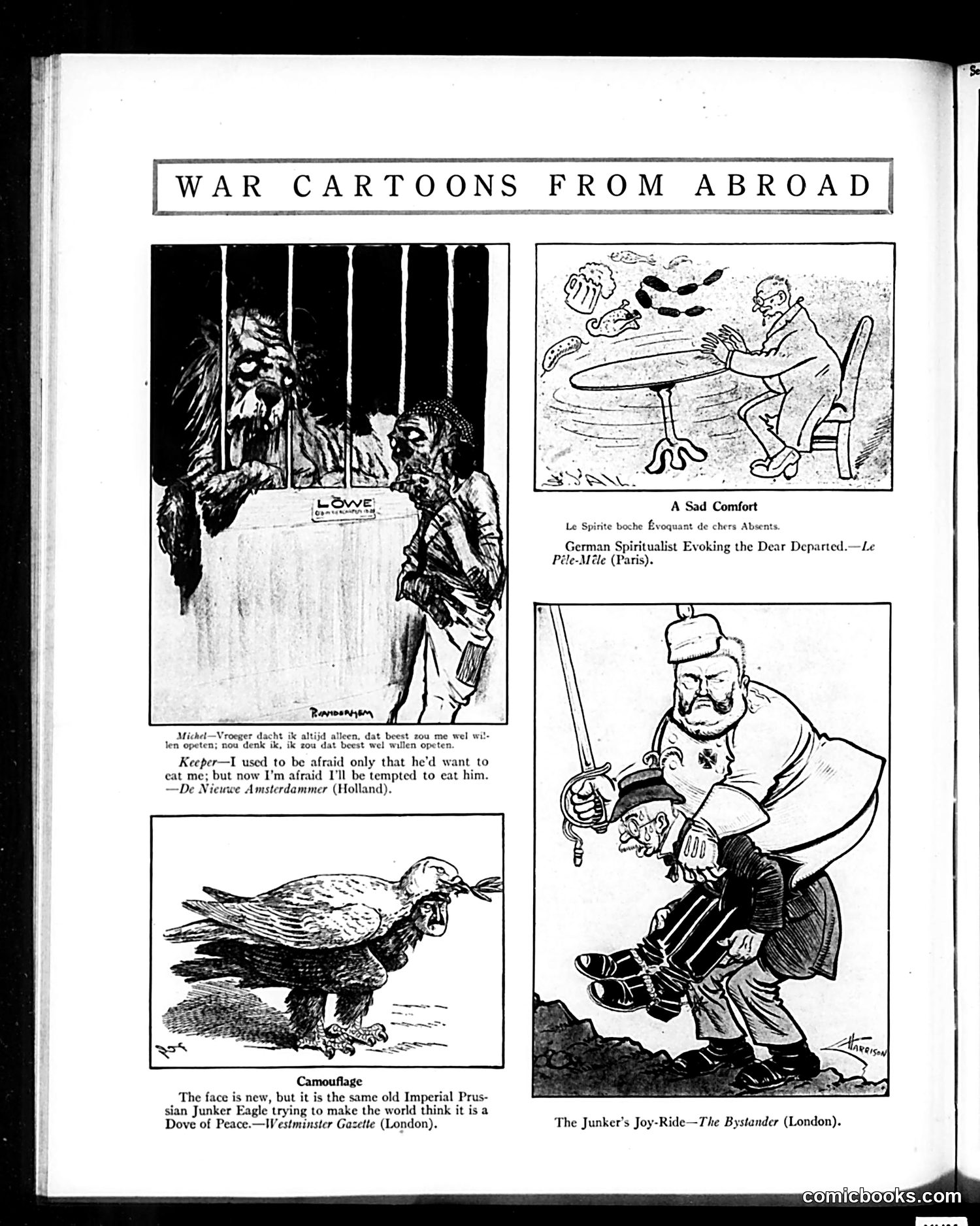
This page reprints satirical cartoons from European publications during World War I, all mocking Germany and its leadership. The top-left cartoon shows a zoo keeper and animal discussing cannibalism—a darkly humorous commentary on wartime starvation in occupied territories. "Camouflage" depicts the German Imperial Eagle wearing a dove costume, sarcastically suggesting Germany falsely presents itself as peaceful while maintaining aggressive militarism. The French cartoon shows a German spiritualist conjuring ghostly soldiers—likely mocking German casualties or the supernatural claims of occult practices sometimes associated with German leadership. "The Junker's Joy-Ride" portrays a Prussian military officer (the "Junker" represents Prussian aristocratic militarism) gleefully carrying away weapons or plunder, embodying satirical portrayals of German militaristic aggression and theft. All cartoons employ exaggeration and grotesque imagery to delegitimize German war efforts to Judge's American readership.
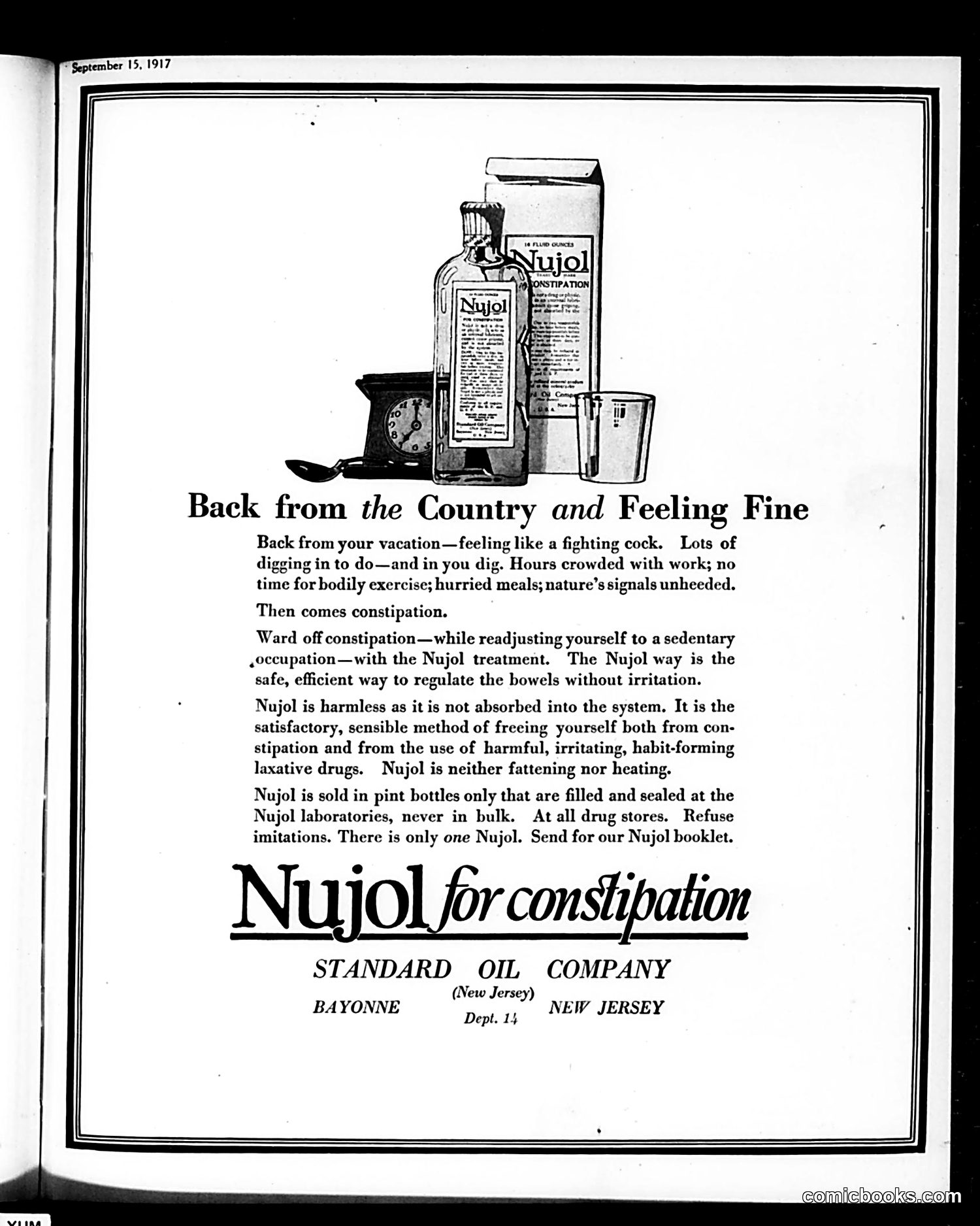
This is a **full-page advertisement**, not satirical content. It's a 1917 ad for Nujol, a mineral oil laxative made by Standard Oil Company. The ad targets post-vacation workers returning to sedentary office jobs. It uses relatable humor ("feeling like a fighting cock") to establish the scenario: vacation ends, workers resume desk jobs with irregular meals and no exercise, leading to constipation. The pitch emphasizes Nujol as a safe, non-habit-forming alternative to harsh laxatives of that era. The visual shows the product bottle alongside a clock and other items suggesting busy work life. The messaging reflects early 20th-century attitudes toward bowel regularity as essential health maintenance, and Standard Oil's diversification beyond petroleum into patent medicines—a common corporate practice before FDA regulation limited such claims.
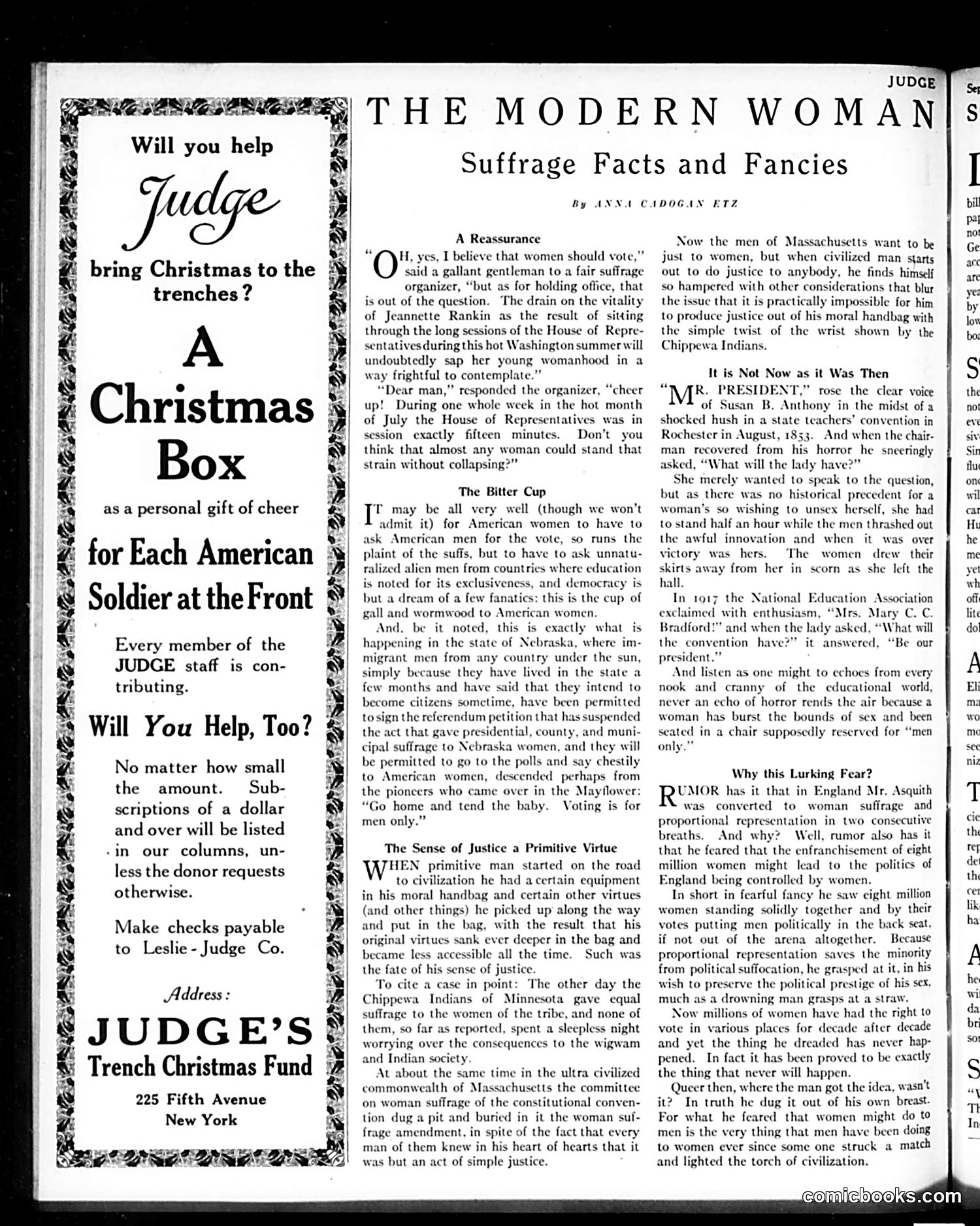
This 1918 *Judge* magazine page contains two distinct elements: **Left side:** A fundraising appeal for the "Judge's Trench Christmas Fund," soliciting donations to send Christmas boxes to American soldiers fighting in World War I. This is straightforward patriotic fundraising. **Right side:** A satirical article titled "Suffrage Facts and Fancies" by Anna Cadogan Etz, mocking anti-suffrage arguments. The piece uses three anecdotes: 1. A man argues women shouldn't hold office because the job would drain their "vitality"—the organizer responds that Congress barely meets, exposing his absurd logic. 2. It ridicules Nebraska men for opposing women's suffrage while permitting newly-arrived immigrant men (who haven't even become citizens) to vote on the issue. 3. Most pointedly, it contrasts the Chippewa Nation, which granted women equal voting rights without societal collapse, with "civilized" Massachusetts, which buried women's suffrage amendments while knowing it was "simple justice." The satire argues that supposedly advanced civilization actually corrupts moral reasoning about justice compared to Indigenous peoples.
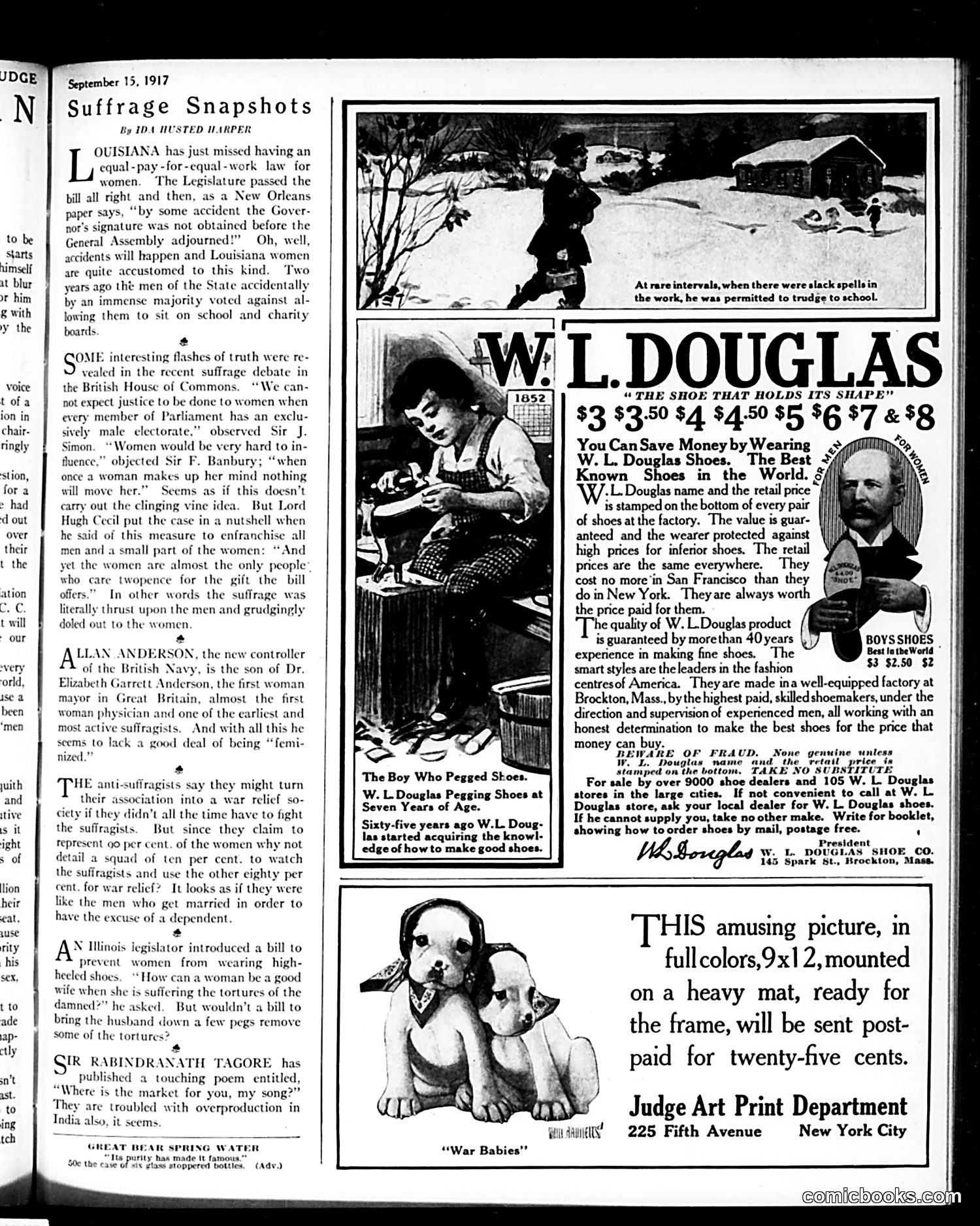
This page features satirical commentary on the women's suffrage debate by columnist Ida Husted Harper. The cartoons mock anti-suffrage arguments through ironic anecdotes: **Key points:** - **Louisiana's "accident"**: The state legislature passed an equal-pay law but the governor didn't sign it before adjournment—satirizing how conveniently men avoid women's rights. - **British Parliament quotes**: Suffragists argued women deserve the vote; anti-suffragists claimed women are too emotional and focused on domestic matters. Harper's satire: if women represent 90% of anti-suffrage sentiment, why not use the remaining 10% for war relief? - **The Illinois legislator**: A bill to ban high heels "for women's health" is mocked as paternalistic control, with Harper suggesting husbands need regulation instead. The page sarcastically reveals how men create obstacles to women's equality while claiming to protect them. The image of a boy trudging to school appears to reference child labor versus education access. The W.L. Douglas shoe advertisement is unrelated commercial content.
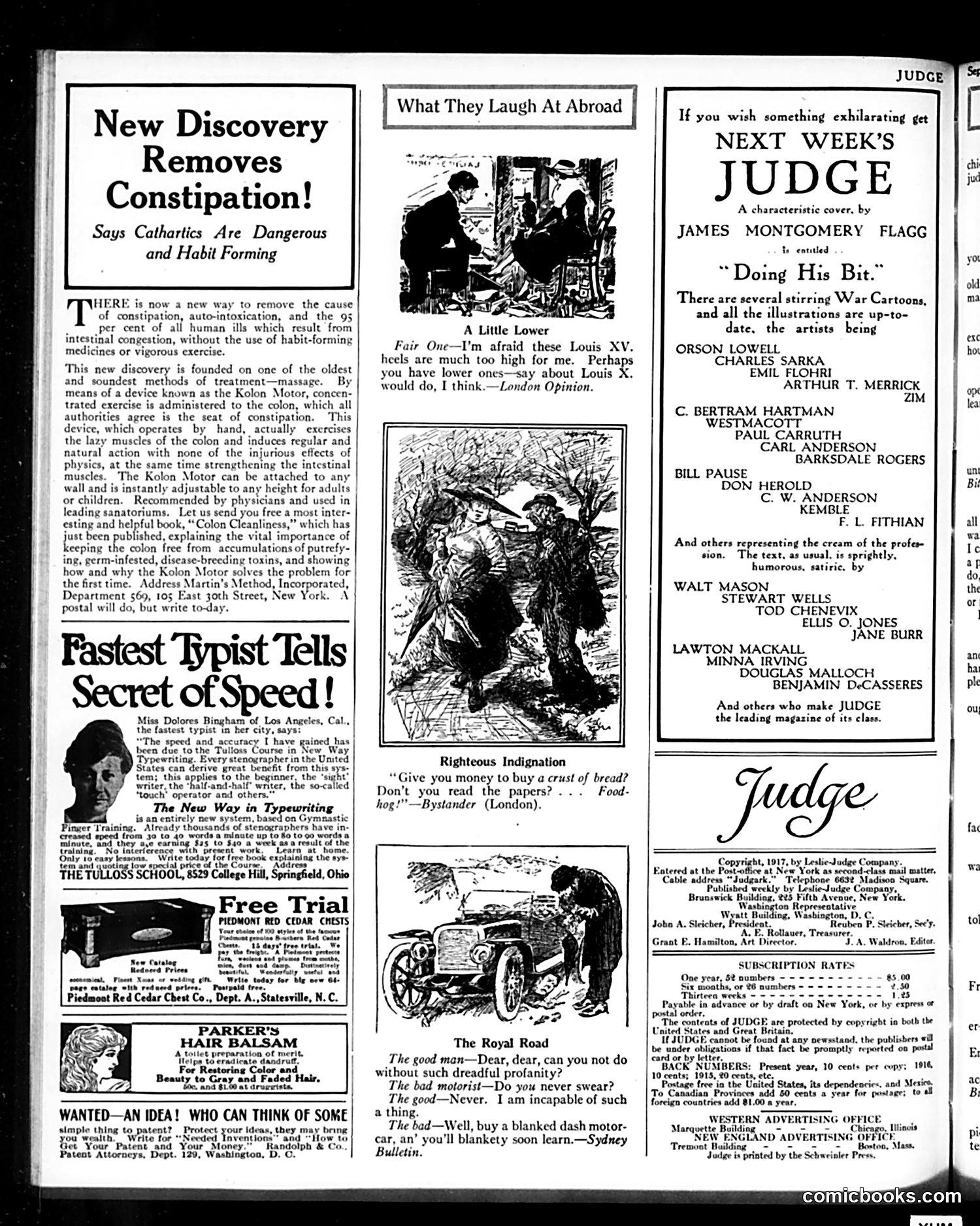
This page from *Judge* (a satirical weekly) mixes advertisements with comic vignettes typical of early 20th-century humor magazines. **The cartoons** are brief, captionless jokes: - **"A Little Lower"**: A flirtation joke where a woman asks a shoe salesman for lower heels, punning "Louis X" (lower) instead of "Louis XV" (higher heel style). Mild innuendo. - **"Righteous Indignation"**: Satirizes hypocrisy—a pious man claims never to swear, but admits he'd curse if he owned a car. References wartime food shortages ("Food-hog"), mocking those who lecture others. - **"The Royal Road"**: Similar hypocrisy joke: a "good man" claims he never swears, but a motorist proves anyone would curse while driving. The **advertisements** push dubious patent remedies (the "Kolon Motor" for constipation), typing courses, and hair products—typical era snake-oil marketing. The page primarily announces next week's cover by James Montgomery Flagg with "War Cartoons," indicating this is WWI-era *Judge*, when patriotic content dominated.
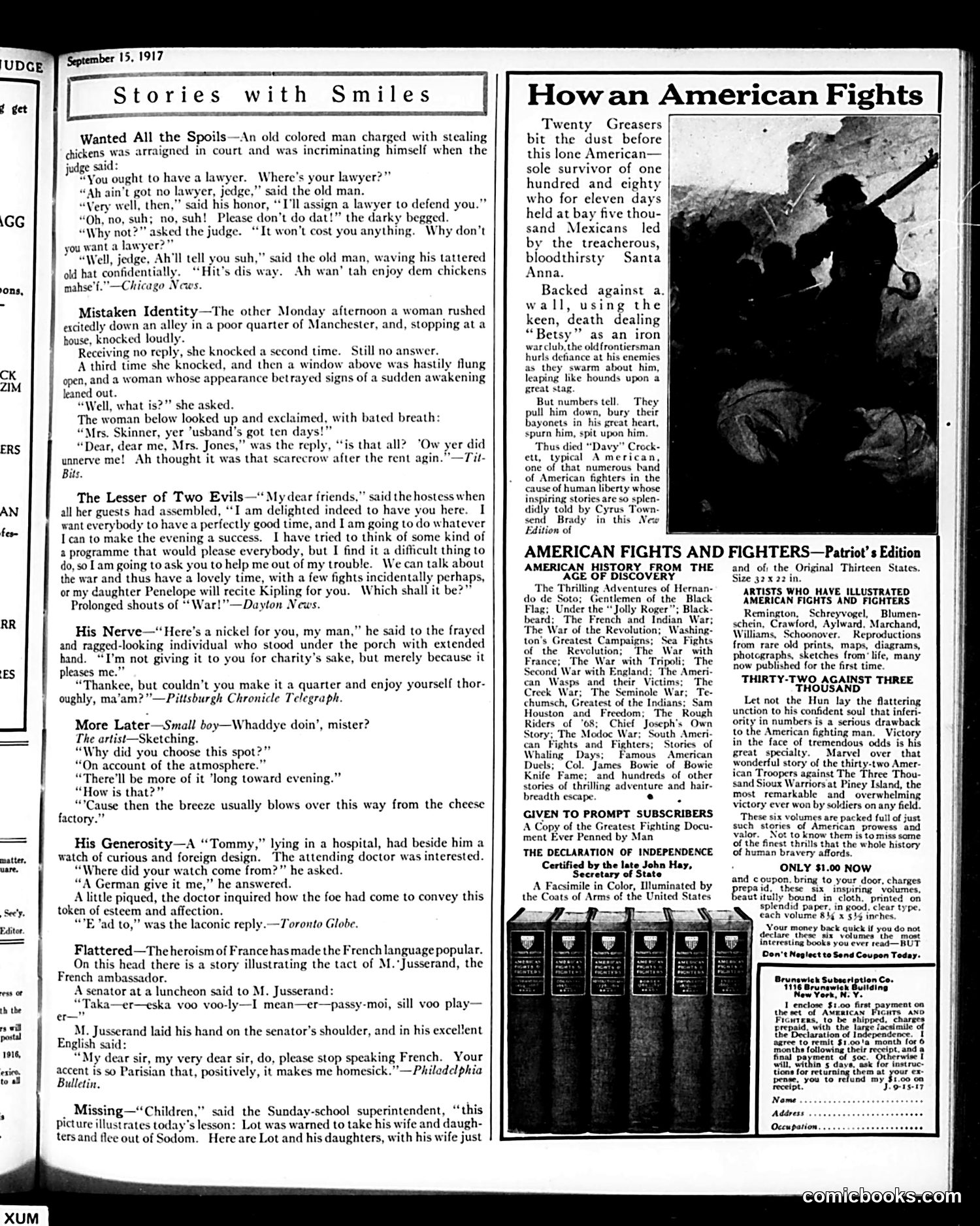
This page contains humorous short stories rather than political cartoons. The jokes reflect early 20th-century American attitudes and concerns: **"Wanted All the Spoils"**: A racial stereotype joke featuring an elderly Black man defending himself in court for stealing chickens. The humor relies on dialect and the premise that he refuses a lawyer to avoid sharing his "spoils"—reflecting period attitudes about race and the justice system. **"Mistaken Identity"**: A working-class British domestic humor piece about a woman mistaking her neighbor's house for hers. **"Lesser of Two Evils"**: References the ongoing World War I (America entered in 1917). Guests must choose between discussing the war or enduring poetry recitation—contemporary readers would recognize this as commentary on how thoroughly WWI dominated social conversation. **Other pieces** reference a soldier's watch (WWI context), French language popularity (likely from French diplomatic presence), and Sunday school lessons. The page primarily offers light social satire and period-typical humor rather than serious political commentary.
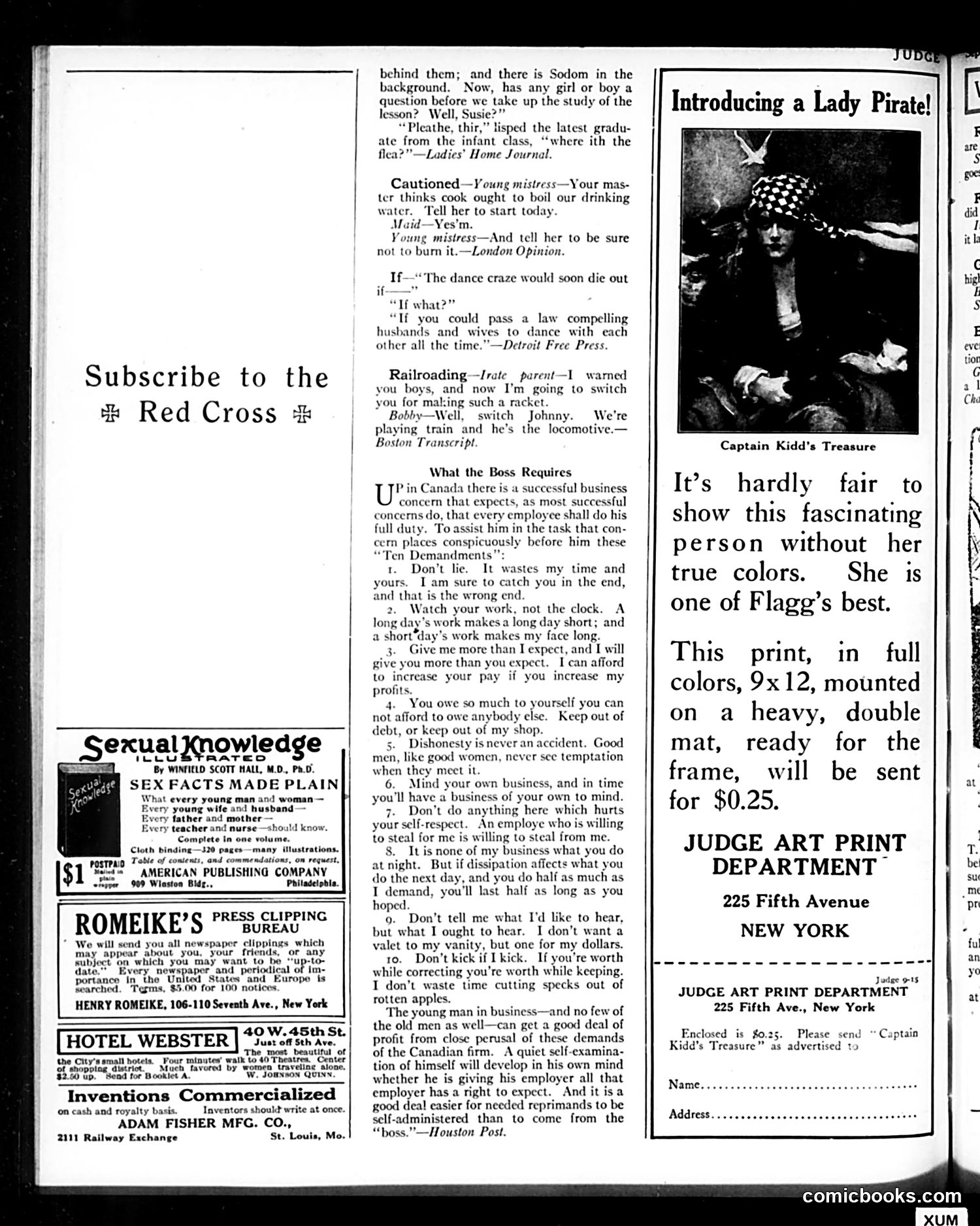
This page is primarily **advertising and advice content** rather than political cartoons. The main features are: 1. **"What the Boss Requires"** - A satirical "Ten Commandments" from a Canadian business, offering workplace advice. It's a humorous critique of employer-employee relations, mocking both demanding bosses and lazy workers through exaggerated demands (don't lie, watch your work not the clock, don't steal). 2. **Brief jokes** from various publications about domestic life (boiling water, dance crazes, children playing trains) — typical early 20th-century humor reflecting middle-class concerns. 3. **Multiple advertisements** for sex education manuals, newspaper clipping services, hotels, and patent commercialization. The "Lady Pirate" advertisement on the right promotes a colored print from Judge's art department. **No clear political satire or caricature appears here.** This is a miscellaneous page of light humor, workplace advice presented comedically, and commercial advertisements typical of Judge magazine's format.
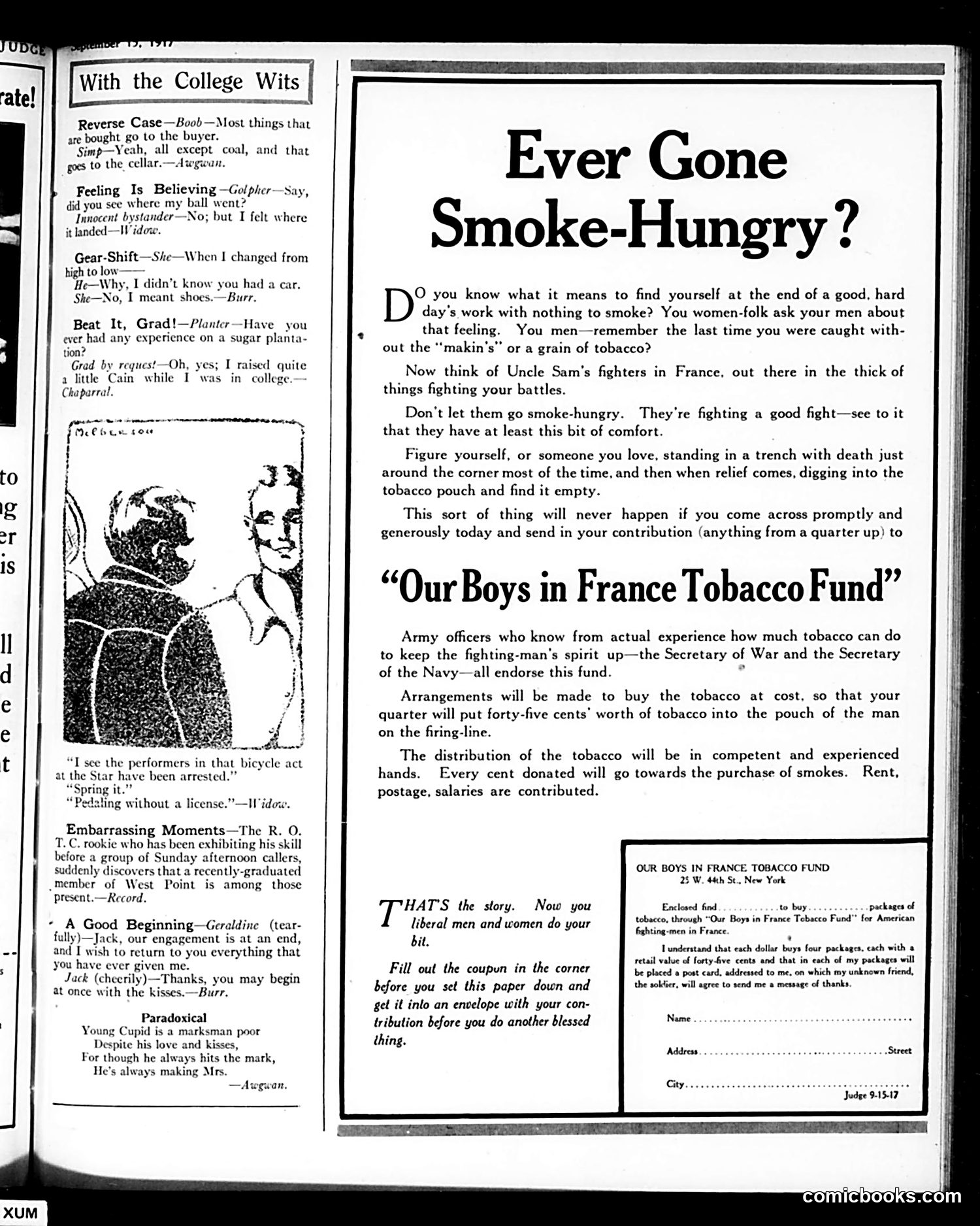
This page is primarily a **WWI-era fundraising advertisement** disguised as magazine content. The large advertisement appeals to American civilians to donate money for tobacco to send to U.S. soldiers fighting in France. The appeal uses emotional manipulation: it asks readers to imagine soldiers in trenches with empty tobacco pouches, positioning cigarettes as morale-critical comfort items. It claims endorsement from the Secretary of War and Navy to lend authority. The mechanism is straightforward—donations of 25 cents buy 45 cents' worth of tobacco, with soldiers supposedly sending thank-you postcards to donors. The left side contains typical Judge magazine humor: puns and brief jokes ("With the College Wits"). These serve as filler around the serious fundraising pitch, which reflects how wartime patriotic appeals dominated American media during 1917-1918.
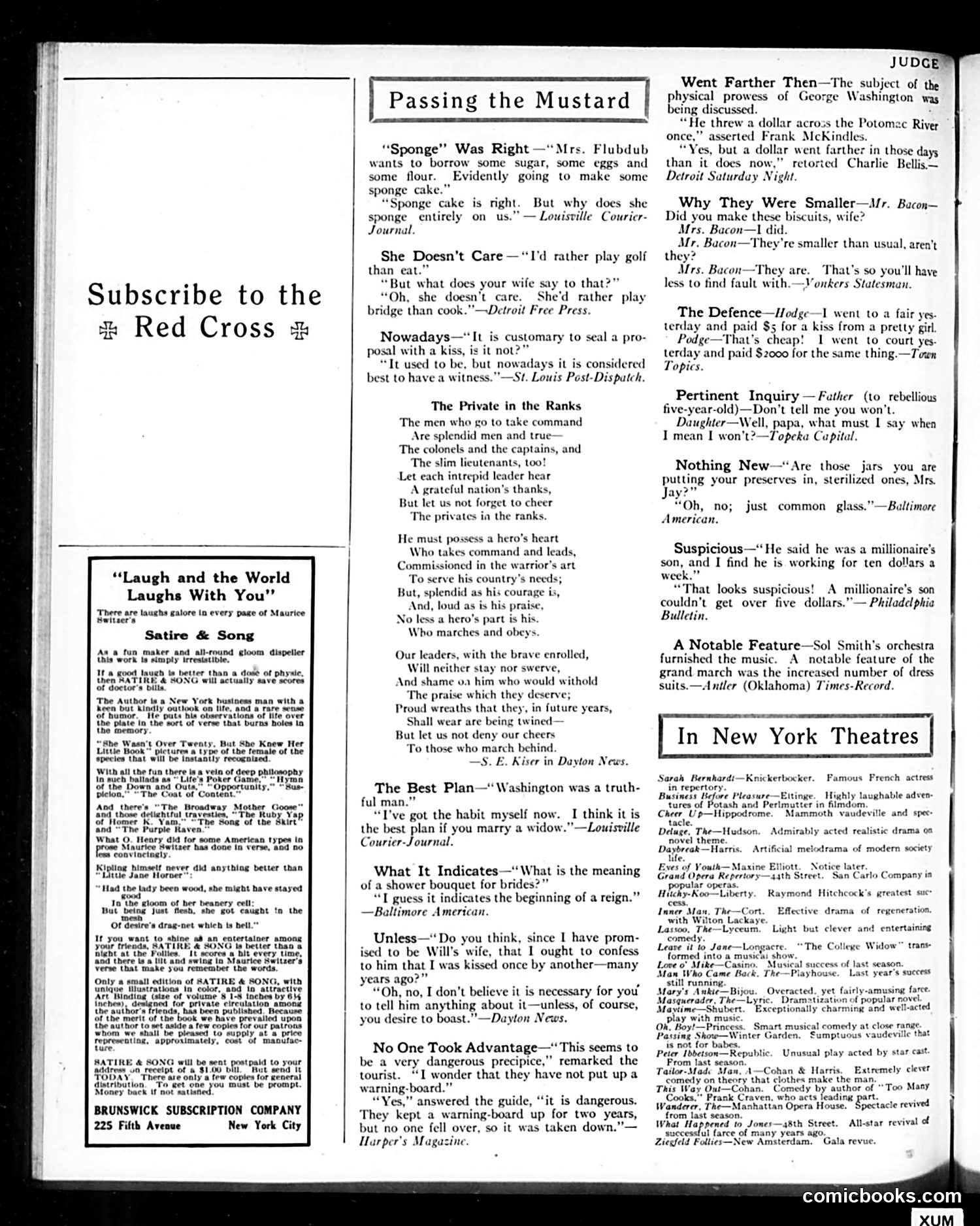
This page from *Judge* magazine contains brief domestic humor sketches mocking everyday married life and social conventions, plus patriotic poetry about WWI soldiers. The cartoons ("Sponge" Was Right, She Doesn't Care, Nowadays) are quick jokes about wives—depicting them as freeloaders, golf-obsessed rather than domestic, and requiring witnesses for proposals. The humor relies on wife-as-burden stereotypes common to early 20th-century satire. The poem "The Private in the Ranks" honors enlisted soldiers during wartime, arguing their sacrifice deserves equal recognition as officers'. This appears patriotic rather than satirical, likely published during or shortly after WWI. The page also advertises *Satire & Song*, a humor book by Maurice Switzer marketed to the magazine's readers as premium entertainment. The overall tone reflects pre-1920s gender humor and military sentiment typical of *Judge*'s audience.
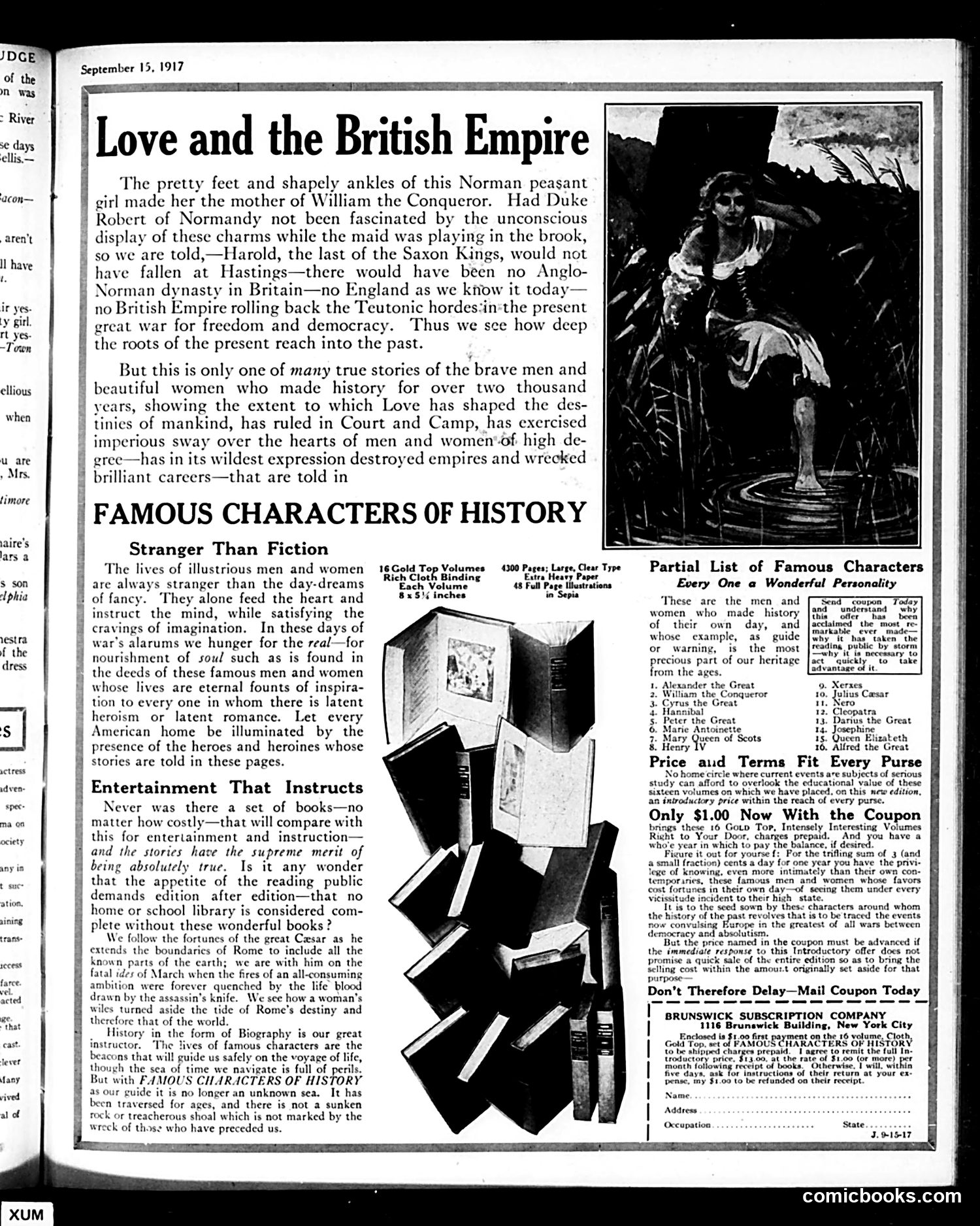
This page is primarily **advertisement disguised as editorial content**, promoting a book series called "Famous Characters of History." The opening essay uses a historical anecdote to frame the book's appeal: it claims that William the Conqueror's existence—and therefore the entire British Empire and present war effort against Germany—traces back to a Norman peasant girl whose physical charms attracted Duke Robert. This creates a whimsical, deterministic argument that romantic love shapes history. The advertisement exploits **WWI patriotism**: it argues that at a time of war "for freedom and democracy," Americans need these books to understand how great historical figures inspire heroism and guide moral choices. The framing positions the books as spiritual/educational nourishment in wartime. The accompanying image shows stacked volumes and a subscription coupon. The "Famous Characters" listed include Alexander, Julius Caesar, and Nero—figures emblematic of power and ambition. Essentially, this uses patriotic and romantic rhetoric to sell an encyclopedia set to American homes, positioning historical knowledge as a patriotic duty during World War I.
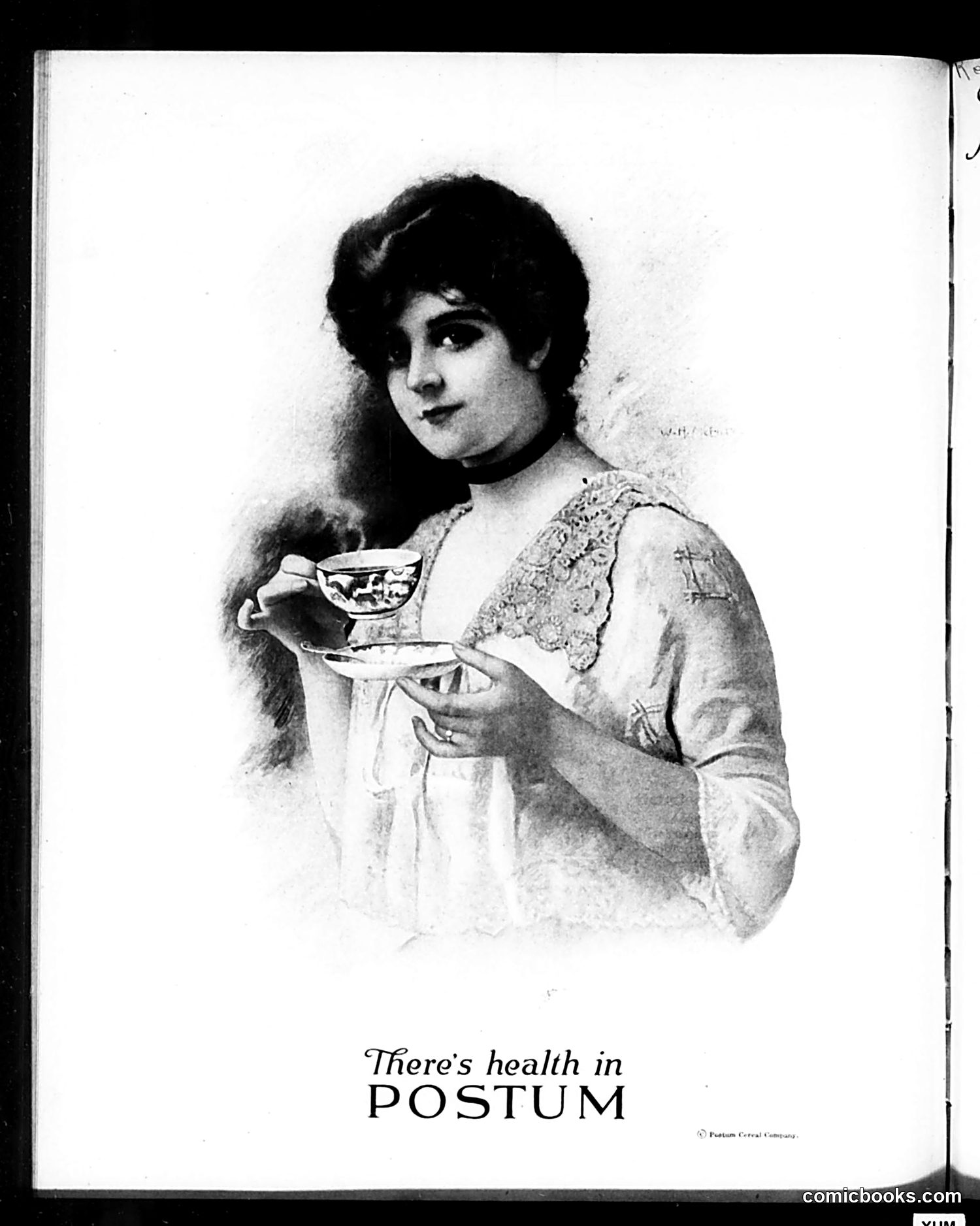
This appears to be a **Postum cereal coffee substitute advertisement** rather than a political cartoon. The image shows a woman in early 20th-century dress holding a cup, with the slogan "There's health in POSTUM" beneath. Postum was a caffeine-free beverage marketed as a healthier alternative to coffee. The advertisement capitalizes on period health consciousness and the "scientific" wellness trends of the era. The elegantly dressed woman suggests refinement and appeals to middle-class consumers, implying that choosing Postum was both fashionable and health-conscious. This is **commercial advertising content** rather than satirical commentary, though it does reflect contemporary anxieties about caffeine's effects on health that advertisers exploited to promote alternative products.