
Judge, 1917-09-15 · page 11 of 28
Judge — September 15, 1917 — page 11: what you’re looking at
What you’re looking at
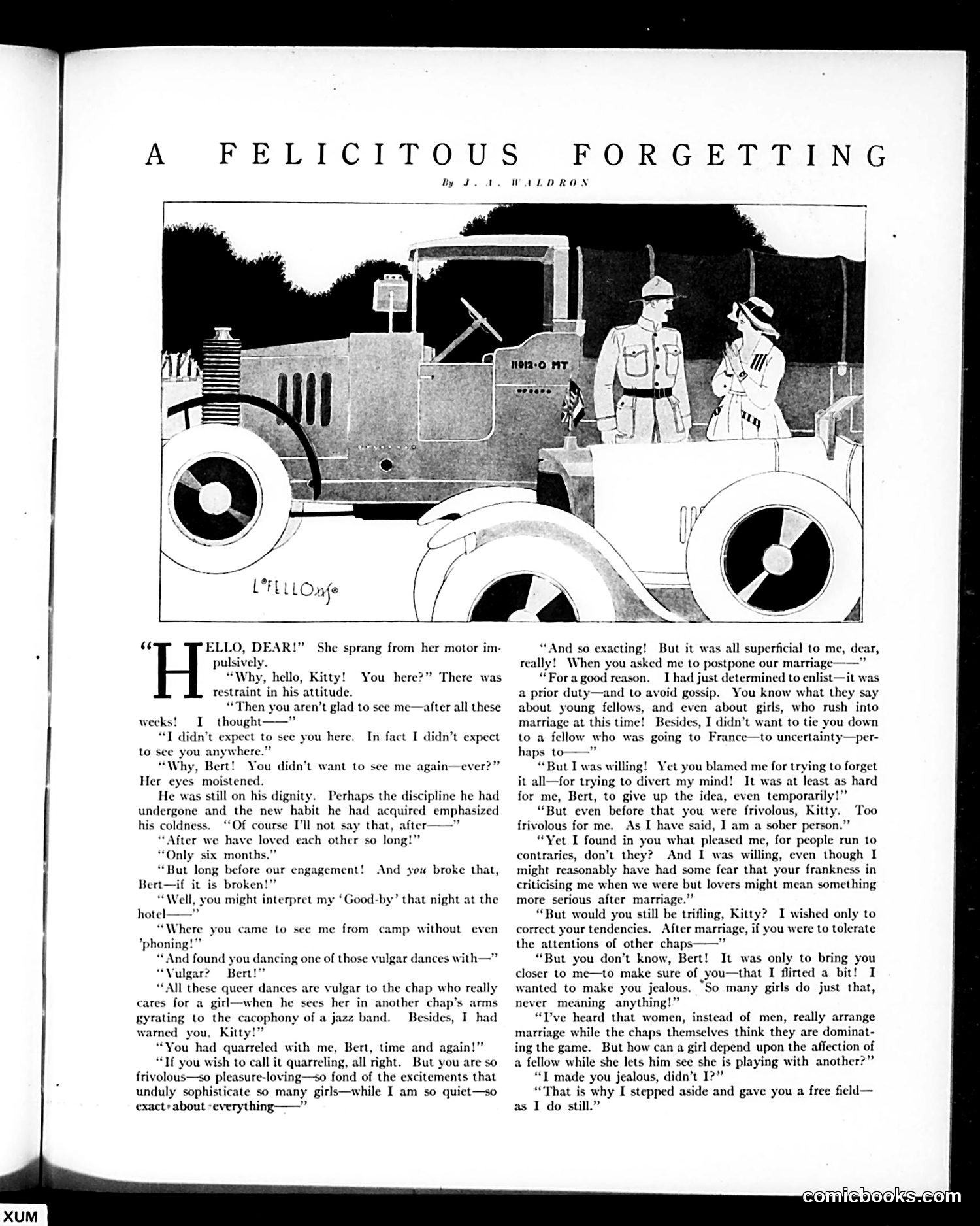
This story-cartoon depicts a post-WWI reconciliation between estranged fiancés. Bert, a soldier (identifiable by his military uniform in the illustration), and Kitty, his girlfriend, confront their relationship's breakdown. The satire targets both characters' war-era relationship anxieties. Bert embodies the stern, duty-bound soldier who enlisted and demanded Kitty postpone marriage—then resented her attempts to enjoy life (dancing, flirting) while he was away. Kitty represents the young woman caught between societal expectations and wartime freedom. The joke turns on their circular argument: Bert criticizes her frivolousness and flirtation as tests of his jealousy, while she defends these behaviors as strategies to keep him emotionally invested. Both claim the moral high ground regarding "correct" wartime behavior. The title suggests they're choosing to forget these grievances and reconcile—though the underlying incompatibility (his sober rigidity versus her social nature) remains unresolved. It's satirical commentary on how war-disrupted relationships attempted reconciliation through willful amnesia rather than genuine understanding.
📄 Transcribed text from this page (OCR, searchable)
Machine-transcribed from the original scan — historical spelling and the odd misread are preserved.
XUM A FELICITOUS " By Jot “ ELLO, DEAR!” pulsively. “Why, hello, Kitty! restraint in his attitude. “Then you aren’t glad to see me—after all these weeks! I thought a 1 didn’t expect to see you here. to see you anywhere.” “Why, Bert! You didn’t want to sce me Her eyes moistened. He was still on his dignity. Perhaps the discipline he had undergone and the new habit he had acquired emphasized his coldne: “Of course I'll not say that, after——” “After we have loved h other so long!” “Only six months.” “But long before our engagement! Bert—if it is broken!” “Well, you might interpret my ‘Good-by’ that night at the hotel— “Where you came to see me from camp without even phoning!” “And found you dancing one of those vulgar dances with—” “Vulgar? Bert!” “All these queer dances are vulgar to the chap who really for a girl—when he her in another chap’s arms gyrating to the cacophony of a jazz band. Besides, I had warned you, Kitty!” “You had quarreled with me, Bert, time and again!” “If you wish to call it quarreling, all right. But you are so frivolous—so pleasure-loving—so fond of the excitements that unduly sophisticate so many girls—while I am so quict—so exact about -everything——” She sprang from her motor im. You here?” There was In fact I didn’t expect ain—ever?”” And you broke that, FORGETTING 1LDRON “And so exacting! But it was all superficial to me, dear, really!) When you asked me to postpone our marriage——” “Fora good reason. I had just determined to enlist—it was a prior duty—and to avoid gossip. You know what they say about young fellows, and even about girls, who rush into marriage at this time! Besides, I didn’t want to tie you down to a fellow who was going to France—to uncertainty—per- haps to—” “But I was willing! Yet you blamed me for trying to forget it all—for trying to divert my min It was at least as hard for me, Bert, to give up the idea, even temporarily!” “But even before that you were frivolous, Kitty. Too frivolous for me. As I have said, I am a sober person.” “Yet I found in you what pleased for people run to contraries, don’t they? And I was ing, even though I might reasonably have had some fear that your frankness in criticising me when we were but lovers might mean something more serious after marriage.” “But would you still be trifling, Kitty? I wished only to correct your tendencies. After marriage, if you were to tolerate the attentions of other chaps: 0, “But you don’t know, Bert! It was only to bring you closer to me—to make sure of you—that I flirted a bit! I wanted to make you jealous. “So many girls do just that, never meaning anything!” “T’ve heard that women, instead of men, really arrange marriage while the chaps themselves think they are dominat- ing the game. But how can a girl depend upon the affection of a fellow while she lets him see she is playing with another?” “TI made you jealous, didn’t 1?” “That is why I stepped aside and gave you a free ficld— as I do still.”