
Judge, 1917-09-15 · page 13 of 28
Judge — September 15, 1917 — page 13: what you’re looking at
What you’re looking at
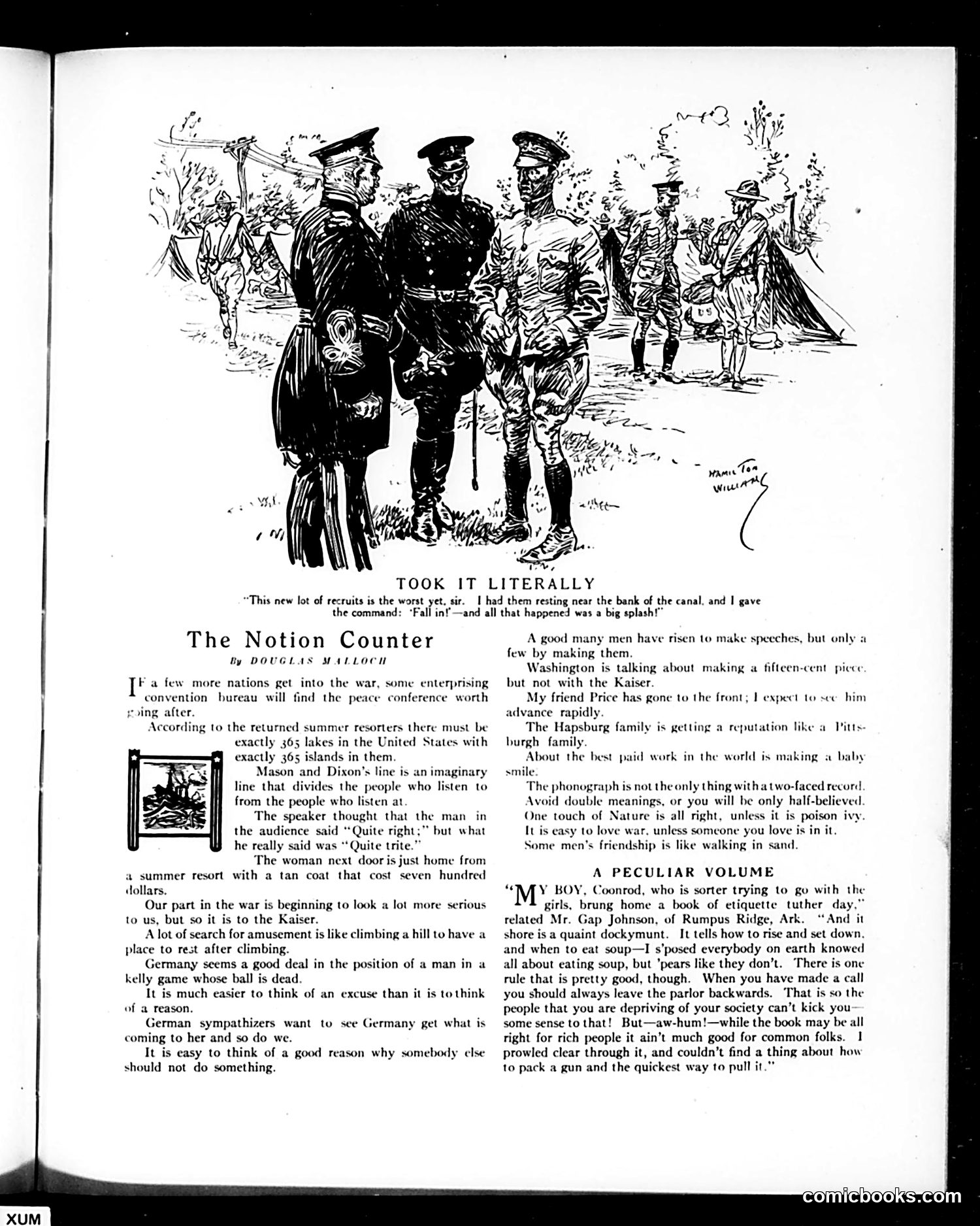
This page contains several satirical short pieces reflecting WWI-era American concerns: **Top Cartoon**: "Took It Literally" depicts a military officer who commanded recruits to "Fall in!" near a canal, resulting in them literally falling into the water. The joke mocks poor training or soldier incompetence. **"The Notion Counter"**: A column of brief satirical observations about American society and the war. Key themes include: - Commentary on the growing seriousness of U.S. involvement in WWI - Social critiques (speakers using clichés, resort fashions, German sympathizers) - Wordplay and philosophical quips typical of magazine humor **"A Peculiar Volume"**: A rural character (Gap Johnson from "Rumpus Ridge") discusses an etiquette book that's useless for working-class people—it teaches parlor manners but nothing practical like "how to pack a gun and the quickest way to pull it." This satirizes the class divide between refined urban society and practical rural/working-class needs during wartime. The overall tone reflects 1917-1918 America adjusting to full war participation.
📄 Transcribed text from this page (OCR, searchable)
Machine-transcribed from the original scan — historical spelling and the odd misread are preserved.
“This new lot of recruits is the worst ys the command: ‘Fall The Notion Counter by DOUGLAS SMALLOCH F a few more nations get into the war, some enterprising convention bureau will find the peace conference worth roing after. According to the returned summer resorters there must be exactly 31 es in the United States with exactly 365 islands in them. Mason and Dixon’s line is an imaginary line that divides the people who listen to from the people who listen at The speaker thought that the man in the audience said “Quite right;" but what he really said was “Quite trite.” The woman next door is just home from & summer resort with a tan coat that cost seven hundred dollars. Our part in the war is beginning to look a lot more serious to us, but so it is to the Kaiser. A lot of search for amusement is like climbing a hill to have a place to rest after climbing. Germany seems a good deal in the position of a man in a kelly game whose ball is dead. It is much easier to think of an excuse than it is to think of a reason. German sympathizers want to see Germany get what is coming to her and so do we. It is easy to think of a good reason why somebody else should not do something. TOOK IT LITERALLY sir. I had them resting near the bank of the canal, and | gave -and all that happened was a big splash!” A good many men have risen to make speeches, but only a few by making them. Washington is talking about making a fifleen-cent picce but not with the Kaiser. My friend Price has gone to the front; | expect to see him advance rapidly. The Hapsburg family is getting a reputation like a Pitts- burgh family. About the best paid work in the world is making a baby smile. The phonograph is not the only thing with a two-faced record Avoid double meanings, or you will be only half-believed One touch of Nature is all right, unless it is poison ivy. It is easy to love war, unless someone you love is in it. Some men’s friendship is like walking in sand. A PECULIAR VOLUME & Y BOY, Coonrod, who is sorter trying to go with the girls, brung home a book of etiquette tuther day,” related Mr. Gap Johnson, of Rumpus Ridge, Ark. “And it shore is a quaint dockymunt. It tells how to rise and set down, and when to eat soup—I s’posed everybody on earth knowed all about eating soup, but ‘pears like they don’t. There is one rule that is pretty good, though. When you have made a call you should always leave the parlor backwards. ‘That is so the people that you are depriving of your society can’t kick you some sense to that! But—aw-hum!—while the book may be all right for rich people it ain’t much good for common folks. 1 prowled clear through it, and couldn’t find a thing about how to pack a gun and the quickest way to pull it.””