
Judge, 1917-09-15 · page 9 of 28
Judge — September 15, 1917 — page 9: what you’re looking at
What you’re looking at
This surreal story by Benjamin De Casseres uses an elevator hijacking as metaphor for stock market chaos. A distracted narrator, preoccupied by morning stock losses, enters an elevator. A young, wickedly grinning operator deliberately overshoots the 45th floor, accelerating upward past the 125th floor through the building's roof into the sky—apparently representing wild, uncontrollable market speculation. The operator demands money ("shell out"), suggesting the predatory nature of market manipulation or fraud. The narrator's forced parachute jump and subsequent discovery that the old elevator operator has disappeared to manufacture parachutes implies that those who orchestrate financial crashes profit from the disaster. The story concludes in a "lunatic asylum," darkly suggesting that witnessing—or experiencing—stock market collapse drives one to madness. This reflects 1920s anxiety about market instability and financial fraud.
📄 Transcribed text from this page (OCR, searchable)
Machine-transcribed from the original scan — historical spelling and the odd misread are preserved.
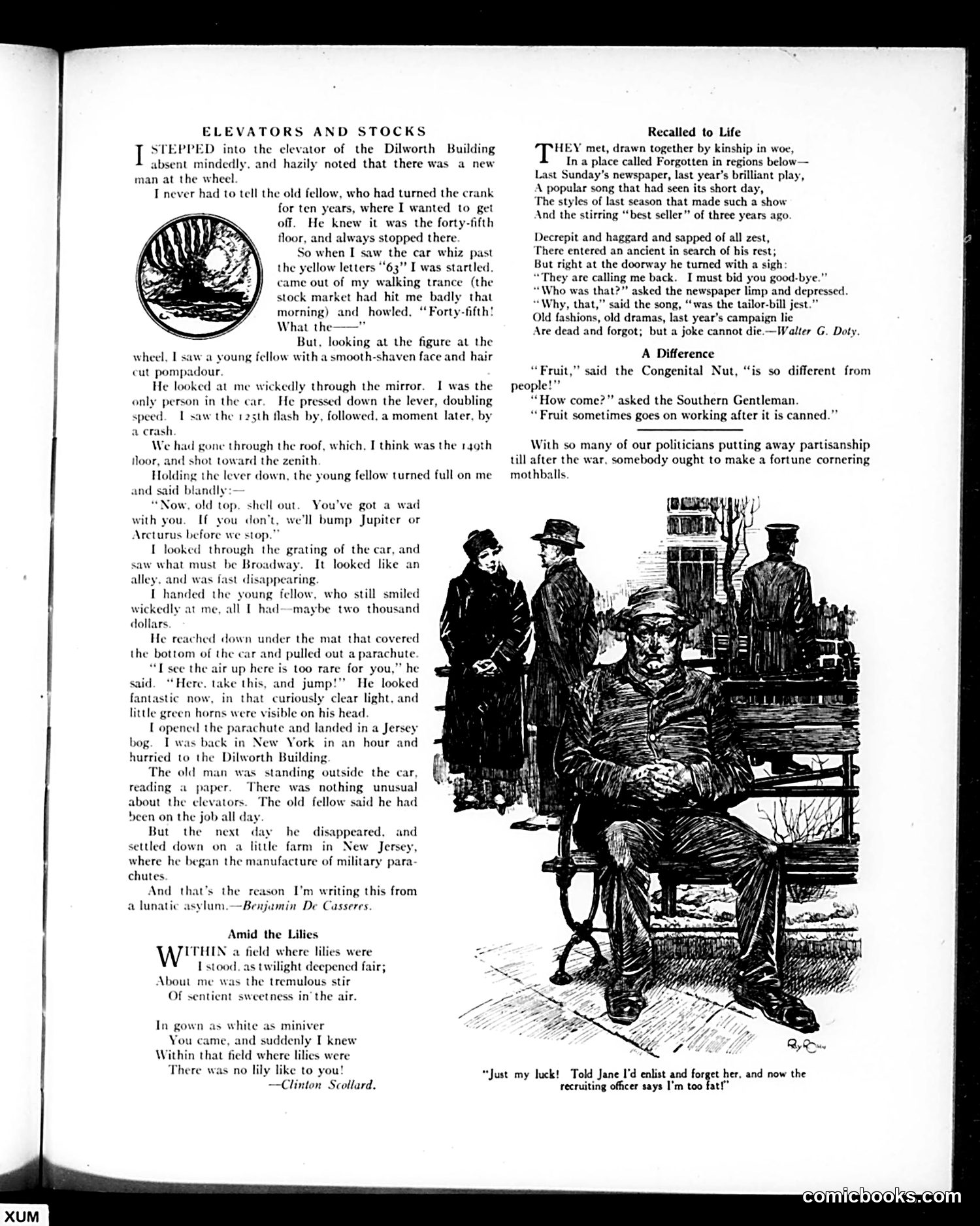
XUM ELEVATORS AND STOCKS I STEPPED into the elevator of the Dilworth Building absent mindedly, and hazily noted that there was a new man at the wheel I never had to tell the old fellow, who had turned the crank for ten years, where I wanted to get off. He knew it was the forty-fifth floor, and always stopped there. So when I saw the car whiz past the yellow letters “63” I was startled. came out of my walking trance (the stock market had hit me badly that morning) and howled, ‘Forty-fifth! What the: a But. looking at the figure at the wheel, I saw a young fellow with a smooth-shaven face and hair cut pompadour He looked at me wickedly through the mirror. I was the only person in the car. He pressed down the lever, doubling speed. 1 saw the 125th flash by, followed, a moment later, by a crash We had gone through the roof, which, I think was the roth floor, and shot toward the zenith. Holding the lever down, the young fellow turned full on me and said blandly “Now, old top. shell out. You've got a wad with you. If you don’t, we'll bump Jupiter or Arcturus before we stop.” I looked through the grating of the car, and saw what must be Broadway. It looked like an alley, and was fast disappearing, I handed the young fellow, who still smiled wickedly at me, all I had--maybe two thousand dollars, He reached down under the mat that covered the bottom of the car and pulled out a parachute. “I see the air up here is too rare for you,” he said. “Here, take this, and jump!”” He looked fantastic now, in that curiously clear light, and little green horns were visible on his head [ opened the parachute and landed in a Jersey bog. Twas back in New York in an hour and hurried to the Dilworth Building. The old man was standing outside the car, reading a paper. There was nothing unusual about the elevators. The old fellow said he had Seen on the job all day But the next day he disappeared, and settled down on a litthke farm in New Jer: where he began the manufacture of military para- chutes And that’s the reason I’m writing this from a lunatic asylum.—Benjamin De Casseres. Amid the Lilies ITHIN a field where lilies were I stood, as twilight deepened fair; About me was the tremulous stir Of sentient sweetness in’ the air. In gown as white as miniver You came, and suddenly I knew Within that field where lilies were There was no lily lik —Clinton Scollard. Recalled to Life THe met, drawn together by kinship in woe, In a place called Forgotten in regions below— Last Sunday's newspaper, last year’s brilliant play, \ popular song that had seen its short day, The styles of last season that made such a show And the stirring “best seller” of three years ago. Decrepit and haggard and sapped of all zest, There entered an ancient in search of his rest; But right at the doorway he turned with a sigh “They are calling me back. I must bid you good-bye.” “Who was that?” asked the newspaper limp and depressed. “Why, that,” said the song, “was the tailor-bill jest.”” Old fashions, old dramas, last year’s campaign lie Are dead and forgot; but a joke cannot die.—Walter G. Doty. A Difference “Fruit,” said the Congenital Nut, “is so different from people!" “How come?” asked the Southern Gentl “Fruit sometimes goes on working after With so many of our politicians putting away partisanship till after the war, somebody ought to make a fortune cornering mothballs. to you! “Just my luck! Told Jane I'd enlist and forget her, and now the recruiting officer says I'm too fat