
Judge, 1917-09-15 · page 26 of 28
Judge — September 15, 1917 — page 26: what you’re looking at
What you’re looking at
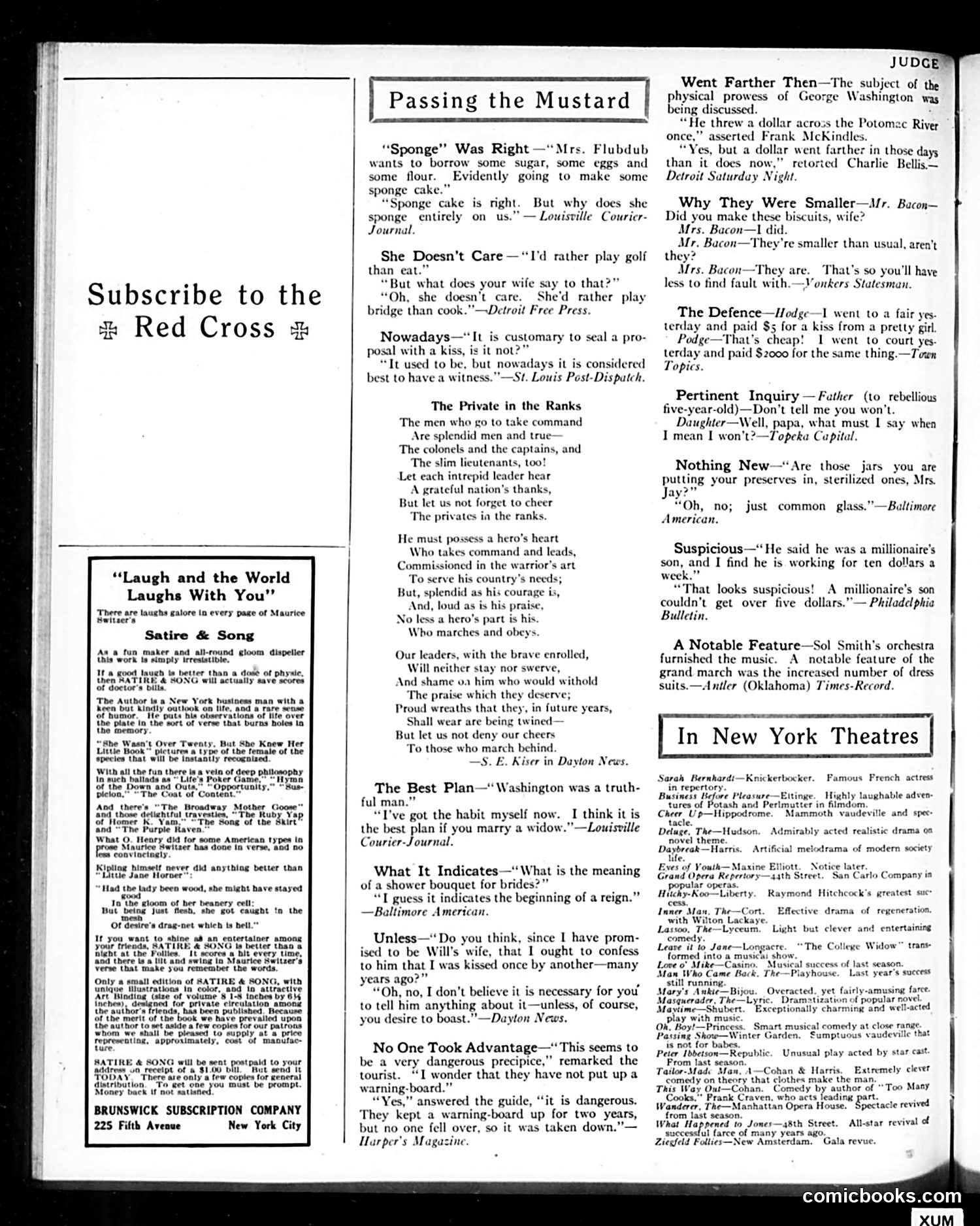
This page from *Judge* magazine contains brief domestic humor sketches mocking everyday married life and social conventions, plus patriotic poetry about WWI soldiers. The cartoons ("Sponge" Was Right, She Doesn't Care, Nowadays) are quick jokes about wives—depicting them as freeloaders, golf-obsessed rather than domestic, and requiring witnesses for proposals. The humor relies on wife-as-burden stereotypes common to early 20th-century satire. The poem "The Private in the Ranks" honors enlisted soldiers during wartime, arguing their sacrifice deserves equal recognition as officers'. This appears patriotic rather than satirical, likely published during or shortly after WWI. The page also advertises *Satire & Song*, a humor book by Maurice Switzer marketed to the magazine's readers as premium entertainment. The overall tone reflects pre-1920s gender humor and military sentiment typical of *Judge*'s audience.
📄 Transcribed text from this page (OCR, searchable)
Machine-transcribed from the original scan — historical spelling and the odd misread are preserved.
Subscribe to the a Red Cross x “Laugh and the World Laughs With You” There are laughs galore in every page of Maurice Switaer's Satire & Song maker and all-round gloom dispeller Unis work is simply Irresistibie. If @ good laugh ls better than a dose of physic, then RATIRE & SONG will actually save scores of doctor's biils ‘The Author ts a New York business man with a keen but kindly outlook a8 life, and a rare senae of humor, He puts hls observations of lite over the plate In the sort of Verse that burns holes in the memory Over Twenty, But Sho Kaew Her pictures a type of the female of the ‘species that will be instantly recognized of the Down and Outs,” “Opportunity, piclon,” “The Coat of Content.” “The Broadway Mother Goose” and “The Purple Haven.” What O. Heary did for some American types In ose Maurice Switzer has done In verse, aod no fess convincingly Kipling himsetf never did anything better than “Little Jane Horner” “Had the lady been wood, she might have stayed ood In the gloom of her beanery cell: But betng Just flesh, she got caught tn the mesh Of desire’s drag-net which ts bell.” It you want to shine af an entertainer among your frieods, SATIRE & SONG Is better than a ight at the Follies. It scores « bit every tims and there is a [lit and swing in Maurice Switzer's Verse that make you remember the words. Only a small edition of SATIRE & SONG, with unique illustrations In color, to attractive Art Binding (size of volume’S 1-8 inches by 644 inehes) designed for private cireulation among the author's friends, has been published. Because f the merit of the book we have prevailed upon ‘author to set aside a few copies for our patrons: whom we shall be pleased to supply at a price Tepresenting, approximately, cost of manufac- ure, SATIRE & SONG will be sent postpaid to your Address 0 receipt of & $1.00 blll. But send it TODAY. There are only a few copies for general distribution. To ket one you must be prompt Money back tf not xatisn BRUNSWICK SUBSCRIPTION COMPANY 225 Fifth Avenue New York City Passing the Mustard “Sponge” Was Right —“Mrs. Flubdub wants to borrow some sugar, some eggs and some flour. Evidently going to make some sponge cake.” “Sponge cake is right. But why does she sponge entirely on us.” — Louisville Courier- Journal. She Doesn't Care —‘‘I'd rather play golf than eat.” “But what does your wife say to that?” “Oh, she doesn’t care. She'd rather play bridge than cook.""—Detroit Free Press. Nowadays—‘ It is customary to seal a pro- posal with a kiss, is it not?” “It used to be, but nowadays it is considered best to have a witness." —St. Louis Post-Dispatch. The Private in the Ranks The men who go to take command Are splendid men and true- The colonels and the captains, and The slim lieutenants, too! Let each intrepid leader hear A grateful nation’s thanks, But let us not forget to cheer The privates in the ranks. He must possess a hero's heart Who takes command and leads, Commissioned in the warrior’s art To serve his country’s needs; But, splendid as his courage is, And, loud as is his praise, No less a hero’s part is his. Who marches and obeys Our leaders, with the brave Will neither stay nor swerve, And shame oa him who would withold ‘The praise which they deserve; Proud wreaths that they, in future years, Shall wear are being twined— But let us not deny our cheers To those who march behind. —S. E. Kiser in Dayton News. The Best Plan—‘ Washington was a truth- ful man.” “T've got the habit myself now. I think it is the best plan if you marry a widow.” —Louisville Courier-Journal. What It Indicates—‘‘ What is the meaning of a shower bouquet for brides?” “T guess it indicates the beginning of a reign.” —Baltimore American. Unless—“Do you think, since I have prom- ised to be Will’s wife, that I ought to confess to him that I was kissed once by another—many years ago?” “Oh, no, I don’t believe it is necessary for you! to tell him anything about it—unless, of course, you desire to boast.” —Dayton News. No One Took Advantage—‘ This seems to be a very dangerous precipice,” remarked the tourist. “I wonder that they have not put up a warning-board.” s,”" answered the guide, “it is dangerous. They kept a warning-board up for two years, but no one fell over, so it was taken down.”— Harper's Magazi JUDGE Went Farther Then—The subject of the physical prowess of George Washington was being discussed. “He threw a dollar across the Potomac River once,” asserted Frank McKindles. “Yes, but a dollar went farther in those days than it does now,” retorted Charlie Bellis— Detroit Saturday Night. Why They Were Smaller—AMr. Bacon— Did you make these biscuits, wife? Mrs. Bacon—I di Mr, Bacon—They’re smaller than usual, aren't they? Mrs. Bacon—They are. That's so you'll have less to find fault with.—Vonkers Statesman. The Defence—Hodge—I went to a fair yes- terday and paid $5 for a kiss from a pretty girl Podge—That's cheap! 1 went to court yes. terday and paid $2000 for the same thing.—Town Topics. Pertinent Inquiry — Father (to rebellious five-year-old)—Don’t tell me you won't. Daughter—Well, papa, what must I say when I mean I won't?—Topeka Capital. Nothing New—‘Are those jars you are putting your preserves in, sterilized ones, Mrs. Jay?” Yh, no; just common glass.” —Bultimore American. Suspicious—‘ He said he was a millionaire’s son, and I find he is working for ten dollars a “That looks suspicious! A millionaire’s son couldn't get over five dollars.” — Philadelphia Bulletin. A Notable Feature—Sol Smith’s orchestra furnished the music. A notable feature of the grand march was the increased number of dress suits.—A ntler (Oklahoma) Times-Record. ene In New York Theatres Sarah Bernhardi—Knickerbocker. Famous French actress in repertory. Business Before Pleasure—Ettinge. Highly laughable adven- tures of Potash and Perlmutter in filmdom Cheer Up—Hippodrome. “Mammoth vaudeville and spec- tacle. Deluge, The—Hudson. Admirably acted realistic drama oa novel theme. Daybreak—Harris. Artificial melodrama of modern society ves of Youth—Maxine Elliott. Notice later. rand Opes Repertory—4ath S San C pular operas Hlichy-Koo Liberty Company ia Raymond Hitchcock's greatest suc cess. Inner Man, The—Cort. Effective drama of regeneration, with Wilton Lackaye Lassoo, The—Lyceum. comedy Leave it to Jane—Longacre formed into a music'ui show Love 0° Mike—Casino. jusi Man Who Came Back, The—Piayhouse still running. Mary's Ankie—Bijou. Overacted. yet fairly-amusing farce. Masquerader, The—Lyric. Dramstization of popular Maytime—Shubert. Exceptionally chi ing and well. play with music. Oh, Boy!—Princess. Smart musical comery at close rang’ Passing Showe—Winter Garden, Sumptuous vaudeville Light but clever and entertaining “The College Widow” trans success of last season Last year's success is not for babes. Peter Idbetson—Republic. Unusual play acted by star cast From last season. Tajlor-Madé Man, A—Cohan & Harris, Extremely clever comedy on theory that clothes make the man. This Way Qut—Cohan. | Comedy by author of “Too Mary Cooks.” Prank Craven, who acts leading part: Wanderer, The—Manhattan Opera House. Spectacie revived from last season. . What Happened to Jones—48th Street. All-star revival of successful farce of many years ago. Ziegfeld Follies—New Amsterdam. Gala revue. comicbooks.com