
A complete issue · 28 pages · 1917
Judge — August 25, 1917
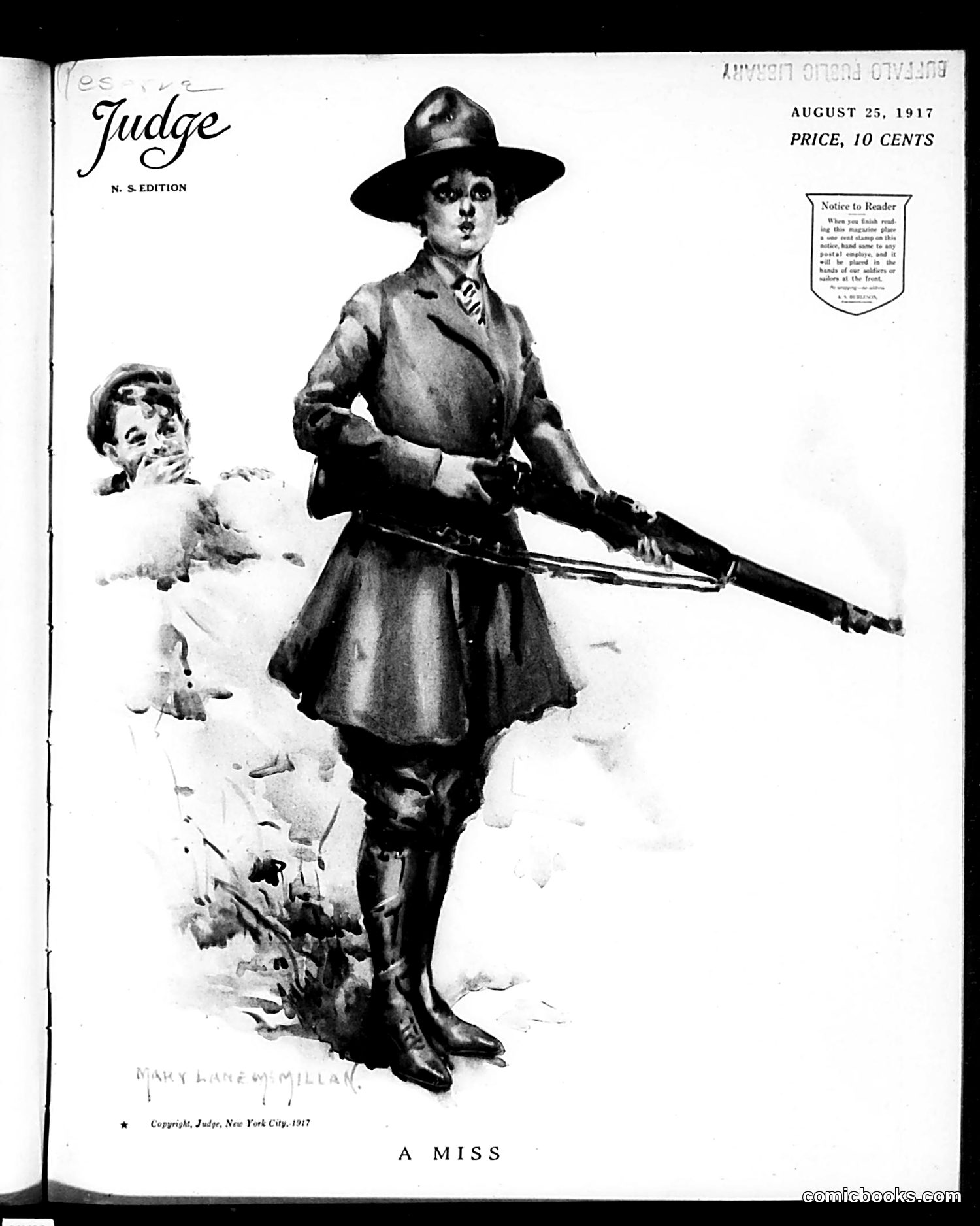
This cover depicts a woman in military attire holding a rifle, with two children visible behind her. The title reads simply "A MISS." The 1917 date is crucial: America had recently entered World War I (April 1917). The satire appears to comment on women's evolving wartime roles—possibly mocking the idea of women as soldiers or military participants, a radical concept at that time. The presence of children alongside the armed woman may suggest irony about maternal duties versus military service. The "MISS" title likely plays on the double meaning: a young unmarried woman, and "to miss" (fail to hit), potentially satirizing women's supposed unsuitability for combat. The artwork is credited to artist Ware Lance McMillan.
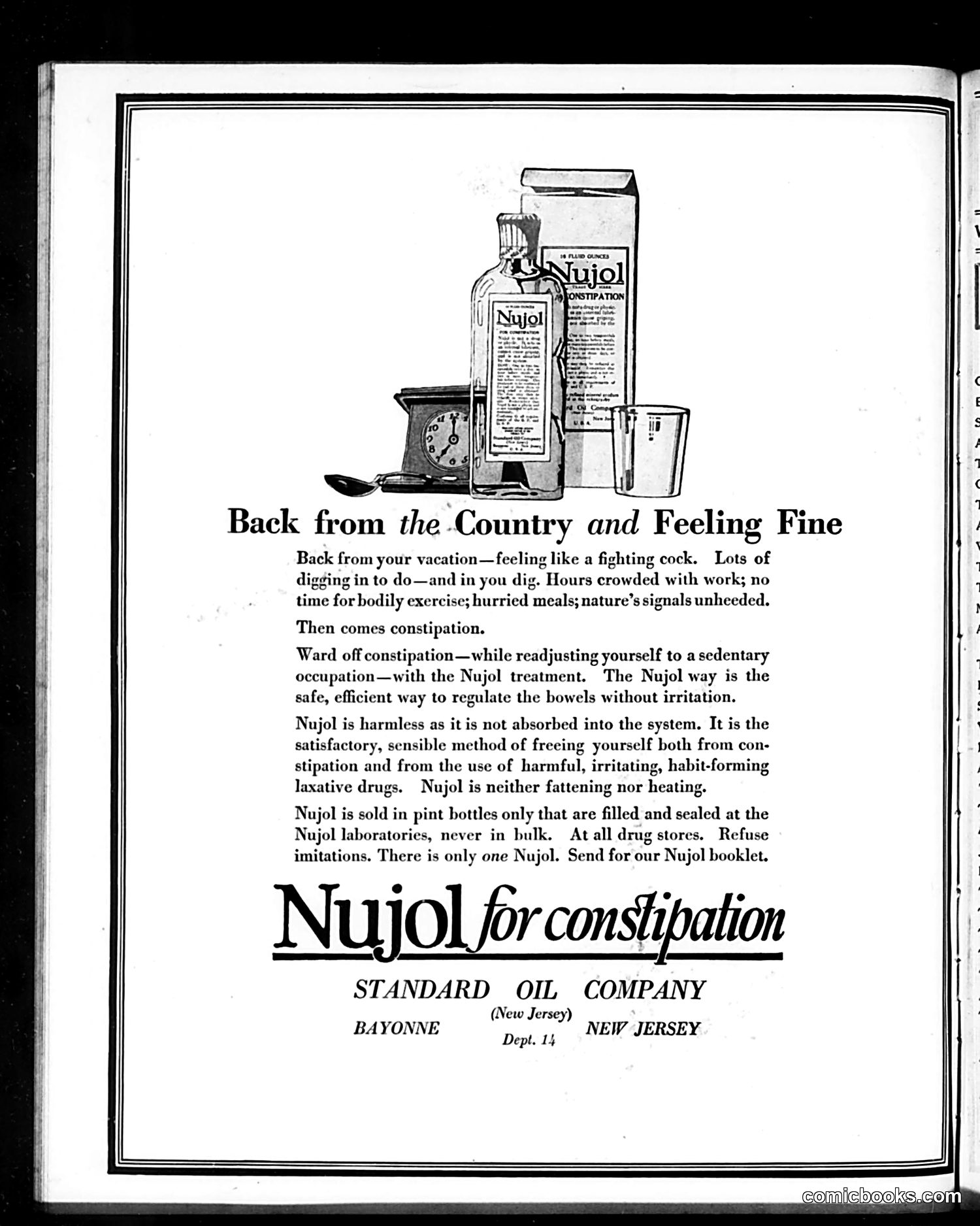
This page is **primarily an advertisement**, not satirical content. It's a Nujol laxative product ad from Standard Oil Company (New Jersey), placed in Judge magazine. The ad uses a relatable scenario: returning from vacation feeling energetic ("like a fighting cock") but then experiencing constipation from disrupted routines. It positions Nujol as a "safe, efficient" solution that works without habit-forming drugs. The image shows the product bottle, box, and accessories (a clock suggesting time pressure, a spoon for dosing). Text emphasizes Nujol is "harmless" because it's not absorbed into the system—key marketing messaging for the era when laxative safety was a genuine concern. This represents typical early-20th-century advertising in humor magazines: straightforward product promotion using everyday situations and health claims.
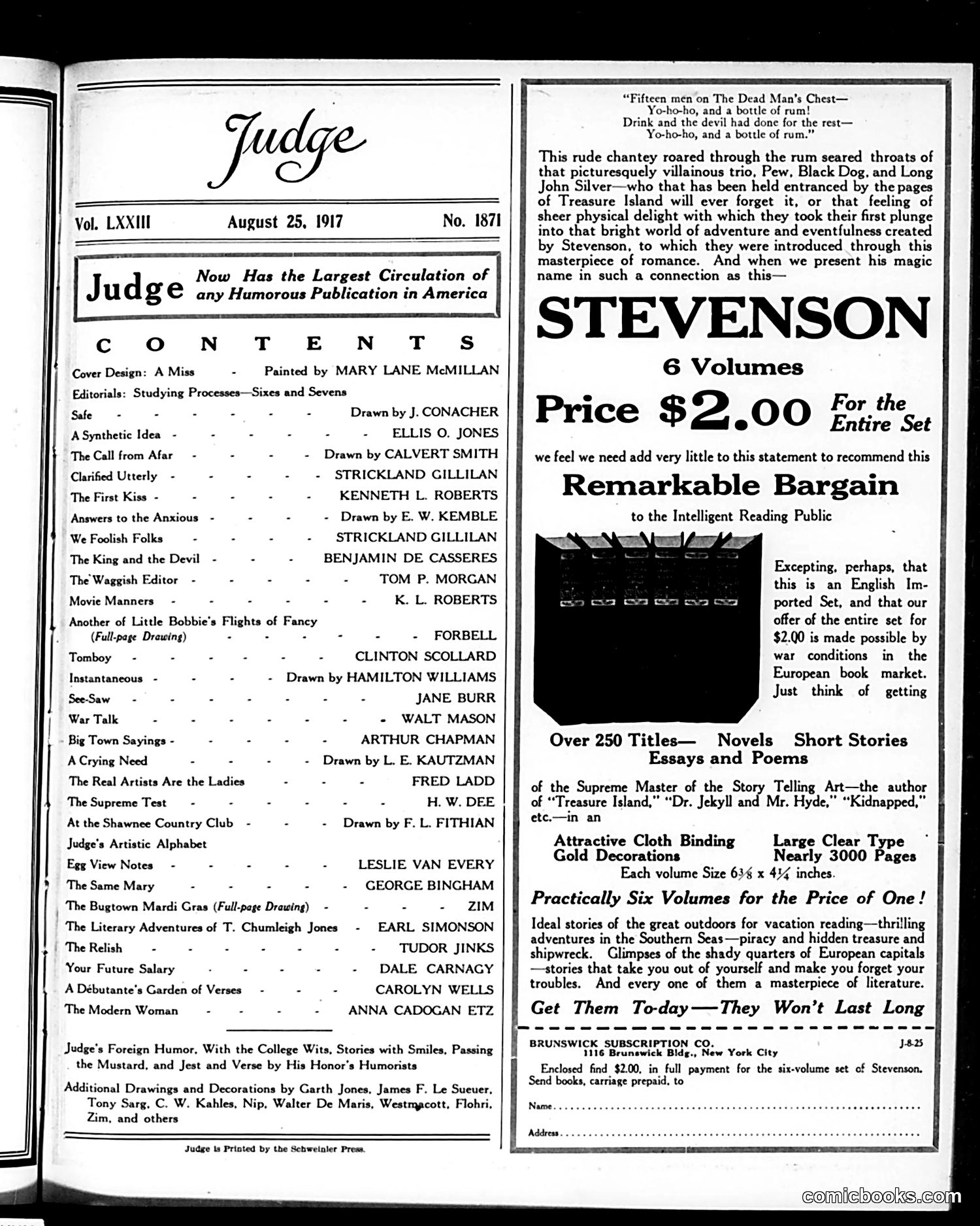
This page is primarily **advertising** rather than political satire. The right side features a full-page ad for a six-volume Stevenson collection at $2.00—positioned as a bargain, notably mentioning "war conditions in the European book market," reflecting WWI's impact on publishing. The left side shows **table of contents** for the magazine's articles and illustrations, including pieces titled "The King and the Devil," "Movie Manners," and "War Talk"—suggesting the issue addresses contemporary wartime topics, though specific cartoons aren't visible in this scan. The cover design credit goes to Mary Lane McMillan, but the actual cover image isn't shown here. Without seeing the actual cartoons, detailed political analysis isn't possible.
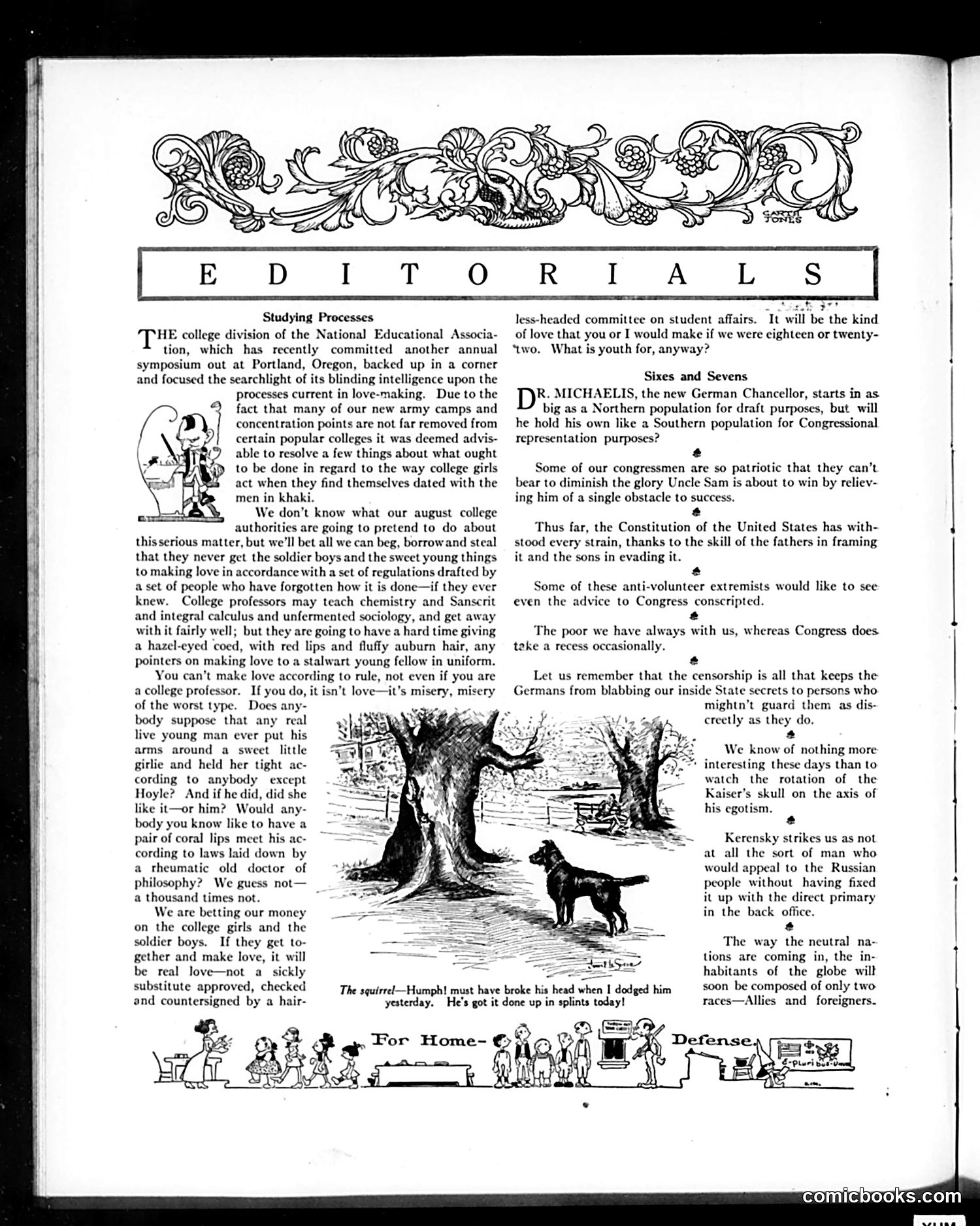
This editorial page critiques college courtship regulations and World War I-era politics. The main article mocks strict rules governing student romance, arguing that love "cannot be made in accordance with a set of regulations" and questioning whether administrators could enforce such codes on soldiers. The central cartoon shows a dog and squirrel, captioned about a head injury from "dodging"—likely a visual pun about evasion. The editorial section references Dr. Michaelis (Germany's new Chancellor), Congressional representation, and constitutional debates about conscription and "anti-volunteer extremists." References to German censorship, Kaiser's ego, and Kerensky (Russian political figure) indicate this page addresses wartime military and diplomatic tensions. The "For Home Defense" banner suggests domestic preparedness concerns during WWI.
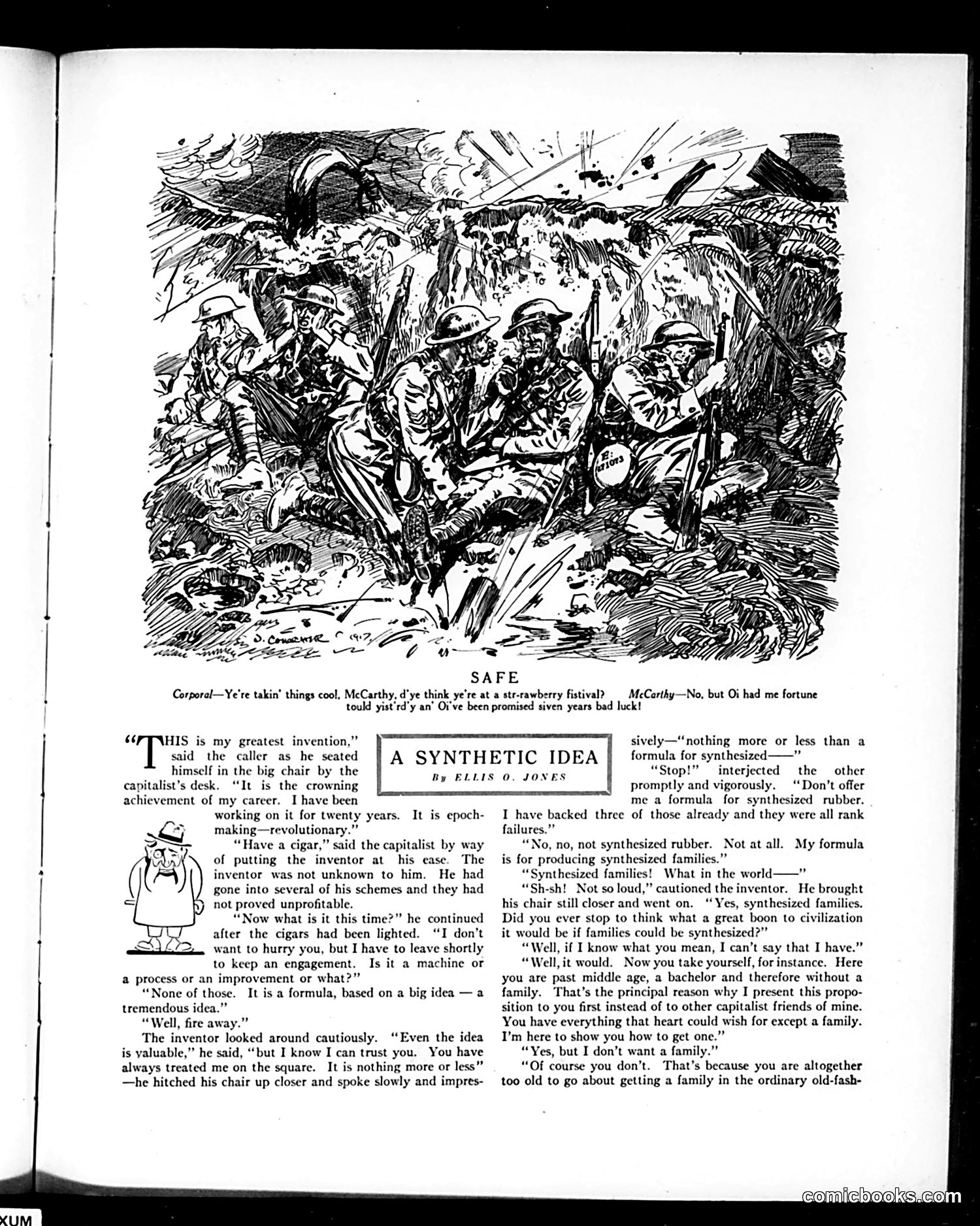
**Top Cartoon ("Safe"):** Depicts soldiers in a WWI trench scene. The caption shows McCarthy warning a corporal about bad luck from a "six-strawberry festival" and unpaid debts spanning seven years. This appears to be dark humor about soldier superstitions regarding luck and survival in combat. **Main Article ("A Synthetic Idea" by Ellis O. Jones):** A capitalist pitches an inventor on a "synthetic families" formula—artificial family units to solve bachelor loneliness. The satire targets both capitalist commodification of human relationships and the era's anxiety about unmarried men lacking traditional family structures. The inventor skeptically counters that synthesized solutions cannot replace genuine human connection, mocking the notion that market-based formulas can solve social problems.
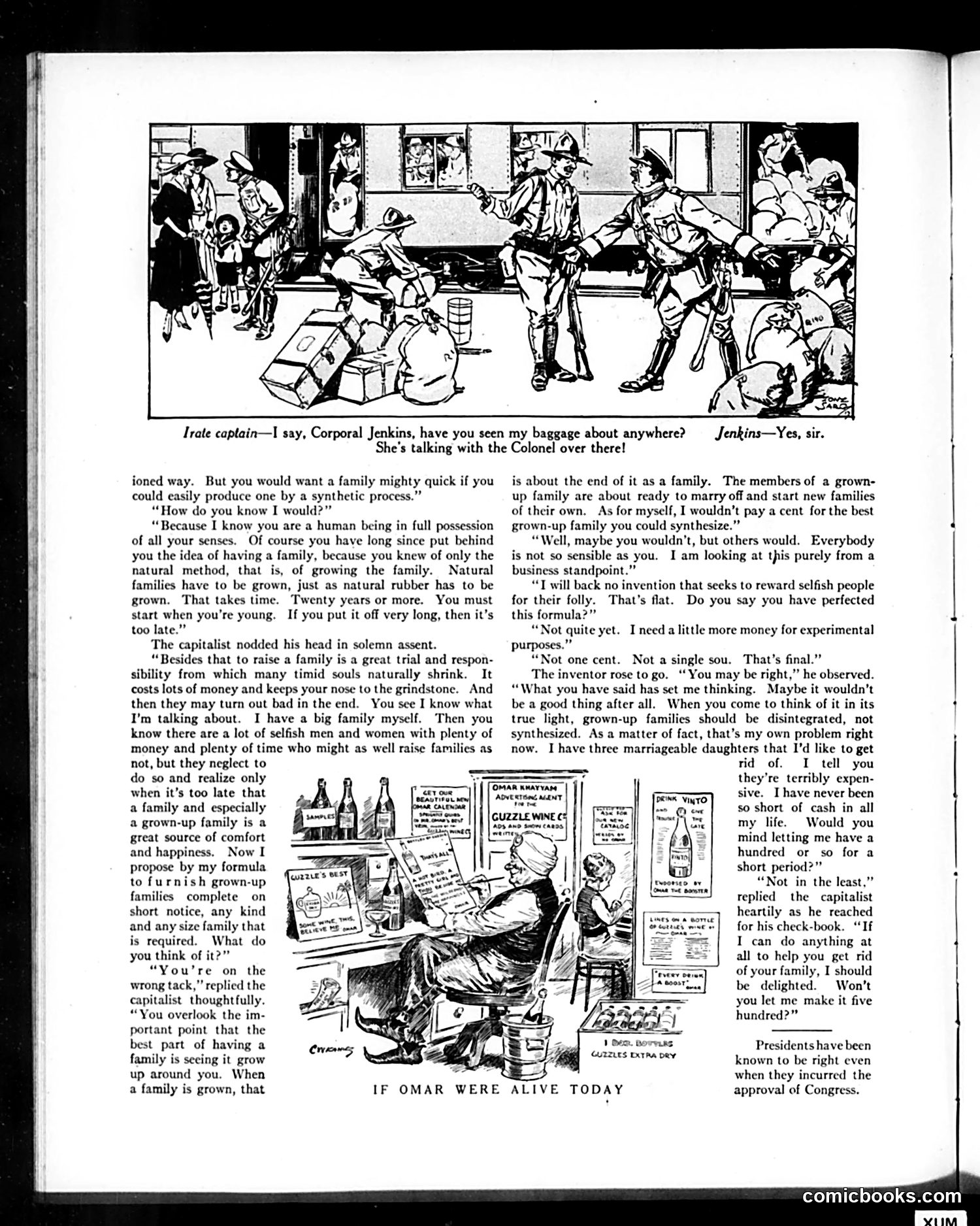
This page contains a dialogue between a capitalist and an inventor about family planning. The capitalist argues that families should remain small because large families drain financial resources and limit social mobility. The inventor counters that growing families are natural and beneficial, providing comfort and happiness. The cartoon titled "IF OMAR WERE ALIVE TODAY" (bottom) depicts a man surrounded by liquor advertisements—including "Guzzle Wine Co." and various bottles. This appears to satirize consumerism and alcohol marketing's ubiquity in modern life, possibly referencing Omar Khayyam's famous hedonistic poetry about wine. The page primarily critiques early 20th-century debates over population control, consumerism, and whether capitalism encourages or discourages family growth.
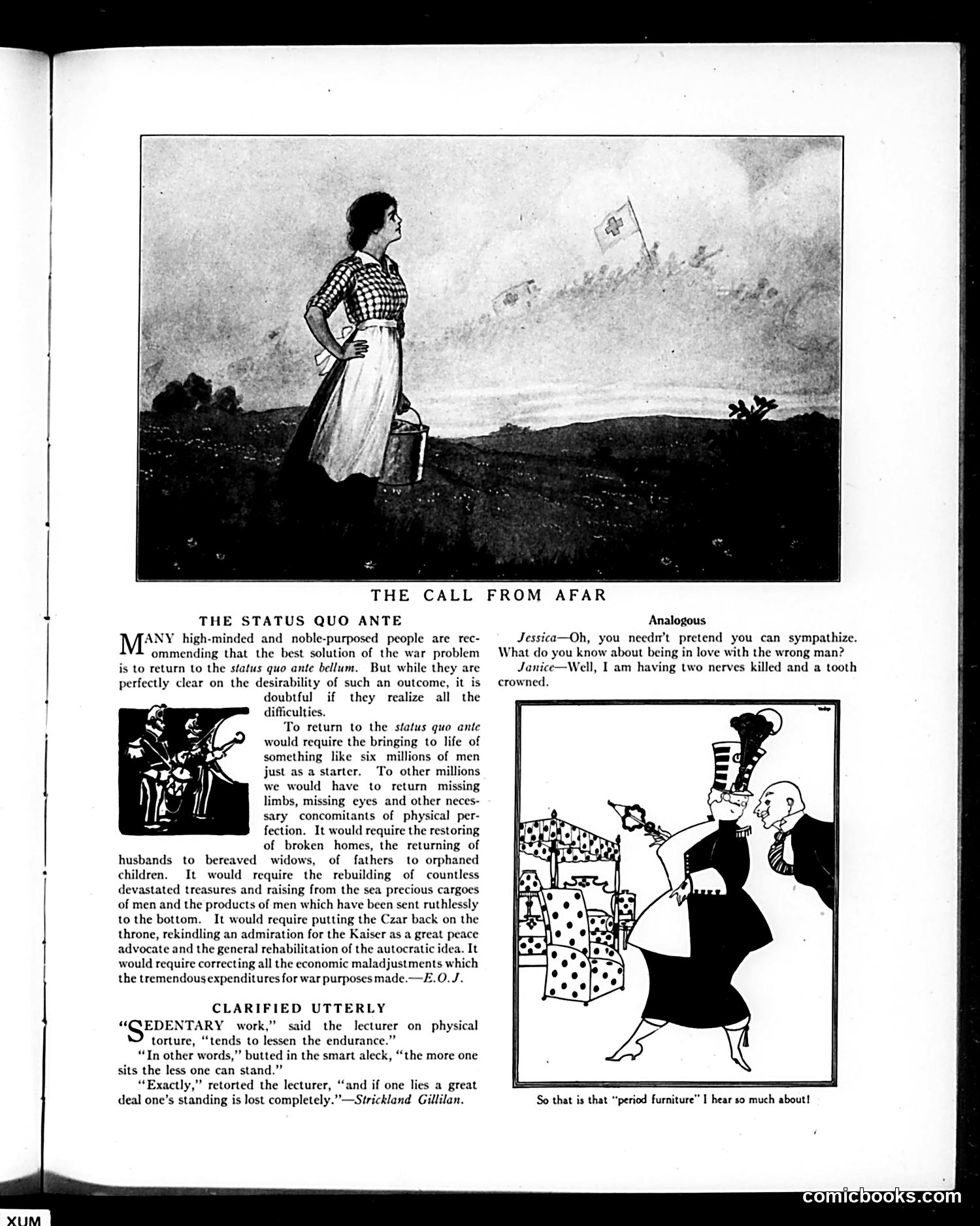
**"The Status Quo Ante"** critiques post-WWI peace advocates who proposed returning Europe to pre-war conditions. The essay sarcastically details the impossibility: resurrecting six million dead soldiers, restoring amputees and the blind, rebuilding destroyed homes and cities, and—most pointedly—reinstalling the Czar and Kaiser as leaders. The satire targets the naïveté of those seeking simple restoration after catastrophic war. **The cartoon dialogue** between Jessica and Janice appears unrelated—a social comedy about romantic disappointment versus dental work, establishing a lighthearted contrast on the page. **"Clarified Utterly"** is a word-play joke: a lecturer on physical endurance makes a pun about "standing"—both literal (posture) and figurative (reputation/resolve)—creating absurdist humor through deliberate misinterpretation. The page juxtaposes serious post-WWI political commentary with trivial domestic humor and wordplay.
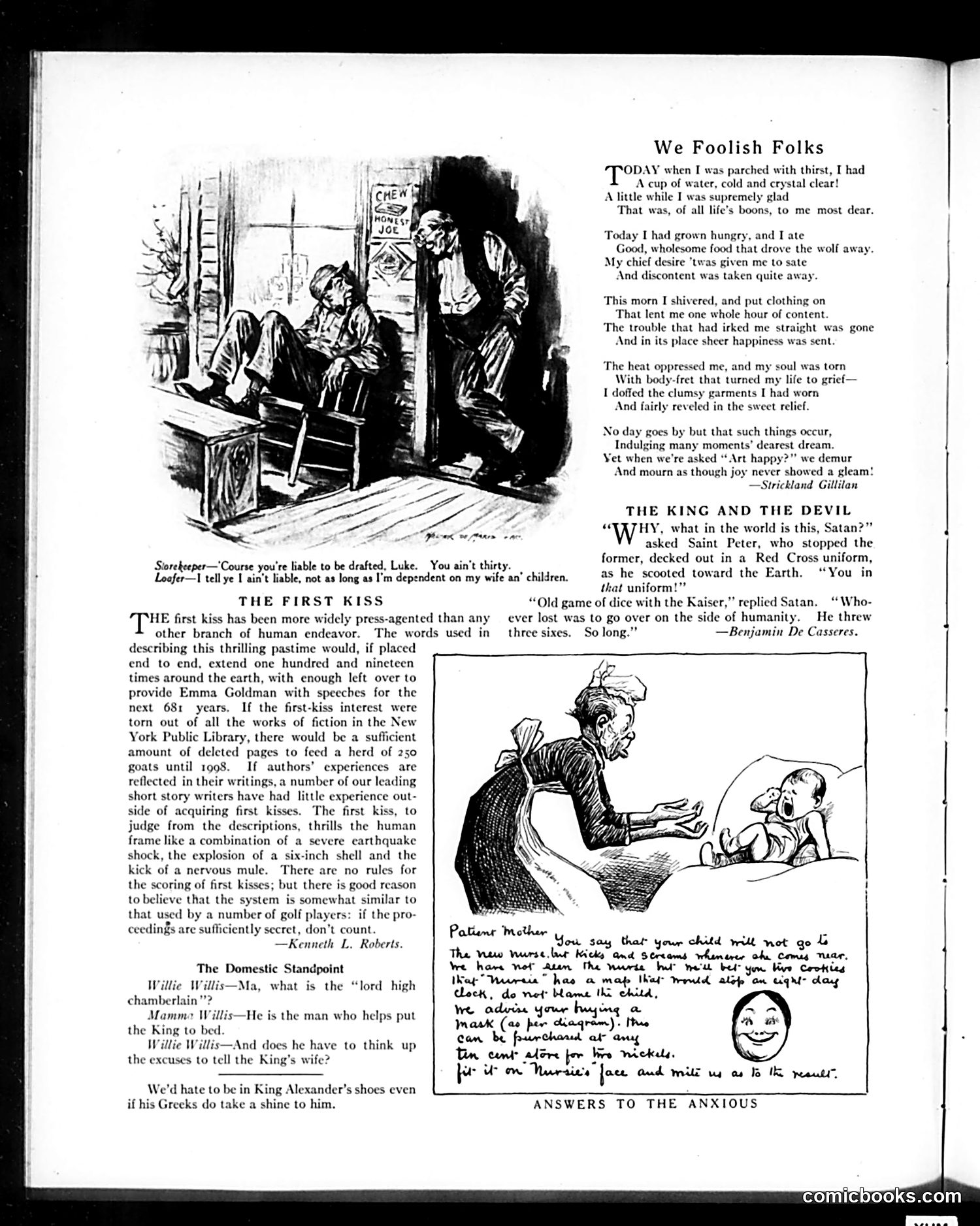
This page contains multiple satirical pieces typical of Judge's social commentary: **"We Foolish Folks"** (poem by Strickland Gillilan): A meditation on human ingratitude—noting how we take daily comforts (food, water, clothing, shelter) for granted, yet when asked if we're happy, we complain rather than acknowledge joy. **"The First Kiss"** (by Kenneth L. Roberts): Humorous essay satirizing the over-romanticization of first kisses in literature. Roberts uses absurdist hyperbole (pages could feed goats until 1998; Emma Goldman reference) to mock how extensively authors describe this moment as earth-shaking, while noting there are "no rules" and secretly-conducted kisses "don't count." **"The King and the Devil"** (dialogue): A wartime joke (Satan wears Red Cross uniform) playing on the irony of evil masquerading as humanitarian aid. The reference to "King Alexander" likely means King Alexander of Serbia/Yugoslavia during WWI. **Bottom cartoon**: A domestic comedy about a patient consulting a nurse regarding childcare arrangements—standard period humor about household management. The page is primarily **humor and social satire**, not political commentary, reflecting early 20th-century concerns about literature, manners, and wartime anxieties.
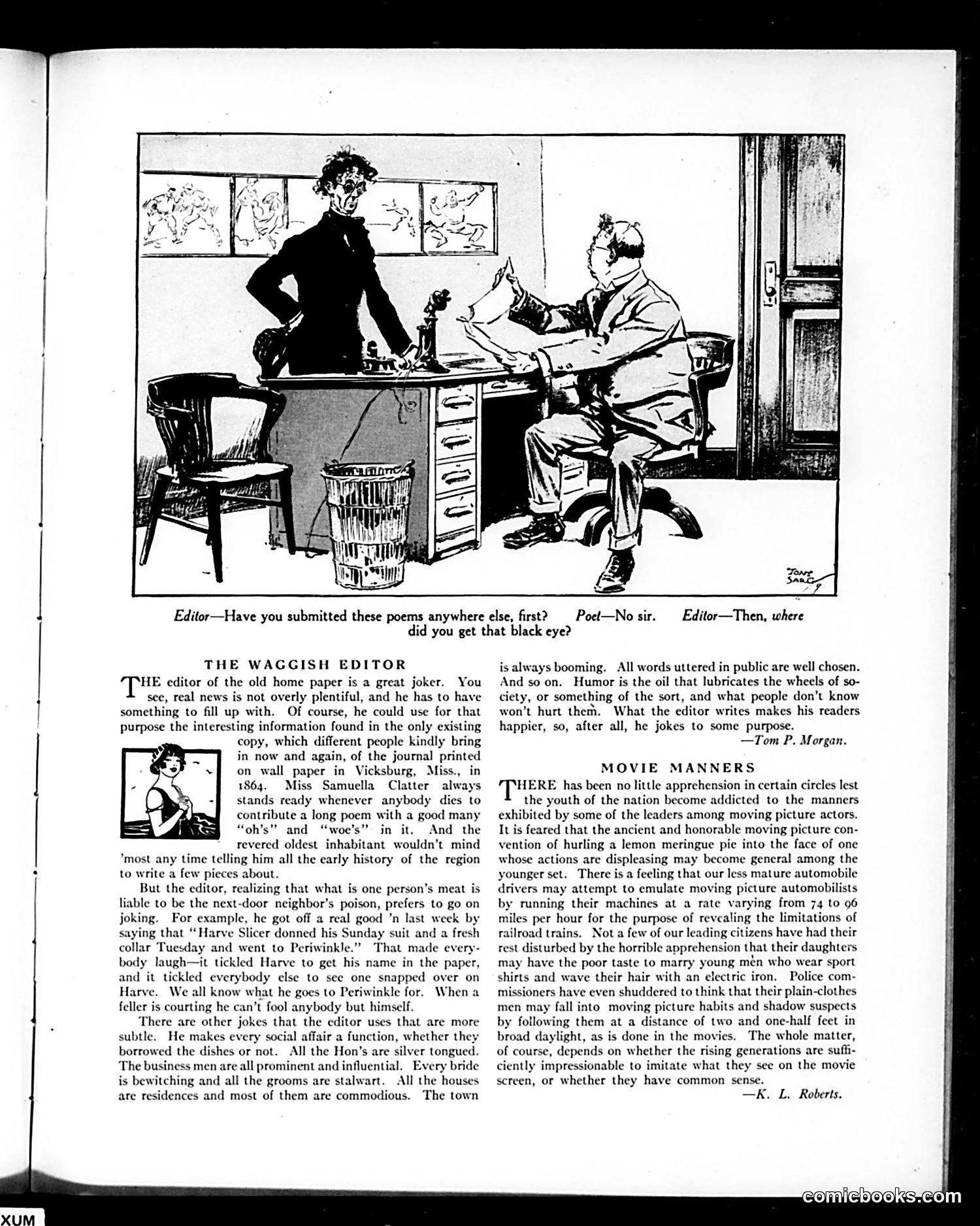
**The Cartoon:** A small-town newspaper editor interviews a poet submitting work. The poet has a black eye; the editor jokes "Then, where did you get that black eye?"—implying the poet's rejection was so harsh he got beaten up. **The Main Article ("The Waggish Editor"):** This celebrates small-town newspaper editors who use humor to fill pages when real news is scarce. The editor makes gentle jokes about locals (like mentioning "Harve Slicer" going to Periwinkle to court), which tickles everyone because they recognize themselves. The article argues this humor serves a social purpose—it makes readers happy and keeps the town spirit up. **"Movie Manners":** This satirizes contemporary anxiety (1920s-era) that young people were imitating Hollywood actors' reckless behavior—reckless driving, slapstick violence, casual fashion—rather than using common sense. It's satirical hand-wringing about youth culture corrupted by movies. Both pieces reflect *Judge* magazine's satirical tone: poking fun at small-town life and modern anxieties while ultimately defending their value.
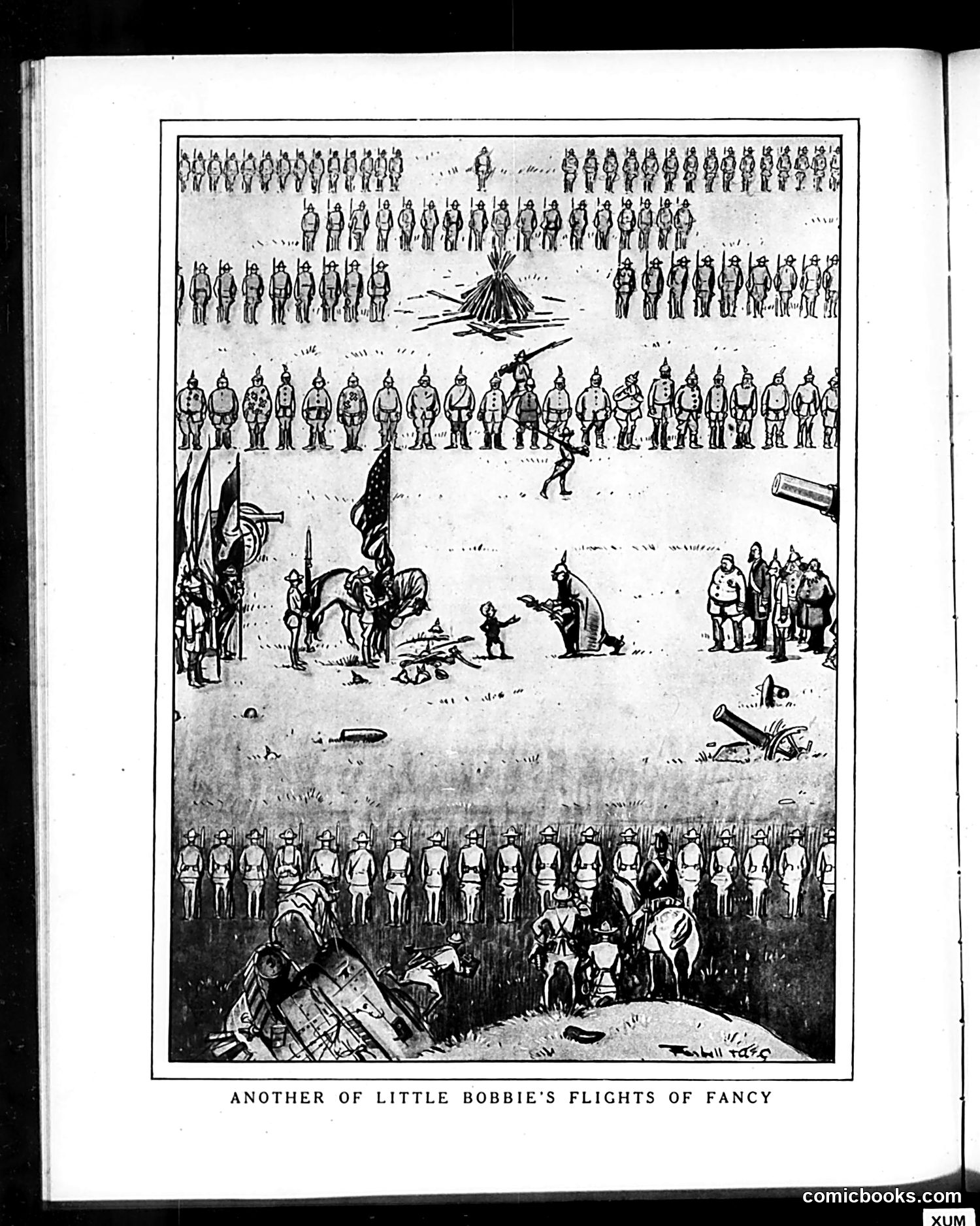
This is a surreal cartoon titled "Another of Little Bobbie's Flights of Fancy," depicting an imaginative child's daydream. The image shows a fantastical military or ceremonial scene with: - Massed soldiers arranged in formation at top and bottom - A central volcano or explosive eruption - Mounted cavalry and military officers with flags - Various armed figures and cannons - Small figures appearing to conduct or observe the action The "Little Bobbie" reference suggests this depicts a child's elaborate fantasy of military grandeur and combat. Without additional context about who created this or when it appeared in Judge magazine, the specific satirical target remains unclear—though it likely mocks either militarism generally or perhaps a specific political/military figure of the era by showing how a child's imagination transforms reality into exaggerated spectacle.
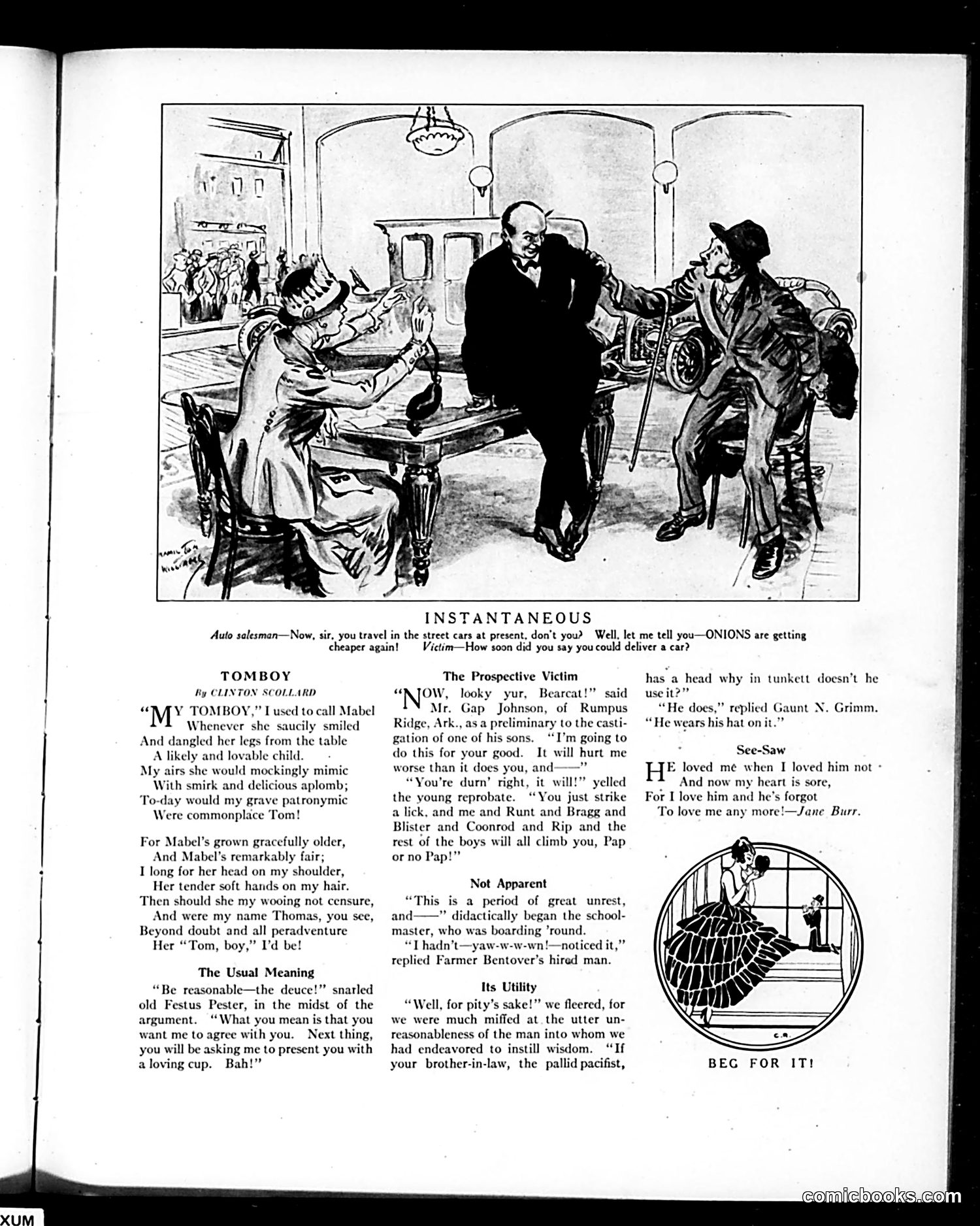
This page contains several short humorous pieces typical of early-20th-century satirical magazines. **"Instantaneous"** (top cartoon): An auto salesman uses a clever sales pitch—mentioning falling onion prices to suggest the customer should buy a car while they can still afford the luxury. The joke plays on rapid economic shifts and aggressive sales tactics. **"Tomboy"** (poem): A nostalgic piece about a man who fondly remembers a girl named Mabel as a spirited child, now grown beautiful. He wishes his name were "Tom" so she'd call him "Tom, boy"—a pun playing on her former tomboy nickname. **Short prose pieces**: Include a man demanding agreement rather than honest discussion; a Southern father threatening to whip his son, only to be warned the boy will gang up on him with friends; a schoolmaster's lecture on "unrest" interrupted by a farm worker's yawn; and a joke about someone's brother-in-law being so dim he "wears his hat on it." **"See-Saw"** (poem): A brief, sentimental verse about unrequited love and changing feelings. The humor relies on wordplay, regional dialect comedy, and observations about human nature and social behavior.
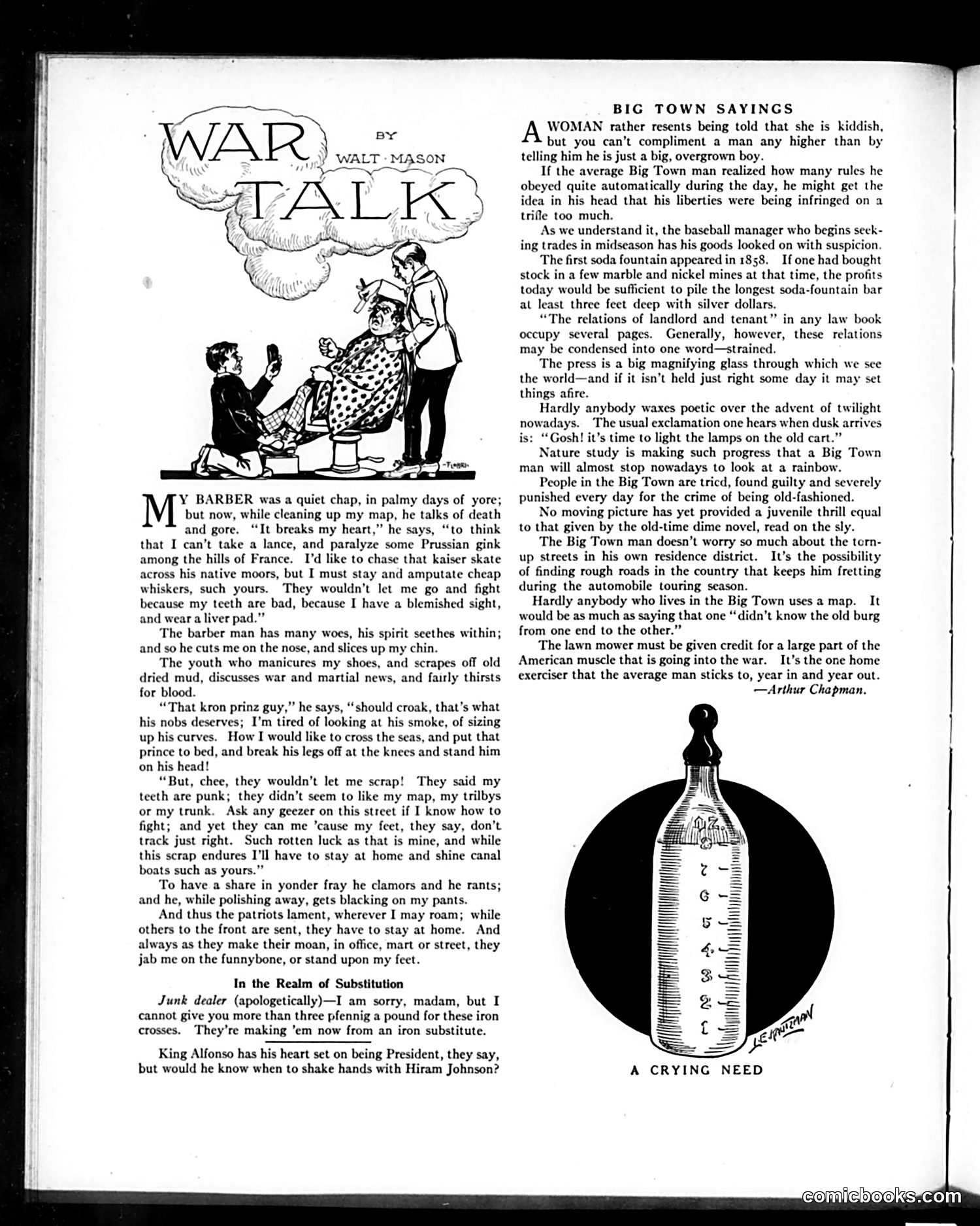
**Main Article ("War Talk" by Walt Mason):** This satirical piece mocks men on the home front during WWI who desperately want to fight but are rejected for minor physical flaws. A barber complains he's unfit due to bad teeth and poor eyesight, while a shoeshine boy with "punk" teeth and odd feet rails against the unfairness. Both men vent their frustration by literally harming the narrator (cutting him, stepping on his feet) while lamenting they must stay home. Mason's satire critiques their self-pitying patriotism and ironic violence toward civilians, suggesting their wartime frustration makes them unbearable to be around. **"In the Realm of Substitution" (brief joke):** A junk dealer apologizes for low payment on iron crosses, explaining they're now mass-produced from cheap iron substitutes—mocking Germany's mass militarization and devaluation of military honors. **Illustrations:** The barrel-shaped figure with the barber/shoeshine imagery and the baby bottle titled "A Crying Need" complement themes of complaint and unmet desires during wartime.
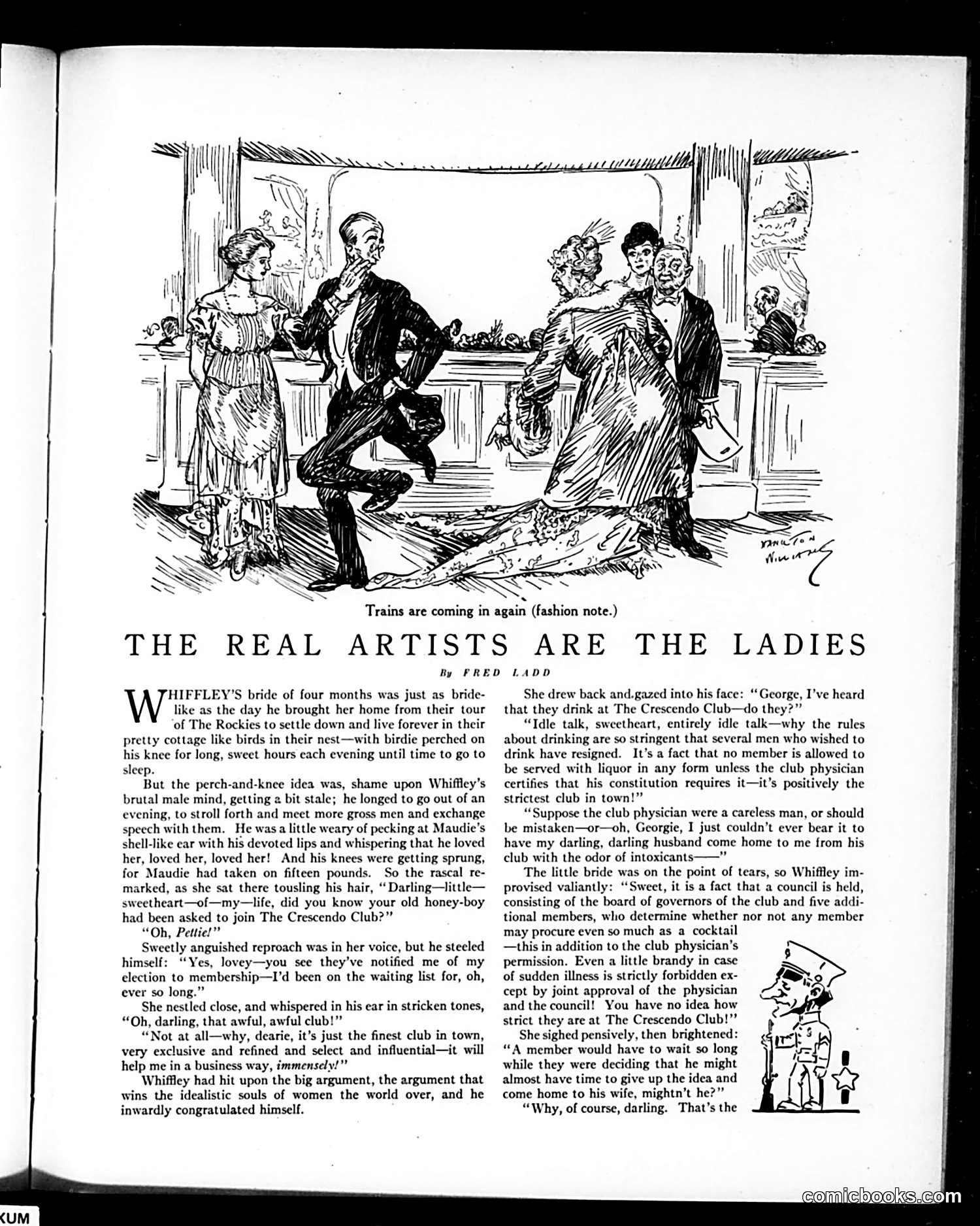
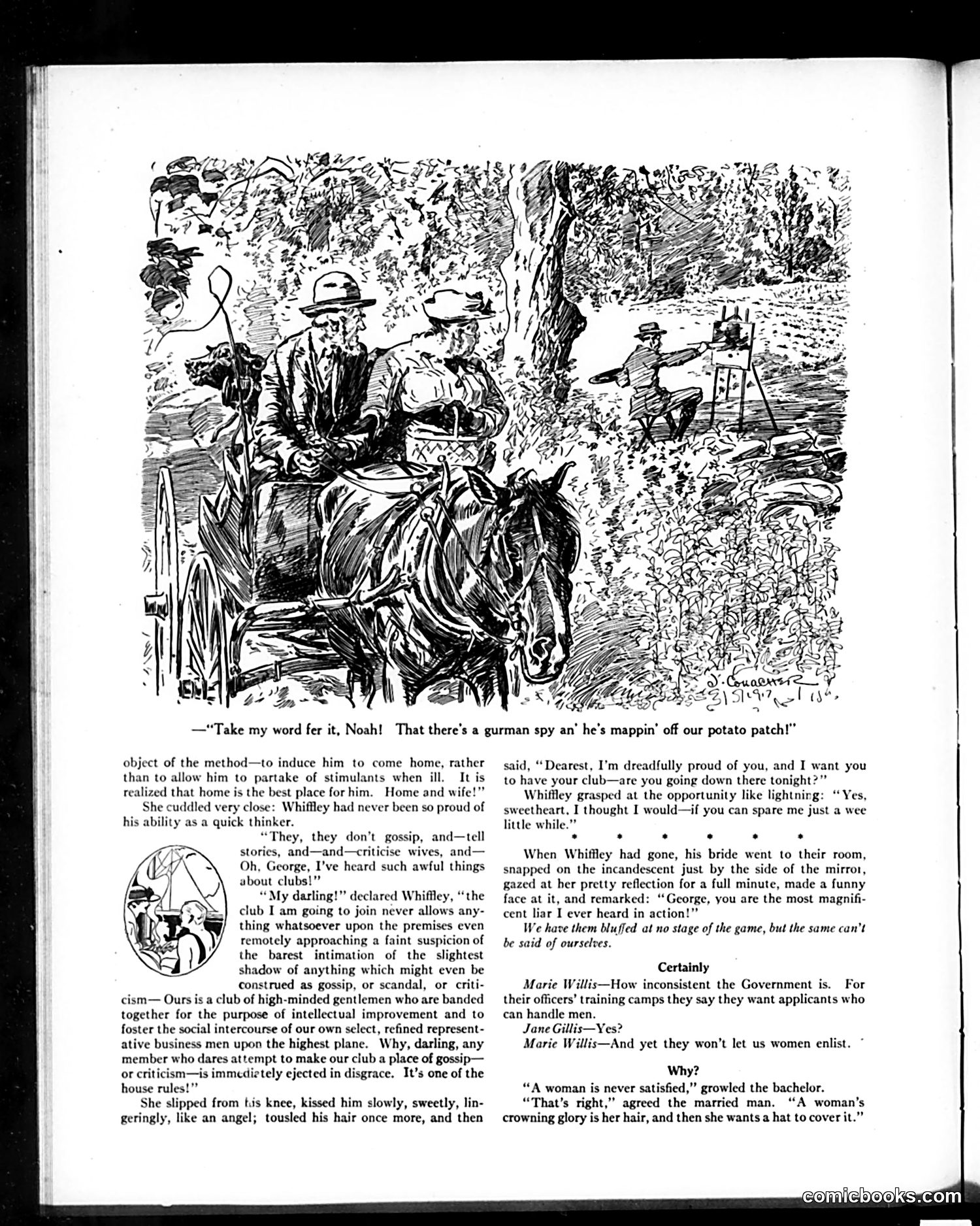
The top cartoon depicts rural figures discussing a man near a potato patch, with one claiming he's a "German spy" mapping their field. This reflects **WWI-era spy hysteria**—Americans' widespread fear of German espionage during the 1910s, often directed at innocent civilians or foreigners. The main text story concerns a man named Whiffley who lies to his wife about joining an exclusive gentlemen's club for "intellectual improvement," when he's actually going out socially. His new bride sees through his deception immediately, remarking he's "the most magnificent liar." **The satire targets**: masculine hypocrisy and the disconnect between men's stated intentions and actual behavior. The story mocks both Whiffley's transparent fabrication and the pretentious language men use to justify leisure activities. A sidebar dialogue satirizes **government inconsistency regarding women**: recruiting officers want men who can "handle men" yet won't allow women to enlist—highlighting the contradiction in excluding women from military service.
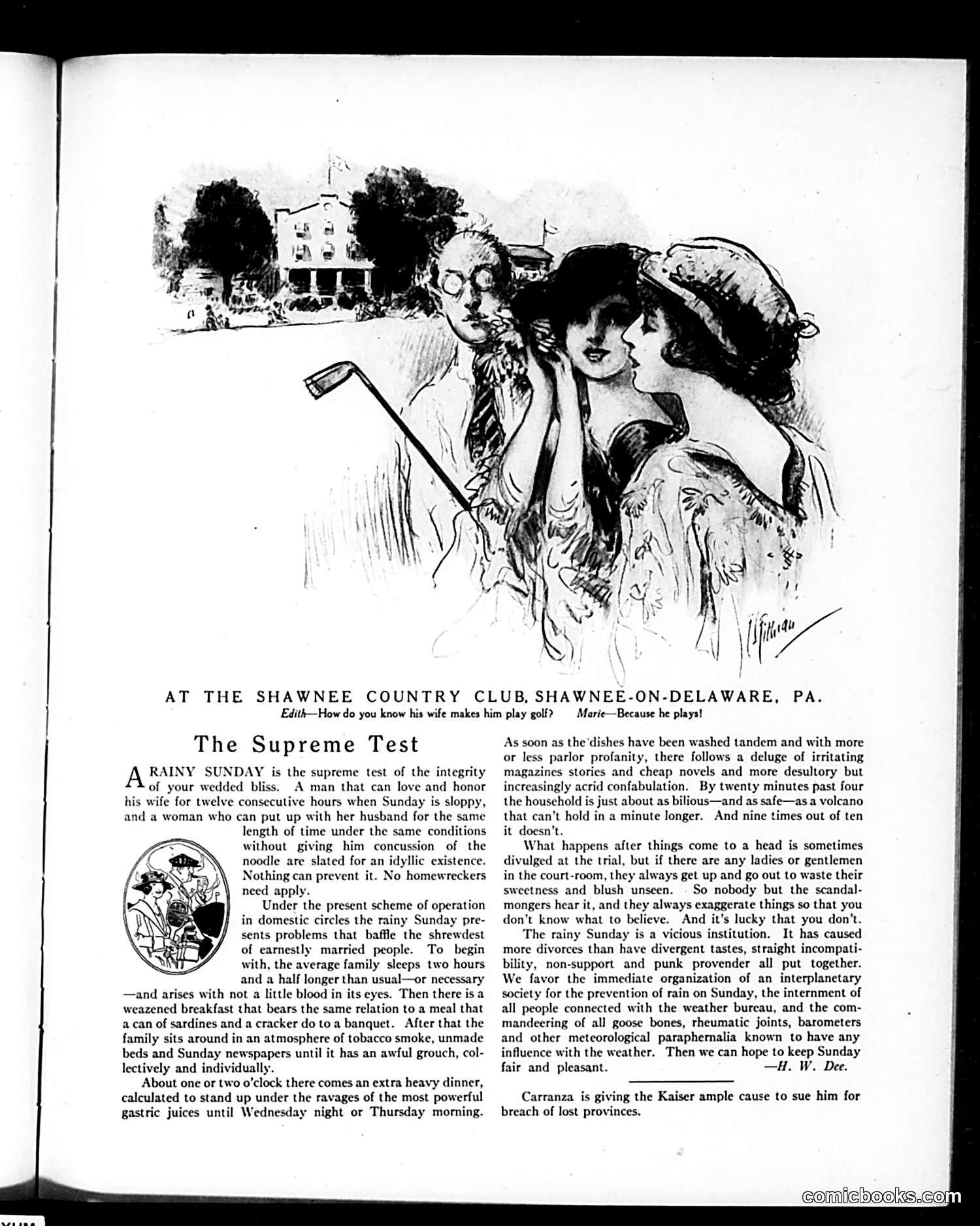
This page satirizes the strain of married life during bad weather, a common domestic complaint of the era. The cartoon at top shows a country club scene where a woman jokes that a man's wife "makes him play golf"—the implication being that golf is preferable to spending a rainy Sunday confined indoors with his spouse. The lengthy article elaborates the joke: rainy Sundays force couples into extended close quarters, beginning with oversleeping, a poor breakfast, and progressing through boredom, irritation, and accumulated domestic tension that frequently escalates into serious marital conflict—so severe that "what happens" is only discussed in divorce court proceedings. Judge's satirical solution is absurdist: establish an interplanetary organization to prevent Sunday rain, intern all weather bureau employees, and confiscate meteorological instruments. The humor targets both marital discord and the early-20th-century fascination with technological/bureaucratic "solutions" to everyday problems. The byline "H. W. Dee" appears to be a pseudonym.
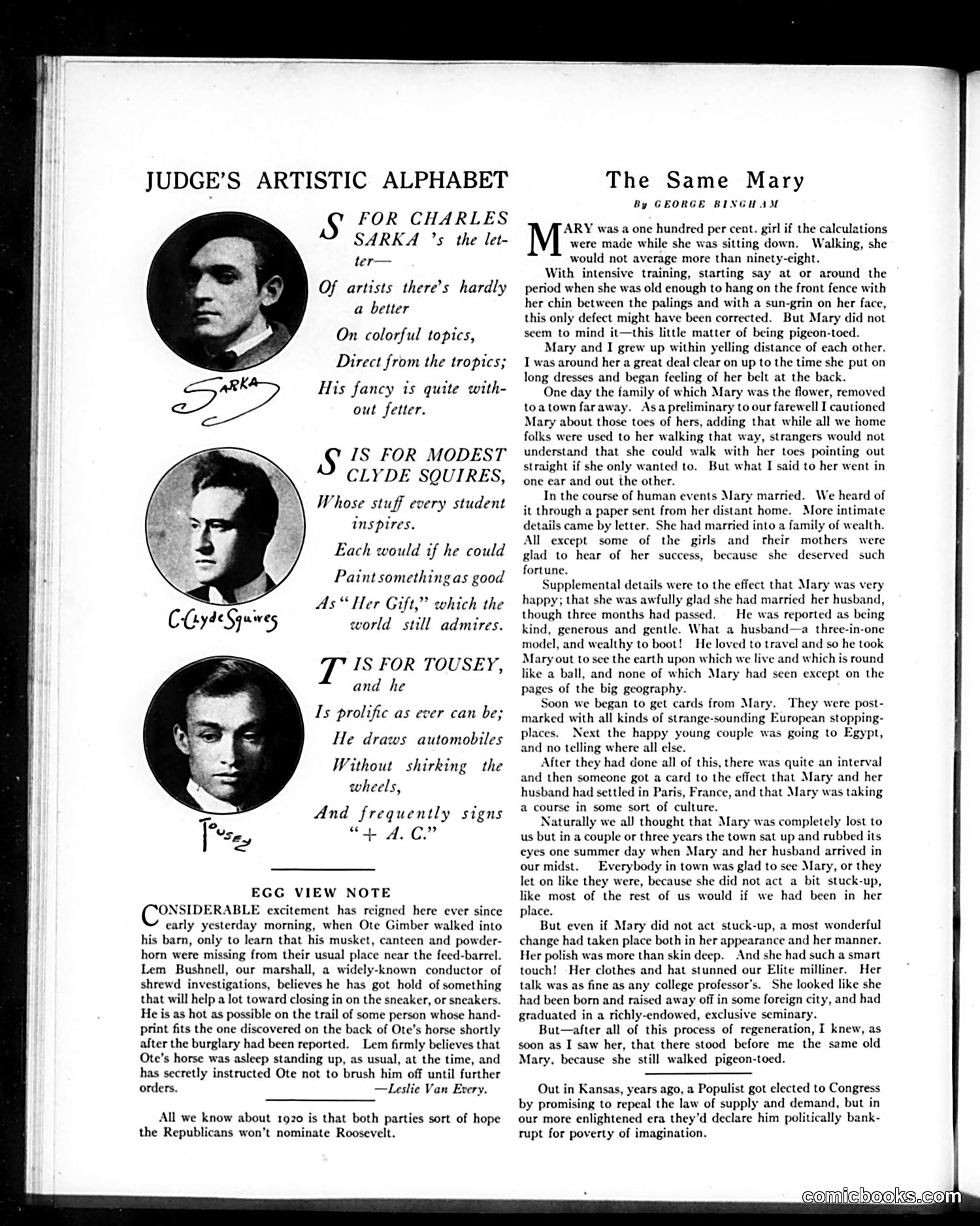
This page contains two unrelated features: **Left side: "Judge's Artistic Alphabet"** — A promotional feature showcasing three cartoonists through illustrated letters. It profiles Charles Sarka (S), Clyde Squires (S), and Tousey (T), praising their artistic skills. Tousey's notation "±4.C" appears to be his signature mark. **Right side: "The Same Mary" by George Bingham** — A nostalgic short story about a childhood friend named Mary who was pigeon-toed but didn't care what others thought. She marries a wealthy, kind man and they travel extensively. The narrative describes her life trajectory from a small-town girl to an international traveler. **Bottom: "Egg View Note"** — A humorous rural mystery sketch about a barn burglary investigation, using folksy characters and dry wit typical of early 20th-century American humor. **Bottom caption** — A quip about 1920 politics, suggesting both Republican and Democratic parties hope to avoid nominating Roosevelt for president.
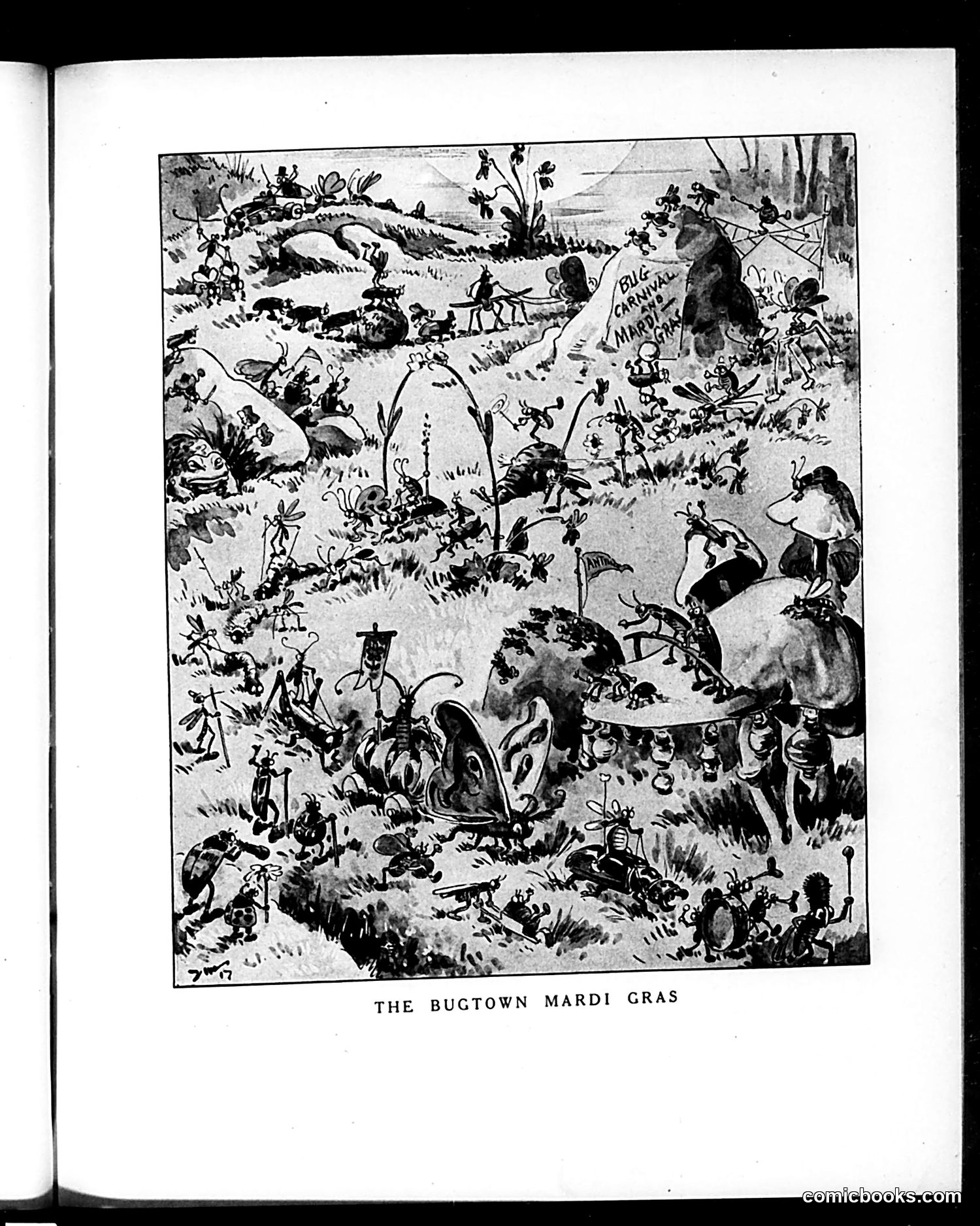
This illustration depicts an elaborate carnival scene populated entirely by anthropomorphized insects and bugs engaged in festive revelry. The composition is densely packed with tiny figures—ants, beetles, flies, and other creatures—participating in Mardi Gras activities. There's a large tent or carnival structure visible, and various insects are shown dancing, parading, and celebrating throughout a natural landscape. The satire likely works on a simple visual pun: insects naturally congregate in outdoor spaces during warm seasons, so imagining them throwing their own version of New Orleans' famous Mardi Gras creates whimsical humor. The detailed, bustling scene showcases the artist's skill at creating complex compositions with hundreds of small characters. Without additional context from Judge magazine's publication date, the specific satirical targets—if any—remain unclear.
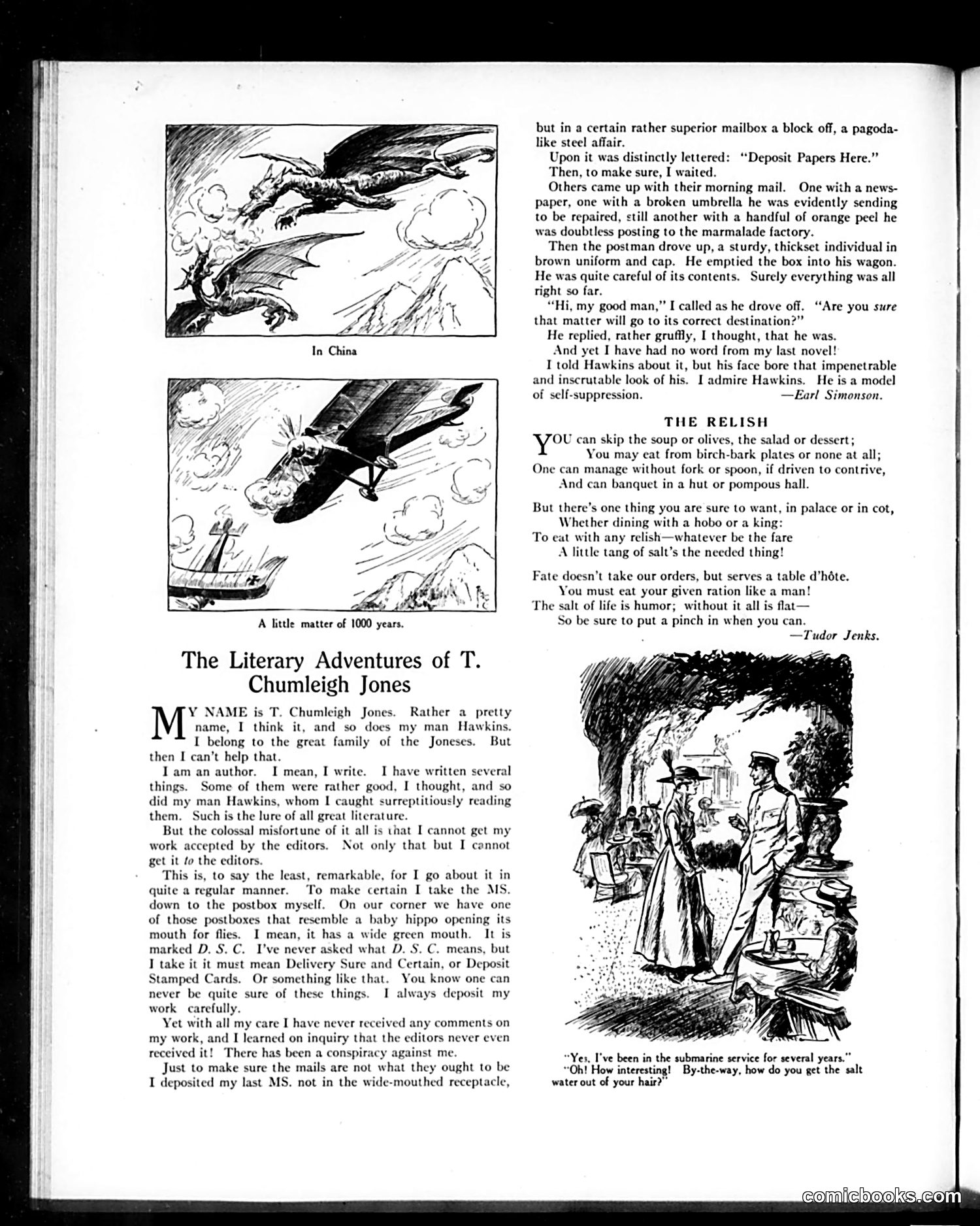
This page contains two satirical pieces from *Judge* magazine: **"The Literary Adventures of T. Chumleigh Jones"** mocks a delusional amateur writer who blames the postal system for his rejected manuscripts. The joke: Chumleigh deposits his work in mailboxes (including one bizarrely labeled "Deposit Papers Here"), yet never hears back. He's convinced there's a "conspiracy" against him, when the obvious explanation is that his writing is simply bad. His long-suffering servant Hawkins's silent disapproval is the running gag. The satire targets self-important wannabe authors who externalize blame rather than accept criticism. **"The Relish"** is a light humorous poem by Tudor Jenks advocating that humor (metaphorically "salt") makes life bearable regardless of circumstance. **The bottom cartoon** appears unrelated—a brief joke about submarine service and salt water in hair, likely a simple pun-based gag common to the era. The overall page satirizes literary pretension and poor self-awareness.
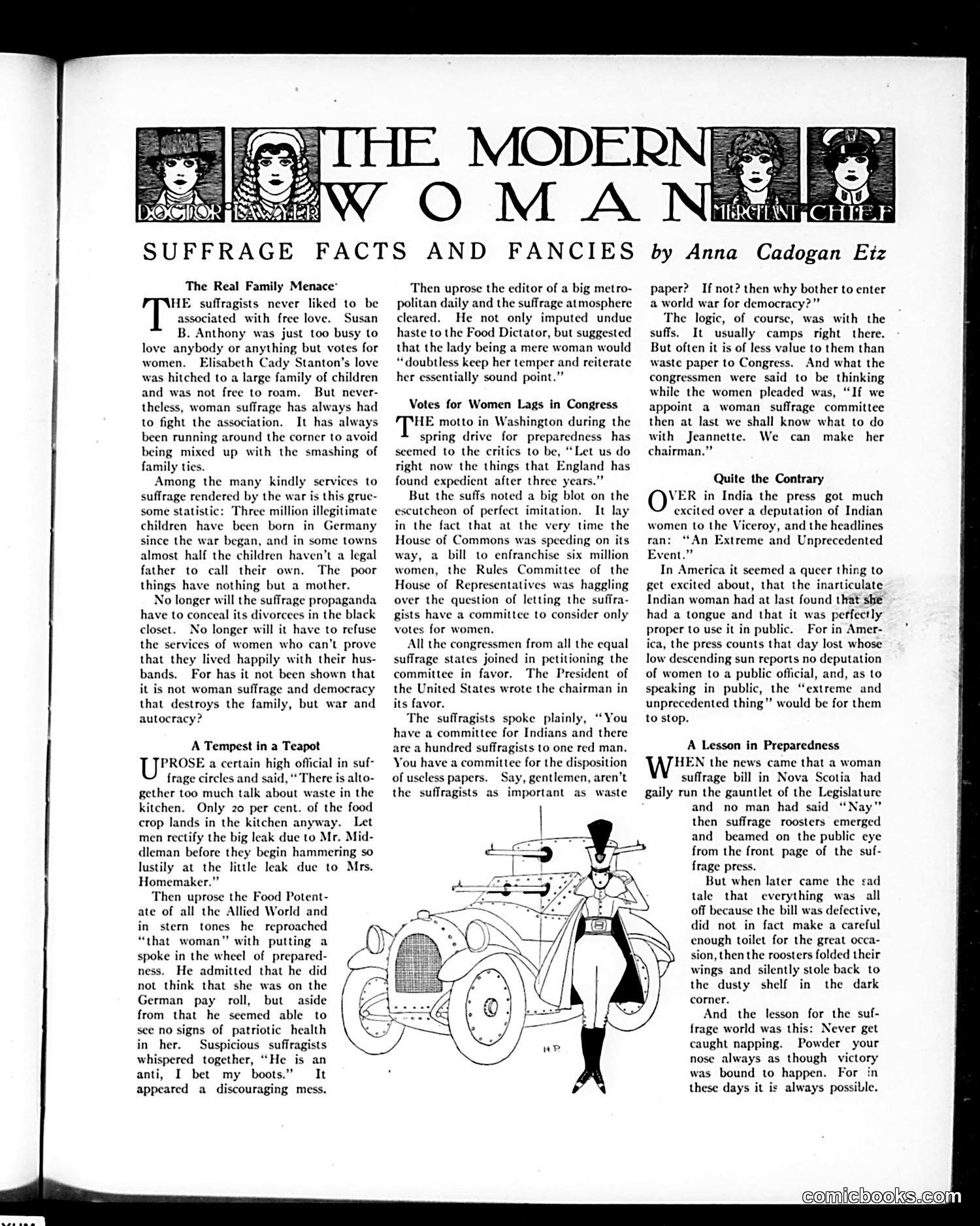
This page satirizes opposition to women's suffrage through three interconnected arguments: **"The Real Family Menace"** attacks anti-suffragists who claim suffrage destroys families. The author notes suffragists like Susan B. Anthony and Elisabeth Cady Stanton were actually devoted to family/domestic life. He then points out the real threat to families—World War I, which produced three million illegitimate German children—comes from war and autocracy, not women voting. **"A Tempest in a Teapot"** mocks a food official who blames a woman for "hindering preparedness" by questioning kitchen waste. A newspaper editor dismisses her concerns by condescendingly suggesting she'll "keep her temper" as "a mere woman." **"Votes for Women Lags in Congress"** criticizes Congress for denying suffragists a committee while establishing committees for Native Americans and waste disposal—implying women voters matter less than literal garbage. The cartoon shows a fashionable woman in a car, contrasting modern female independence with Congressional reluctance to grant voting rights.
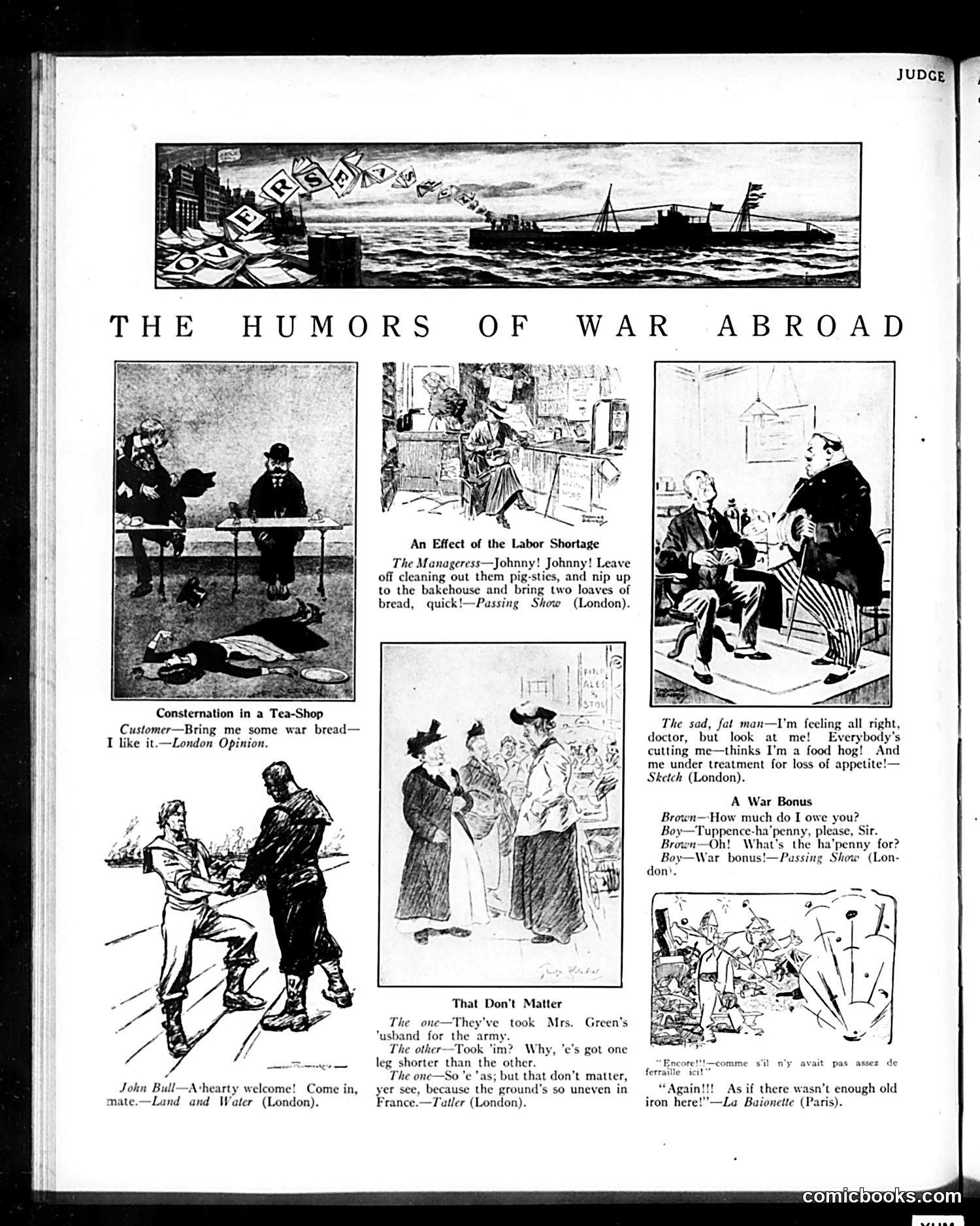
This Judge page collects wartime satirical cartoons from multiple British and allied publications, addressing WWI-era social disruptions: **Labor Shortage**: A farm manager orders a boy to abandon chores for bakery errands—reflecting severe worker depletion as men enlisted. **Tea-Shop Complaint**: A customer requests "war bread" (likely rationed or inferior quality), then a fat man worries he's seen as a food hog despite appetite loss—satire on rationing anxieties and food scarcity. **War Bonus**: A shopkeeper's "war bonus" tack-on of half-pence mocks inflation and profiteering disguised as patriotic surcharges. **Labor Displacement**: A woman's husband was conscripted despite having one leg shorter—gallows humor about how desperation drove even the disabled into service. **Iron Scrap**: French cartoon mocks British salvage efforts, sarcastically suggesting France has "enough old iron" already—likely referencing competing resource claims between allies. Overall: homefront complaints about shortages, inflation, conscription, and inter-allied tensions.
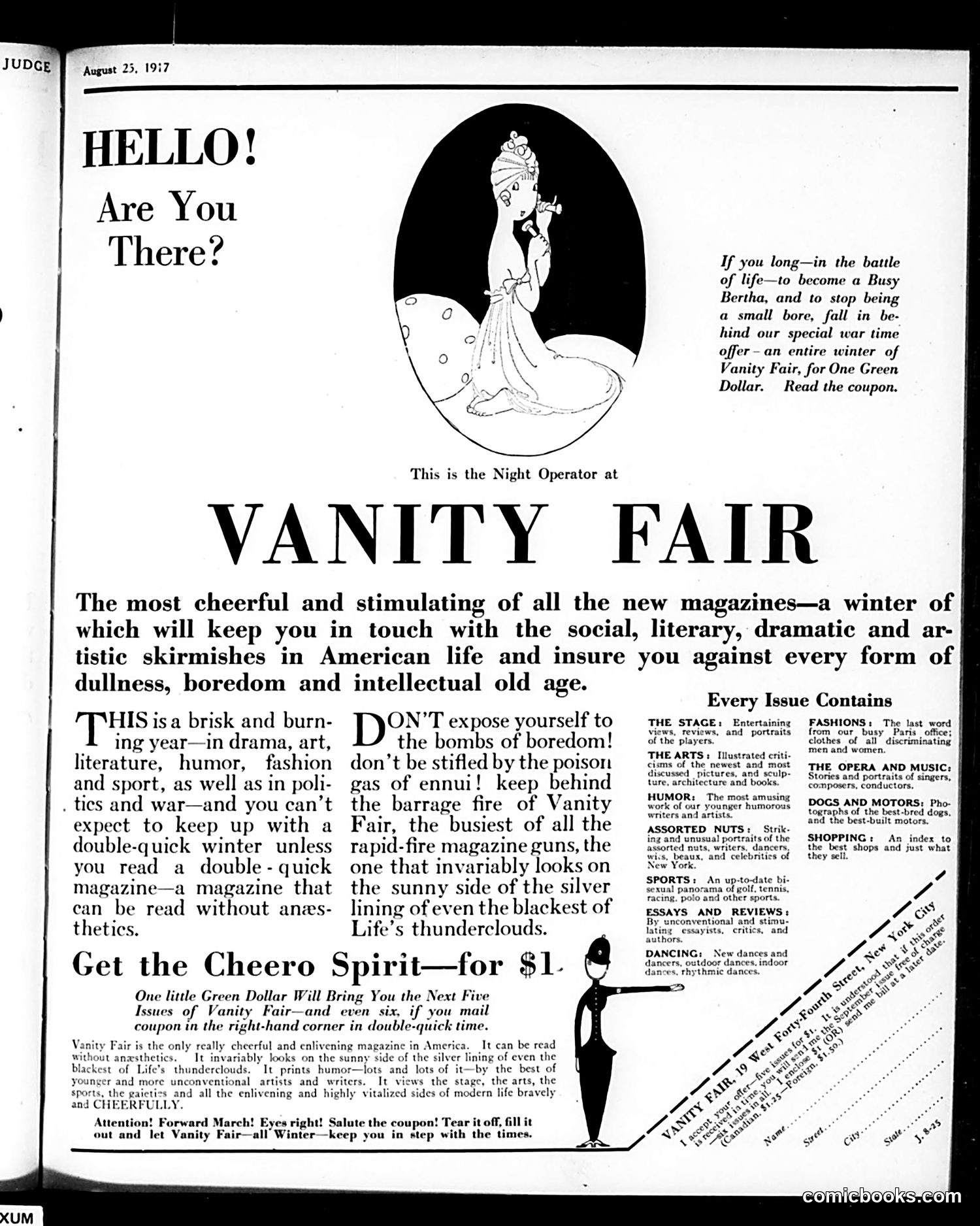
This is primarily a **Vanity Fair magazine advertisement**, not political satire. The illustration depicts an elegant woman ("the Night Operator") answering a telephone—a reference to telephone switchboard operators, a common female occupation of the era. The advertisement uses **World War I messaging** to sell subscriptions: phrases like "battle of life," "barrage fire," "bombs of boredom," and "poison gas of ennui" employ military vocabulary familiar to 1917 readers (America entered WWI in April 1917). The copy promises Vanity Fair will keep readers mentally sharp during wartime and prevent intellectual dullness. The satirical angle mocks "Busy Bertha" (a woman trying to be sophisticated and engaged) and warns against becoming "a small bore"—suggesting Vanity Fair readers would be culturally current and socially valuable. The "$1 Green Dollar" offer is a sales pitch using patriotic language. The joke: only stylish magazine readers would avoid being tedious during America's war year.
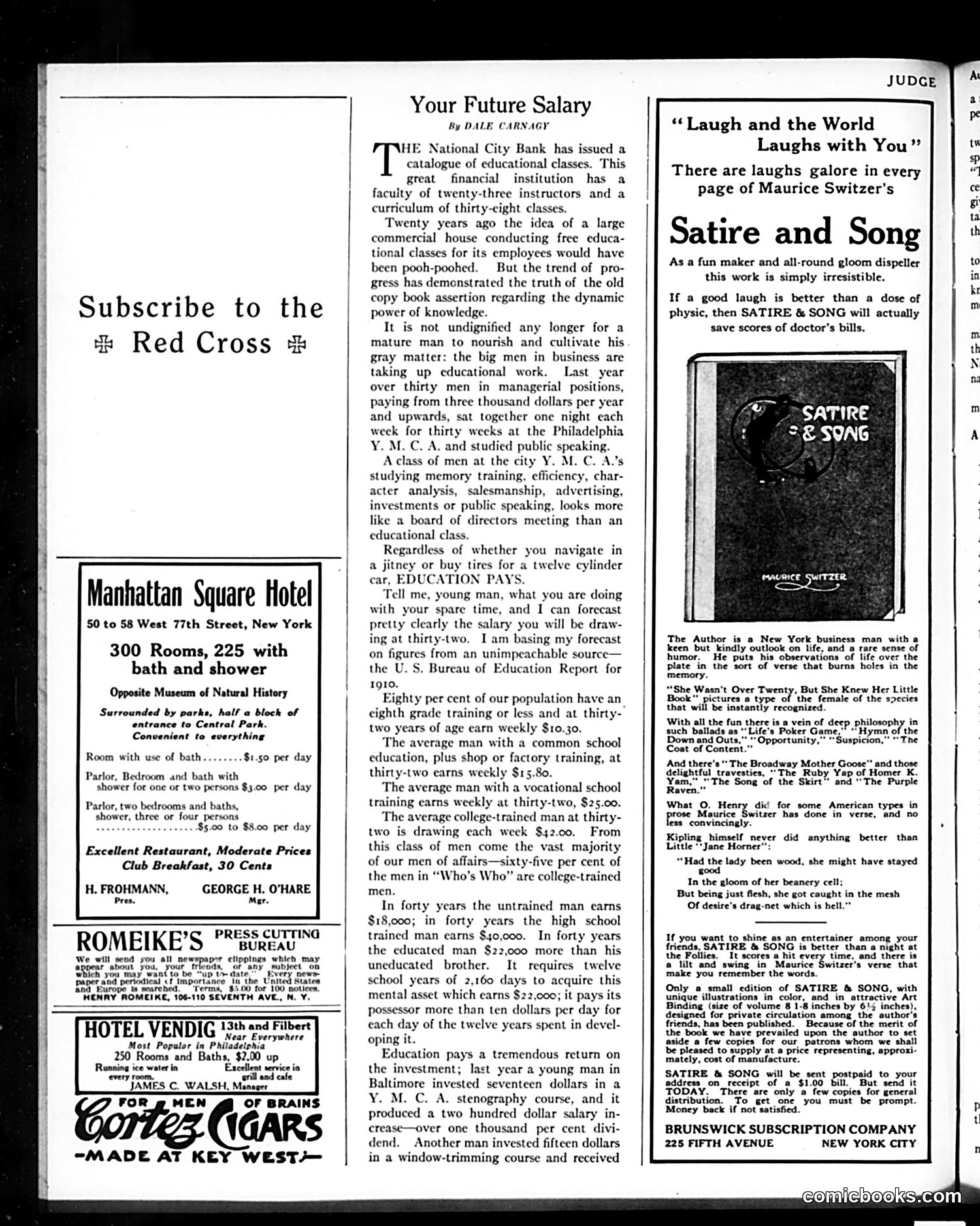
This is primarily an **advertisement/article hybrid**, not a cartoon. The piece argues that education directly increases earnings potential, using 1910 U.S. Bureau of Education statistics. **The argument's progression:** - Untrained workers at age 32 earn $10.30/week - High school-trained men earn $40,000 over 40 years - College-trained men earn $22,000 *more* than untrained workers - 65% of "Who's Who" entries are college-educated **The satire/point:** The article champions adult education through institutions like the National City Bank's classes and YMCAs, countering the old belief that mature men shouldn't pursue education. It's essentially early self-help literature promoting education as financial investment—a radical idea for 1910s America. The page also contains hotel and service advertisements typical of Judge magazine's revenue model.
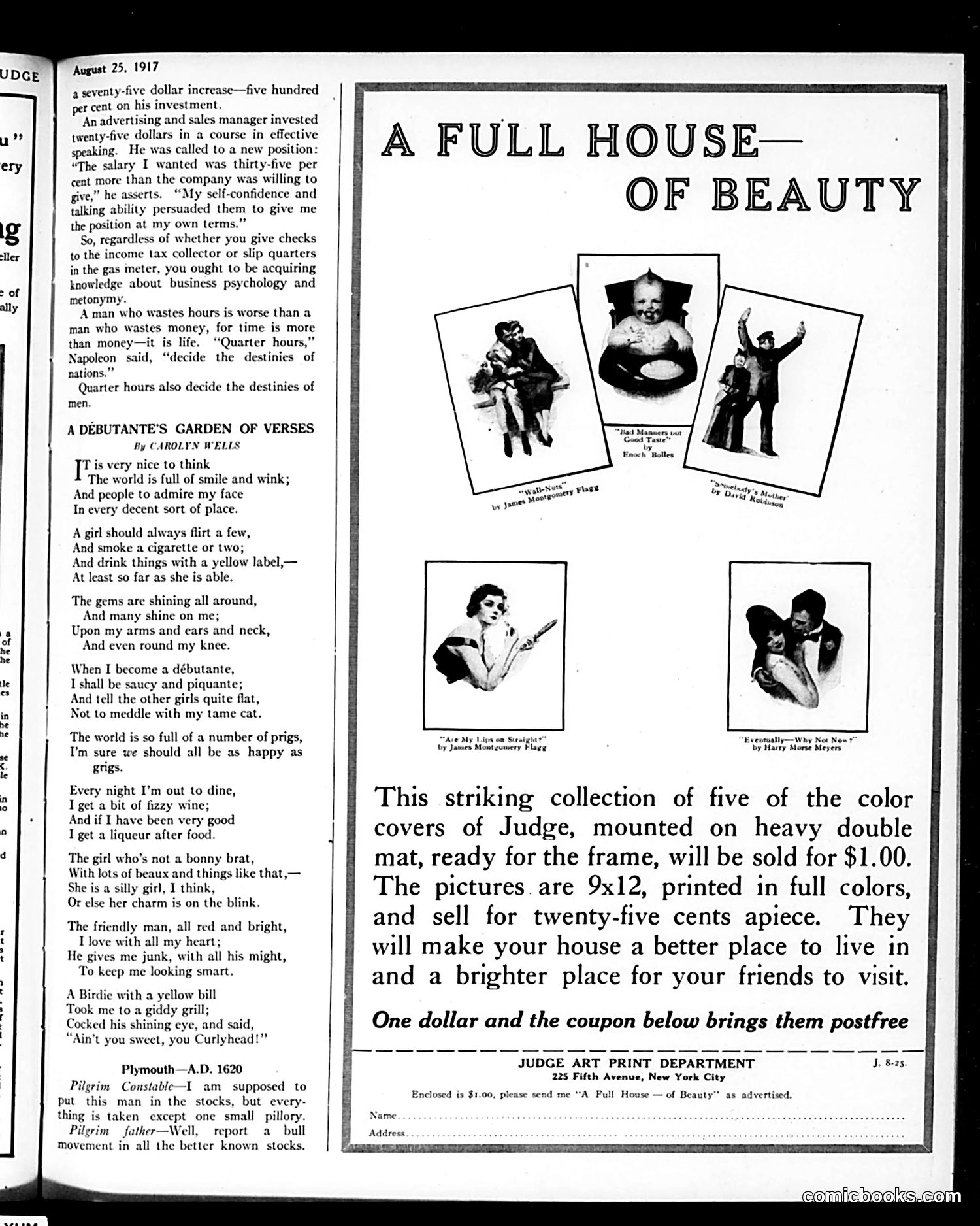
This page mixes editorial content with advertising. The left side features a business advice column praising self-confidence in negotiating salary, plus "A Debutante's Garden of Verses" by Carolyn Wells—satirical poetry mocking young upper-class women who smoke, drink alcohol ("yellow label" bottles), flirt excessively, and spend lavishly on jewels and socializing. The humor targets their frivolous behavior and moral laxity. A brief satirical note jokes about Pilgrims and stocks—likely a pun playing on both the pillory (punishment device) and financial stocks, typical of Judge's wordplay humor. The right side is primarily an **advertisement** for framed Judge magazine cover art prints (five color covers, $1.00 mounted or 25 cents individually). The covers feature illustrative artwork by artists like Enoch Bolles and James Montgomery Flagg, typical of Judge's cover style during this WWI-era period.
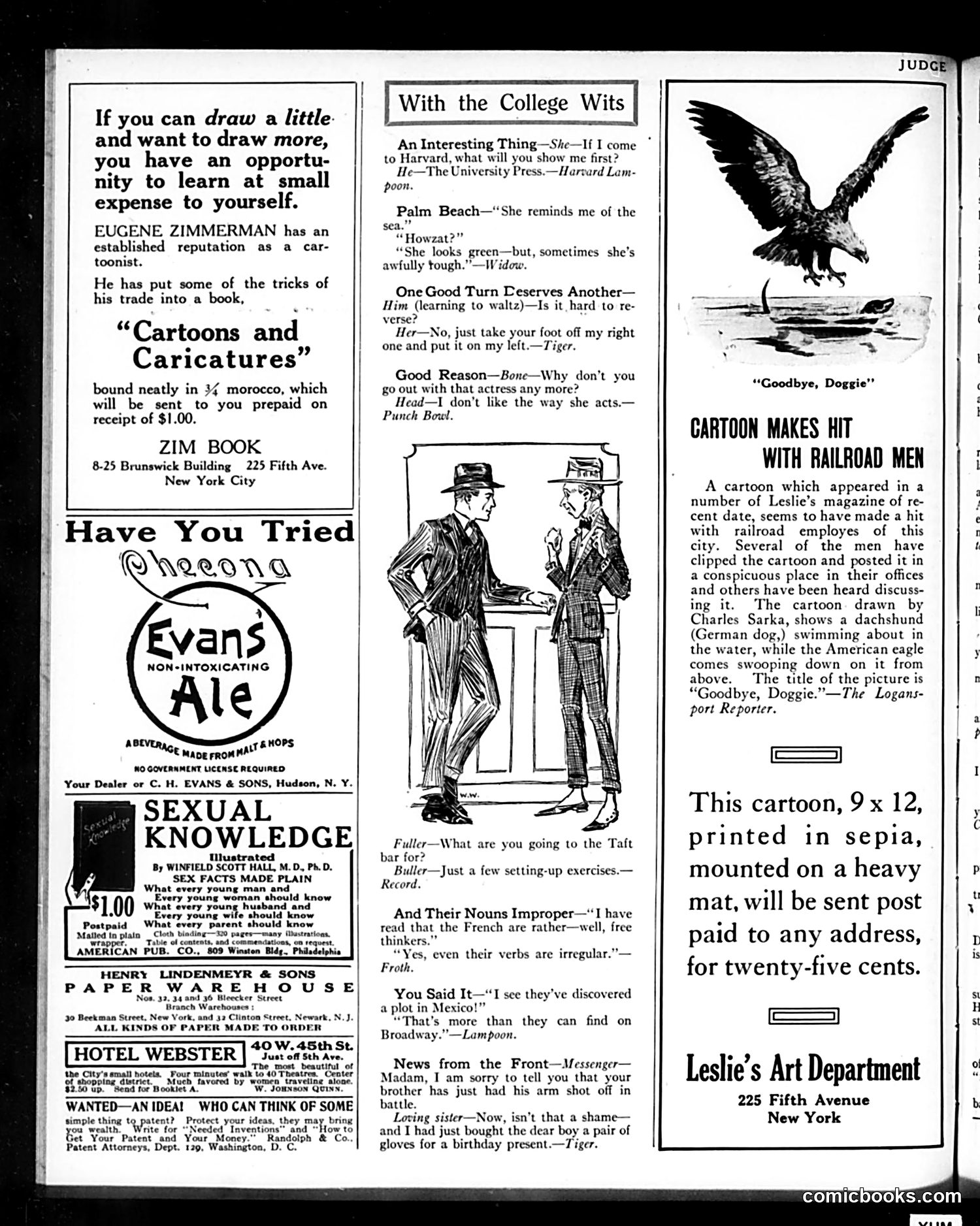
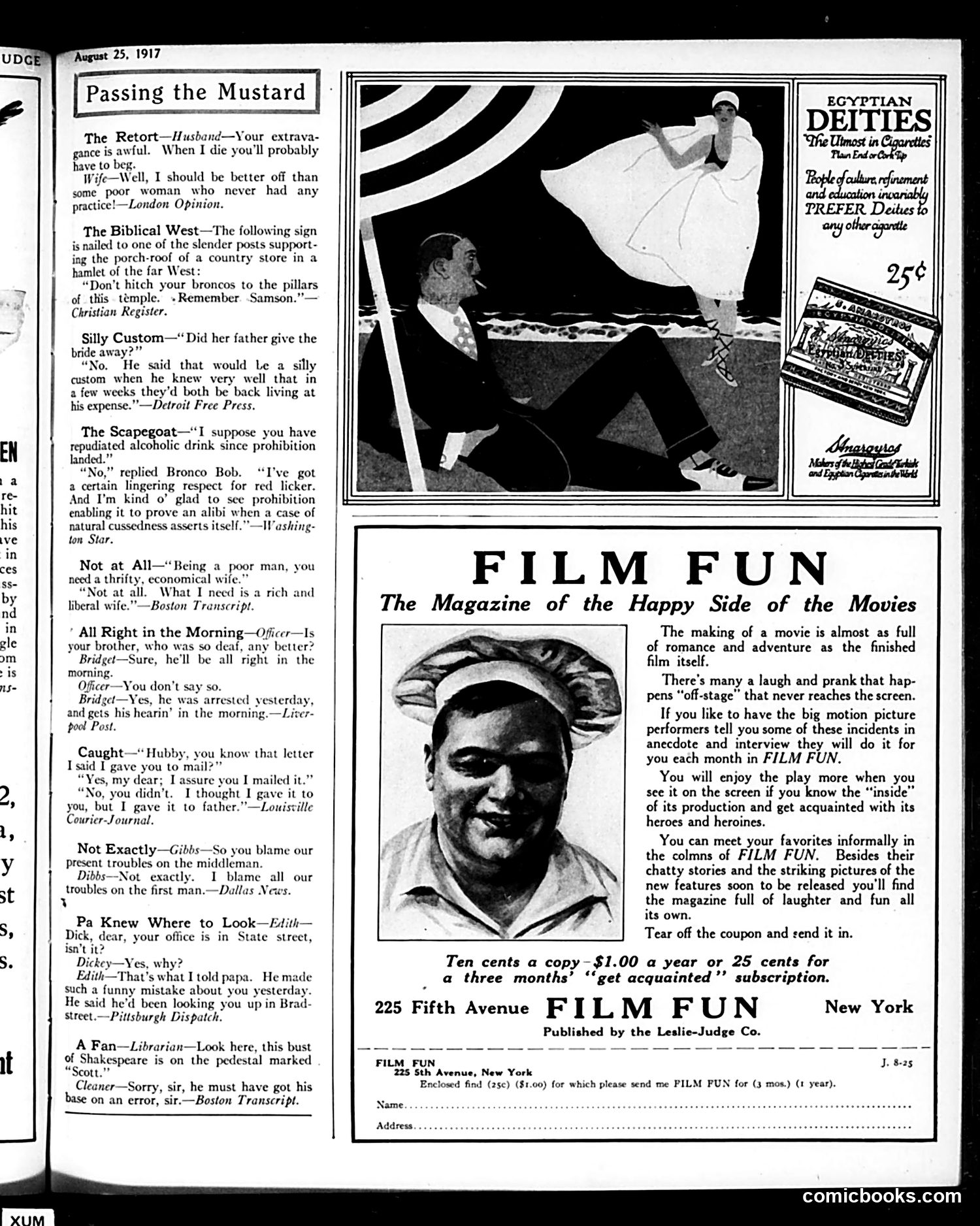
This page contains brief humorous anecdotes rather than political cartoons. The jokes rely on wordplay and domestic/social situations typical of early 20th-century American humor: The collection satirizes marriage dynamics ("Your extravagance is awful"), prohibition-era drinking culture ("I've got a certain lingering respect for red licker"), and class anxieties (poor men needing rich wives). One joke references the Biblical story of Samson, warning cowboys not to hitch horses to porch pillars. Another plays on deafness and court hearings. The page's main content is advertising for *Film Fun*, a companion magazine celebrating Hollywood's behind-the-scenes culture. This reflects 1917's growing movie industry and public fascination with film actors' private lives. The humor is genteel and accessible to Judge's middle-class readership, avoiding sharp political commentary in favor of relatable domestic comedy and contemporary cultural references.
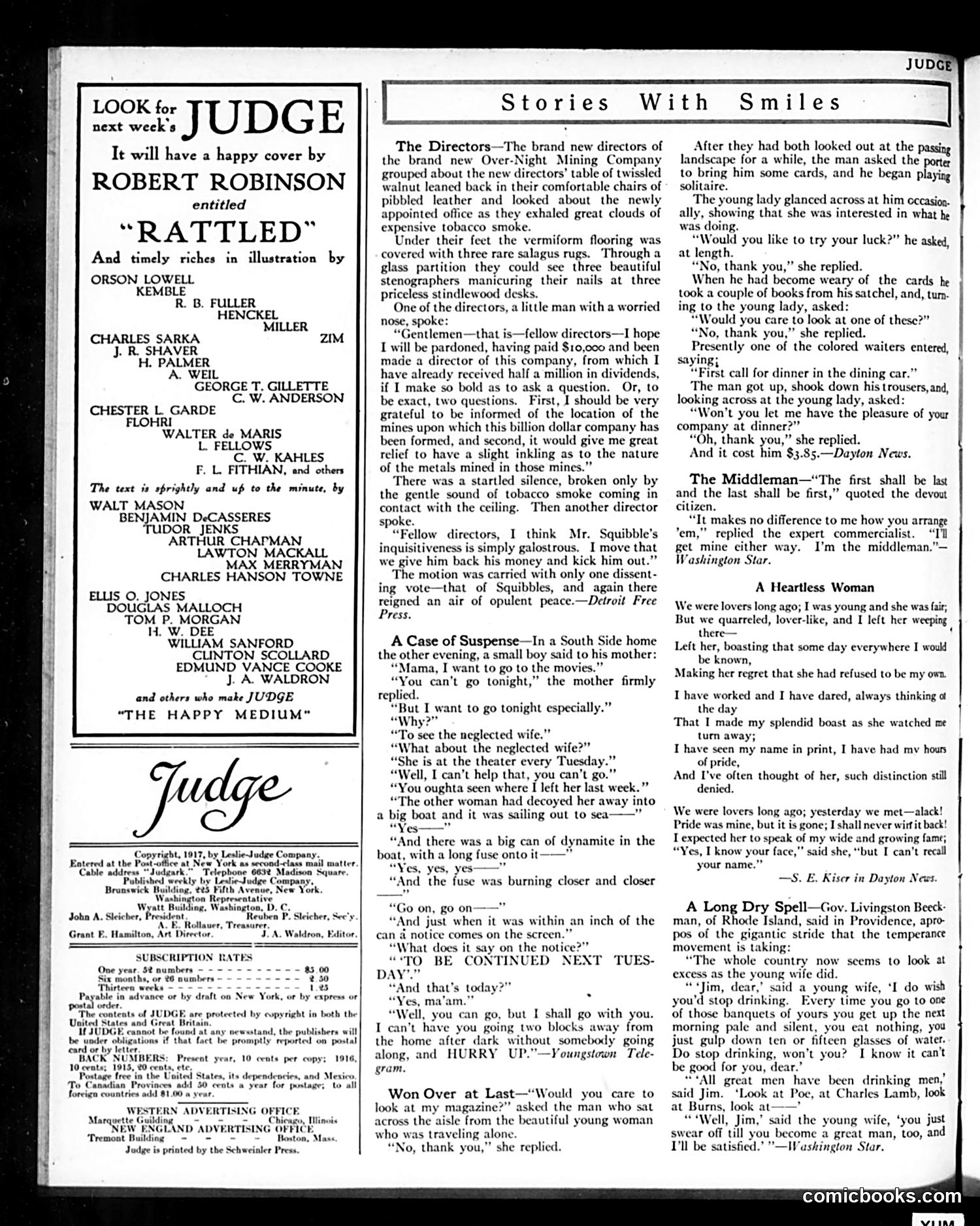
This is primarily a **promotional/masthead page** for Judge magazine, not a satirical cartoon page. The left side advertises next week's cover by Robert Robinson titled "RATTLED" and lists contributing artists and writers. The right side contains brief **humorous stories** rather than political satire: 1. **"The Directors"** mocks corporate fraud—new mining company directors sit in luxury while one naive investor questions where the actual mines are. They vote to expel him and return his money to maintain their profitable scheme. The satire targets financial corruption and shell companies. 2. **"A Case of Suspense"** is domestic humor about a boy wanting to see a movie featuring a "neglected wife" character (likely from a melodrama serial). The joke plays on the mother's misunderstanding. 3. Partial story fragments about romantic regrets and drinking appear below. The content reflects 1917 concerns: **corporate malfeasance** and popular **melodramatic cinema**. No specific political figures are caricatured; the satire is social/general rather than topical.
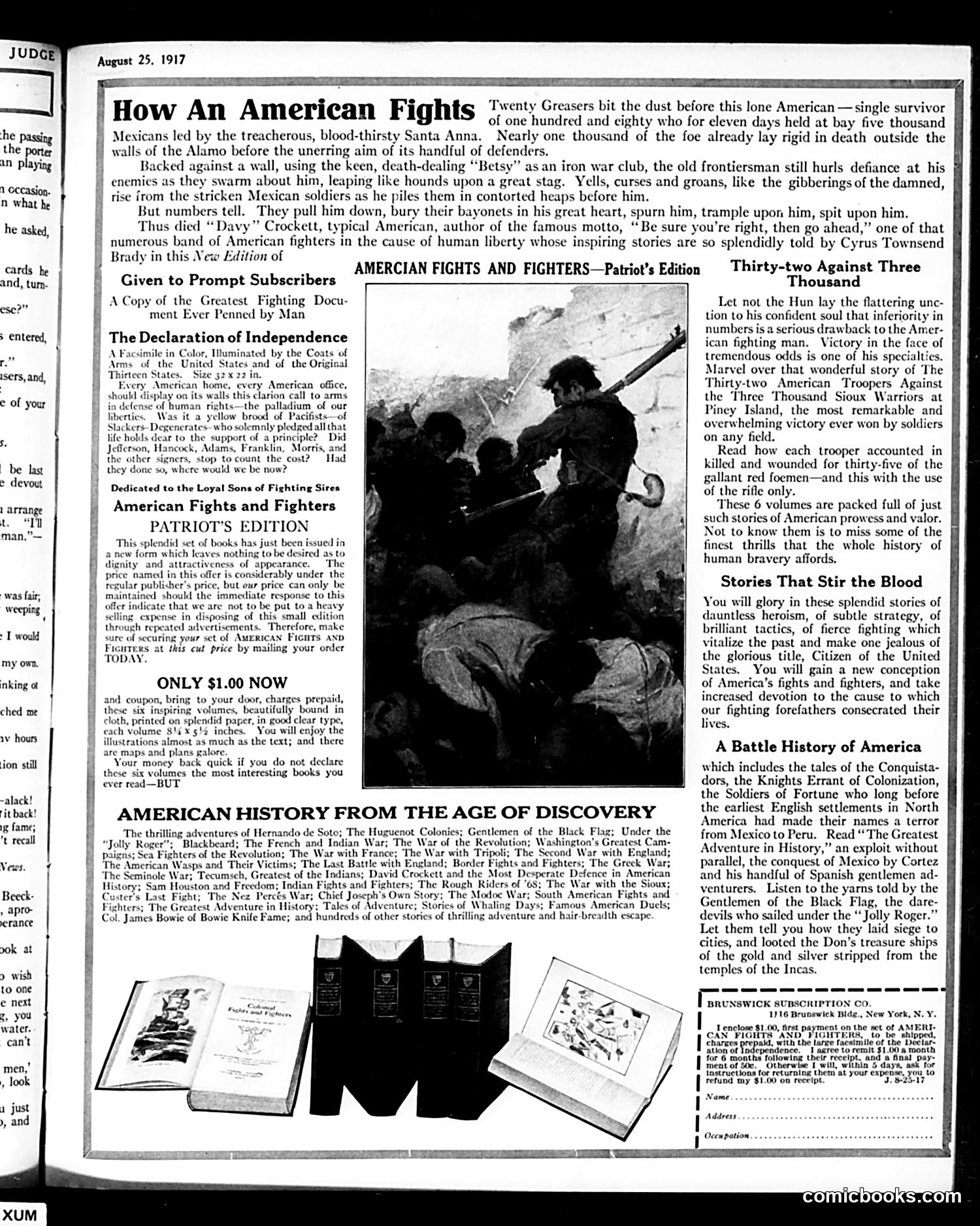
This page is primarily **advertising disguised as patriotic content**, not satire. It promotes a six-volume book series called "American Fights and Fighters" by selling romanticized frontier and military narratives. The main image depicts the **Battle of the Alamo**, showing a lone American defender (implied to be Davy Crockett) fighting Mexican soldiers. The accompanying text uses inflammatory language, calling the enemy "treacherous, blood-thirsty," and dehumanizingly refers to them as "greasers"—a racial slur for Mexicans. **Historical context**: Published in August 1917, this appeared after America's entry into World War I (April 1917). The advertisement exploits patriotic fervor by conflating past conflicts with current military needs, framing American fighters as inherently superior and heroic. The racial animus toward Mexicans here reflects contemporary American attitudes, though it's presented as straightforward historical narrative rather than explicit political commentary. The offer ($1.00 for six volumes) targets working-class patriotic sentiment during wartime.

This page appears to be a simple advertisement or public service announcement rather than a satirical cartoon. It contains only text in a bordered box reading "Subscribe to the Red Cross," with no visible illustrations, caricatures, or satirical commentary. Given that this appears in *Judge*, a satirical magazine, the placement may be ironic—possibly suggesting that even a serious charitable cause like Red Cross subscription deserves prominent promotion, or perhaps implying social commentary about American philanthropy. However, without additional context, images, or editorial framing visible on this page, the specific satirical intent cannot be determined from what's shown here. The page functions as a straightforward call to charitable action rather than political satire.