
Judge, 1917-08-25 · page 12 of 28
Judge — August 25, 1917 — page 12: what you’re looking at
What you’re looking at
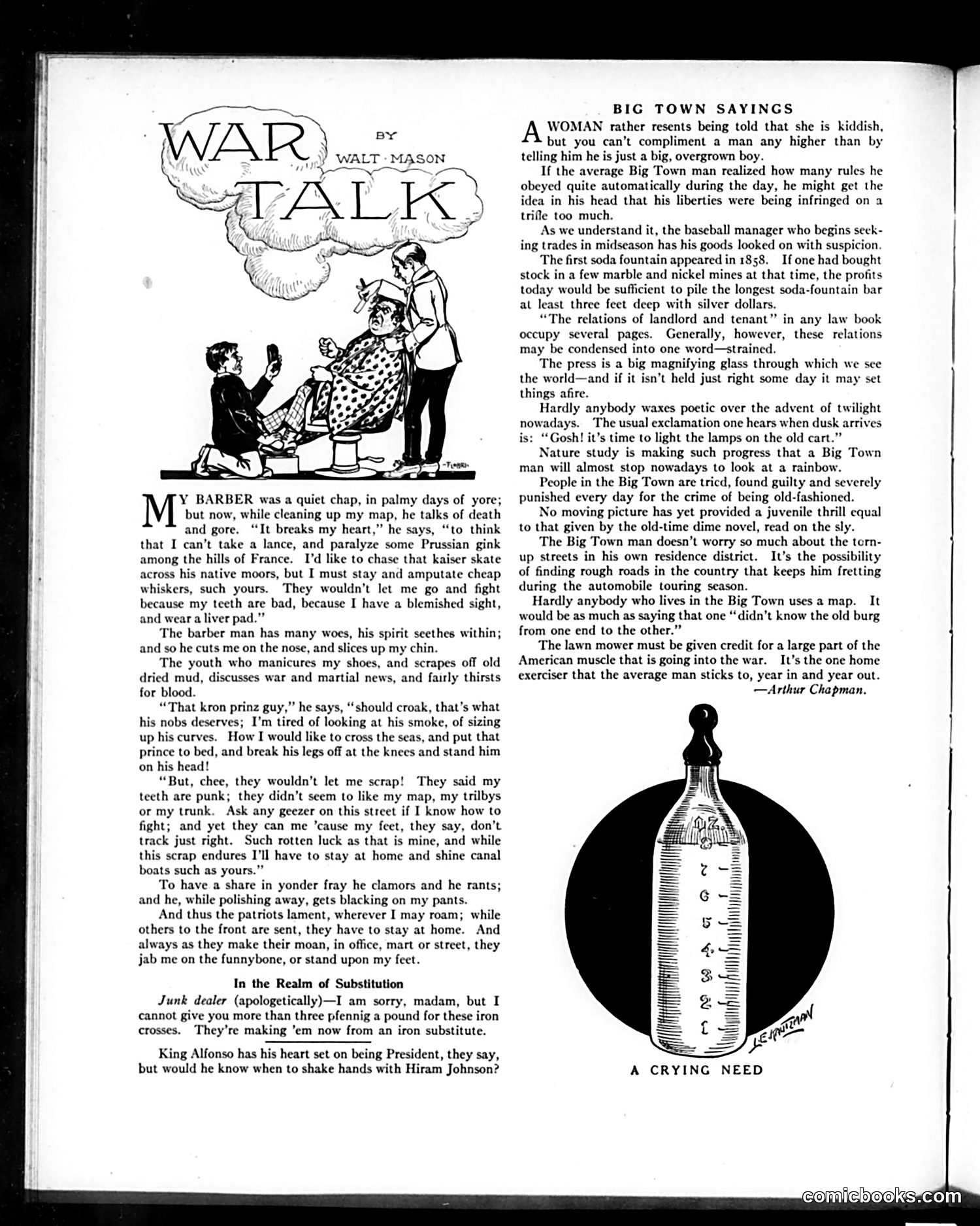
**Main Article ("War Talk" by Walt Mason):** This satirical piece mocks men on the home front during WWI who desperately want to fight but are rejected for minor physical flaws. A barber complains he's unfit due to bad teeth and poor eyesight, while a shoeshine boy with "punk" teeth and odd feet rails against the unfairness. Both men vent their frustration by literally harming the narrator (cutting him, stepping on his feet) while lamenting they must stay home. Mason's satire critiques their self-pitying patriotism and ironic violence toward civilians, suggesting their wartime frustration makes them unbearable to be around. **"In the Realm of Substitution" (brief joke):** A junk dealer apologizes for low payment on iron crosses, explaining they're now mass-produced from cheap iron substitutes—mocking Germany's mass militarization and devaluation of military honors. **Illustrations:** The barrel-shaped figure with the barber/shoeshine imagery and the baby bottle titled "A Crying Need" complement themes of complaint and unmet desires during wartime.
📄 Transcribed text from this page (OCR, searchable)
Machine-transcribed from the original scan — historical spelling and the odd misread are preserved.
CARTE WAR ) 7 W ‘ ; ) WALT -MASON but now, while cleaning up my map, he talks of death and gore. “It breaks my heart,” he says, “to think that I can’t take a lance, and paralyze some Prussian gink among the hills of France. I'd like to chase that kaiser skate across his native moors, but I must stay and amputate cheap whiskers, such yours. They wouldn’t let me go and fight because my teeth are bad, because I have a blemished sight, and wear a liver pad.” The barber man has many woes, his spirit seethes within; and so he cuts me on the nose, and slices up my chin. The youth who manicures my shoes, and scrapes off old dried mud, discusses war and martial news, and fairly thirsts for blood. “That kron prinz guy,” he says, “should croak, that’s what his nobs deserves; I’m tired of looking at his smoke, of sizing up his curves. How I would like to cross the seas, and put that prince to bed, and break his legs off at the knees and stand him on his head! “But, chee, they wouldn’t let me scrap! They said my teeth are punk; they didn’t seem to like my map, my trilbys or my trunk. Ask any geezer on this street if I know how to fight; and yet they can me ’cause my feet, they say, don’t track just right. Such rotten luck as that is mine, and while this scrap endures I'll have to stay at home and shine canal boats such as yout To have a share in yonder fray he clamors and he rants; and he, while polishing away, gets blacking on my pants. And thus the patriots lament, wherever I may roam; while others to the front are sent, they have to stay at home. And always as they make their moan, in office, mart or street, they jab me on the funnybone, or stand upon my feet. In the Realm of Substitution Junk dealer (apologetically)—I am sorry, madam, but I cannot give you more than three pfennig a pound for these iron crosses. They're making ’em now from an iron substitute. M* BARBER was a quiet chap, in palmy days of yore; King Alfonso has his heart set on being President, they say, but would he know when to shake hands with Hiram Johnson? BIG TOWN SAYINGS WOMAN rather resents being told that she is kiddish, but you can’t compliment a man any higher than by telling him he is just a big, overgrown boy. If the average Big Town man realized how many rules he obeyed quite automatically during the day, he might get the idea in his head that his liberties were being infringed on a trifle too much. As we understand it, the baseball manager who begins seck- ing trades in midseason has his goods looked on with suspicion The first soda fountain appeared in 1858. If one had bought stock in a few marble and nickel mines at that time, the profits today would be sufficient to pile the longest soda-fountain bar at least three feet deep with silver dollars. “The relations of landlord and tenant” in any law book occupy several pages. Generally, however, these relations may be condensed into one word—strained. The press is a big magnifying glass through which we see the world—and if it isn’t held just right some day it may set things afire. Hardly anybody waxes poetic over the advent of twilight nowadays. The usual exclamation one hears when dusk arrives is: osh! it’s time to light the lamps on the old cart.” Nature study is making such progress that a Big Town man will almost stop nowadays to look at a rainbow. People in the Big Town are tricd, found guilty and severely punished every day for the crime of being old-fashioned. No moving picture has yet provided a juvenile thrill equal to that given by the old-time dime novel, read on the sly. The Big Town man doesn’t worry so much about the torn- up streets in his own residence district. It’s the possibility of finding rough roads in the country that keeps him fretting during the automobile touring season. Hardly anybody who lives in the Big Town uses a map. It would be as much as saying that one “didn’t know the old burg from one end to the other.” The lawn mower must be given credit for a large part of the American muscle that is going into the war. It’s the one home exerciser that the average man sticks to, year in and year out. —Arthur Chapman. Pye A CRYING NEED