
Judge, 1917-08-25 · page 16 of 28
Judge — August 25, 1917 — page 16: what you’re looking at
What you’re looking at
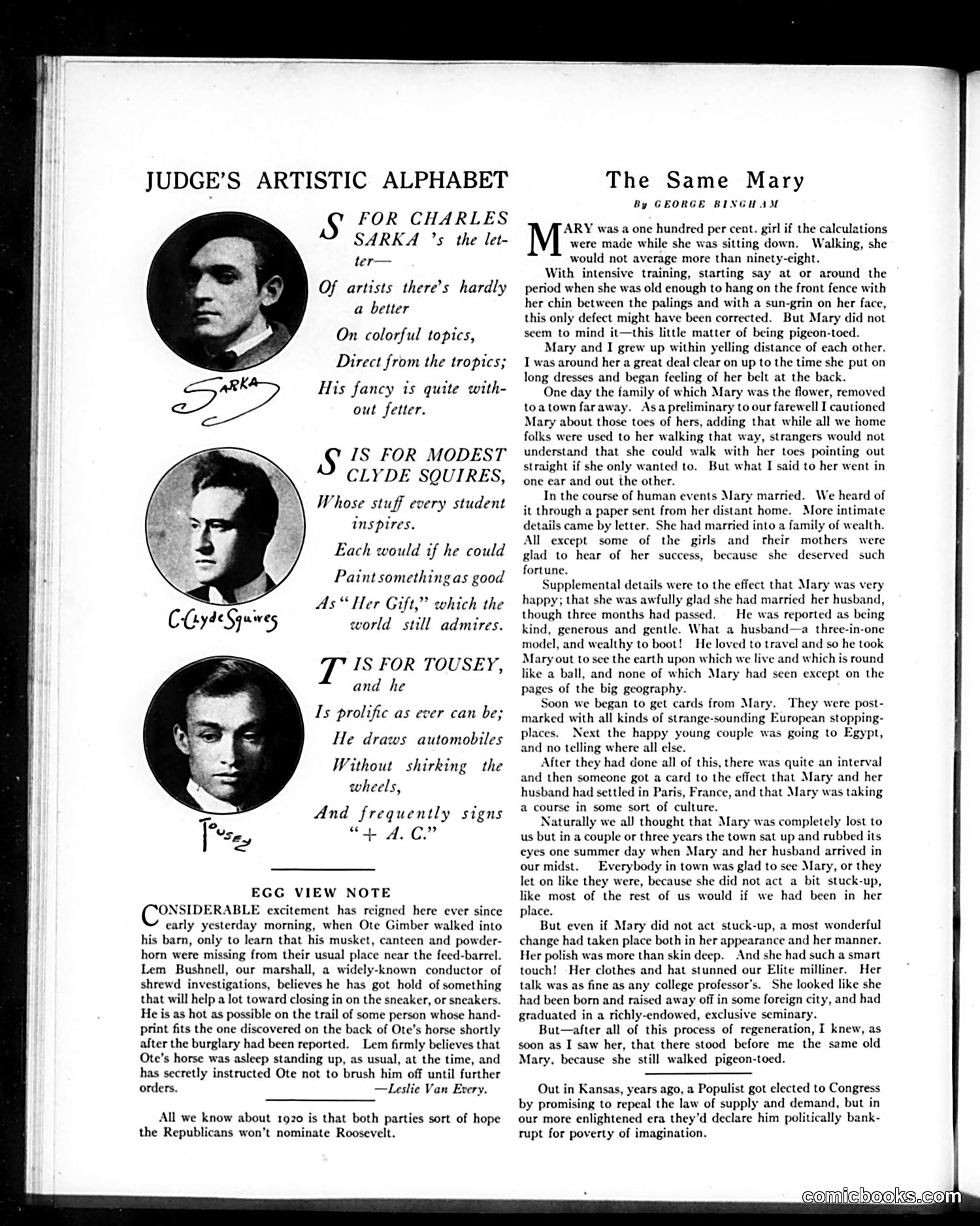
This page contains two unrelated features: **Left side: "Judge's Artistic Alphabet"** — A promotional feature showcasing three cartoonists through illustrated letters. It profiles Charles Sarka (S), Clyde Squires (S), and Tousey (T), praising their artistic skills. Tousey's notation "±4.C" appears to be his signature mark. **Right side: "The Same Mary" by George Bingham** — A nostalgic short story about a childhood friend named Mary who was pigeon-toed but didn't care what others thought. She marries a wealthy, kind man and they travel extensively. The narrative describes her life trajectory from a small-town girl to an international traveler. **Bottom: "Egg View Note"** — A humorous rural mystery sketch about a barn burglary investigation, using folksy characters and dry wit typical of early 20th-century American humor. **Bottom caption** — A quip about 1920 politics, suggesting both Republican and Democratic parties hope to avoid nominating Roosevelt for president.
📄 Transcribed text from this page (OCR, searchable)
Machine-transcribed from the original scan — historical spelling and the odd misread are preserved.
JUDGE’S ARTISTIC ALPHABET FOR CHARLES SARKA ’s the let- ter— Of artists there’s hardly a better On colorful topics, Direct from the tropics; His fancy is quite with- out fetter. IS FOR MODEST CLYDE SQUIRES, Whose stuff every student inspires. Each would if he could Paintsomethingas good As“ Her Gift,” which the world still admires. IS FOR TOUSEY, and he Is prolific as ever can be; He draws automobiles Without shirking the wheels, And frequently signs “+ 4.C” EGG VIEW NOTE ‘ONSIDERABLE excitement has reigned here ever since early yesterday morning, when Ote Gimber walked into his barn, only to learn that his musket, canteen and powder- horn were missing from their usual place near the feed-barrel. Lem Bushnell, our marshall, a widely-known conductor of shrewd investigations, believes he has got hold of something that will help a lot toward closing in on the sneaker, or sneakers. He is as hot as possible on the trail of some person whose hand- print fits the one discovered on the back of Ote’s horse shortly after the burglary had been reported. Lem firmly believes that Ote’s horse was asleep standing up, as usual, at the time, and has secretly instructed Ote not to brush him off until further orders. —Leslie Van Every. All we know about 1920 is that both parties sort of hope the Republicans won't nominate Roosevelt. The Same Mary By GEORGE BINGHAM ARY was a one hundred per cent. girl if the calculations M were made while she was sitting down. Walking, she would not average more than ninety-cight. With intensive training, starting say at or around the period when she was old enough to hang on the front fence with her chin between the palings and with a sun-grin on her face, this only defect might have been corrected. But Mary did not seem to mind it—this little matter of being pigeon-toed. Mary and I grew up within yelling distance of each other. I was around her a great deal clear on up to the time she put on long dresses and began feeling of her belt at the back. One day the family of which Mary was the flower, removed toatown faraway. Asa preliminary to our farewell I cautioned Mary about those toes of hers, adding that while all we home folks were used to her walking that way, strangers would not understand that she could walk with her toes pointing out straight if she only wanted to. But what I said to her went in one ear and out the other. In the course of human events Mary married. We heard of it through a paper sent from her distant home. More intimate details came by letter. She had married into a family of wealth. All except some of the girls and their mothers were glad to hear of her success, because she deserved such fortune. Supplemental details were to the effect that Mary was very happy; that she was awfully glad she had married her husband, though three months had passed. He was reported as being kind, generous and gentle. What a husband—a three-in-one model, and wealthy to boot! He loved to travel and so he took Mary out to see the earth upon which we live and which is round like a ball, and none of which Mary had seen except on the pages of the big geography. Soon we began to get cards from Mary. They were post- marked with all kinds of strange-sounding European stopping- places. Next the happy young couple was going to Egypt, and no telling where all else. After they had done all of this, there was quite an interval and then someone got a card to the effect that Mary and her husband had settled in Paris, France, and that Mary was taking a course in some sort of culture. Naturally we al) thought that Mary was completely lost to us but in a couple or three years the town sat up and rubbed its eyes one summer day when Mary and her husband arrived in our midst. | Everybody in town was glad to see Mary, or they let on like they were, because she did not act a bit stuck-up, like most of the rest of us would if we had been in her place. But even if Mary did not act stuck-up, a most wonderful change had taken place both in her appearance and her manner. Her polish was more than skin deep. And she had such a smart touch! Her clothes and hat stunned our Elite milliner. Her talk was as fine as any college professor's. She looked like she had been born and raised away off in some foreign city, and had graduated in a richly-endowed, exclusive seminary. But—after all of this process of regeneration, I knew, as soon as I saw her, that there stood before me the same old Mary, because she still walked pigeon-toed. Out in Kansas, years ago, a Populist got elected to Congress by promising to repeal the law of supply and demand, but in our more enlightened era they’d declare him politically bank- rupt for poverty of imagination.