
Judge, 1917-08-25 · page 9 of 28
Judge — August 25, 1917 — page 9: what you’re looking at
What you’re looking at
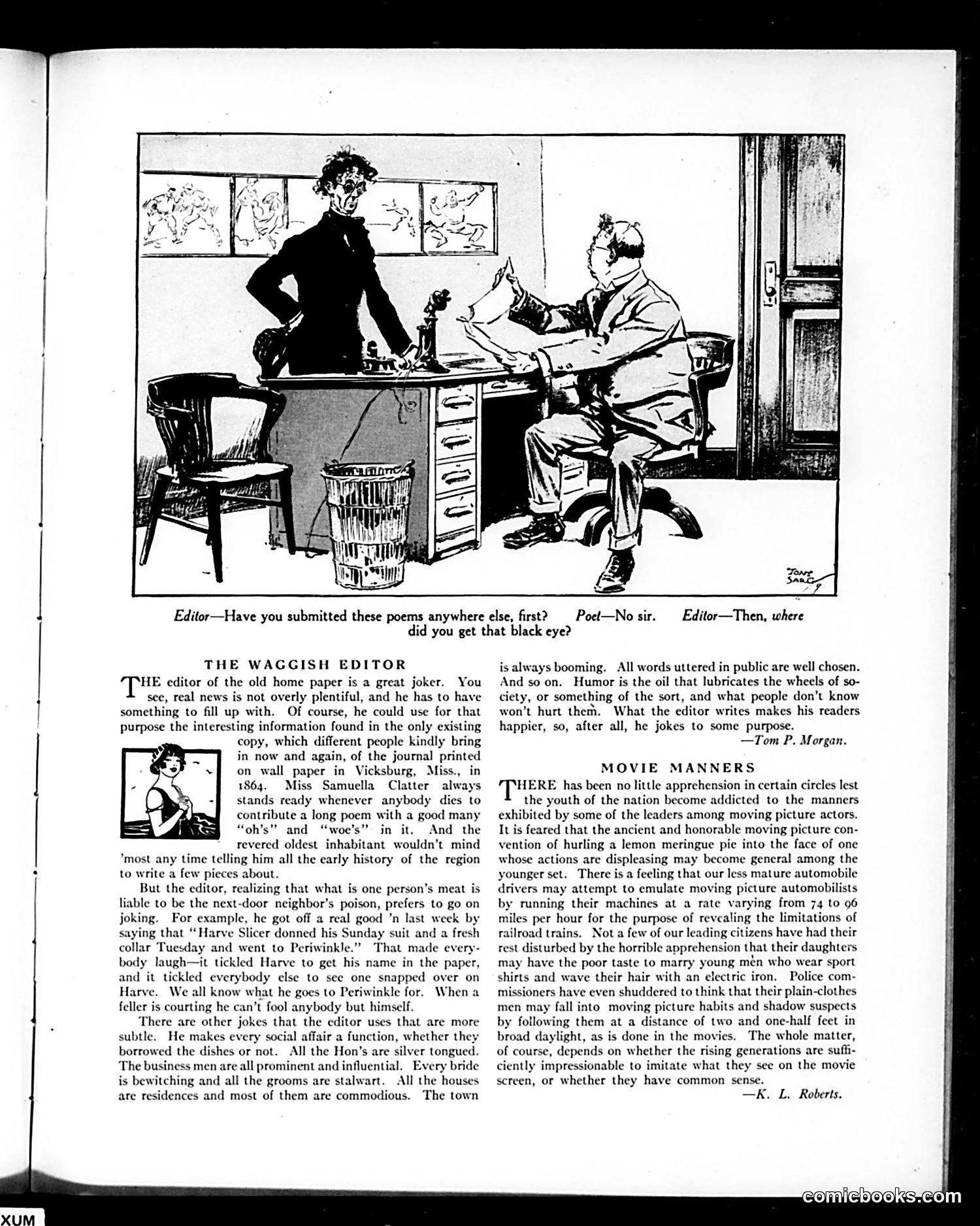
**The Cartoon:** A small-town newspaper editor interviews a poet submitting work. The poet has a black eye; the editor jokes "Then, where did you get that black eye?"—implying the poet's rejection was so harsh he got beaten up. **The Main Article ("The Waggish Editor"):** This celebrates small-town newspaper editors who use humor to fill pages when real news is scarce. The editor makes gentle jokes about locals (like mentioning "Harve Slicer" going to Periwinkle to court), which tickles everyone because they recognize themselves. The article argues this humor serves a social purpose—it makes readers happy and keeps the town spirit up. **"Movie Manners":** This satirizes contemporary anxiety (1920s-era) that young people were imitating Hollywood actors' reckless behavior—reckless driving, slapstick violence, casual fashion—rather than using common sense. It's satirical hand-wringing about youth culture corrupted by movies. Both pieces reflect *Judge* magazine's satirical tone: poking fun at small-town life and modern anxieties while ultimately defending their value.
📄 Transcribed text from this page (OCR, searchable)
Machine-transcribed from the original scan — historical spelling and the odd misread are preserved.
Editor—Have you submitted these poems anywhere else, first? did you get that black eye? THE WAGGISH EDITOR TH editor of the old home paper is a great joker. You see, real news is not overly plentiful, and he has to have something to fill up with. Of course, he could use for that purpose the interesting information found in the only existing copy, which different people kindly bring in now and again, of the journal printed on wall paper in Vicksburg, Miss., in 1864. Miss Samuella Clatter always stands ready whenever anybody dies to contribute a long poem with a good many “oh’s” and “woe’s” in it. And the revered oldest inhabitant wouldn’t mind ’most any time telling him all the early history of the region to write a few pieces about. But the editor, realizing that what is one person’s meat is liable to be the next-door neighbor’s poison, prefers to go on joking. For example, he got off a real good 'n last week by saying that “Harve Slicer donned his Sunday suit and a fresh collar Tuesday and went to Periwinkle.” That made every- body laugh—it tickled Harve to get his name in the paper, and it tickled everybody else to see one snapped over on Harve. We all know what he goes to Periwinkle for. When a feller is courting he can’t fool anybody but himself. There are other jokes that the editor uses that are more subtle. He makes every social affair a function, whether they borrowed the dishes or not. All the Hon’s are silver tongued. The business men are all prominent and influential. Every bride is bewitching and all the grooms are stalwart. All the houses are residences and most of them are commodious. The town Poet—No sir. Editor—Then, where is always booming. All words uttered in public are well chosen. And so on. Humor is the oil that lubricates the wheels of so- ciety, or something of the sort, and what people don’t know won't hurt them. What the editor writes makes his readers happier, so, after all, he jokes to some purpose. —Tom P. Morgan. MOVIE MANNERS THERE has been no little apprehension in certain circles lest the youth of the nation become addicted to the manners exhibited by some of the leaders among moving picture actors. It is feared that the ancient and honorable moving picture con- vention of hurling a lemon meringue pie into the face of one whose actions are displeasing may become gencral among the younger set. There is a feeling that our less mature automobile drivers may attempt to emulate moving picture automobilists by running their machines at a rate varying from 74 to 96 miles per hour for the purpose of revealing the limitations of railroad trains. Not a few of our leading citizens have had their rest disturbed by the horrible apprehension that their daughters have the poor taste to marry young mén who wear sport shirts and wave their hair with an electric iron. Police com- missioners have even shuddered to think that their plain-clothes men may fall into moving picture habits and shadow suspects by following them at a distance of two and one-half feet in broad daylight, as is done in the movies. The whole matter, of course, depends on whether the rising generations are suffi- ciently impressionable to imitate what they see on the movie screen, or whether they have common sense. —K. L. Roberts.