
Judge, 1917-08-25 · page 14 of 28
Judge — August 25, 1917 — page 14: what you’re looking at
What you’re looking at
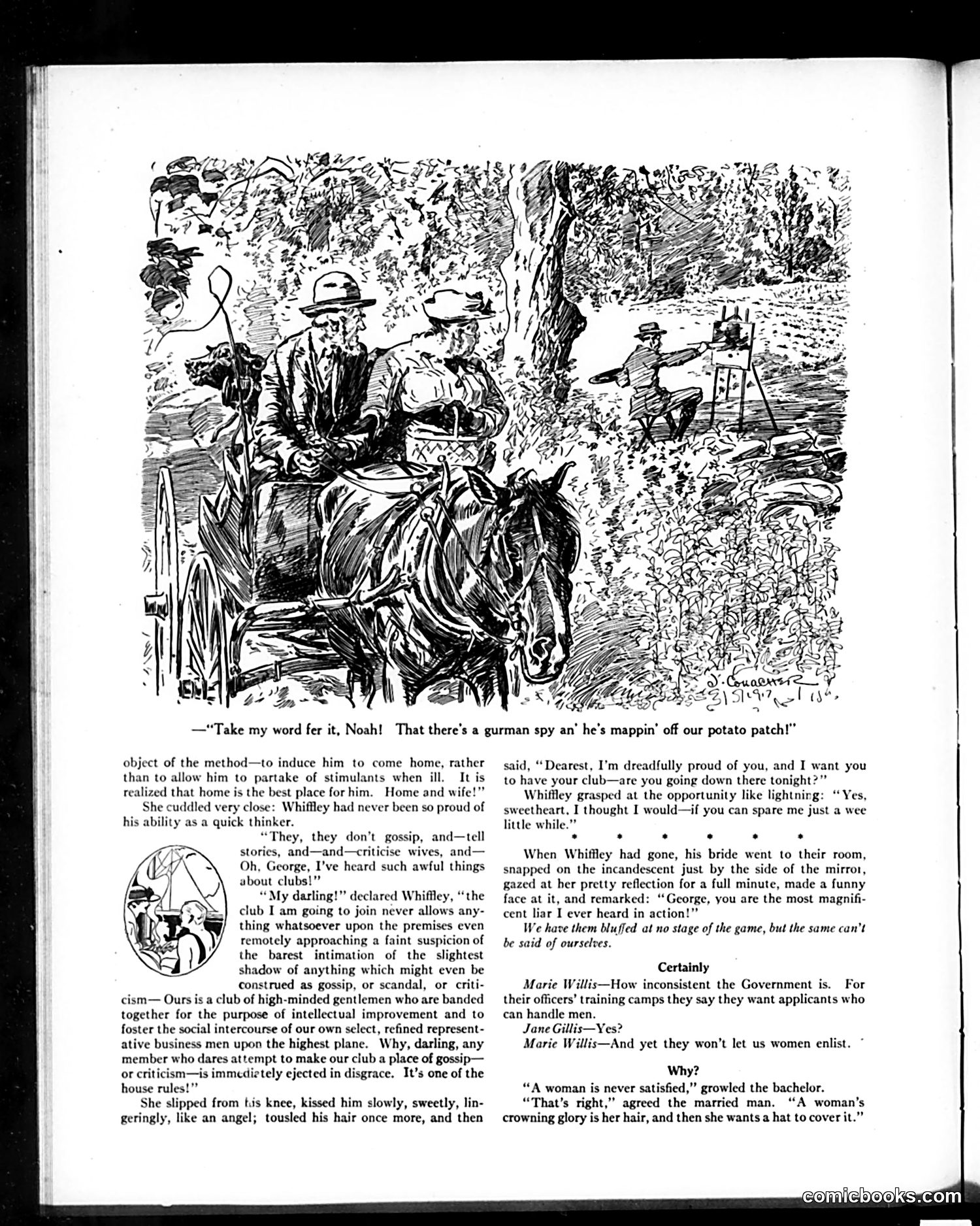
The top cartoon depicts rural figures discussing a man near a potato patch, with one claiming he's a "German spy" mapping their field. This reflects **WWI-era spy hysteria**—Americans' widespread fear of German espionage during the 1910s, often directed at innocent civilians or foreigners. The main text story concerns a man named Whiffley who lies to his wife about joining an exclusive gentlemen's club for "intellectual improvement," when he's actually going out socially. His new bride sees through his deception immediately, remarking he's "the most magnificent liar." **The satire targets**: masculine hypocrisy and the disconnect between men's stated intentions and actual behavior. The story mocks both Whiffley's transparent fabrication and the pretentious language men use to justify leisure activities. A sidebar dialogue satirizes **government inconsistency regarding women**: recruiting officers want men who can "handle men" yet won't allow women to enlist—highlighting the contradiction in excluding women from military service.
📄 Transcribed text from this page (OCR, searchable)
Machine-transcribed from the original scan — historical spelling and the odd misread are preserved.
7 go. >: < : Faye wi <s Gr —"Take my word fer it, Noah! That there's a gurman spy an’ he’s mappin’ off our potato patch!” object of the method—to induce him to come home, rather to allow him to partake of stimulants when ill. It is d that home is the best place for him. Home and wife!” She cuddled very close: Whiffley had never been so proud of his ability as a quick thinker. “They, they don’t gossi stories, and—and—criticise v Oh, George, I’ve heard such awful things about clubs!” “My darling!” declared Whiffley, “the club I am going to join never allows any- thing whatsoever upon the premises even remotely approaching a faint suspicion of the barest intimation of the slightest shadow of anything which might even be construed as gossip, or scandal, or criti- cism— Ours is a club of high-minded gentlemen who are banded together for the purpose of intellectual improvement and to foster the social intercourse of our own select, refined represent- ative business men upon the highest plane. Why, darling, any member who dares attempt to make our club a place of gossip— or criticism—is immedietely ejected in disgrace. It’s one of the house rules!” She slipped from tis knee, kissed him slowly, sweetly, lin- geringly, like an angel; tousled his hair once more, and then said, “Dearest, I’m dreadfully proud of you, and I want you to have your club—are you going down there tonight?” Whiffley grasped at the opportunity like lightning: “ Yes, sweetheart, I thought I would—if you can spare me just a wee little while.” . . . . . . When Whiffley had gone, his bride went to their room, snapped on the incandescent just by the side of the mirrot, gazed at her pretty reflection for a full minute, made a funny face at it, and remarked: “George, you are the most magnifi- cent liar I ever heard in action!” We have them bluffed at no stage of the game, but the same can't be said of ourselves. Certainly Marie Willis—How inconsistent the Government is. For their officers’ training camps they say they want applicants who can handle men. Jane Gillis—Yes? Marie Willis—And yet they won’t let us women enlist. ~ Why? “A woman is never satisfied,” growled the bachelor. “That’s right,” agreed the married man. ‘A woman’s crowning glory is her hair, and then she wants a hat to cover it.”