
A complete issue · 28 pages · 1917
Judge — April 14, 1917
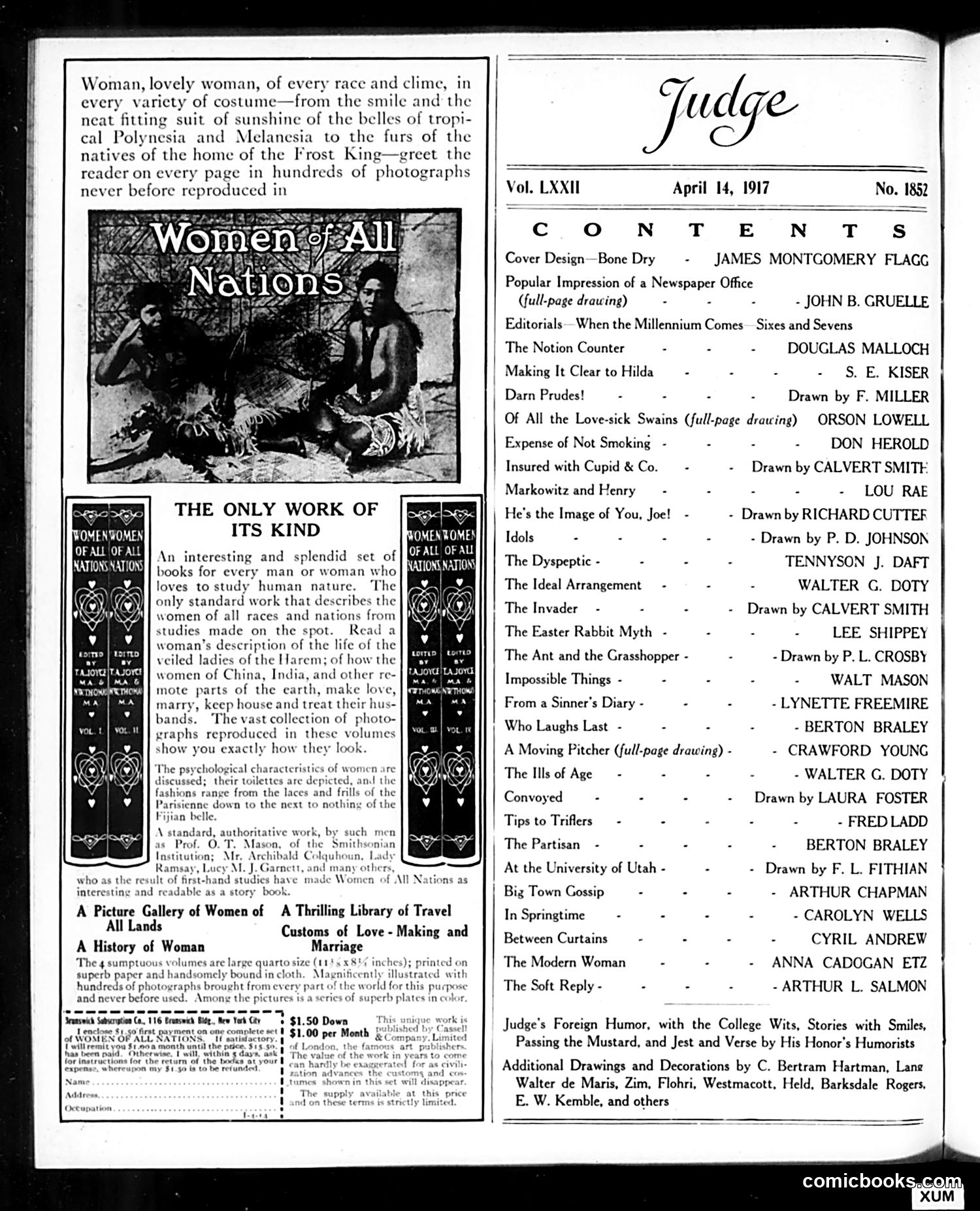
This page is primarily **advertising** for a book series titled *Women of All Nations*, promoting a multi-volume encyclopedic work featuring photographs of women from various cultures and dress. The ad emphasizes the book's comprehensiveness in documenting women's "physiological characteristics" and fashion across different regions—from tropical Polynesia to arctic regions. The framing reflects early 20th-century **ethnographic and anthropological interests**, common in this period, though presented through a lens that objectifies non-Western women by emphasizing visual documentation and "study of human nature." The magazine's contents page lists various satirical articles and cartoons, though specific political commentary isn't visible on this particular page.
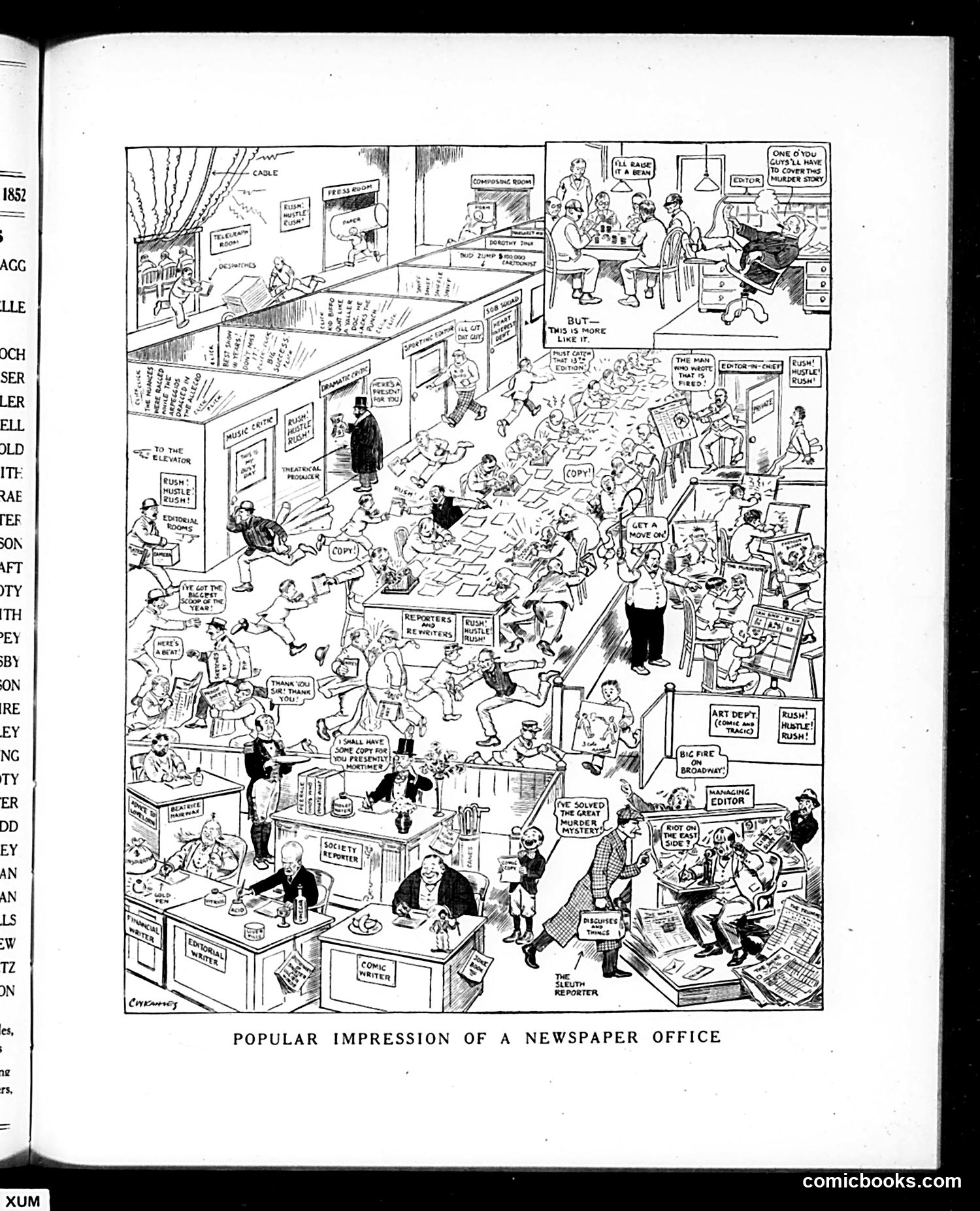
This satirical cartoon depicts a chaotic newspaper office as the public imagined it—far messier and more dramatic than reality. The scene shows dozens of workers in apparent pandemonium: people running, papers flying everywhere, staff shouting "Rush!" repeatedly, and general disorder. The humor lies in contrasting perception versus reality. Labels identify various departments (Art Department, Comic Writer, Society Reporter, etc.), suggesting the public believed newspapers operated in constant crisis mode with frantic deadlines and screaming editors. The caption and small upper panels showing an orderly, calm office suggest this chaotic scene represents popular *misconception*. The satire gently mocks both the public's exaggerated notions of newspaper life and perhaps the newspapers' own self-dramatizing culture around the romance of the press.
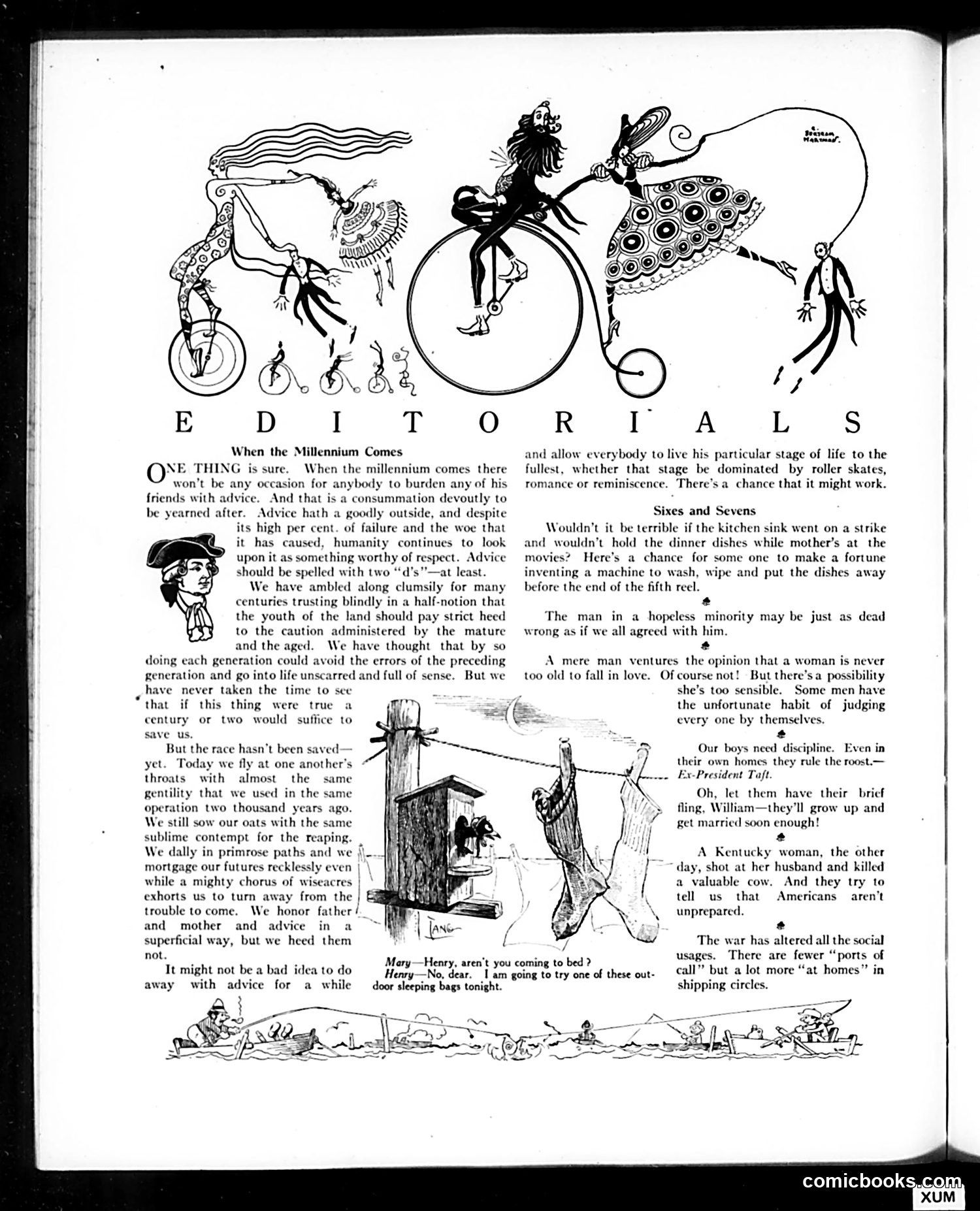
This satirical editorial page uses decorative header illustrations (figures on unicycles and wheels) to frame social commentary. The main text discusses generational conflict, arguing that older generations shouldn't burden youth with unsolicited advice. The author defends the younger generation against criticism, suggesting their apparent recklessness stems from living through turbulent times. The included illustrations and brief anecdotes mock contemporary social issues: women's independence (the "Sixes and Sevens" section about kitchen strikes), gender relations, and post-war social disruption. A cartoon showing laundry on a clothesline with dialogue about "outdoor sleeping bags" appears to satirize domestic discord, possibly related to marital conflicts or changing family structures during this period. The overall tone critiques older Americans' judgmental attitudes toward social change.
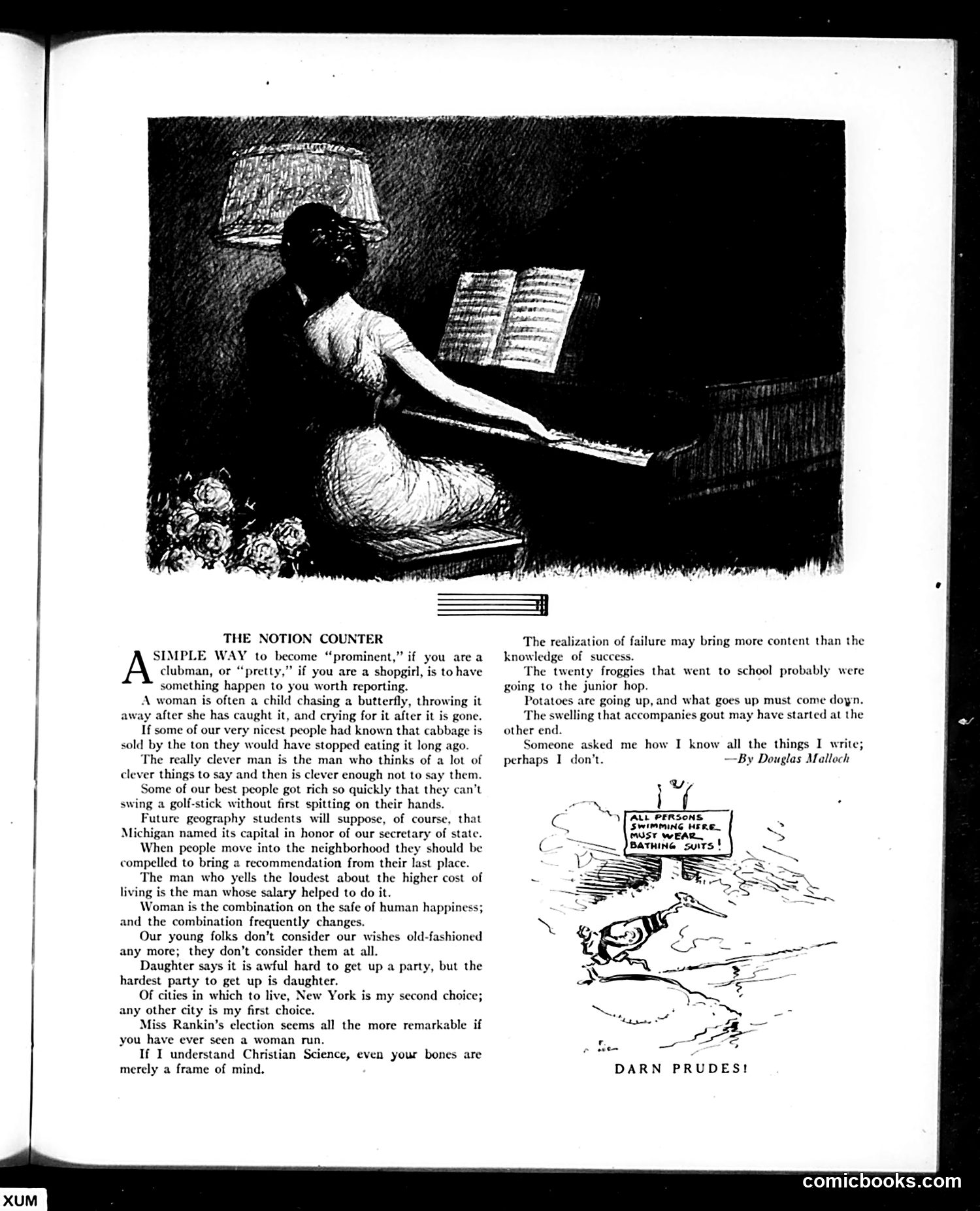
**Top Image: "The Notion Counter"** This illustration depicts a woman at a piano reading sheet music by lamplight, surrounded by flowers. The satirical essay critiques shallow social ambitions—how people become "prominent" through superficial means (gossip, shopping, reporting trivial news). The woman at the piano likely represents cultured refinement, contrasting with the essay's mockery of those who pursue status through empty social climbing. **Bottom Cartoon: "Darn Prudes!"** A figure at a beach expresses frustration about prudish bathing suit regulations ("All persons must wear regulation bathing suits!"). This satirizes early 20th-century strict dress codes for swimming, mocking both the rigid moral standards and those enforcing them. The cartoon suggests irritation with restrictive social conventions limiting personal freedom.
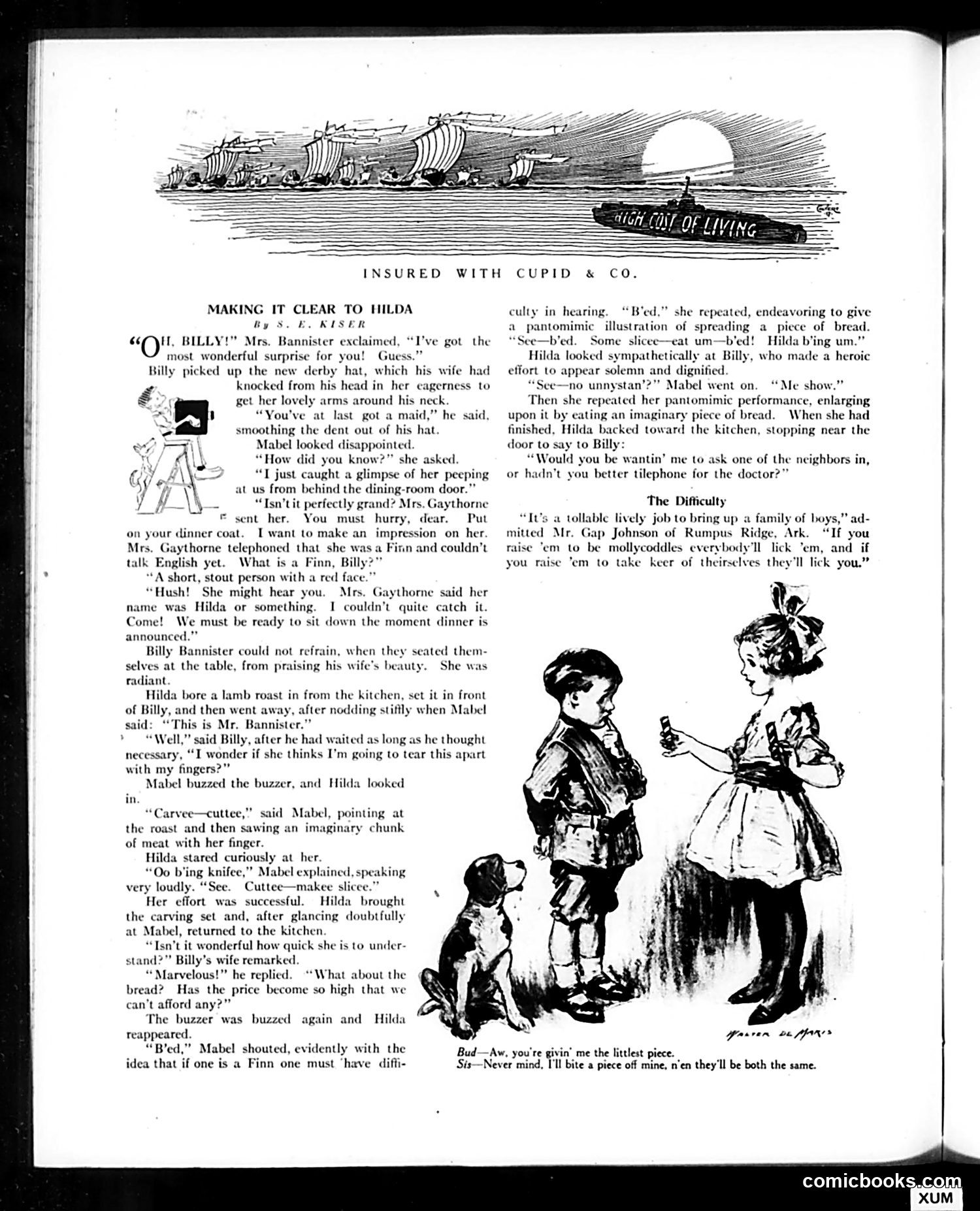
This page from *Judge* contains a humorous domestic story rather than political satire. The narrative concerns Billy Bannister's efforts to impress his wife's friend Mrs. Gaythorne by presenting an elaborate dinner. When Billy's wife Hilda struggles to understand his instructions about serving a lamb roast and carving technique—mishearing "carve" as "Finn" and other miscommunications—comedic chaos ensues. The accompanying illustration shows children (including what appears to be a dog) dividing food, with dialogue about sharing pieces fairly. The humor relies on domestic miscommunication and slapstick situations rather than political commentary. This represents *Judge's* lighter content alongside its satirical offerings.
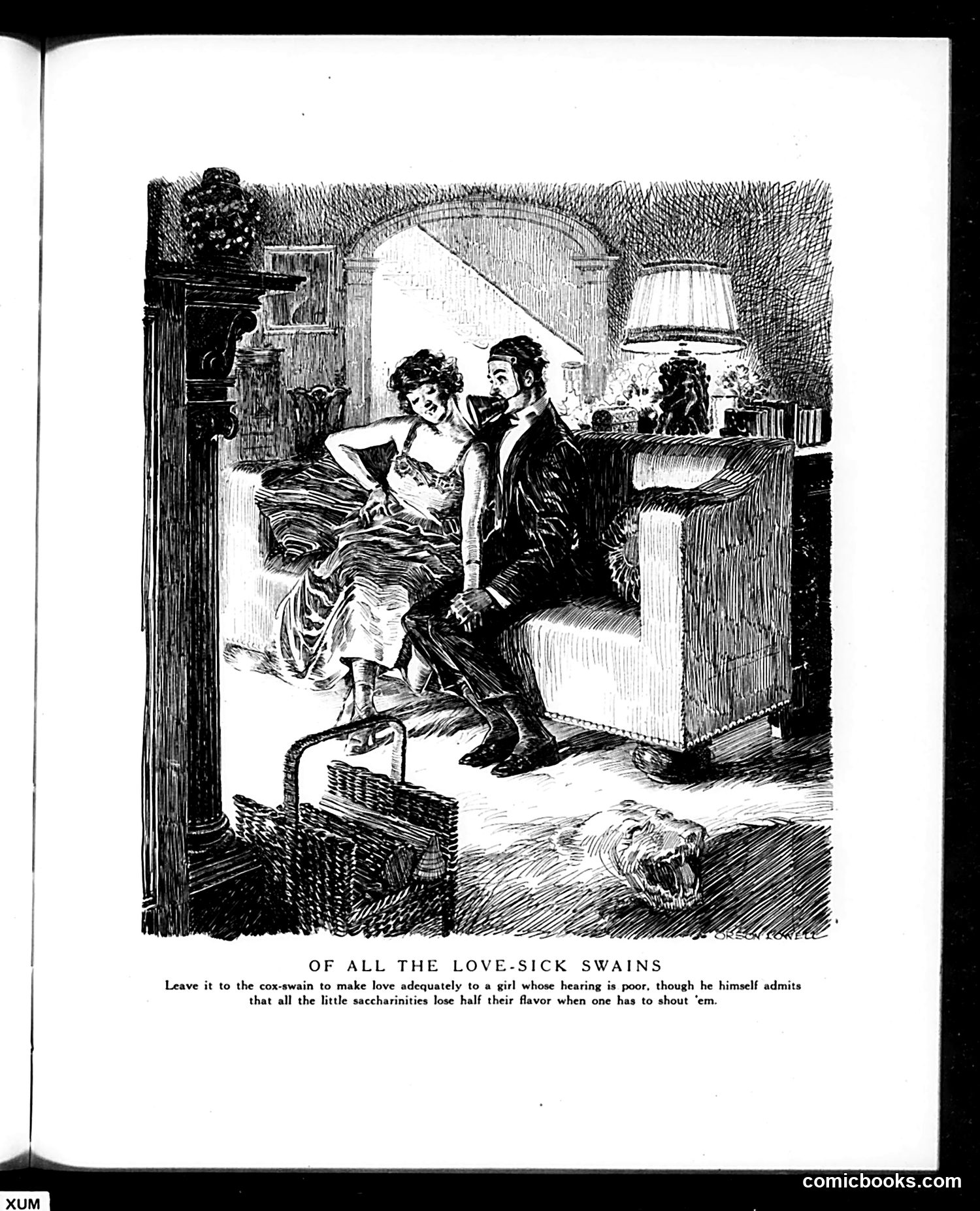
This satirical cartoon mocks romantic courtship difficulties. The scene shows a well-dressed man (a "love-sick swain") attempting to court a woman in an elegant parlor setting. The joke centers on the caption's pun: a "cox-swain" (coxswain—the person who steers a boat and shouts commands) is being humorously equated with a man courting a deaf or hard-of-hearing woman. The satire suggests that romantic sweet-talk ("saccharinities") loses its charm when delivered by shouting—reducing tender whispers to loud commands, as if he were steering a boat. The woman's apparent hearing difficulty transforms intimate conversation into something crude and ungainly, undermining the gentleman's romantic efforts entirely.
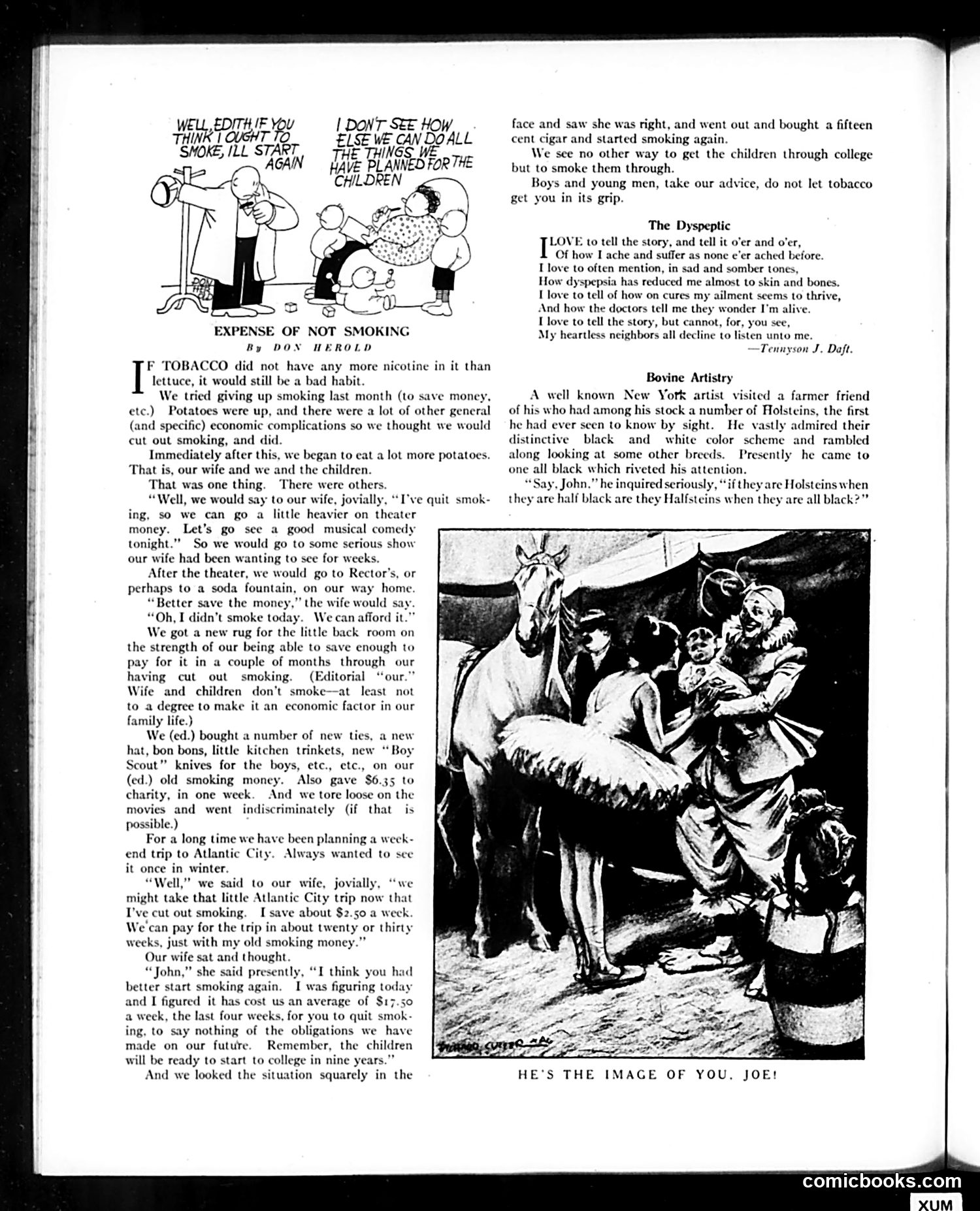
**Top Cartoon ("Expense of Not Smoking")** by Don Herold depicts a domestic debate about quitting smoking. A husband announces he'll stop smoking to save money for his family's future. However, the satire reveals the opposite result: without cigarettes to blame for spending, he and his family spend even more freely on theater, restaurants, gifts, and luxuries. When his wife calculates the actual cost of his abstinence, she ironically advises him to *resume* smoking—it's cheaper. The joke satirizes human rationalization and impulse spending: removing one vice doesn't create financial discipline; it simply redirects excess spending elsewhere. **Bottom Section ("Bovine Artistry")** presents a mild pun-based anecdote. A New York artist visiting a farm admires Holstein cattle (the distinctive black-and-white breed). Upon seeing an all-black cow, he jokes whether these are called "Halfsteins" when only partially black. It's straightforward wordplay with no deeper satire. Both pieces exemplify Judge's accessible humor targeting middle-class readers' everyday situations and foibles.
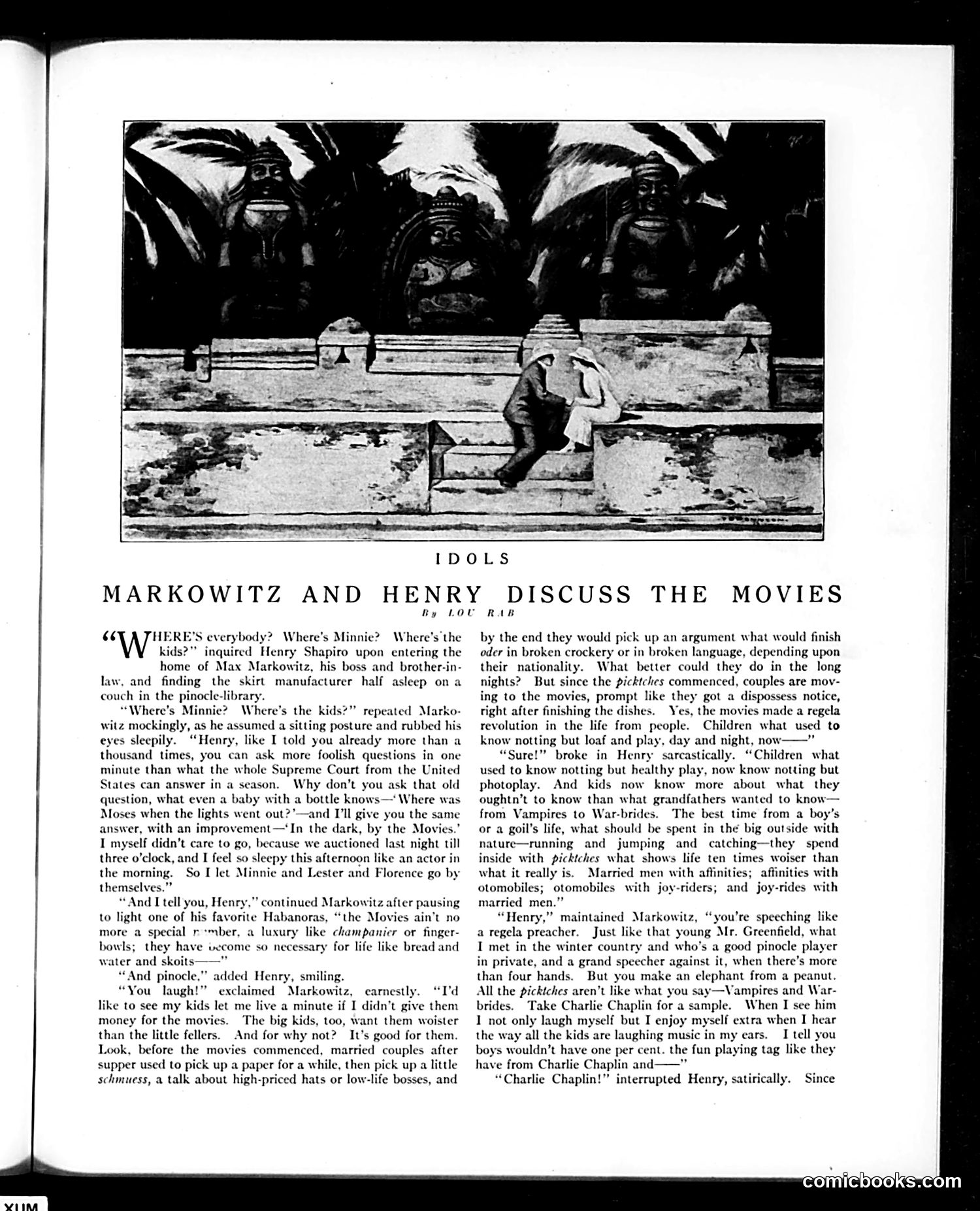
This dialogue satirizes immigrant Jewish businessmen debating the social impact of cinema, circa 1910s-1920s. Max Markowitz (a skirt manufacturer) and his brother-in-law Henry represent opposing views: Markowitz defends movies as harmless entertainment and family recreation, while Henry warns they're corrupting influences—encouraging idleness, exposing children to vice (vampires, war-brides), and replacing healthy outdoor play. The satire mocks both positions through exaggerated Yiddish-inflected English ("regela," "picktches" for pictures, "schmuess"). Markowitz's invocation of Charlie Chaplin as wholesome counterevidence suggests the genuine cultural anxiety movies provoked among respectable immigrants, who feared cinema's popularity was eroding traditional values. The piece captures a transitional moment when film was still morally controversial.
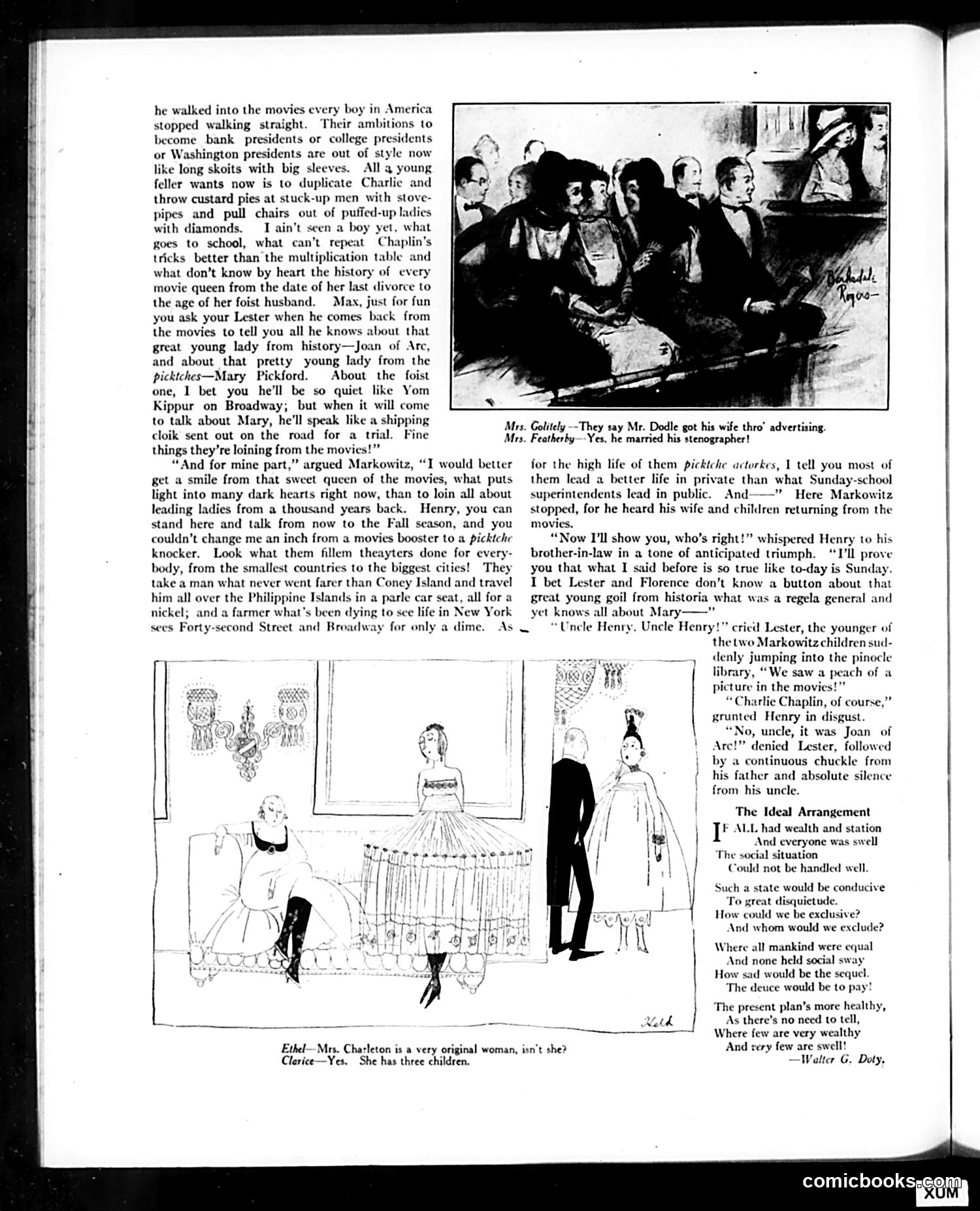
This page satirizes early cinema's cultural dominance over education and traditional values among American children, particularly immigrant families. **Main Cartoon:** Two men (appearing to be Jewish immigrants, suggested by names "Markowitz" and Yiddish-inflected speech) debate movies versus education. One defends cinema's ability to educate and inspire wonder; the other criticizes how children now idolize movie stars over historical figures. The joke's punchline: when the men's children return from the movies, they confuse Joan of Arc with Mary Pickford (a famous silent film actress), proving the uncle's point that movies corrupt learning. **Secondary Cartoon:** A society drawing with a short humorous exchange mocking how people marry through unconventional means (advertising, office romance). **Poem:** "The Ideal Arrangement" satirizes wealth and social hierarchy—suggesting the current class system, though problematic, maintains necessary social order. **Context:** This reflects 1920s anxiety about movies' influence on immigrant communities and youth, contrasting cinematic entertainment with classical education.
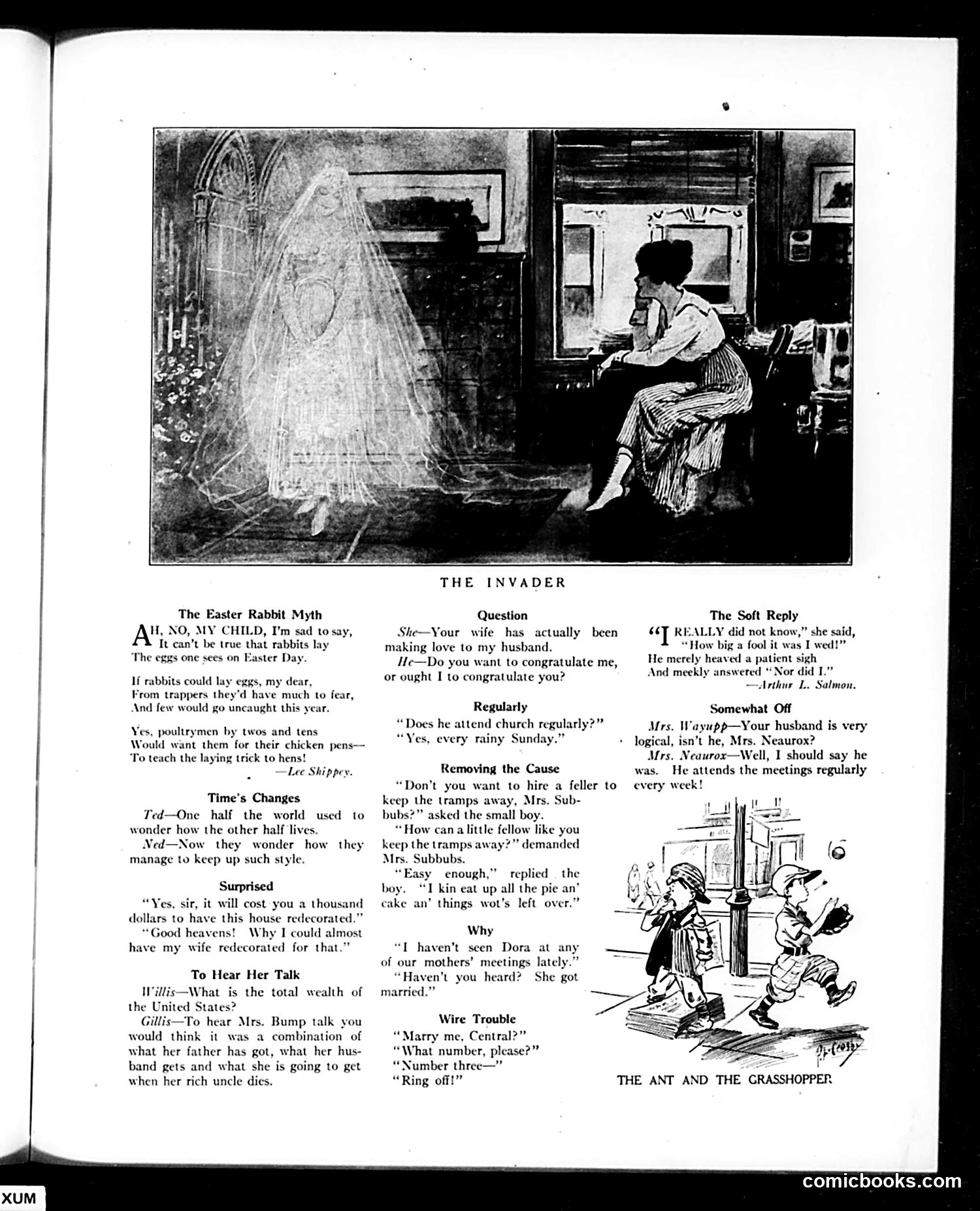
This page contains multiple brief humorous pieces typical of early-20th-century satirical magazines: **"The Invader"** (top illustration): Shows a woman confronting another about infidelity. The joke plays on marital indifference—when accused of the wife making love to the husband, he responds with circular logic about who should congratulate whom, suggesting neither cares. **Short jokes** address common social themes: - Women's gossip and materialism (Mrs. Bump's wealth delusions) - Class anxieties (house redecorating costs) - Religious hypocrisy (attending church only on rainy Sundays) - Gender roles (the telephone operator "Central" as romantic prospect) **"The Ant and the Grasshopper"** (bottom right): A small illustration referencing Aesop's fable about industriousness versus idleness. The humor relies on contemporary concerns: marriage dynamics, conspicuous consumption, social climbing, and domestic help. The satirical tone gently mocks middle-class pretensions and gender relations of the era.
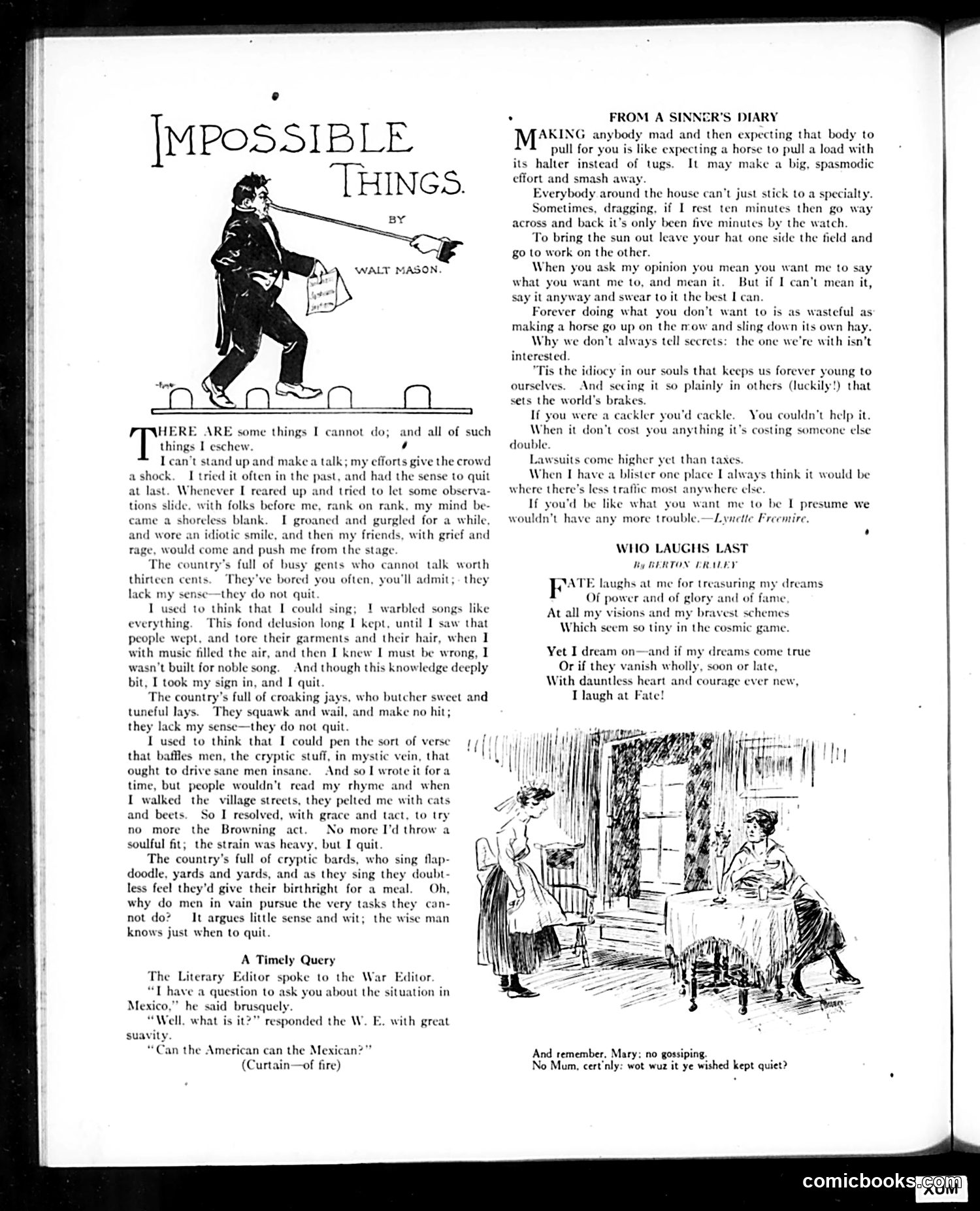
This page contains three separate pieces of satirical writing typical of Judge magazine's humor: **"Impossible Things"** is Mason's humorous essay about knowing when to quit. He recounts failed attempts at public speaking, singing, and writing poetry, emphasizing that the wisest trait is recognizing one's limitations. The satire targets people who persist stubbornly in pursuits they're unsuited for—particularly those filling the country who "lack my sense—they do not quit." It's gentle self-deprecation used to mock those lacking self-awareness. **"A Timely Query"** is a brief joke about the Mexican-American tensions of the era (likely referencing the Mexican Revolution or border conflicts). The War Editor responds to a question about American-Mexican relations with "(Curtain—of fire)"—a pun suggesting military conflict rather than diplomatic discussion. **"Who Laughs Last"** is a poem fragment about maintaining optimism despite setbacks. The page reflects early 20th-century American attitudes: self-help philosophy, gentle mockery of pretentiousness, and contemporary geopolitical concerns.
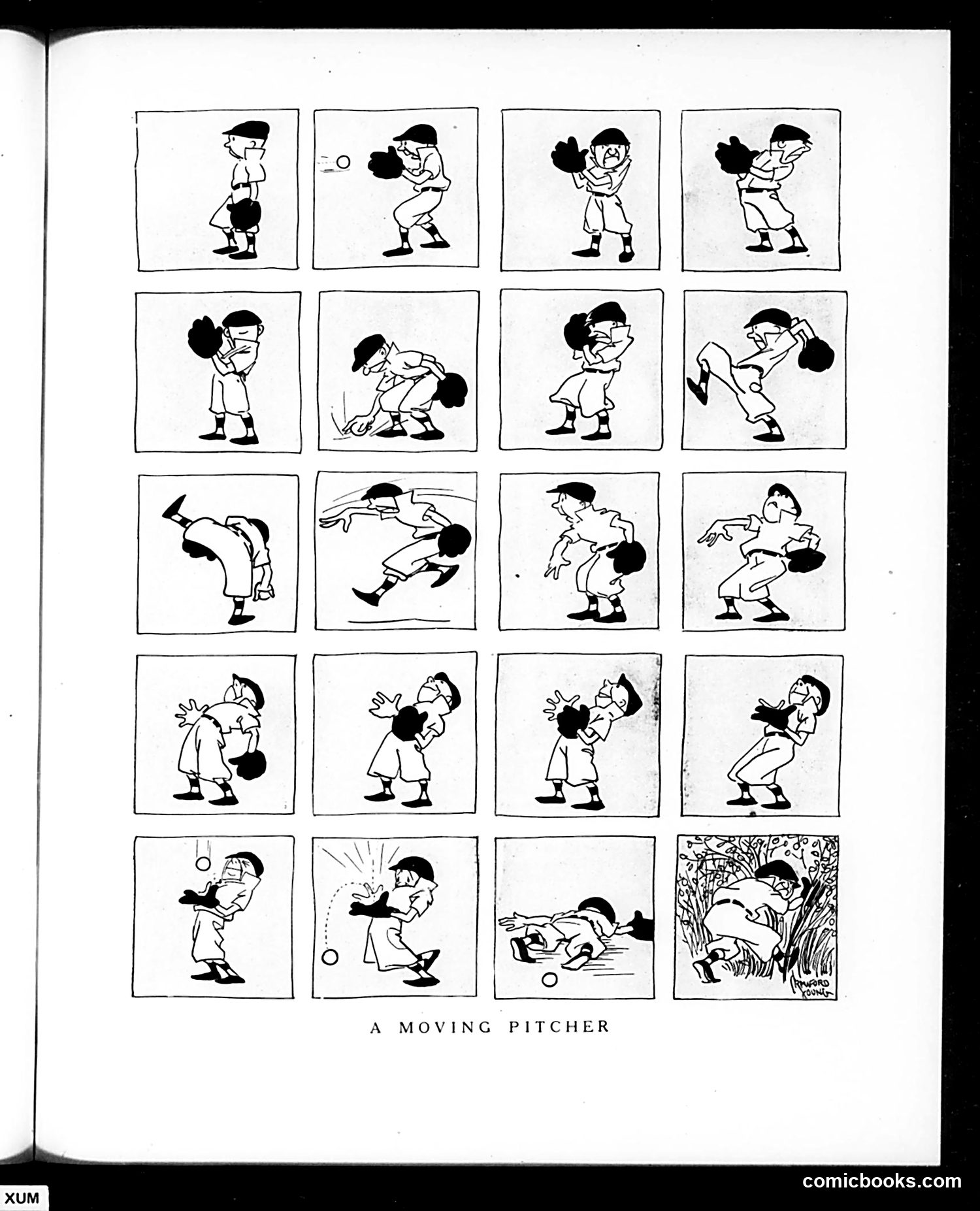
This is a humorous sports comic strip titled "A Moving Pitcher," showing a baseball pitcher's increasingly chaotic performance. The sequence depicts: 1. A confident pitcher starting his windup 2. Progressive loss of control—wild throws, stumbling motions, and erratic body positions 3. The pitcher literally falling apart mid-pitch 4. Ending with the pitcher collapsed in grass/bushes The humor plays on "moving pitcher" as a pun: both a pitcher who relocates/travels AND a pitcher whose movements become absurdly exaggerated and uncontrolled. It's slapstick comedy mocking poor pitching mechanics and athletic incompetence, common in early 20th-century Judge magazine's sports humor. The escalating physical comedy culminates in complete failure and collapse, a classic comedic formula of the era.
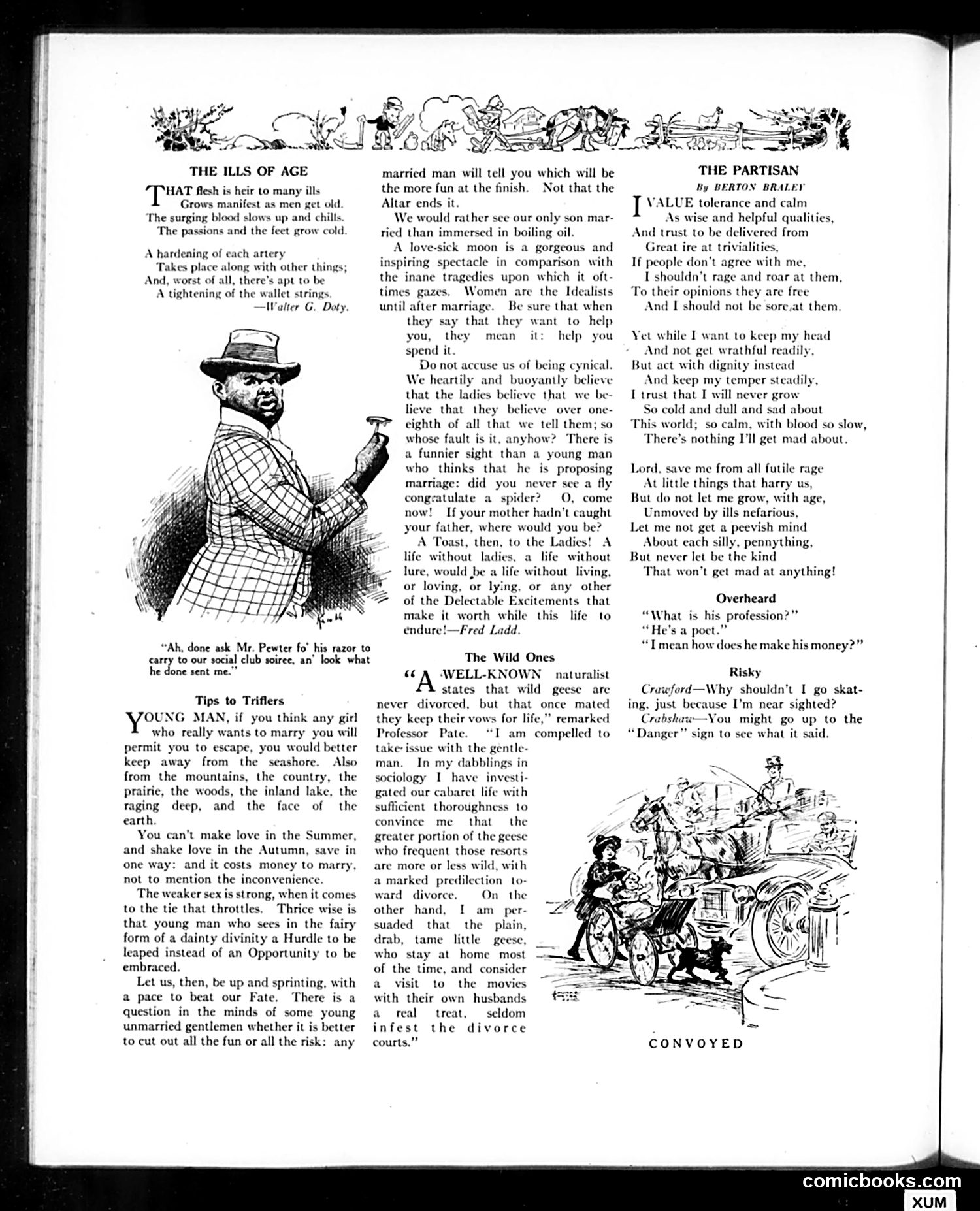
This page contains three distinct pieces of satirical content: **"The Ills of Age"** — A poem with accompanying caricature mocking aging men, particularly their financial stinginess ("tightening of the wallet strings"). The illustration shows an older man in checked clothing, likely depicting a miserly elderly figure. **"Tips to Triflers"** — Cynical advice to young unmarried men about courtship and marriage, satirizing both male hesitation and female mercenary motives. It treats marriage as an inescapable trap and women as manipulative—reflecting common early-20th-century satirical tropes about gender relations. **"The Wild Ones"** — A dialogue between professors debating whether geese divorce. This appears to be social commentary using animal behavior as metaphor, suggesting that respectable, homebody women remain faithful while "wild" women frequenting cabarets (speakeasies?) pursue divorce—likely referencing 1920s urban culture and changing gender roles. **"The Partisan"** (poem) — Advocates political tolerance despite disagreement. The page represents typical Judge magazine content: cynical observations on aging, gender relations, and modern social behavior.
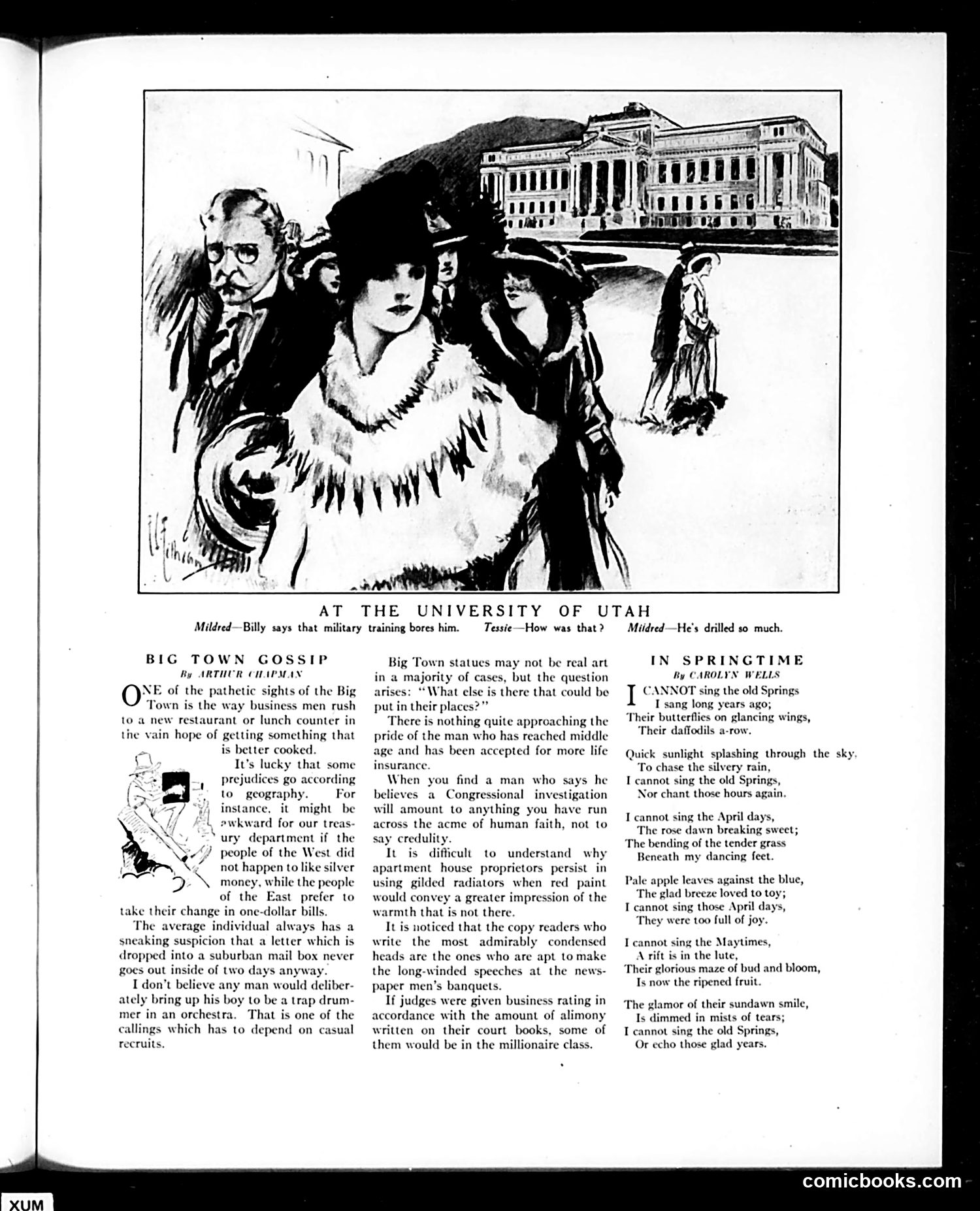
**The Cartoon (Top):** Depicts fashionably dressed people outside the University of Utah building. The caption jokes that "Billy says military training bores him" because "He's drilled so much"—a pun on military drilling versus the tedious repetition itself. **Big Town Gossip (Left Column):** A humor column by Arthur Chapman offering satirical observations about urban life. Topics include: businessmen rushing to lunch counters, regional preferences for silver vs. paper money, the suspicious fate of suburban mail, and commentary on congressional investigations being exercises in futility. The piece mocks the vanity of men who've reached middle age and gotten life insurance approval, and ridicules apartment landlords using decorative gold radiators while providing inadequate heat. **In Springtime (Right Column):** A melancholic poem by Carolyn Wells about lost youth—the speaker cannot recapture the joy of springtime from years past because the passage of time has dimmed those memories with tears and maturity. The page reflects early 20th-century urban American humor and nostalgic romanticism.
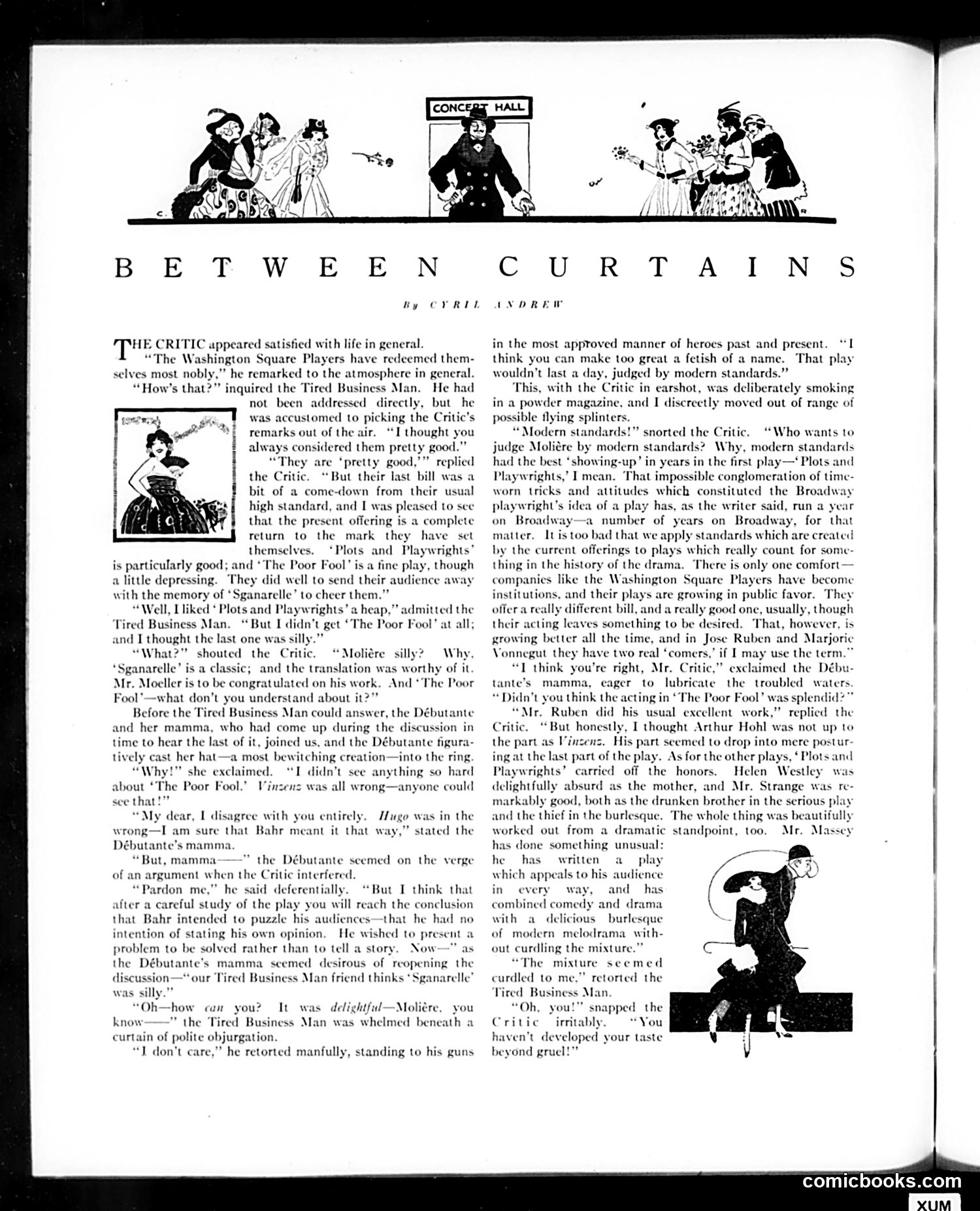
This piece satirizes pretentious theater criticism through a conversation between a self-important Critic and a straightforward "Tired Business Man." The Critic praises the Washington Square Players' productions—particularly a Molière adaptation ("Sganarelle") and "The Poor Fool"—but when the Tired Business Man admits he found them confusing or silly, the Critic launches into defensive snobbery about classical standards versus "modern" commercial theater. The satire's target: critics who judge art by historical reputation rather than actual merit, and who use elaborate justifications to intimidate ordinary audiences into accepting incomprehensible work. The Tired Business Man's stubborn refusal to genuflect before the Critic's authority—"I don't care...I think you can make too great a fetish of a name"—represents common sense resisting intellectual gatekeeping. The joke is that the Critic cannot tolerate anyone questioning canonical taste.
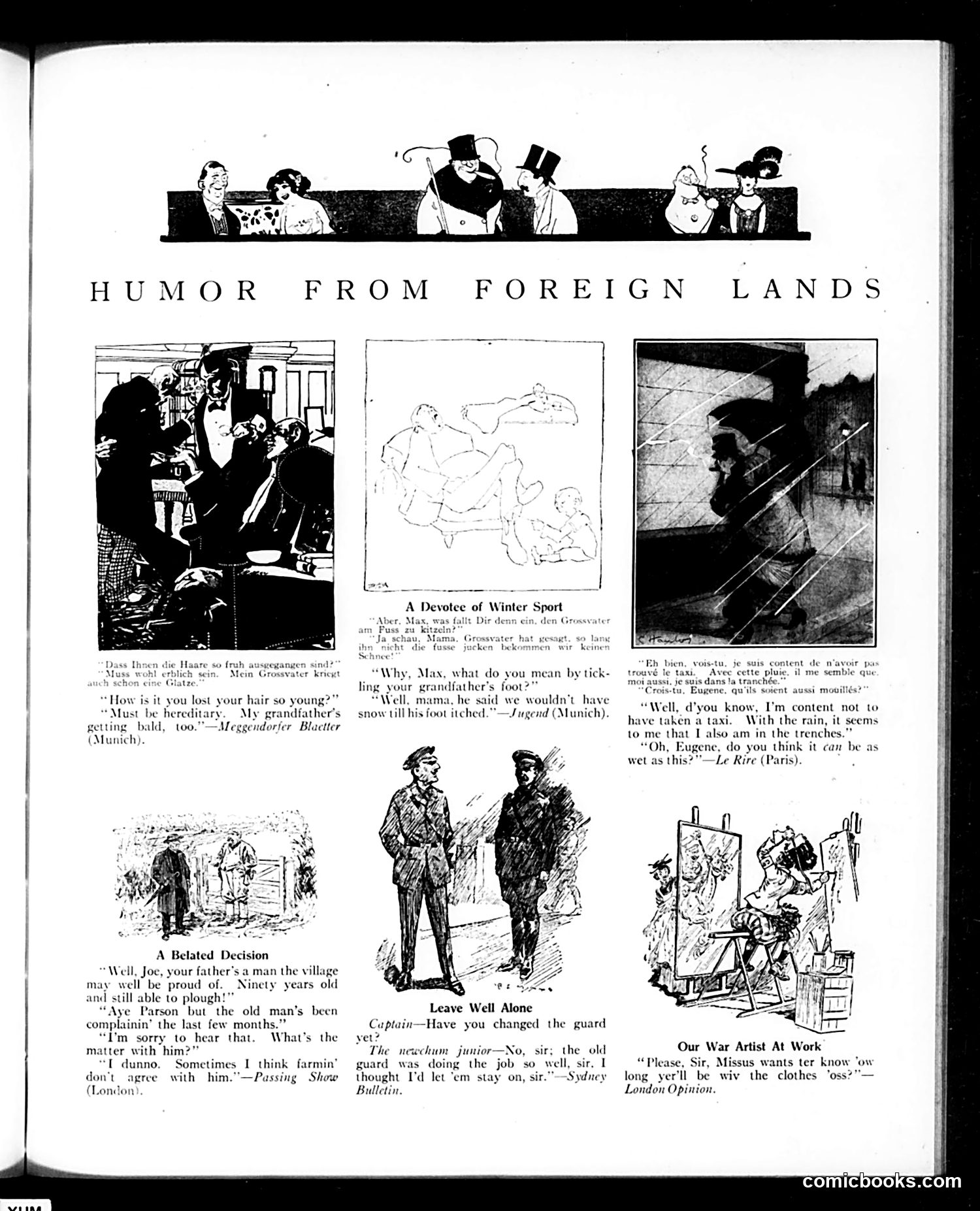
This page collects short humorous anecdotes and cartoons from European publications, presenting them as cultural commentary. The jokes reflect WWI-era sensibilities: **Key items:** - "A Devotee of Winter Sport" (German/French sources): A child tickles grandfather's foot; the joke plays on generational differences and physical decline with dark humor about age. - "A Belated Decision" (British): An elderly farmer remains vigorous at 90, but his son worries farming is killing him—satirizing rural life's hardships. - "Leave Well Alone" (British): A soldier keeps an incompetent guard on duty rather than change him—poking fun at military bureaucracy and laziness. - "Our War Artist At Work" (British): A woman asks a war correspondent about clothes, seemingly indifferent to serious journalism—mocking superficial civilian concerns during wartime. The page's structure—republishing foreign humor—emphasizes international perspectives on common themes: aging, rural hardship, military absurdity, and wartime priorities.
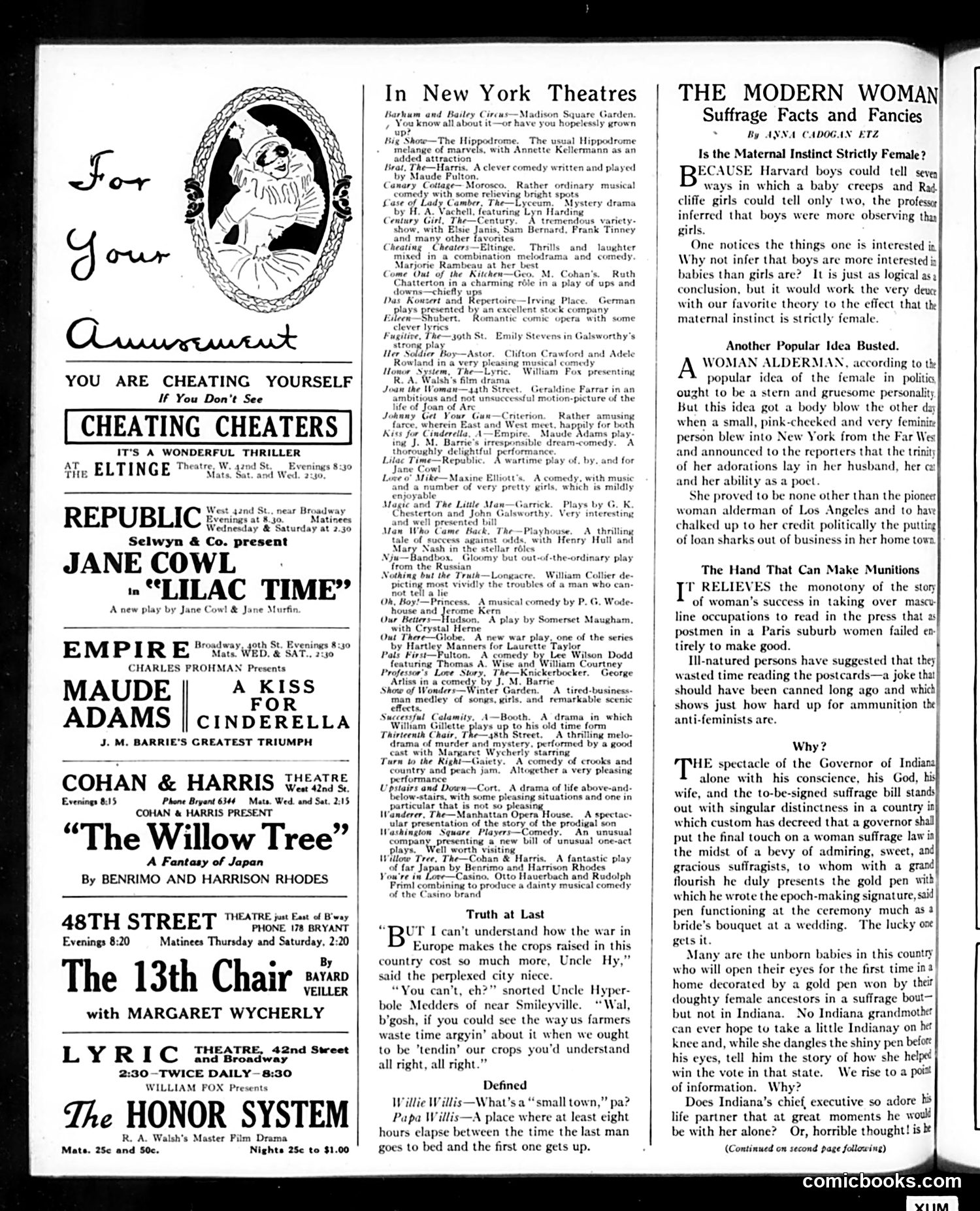
This page is primarily **theatrical advertising** for New York Broadway productions (circa 1917-1918, based on play titles and war references). The only substantive comic content is the small "Truth at Last" joke at bottom right: A perplexed city niece asks her Uncle Hyperbole why European war raises U.S. crop prices. His response is cut off, but the satire targets urban ignorance about agriculture and wartime economics. The joke reflects early-20th-century city-versus-country stereotypes—city dwellers portrayed as disconnected from how global conflict affects food supply chains and farm economics. The "Uncle" figure (a stock character for dispensing wisdom) is positioned to educate the naive urban relative. The page's main content—extensive theater listings—indicates Judge's audience: educated, urban, theater-going Americans with disposable income during the WWI era.
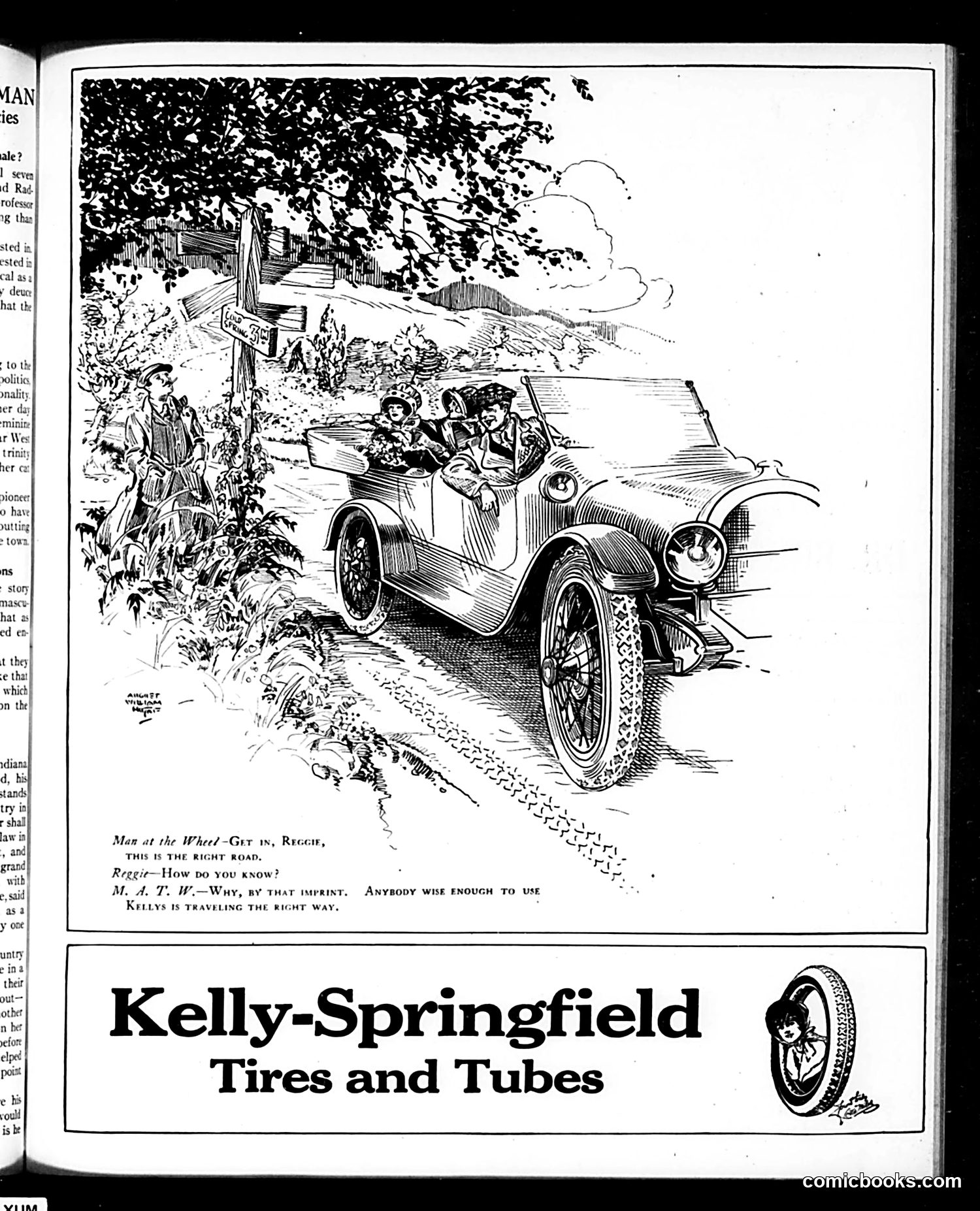
This is a Kelly-Springfield Tires advertisement disguised as satirical humor, typical of Judge magazine's advertorial content. **The Setup:** A rural character ("Reggie," rendered in dialect) asks a man at the wheel how he knows they're on the right road. **The Joke/Advertisement:** The driver responds that anyone wise enough to use Kelly's tires must be traveling correctly—implying Kelly's tires are a mark of good judgment and reliability. **The Satire:** The humor relies on circular logic and gentle mockery of rural/provincial speech patterns (phonetic dialect spelling was common in period comics). The implication is that Kelly's tires are so trustworthy that using them is itself proof of sound decision-making. **Context:** This represents early 20th-century automotive advertising when tire quality varied significantly and brand loyalty signaled consumer sophistication. The illustration shows a touring car on a country road, depicting the emerging leisure travel culture.
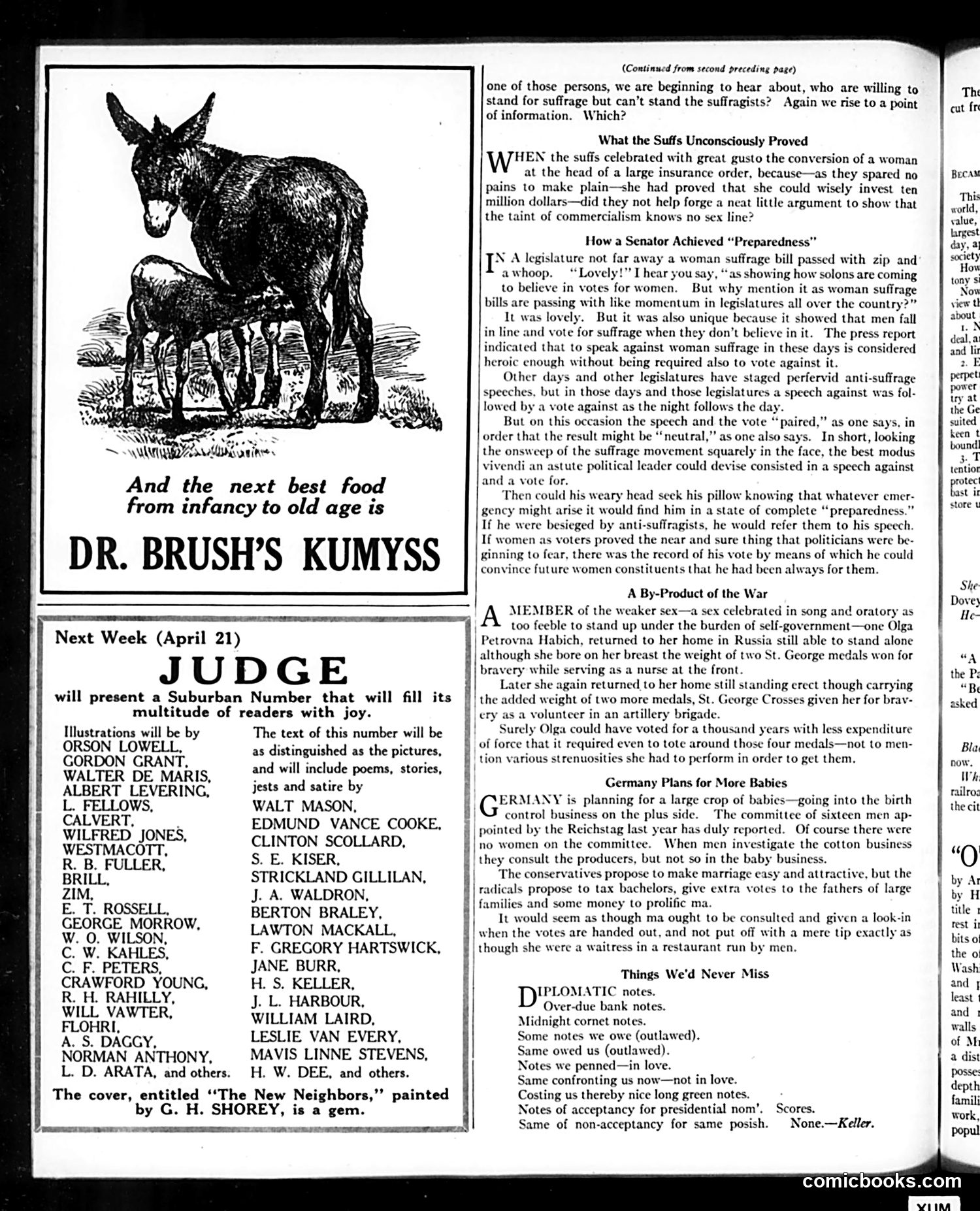
This page from Judge magazine (dated April 21, though year unclear) contains anti-suffrage political satire alongside advertising and editorial content. **The Main Satire ("What the Suffs Unconsciously Proved"):** Judge mocks women's suffrage advocates ("suffs") by arguing that their celebration of a female insurance executive—praised for wisely investing millions—actually proves women are tainted by commercialism, not worthy of voting rights. The satire attacks suffragists' own logic. **"How a Senator Achieved 'Preparedness'":** This piece ridicules a senator who publicly *spoke against* women's suffrage while secretly *voting for* it. Judge suggests this cowardly "pairing" of contradictory positions allowed politicians to hedge bets: they could cite their speech to anti-suffragists or their vote to future female voters. The satire portrays male politicians as opportunistic and dishonest regarding women's voting rights. **The Advertisement:** An unrelated ad for Dr. Brush's Kumyss (likely a dairy product) features a donkey—possibly ironic visual commentary, though connection unclear. The page reflects early-20th-century Judge's consistent opposition to women's suffrage through ridicule rather than argument.
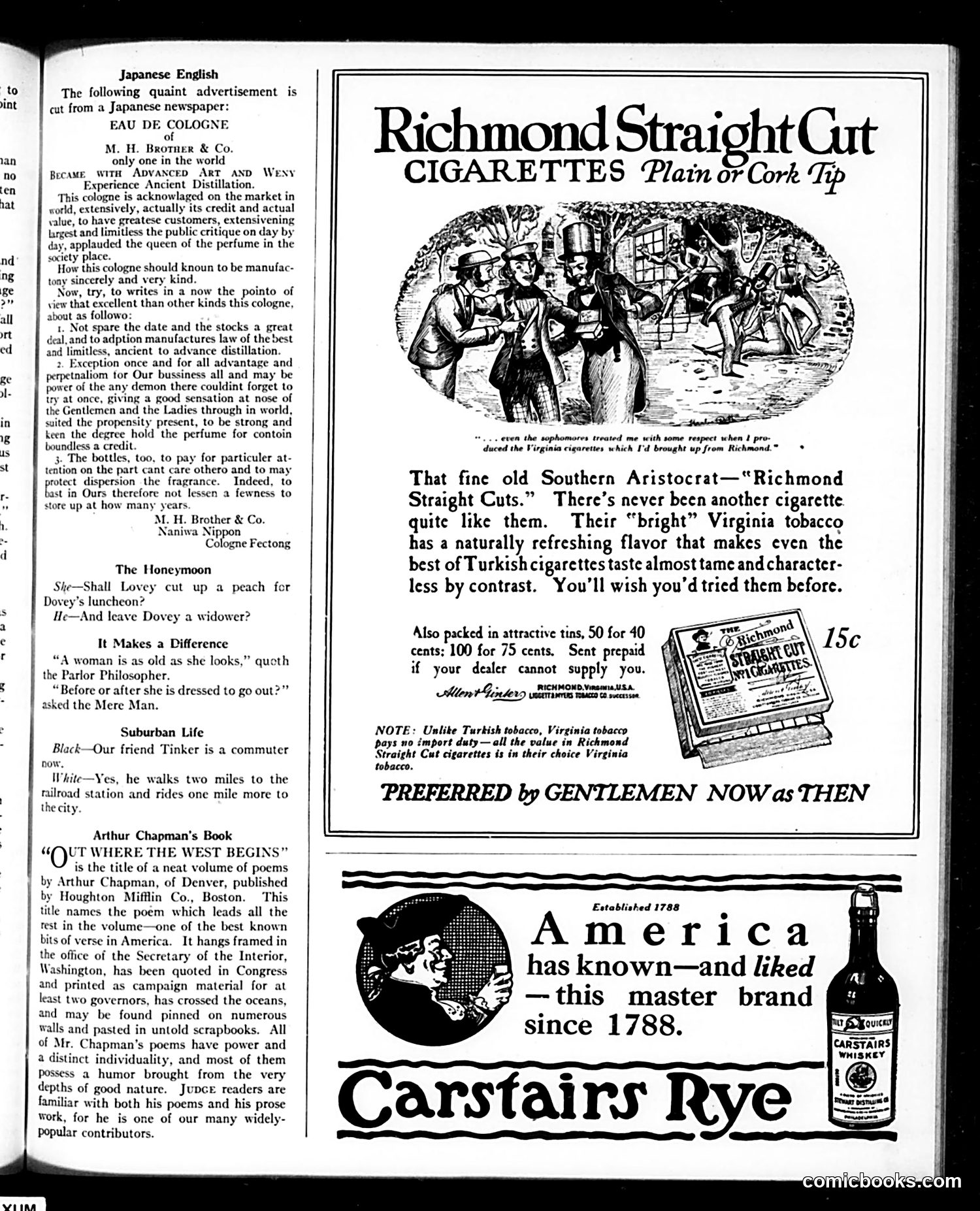
This page is primarily **advertisements** interspersed with brief humorous items. The main satirical content is: **"Japanese English" Section**: A mock advertisement from a Japanese newspaper selling cologne. The humor relies on **broken English translation**—garbled, grammatically incorrect phrasing ("only one in the world," "greatese customers," "boundless a credit"). This satirizes early 20th-century Japanese commercial English and Western attitudes toward non-native English speakers, presenting their language attempts as comically incompetent while actually mocking the Japanese writer's ad. **Secondary humor pieces** ("It Makes a Difference," "Suburban Life") are brief quips about marriage and commuting with no political content. The page is otherwise dominated by period **product advertisements** for Richmond Straight Cut Cigarettes and Carstairs Rye Whiskey, featuring no satire—just standard marketing copy typical of Judge's revenue model. The satire here is gentle, focused on language rather than serious political critique.
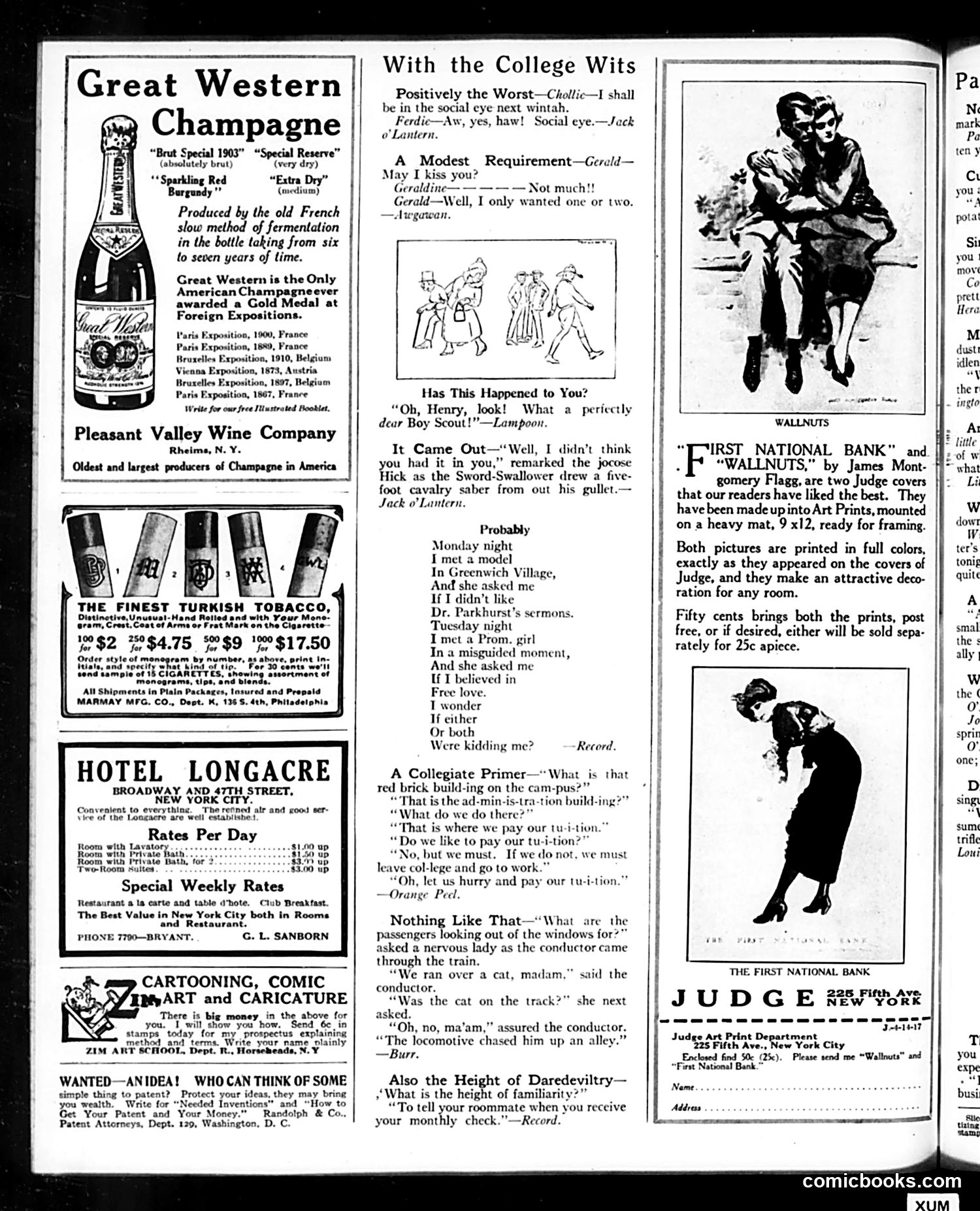
This page is primarily **advertising and filler content** from Judge magazine, with minimal political satire. The central content features **"With the College Wits,"** a series of brief humor pieces from college publications (Jack o' Lantern, Awgawan, Orange Peel, Record). These jokes target early 1900s college life: social pretension, awkward dating rituals, Boy Scouts, free love discussions, and tuition complaints. The humor is gentle mockery of collegiate culture rather than political commentary. The page is dominated by **advertisements**: Great Western Champagne (claiming to be America's only gold-medal champagne), Turkish tobacco cigarettes, Hotel Longacre, and patent/cartooning school promotions. On the right side are **James Montgomery Flagg illustrations** being promoted as art prints available through Judge—described as readers' favorite covers. There is **no significant political or social satire** on this page. It reflects period attitudes (casual references to Greenwich Village models, free love debates) but offers no deeper commentary than typical college humor of the era.
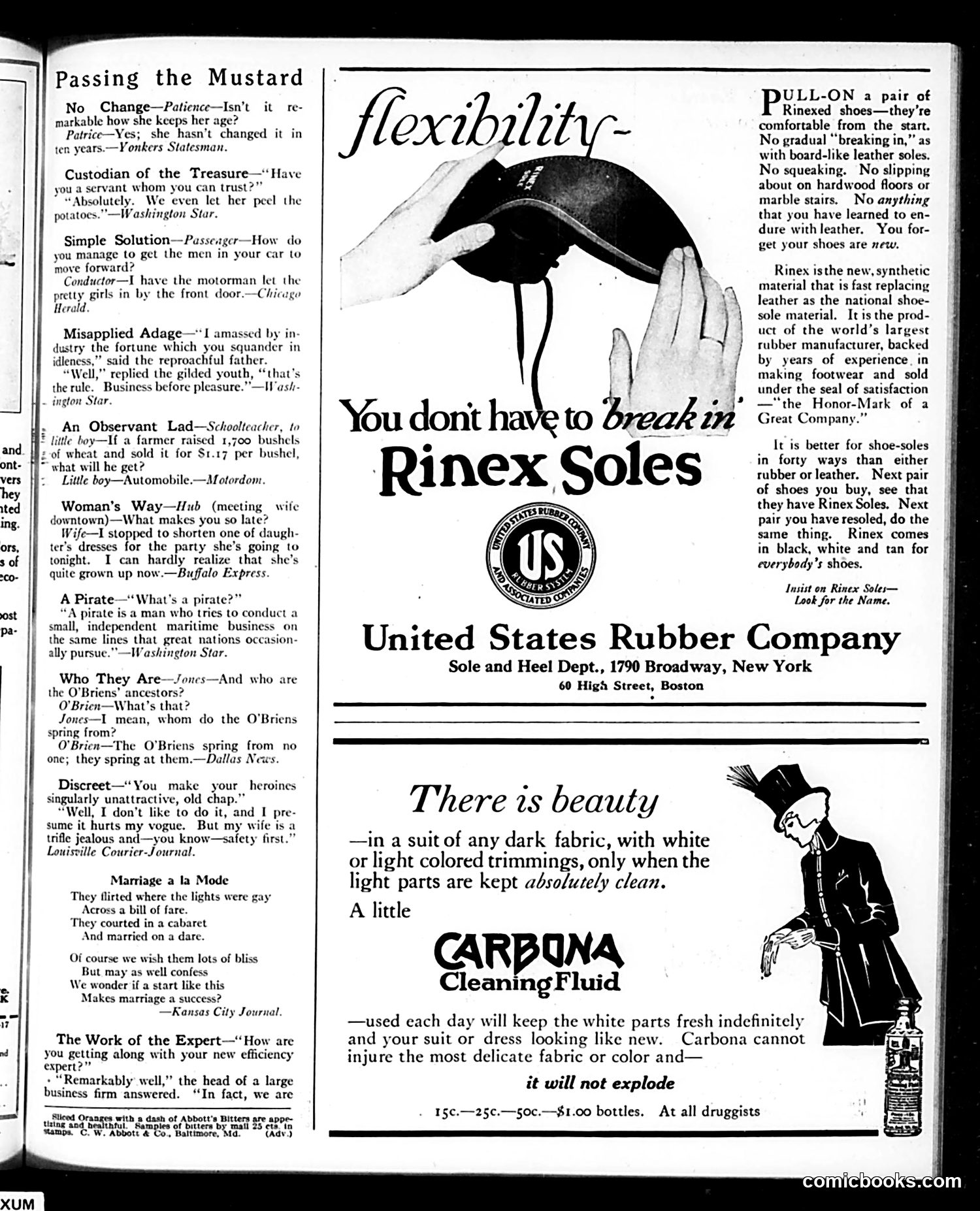
This page consists primarily of **advertising** for two products (Rinex Soles shoe material and Carbona Cleaning Fluid) alongside a column titled "Passing the Mustard"—a collection of brief humorous anecdotes and jokes. The jokes are lighthearted social commentary typical of early 20th-century humor: - **"No Change"**: mocks women's vanity about aging - **"Simple Solution"**: suggests men move forward in trolleys when attractive women board—implying male weakness for female beauty - **"Misapplied Adage"**: a wealthy young man justifies frivolous spending as "business before pleasure" - **"Observant Lad"**: a child's logical (but naive) assumption that a farmer's profit goes to automobiles - **"Woman's Way"**: satirizes a wife altering her daughter's dress, sardonically noting the girl has "grown up" - **"Marriage a la Mode"**: criticizes hasty, casual marriages conducted in cabarets The humor targets class pretension, gender dynamics, and social anxieties of the era. No specific political figures or events are referenced; the satire is generalized social commentary.
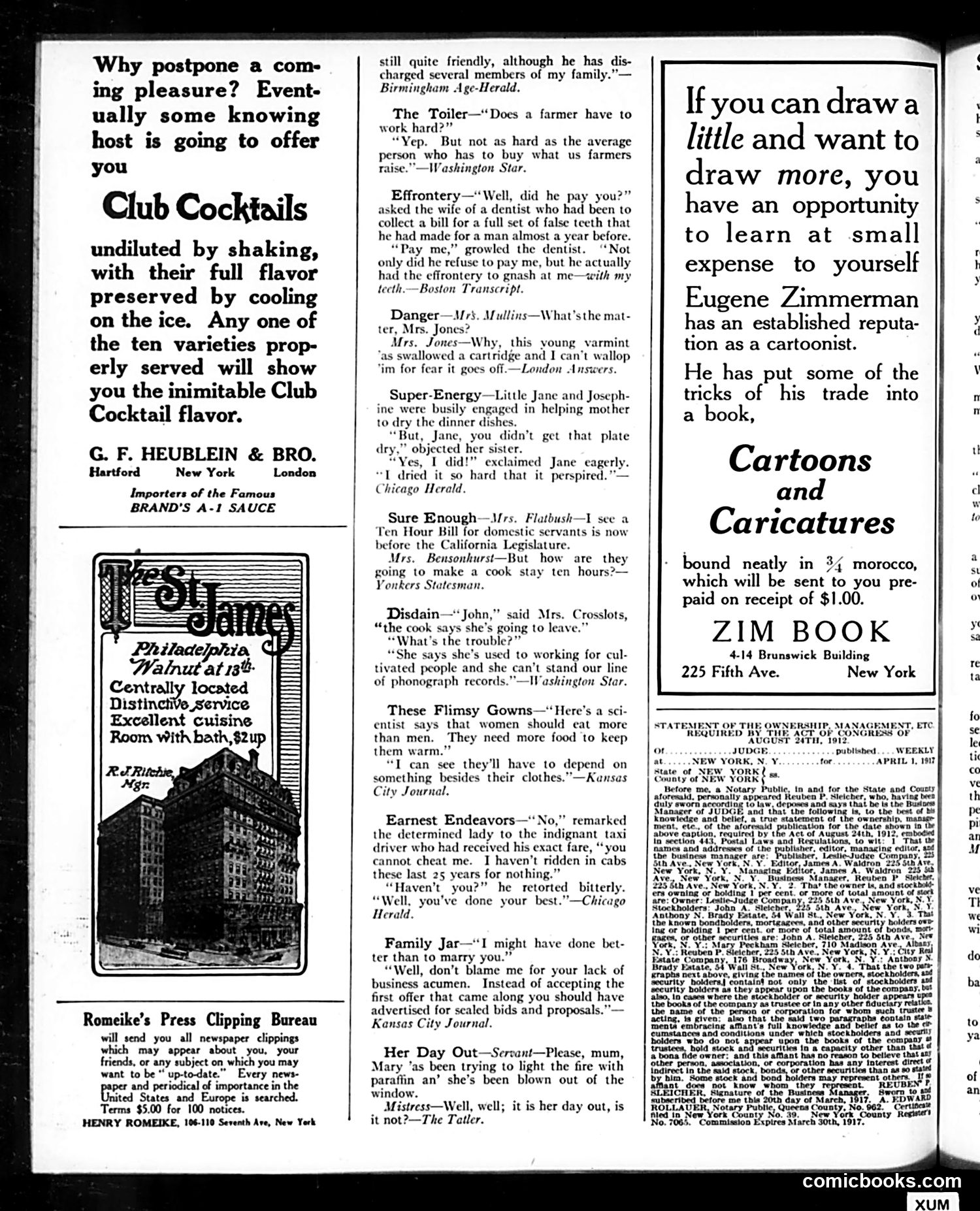
This page is primarily **advertisements and humorous anecdotes** rather than political cartoons. The content consists of: **Main Features:** - Ads for Club Cocktails, a Philadelphia hotel, and press clipping services - A book advertisement for Eugene Zimmerman's *Cartoons and Caricatures* instructional guide - Multiple brief jokes/anecdotes on topics like labor, dentistry, household servants, and marital disputes **Social Commentary:** The anecdotes reflect early 20th-century class anxieties: servants leaving employment, disputes over payment, wage labor complaints. One joke mocks a farmer's complaint about high living costs—suggesting economic frustration among rural workers. **No identifiable political figures or events** are caricatured on this page. The humor is domestic and situational rather than topical satire. This appears to be a **filler page** typical of magazines of this era, using light domestic humor to fill space between major editorial content and advertisements.
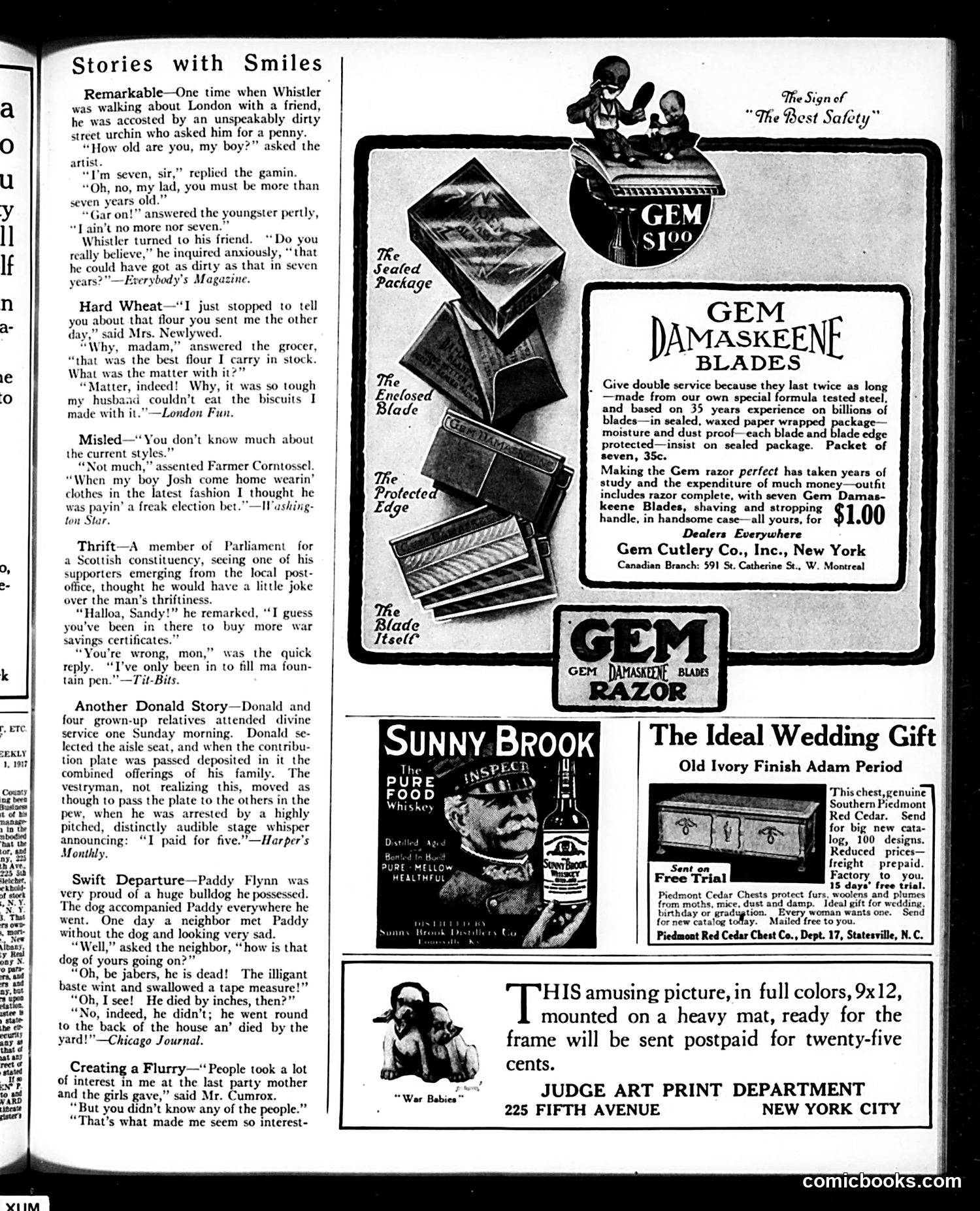
This page is primarily **humorous anecdotes** rather than political cartoons. The left column contains short jokes and witty stories, many attributed to famous figures or publications of the era. Notable references include: - **Whistler** (the artist James McNeill Whistler), used in a joke about a dirty London street child - **War savings certificates** mentioned in a Scottish MP anecdote, suggesting this was published during or shortly after WWI - Light social satire about marriage, farming, thriftiness, and class differences The right side contains **period advertisements** for Gem razor blades, cedar chests, and other products—typical of early 20th-century magazines. **For modern readers:** These are gentle, observational humor pieces typical of the era's middle-class magazines. The jokes rely on wordplay, Irish dialect humor, and mild social commentary rather than sharp political satire. The overall tone is lighthearted domesticity rather than incisive social criticism.
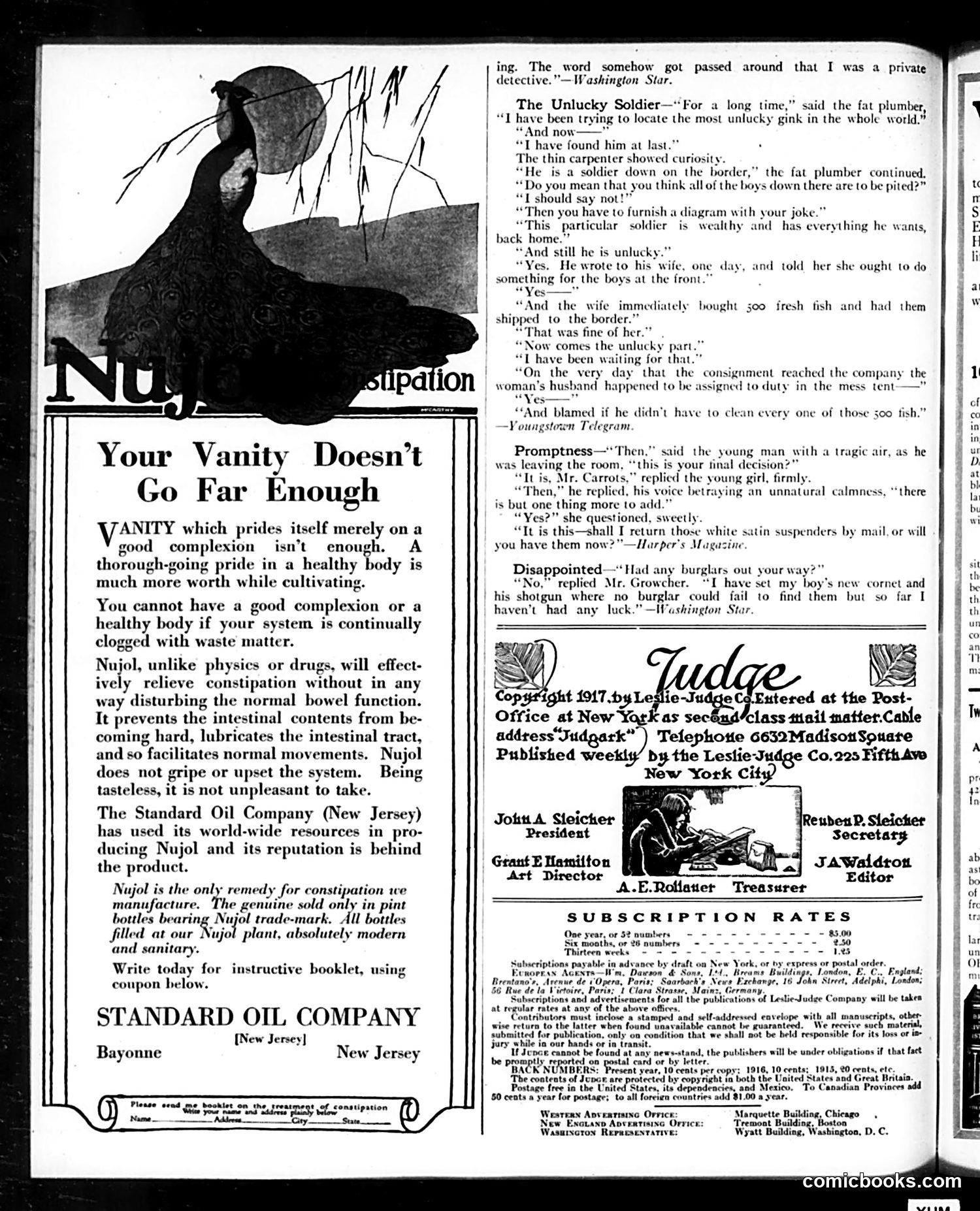
This page is primarily **advertising and miscellaneous content** rather than political satire. The main element is a **Nujol laxative advertisement** featuring a stylized image of a woman and promoting constipation relief as essential to vanity and health. Standard Oil Company's pitch emphasizes that external beauty requires internal wellness. Below are three **humorous anecdotes** unrelated to current events: 1. "The Unlucky Soldier" — A soldier with wealth and comfort is assigned mess-tent duty cleaning 500 fish his wife shipped to soldiers at the border, creating ironic misfortune. 2. "Promptness" — A rejected suitor asks whether to return "white satin suspenders" by mail or in person, implying he borrowed intimate items. 3. "Disappointed" — A homeowner places his son's new cornet and shotgun where burglars can easily find them, yet experiences no break-ins. These are **light domestic jokes** about everyday situations rather than political commentary. The page concludes with masthead information and subscription rates for Judge magazine.
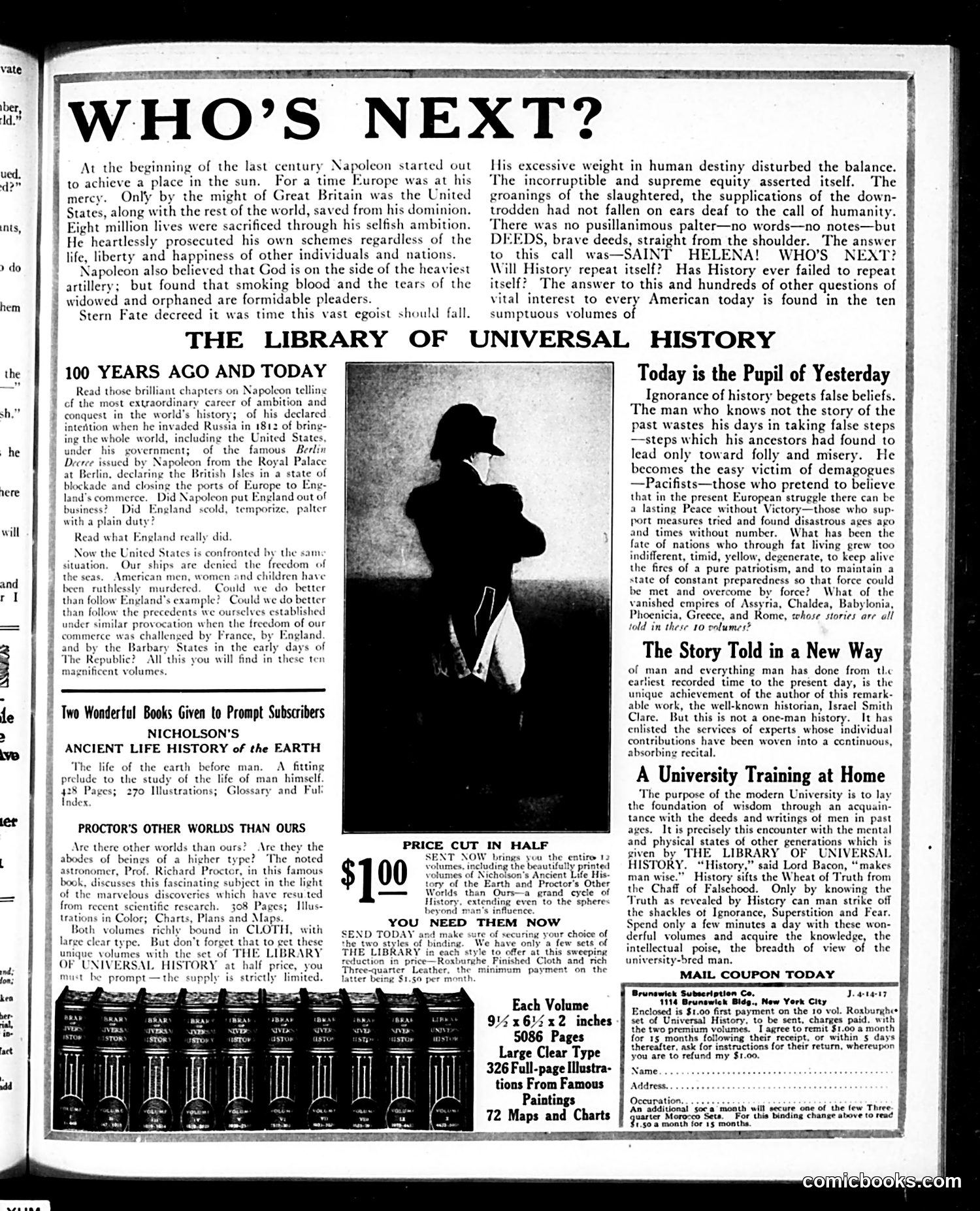
This page is primarily **advertising and editorial content** rather than traditional political cartooning. The central silhouette image appears to be **Napoleon**, referenced extensively in the surrounding text. The content draws a historical parallel: just as Napoleon threatened world dominance a century earlier, the United States now faces similar threats (likely Germany, given Judge's pre-WWI timeline). The text argues that Britain defeated Napoleon through military might, implying America must similarly prepare for conflict. The rhetorical question "WHO'S NEXT?" suggests that history repeats—if Napoleon fell, who will be the next would-be conqueror? This serves as propaganda promoting the sale of "The Library of Universal History," positioned as essential reading to understand current threats. The underlying message: **studying history provides lessons for present dangers**. By marketing historical volumes alongside this nationalist rhetoric, the advertisement conflates commercial interest with civic duty—readers who ignore history's warnings risk repeating its mistakes.
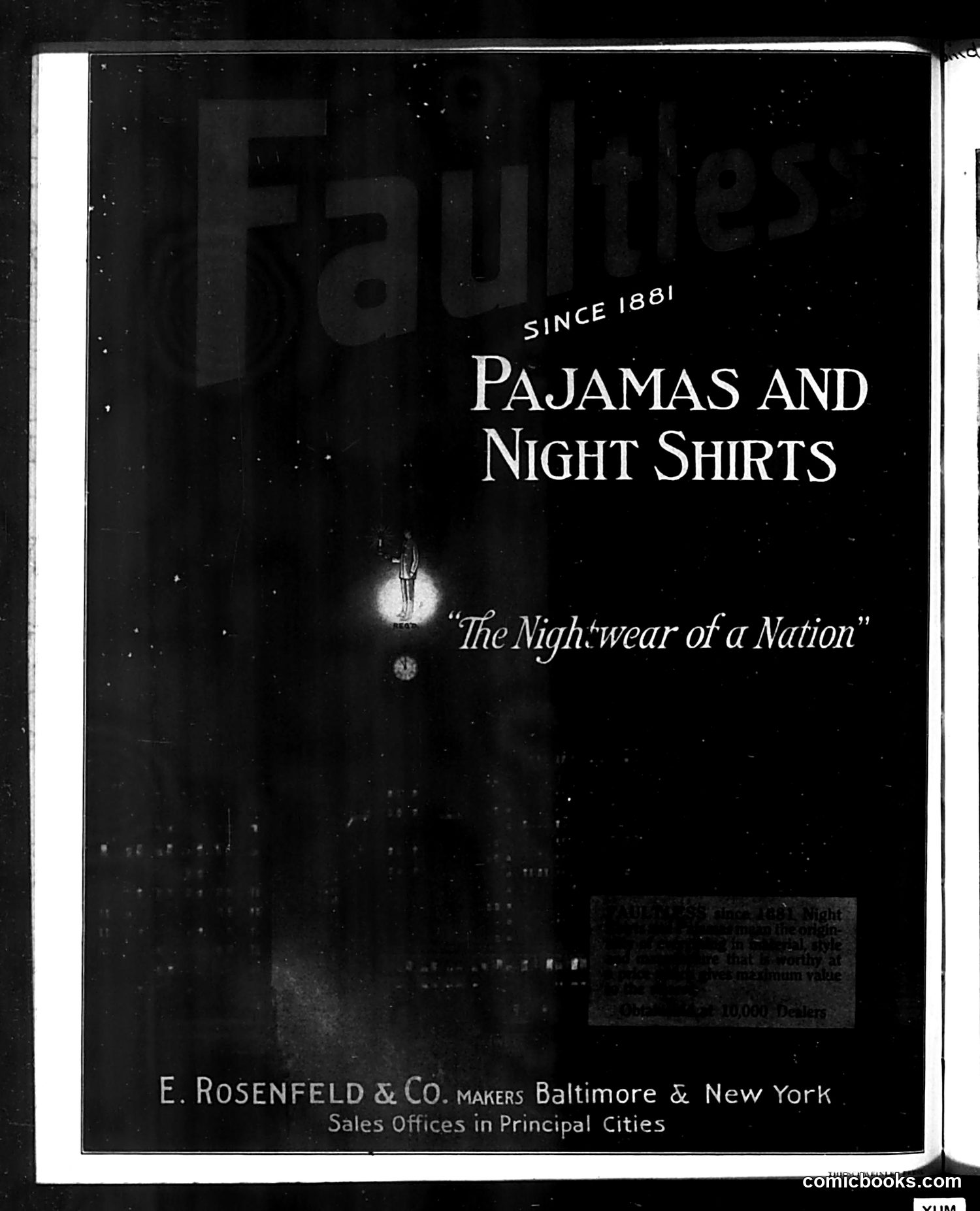
This is primarily a **full-page advertisement** rather than political satire or cartoon content. E. Rosenfeld & Co., a Baltimore and New York manufacturer, promotes pajamas and nightshirts as "The Nightwear of a Nation," claiming to have been in business since 1881. The dark, atmospheric image shows a nighttime cityscape with a solitary illuminated figure, evoking a moody urban scene. This aesthetic choice—emphasizing nighttime and the solitary individual—visually supports the product being advertised (sleepwear). There is no evident political commentary or satirical content visible. The page functions as a straightforward commercial advertisement leveraging mood and patriotic language ("of a Nation") to market clothing to readers of *Judge* magazine. The small text box in the lower right appears damaged or illegible in this reproduction.