
Judge, 1917-04-14 · page 16 of 28
Judge — April 14, 1917 — page 16: what you’re looking at
What you’re looking at
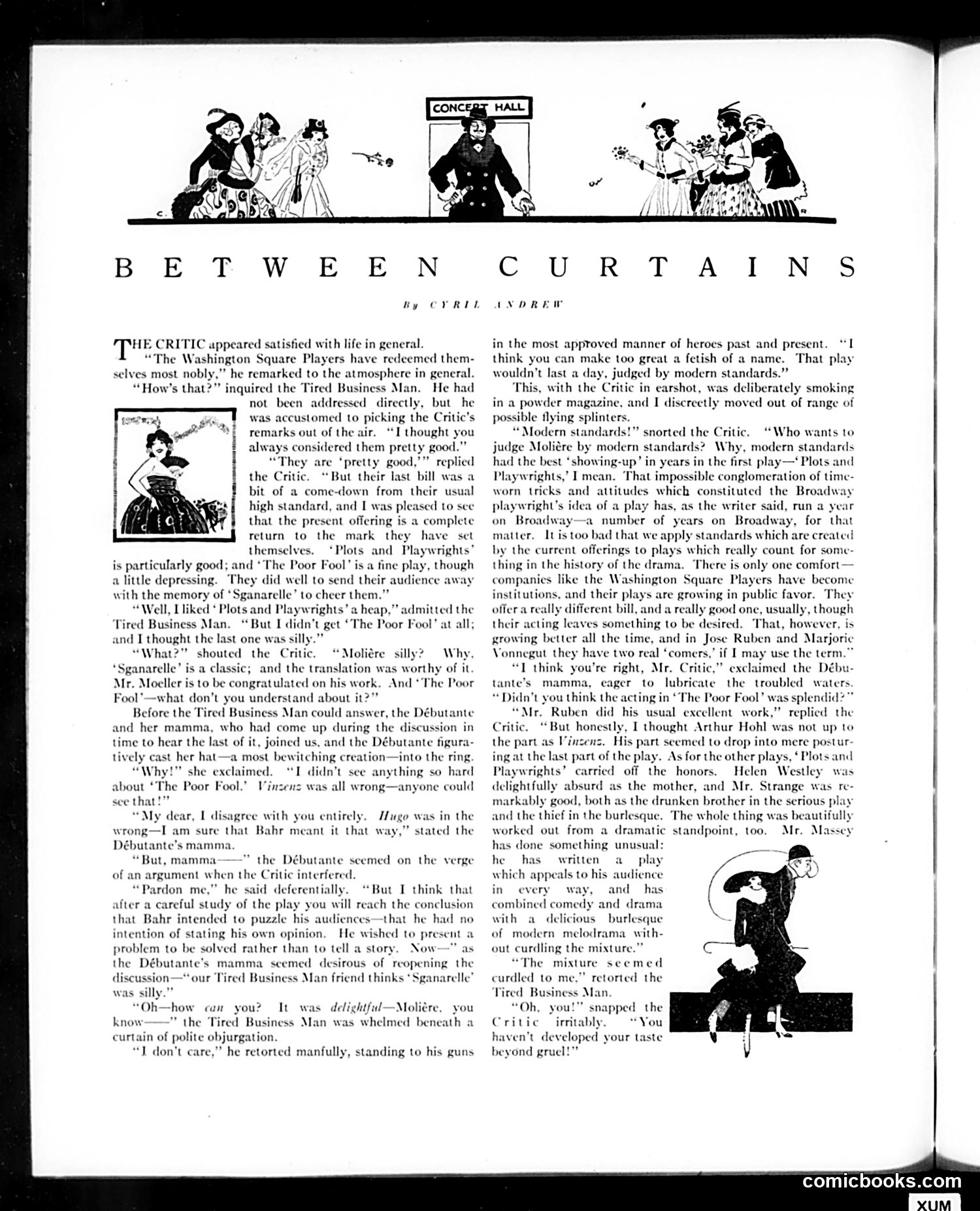
This piece satirizes pretentious theater criticism through a conversation between a self-important Critic and a straightforward "Tired Business Man." The Critic praises the Washington Square Players' productions—particularly a Molière adaptation ("Sganarelle") and "The Poor Fool"—but when the Tired Business Man admits he found them confusing or silly, the Critic launches into defensive snobbery about classical standards versus "modern" commercial theater. The satire's target: critics who judge art by historical reputation rather than actual merit, and who use elaborate justifications to intimidate ordinary audiences into accepting incomprehensible work. The Tired Business Man's stubborn refusal to genuflect before the Critic's authority—"I don't care...I think you can make too great a fetish of a name"—represents common sense resisting intellectual gatekeeping. The joke is that the Critic cannot tolerate anyone questioning canonical taste.
📄 Transcribed text from this page (OCR, searchable)
Machine-transcribed from the original scan — historical spelling and the odd misread are preserved.
By CYRIL HE CRITIC appeared satisfied with life in general. “The Washington Square Players have redeemed them- selves most nobly,” he remarked to the atmosphere in general. “How's that? inquired the Tired Business Man. He had not been addressed directly, but he was accustomed to picking the Critic’: remarks out of the air. “I thought you always considered them pretty good.” “They are ‘pretty good,’” replied the Crit “But their last bill was a bit of a come-down from their usual high standard, and I was pleased to sce t the present offering is a complete return to the mark they have set themselves. ‘Plots and Playwrights’ is particularly good; and ‘The Poor Fool’ is a fine play, though a little depressing. They did well to send their audience away with the memory of ‘Sganarelle’ to cheer them. “Well, Lliked ‘ Plots and Playwrights’ a heap,” admitted the Tired Business Man. “But I didn’t get ‘The Poor Fool’ at all; and I thought the last one was sill “What?” shouted the Critic. “Moliére silly? Why. *Sganarelle’ is a classic; and the translation was worthy of it. Mr. Moeller is to be congratulated on his work. And *The Poor Fool’—what don’t you understand about it Before the Tired Business Man could answer, the Débutante and her mamma, who had come up during the discussion in time to hear the last of it, joined us, and the Débutante figura- tively cast her hat—a most bewitching creation—into the ring Why!” she exclaimed. “I didn’t see anything so hard about ‘The Poor Fool.’ Vinzenz was all wrong—anyone could see that!” “My dear, I disagree with you entirely. Hugo was in the wrong—I am sure that Bahr meant it that way,” stated the Débutante’s mamma “But, mamma the Débutante seemed on the verge of an argument when the Critic interfered. “Pardon me,” he said deferentially. “But I think that after a careful study of the play you will reach the conclusion that Bahr intended to puzzle his audiences—that he had no intention of stating his own opinion. He wished to present a problem to be solved rather than to tell a story, Now—" as the Débutante’s mamma seemed desirous of reopening the discussion—* our Tired Business Man friend thinks * Sganarelle” was silly.” “Oh—how can you? It was delightful—Moliére. you know * the Tired Business Man was whelmed beneath a curtain of polite objurgation, “J don't care,” he retorted manfull, standing to his guns tVDREW in the most approved manner of heroes past and present. “1 think you can make too great a fetish of a name. That play wouldn't last a day, judged by modern standards.” This, with the Critic in earshot, was deliberately smoking in a powder magazine, and I discreetly moved out of range of possible flying splinters. “Modern standards!” snorted the Critic. ‘Who wants to judge Moliére by modern standards? Why, modern standards had the best ‘showing-up’ in years in the first play— Plots and Playwrights,’ I mean. That impossible conglomeration of time- worn tricks and attitudes which constituted the Broadway playwright’s idea of a play has, as the writer said, run a year on Broadway—a number of years on Broadway, for that matter, It is too bad that we apply standards which are created by the current offerings to plays which really count for some thing in the history of the drama. There is only one comfort— companies like the Washington Square Players have become institutions, and their plays are growing in public favor. They offer a really different bill, and a really good one, usually, though their acting leaves something to be desired. That, however, is growing better all the time, and in Jose Ruben and Marjoric Vonnegut they have two real ‘comers,’ if I may use the term.” “I think you're right, Mr. Critic,” exclaimed the Débu- tante’s mamma, cager to lubricate the troubled waters. “Didn't you think the acting in ‘The Poor Fool’ was splendid?” Mr. Ruben did his usual excellent work,” replied the Critic. “But honestly, I thought Arthur Hohl was not up to the part as Vinzens. His part seemed to drop into mere postur- ing at the last part of the play. As for the other plays, ‘Plots and Playwrights’ carried off the honors. Helen Westley was delightfully absurd as the mother, and Mr. Strange was re- markably good, both as the drunken brother in the serious play and the thief in the burlesque, The whole thing was beautifully worked out from a dramatic standpoint, too. Mr. Massey has done something unusual: _ he has written’ a play a. which appeals to his audience x in every way, and has combined comedy and drama with a delicious burlesque of modern melodrama with- out curdling the mixture.” “The mixture seemed curdled to mi retorted the Tired Business Man “Oh, you!” snapped the Critic — irritably. “You haven't developed your taste beyond gruel!” comicbooks.com