
Judge, 1917-04-14 · page 10 of 28
Judge — April 14, 1917 — page 10: what you’re looking at
What you’re looking at
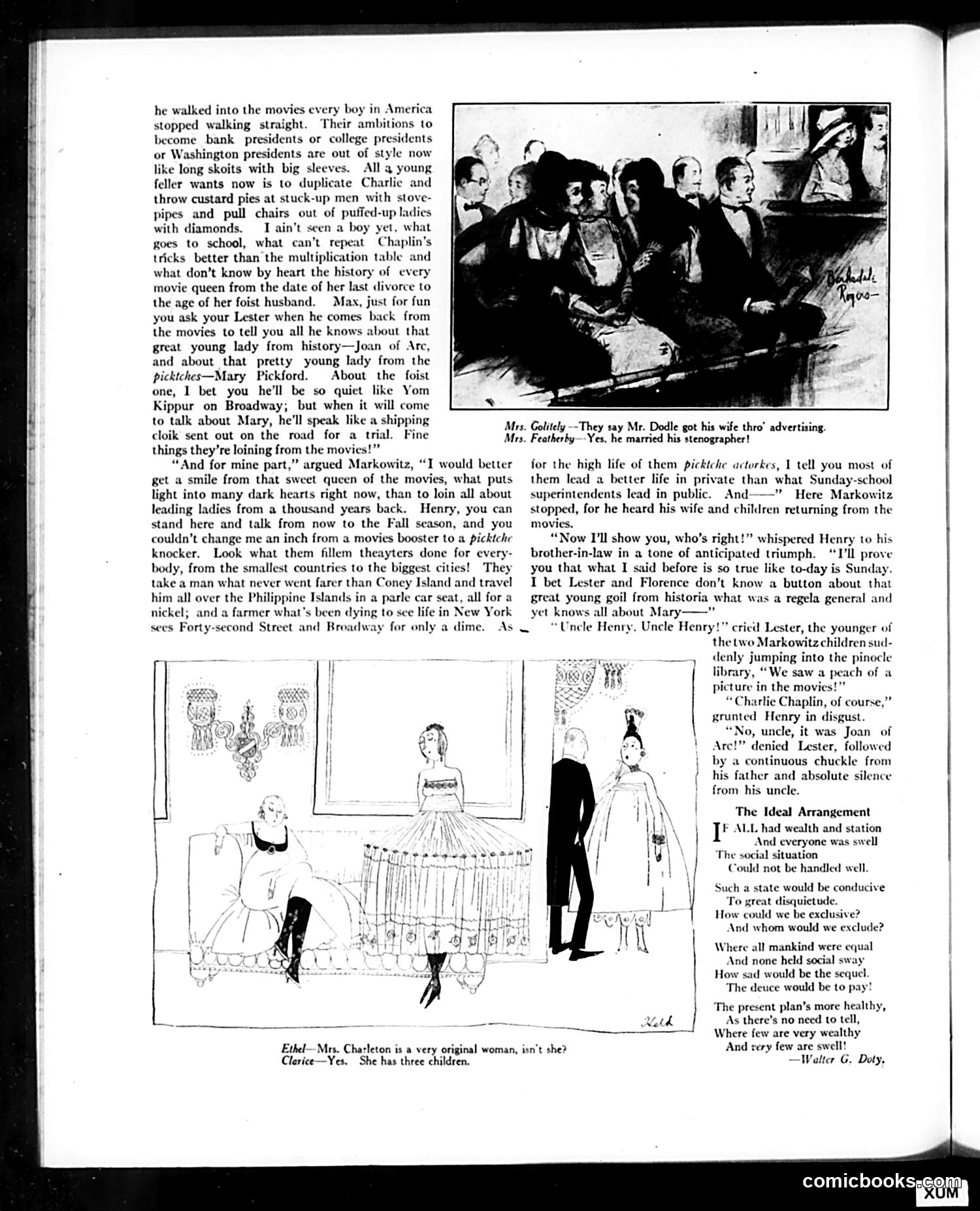
This page satirizes early cinema's cultural dominance over education and traditional values among American children, particularly immigrant families. **Main Cartoon:** Two men (appearing to be Jewish immigrants, suggested by names "Markowitz" and Yiddish-inflected speech) debate movies versus education. One defends cinema's ability to educate and inspire wonder; the other criticizes how children now idolize movie stars over historical figures. The joke's punchline: when the men's children return from the movies, they confuse Joan of Arc with Mary Pickford (a famous silent film actress), proving the uncle's point that movies corrupt learning. **Secondary Cartoon:** A society drawing with a short humorous exchange mocking how people marry through unconventional means (advertising, office romance). **Poem:** "The Ideal Arrangement" satirizes wealth and social hierarchy—suggesting the current class system, though problematic, maintains necessary social order. **Context:** This reflects 1920s anxiety about movies' influence on immigrant communities and youth, contrasting cinematic entertainment with classical education.
📄 Transcribed text from this page (OCR, searchable)
Machine-transcribed from the original scan — historical spelling and the odd misread are preserved.
he walked into the movies every boy in America stopped walking straight. Their ambitions to become bank presidents or college presidents or Washington presidents are out of style now like long skoits with big slee All a young feller wants now is to duplicate Charlie and throw custard pies at stuck-up men with stove- pipes and pull chairs out of puffed-up lad with diamonds. I ain't seen a boy yet, what goes to school, what can’t repeat Chaplin's tricks better than the multip jon table and what don’t know by heart the history of every movie queen from the date of her last divorce to the age of her foist husband. Max, just for fun you ask your Lester when he comes back from the movies to tell you all he knows about that great young lady from history—Joan of Arc, and about that pretty young lady from the picktches—Mary Pickford. About the foist one, I bet you he'll be so quiet like Yom Kippur on Broadway; but when it will come to talk about Mary, he'll speak like a shipping M . ; a Mrs. cloik sent out on the road for a trial. Fine Mrs. things they’re loining from the movies!” “And for mine part,” argued Markowitz, “I would better get a smile from that sweet queen of the movies, what puts light into many dark hearts right now, than to loin all about leading ladies from a thousand years back. Henry, you can stand here and talk from now to the Fall season, and you couldn’t change me an inch from a movies booster to a picktche knocker. Look what them fillem theayters done for every- body, from the smallest countries to the biggest c They take a man what never went farer than Coney Island and travel him all over the Philippine Islands in a parle car seat, all for a farmer what's been dying to see life in New York cond Street and Broadway for only a dime. As J Ethel—Ms. Chazleton is a very original woman, is Clarice—Yes. She has three children. Golitely They say Mr. Dodle got his wife thro’ advertising. Featherby—-Yes, he married his stenographer! for the high life of them picktche actorkes, 1 tell you most of them lead a better life in private than what Sunday-school superintendents lead in public. And——” Here Markowitz stopped, for he heard his wife and children returning from the movies. “Now I'll show you, who's right!” whispered Henry to his brother-in-law in a tone of anticipated triumph. “I'll prove you that what I said before is so true like to-day is Sunday. I bet Lester and Florence don’t know a button about that great young goil from historia what was a regela general and 1 kno} about Mary——” “Uncle Henry, Uncle Henry!” cried Lester, the younger of the two Markowitz children sud- denly jumping into the pinocle library, “We saw a peach of a picture in the movies!” “Charlie Chaplin, of course,” grunted Henry in disgust. “No, uncle, it Joan of Are!” denied’ Lester, followed by a continuous chuckle from his father and absolute silence from his uncle. The Ideal Arrangement I' ALL had wealth and station And everyone was swell The social situation Could not be handled well. Such a state would be conducive To great disquictude. How could we be exclusive? And whom would we exclude? Where all mankind were equal And none held social sway How sad would be the sequel The deuce would be to pay! The present plan’s more healthy, As there's no need to tell, Where few are very wealthy n't she? And tery few are swell! —Walter G. Doty,