
Judge, 1917-04-14 · page 8 of 28
Judge — April 14, 1917 — page 8: what you’re looking at
What you’re looking at
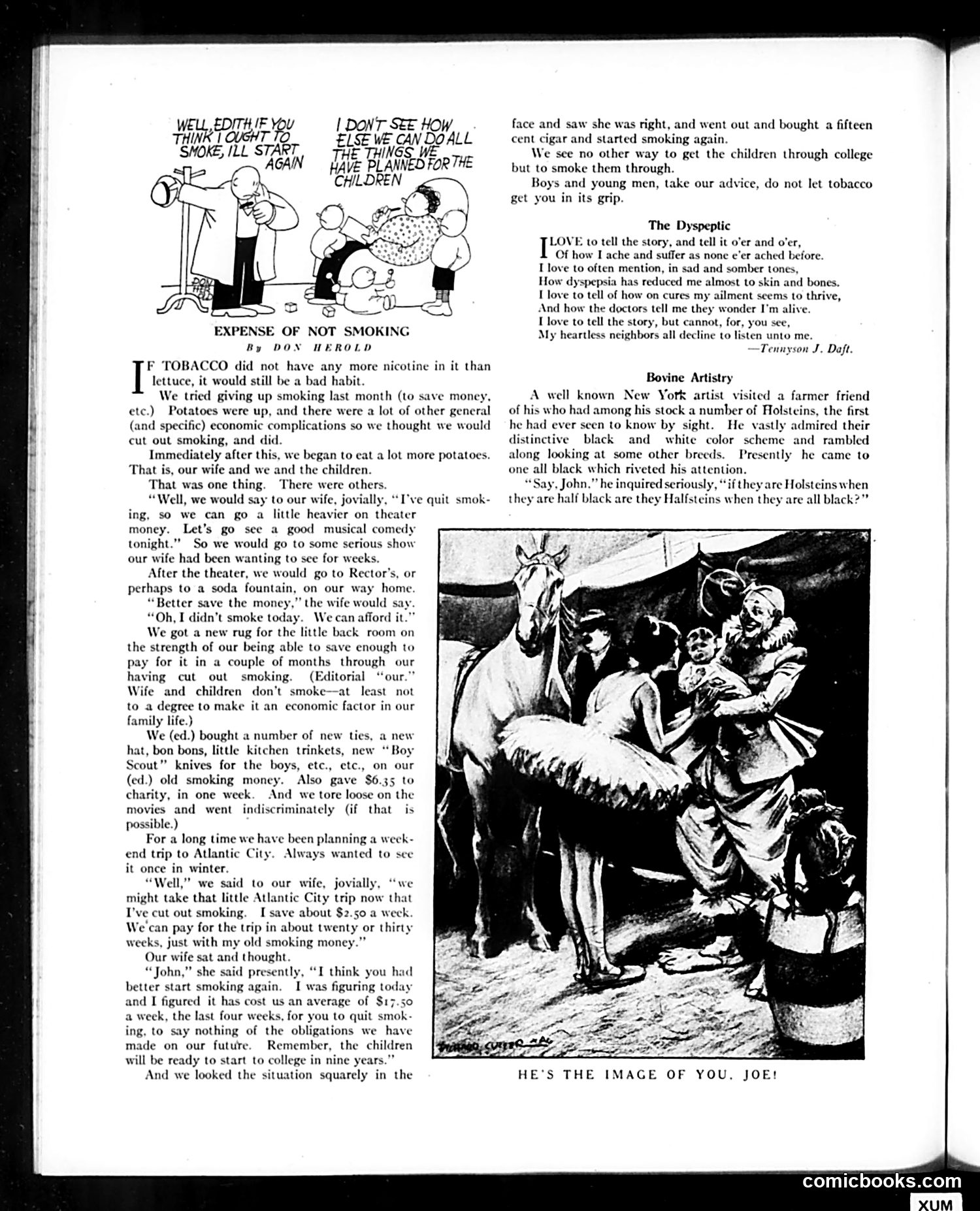
**Top Cartoon ("Expense of Not Smoking")** by Don Herold depicts a domestic debate about quitting smoking. A husband announces he'll stop smoking to save money for his family's future. However, the satire reveals the opposite result: without cigarettes to blame for spending, he and his family spend even more freely on theater, restaurants, gifts, and luxuries. When his wife calculates the actual cost of his abstinence, she ironically advises him to *resume* smoking—it's cheaper. The joke satirizes human rationalization and impulse spending: removing one vice doesn't create financial discipline; it simply redirects excess spending elsewhere. **Bottom Section ("Bovine Artistry")** presents a mild pun-based anecdote. A New York artist visiting a farm admires Holstein cattle (the distinctive black-and-white breed). Upon seeing an all-black cow, he jokes whether these are called "Halfsteins" when only partially black. It's straightforward wordplay with no deeper satire. Both pieces exemplify Judge's accessible humor targeting middle-class readers' everyday situations and foibles.
📄 Transcribed text from this page (OCR, searchable)
Machine-transcribed from the original scan — historical spelling and the odd misread are preserved.
SSE | DonT EE HOW ae AW Oe iy ie Ble FORTHE CHILDREN WELL EDT HIE py THINK | OUGHT es MLL STAr, EXPENSE OF NOT SMOKING By DON HEROLD * TOBACCO did not h: any more nicotine in it than I lettuce, it would still be 1 habit. We tried giving up smoking last month (to save money, etc.) Potatoes were up, and there were a lot of other general (and specific) economic complications so we thought we would cut out smoking, and did. Immediately after thi: That is, our wife and we and the children. That was one thing. There were others. “Well, we would say to our wife, jovially, “I’ve quit smok- ing, so we can go a little heavier on theater money. Let’s go see a good musical comedy tonight.” So we would go to some serious show our wife had been wanting to see for weeks. After the theater, we would go to Rector’s, or perhaps to a soda fountain, on our way home. “Better save the money,” the wife would say. “Oh, I didn’t smoke today. We can afford it. We got a new rug for the little back room on the strength of our being able to save enough to pay for it in a couple of months through our having cut out smoking. (Editorial “our.” Wife and children don't smoke—at least not to a degree to make it an economic factor in our family life.) We (ed.) bought a number of new ties, a new hat, bon bons, little kitchen trinkets, new “Boy Scout” knives for the boys, etc., etc., on our (ed.) old smoking money. Also gave $6.35 to charity, in one w And _ we tore loose on the movies and went indiscriminately (if that is possible.) For a long time we have been planning a week- end trip to Atlantic City. Always wanted to see it once in winte: “Well,” we said to our wife, jovially, “we might take that little Atlantic City trip now that I've cut out smoking. I save about $ a week. We'can pay for the trip in about twenty or thirty weeks, just with my old smoking money.” Our wife sat and thought. “John,” she said presently, “I think you had better start smoking again. I was figuring today and I figured it has cost us an average of $17.50 a week, the last four weeks, for you to quit smok- ing, to say nothing of the obligations we have made on our future. Remember, the children will be ready to start to college in nine o And we looked the situation squarely in 1 the we began to eat a lot more potatoes. face and saw she was right, and went out and bought a fifteen cent cigar and started smoking again. We sce no other way to get the children through college but to smoke them through. Boys and young men, take our advice, do not let tobacco get you in its grip. The Dyspeptic LOVE to tell the story, and tell it o’er and o'er, Of how I ache and suffer as none e’er ached before. I love to often mention, in sad and somber tones, How dyspepsia has reduced me almost to skin and bones. I love to tell of how on cures my ailment scems to thrive, And how the doctors tell me they wonder I'm I love to tell the story, but cannot, for, you see, My heartless neighbors all decline to listen unto me. Tennyson J. Daft. Bovine Artistry A well known New York artist visited a farmer friend of his who had among his stock a number of Holsteins, the first he had seen to know by sight. He vastly admired their distinctive black and white color scheme and rambled along looking at some other breeds. Presently he came to one all black which riveted his attention. john,” he inquired seriously, “if they are Holsteins when half black are they Halfsteins when they are all black?” E'S THE IMAGE OF YOU, JOE! comicbooks.com