
Judge, 1917-04-14 · page 12 of 28
Judge — April 14, 1917 — page 12: what you’re looking at
What you’re looking at
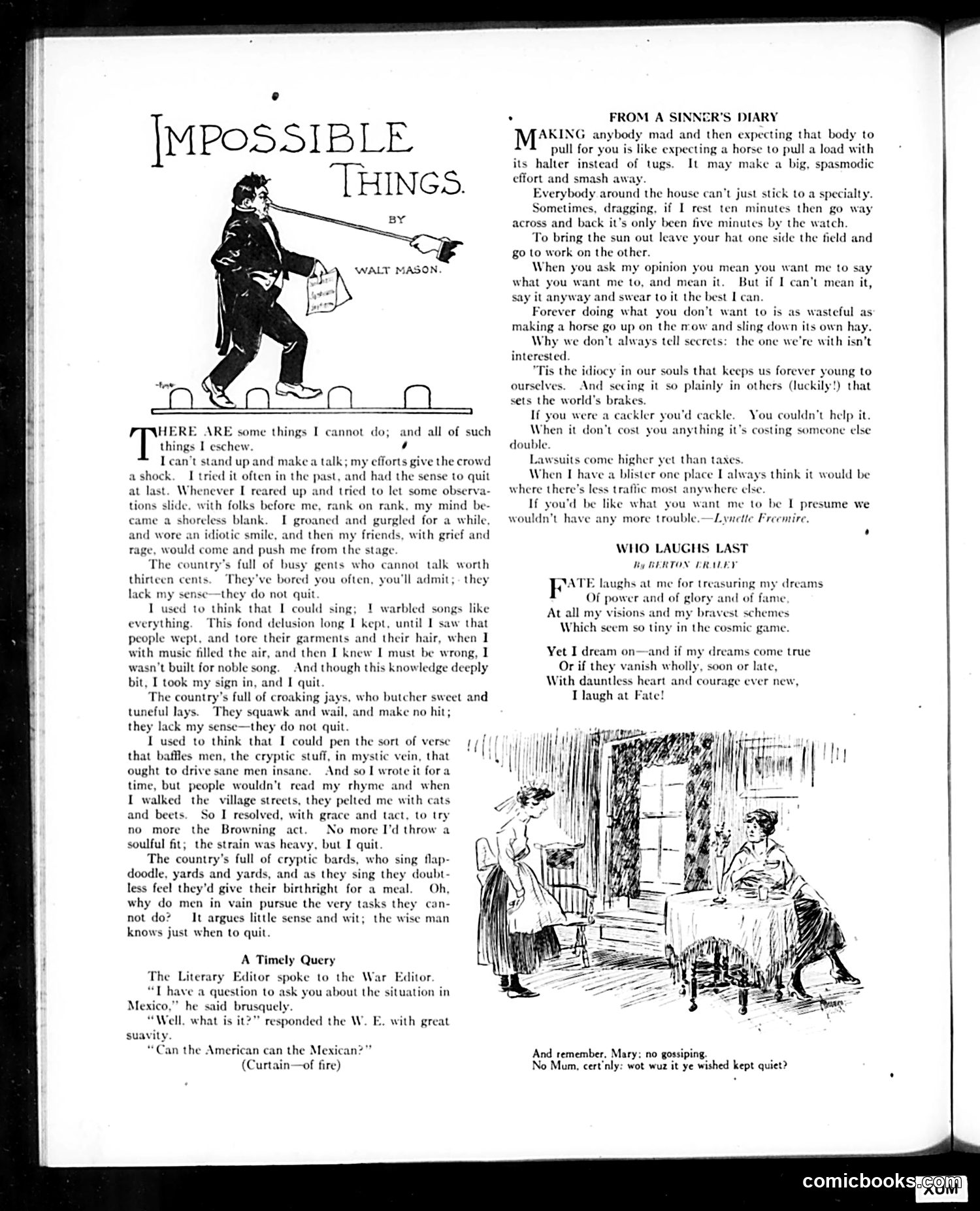
This page contains three separate pieces of satirical writing typical of Judge magazine's humor: **"Impossible Things"** is Mason's humorous essay about knowing when to quit. He recounts failed attempts at public speaking, singing, and writing poetry, emphasizing that the wisest trait is recognizing one's limitations. The satire targets people who persist stubbornly in pursuits they're unsuited for—particularly those filling the country who "lack my sense—they do not quit." It's gentle self-deprecation used to mock those lacking self-awareness. **"A Timely Query"** is a brief joke about the Mexican-American tensions of the era (likely referencing the Mexican Revolution or border conflicts). The War Editor responds to a question about American-Mexican relations with "(Curtain—of fire)"—a pun suggesting military conflict rather than diplomatic discussion. **"Who Laughs Last"** is a poem fragment about maintaining optimism despite setbacks. The page reflects early 20th-century American attitudes: self-help philosophy, gentle mockery of pretentiousness, and contemporary geopolitical concerns.
📄 Transcribed text from this page (OCR, searchable)
Machine-transcribed from the original scan — historical spelling and the odd misread are preserved.
MPoS SLB LE HERE ARE some things I cannot do; and all of such things I eschew. ‘ I can’t stand up and make a talk; my efforts give the crowd ashock. I tried it often in the past, and had the sense to quit at last. Whenever [ reared up and tried to let some observa- tions slide. with folks before me, rank on rank, my mind be- came a shoreless blank. I groaned and gurgled for a while, and wore an idiotic smile, and then my friends, with grief and rage, would come and push me from the stage The country’s full of busy gents who cannot talk worth thirteen cents. They've bored you often, you'll admit;- they lack my sense—they do not quit I used to think that I could sing; ! warbled songs like everything. This fond delusion long I kept, until I saw that people wept, and tore their garments and their hair, when I with music filled the air, and then I knew I must be wrong, I wasn’t built for noble song. And though this knowledge deeply bit, I took my sign in, and I quit The country’s full of croaking jays, who butcher sweet and tuneful lays. They squawk and wail, and make no hit; they lack my sense—they do not quit. I used to think that I could pen the sort of verse that baffles men, the cryptic stuff, in mystic vein, that ought to drive sane men insane. And so I wrote it fora time, but people wouldn't read my rhyme and when I walked the village streets, they pelted me with cats and beets. So I resolved, with grace and tact, to try no more the Browning act. No more I'd throw a soulful fit; the strain was heavy, but I quit The country’s full of cryptic bards, who sing flap- doodle, yards and yards, and as they sing they doubt- less feel they'd give their birthright for a meal. Oh, why do men in vain pursue the very tasks they can- not do? It argues little sense and wit; the wise man knows just when to quit. A Timely Query The Literary Editor spoke to the War “T have a question to ask you about the situation in Mexico,” he said brusquely. “Well. what is it?” responded the W. F suavity. “Can the Ameri itor. with great an can the Mexican?” (Curtain—of fire) . FROM A SINNER’S DIARY MAkixc anybody mad and then expecting that body to pull for you is like expecting a horse to pull a load with its halter instead of tugs. It may make a big, spasmodic effort and smash aw: 2verybody around the house can’t just stick to a specialty. Sometimes, dragging, if I rest ten minutes then go way across and back it’s only been five minutes by the watch. To bring the sun out leave your hat one side the field and go to work on the other. When you ask my opinion you mean you want me to say what you want me to, and mean it. But if I can’t mean it, say it anyway and swear to it the best I can Forever doing what you don’t want to is as wasteful as: making a horse go up on the mow and sling down its own hay. Why we don’t always tell secrets: the one we're with isn’t interested. ‘Tis the idiocy in our souls that keeps us forever young to ourselves. And secing it so plainly in others (luckily!) that sets the world’s brakes. If you were a cackler you'd cackle. When it don’t cost you anything double. Lawsuits come higher yet than taxes. When I have a blister one place I always think it would be where there’s less traftic most anywhere else: If you'd be like what you want me to be I presume we wouldn't have any more trouble.—Lynette Freemire. You couldn't help it. 's costing someone else WHO LAUGHS LAST By BERTON ERALEY | a TE laughs at me for treasuring my dreams Of power and of glory and of fame At all my visions and my bravest schemes Which seem so tiny in the cosmic Yet I dream on—and if my dreams come true Or if they vanish wholly, soon or late, With dauntless heart and courage ever new, T laugh at F And remember, Mary: no gossiping. : No Mum, cert’nly: wot wuz it ye wished kept quiet? comicbookoms HH |